
A small, honest operating system for swarms of AI agents: kernel, policy gate, router, MCP and a 3D memory graph.
Python
0
10 commits
updated Sep 16, 2026
See what people are saying (1)
README
enjambre
A small, honest operating system for swarms of AI agents.
Enjambre is Spanish for swarm. It takes the agents you already have (Claude Code, Codex, a local model behind Ollama, a hosted API, your own scripts) and gives them what a team of processes needs to work together without lying to each other: a kernel, a queue, leases, a permission gate, a router and a shared memory you can see.
pip install .            # from a clone; one dependency (PyYAML)
enjambre demo            # open http://127.0.0.1:8765
Runs on Linux, macOS and Windows with Python 3.10 or newer; every change is tested on all three.
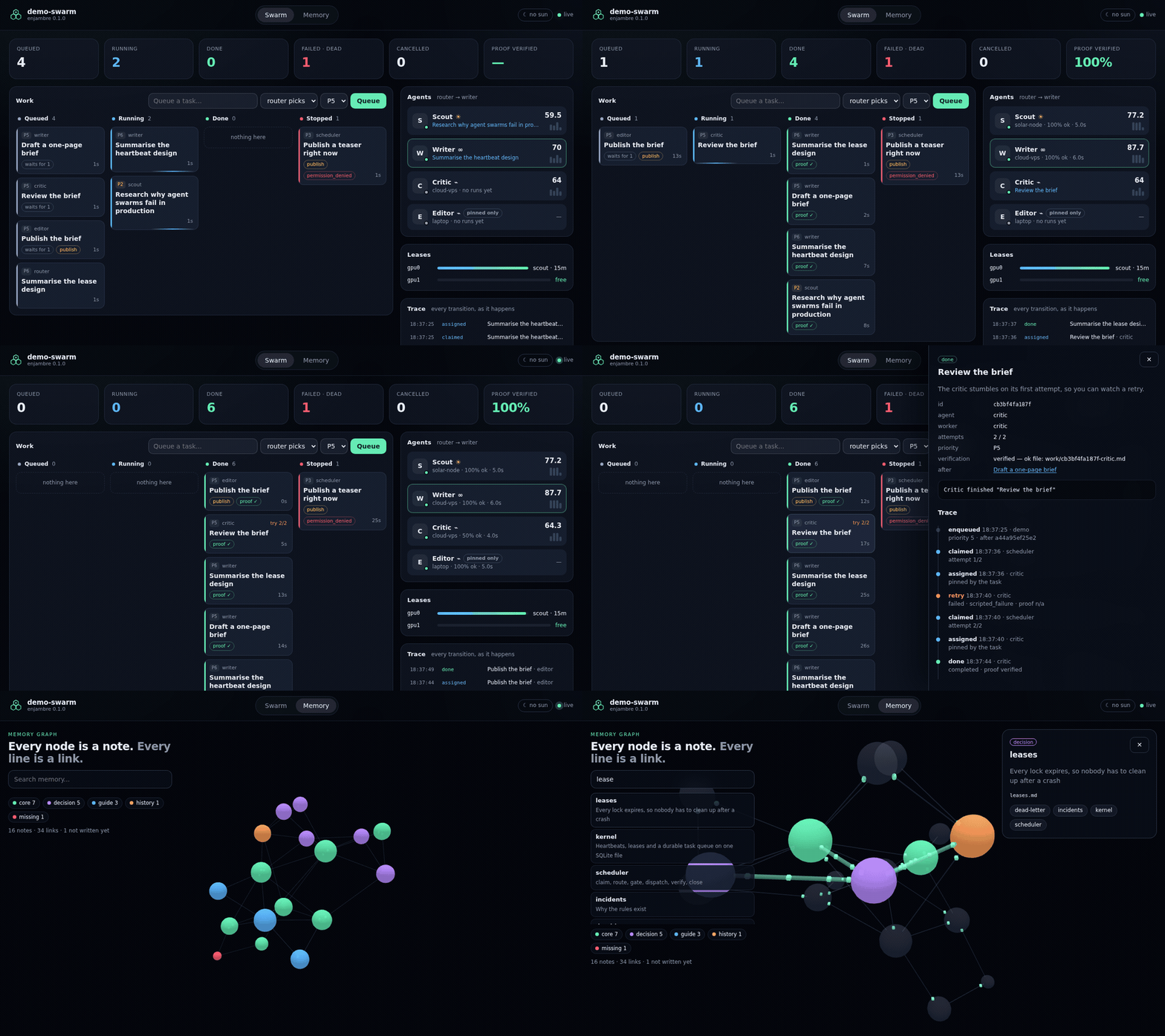
The demo needs no model and no API key. Four scripted agents run a small editorial pipeline: research, draft, review, publish. The critic stumbles once so you can watch a retry. The writer tries to publish without permission and the gate stops it before it runs. The router explains every choice it makes.
Why
Single agents are easy now. Swarms fail in boring, expensive ways:
- A worker dies holding the GPU, and nobody notices for ten hours.
- A task is reported as done, and the file it promised does not exist.
- A nightly job looks offline two thirds of the time because it only runs every 30 minutes.
- A rule written in the prompt is ignored the one time it matters.
- A failed step leaves everything downstream waiting forever.
enjambre was extracted from a real swarm that runs day and night on a solar-powered workstation and a small cloud server. Every mechanism below exists because one of those failures happened.
What you get
| Kernel | One SQLite file. Processes report heartbeats and their state (alive, stale, offline) is derived from the age of the last one, never declared. |
| Leases | GPUs, API quotas, browsers: every lock expires on its own. A crashed holder cannot block anyone for long. |
| Durable queue | Priorities, atomic claims, idempotency keys, task leases that long jobs renew, automatic retries, a dead-letter state that always records a reason. |
| DAG | Tasks wait for their dependencies, receive upstream results as data (never as instructions), and die visibly when something upstream fails. Retrying the upstream task brings them back. |
| Proof of delivery | A task can declare what must exist when it is done, and agents declare artifacts. The kernel checks files, directories and URLs itself, and a file older than the task does not count. Record the verdict, or enforce it. |
| Policy gate | Rules travel with every prompt, and permissions are enforced in code before any agent runs. A broken edit of the policy never replaces the last good one. |
| Router | Picks an agent from measured success and latency, declared cost, and energy. Agents on solar power win while the sun is up. Every decision comes with a readable reason. |
| Adapters | cli for any command-line agent (no shell, isolated environment), openai for any OpenAI-compatible endpoint, scripted for demos and tests. |
| MCP server | Any MCP client can heartbeat, lease, claim, renew and complete tasks, check permissions and query memory. |
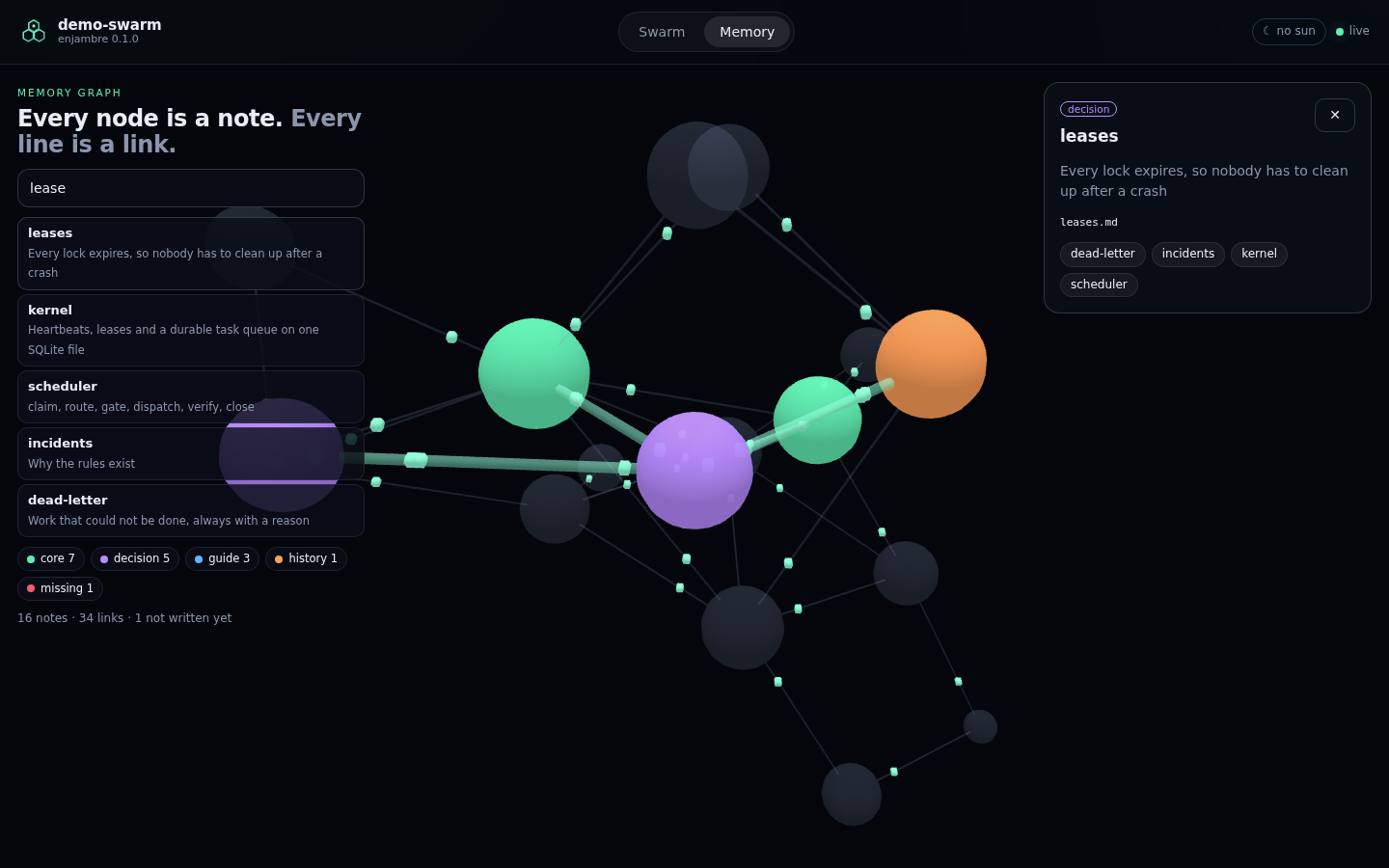
| Memory graph | A folder of markdown notes becomes a 3D graph you can explore, search and teach with. Links to notes nobody wrote yet show up in red. |
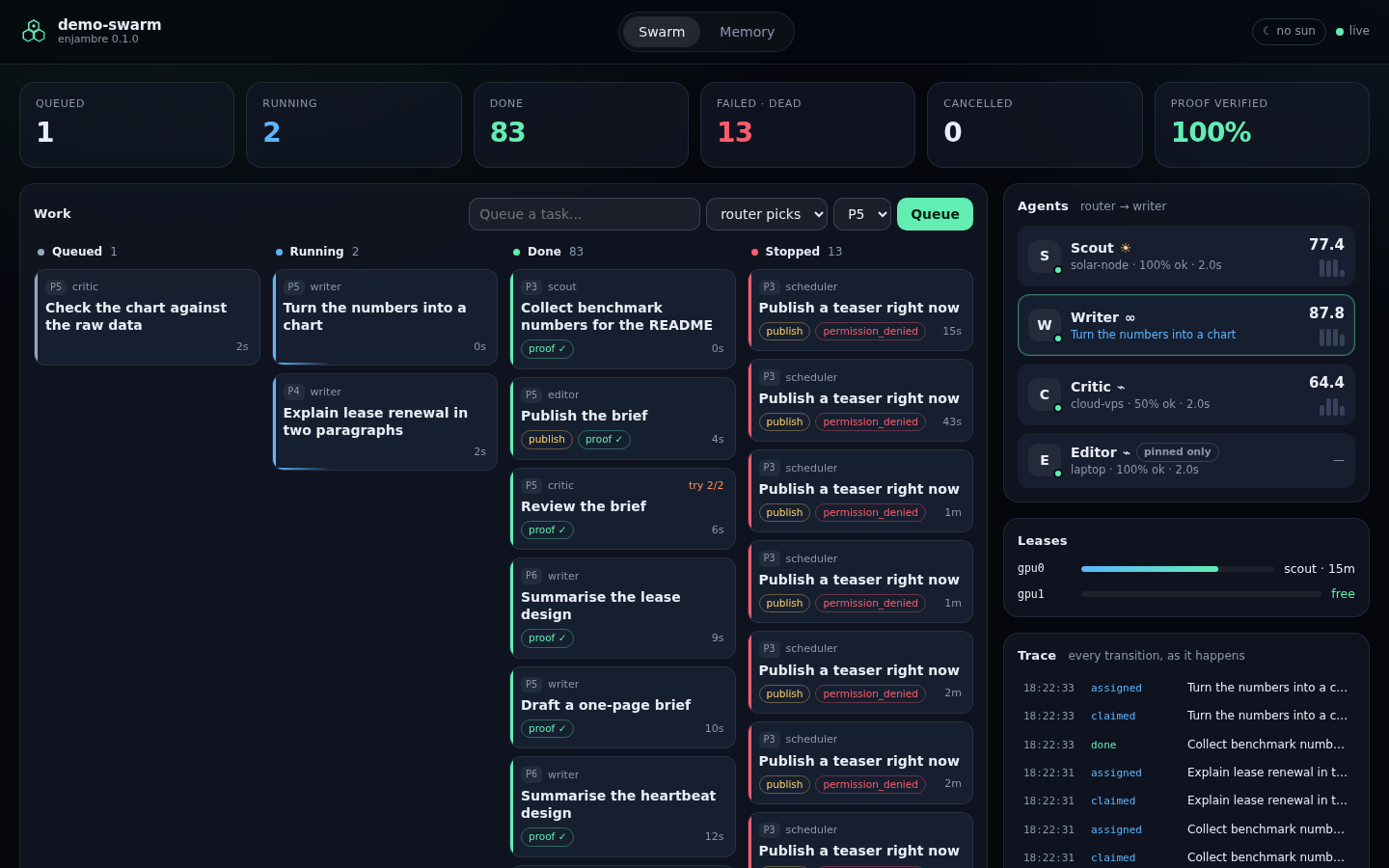
| Dashboard | Live board, agents, leases, trace and task timelines. No build step, no framework, strict Content Security Policy. |
A swarm is a folder
my-swarm/
├── swarm.yaml        agents, router, scheduler, kernel, memory
├── policy.yaml       rules and permissions (hot-reloaded)
├── prompts/<id>.md   the role of each agent
└── memory/           markdown notes, shown as the memory graph
enjambre init my-swarm     # start from the demo template
enjambre up my-swarm       # API + dashboard + scheduler
Put the folder in git and every change to your swarm has an author, a date and a revert.
Bring your own agents
agents:
  coder:
    adapter: cli
    energy: solar            # this machine runs on panels: prefer it while the sun is up
    options:
      command: ["claude", "-p"]
      env: [ANTHROPIC_API_KEY]   # the only variables the child process can see

  reviewer:
    adapter: cli
    options:
      command: ["codex", "exec", "{prompt}"]
      stdin: false               # the prompt goes in as an argument (never through a shell)
      env: [OPENAI_API_KEY]

  local:
    adapter: openai
    options:
      base_url: http://localhost:11434/v1
      model: qwen3:8b

  researcher:
    adapter: openai
    cost: 0.5
    options:
      base_url: https://openrouter.ai/api/v1
      model: deepseek/deepseek-chat
      api_key_env: OPENROUTER_API_KEY   # the name of the variable, never the key

router:
  weights: {success: 35, latency: 15, cost: 20, energy: 30}
  solar_window: {start: "09:30", end: "17:30", timezone: Europe/Madrid}
On Windows, CLIs installed with npm are .cmd launchers. enjambre finds them, but only
passes them the prompt through stdin (stdin: true, the default): cmd.exe would re-parse a
prompt given as an argument.
Agents answer with a small JSON contract (status, result, artifacts...). The scheduler
appends it to every prompt, together with the agent's role, the policy and the results of
upstream tasks.
Permissions that do not depend on the model
# policy.yaml
rules:
  - id: verify
    rule: Never report work as done without a check that passed.
operations:
  publish: [editor]          # only the editor may run tasks with operation: publish
agents:
  writer:
    forbidden: [Publishing anything yourself.]
    vetoed_operations: [publish]
Join from any MCP client
# Claude Code
claude mcp add enjambre -- enjambre mcp --dir ./my-swarm

# a remote swarm started with `ENJAMBRE_TOKEN=... enjambre up --host 0.0.0.0`
claude mcp add enjambre -e ENJAMBRE_TOKEN=... -- enjambre mcp --url http://swarm-host:8765
# Codex (~/.codex/config.toml)
[mcp_servers.enjambre]
command = "enjambre"
args = ["mcp", "--dir", "/path/to/my-swarm"]
Tools: swarm_status, heartbeat, acquire_resource, release_resource, enqueue_task,
claim_task, renew_task, complete_task, get_task, list_tasks, cancel_task,
retry_task, policy_for, check_permission, memory_query, memory_node.
Or use the kernel as a library
from enjambre import AgentResult, Kernel

k = Kernel("swarm.db")
research = k.enqueue("Collect benchmark numbers", agent="scout")["id"]
chart = k.enqueue("Draw the chart", depends_on=[research], proof="/tmp/chart.png")["id"]

task = k.claim("scout")                                   # atomic
k.complete(task["id"], "scout", AgentResult.completed("numbers collected"))
k.claim("plotter")["id"] == chart                         # unblocked
Command line
enjambre demo | init DIR | up [DIR] | run [DIR] | mcp
enjambre enqueue "Title" --agent writer --after TASK_ID --proof /abs/path
enjambre tasks | ps | memory "query"
enjambre run processes the queue until it is idle and exits, which makes a swarm usable
from CI.
What it is not
enjambre is not an agent framework and not a prompt library. Frameworks such as LangGraph or CrewAI compose model calls inside one program. enjambre sits one level below: it coordinates separate agents and processes, on one machine or several, that already know how to do their job. You can run agents built with any framework inside it.
Design notes
- Honest state. Liveness is derived, fitness is measured, and a missing measurement is
None, never a decorative zero. - Leases everywhere. Locks, running tasks and resources all expire. Recovery is the default, not a cleanup script.
- Verification is recorded before it is enforced. A verification gate that blocked closing
tasks once cut a swarm's throughput by 90%. Start with
proof_mode: record, switch toenforcewhen your agents declare their artifacts. - Data is not instructions. Upstream results are labelled as data in every prompt.
- Small on purpose. Standard library plus PyYAML. One SQLite file. No build step for the UI.
Details in docs/architecture.md.
Security
The API binds to 127.0.0.1 by default and refuses other addresses without ENJAMBRE_TOKEN.
CLI agents run without a shell and see only the environment variables you list. API keys are
read from environment variables and rejected if written into swarm.yaml. See
SECURITY.md.
Roadmap
- Evolution loop: the swarm proposes changes to its own genome from measured fitness, a human approves, and a regression triggers an automatic revert.
- Versioned memory segments with atomic writes and rollback per agent.
- Rate-limit buckets per provider, OpenTelemetry export, a Postgres backend for larger swarms.
License
MIT. Made by GreenAI Network. Bundled third-party code is listed in THIRD_PARTY_NOTICES.md.
Contributors

10 commits
Similar repos


Languages
Python
81.0%
JavaScript
9.6%
CSS
7.8%
HTML
1.6%
A small, honest operating system for swarms of AI agents: kernel, policy gate, router, MCP and a 3D memory graph.
Python
0
10 commits
updated Sep 16, 2026
See what people are saying (1)
README
enjambre
A small, honest operating system for swarms of AI agents.
Enjambre is Spanish for swarm. It takes the agents you already have (Claude Code, Codex, a local model behind Ollama, a hosted API, your own scripts) and gives them what a team of processes needs to work together without lying to each other: a kernel, a queue, leases, a permission gate, a router and a shared memory you can see.
pip install .            # from a clone; one dependency (PyYAML)
enjambre demo            # open http://127.0.0.1:8765
Runs on Linux, macOS and Windows with Python 3.10 or newer; every change is tested on all three.
The demo needs no model and no API key. Four scripted agents run a small editorial pipeline: research, draft, review, publish. The critic stumbles once so you can watch a retry. The writer tries to publish without permission and the gate stops it before it runs. The router explains every choice it makes.
Why
Single agents are easy now. Swarms fail in boring, expensive ways:
- A worker dies holding the GPU, and nobody notices for ten hours.
- A task is reported as done, and the file it promised does not exist.
- A nightly job looks offline two thirds of the time because it only runs every 30 minutes.
- A rule written in the prompt is ignored the one time it matters.
- A failed step leaves everything downstream waiting forever.
enjambre was extracted from a real swarm that runs day and night on a solar-powered workstation and a small cloud server. Every mechanism below exists because one of those failures happened.
What you get
| Kernel | One SQLite file. Processes report heartbeats and their state (alive, stale, offline) is derived from the age of the last one, never declared. |
| Leases | GPUs, API quotas, browsers: every lock expires on its own. A crashed holder cannot block anyone for long. |
| Durable queue | Priorities, atomic claims, idempotency keys, task leases that long jobs renew, automatic retries, a dead-letter state that always records a reason. |
| DAG | Tasks wait for their dependencies, receive upstream results as data (never as instructions), and die visibly when something upstream fails. Retrying the upstream task brings them back. |
| Proof of delivery | A task can declare what must exist when it is done, and agents declare artifacts. The kernel checks files, directories and URLs itself, and a file older than the task does not count. Record the verdict, or enforce it. |
| Policy gate | Rules travel with every prompt, and permissions are enforced in code before any agent runs. A broken edit of the policy never replaces the last good one. |
| Router | Picks an agent from measured success and latency, declared cost, and energy. Agents on solar power win while the sun is up. Every decision comes with a readable reason. |
| Adapters | cli for any command-line agent (no shell, isolated environment), openai for any OpenAI-compatible endpoint, scripted for demos and tests. |
| MCP server | Any MCP client can heartbeat, lease, claim, renew and complete tasks, check permissions and query memory. |
| Memory graph | A folder of markdown notes becomes a 3D graph you can explore, search and teach with. Links to notes nobody wrote yet show up in red. |
| Dashboard | Live board, agents, leases, trace and task timelines. No build step, no framework, strict Content Security Policy. |
A swarm is a folder
my-swarm/
├── swarm.yaml        agents, router, scheduler, kernel, memory
├── policy.yaml       rules and permissions (hot-reloaded)
├── prompts/<id>.md   the role of each agent
└── memory/           markdown notes, shown as the memory graph
enjambre init my-swarm     # start from the demo template
enjambre up my-swarm       # API + dashboard + scheduler
Put the folder in git and every change to your swarm has an author, a date and a revert.
Bring your own agents
agents:
  coder:
    adapter: cli
    energy: solar            # this machine runs on panels: prefer it while the sun is up
    options:
      command: ["claude", "-p"]
      env: [ANTHROPIC_API_KEY]   # the only variables the child process can see

  reviewer:
    adapter: cli
    options:
      command: ["codex", "exec", "{prompt}"]
      stdin: false               # the prompt goes in as an argument (never through a shell)
      env: [OPENAI_API_KEY]

  local:
    adapter: openai
    options:
      base_url: http://localhost:11434/v1
      model: qwen3:8b

  researcher:
    adapter: openai
    cost: 0.5
    options:
      base_url: https://openrouter.ai/api/v1
      model: deepseek/deepseek-chat
      api_key_env: OPENROUTER_API_KEY   # the name of the variable, never the key

router:
  weights: {success: 35, latency: 15, cost: 20, energy: 30}
  solar_window: {start: "09:30", end: "17:30", timezone: Europe/Madrid}
On Windows, CLIs installed with npm are .cmd launchers. enjambre finds them, but only
passes them the prompt through stdin (stdin: true, the default): cmd.exe would re-parse a
prompt given as an argument.
Agents answer with a small JSON contract (status, result, artifacts...). The scheduler
appends it to every prompt, together with the agent's role, the policy and the results of
upstream tasks.
Permissions that do not depend on the model
# policy.yaml
rules:
  - id: verify
    rule: Never report work as done without a check that passed.
operations:
  publish: [editor]          # only the editor may run tasks with operation: publish
agents:
  writer:
    forbidden: [Publishing anything yourself.]
    vetoed_operations: [publish]
Join from any MCP client
# Claude Code
claude mcp add enjambre -- enjambre mcp --dir ./my-swarm

# a remote swarm started with `ENJAMBRE_TOKEN=... enjambre up --host 0.0.0.0`
claude mcp add enjambre -e ENJAMBRE_TOKEN=... -- enjambre mcp --url http://swarm-host:8765
# Codex (~/.codex/config.toml)
[mcp_servers.enjambre]
command = "enjambre"
args = ["mcp", "--dir", "/path/to/my-swarm"]
Tools: swarm_status, heartbeat, acquire_resource, release_resource, enqueue_task,
claim_task, renew_task, complete_task, get_task, list_tasks, cancel_task,
retry_task, policy_for, check_permission, memory_query, memory_node.
Or use the kernel as a library
from enjambre import AgentResult, Kernel

k = Kernel("swarm.db")
research = k.enqueue("Collect benchmark numbers", agent="scout")["id"]
chart = k.enqueue("Draw the chart", depends_on=[research], proof="/tmp/chart.png")["id"]

task = k.claim("scout")                                   # atomic
k.complete(task["id"], "scout", AgentResult.completed("numbers collected"))
k.claim("plotter")["id"] == chart                         # unblocked
Command line
enjambre demo | init DIR | up [DIR] | run [DIR] | mcp
enjambre enqueue "Title" --agent writer --after TASK_ID --proof /abs/path
enjambre tasks | ps | memory "query"
enjambre run processes the queue until it is idle and exits, which makes a swarm usable
from CI.
What it is not
enjambre is not an agent framework and not a prompt library. Frameworks such as LangGraph or CrewAI compose model calls inside one program. enjambre sits one level below: it coordinates separate agents and processes, on one machine or several, that already know how to do their job. You can run agents built with any framework inside it.
Design notes
- Honest state. Liveness is derived, fitness is measured, and a missing measurement is
None, never a decorative zero. - Leases everywhere. Locks, running tasks and resources all expire. Recovery is the default, not a cleanup script.
- Verification is recorded before it is enforced. A verification gate that blocked closing
tasks once cut a swarm's throughput by 90%. Start with
proof_mode: record, switch toenforcewhen your agents declare their artifacts. - Data is not instructions. Upstream results are labelled as data in every prompt.
- Small on purpose. Standard library plus PyYAML. One SQLite file. No build step for the UI.
Details in docs/architecture.md.
Security
The API binds to 127.0.0.1 by default and refuses other addresses without ENJAMBRE_TOKEN.
CLI agents run without a shell and see only the environment variables you list. API keys are
read from environment variables and rejected if written into swarm.yaml. See
SECURITY.md.
Roadmap
- Evolution loop: the swarm proposes changes to its own genome from measured fitness, a human approves, and a regression triggers an automatic revert.
- Versioned memory segments with atomic writes and rollback per agent.
- Rate-limit buckets per provider, OpenTelemetry export, a Postgres backend for larger swarms.
License
MIT. Made by GreenAI Network. Bundled third-party code is listed in THIRD_PARTY_NOTICES.md.
Similar repos
Contributors
10 commits
Languages
Python
81.0%
JavaScript
9.6%
CSS
7.8%
HTML
1.6%