
Open source runtime to migrate DRF to FastAPI (and more to come) 🚚
See the codeSee what people are saying
README

Sanka
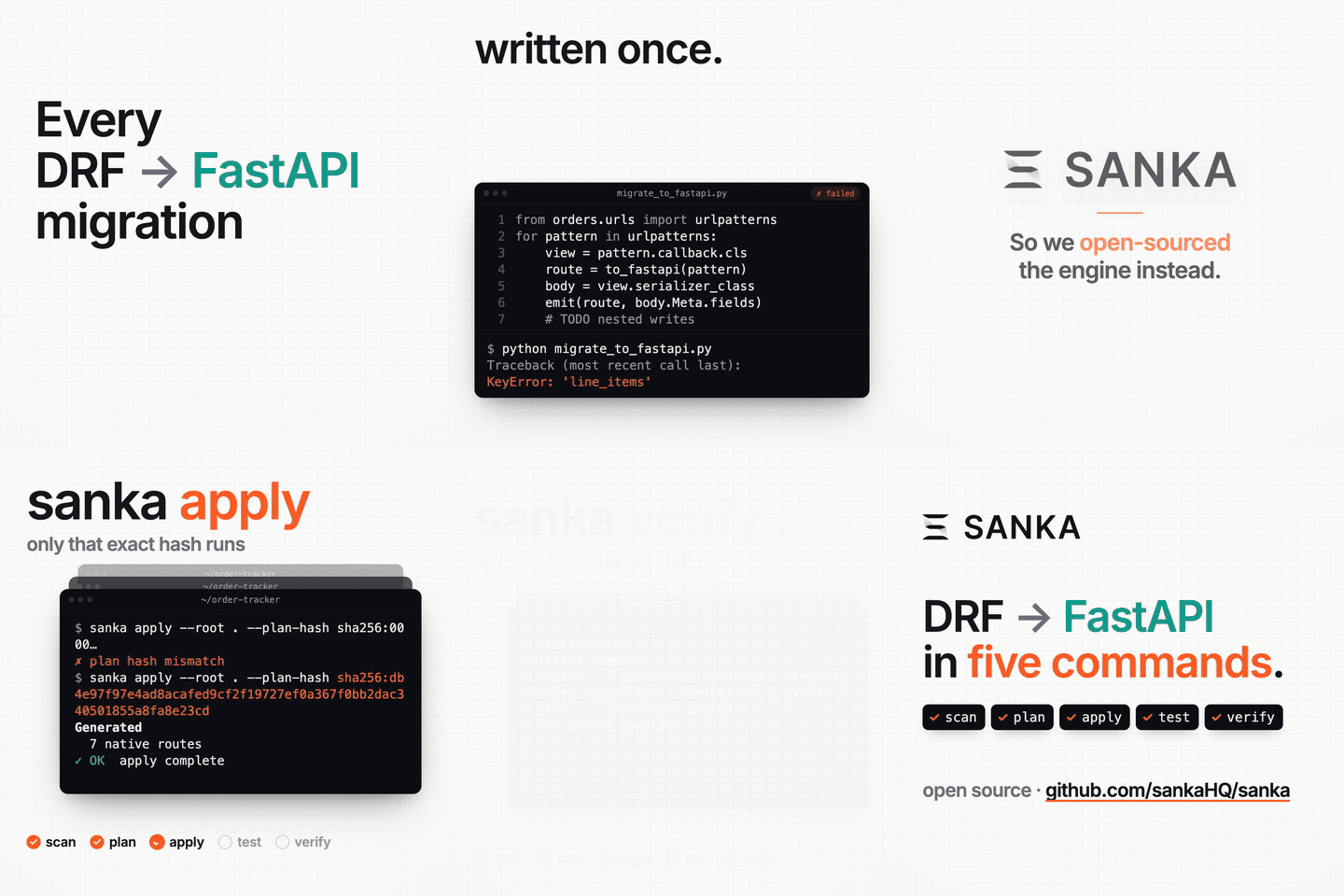
The open source runtime to migrate DRF to FastAPI (and more to come): scan the
source, review an immutable plan, apply that exact plan, and verify the result.
One sanka executable covers everything you need for migration projects - Open source and available as a hosted service. Python 3.12 or newer is required.




Why Sanka?
- The migration actually finishes:
verifyreconciles the generated result against the source — an exit code alone is never treated as completion evidence - Review once, apply exactly that:
applyrequires the exact reviewed plan hash, so nothing drifts between what you approved and what ran - Measurably better than the model alone: +11 points aggregate across eight frontier models on 17 matched migrations — the weaker the model, the bigger the gain (see benchmarks)
- Local by default:
scan,plan,apply,testandverifynever require a Sanka token - Verified extensions, isolated execution: every wheel is checked against its manifest, URL, SHA-256 digest and runtime constraint, then run in an isolated child environment — PyPI is not a fallback
- Built for agents: add
--jsonto any command for one machine-readablesanka-cli/v1document — no scraping human output - Open source: Apache-2.0 tooling around an AGPL-3.0 migration engine
Benchmarks
Every model gets better at migrations with Sanka, and the models that need the most help gain the most. Same 17 migrations, same prompts, isolated workspaces — the only difference is the CLI.
| Model | Model only | + Sanka CLI | Δ |
|---|---|---|---|
| GPT-6 Astra (high) | 16/17 · 94.1% | 17/17 · 100.0% | +5.9 |
| Claude Opus 5 (high) | 17/17 · 100.0% | 17/17 · 100.0% | — |
| Claude Sonnet 5 (high) | 12/17 · 70.6% | 16/17 · 94.1% | +23.5 |
| GPT-5.6 Terra (high) | 12/17 · 70.6% | 15/17 · 88.2% | +17.6 |
| GPT-5.6 Sol (high) | 15/17 · 88.2% | 15/17 · 88.2% | — |
| GLM 5.3 Flash (high) | 11/17 · 64.7% | 14/17 · 82.4% | +17.6 |
| GPT-5.6 Luna (high) | 13/17 · 76.5% | 13/17 · 76.5% | — |
| DeepSeek V4 Flash (high) | 5/17 · 29.4% | 9/17 · 52.9% | +23.5 |
| Aggregate | 101/136 · 74.3% | 116/136 · 85.3% | +11.0 |
The suite is 17 migrations — 11 Django REST Framework to FastAPI and 6 to Flask —
run at high reasoning effort. A pass requires all eight grading gates. These are
synthetic repository fixtures, not production migrations. Measured on
sanka-cli 0.2.7 with extensions 0.1.0a16; the latest set substitutes the eight
CLI upload-task reruns, so it is not a fresh full-suite pass@1 run.
Full leaderboard, per-task results, cost and token efficiency, and the raw JSON: sanka.com/bench. The evaluator, tasks and baselines are open source at sankaHQ/bench.
Try it in 3 minutes
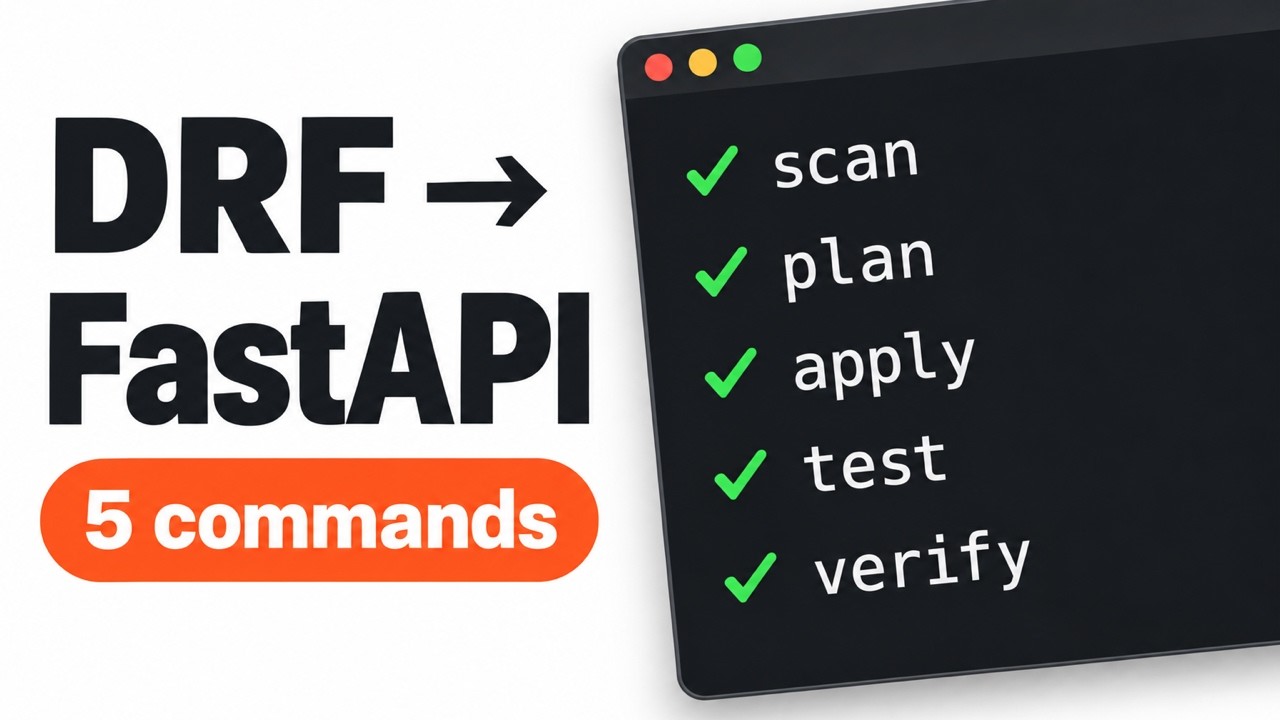
Migrate the example Django REST Framework app on your machine. Nothing here needs an account. Prefer to watch first? The 7-minute walkthrough runs every step below from a clean checkout:
git clone https://github.com/sankaHQ/sanka-examples
cd sanka-examples/django/order-tracker
uv venv --python 3.12 .venv && source .venv/bin/activate && uv pip install -r requirements.txt
uv tool install --python 3.12 sanka-cli
sanka extension add sanka/drf-to-fastapi

sanka scan .
sanka plan . --to fastapi        # answers: minimal, .sanka/output/fastapi, uv, native
sanka apply --root . --plan-hash sha256:<hash printed by plan>
sanka test .
sanka verify .
plan prints a hash; apply accepts only that hash. verify replays requests
against the DRF app and the generated FastAPI app and diffs the responses. The
DRF to FastAPI guide
walks through what each step checks and what stays manual.
Install
On macOS/Linux, use the Sanka installer, which manages Python for you:
curl -fLsS https://github.com/sankaHQ/sanka/releases/latest/download/install.sh -o /tmp/sanka-install.sh
sh /tmp/sanka-install.sh
sanka --help
sanka doctor
With uv installed, including on Windows, explicitly select the supported Python runtime:
uv tool install --python 3.12 sanka-cli
sanka --help
The macOS/Linux uv prerequisite is curl -LsSf https://astral.sh/uv/install.sh | sh;
follow its printed shell setup instructions. Advanced pip users should use a
Python 3.12+ virtual environment and python -m pip install sanka-cli.
Bare pip can select an older system interpreter and report “No matching distribution found.”
The installer pins the CLI version of its release (sh install.sh --version X.Y.Z selects
another). See installation and recovery
for Homebrew upgrades, PATH conflicts, and project environments.
Extensions
The base installation contains no provider or framework implementation.
Official extensions are immutable GitHub release wheels described by the
sankaHQ/extensions marketplace.
Configure its trusted snapshot, then install only the components required by a
migration:
sanka extension marketplace add https://github.com/sankaHQ/extensions.git --name sanka
sanka extension add sanka/drf-to-fastapi
Sanka verifies each manifest, URL, SHA-256 digest, runtime constraint, and
wheel identity before installing it in an isolated environment. PyPI is not a
extension fallback. The official catalog defaults to the published bundle pinned by this
CLI release, never the development branch. Upgrade the CLI, then run
sanka extension marketplace upgrade to adopt its catalog without changing project
pins. To inspect a candidate or retain a particular catalog, add a separately named
marketplace with --revision FULL_COMMIT_SHA; upgrades retain that exact revision.
Explicit revisions may refer to unpublished artifacts, which still fail installation.
Project pins live in .sanka/extensions.lock; marketplace
snapshots and verified artifacts live under ~/.sanka/extensions or
$SANKA_HOME/extensions.
Experimental code paths are developed in the same repository before they enter the catalog: see the TypeScript to Rust guide and the React Native to native guide.
Local lifecycle
A migration runs in five steps:
cd my-django-app
sanka scan .
sanka plan .
sanka apply --plan-hash sha256:<hash-from-plan>
sanka test .
sanka verify .
scan and plan do not write to the destination. apply requires the exact
reviewed plan hash. verify reconciles the generated or transferred result;
an exit code alone is not completion evidence. Add --json for one
sanka-cli/v1 machine-readable document.
New to the CLI? Start with the quickstart. See the DRF to FastAPI guide for the supported native and compatibility envelopes.
Local and hosted commands
Hosted execution is optional. For repository runs on Sanka's infrastructure with
a credit limit, see Cloud Runs; the sanka cloud commands
use the workspace's developer API token and the hosted service must be enabled
separately.
Authentication is selected after command routing:
| Surface | Execution | Sanka token |
|---|---|---|
scan, plan, validate, apply, test, verify, status, migrate, connect, extension | local runtime or verified extension | never |
plan, apply, or verify with an explicit cloud selector | hosted migration API | required |
auth, resources, workflows, AI, functions (custom functions) | hosted Sanka API | required where the command already requires it |
| assessment | public hosted API | not required |
Missing hosted credentials do not block local help, inspection, planning, extension management, testing, or verification.
The Python and Node sanka-sdk migration adapters are thin local subprocess
clients. They invoke sanka <command> ... --json; they do not install the CLI,
reimplement migration behavior, or silently switch local commands to the
hosted API.
SDKs
Drive the same lifecycle from your own code:
- Python —
pip install sanka-sdk· SDK reference · quickstart - Node.js —
npm install sanka-sdk· SDK reference · quickstart
Licensing
The wheel declares Apache-2.0 AND AGPL-3.0-only and contains both license
texts plus NOTICE:
| Source zone | License |
|---|---|
packages/sanka-cli/src/sanka_cli | Apache-2.0 |
packages/sanka-cli/src/sanka_extensions (including the SDK compatibility modules) | Apache-2.0 |
packages/sanka-cli/src/sanka | AGPL-3.0-only |
scripts, tests, and docs | Apache-2.0 |
The canonical Apache Sanka Extension SDK and provider sources remain in
sankaHQ/extensions. See
LICENSE, architecture, and
dependency review.
Development
uv sync --frozen --all-packages
make check
make build-release
make check verifies the Sanka Extension SDK against
the immutable extensions commit recorded in scripts/check_connector_sdk_sync.py.
The check validates both the canonical facade and compatibility implementation;
--upstream-repo can point to an existing clone containing the pinned commit.
Contributing
Read CONTRIBUTING.md before submitting a PR. Open or reuse an issue first, agree on the scope of substantial changes with a maintainer, then link your PR to that issue. The guide also explains development checks and the repository's license boundaries. This project follows the Contributor Covenant code of conduct.
See Sanka Fix for optional cloud verification and repair of existing Sanka Code runs.
Contributors


Similar repos


Languages
Python
99.6%
Open source runtime to migrate DRF to FastAPI (and more to come) 🚚
See the codeSee what people are saying
README
Sanka
The open source runtime to migrate DRF to FastAPI (and more to come): scan the
source, review an immutable plan, apply that exact plan, and verify the result.
One sanka executable covers everything you need for migration projects - Open source and available as a hosted service. Python 3.12 or newer is required.
Why Sanka?
- The migration actually finishes:
verifyreconciles the generated result against the source — an exit code alone is never treated as completion evidence - Review once, apply exactly that:
applyrequires the exact reviewed plan hash, so nothing drifts between what you approved and what ran - Measurably better than the model alone: +11 points aggregate across eight frontier models on 17 matched migrations — the weaker the model, the bigger the gain (see benchmarks)
- Local by default:
scan,plan,apply,testandverifynever require a Sanka token - Verified extensions, isolated execution: every wheel is checked against its manifest, URL, SHA-256 digest and runtime constraint, then run in an isolated child environment — PyPI is not a fallback
- Built for agents: add
--jsonto any command for one machine-readablesanka-cli/v1document — no scraping human output - Open source: Apache-2.0 tooling around an AGPL-3.0 migration engine
Benchmarks
Every model gets better at migrations with Sanka, and the models that need the most help gain the most. Same 17 migrations, same prompts, isolated workspaces — the only difference is the CLI.
| Model | Model only | + Sanka CLI | Δ |
|---|---|---|---|
| GPT-6 Astra (high) | 16/17 · 94.1% | 17/17 · 100.0% | +5.9 |
| Claude Opus 5 (high) | 17/17 · 100.0% | 17/17 · 100.0% | — |
| Claude Sonnet 5 (high) | 12/17 · 70.6% | 16/17 · 94.1% | +23.5 |
| GPT-5.6 Terra (high) | 12/17 · 70.6% | 15/17 · 88.2% | +17.6 |
| GPT-5.6 Sol (high) | 15/17 · 88.2% | 15/17 · 88.2% | — |
| GLM 5.3 Flash (high) | 11/17 · 64.7% | 14/17 · 82.4% | +17.6 |
| GPT-5.6 Luna (high) | 13/17 · 76.5% | 13/17 · 76.5% | — |
| DeepSeek V4 Flash (high) | 5/17 · 29.4% | 9/17 · 52.9% | +23.5 |
| Aggregate | 101/136 · 74.3% | 116/136 · 85.3% | +11.0 |
The suite is 17 migrations — 11 Django REST Framework to FastAPI and 6 to Flask —
run at high reasoning effort. A pass requires all eight grading gates. These are
synthetic repository fixtures, not production migrations. Measured on
sanka-cli 0.2.7 with extensions 0.1.0a16; the latest set substitutes the eight
CLI upload-task reruns, so it is not a fresh full-suite pass@1 run.
Full leaderboard, per-task results, cost and token efficiency, and the raw JSON: sanka.com/bench. The evaluator, tasks and baselines are open source at sankaHQ/bench.
Try it in 3 minutes
Migrate the example Django REST Framework app on your machine. Nothing here needs an account. Prefer to watch first? The 7-minute walkthrough runs every step below from a clean checkout:
git clone https://github.com/sankaHQ/sanka-examples
cd sanka-examples/django/order-tracker
uv venv --python 3.12 .venv && source .venv/bin/activate && uv pip install -r requirements.txt
uv tool install --python 3.12 sanka-cli
sanka extension add sanka/drf-to-fastapi

sanka scan .
sanka plan . --to fastapi        # answers: minimal, .sanka/output/fastapi, uv, native
sanka apply --root . --plan-hash sha256:<hash printed by plan>
sanka test .
sanka verify .
plan prints a hash; apply accepts only that hash. verify replays requests
against the DRF app and the generated FastAPI app and diffs the responses. The
DRF to FastAPI guide
walks through what each step checks and what stays manual.
Install
On macOS/Linux, use the Sanka installer, which manages Python for you:
curl -fLsS https://github.com/sankaHQ/sanka/releases/latest/download/install.sh -o /tmp/sanka-install.sh
sh /tmp/sanka-install.sh
sanka --help
sanka doctor
With uv installed, including on Windows, explicitly select the supported Python runtime:
uv tool install --python 3.12 sanka-cli
sanka --help
The macOS/Linux uv prerequisite is curl -LsSf https://astral.sh/uv/install.sh | sh;
follow its printed shell setup instructions. Advanced pip users should use a
Python 3.12+ virtual environment and python -m pip install sanka-cli.
Bare pip can select an older system interpreter and report “No matching distribution found.”
The installer pins the CLI version of its release (sh install.sh --version X.Y.Z selects
another). See installation and recovery
for Homebrew upgrades, PATH conflicts, and project environments.
Extensions
The base installation contains no provider or framework implementation.
Official extensions are immutable GitHub release wheels described by the
sankaHQ/extensions marketplace.
Configure its trusted snapshot, then install only the components required by a
migration:
sanka extension marketplace add https://github.com/sankaHQ/extensions.git --name sanka
sanka extension add sanka/drf-to-fastapi
Sanka verifies each manifest, URL, SHA-256 digest, runtime constraint, and
wheel identity before installing it in an isolated environment. PyPI is not a
extension fallback. The official catalog defaults to the published bundle pinned by this
CLI release, never the development branch. Upgrade the CLI, then run
sanka extension marketplace upgrade to adopt its catalog without changing project
pins. To inspect a candidate or retain a particular catalog, add a separately named
marketplace with --revision FULL_COMMIT_SHA; upgrades retain that exact revision.
Explicit revisions may refer to unpublished artifacts, which still fail installation.
Project pins live in .sanka/extensions.lock; marketplace
snapshots and verified artifacts live under ~/.sanka/extensions or
$SANKA_HOME/extensions.
Experimental code paths are developed in the same repository before they enter the catalog: see the TypeScript to Rust guide and the React Native to native guide.
Local lifecycle
A migration runs in five steps:
cd my-django-app
sanka scan .
sanka plan .
sanka apply --plan-hash sha256:<hash-from-plan>
sanka test .
sanka verify .
scan and plan do not write to the destination. apply requires the exact
reviewed plan hash. verify reconciles the generated or transferred result;
an exit code alone is not completion evidence. Add --json for one
sanka-cli/v1 machine-readable document.
New to the CLI? Start with the quickstart. See the DRF to FastAPI guide for the supported native and compatibility envelopes.
Local and hosted commands
Hosted execution is optional. For repository runs on Sanka's infrastructure with
a credit limit, see Cloud Runs; the sanka cloud commands
use the workspace's developer API token and the hosted service must be enabled
separately.
Authentication is selected after command routing:
| Surface | Execution | Sanka token |
|---|---|---|
scan, plan, validate, apply, test, verify, status, migrate, connect, extension | local runtime or verified extension | never |
plan, apply, or verify with an explicit cloud selector | hosted migration API | required |
auth, resources, workflows, AI, functions (custom functions) | hosted Sanka API | required where the command already requires it |
| assessment | public hosted API | not required |
Missing hosted credentials do not block local help, inspection, planning, extension management, testing, or verification.
The Python and Node sanka-sdk migration adapters are thin local subprocess
clients. They invoke sanka <command> ... --json; they do not install the CLI,
reimplement migration behavior, or silently switch local commands to the
hosted API.
SDKs
Drive the same lifecycle from your own code:
- Python —
pip install sanka-sdk· SDK reference · quickstart - Node.js —
npm install sanka-sdk· SDK reference · quickstart
Licensing
The wheel declares Apache-2.0 AND AGPL-3.0-only and contains both license
texts plus NOTICE:
| Source zone | License |
|---|---|
packages/sanka-cli/src/sanka_cli | Apache-2.0 |
packages/sanka-cli/src/sanka_extensions (including the SDK compatibility modules) | Apache-2.0 |
packages/sanka-cli/src/sanka | AGPL-3.0-only |
scripts, tests, and docs | Apache-2.0 |
The canonical Apache Sanka Extension SDK and provider sources remain in
sankaHQ/extensions. See
LICENSE, architecture, and
dependency review.
Development
uv sync --frozen --all-packages
make check
make build-release
make check verifies the Sanka Extension SDK against
the immutable extensions commit recorded in scripts/check_connector_sdk_sync.py.
The check validates both the canonical facade and compatibility implementation;
--upstream-repo can point to an existing clone containing the pinned commit.
Contributing
Read CONTRIBUTING.md before submitting a PR. Open or reuse an issue first, agree on the scope of substantial changes with a maintainer, then link your PR to that issue. The guide also explains development checks and the repository's license boundaries. This project follows the Contributor Covenant code of conduct.
See Sanka Fix for optional cloud verification and repair of existing Sanka Code runs.
Similar repos
Contributors
Languages
Python
99.6%