Super-fast/easy runtime validators and serializers via transformation
See the code





// RUNTIME VALIDATORS
export function is<T>(input: unknown): input is T; // returns boolean
export function assert<T>(input: unknown): T; // throws TypeGuardError
export function assertGuard<T>(input: unknown): asserts input is T;
export function validate<T>(input: unknown): IValidation<T>; // detailed

// JSON FUNCTIONS
export namespace json {
  export function schema<T>(): IJsonSchemaUnit<T>; // JSON schema
  export function assertParse<T>(input: string): T; // type safe parser
  export function assertStringify<T>(input: T): string; // safe and faster
}

// AI FUNCTION CALLING HARNESS
export namespace llm {
  // collection of function calling schemas + validators/parsers
  export function application<Class>(): ILlmApplication<Class>;
  export function structuredOutput<P>(): ILlmStructuredOutput;
  // typed questions for evaluation models + checked answer decoder
  export function evaluation<T>(): ILlmEvaluation<T>;
  // lenient json parser + type coercion
  export function parse<T>(str: string): T;
}

// PROTOCOL BUFFER
export namespace protobuf {
  export function message<T>(): string; // Protocol Buffer message
  export function assertDecode<T>(buffer: Uint8Array): T; // safe decoder
  export function assertEncode<T>(input: T): Uint8Array; // safe encoder
}

// RANDOM GENERATOR
export function random<T>(g?: Partial<IRandomGenerator>): T;
typia is a transformer library supporting below features:
[!NOTE]
- Only one line required, with pure TypeScript type
- Runtime validator is 20,000x faster than
class-validator- JSON serialization is 200x faster than
class-transformer- LLM function calling harness turns 6.75% → 100% accuracy
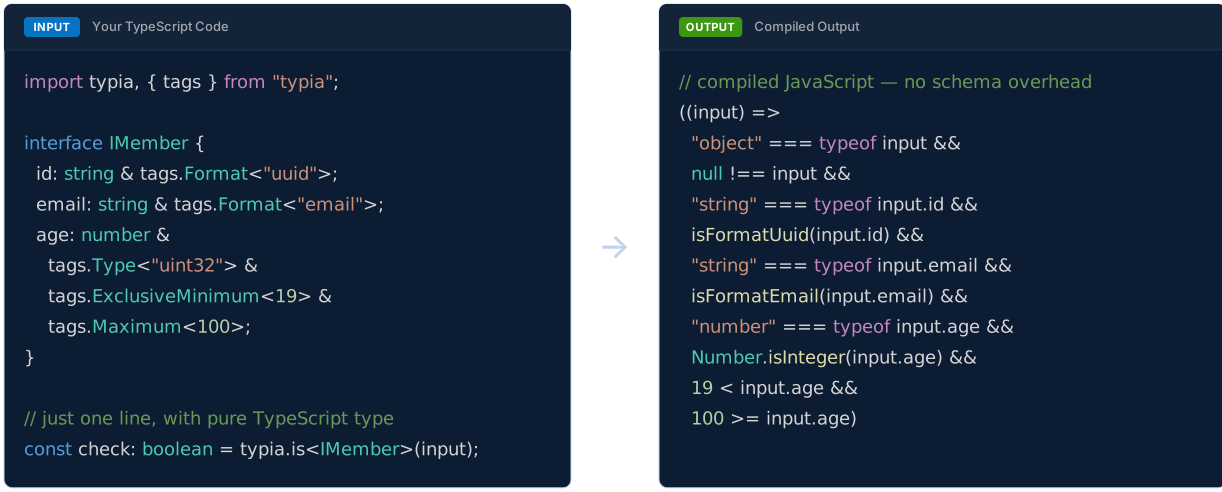
Write the type on the left, and typia compiles it into the validator on the right — at build time, with no schema and no runtime reflection.
Install typia with the ttsc toolchain.
# install
npm i typia
npm i -D ttsc typescript

# build
npx ttsc

# run a script directly
npx ttsx src/index.ts
You must use ttsc and ttsx. The stock tsc, ts-node, and tsx cannot apply the typia transform, so they will not work.
For bundler integration (Vite, Next.js, Webpack, Rollup, esbuild, ...), use @ttsc/unplugin.
If you call typia function, it would be compiled like below.
This is the key concept of typia, transforming TypeScript type to a runtime function. The typia.is<T>() function is transformed to a dedicated type checker by analyzing the target type T in the compilation level.
This feature enables developers to ensure type safety in their applications, leveraging TypeScript's static typing while also providing runtime validation. Instead of defining additional schemas, you can simply utilize the pure TypeScript type itself.
//----
// examples/checkString.ts
//----
import typia, { tags } from "typia";
export const checkString = typia.createIs<string>();

//----
// examples/checkString.js
//----
import typia from "typia";
export const checkString = (() => {
  return (input) => "string" === typeof input;
})();

Thanks for your support.
Your donation encourages typia development.
You can experience how typia works by playground website:
Check out the document in the website:
dev.to Articles(top 24 of 91)
13,582 followers · starred Feb 2024
297 followers · starred Jul 2022
568 followers · starred Jul 2022
552 followers · starred Oct 2023
Super-fast/easy runtime validators and serializers via transformation
See the code
// RUNTIME VALIDATORS
export function is<T>(input: unknown): input is T; // returns boolean
export function assert<T>(input: unknown): T; // throws TypeGuardError
export function assertGuard<T>(input: unknown): asserts input is T;
export function validate<T>(input: unknown): IValidation<T>; // detailed

// JSON FUNCTIONS
export namespace json {
  export function schema<T>(): IJsonSchemaUnit<T>; // JSON schema
  export function assertParse<T>(input: string): T; // type safe parser
  export function assertStringify<T>(input: T): string; // safe and faster
}

// AI FUNCTION CALLING HARNESS
export namespace llm {
  // collection of function calling schemas + validators/parsers
  export function application<Class>(): ILlmApplication<Class>;
  export function structuredOutput<P>(): ILlmStructuredOutput;
  // typed questions for evaluation models + checked answer decoder
  export function evaluation<T>(): ILlmEvaluation<T>;
  // lenient json parser + type coercion
  export function parse<T>(str: string): T;
}

// PROTOCOL BUFFER
export namespace protobuf {
  export function message<T>(): string; // Protocol Buffer message
  export function assertDecode<T>(buffer: Uint8Array): T; // safe decoder
  export function assertEncode<T>(input: T): Uint8Array; // safe encoder
}

// RANDOM GENERATOR
export function random<T>(g?: Partial<IRandomGenerator>): T;
typia is a transformer library supporting below features:
[!NOTE]
- Only one line required, with pure TypeScript type
- Runtime validator is 20,000x faster than
class-validator- JSON serialization is 200x faster than
class-transformer- LLM function calling harness turns 6.75% → 100% accuracy
Write the type on the left, and typia compiles it into the validator on the right — at build time, with no schema and no runtime reflection.
Install typia with the ttsc toolchain.
# install
npm i typia
npm i -D ttsc typescript

# build
npx ttsc

# run a script directly
npx ttsx src/index.ts
You must use ttsc and ttsx. The stock tsc, ts-node, and tsx cannot apply the typia transform, so they will not work.
For bundler integration (Vite, Next.js, Webpack, Rollup, esbuild, ...), use @ttsc/unplugin.
If you call typia function, it would be compiled like below.
This is the key concept of typia, transforming TypeScript type to a runtime function. The typia.is<T>() function is transformed to a dedicated type checker by analyzing the target type T in the compilation level.
This feature enables developers to ensure type safety in their applications, leveraging TypeScript's static typing while also providing runtime validation. Instead of defining additional schemas, you can simply utilize the pure TypeScript type itself.
//----
// examples/checkString.ts
//----
import typia, { tags } from "typia";
export const checkString = typia.createIs<string>();

//----
// examples/checkString.js
//----
import typia from "typia";
export const checkString = (() => {
  return (input) => "string" === typeof input;
})();
Thanks for your support.
Your donation encourages typia development.
You can experience how typia works by playground website:
Check out the document in the website:
dev.to Articles(top 24 of 91)
13,582 followers · starred Feb 2024
297 followers · starred Jul 2022
568 followers · starred Jul 2022
552 followers · starred Oct 2023





