
Go to TypeScript transpiler
See the codeREADME
GoScript: a Go to TypeScript compiler
Your Go code runs anywhere TypeScript runs: Node, Bun, and the browser.


Overview
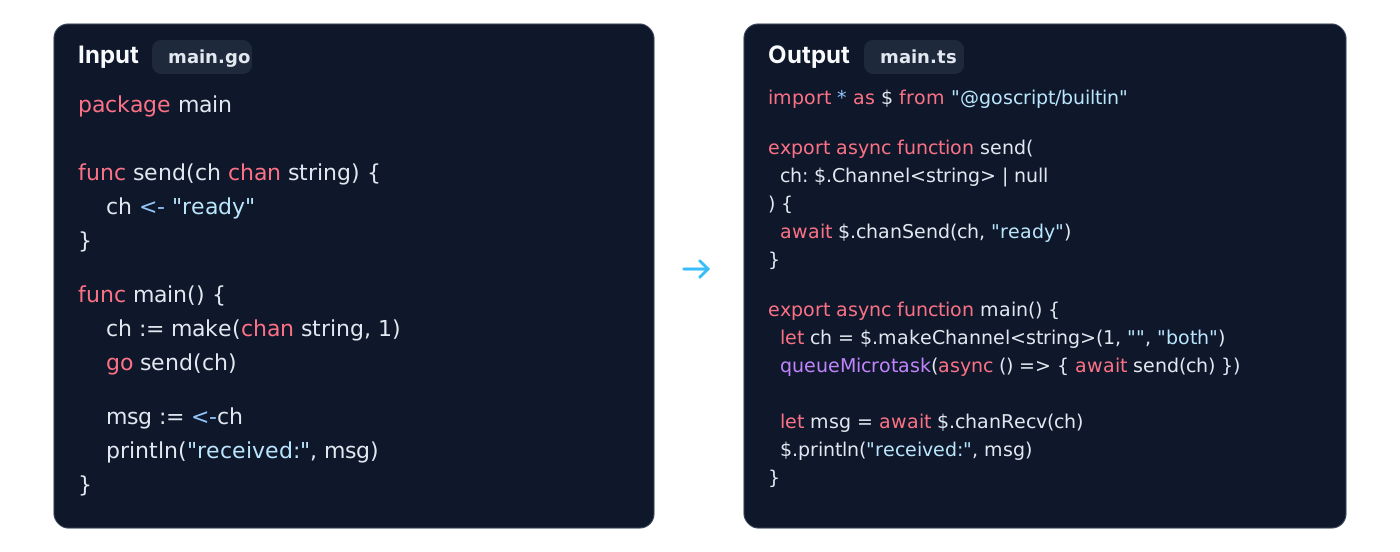
GoScript is a Go to TypeScript compiler, so Go can run anywhere TypeScript
runs. It loads packages from a Go module, type-checks them with the Go
toolchain, and emits deterministic TypeScript packages under
@goscript/<go-package>/.
GoScript compiles package graphs, generics, interfaces, pointer and value
semantics, goroutines, channels, select, defer, async call propagation,
package tests, and a practical standard-library override surface. The output
stays readable enough to inspect, bundle, and debug like code you wrote.
GoScript is developed and tuned against
Spacewave, a large Go and TypeScript app
framework. Spacewave compiles its browser core plugin through GoScript,
including its go-git storage backend and the go-mysql-server SQL engine, and
runs its core package tests through goscript test in CI. That dogfooding keeps
build speed and runtime compatibility tied to complex application code instead
of toy examples.
GoScript shares GopherJS's long-term browser goal: make ordinary Go programs run in JavaScript environments. The difference is the runtime strategy. GopherJS models a Go runtime with its own goroutine scheduler. GoScript emits readable TypeScript modules and maps concurrency onto JavaScript async work and runtime channel helpers instead of implementing a full goroutine scheduler.
Why GoScript?
Use GoScript when Go is the source of truth and part of the product must run in a TypeScript runtime. It compiles real application code: database engines, git implementations, cryptography, and concurrent framework code, not just self-contained algorithms.
Good fits today include:
- Sharing validation, formatting, parsing, and business rules between Go services and TypeScript applications
- Publishing TypeScript packages from Go data structures and algorithms
- Running Go application and framework code in Bun, browsers, and modern bundlers
- Moving Go framework code into browser/plugin paths without rewriting it in TypeScript
- Building package-level test workflows that exercise generated TypeScript instead of handwritten ports
GoScript does not run every valid Go program: code that depends on unsafe
memory operations, cgo, or standard-library packages without an override or
clean transpilation is unsupported. See Limitations for the
precise list.
Useful docs:
Current Surface
Works Today
The compiler runs large real-world package graphs. Each claim below names its proof: a compliance fixture under tests/tests (500+ fixtures, each a Go program compiled, typechecked, and executed against expected output), a runtime test under gs/, or a consuming project.
- Go package loading through
go/packageswithGOOS=jsandGOARCH=wasm, with build tags through CLI build flags (tests/tests/*, all fixtures) - Structs, methods, interfaces, type assertions, typed nils, and value copying
(
struct_*,interface_*fixtures) - Pointers and address-taken variables through the
VarRefruntime model (address_of_pointer_deref,gs/builtin/varRef.ts) - Arrays, slices, maps, strings, named types, complex values, and builtins
(
array_*,slice_*,map_*fixtures) - Generics through generated type-argument dictionaries (
generic_*fixtures) - Goroutines, channels,
select,defer, and async call propagation, mapped onto JavaScript async/await plus the runtime scheduler (goroutines*,channel_*,select_*fixtures;gs/builtin/scheduler.ts) gotoand labeled statements through state-machine lowering (forward_goto_statement)- Exact 64-bit integers:
int64anduint64compile to TypeScriptbigintwith Go overflow semantics (wide_uint64_exact_arithmetic,constant_shift_64,gs/builtin/wide-int.test.ts) - 32-bit integer multiplication through
Math.imul(imul_32bit),float32rounding throughMath.fround(float32_rounding), and bit operations throughMath.clz32(gs/math/bits) - A working
reflectsubset covering types, values, struct fields, maps,MakeFunc,FuncOf, andDeepEqual(reflect_*fixtures,gs/reflect/) - Handwritten standard-library overrides under gs/, including
crypto(aes, cipher, ecdh, ed25519, rand, sha1, sha256, sha512),compress(gzip, zlib),encoding(binary, json),osandsyscall/jsfilesystem support,net/http,database/sql/driver,go/token,go/scanner,time,sync,reflect, andtesting - Third-party package overrides under
gs/github.com/, including go-git/go-billy, klauspost/compress, zeebo/blake3, mr-tron/base58, pkg/errors, hack-pad/safejs, and protobuf-go-lite goscript test, which compiles Go package tests to TypeScript, typechecks the generated workspace, and runs it with Bun or in a Chromium browser (--browser), reporting failures with compiler-stage classifications- Real application graphs: Spacewave's browser core plugin compiles and boots
through GoScript in its end-to-end WASM harness, a package graph that
includes go-git and the go-mysql-server SQL engine; Spacewave also runs its
core package tests through
goscript test(spacewave/package.json, scriptstest:go:goscriptandtest:go:e2e:wasm:goscript) - Browser/WASM compilation for import-free single-file demos
(
compiler/wasm/compile_test.go, the website playground)
Limitations
- CLI, Go API, and Node API inputs are package patterns, not direct
main.gofiles. - Browser source compilation is import-free only; package imports return a
structured
goscript/wasm:imports-unsupporteddiagnostic (compiler/wasm/compile_test.go). Imported code uses the package workflow. unsafetype-checks, but most operations (Alignof,Offsetof,Sizeof, pointer conversion) throw at runtime (gs/unsafe/unsafe.ts). Pointer arithmetic and cgo are unsupported.- Plain
int,uint,uintptr, and integers narrower than 64 bits compile to JavaScriptnumber; onlyint64anduint64arebigint.uintanduintptrarithmetic routes through the 64-bit runtime helpers to preserve full width, but plainintdoes not model 64-bit overflow (compiler/lowering.go,isBigIntBackedType). - Standard-library coverage is override-driven, not complete. A package
without a
gs/override must transpile cleanly or it is unsupported; there are no real sockets, processes, or plugin loading beyond what the JavaScript host provides. - The
reflectoverride is a subset; remaining parity gaps are tracked ings/reflect/parity.json. goscript testsupports a GoScript-compatible subset oftesting, not the completego testflag surface (cmd/goscript/cmd-test_test.go).- Concurrency lowers to async/await and 64-bit arithmetic uses
bigint; both cost more than plain synchronous JavaScript withnumber. Benchmarks live under tests/bench.
Getting Started
Install Bun for TypeScript tests, examples, and website builds:
curl -fsSL https://bun.sh/install | bash
Install the CLI:
go install github.com/s4wave/goscript/cmd/goscript@latest
Compile a Go package from a module directory:
goscript compile --package . --output ./output
The output tree looks like this:
output/
└── @goscript/
    ├── builtin/
    └── example.com/my/module/
        ├── index.ts
        └── main.gs.ts
For a generated package main, GoScript emits a main-script guard so the module
can run directly in Bun or a bundler that resolves @goscript/* imports. See
example/simple for the smallest compile-and-run workflow.
TypeScript Projects
Generated package indexes re-export generated files such as ./main.gs.ts, and
some package-local imports also use explicit .ts specifiers. Your TypeScript
project needs to allow those imports and map @goscript/* to the generated
output root.
Use this shape as the starting point:
{
  "compilerOptions": {
    "target": "ES2022",
    "module": "ESNext",
    "moduleResolution": "bundler",
    "lib": ["ES2022", "esnext.disposable", "DOM"],
    "baseUrl": ".",
    "paths": {
      "@goscript/*": ["./output/@goscript/*"]
    },
    "allowImportingTsExtensions": true,
    "rewriteRelativeImportExtensions": true,
    "allowSyntheticDefaultImports": true,
    "esModuleInterop": true,
    "skipLibCheck": true,
    "strict": true
  }
}
The important settings are:
moduleResolution: "bundler"so@goscript/*package imports resolve like a modern app build.allowImportingTsExtensions: truebecause generated indexes and same-package imports can reference.tsfiles directly.rewriteRelativeImportExtensions: trueif TypeScript is emitting JavaScript instead of only typechecking.pathspointing at the generated@goscript/tree.
If your bundler owns JavaScript emission and TypeScript only typechecks, adding
"noEmit": true is also a good fit.
Command Line
goscript compile \
  --package ./my-go-package \
  --output ./output
Common options:
--package <pattern>: Go package pattern to compile. Repeat for multiple packages.--output <dir>: output directory for the generated TypeScript tree.--dir <dir>: working directory for module/package loading.--build-flags <flag>: Go build flag, repeatable.--all-dependencies: compile dependency packages instead of only requested packages.--gs-path <dir>: additional GoScript override root containing package-path directories.--package-blocklist <paths>: comma-separated Go import paths to reject from the compiled package graph.--compiler-cache-root <dir>: explicit compiler package artifact cache root.--protobuf-ts-binding: bind.pb.gofiles to sibling.pb.tsfiles instead of emitting.pb.gs.ts.--deferred-function: repeat for each exported, non-genericpackage/path.Functionto load on first call. This opts into late package initialization and requires eager callers to move shared concrete types and values into a separate package. Calls become asynchronous; function values remain lazy until invoked. Configure the equivalentdeferredFunctionsarray through the TypeScript API.--disable-emit-builtin: skip copying handwrittengs/runtime packages.
Run Go package tests through GoScript:
goscript test --tags goscript ./...
goscript test loads package test variants, compiles each selected package
through the normal GoScript pipeline, writes a TypeScript test runner, typechecks
the generated workspace, and runs it with Bun. Useful options:
--tags <tags>: comma-separated Go build tags.--run <regexp>: run only matching Go test names.--count <n>: run selected tests multiple times.--short: report true fromtesting.Short.--timeout <duration>: maximum package-test runtime.--workdir <dir>: generated test workspace directory.--output <dir>: generated TypeScript output root.-p <n>: maximum package typecheck/runtime commands to run concurrently.--browser: run package runtimes in a Chromium browser instead of Bun.--runtime-groups: run package runtimes in grouped Bun worker processes.--incremental-typecheck: reuse TypeScript build-info files in the test workdir.
The output is shaped like go test where possible and classifies failures that
occur before the generated tests run.
APIs
Go API:
package main

import (
	"context"

	"github.com/s4wave/goscript/compiler"
)

func main() {
	comp, err := compiler.NewCompiler(&compiler.Config{
		Dir:        ".",
		OutputPath: "./output",
	}, nil, nil)
	if err != nil {
		panic(err)
	}
	if _, err := comp.CompilePackages(context.Background(), "."); err != nil {
		panic(err)
	}
}
Node/Bun API:
import { compile } from 'goscript'

await compile({
  pkg: '.',
  output: './output',
  dir: process.cwd(),
})
WASM adapter package:
package main

import "github.com/s4wave/goscript/compiler/wasm"

func main() {
	ts, err := wasm.CompileSource(`
package main

func main() {
	println("hello from GoScript")
}
`, "main")
	if err != nil {
		panic(err)
	}
	_ = ts
}
The website compiles this package into the browser build. Browser source compilation accepts import-free single-file demos. Package imports return a structured diagnostic; compile imported code with the package workflow.
Architecture
GoScript uses a linear compiler pipeline:
public adapter
  -> compile request
  -> package graph
  -> semantic model
  -> lowered program
  -> TypeScript emitter
  -> runtime/override package copy
Each stage has a small, testable job:
- Request validation normalizes CLI, Go API, Node/Bun API, and WASM inputs.
- Package loading records Go package identities, dependency edges, build tags, and diagnostics.
- Semantic modeling computes type, value, import, addressability, interface, and async facts.
- Lowering turns Go syntax plus semantic facts into a compiler IR.
- TypeScript emission renders deterministic, semicolon-free TypeScript from that IR.
- Runtime contracts keep generated helper names and
@goscript/builtinimports stable. - Override discovery copies handwritten runtime and standard-library packages when direct transpilation is not the right runtime shape.
This separation keeps type and runtime decisions out of string rendering, so generated output changes are easier to explain, test, and debug.
Running from Source
Install dependencies:
bun install
Run the core checks:
bun run test
bun run lint
bun run build
Run the simple package example:
bun run example
Build the static website and browser demo assets:
bun run website:build
The website playground can compile and run import-free single-file demos in the browser. Compliance examples and imported-package examples are precompiled by the website build.
Examples
- example/simple: smallest package compile-and-run workflow.
- example/app: full-stack application example using generated TypeScript.
- tests/tests: inherited compliance fixtures and generated output snapshots.
- tests/deps: legacy snapshot tree of compiled test-library dependencies; explicit input only, not written by test runs.
Contributing
GoScript is experimental. Small compatibility shims are usually the wrong fix; prefer adding focused compiler or compliance tests that name the missing Go behavior, then implement the behavior in the compiler or runtime stage that actually owns it.
Use the repo scripts rather than direct package-manager commands:
bun run test
bun run lint
bun run build
Please open issues for unsupported Go shapes, runtime gaps, and standard-library override gaps.
License
MIT
Contributors

1,570 commits

51 commits

41 commits

13 commits
Similar repos


Languages
TypeScript
84.6%
Go
12.9%
HTML
2.1%
Go to TypeScript transpiler
See the codeREADME
GoScript: a Go to TypeScript compiler
Your Go code runs anywhere TypeScript runs: Node, Bun, and the browser.
Overview
GoScript is a Go to TypeScript compiler, so Go can run anywhere TypeScript
runs. It loads packages from a Go module, type-checks them with the Go
toolchain, and emits deterministic TypeScript packages under
@goscript/<go-package>/.
GoScript compiles package graphs, generics, interfaces, pointer and value
semantics, goroutines, channels, select, defer, async call propagation,
package tests, and a practical standard-library override surface. The output
stays readable enough to inspect, bundle, and debug like code you wrote.
GoScript is developed and tuned against
Spacewave, a large Go and TypeScript app
framework. Spacewave compiles its browser core plugin through GoScript,
including its go-git storage backend and the go-mysql-server SQL engine, and
runs its core package tests through goscript test in CI. That dogfooding keeps
build speed and runtime compatibility tied to complex application code instead
of toy examples.
GoScript shares GopherJS's long-term browser goal: make ordinary Go programs run in JavaScript environments. The difference is the runtime strategy. GopherJS models a Go runtime with its own goroutine scheduler. GoScript emits readable TypeScript modules and maps concurrency onto JavaScript async work and runtime channel helpers instead of implementing a full goroutine scheduler.
Why GoScript?
Use GoScript when Go is the source of truth and part of the product must run in a TypeScript runtime. It compiles real application code: database engines, git implementations, cryptography, and concurrent framework code, not just self-contained algorithms.
Good fits today include:
- Sharing validation, formatting, parsing, and business rules between Go services and TypeScript applications
- Publishing TypeScript packages from Go data structures and algorithms
- Running Go application and framework code in Bun, browsers, and modern bundlers
- Moving Go framework code into browser/plugin paths without rewriting it in TypeScript
- Building package-level test workflows that exercise generated TypeScript instead of handwritten ports
GoScript does not run every valid Go program: code that depends on unsafe
memory operations, cgo, or standard-library packages without an override or
clean transpilation is unsupported. See Limitations for the
precise list.
Useful docs:
Current Surface
Works Today
The compiler runs large real-world package graphs. Each claim below names its proof: a compliance fixture under tests/tests (500+ fixtures, each a Go program compiled, typechecked, and executed against expected output), a runtime test under gs/, or a consuming project.
- Go package loading through
go/packageswithGOOS=jsandGOARCH=wasm, with build tags through CLI build flags (tests/tests/*, all fixtures) - Structs, methods, interfaces, type assertions, typed nils, and value copying
(
struct_*,interface_*fixtures) - Pointers and address-taken variables through the
VarRefruntime model (address_of_pointer_deref,gs/builtin/varRef.ts) - Arrays, slices, maps, strings, named types, complex values, and builtins
(
array_*,slice_*,map_*fixtures) - Generics through generated type-argument dictionaries (
generic_*fixtures) - Goroutines, channels,
select,defer, and async call propagation, mapped onto JavaScript async/await plus the runtime scheduler (goroutines*,channel_*,select_*fixtures;gs/builtin/scheduler.ts) gotoand labeled statements through state-machine lowering (forward_goto_statement)- Exact 64-bit integers:
int64anduint64compile to TypeScriptbigintwith Go overflow semantics (wide_uint64_exact_arithmetic,constant_shift_64,gs/builtin/wide-int.test.ts) - 32-bit integer multiplication through
Math.imul(imul_32bit),float32rounding throughMath.fround(float32_rounding), and bit operations throughMath.clz32(gs/math/bits) - A working
reflectsubset covering types, values, struct fields, maps,MakeFunc,FuncOf, andDeepEqual(reflect_*fixtures,gs/reflect/) - Handwritten standard-library overrides under gs/, including
crypto(aes, cipher, ecdh, ed25519, rand, sha1, sha256, sha512),compress(gzip, zlib),encoding(binary, json),osandsyscall/jsfilesystem support,net/http,database/sql/driver,go/token,go/scanner,time,sync,reflect, andtesting - Third-party package overrides under
gs/github.com/, including go-git/go-billy, klauspost/compress, zeebo/blake3, mr-tron/base58, pkg/errors, hack-pad/safejs, and protobuf-go-lite goscript test, which compiles Go package tests to TypeScript, typechecks the generated workspace, and runs it with Bun or in a Chromium browser (--browser), reporting failures with compiler-stage classifications- Real application graphs: Spacewave's browser core plugin compiles and boots
through GoScript in its end-to-end WASM harness, a package graph that
includes go-git and the go-mysql-server SQL engine; Spacewave also runs its
core package tests through
goscript test(spacewave/package.json, scriptstest:go:goscriptandtest:go:e2e:wasm:goscript) - Browser/WASM compilation for import-free single-file demos
(
compiler/wasm/compile_test.go, the website playground)
Limitations
- CLI, Go API, and Node API inputs are package patterns, not direct
main.gofiles. - Browser source compilation is import-free only; package imports return a
structured
goscript/wasm:imports-unsupporteddiagnostic (compiler/wasm/compile_test.go). Imported code uses the package workflow. unsafetype-checks, but most operations (Alignof,Offsetof,Sizeof, pointer conversion) throw at runtime (gs/unsafe/unsafe.ts). Pointer arithmetic and cgo are unsupported.- Plain
int,uint,uintptr, and integers narrower than 64 bits compile to JavaScriptnumber; onlyint64anduint64arebigint.uintanduintptrarithmetic routes through the 64-bit runtime helpers to preserve full width, but plainintdoes not model 64-bit overflow (compiler/lowering.go,isBigIntBackedType). - Standard-library coverage is override-driven, not complete. A package
without a
gs/override must transpile cleanly or it is unsupported; there are no real sockets, processes, or plugin loading beyond what the JavaScript host provides. - The
reflectoverride is a subset; remaining parity gaps are tracked ings/reflect/parity.json. goscript testsupports a GoScript-compatible subset oftesting, not the completego testflag surface (cmd/goscript/cmd-test_test.go).- Concurrency lowers to async/await and 64-bit arithmetic uses
bigint; both cost more than plain synchronous JavaScript withnumber. Benchmarks live under tests/bench.
Getting Started
Install Bun for TypeScript tests, examples, and website builds:
curl -fsSL https://bun.sh/install | bash
Install the CLI:
go install github.com/s4wave/goscript/cmd/goscript@latest
Compile a Go package from a module directory:
goscript compile --package . --output ./output
The output tree looks like this:
output/
└── @goscript/
    ├── builtin/
    └── example.com/my/module/
        ├── index.ts
        └── main.gs.ts
For a generated package main, GoScript emits a main-script guard so the module
can run directly in Bun or a bundler that resolves @goscript/* imports. See
example/simple for the smallest compile-and-run workflow.
TypeScript Projects
Generated package indexes re-export generated files such as ./main.gs.ts, and
some package-local imports also use explicit .ts specifiers. Your TypeScript
project needs to allow those imports and map @goscript/* to the generated
output root.
Use this shape as the starting point:
{
  "compilerOptions": {
    "target": "ES2022",
    "module": "ESNext",
    "moduleResolution": "bundler",
    "lib": ["ES2022", "esnext.disposable", "DOM"],
    "baseUrl": ".",
    "paths": {
      "@goscript/*": ["./output/@goscript/*"]
    },
    "allowImportingTsExtensions": true,
    "rewriteRelativeImportExtensions": true,
    "allowSyntheticDefaultImports": true,
    "esModuleInterop": true,
    "skipLibCheck": true,
    "strict": true
  }
}
The important settings are:
moduleResolution: "bundler"so@goscript/*package imports resolve like a modern app build.allowImportingTsExtensions: truebecause generated indexes and same-package imports can reference.tsfiles directly.rewriteRelativeImportExtensions: trueif TypeScript is emitting JavaScript instead of only typechecking.pathspointing at the generated@goscript/tree.
If your bundler owns JavaScript emission and TypeScript only typechecks, adding
"noEmit": true is also a good fit.
Command Line
goscript compile \
  --package ./my-go-package \
  --output ./output
Common options:
--package <pattern>: Go package pattern to compile. Repeat for multiple packages.--output <dir>: output directory for the generated TypeScript tree.--dir <dir>: working directory for module/package loading.--build-flags <flag>: Go build flag, repeatable.--all-dependencies: compile dependency packages instead of only requested packages.--gs-path <dir>: additional GoScript override root containing package-path directories.--package-blocklist <paths>: comma-separated Go import paths to reject from the compiled package graph.--compiler-cache-root <dir>: explicit compiler package artifact cache root.--protobuf-ts-binding: bind.pb.gofiles to sibling.pb.tsfiles instead of emitting.pb.gs.ts.--deferred-function: repeat for each exported, non-genericpackage/path.Functionto load on first call. This opts into late package initialization and requires eager callers to move shared concrete types and values into a separate package. Calls become asynchronous; function values remain lazy until invoked. Configure the equivalentdeferredFunctionsarray through the TypeScript API.--disable-emit-builtin: skip copying handwrittengs/runtime packages.
Run Go package tests through GoScript:
goscript test --tags goscript ./...
goscript test loads package test variants, compiles each selected package
through the normal GoScript pipeline, writes a TypeScript test runner, typechecks
the generated workspace, and runs it with Bun. Useful options:
--tags <tags>: comma-separated Go build tags.--run <regexp>: run only matching Go test names.--count <n>: run selected tests multiple times.--short: report true fromtesting.Short.--timeout <duration>: maximum package-test runtime.--workdir <dir>: generated test workspace directory.--output <dir>: generated TypeScript output root.-p <n>: maximum package typecheck/runtime commands to run concurrently.--browser: run package runtimes in a Chromium browser instead of Bun.--runtime-groups: run package runtimes in grouped Bun worker processes.--incremental-typecheck: reuse TypeScript build-info files in the test workdir.
The output is shaped like go test where possible and classifies failures that
occur before the generated tests run.
APIs
Go API:
package main

import (
	"context"

	"github.com/s4wave/goscript/compiler"
)

func main() {
	comp, err := compiler.NewCompiler(&compiler.Config{
		Dir:        ".",
		OutputPath: "./output",
	}, nil, nil)
	if err != nil {
		panic(err)
	}
	if _, err := comp.CompilePackages(context.Background(), "."); err != nil {
		panic(err)
	}
}
Node/Bun API:
import { compile } from 'goscript'

await compile({
  pkg: '.',
  output: './output',
  dir: process.cwd(),
})
WASM adapter package:
package main

import "github.com/s4wave/goscript/compiler/wasm"

func main() {
	ts, err := wasm.CompileSource(`
package main

func main() {
	println("hello from GoScript")
}
`, "main")
	if err != nil {
		panic(err)
	}
	_ = ts
}
The website compiles this package into the browser build. Browser source compilation accepts import-free single-file demos. Package imports return a structured diagnostic; compile imported code with the package workflow.
Architecture
GoScript uses a linear compiler pipeline:
public adapter
  -> compile request
  -> package graph
  -> semantic model
  -> lowered program
  -> TypeScript emitter
  -> runtime/override package copy
Each stage has a small, testable job:
- Request validation normalizes CLI, Go API, Node/Bun API, and WASM inputs.
- Package loading records Go package identities, dependency edges, build tags, and diagnostics.
- Semantic modeling computes type, value, import, addressability, interface, and async facts.
- Lowering turns Go syntax plus semantic facts into a compiler IR.
- TypeScript emission renders deterministic, semicolon-free TypeScript from that IR.
- Runtime contracts keep generated helper names and
@goscript/builtinimports stable. - Override discovery copies handwritten runtime and standard-library packages when direct transpilation is not the right runtime shape.
This separation keeps type and runtime decisions out of string rendering, so generated output changes are easier to explain, test, and debug.
Running from Source
Install dependencies:
bun install
Run the core checks:
bun run test
bun run lint
bun run build
Run the simple package example:
bun run example
Build the static website and browser demo assets:
bun run website:build
The website playground can compile and run import-free single-file demos in the browser. Compliance examples and imported-package examples are precompiled by the website build.
Examples
- example/simple: smallest package compile-and-run workflow.
- example/app: full-stack application example using generated TypeScript.
- tests/tests: inherited compliance fixtures and generated output snapshots.
- tests/deps: legacy snapshot tree of compiled test-library dependencies; explicit input only, not written by test runs.
Contributing
GoScript is experimental. Small compatibility shims are usually the wrong fix; prefer adding focused compiler or compliance tests that name the missing Go behavior, then implement the behavior in the compiler or runtime stage that actually owns it.
Use the repo scripts rather than direct package-manager commands:
bun run test
bun run lint
bun run build
Please open issues for unsupported Go shapes, runtime gaps, and standard-library override gaps.
License
MIT
Similar repos
Contributors
1,570 commits
51 commits
41 commits
13 commits
Languages
TypeScript
84.6%
Go
12.9%
HTML
2.1%