Real-time monitoring dashboard for Proxmox VE, PBS, Docker, Kubernetes, TrueNAS and vSphere. Self-hosted, with smart alerts and AI patrols that catch silent failures.
See the code
Real-time Proxmox, Docker and Kubernetes monitoring that finds what needs attention.



Pulse is a self-hosted monitoring workspace for Proxmox, Docker, Kubernetes, TrueNAS, physical and virtual machines, and early-access VMware vSphere environments. It combines live infrastructure state, history, alerts, recovery visibility, and scheduled health checks without requiring a conventional enterprise monitoring stack.
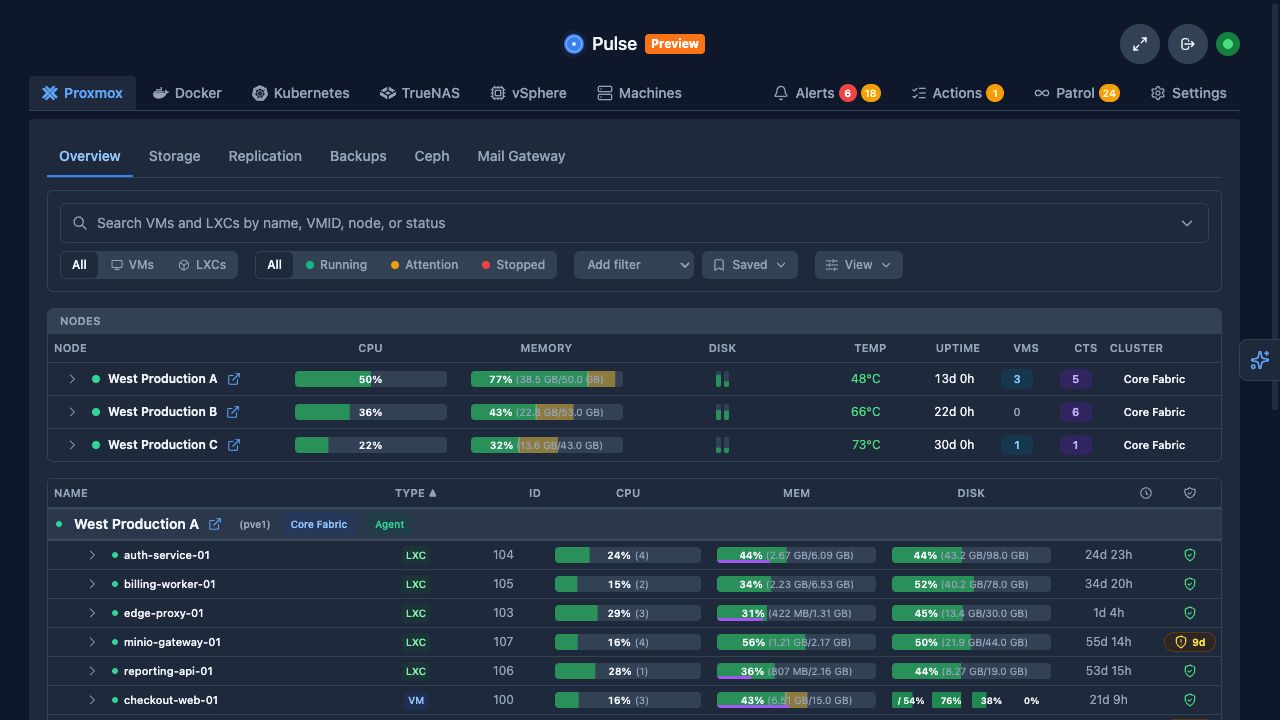
| Platform | Coverage |
|---|---|
| Proxmox VE, PBS, and PMG | Nodes, guests, storage, backups, replication, Ceph, mail gateways, and alerts |
| Docker and Podman | Hosts, containers, Compose projects, Swarm services, health, images, and updates |
| Kubernetes | Clusters, nodes, workloads, pods, services, storage, and events through the unified agent |
| TrueNAS SCALE and CORE | Pools, datasets, disks, snapshots, replication tasks, apps, VMs, and alerts |
| Linux, Windows, and macOS machines | Host health, filesystems, networking, temperatures, RAID, and availability through the unified agent |
| VMware vSphere | Early-access inventory, hosts, clusters, VMs, datastores, networks, snapshots, and recovery context; validate against your own vCenter before production use |
Platform pages keep storage and recovery information beside the infrastructure it belongs to. Alerts, Actions, and Patrol remain cross-platform views.
Pulse Patrol runs scheduled checks across the current state and recent history of your infrastructure. Community installations can use a local model or their own AI provider for watch-only analysis. Pulse Pro adds investigation and policy-bound fixes with approval, verification, and an audit trail.
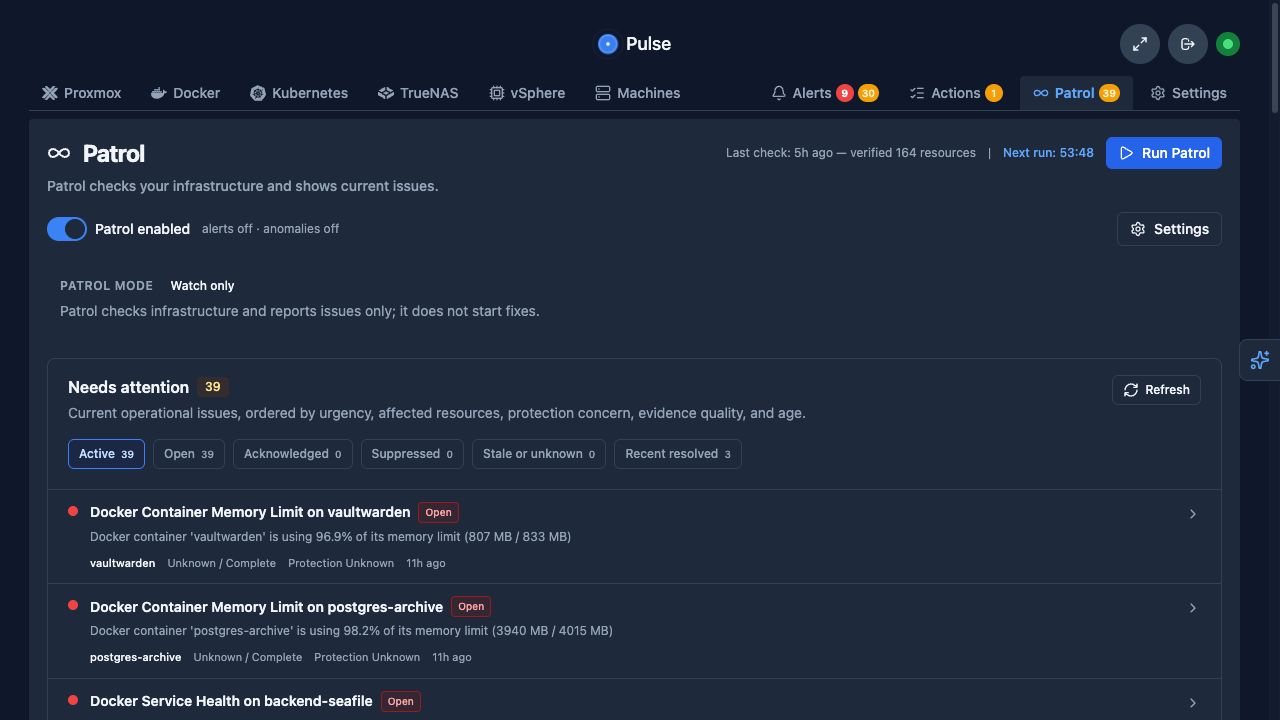
Pulse also includes an interactive Assistant and an MCP adapter for external clients such as Claude Code and OpenCode. Both sit on top of the same scoped inventory, metrics, alert, storage, and governed-action contracts.
Choose an exact version from the latest release and keep that version pinned during installation.
docker run -d \
  --name pulse \
  -p 7655:7655 \
  -v pulse_data:/data \
  -e PULSE_DEPLOYMENT_METHOD=docker_run \
  --restart unless-stopped \
  rcourtman/pulse:vX.Y.Z
Open http://<your-ip>:7655 and follow the bootstrap-token setup. Docker host
monitoring is provided by the unified agent; the Pulse server container does
not need the Docker socket.
The installer is signed. Verify install.sh against the pinned
pulse-installer key before running it:
export PULSE_VERSION=vX.Y.Z
curl -fsSLO "https://github.com/rcourtman/Pulse/releases/download/${PULSE_VERSION}/install.sh" &&
curl -fsSLO "https://github.com/rcourtman/Pulse/releases/download/${PULSE_VERSION}/install.sh.sshsig" &&
ssh-keygen -Y verify \
  -f <(printf '%s\n' 'pulse-installer namespaces="pulse-install" ssh-ed25519 AAAAC3NzaC1lZDI1NTE5AAAAIMZd/DaH+BldzOkq1A8KVTcFk73nAyrE8aJOyf7i00jm pulse-installer') \
  -I pulse-installer \
  -n pulse-install \
  -s install.sh.sshsig < install.sh &&
bash install.sh --version "${PULSE_VERSION}"
Paste the whole block: installation stops if either download or signature verification fails. Do not run the final command separately to bypass a failure.
The GitHub installer installs the Pulse server. Install and upgrade agents (including v5-to-v6 agent upgrades) with the per-host command generated under Settings → Infrastructure → Install on a host.
Often not. Proxmox VE, PBS, and PMG are monitored through the Proxmox API with a read-only token, so no Pulse host agent is required. The generated setup script creates a privilege-separated monitoring user. Install the unified agent only where you want data the platform API cannot provide, such as host SMART health, temperatures, Docker hosts, or standalone machines.
API-only does not mean guest-agent-free. VM filesystem and memory requests through QEMU Guest Agent can share the channel used by freeze-enabled backups. Read-only permissions do not prove backup safety. Do not add permissions, enable or restart an agent, or send manual guest-agent probes during a backup, freeze or thaw. Use the existing backup safety precaution. Stopping Pulse also stops its monitoring and alerts. An OK backup task does not prove successful thaw.
The agent is operator-controlled by design. Command execution is off by
default, the local listener binds to localhost, and generated systemd units
ship hardened. On Linux, the installer's --least-privilege profile runs the
service as a dedicated non-root user, with optional scoped sudo grants for
the few collectors that need elevation. The
agent security model documents exactly what the
agent can and cannot do at each privilege level.
[!IMPORTANT] GitHub release assets and
rcourtman/pulseimages are Community builds. Relay, Pro, and eligible legacy customers should use the private image or Linux archive provided by the Pulse download portal. Replacing a private Pro runtime with a public Community build removes its private runtime hooks.
Relay is no longer sold. Existing Relay subscribers receive Pro features at their current price for as long as their subscription continues. Existing paired phones keep working until 31 March 2027. Relay connects the app, not the web UI. Use your own VPN or tunnel for remote web access. For phone alerts, add an ntfy, Gotify or Pushover destination and open Pulse in your phone's browser.
Core self-hosted monitoring is not gated by monitored-system or child-resource volume. See the runtime-aligned capability reference and current plans for details.
Localized getting started guides: Deutsch · Español
Pulse uses Go 1.26 and a SolidJS/TypeScript frontend. The managed development
runtime starts the frontend at http://127.0.0.1:5173 and proxies API and
WebSocket traffic to the backend on port 7655.
npm ci
npm --prefix frontend-modern ci
npm run dev
Useful checks:
go test ./...
npm --prefix frontend-modern test
npm --prefix frontend-modern run type-check
python3 scripts/check_public_docs.py
See CONTRIBUTING.md before investing in a code change. Pulse uses an issue-first contribution process and does not normally accept unsolicited pull requests.
Everything in this repository is licensed under the MIT License. There is no dual licensing and no commercial or source-available code here.
Pulse Pro is a separate commercial product, built from private sources and distributed through pulserelay.pro. Its use is governed by the Terms of Service, which apply to that product only, not to anything in this repository.
Go module
Latest release
Releases this year
(top 24 of 42)
461 followers · starred Jan 2026
186 followers · starred Aug 2025
106 followers · starred Jan 2026
515 followers · starred Jan 2026
Real-time monitoring dashboard for Proxmox VE, PBS, Docker, Kubernetes, TrueNAS and vSphere. Self-hosted, with smart alerts and AI patrols that catch silent failures.
See the code
Real-time Proxmox, Docker and Kubernetes monitoring that finds what needs attention.
Pulse is a self-hosted monitoring workspace for Proxmox, Docker, Kubernetes, TrueNAS, physical and virtual machines, and early-access VMware vSphere environments. It combines live infrastructure state, history, alerts, recovery visibility, and scheduled health checks without requiring a conventional enterprise monitoring stack.
| Platform | Coverage |
|---|---|
| Proxmox VE, PBS, and PMG | Nodes, guests, storage, backups, replication, Ceph, mail gateways, and alerts |
| Docker and Podman | Hosts, containers, Compose projects, Swarm services, health, images, and updates |
| Kubernetes | Clusters, nodes, workloads, pods, services, storage, and events through the unified agent |
| TrueNAS SCALE and CORE | Pools, datasets, disks, snapshots, replication tasks, apps, VMs, and alerts |
| Linux, Windows, and macOS machines | Host health, filesystems, networking, temperatures, RAID, and availability through the unified agent |
| VMware vSphere | Early-access inventory, hosts, clusters, VMs, datastores, networks, snapshots, and recovery context; validate against your own vCenter before production use |
Platform pages keep storage and recovery information beside the infrastructure it belongs to. Alerts, Actions, and Patrol remain cross-platform views.
Pulse Patrol runs scheduled checks across the current state and recent history of your infrastructure. Community installations can use a local model or their own AI provider for watch-only analysis. Pulse Pro adds investigation and policy-bound fixes with approval, verification, and an audit trail.
Pulse also includes an interactive Assistant and an MCP adapter for external clients such as Claude Code and OpenCode. Both sit on top of the same scoped inventory, metrics, alert, storage, and governed-action contracts.
Choose an exact version from the latest release and keep that version pinned during installation.
docker run -d \
  --name pulse \
  -p 7655:7655 \
  -v pulse_data:/data \
  -e PULSE_DEPLOYMENT_METHOD=docker_run \
  --restart unless-stopped \
  rcourtman/pulse:vX.Y.Z
Open http://<your-ip>:7655 and follow the bootstrap-token setup. Docker host
monitoring is provided by the unified agent; the Pulse server container does
not need the Docker socket.
The installer is signed. Verify install.sh against the pinned
pulse-installer key before running it:
export PULSE_VERSION=vX.Y.Z
curl -fsSLO "https://github.com/rcourtman/Pulse/releases/download/${PULSE_VERSION}/install.sh" &&
curl -fsSLO "https://github.com/rcourtman/Pulse/releases/download/${PULSE_VERSION}/install.sh.sshsig" &&
ssh-keygen -Y verify \
  -f <(printf '%s\n' 'pulse-installer namespaces="pulse-install" ssh-ed25519 AAAAC3NzaC1lZDI1NTE5AAAAIMZd/DaH+BldzOkq1A8KVTcFk73nAyrE8aJOyf7i00jm pulse-installer') \
  -I pulse-installer \
  -n pulse-install \
  -s install.sh.sshsig < install.sh &&
bash install.sh --version "${PULSE_VERSION}"
Paste the whole block: installation stops if either download or signature verification fails. Do not run the final command separately to bypass a failure.
The GitHub installer installs the Pulse server. Install and upgrade agents (including v5-to-v6 agent upgrades) with the per-host command generated under Settings → Infrastructure → Install on a host.
Often not. Proxmox VE, PBS, and PMG are monitored through the Proxmox API with a read-only token, so no Pulse host agent is required. The generated setup script creates a privilege-separated monitoring user. Install the unified agent only where you want data the platform API cannot provide, such as host SMART health, temperatures, Docker hosts, or standalone machines.
API-only does not mean guest-agent-free. VM filesystem and memory requests through QEMU Guest Agent can share the channel used by freeze-enabled backups. Read-only permissions do not prove backup safety. Do not add permissions, enable or restart an agent, or send manual guest-agent probes during a backup, freeze or thaw. Use the existing backup safety precaution. Stopping Pulse also stops its monitoring and alerts. An OK backup task does not prove successful thaw.
The agent is operator-controlled by design. Command execution is off by
default, the local listener binds to localhost, and generated systemd units
ship hardened. On Linux, the installer's --least-privilege profile runs the
service as a dedicated non-root user, with optional scoped sudo grants for
the few collectors that need elevation. The
agent security model documents exactly what the
agent can and cannot do at each privilege level.
[!IMPORTANT] GitHub release assets and
rcourtman/pulseimages are Community builds. Relay, Pro, and eligible legacy customers should use the private image or Linux archive provided by the Pulse download portal. Replacing a private Pro runtime with a public Community build removes its private runtime hooks.
Relay is no longer sold. Existing Relay subscribers receive Pro features at their current price for as long as their subscription continues. Existing paired phones keep working until 31 March 2027. Relay connects the app, not the web UI. Use your own VPN or tunnel for remote web access. For phone alerts, add an ntfy, Gotify or Pushover destination and open Pulse in your phone's browser.
Core self-hosted monitoring is not gated by monitored-system or child-resource volume. See the runtime-aligned capability reference and current plans for details.
Localized getting started guides: Deutsch · Español
Pulse uses Go 1.26 and a SolidJS/TypeScript frontend. The managed development
runtime starts the frontend at http://127.0.0.1:5173 and proxies API and
WebSocket traffic to the backend on port 7655.
npm ci
npm --prefix frontend-modern ci
npm run dev
Useful checks:
go test ./...
npm --prefix frontend-modern test
npm --prefix frontend-modern run type-check
python3 scripts/check_public_docs.py
See CONTRIBUTING.md before investing in a code change. Pulse uses an issue-first contribution process and does not normally accept unsolicited pull requests.
Everything in this repository is licensed under the MIT License. There is no dual licensing and no commercial or source-available code here.
Pulse Pro is a separate commercial product, built from private sources and distributed through pulserelay.pro. Its use is governed by the Terms of Service, which apply to that product only, not to anything in this repository.
Go module
Latest release
Releases this year
(top 24 of 42)
461 followers · starred Jan 2026
186 followers · starred Aug 2025
106 followers · starred Jan 2026
515 followers · starred Jan 2026



