
See what people are saying
README
Go System One
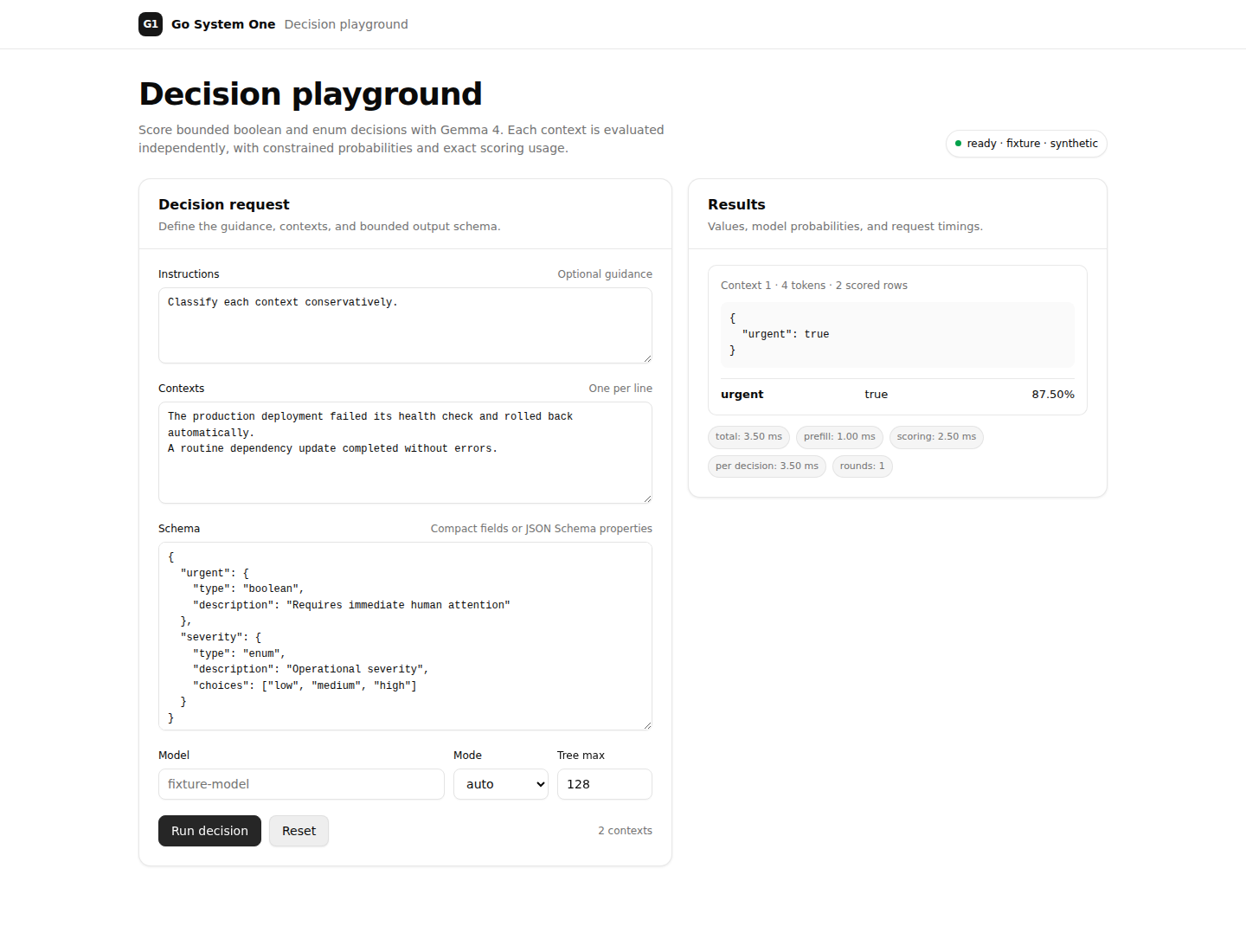
Go System One uses Gemma 4 12B to choose between a fixed set of boolean or enum values. We started with a fixed Gemma baseline, built a llama.cpp prototype to define the expected results and speed, then replaced it with a native Go runtime.
The current NVIDIA path loads hand-tuned PTX kernels directly from Go through the NVIDIA Driver API. It needs no CGo, llama.cpp or CUDA toolkit at run time, and reduced the pinned RTX 3060 request from about 521 ms in the first native version to an 81.13 ms median.
Run
Go 1.26.2 or the version in go.mod is required. Model files are downloaded separately under the Gemma licence.
make setup
make artifacts-download ACCEPT_GEMMA_LICENSE=1 HF_TOKEN="$HF_TOKEN"
make run BACKEND=nvidia LISTEN=127.0.0.1:8080
Open http://127.0.0.1:8080/go-system-one.
Documentation
Licence
Contributors



Similar repos


Languages
Go
92.0%
Assembly
6.4%
See what people are saying
README
Go System One
Go System One uses Gemma 4 12B to choose between a fixed set of boolean or enum values. We started with a fixed Gemma baseline, built a llama.cpp prototype to define the expected results and speed, then replaced it with a native Go runtime.
The current NVIDIA path loads hand-tuned PTX kernels directly from Go through the NVIDIA Driver API. It needs no CGo, llama.cpp or CUDA toolkit at run time, and reduced the pinned RTX 3060 request from about 521 ms in the first native version to an 81.13 ms median.
Run
Go 1.26.2 or the version in go.mod is required. Model files are downloaded separately under the Gemma licence.
make setup
make artifacts-download ACCEPT_GEMMA_LICENSE=1 HF_TOKEN="$HF_TOKEN"
make run BACKEND=nvidia LISTEN=127.0.0.1:8080
Open http://127.0.0.1:8080/go-system-one.
Documentation
Licence
Similar repos
Contributors
Languages
Go
92.0%
Assembly
6.4%