Turn markdown into a knowledge graph with an ontology you write and a cutoff you own. Closed yes/no decisions, not free-form JSON.
See the codeTurn markdown into a knowledge graph with an ontology you write and a cutoff you own.
Your code proposes names. Your ontology says which kinds and links are legal. A small local decision model answers one closed yes-or-no question at a time. Anything it is unsure about waits for a person instead of silently entering your graph.
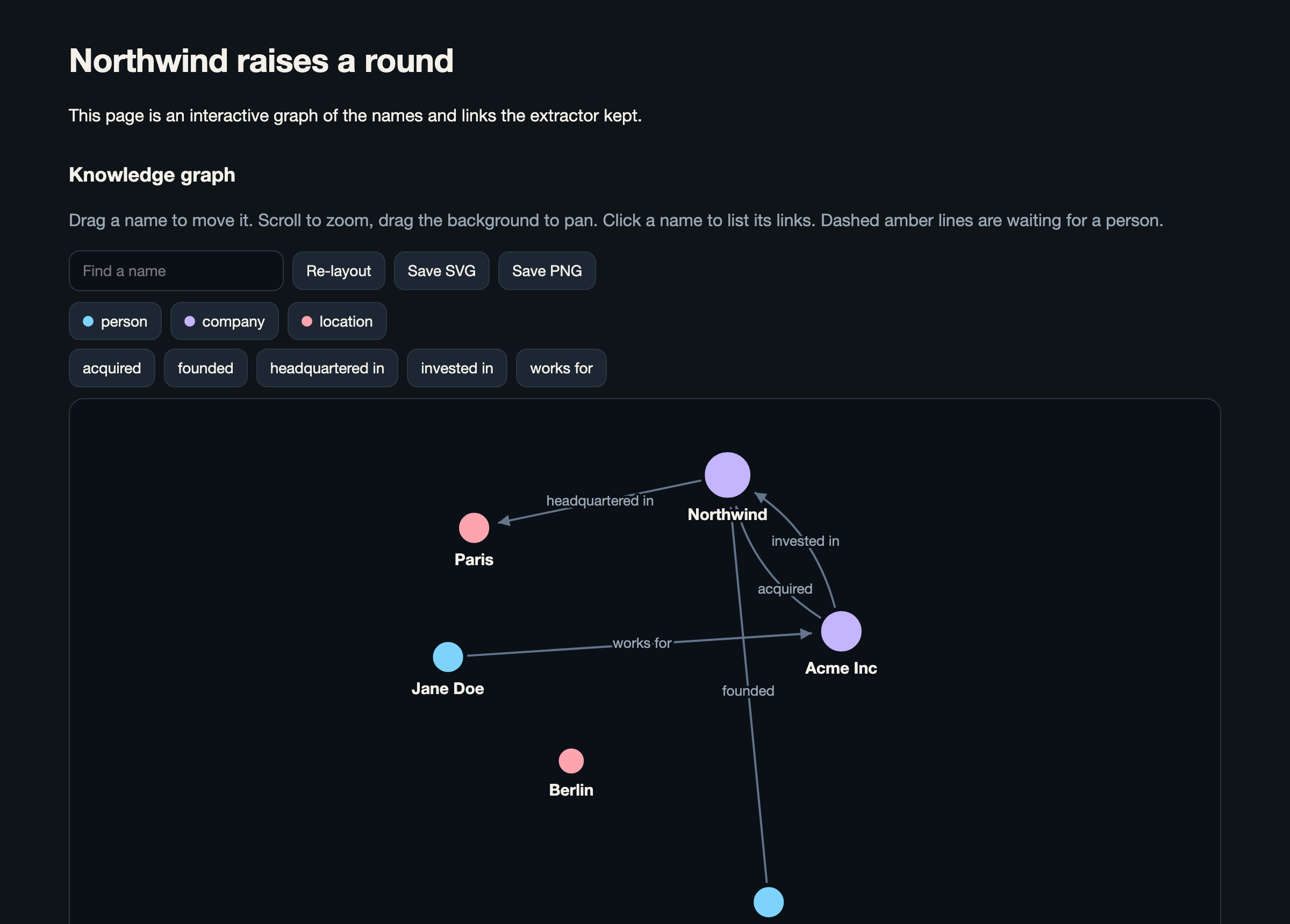
Real output from a local tev1 run on 13_northwind.md: open the interactive page · full report · read the article (PDF). One of the five links in that graph is wrong (Acme ACQUIRED Northwind; the text says "invested in"). We left it in. That is what the review queue and your cutoff are for.
Rust (native): cargo add edgextract or cargo install edgextract.
Browser WASM: npm i @raphael.mansuy/edgextract (demo: GitHub Pages · Hugging Face Space).
git clone https://github.com/raphaelmansuy/edgextract && cd edgextract
uv sync --all-extras
ollama pull tev1                       # a local decision model (Ollama 0.35+)
uv run edgextract --model tev1 report data/golden/docs/13_northwind.md \
    --ontology company_news --out graph.html
open graph.html
No model yet? Everything below runs offline against a stand-in model:
make test examples
Or from Python, in five lines:
from edgextract import extract_text, load_ontology_named, write_report

text = open("note.md").read()
ontology = load_ontology_named("company_news")      # or "tech_docs", "conll04", or a YAML path
result = extract_text(text, ontology, model="tev1")
write_report("graph.html", text, result, ontology, title="My note")
Hosted demo: GitHub Pages · Hugging Face Space (direct app) — Chromium with WebGPU; first Load Tev1 downloads ~1 GB from Hugging Face into the browser cache (no server of ours sees your text). The hosted page does not call 127.0.0.1:11434. Optional Ollama: ?backend=ollama&host=https://your-host plus OLLAMA_ORIGINS (HTTPS required; the browser blocks mixed-content http://). Open the Space on *.hf.space, not only the Hub iframe.
The Rust crate compiles to WebAssembly, and a small Vite + TypeScript page runs the whole pipeline in a tab. Your text goes only to the decision model you name (by default Tev1 on WebGPU in this tab; Ollama is one click away), never to a server of ours.
ollama pull tev1                  # Ollama already accepts pages served from localhost;
                                  # for another origin set OLLAMA_ORIGINS before `ollama serve`
make demo                # builds the wasm, then serves http://localhost:5273
# WebGPU default loads raphaelmansuy/tev1-0.8b-onnx-webgpu (~1 GB, browser cache).
# Optional: make demo-webgpu-model / make demo-webgpu-publish / make demo-webgpu-export-tev1
# Attribution: docs/THIRD_PARTY_NOTICES.md
# GitHub Pages: push to master runs .github/workflows/pages.yml (lean dist, Hub weights).
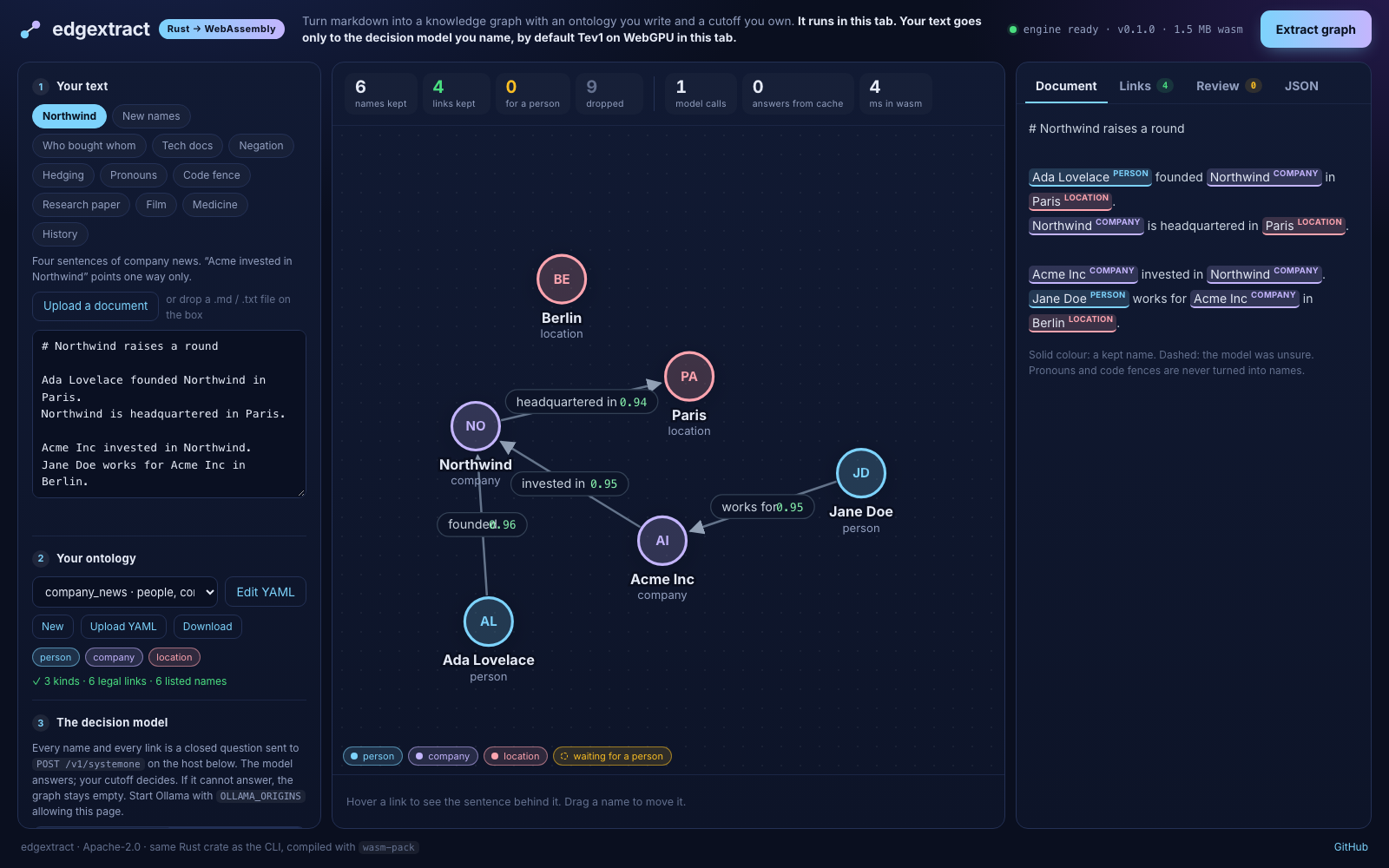
.md / .txt file, or paste text.raphaelmansuy/tev1-0.8b-onnx-webgpu (Together Tev1 ONNX; attribution in docs/THIRD_PARTY_NOTICES.md). Ollama is the other option (http://localhost:11434, model tev1; set OLLAMA_ORIGINS) and remains the Metal/CUDA speed ceiling. Same closed-question JSON either way. There is no rule-based mode in the page. If the backend cannot answer, the graph stays empty.make demo-e2e runs the Playwright suite against a deterministic test double of the host (34 tests, with screenshots in docs/img/demo). Details in web/README.md.
A chat model writes the next token. A JSON schema makes the output well-formed. It does not make it true, and it does not tell you how sure the model was. You parse, repair, and hope.
edgextract asks a different question. For every candidate pair it sends a closed yes-or-no to Ollama's POST /v1/systemone and gets back a probability. Your cutoff then decides: keep, send to a person, or drop.
We measured it on CoNLL04, a standard news benchmark (288 test sentences, exact-span scoring, none of the names pre-listed). Same scorer for every row. The first run used a smaller name finder and scored slightly higher on links; we publish both and use the final, shipped configuration as the number of record.
| Method | Names F1 | Links F1 | Trained on CoNLL04? |
|---|---|---|---|
| SpERT (published) | 0.889 | 0.715 | yes |
edgextract + tev1, final run | 0.690 | 0.388 | no |
edgextract + tev1, first run | 0.658 | 0.411 | no |
| Mistral Small, JSON per sentence | 0.643 | 0.330 | no |
Read this table honestly. A model trained on the benchmark's own training sentences still wins by a wide margin. The comparison that matters is the zero-shot rows. There, the closed decision keeps far fewer wrong links than the chat model (links precision 0.41 against 0.27; 218 wrong links kept against 504) and gives up some recall for it. Name scores on that test are close (0.690 against 0.643). On the twelve tech notes they are not: tev1 scores 0.97, mostly because the names are already on the list, and Mistral Small scored 0.68 on the saved run (0.80 on an earlier run the same day). See the full evaluation.
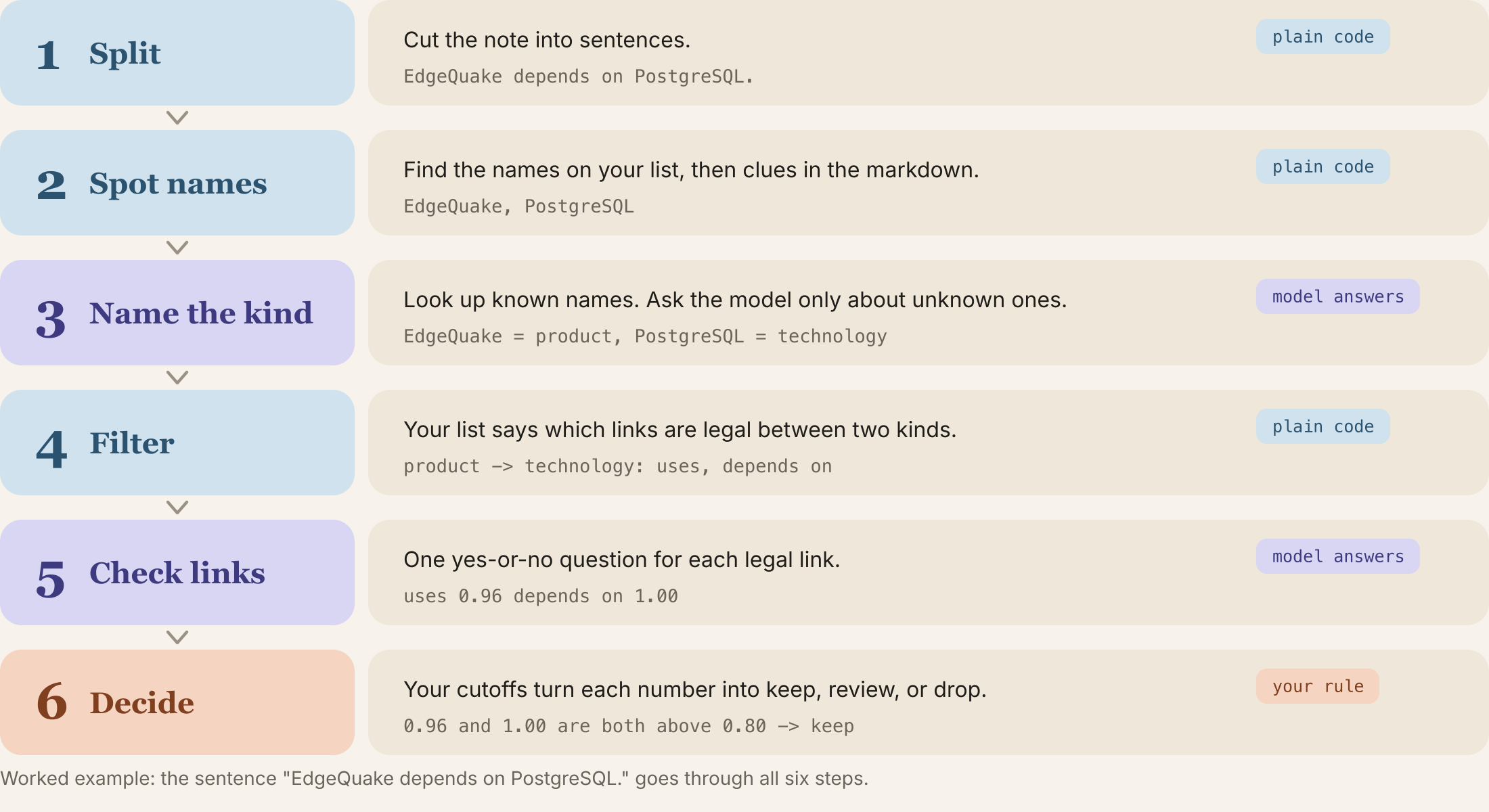
The model never finds a span and never invents a type.
uv run edgextract init-ontology my_domain.yaml       # a commented starter
uv run edgextract validate-ontology my_domain.yaml   # prints kinds and legal links in plain words
id: company_news
types:
  - {id: PERSON,  description: A named person (founder, executive, investor).}
  - {id: COMPANY, description: A named company, startup, or fund.}
relations:
  - id: FOUNDED
    description: The person founded the company.
    domain: [PERSON]
    range: [COMPANY]
gazetteer:            # optional: names you already know
  Ada Lovelace: PERSON
Nine short scripts, each one idea. See examples/README.md.
01_hello_decision | One closed question and its probability |
02_pick_a_label | Yes-or-no and a scored level |
03_type_a_name | Looking up and typing names |
04_find_links | One yes-or-no per legal link |
05_extract_a_document | The whole pipeline |
06_review_queue | Uncertain items, written as sentences |
07_your_own_ontology | Company news instead of software docs |
08_compare_with_chat_model | Decision model against chat JSON |
09_export_graph | JSON, Cypher, interactive HTML |
EdgeQuake-shaped JSON: entities with canonical UPPER_SNAKE names and kinds, relationships with the evidence sentence, a review list for uncertain items, and a rejected list. edgextract export-cypher prints Cypher; edgextract graph writes the interactive page.
GateConfig.fitted starts false. Fit them on your labels with edgextract calibrate. We do not claim anything about hosted-Jev calibration.weight is the model's probability. The cutoff compares that number. It is not a rescaled score.tev1 and 77.8 s for gemma4 on the same computer, and 3.9 s for hosted Mistral. A later tev1 pass with the model already loaded took 4.3 s. The library default model is nimble, which scored 0.38 on links for that note. The published CoNLL04 run used tev1 and the larger name finder, which edgextract report does not load unless you run eval-benchmark.format/JSON-schema on a chat host is not a decision. Do not call it one.EdgeQuake was the inspiration for the output shape. edgextract is an independent Python library.
By Raphael MANSUY.
Turn markdown into a knowledge graph with an ontology you write and a cutoff you own. Closed yes/no decisions, not free-form JSON.
See the codeTurn markdown into a knowledge graph with an ontology you write and a cutoff you own.
Your code proposes names. Your ontology says which kinds and links are legal. A small local decision model answers one closed yes-or-no question at a time. Anything it is unsure about waits for a person instead of silently entering your graph.
Real output from a local tev1 run on 13_northwind.md: open the interactive page · full report · read the article (PDF). One of the five links in that graph is wrong (Acme ACQUIRED Northwind; the text says "invested in"). We left it in. That is what the review queue and your cutoff are for.
Rust (native): cargo add edgextract or cargo install edgextract.
Browser WASM: npm i @raphael.mansuy/edgextract (demo: GitHub Pages · Hugging Face Space).
git clone https://github.com/raphaelmansuy/edgextract && cd edgextract
uv sync --all-extras
ollama pull tev1                       # a local decision model (Ollama 0.35+)
uv run edgextract --model tev1 report data/golden/docs/13_northwind.md \
    --ontology company_news --out graph.html
open graph.html
No model yet? Everything below runs offline against a stand-in model:
make test examples
Or from Python, in five lines:
from edgextract import extract_text, load_ontology_named, write_report

text = open("note.md").read()
ontology = load_ontology_named("company_news")      # or "tech_docs", "conll04", or a YAML path
result = extract_text(text, ontology, model="tev1")
write_report("graph.html", text, result, ontology, title="My note")
Hosted demo: GitHub Pages · Hugging Face Space (direct app) — Chromium with WebGPU; first Load Tev1 downloads ~1 GB from Hugging Face into the browser cache (no server of ours sees your text). The hosted page does not call 127.0.0.1:11434. Optional Ollama: ?backend=ollama&host=https://your-host plus OLLAMA_ORIGINS (HTTPS required; the browser blocks mixed-content http://). Open the Space on *.hf.space, not only the Hub iframe.
The Rust crate compiles to WebAssembly, and a small Vite + TypeScript page runs the whole pipeline in a tab. Your text goes only to the decision model you name (by default Tev1 on WebGPU in this tab; Ollama is one click away), never to a server of ours.
ollama pull tev1                  # Ollama already accepts pages served from localhost;
                                  # for another origin set OLLAMA_ORIGINS before `ollama serve`
make demo                # builds the wasm, then serves http://localhost:5273
# WebGPU default loads raphaelmansuy/tev1-0.8b-onnx-webgpu (~1 GB, browser cache).
# Optional: make demo-webgpu-model / make demo-webgpu-publish / make demo-webgpu-export-tev1
# Attribution: docs/THIRD_PARTY_NOTICES.md
# GitHub Pages: push to master runs .github/workflows/pages.yml (lean dist, Hub weights).
.md / .txt file, or paste text.raphaelmansuy/tev1-0.8b-onnx-webgpu (Together Tev1 ONNX; attribution in docs/THIRD_PARTY_NOTICES.md). Ollama is the other option (http://localhost:11434, model tev1; set OLLAMA_ORIGINS) and remains the Metal/CUDA speed ceiling. Same closed-question JSON either way. There is no rule-based mode in the page. If the backend cannot answer, the graph stays empty.make demo-e2e runs the Playwright suite against a deterministic test double of the host (34 tests, with screenshots in docs/img/demo). Details in web/README.md.
A chat model writes the next token. A JSON schema makes the output well-formed. It does not make it true, and it does not tell you how sure the model was. You parse, repair, and hope.
edgextract asks a different question. For every candidate pair it sends a closed yes-or-no to Ollama's POST /v1/systemone and gets back a probability. Your cutoff then decides: keep, send to a person, or drop.
We measured it on CoNLL04, a standard news benchmark (288 test sentences, exact-span scoring, none of the names pre-listed). Same scorer for every row. The first run used a smaller name finder and scored slightly higher on links; we publish both and use the final, shipped configuration as the number of record.
| Method | Names F1 | Links F1 | Trained on CoNLL04? |
|---|---|---|---|
| SpERT (published) | 0.889 | 0.715 | yes |
edgextract + tev1, final run | 0.690 | 0.388 | no |
edgextract + tev1, first run | 0.658 | 0.411 | no |
| Mistral Small, JSON per sentence | 0.643 | 0.330 | no |
Read this table honestly. A model trained on the benchmark's own training sentences still wins by a wide margin. The comparison that matters is the zero-shot rows. There, the closed decision keeps far fewer wrong links than the chat model (links precision 0.41 against 0.27; 218 wrong links kept against 504) and gives up some recall for it. Name scores on that test are close (0.690 against 0.643). On the twelve tech notes they are not: tev1 scores 0.97, mostly because the names are already on the list, and Mistral Small scored 0.68 on the saved run (0.80 on an earlier run the same day). See the full evaluation.
The model never finds a span and never invents a type.
uv run edgextract init-ontology my_domain.yaml       # a commented starter
uv run edgextract validate-ontology my_domain.yaml   # prints kinds and legal links in plain words
id: company_news
types:
  - {id: PERSON,  description: A named person (founder, executive, investor).}
  - {id: COMPANY, description: A named company, startup, or fund.}
relations:
  - id: FOUNDED
    description: The person founded the company.
    domain: [PERSON]
    range: [COMPANY]
gazetteer:            # optional: names you already know
  Ada Lovelace: PERSON
Nine short scripts, each one idea. See examples/README.md.
01_hello_decision | One closed question and its probability |
02_pick_a_label | Yes-or-no and a scored level |
03_type_a_name | Looking up and typing names |
04_find_links | One yes-or-no per legal link |
05_extract_a_document | The whole pipeline |
06_review_queue | Uncertain items, written as sentences |
07_your_own_ontology | Company news instead of software docs |
08_compare_with_chat_model | Decision model against chat JSON |
09_export_graph | JSON, Cypher, interactive HTML |
EdgeQuake-shaped JSON: entities with canonical UPPER_SNAKE names and kinds, relationships with the evidence sentence, a review list for uncertain items, and a rejected list. edgextract export-cypher prints Cypher; edgextract graph writes the interactive page.
GateConfig.fitted starts false. Fit them on your labels with edgextract calibrate. We do not claim anything about hosted-Jev calibration.weight is the model's probability. The cutoff compares that number. It is not a rescaled score.tev1 and 77.8 s for gemma4 on the same computer, and 3.9 s for hosted Mistral. A later tev1 pass with the model already loaded took 4.3 s. The library default model is nimble, which scored 0.38 on links for that note. The published CoNLL04 run used tev1 and the larger name finder, which edgextract report does not load unless you run eval-benchmark.format/JSON-schema on a chat host is not a decision. Do not call it one.EdgeQuake was the inspiration for the output shape. edgextract is an independent Python library.
By Raphael MANSUY.