
基本稳定可用 A context-compression plugin for small context windows (a 100K context is enough), token savings (5x fewer tokens), and month-long single sessions (billions of tokens).上下文压缩插件,兼顾小窗口(100k上下文足矣)省token(省5倍token)和超长会话(数月级别几十亿token单会话)。billion-context is all you need
TypeScript
467
1,649 commits
updated Oct 2, 2026
See what people are saying
README
billion-context
Context-compression plugin — billion-context is all you need.
small context windows (100K is enough) · 5× fewer tokens · month-long single sessions (billions of tokens) · high compression quality



npm install -g billion-context





Cache health at a glance: a healthy session keeps a 95–97% prefix-cache hit rate — compression itself costs ≤2%. Sustained lower? Check attribution with
/acpor/acp-cache(see FAQ); usual causes, in order: upstream cache TTL expiry · model switch · a bili bug (please report) · other/unknown.
Community
QQ Group: 1056132097 (full) 1108730198 (open)
📄 Paper / Preprint
- Model-Driven Incremental Hierarchical Compression: Training-Free Multi-Generational Context Management for Long-Lived Coding Agents (English, v0.2)
📝 The paper itself is open-sourced under the MIT License as part of the codebase (
paper/). It is a living document — anyone may edit it; improvements are welcome via pull request.
A production-scale longitudinal study: 4.5 months, three hosts, 174,327 model calls, 18.76B cumulative input tokens (~24.7B across all hosts), zero window violations on 204,800-token models, marathon sessions of 8,584–12,049 calls.
billion-context sits between any agent and its model API, rewriting Anthropic/OpenAI streams with acp-kernel compression. The model decides when and what to compress into high-fidelity summaries — not a hard truncation limit.
Why
Long coding sessions blow up context. Each provider charges per token, and once you pass the context window the session degrades or dies. billion-context compresses consumed conversation into layered summaries so you can run a single session for days — billions of tokens through one context window.
Unlike a host's built-in summarizer, compression here is incremental, reversible, and prefix-cache friendly: summaries are written in small ranges, can be decompressed on demand, and the cache prefix stays intact.
How it works
Agent (Claude Code / Codex / Cursor / Aider ...)
        │  you point the agent's base URL at the proxy
        ▼
┌─────────────────┐
│  billion-context│   1. parse the request (Anthropic or OpenAI shape)
│     proxy       │   2. run acp-kernel compression on the conversation
│                 │   3. inject a `compress` tool + compression philosophy
│                 │   4. forward to the real model API
│                 │   5. rewrite the streaming response
└─────────────────┘
        │
        ▼
   real model API (Anthropic / OpenAI / compatible)
Context-management tools
The proxy injects four context-management tools into the conversation; the model calls them itself as context grows, and the proxy executes compress server-side so folded ranges stay summarized in history until restored:
compress— fold a message range into a detailed summary.decompress— restore a compressed range when exact details are needed again.search_context— keyword search over compressed summaries and visible messages.acp_status— context-usage overview plus which ranges are still compressible.
Which do I need?
Pick by your client:
| Client | Use |
|---|---|
| pi | billion-context-pi (in-process extension) |
| opencode (1.x / 2.x) | billion-context — bili opencode (launcher) or bili plugin install opencode (native); standalone opencode-acp remains usable on 1.x — full guide: OpenCode |
| omp | billion-context via bili omp (built-in plugin) or bili plugin install omp (self-spawning native plugin, no launcher) |
| dsh | bili dsh (launcher — full native plugin via --patch) or bili plugin install dsh ≡ dsh plugin --profile <name> add billion-context (one unified lane) — details: CLIENTS.md |
| kimi | bili plugin install kimi (self-spawning native, Kimi Code ≥ 2.0.0) or bili kimi (cert-MITM) or /bili/ prefix — details: CLIENTS.md |
| hermes | bili plugin install hermes (self-spawning native, Python plugin #958) or bili hermes (cert-MITM) |
| zcode (Z.ai / bigmodel coding plan) | bili plugin install zcode (self-spawning native, #1145) or cert-MITM via the GUI's Settings → Network or /bili/ prefix — details: CLIENTS.md |
| claude | bili claude (launcher) or bili plugin install claude (native posture, #964 — managed settings block + session-owned proxy; see the notes below) |
| codex | bili codex (launcher — the full zero-config posture) or bili plugin install codex (MCP-shell tools companion: start bili first — the shell never spawns a proxy and never routes codex's own traffic) — details: CLIENTS.md |
| jcode | billion-context via bili jcode (cert-MITM) or /bili/ prefix — no native mode (compiled Rust binary, no plugin seam, #962) |
| gemini (Gemini CLI) | bili gemini (launcher, GOOGLE_GEMINI_BASE_URL /bili/ rewrite) or /bili/ prefix — launcher-only (no in-loop tool seam, #1043) |
| iflow (iFlow CLI) | bili iflow (launcher, IFLOW_BASE_URL /bili/ rewrite) or /bili/ prefix |
| qwen (Qwen Code) | bili qwen (launcher, cert-MITM) or /bili/ prefix |
| mcode (MiniMax Code) | billion-context via bili mcode (cert-MITM) or /bili/ prefix — no native mode (event hooks only, no model-request seam, #1050) |
| aider | billion-context via bili aider (cert-MITM) or /bili/ prefix — no native mode (shell-command-only hooks, no tool-injection seam, #1048) |
| copilot (GitHub Copilot CLI) | bili copilot (launcher, cert-MITM) — closed Go binary, no plugin seam (#1049) |
| amp (Amp CLI) | bili amp (launcher, cert-MITM) — closed Go binary, no plugin seam (#1049) |
| goose (Goose CLI) | bili goose (launcher) — rustls trusts no CA file, so no cert-MITM: openai/anthropic legs via OPENAI_HOST/ANTHROPIC_HOST, custom providers via a regenerated GOOSE_PATH_ROOT overlay (#1049) |
| everything else (no context hook) | billion-context — bili <client> (launcher, preferred) or /bili/ prefix |
Native mode vs standalone extensions. The host-native plugins (bili plugin install …) and the standalone in-process extensions (billion-context-pi, opencode-acp) are mutually exclusive — both active means double compression. The installer makes the switch: it replaces the legacy entries (bare name, npm: alias, versioned, path form; array or object shape) and snapshots the original config to .bili-bak once; a project-local install is not touched — remove that one by hand. As a runtime safety net for manual installs, the native entries set BILLION_CONTEXT_NATIVE=<host> synchronously at load so a standalone extension can stand down at action time. On the pi side the marker needs billion-context-pi 0.1.72+, and the pi-native entry scans both pi settings files once its proxy is up and warns loudly when it spots a co-resident legacy entry the installer never saw — that warning is the only visible signal while an old billion-context-pi silently double-compresses.
Install
npm install -g billion-context
This installs the bili command (bili-proxy is kept as an alias).
Quickstart
Three ways to use it — pick one:
- Native plugin (most native):
bili plugin install <client>— bili becomes a plugin inside the client; start the client as usual. - Launcher (config-free): one
bili <client>command brings up the proxy and the client together — no real config file is ever touched. - URL change (most universal): prefix your client's baseURL with the proxy
origin +
/bili/.
Mechanism details behind these three options (plugin lifecycle, runtime-info protocol, injection priority) live in TECHNICAL-NOTES.md.
Ports, briefly (#1660): bili start (manual) owns 8787. Everything a lane
spawns for you (native hooks, launcher lanes) lives in a separate
self-managed zone starting at 18787 — collisions hop +1 and each lane
remembers its drift, so zero-config installs never fight you for a port,
and a deliberate bili start daemon is attached by default. An
upgrade-restart that finds the previous build still draining on the lane's
port waits for it to release (up to 5s) and rebinds the SAME port instead of
drifting (#1723); only a genuinely occupied port hops +1 — and that hop is
now logged loudly.
Option 1 — Native plugin (bili plugin install pi / omp / opencode / dsh / kimi / hermes / zcode)
The proxy lives inside the client: install once, then start the client exactly as you always do — no launcher command, no env vars, no fixed port, no URL edits. Supported today for pi, omp, opencode (1.x and 2.x), dsh, kimi, hermes and zcode:
bili plugin install pi          # registers a "billion-context" entry in pi's settings (npm form when bili itself was npm-installed)
bili plugin install omp         # registers an extensions entry in omp's config.yml (~/.omp/agent/config.yml)
bili plugin install opencode    # registers the plugin in opencode's real config + disables native auto-compaction
bili plugin install dsh         # runs 'dsh plugin --profile <name> add billion-context' for every existing profile
bili plugin install kimi        # writes $KIMI_CODE_HOME/plugins/managed/billion-context/kimi.plugin.json (+ installed.json record); per-session routing block lands in config.toml on first start (Kimi Code >= 2.0.0)
bili plugin install hermes      # copies the Python plugin into ~/.hermes/plugins/billion-context/ (+ machine-owned bili.json sidecar) and enables it via `hermes plugins enable billion-context`
bili plugin install zcode       # writes hooks.enabled + a SessionStart hook + mcp.servers.bili into ~/.zcode/cli/config.json; per-session routing lands in the bigmodel provider store on first start
bili plugin remove <client>     # undo (dsh removes through the same channel; config snapshots go to .bili-bak)
Where a client has its own plugin channel you can also install natively, skipping bili commands entirely:
- dsh:
dsh plugin --profile <name> add billion-contextis the very commandbili plugin install dshdrives per profile — same end state either way (pnpm into the profile, bundled patch layer mounted by dsh itself); remove through the same channel. See the dsh section below. - opencode: add the bare npm name to your real config's plugin list —
"plugin": ["billion-context"](npm form only; a git checkout has no published entry). The package publishesexports["./server"]→dist/agent/opencode-native.js, so opencode loads it through its own Npm.add machinery and the plugin self-spawns exactly like the bili-installed form. Do the two things the bili installer would have done for you too: set"compaction": { "auto": false }in the same config (otherwise OpenCode's native auto-compaction double-compresses) and keep a manual backup of the file first.
For pi / omp / kimi / claude there is no client-side channel — bili plugin install <client> writes their config entries for you (kimi's declarative
kimi.plugin.json + registry record, claude's managed settings block, …).
Notes:
- Native mode is mutually exclusive with the standalone in-process extensions (
billion-context-pi,opencode-acp) — the installer swaps the entries and snapshots the original config (.bili-bak). - OpenCode legacy sessions, V1/V2 shapes and caveats: OpenCode.
kimireports runtime-info at bootstrap only (static headers can't carry per-request window/model values); subagent tool calls are routed by the proxy's outbound tool-use witness ring (#1685) — no model-visible conversation id.hermes's native plugin is Python: it points hermes' httpx stack at the proxy via env vars after a health check and stamps per-request headers through anllm_requestmiddleware.codexis the one client a plugin install cannot make self-sufficient: codex routes model traffic via env only (no config-file routing seam for the default ChatGPT-login provider — a managedmodel_providersblock would force API-key auth and drop subscription login), and an MCP server cannot inject env into its parent.bili plugin install codexwrites a single[mcp_servers.bili]block into~/.codex/config.toml(command = node, args = dist/mcp.js) exposing the four ACP tools; at session start the shell resolves a proxy — envBILI_MCP_PROXY> the live-instance record (any lane's proxy or abili startdaemon) > the 8787 user-zone default (#1660 removed the install-time origin bake, #403) — nothing reachable →tools/listfails with -32003. So: start bili first (bili startor any client's lane proxy), export HTTPS_PROXY yourself if you also want compression, or usebili codexfor the zero-config full posture. Mechanics: CLIENTS.md.claudehas a native posture (#964): managed settings block +SessionStarthook + MCP shell; the hook rides the self-managed port zone (#1660) and re-pins the managed URL to the live origin each session, so port drift self-heals. Opt out withBILI_NATIVE_CLAUDE=0(passthrough). Mechanics: TECHNICAL-NOTES.md.zcodehas a native posture (#1145): managed~/.zcode/cli/config.jsonblock + per-session providerbaseURLrewrite. Full mechanics: CLIENTS.md.jcodeandaiderhave no native mode (no plugin/MCP/tool-injection seam: #962, #1048) — usebili jcode/bili aider.copilot,ampandgooseare launcher-only (#1049); goose cannot be cert-MITMed (rustls trusts no CA file) and rides plain-HTTP base-URL redirects instead.
Option 2 — Launcher (bili pi / bili codex / bili claude / bili omp / bili opencode / bili hermes / bili dsh / bili codebuddy / bili qoder / bili trae / bili jcode / bili kimi / bili gemini / bili iflow / bili qwen / bili mcode / bili aider / bili copilot / bili amp / bili goose)
The launcher wraps a client in one command: it starts a proxy on an
independent port (a fresh instance is always spawned — a port is never
reused), then points the client at it — certificate-based MITM where the
client honors proxy/CA env vars, or an isolated /bili/ config rewrite
where it doesn't. No real config file is ever edited; the client's own
config is READ to discover which HTTPS upstream hosts it talks to, and those
hosts are whitelisted for MITM so the proxy can TLS-terminate exactly them
and blind-tunnel everything else.
bili pi                               # launch pi through the proxy — file-free (#535): env + extension registerProvider, real ~/.pi untouched
bili codex                            # launch codex through the proxy
bili claude                           # launch claude through the proxy
bili omp                              # pi-style, file-free (#535): env + extension registerProvider + compaction cancel, real ~/.omp untouched
bili opencode                         # OpenCode (1.x & 2.x): full guide in the [OpenCode](CLIENTS.md#opencode) section below
bili hermes                           # file-free (#535): hermes proxy env (HTTPS_PROXY + combined CA bundle via SSL_CERT_FILE) — https via CONNECT MITM, http via absolute-form forward proxy; real ~/.hermes untouched
bili dsh                              # deepseek-harness: full native plugin injected via --patch (#941) — real dsh tools, session-bound /acp + /acp-cache (plugin mode); non-loopback upstreams ride proxy envs, loopback keeps the overlay DSH_HOME rewrite (#535); dsh auto-compaction off outside web profiles (#1772)
bili codebuddy                        # Tencent CodeBuddy Code CLI: CODEBUDDY_BASE_URL /bili/ rewrite (OpenAI chat completions wire), budget aligned via CODEBUDDY_AUTO_COMPACT_WINDOW; real ~/.codebuddy untouched
bili qoder                            # qoder: model endpoint is hardcoded https (no /bili/ rewrite possible) — cert-MITM via HTTPS_PROXY + NODE_EXTRA_CA_CERTS, default model hosts whitelisted (#653)
bili trae                             # Trae CLI (ByteDance, closed Go binary, no base-URL override) — cert-MITM via HTTPS_PROXY + SSL_CERT_FILE, model host from TRAE_CLI_API_HOST or the default enterprise gateway (#655)
bili jcode                            # jcode (Rust agent harness) — env-only cert-MITM launch: HTTPS_PROXY + SSL_CERT_FILE, model host api.z.ai whitelisted, local loopback providers stay direct via NO_PROXY
bili kimi                             # Kimi Code CLI (Moonshot): standard proxy envs except an unconditional loopback bypass — https via cert-MITM, http via absolute-form forward proxy; loopback endpoints inventoried with a manual /bili/ hint (#757)
bili gemini                           # Gemini CLI (Google): GOOGLE_GEMINI_BASE_URL /bili/ rewrite to generativelanguage.googleapis.com (Google native wire), real ~/.gemini untouched
bili iflow                            # iFlow CLI: IFLOW_BASE_URL /bili/ rewrite to apis.iflow.cn/v1 (OpenAI chat-completions wire), real ~/.iflow untouched
bili qwen                             # Qwen Code (multi-protocol gemini-cli fork, no base-URL hook): cert-MITM via HTTPS_PROXY + NODE_EXTRA_CA_CERTS, default DashScope/Qwen model hosts whitelisted, custom relays via --mitm-domain
bili mcode                            # MiniMax Code CLI: same shape as kimi (proxy envs, unconditional loopback bypass, cert-MITM/absolute-form); session bound via X-Mavis-Session-Id (#1050)
bili aider                            # Aider (Python pair programmer): cert-MITM via HTTPS_PROXY + SSL_CERT_FILE/REQUESTS_CA_BUNDLE; endpoint from OPENAI_API_BASE / ANTHROPIC_BASE_URL / --openai-api-base / .aider.conf.yml (#1048)
bili copilot                          # Copilot CLI (GitHub, closed Go binary) — cert-MITM via HTTPS_PROXY + SSL_CERT_FILE, api.githubcopilot.com + per-plan subdomains whitelisted (#1049)
bili amp                              # Amp CLI (Sourcegraph, closed Go binary) — cert-MITM via HTTPS_PROXY + SSL_CERT_FILE, ampcode.com whitelisted (#1049)
bili goose                            # Goose (Block, Rust/reqwest): rustls release builds trust no CA file — openai/anthropic legs via OPENAI_HOST/ANTHROPIC_HOST, custom providers via a regenerated GOOSE_PATH_ROOT overlay (/bili/ rewrites, real config untouched) (#1049)
bili pi --mitm-domain api.foo.com     # add a domain to the MITM whitelist
Option 3 — URL change (/bili/ prefix)
Start the proxy:
bili
Then just prefix your client's existing baseURL with http://localhost:8787/bili/.
The full upstream URL is embedded in the path, so the proxy knows where to
forward without any config:
client baseURL before:  https://api.openai.com/v1
client baseURL after:   http://localhost:8787/bili/https://api.openai.com/v1
For more per-client configuration examples, see the web UI guide at http://localhost:8787.
Verify. With the proxy running and your config saved, check it answers and that your first real request shows compression activity in the log:
# Health check (proxy up + where it forwards)
curl -s http://localhost:8787/__bili/health
# → {"ok":true,"upstream":"https://api.anthropic.com"}

# Live session stats (after a real request)
curl -s http://localhost:8787/__bili/stats
Then send one message from your client and watch the log
(~/.local/state/billion-context/bili.log, also printed to stderr). You
should see a processTurn line per request, and once the conversation grows,
[acp-usage] round N input=X cached=Y (cache hit Z%) + a compress event.
Client deep dives
Everything that doesn't fit in one Quickstart line — how each client's lanes attach, what gets written where, and known limitations — lives in CLIENTS.md: dsh · Kimi Code · Hermes · ZCode · Gemini family (Gemini CLI / iFlow CLI / Qwen Code) · cert-MITM clients that never compress (CONNECT blind tunnels, #897) · unrecognized endpoints going direct (#1290) · OpenCode (launcher / native / pure proxy, /acp status & rules, legacy opencode-acp sessions #920).
FAQ
How do I check my cache hit rate? Don't dig through logs — /acp-cache
prints a text summary report right in the client, headed by a clickable
Web UI link: open it for the web version of the session page — the cache
hit-rate line chart plus per-break attribution:
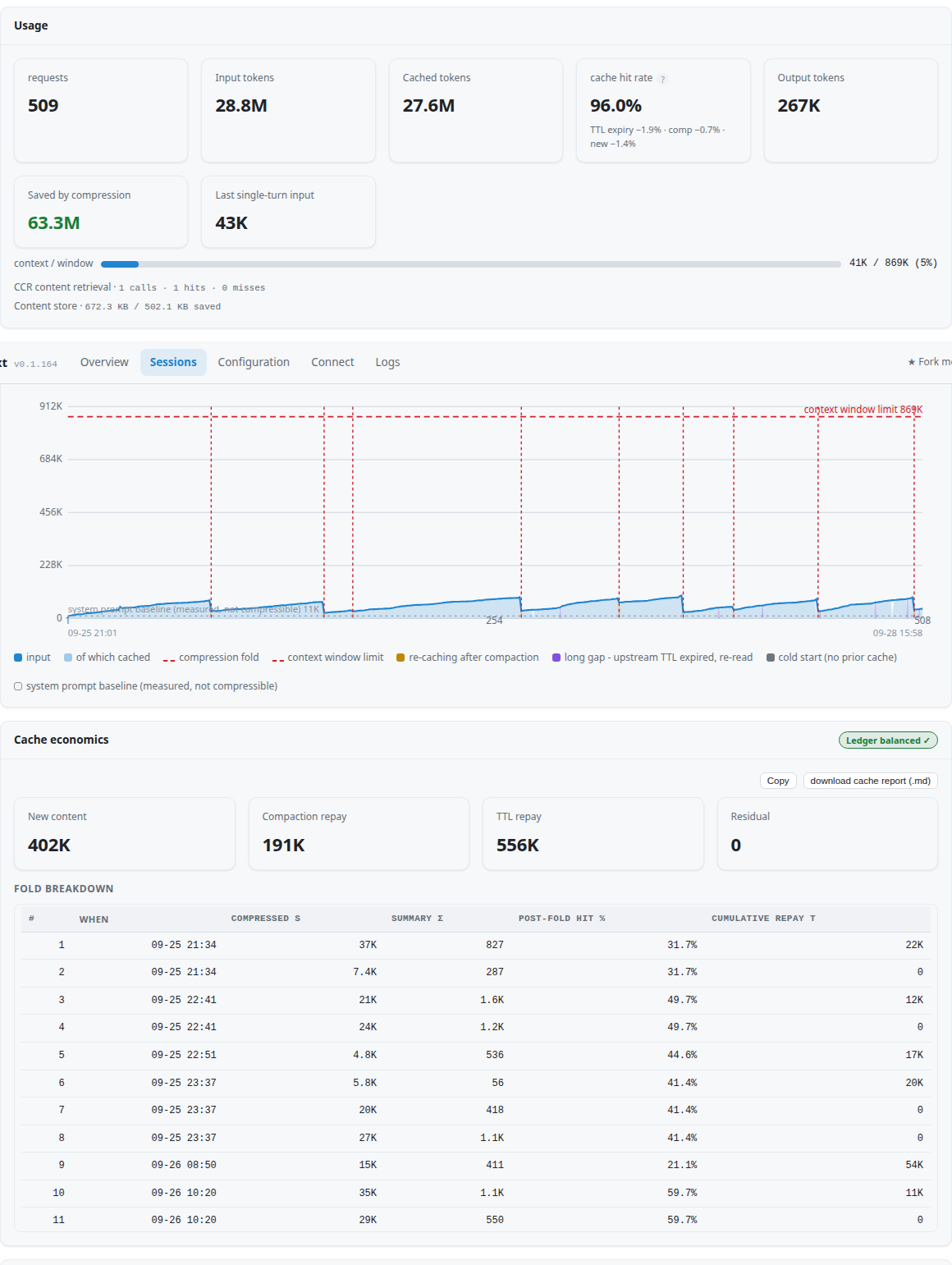 The report has four
blocks that pin things down at a glance: GRAND LEDGER (totals + hit% with
an explicit
The report has four
blocks that pin things down at a glance: GRAND LEDGER (totals + hit% with
an explicit HEALTHY verdict; misses decomposed into new content /
compress re-pay / upstream-ttl-or-client-rewrite) · FOLD ECONOMICS (per-fold
economics: net tokens saved, paid-back verdicts) · LINE ITEMS (anomalies
only: hit<85% or miss≥5000). Rule of thumb: compression itself costs ≤2% —
a healthy session sits at 95–97%. When you see less, the attribution tells
you which of the usual suspects it was, in this order: ① upstream cache TTL
expiry (shows up as stable-prefix misses — the top-spikes line names idle
times), ② a model switch, ③ a bili bug (report it with the page attached),
④ other/unknown. /acp-cache [full] lists every fold & line; same report over
Since #1535 the report ends with a MODEL SWITCHES section: a mid-session
model change invalidates the provider's prefix cache, so the whole stable
prefix is re-billed on the next request — each switch's unexplained residual
(its ttl bucket minus new content) is charged to the switch instead of
masquerading as TTL expiry; per-event from → to, hit %, and attributed
tokens are listed (full lists every event, the summary the last 8), and
the web sessions table gains a matching model-switch column.
HTTP: GET /__bili/cache-report; the raw per-request [acp-usage] lines still
land in the log file for deep dives.
What does /acp show? In clients with the native plugin (opencode, dsh),
/acp renders the ACP status panel of the current conversation straight from
the proxy (session, blocks, compressible ranges, usage); before the first model
request it shows an idle notice instead. /acp-cache [full] prints the cache
report above.
Can I query sessions and config over the web? Yes — open
http://localhost:8787: an overview dashboard, session
list with per-session detail, live logs, a config editor, and an upstream
connectivity test. Everything is also plain JSON for scripting
(/__bili/stats, /__bili/sessions, /__bili/config, …).
When does compression happen? It is model-driven: the injected context
tools are called by the model as context grows, gentle growth nudges
(~50K-token steps by design, adjustable via compress.nudgeGrowthTokens)
prompt it along the way, and preflight fires as a hard backstop when the input
alone exceeds the window (#470). Watch it live with /acp or the web UI.
Is bili transparent? How do I turn it off? Unrecognized endpoints forward
unchanged (CLIENTS.md), and every mode reverses cleanly:
bili plugin remove <client> for native installs, stop using the launcher
command / env vars / /bili/ prefix for the other two — traffic goes direct
again immediately.
Where are logs and session data stored? Log:
~/.local/state/billion-context/bili.log (also mirrored to stderr); session
state: ~/.local/share/billion-context/ (XDG-overridable; Windows AV exclusion
#362, opt-in cleanup #1082) — full paths in CONFIGURATION.md.
Running the proxy
Flags
bili --port 9000              # change listen port
bili --host 0.0.0.0           # listen on all interfaces (see host note below)
bili --debug                 # verbose logging (also: set "debug": true in config)
bili --passthrough           # forward without compression (smoke-test mode)
bili --config ~/my-bili.json # use a different config file
bili update                  # check & install a newer version now (bypasses throttle)
bili --no-auto-update        # disable self-update for this run
bili --auto-restart-on-update   # self-restart when a new version is installed (default off)
Flags override env vars and the config file. bili --help lists them all.
Remote agents (--host)
By default the proxy binds 127.0.0.1 and only accepts loopback connections. To serve agents on other machines: bili --host 0.0.0.0 (or your LAN IP); remote agents point their model baseURL at http://<this-host>:<port>/bili/….
- MITM-mode
CONNECTthen also accepts remote clients — for whitelisted model hosts only. Blind tunnels to arbitrary hosts stay loopback-only, so the proxy can never be used as an open relay. /bili/<absolute-url>destination admission (#409): the proxy itself and link-local/metadata addresses are always denied; loopback/private destinations are allowed for local clients (self-hosted upstreams) and denied for remote clients unless listed inBILI_TUNNEL_ALLOWED_HOSTS(hostorhost:port, comma-separated). One exception (#1073): a local client relaying a management path (/__bili/*,/__acp/*) to a loopback IP-literal destination is forwarded unmarked; remote peers and hostname destinations keep the internal tunnel marker unconditionally, and management paths stay unreachable through the tunnel even via NAT hairpin. An absolute-form request addressed to the instance's own endpoint on a management path is served locally instead of tunneled (a forward-proxy-style health probe gets a real answer).- There is no authentication: only do this on a trusted LAN or behind a firewall. The
/__bili/management endpoints remain loopback-only. A startup[security]warning reminds you of the above.
Debugging
bili --debug (or env ACP_DEBUG=1, or "debug": true in config — flag > env > config) logs every processTurn (tag counts, token usage), the nudge decision (growth/usage/pendingT1/shouldInject), client headers, and SSE rewrites.
Log file
All logs tee to ~/.local/state/billion-context/bili.log by default (XDG state dir) and still print to stderr. Override with "logFile" in config or ACP_LOG_FILE (off disables the file). Auto-rotates at 10 MB (bili.log.old). Per-request cache-hit stats log as [acp-usage] round N input=X cached=Y (cache hit Z%) so you can measure prefix-cache health directly from the log.
Self-update
The proxy checks npm on startup and every 3 minutes; a newer version is installed in place and a notice is logged — restart bili to pick it up, unless you enable opt-in self-restart (--auto-restart-on-update flag, env ACP_AUTO_RESTART_ON_UPDATE=1, or "autoRestartOnUpdate": true in config — default OFF): with zero in-flight requests it verifies the new install, stops accepting connections, drains, spawns a replacement on the same port, and exits once it accepts connections (clients reconnect automatically; session state survives on disk). Safety gates: zero in-flight through the drain window, an install sanity check before re-exec, and a 10-minute cooldown marker so a flapping version can never loop-restart; any failure resumes the original listener and falls back to the plain reminder.
While the running process is behind the on-disk install ("stale"), the web UI shows a banner (running vs installed version, auto-restart state) and GET /__bili/status returns {version, diskVersion, stale, autoRestartOnUpdate, advisory, inFlight} for scripting (advisory is the active critical-defect entry or null, see below). Disable permanently via "autoUpdate": false in config or ACP_AUTO_UPDATE=0.
Critical-defect advisories (forced updates)
Independent of auto-update (#1481): even with autoUpdate off, the proxy polls a small companion npm package (billion-context-advisories, published by CI from this repo's advisories/ directory) on the same 3-minute cadence. Each advisory names a semver range of broken versions (affected), the exact version to install (target — which may be older than the current one, i.e. a rollback), and a user-facing reason. When the local version falls inside affected, bili force-installs target through the self-updater's full safety chain (cross-process lock, backup + verify + rollback; source checkouts and host-managed installs are refused with manual instructions instead) and warns prominently: a one-time [advisory] ⚠️ … log line per process per advisory id, a banner on the web UI showing the reason and the exact manual upgrade command, and the active entry under advisory in /__bili/status. The check is fail-open by design: an unreachable or malformed advisory source only produces a warning — model traffic is never blocked by it. Disable via config ("advisoryCheck": false) or env (BILI_ADVISORY_CHECK=0); point at a custom document with "advisoryUrl" / BILI_ADVISORY_URL.
Configuration
The full configuration reference — config file location, top-level keys, providers, compression tuning, environment variables — lives in CONFIGURATION.md.
Two knobs people look for first:
- Upstream proxy (firewall/GFW) — routing the proxy's own outbound traffic through v2rayA/clash: full resolution order, empty-string = explicit direct, SOCKS5 rejection, both egress paths, and the
mitm://vshttps://key schemes live in CONFIGURATION.md (Server Settings →proxy; Providers → key schemes). - Wire-compat role rewrite (
compat.roles) — an upstream that rejects thedeveloperrole? Covered by CONFIGURATION.md (Server Settings →compat) — including the learn-on-failure auto-fix that needs no configuration at all.
How sessions work
The proxy keys compression state on the conversation value the client itself provides, verbatim (src/session-id.ts) — no hashing, no protocol/upstream/API-key dimensions (those mutate mid-conversation and orphaned state exactly when users kept talking, #280/#286). The id stays inside the proxy (state store, persistence, UI label); it is never sent upstream.
Where the value comes from, first hit wins: the plugin's
x-bili-plugin-conversation (honored only alongside the x-bili-plugin
marker header), then per-client headers (x-claude-code-session-id,
x-grok-session-id/x-grok-conv-id, x-mavis-session-id), then generic
headers (x-session-affinity, x-acp-session, x-session-id,
x-opencode-session, session-id/session_id), then body fields:
session_id / metadata.session_id on the Responses wire, and
prompt_cache_key promoted over the content-fingerprint fallback on the
Responses/OpenAI/Anthropic wires.
| Client | Sends conversation id? | Source |
|---|---|---|
| Codex | ✅ yes | body.session_id / turn-metadata thread id |
| OpenCode | ✅ yes | x-session-affinity / x-opencode-session header (ses_…) |
| Claude Code | ✅ yes | x-claude-code-session-id header |
| omp (via plugin) | ✅ yes | prompt_cache_key promoted over any fingerprint (#268) |
| pi (bare) | ❌ no | nothing → anonymous prefix affinity below |
Header-less clients (pi-like): anonymous prefix affinity. With no conversation signal at all, the proxy resolves the session from the replayed history itself (src/prefix-affinity.ts, #309): a request reattaches to a stored session only when its history reproduces that session's message chain byte-exactly from position 0; otherwise it gets its own deterministic pfa-… session. Consequences (#1262): a resumed conversation reattaches to its own session (even after a proxy restart, #499); a new task with an identical opener does NOT inherit another conversation's blocks — it mints a fresh, fully separate session; a request with no usable signal at all gets an explicit 400 instead of silently colliding.
Design record and threat model: SESSION-IDENTITY.md. The message-granularity sibling (why identity is content-derived, not an assigned id) is MESSAGE-IDENTITY.md.
For upstream sticky-routing, the proxy forwards only identity values the
client already supplied (e.g. a body session_id is forwarded upstream as
x-session-id); it never synthesizes one itself.
Recommendation: explicit-id clients are safe to run concurrently. For header-less multi-agent use, prefer the client plugin (stamps a stable id per conversation) or pass an explicit x-acp-session header — otherwise prefix affinity still keeps distinct tasks apart (a diverged fork costs one raw resend plus a compression-ladder restart).
Derived (child) sessions inherit the parent's compressed context (#1333, #1362)
A child session (subagent/fork starting from an empty history) reports its lineage at birth — its identity registration carries parentConversationId and the proxy records a read-only derivedFrom link — so decompress / search_context fall back along the parent chain for content the child never saw itself (cycle-guarded, depth cap 8). Nothing is copied into the child, the parent is never modified; if the parent is unknown the child simply starts fresh. Per-lane parent signals (pi/omp parentSession header, OpenCode V1/V2 parentID): SESSION-IDENTITY.md. claude/codex/dsh need nothing here: they share one session id across subagents or have no child-session concept at all.
Windows: exclude the sessions dir from antivirus (#362)
The proxy rewrites each session's state file every turn of a long session; on Windows, real-time AV (Defender), the search indexer, or a sync tool (OneDrive) can lock the sessions dir mid-write, so persists fail with EPERM until the lock clears. Fix at the root: add %USERPROFILE%\.local\share\billion-context\ to your antivirus exclusions (Defender steps included) and keep sync tools off that path — CONFIGURATION.md.
Session file cleanup (#1082)
Short-lived sessions leave small state files behind that are never resumed. Cleanup is opt-in (BILI_SESSION_GC=1; off by default — session files are user data, no silent deletion policy): when enabled, bili sweeps the sessions dir at boot and hourly and deletes a file only when BOTH hold — older than BILI_SESSION_GC_MAX_AGE_DAYS (default 7 days) AND never compressed with its newest request body ≤ BILI_SESSION_GC_MAX_TOKENS tokens (default 1M) — so deletion loses nothing but bytes. CCR content stores follow their session file's lifecycle; compressed sessions are never deleted; every deletion is audit-logged. Full policy: CONFIGURATION.md.
Status
Early. Protocol handling and compression work against mock tests (500+ passing). Real-model integration testing is the next milestone. Expect rough edges.
Client-side plugins for pi / omp / opencode ship inside billion-context (dist/agent/*.js) for the cooperative-proxy path. See the "Which do I need?" section above for how billion-context, the standalone billion-context-pi, and opencode-acp relate.
Attribution requirement (one term on top of MIT)
This project is MIT-licensed plus one additional term: any product or service (commercial or open source) whose users can see or interact with it and which uses this software must attribute it — stating that it uses billion-context with a link back to this repository — on its home page, documentation, or About/Credits page. Pure server-side/embedded use satisfies this via shipped documentation. See the Additional Term at the end of LICENSE.
If you build on this project, we'd love to hear about it: open an issue (no obligation) so we can track where it's used.
License
MIT
Significant stargazers

10 followers · starred Sep 2026
Similar repos


Languages
TypeScript
99.2%
基本稳定可用 A context-compression plugin for small context windows (a 100K context is enough), token savings (5x fewer tokens), and month-long single sessions (billions of tokens).上下文压缩插件,兼顾小窗口(100k上下文足矣)省token(省5倍token)和超长会话(数月级别几十亿token单会话)。billion-context is all you need
TypeScript
467
1,649 commits
updated Oct 2, 2026
See what people are saying
README
billion-context
Context-compression plugin — billion-context is all you need.
small context windows (100K is enough) · 5× fewer tokens · month-long single sessions (billions of tokens) · high compression quality
npm install -g billion-context
Cache health at a glance: a healthy session keeps a 95–97% prefix-cache hit rate — compression itself costs ≤2%. Sustained lower? Check attribution with
/acpor/acp-cache(see FAQ); usual causes, in order: upstream cache TTL expiry · model switch · a bili bug (please report) · other/unknown.
Community
QQ Group: 1056132097 (full) 1108730198 (open)
📄 Paper / Preprint
- Model-Driven Incremental Hierarchical Compression: Training-Free Multi-Generational Context Management for Long-Lived Coding Agents (English, v0.2)
📝 The paper itself is open-sourced under the MIT License as part of the codebase (
paper/). It is a living document — anyone may edit it; improvements are welcome via pull request.
A production-scale longitudinal study: 4.5 months, three hosts, 174,327 model calls, 18.76B cumulative input tokens (~24.7B across all hosts), zero window violations on 204,800-token models, marathon sessions of 8,584–12,049 calls.
billion-context sits between any agent and its model API, rewriting Anthropic/OpenAI streams with acp-kernel compression. The model decides when and what to compress into high-fidelity summaries — not a hard truncation limit.
Why
Long coding sessions blow up context. Each provider charges per token, and once you pass the context window the session degrades or dies. billion-context compresses consumed conversation into layered summaries so you can run a single session for days — billions of tokens through one context window.
Unlike a host's built-in summarizer, compression here is incremental, reversible, and prefix-cache friendly: summaries are written in small ranges, can be decompressed on demand, and the cache prefix stays intact.
How it works
Agent (Claude Code / Codex / Cursor / Aider ...)
        │  you point the agent's base URL at the proxy
        ▼
┌─────────────────┐
│  billion-context│   1. parse the request (Anthropic or OpenAI shape)
│     proxy       │   2. run acp-kernel compression on the conversation
│                 │   3. inject a `compress` tool + compression philosophy
│                 │   4. forward to the real model API
│                 │   5. rewrite the streaming response
└─────────────────┘
        │
        ▼
   real model API (Anthropic / OpenAI / compatible)
Context-management tools
The proxy injects four context-management tools into the conversation; the model calls them itself as context grows, and the proxy executes compress server-side so folded ranges stay summarized in history until restored:
compress— fold a message range into a detailed summary.decompress— restore a compressed range when exact details are needed again.search_context— keyword search over compressed summaries and visible messages.acp_status— context-usage overview plus which ranges are still compressible.
Which do I need?
Pick by your client:
| Client | Use |
|---|---|
| pi | billion-context-pi (in-process extension) |
| opencode (1.x / 2.x) | billion-context — bili opencode (launcher) or bili plugin install opencode (native); standalone opencode-acp remains usable on 1.x — full guide: OpenCode |
| omp | billion-context via bili omp (built-in plugin) or bili plugin install omp (self-spawning native plugin, no launcher) |
| dsh | bili dsh (launcher — full native plugin via --patch) or bili plugin install dsh ≡ dsh plugin --profile <name> add billion-context (one unified lane) — details: CLIENTS.md |
| kimi | bili plugin install kimi (self-spawning native, Kimi Code ≥ 2.0.0) or bili kimi (cert-MITM) or /bili/ prefix — details: CLIENTS.md |
| hermes | bili plugin install hermes (self-spawning native, Python plugin #958) or bili hermes (cert-MITM) |
| zcode (Z.ai / bigmodel coding plan) | bili plugin install zcode (self-spawning native, #1145) or cert-MITM via the GUI's Settings → Network or /bili/ prefix — details: CLIENTS.md |
| claude | bili claude (launcher) or bili plugin install claude (native posture, #964 — managed settings block + session-owned proxy; see the notes below) |
| codex | bili codex (launcher — the full zero-config posture) or bili plugin install codex (MCP-shell tools companion: start bili first — the shell never spawns a proxy and never routes codex's own traffic) — details: CLIENTS.md |
| jcode | billion-context via bili jcode (cert-MITM) or /bili/ prefix — no native mode (compiled Rust binary, no plugin seam, #962) |
| gemini (Gemini CLI) | bili gemini (launcher, GOOGLE_GEMINI_BASE_URL /bili/ rewrite) or /bili/ prefix — launcher-only (no in-loop tool seam, #1043) |
| iflow (iFlow CLI) | bili iflow (launcher, IFLOW_BASE_URL /bili/ rewrite) or /bili/ prefix |
| qwen (Qwen Code) | bili qwen (launcher, cert-MITM) or /bili/ prefix |
| mcode (MiniMax Code) | billion-context via bili mcode (cert-MITM) or /bili/ prefix — no native mode (event hooks only, no model-request seam, #1050) |
| aider | billion-context via bili aider (cert-MITM) or /bili/ prefix — no native mode (shell-command-only hooks, no tool-injection seam, #1048) |
| copilot (GitHub Copilot CLI) | bili copilot (launcher, cert-MITM) — closed Go binary, no plugin seam (#1049) |
| amp (Amp CLI) | bili amp (launcher, cert-MITM) — closed Go binary, no plugin seam (#1049) |
| goose (Goose CLI) | bili goose (launcher) — rustls trusts no CA file, so no cert-MITM: openai/anthropic legs via OPENAI_HOST/ANTHROPIC_HOST, custom providers via a regenerated GOOSE_PATH_ROOT overlay (#1049) |
| everything else (no context hook) | billion-context — bili <client> (launcher, preferred) or /bili/ prefix |
Native mode vs standalone extensions. The host-native plugins (bili plugin install …) and the standalone in-process extensions (billion-context-pi, opencode-acp) are mutually exclusive — both active means double compression. The installer makes the switch: it replaces the legacy entries (bare name, npm: alias, versioned, path form; array or object shape) and snapshots the original config to .bili-bak once; a project-local install is not touched — remove that one by hand. As a runtime safety net for manual installs, the native entries set BILLION_CONTEXT_NATIVE=<host> synchronously at load so a standalone extension can stand down at action time. On the pi side the marker needs billion-context-pi 0.1.72+, and the pi-native entry scans both pi settings files once its proxy is up and warns loudly when it spots a co-resident legacy entry the installer never saw — that warning is the only visible signal while an old billion-context-pi silently double-compresses.
Install
npm install -g billion-context
This installs the bili command (bili-proxy is kept as an alias).
Quickstart
Three ways to use it — pick one:
- Native plugin (most native):
bili plugin install <client>— bili becomes a plugin inside the client; start the client as usual. - Launcher (config-free): one
bili <client>command brings up the proxy and the client together — no real config file is ever touched. - URL change (most universal): prefix your client's baseURL with the proxy
origin +
/bili/.
Mechanism details behind these three options (plugin lifecycle, runtime-info protocol, injection priority) live in TECHNICAL-NOTES.md.
Ports, briefly (#1660): bili start (manual) owns 8787. Everything a lane
spawns for you (native hooks, launcher lanes) lives in a separate
self-managed zone starting at 18787 — collisions hop +1 and each lane
remembers its drift, so zero-config installs never fight you for a port,
and a deliberate bili start daemon is attached by default. An
upgrade-restart that finds the previous build still draining on the lane's
port waits for it to release (up to 5s) and rebinds the SAME port instead of
drifting (#1723); only a genuinely occupied port hops +1 — and that hop is
now logged loudly.
Option 1 — Native plugin (bili plugin install pi / omp / opencode / dsh / kimi / hermes / zcode)
The proxy lives inside the client: install once, then start the client exactly as you always do — no launcher command, no env vars, no fixed port, no URL edits. Supported today for pi, omp, opencode (1.x and 2.x), dsh, kimi, hermes and zcode:
bili plugin install pi          # registers a "billion-context" entry in pi's settings (npm form when bili itself was npm-installed)
bili plugin install omp         # registers an extensions entry in omp's config.yml (~/.omp/agent/config.yml)
bili plugin install opencode    # registers the plugin in opencode's real config + disables native auto-compaction
bili plugin install dsh         # runs 'dsh plugin --profile <name> add billion-context' for every existing profile
bili plugin install kimi        # writes $KIMI_CODE_HOME/plugins/managed/billion-context/kimi.plugin.json (+ installed.json record); per-session routing block lands in config.toml on first start (Kimi Code >= 2.0.0)
bili plugin install hermes      # copies the Python plugin into ~/.hermes/plugins/billion-context/ (+ machine-owned bili.json sidecar) and enables it via `hermes plugins enable billion-context`
bili plugin install zcode       # writes hooks.enabled + a SessionStart hook + mcp.servers.bili into ~/.zcode/cli/config.json; per-session routing lands in the bigmodel provider store on first start
bili plugin remove <client>     # undo (dsh removes through the same channel; config snapshots go to .bili-bak)
Where a client has its own plugin channel you can also install natively, skipping bili commands entirely:
- dsh:
dsh plugin --profile <name> add billion-contextis the very commandbili plugin install dshdrives per profile — same end state either way (pnpm into the profile, bundled patch layer mounted by dsh itself); remove through the same channel. See the dsh section below. - opencode: add the bare npm name to your real config's plugin list —
"plugin": ["billion-context"](npm form only; a git checkout has no published entry). The package publishesexports["./server"]→dist/agent/opencode-native.js, so opencode loads it through its own Npm.add machinery and the plugin self-spawns exactly like the bili-installed form. Do the two things the bili installer would have done for you too: set"compaction": { "auto": false }in the same config (otherwise OpenCode's native auto-compaction double-compresses) and keep a manual backup of the file first.
For pi / omp / kimi / claude there is no client-side channel — bili plugin install <client> writes their config entries for you (kimi's declarative
kimi.plugin.json + registry record, claude's managed settings block, …).
Notes:
- Native mode is mutually exclusive with the standalone in-process extensions (
billion-context-pi,opencode-acp) — the installer swaps the entries and snapshots the original config (.bili-bak). - OpenCode legacy sessions, V1/V2 shapes and caveats: OpenCode.
kimireports runtime-info at bootstrap only (static headers can't carry per-request window/model values); subagent tool calls are routed by the proxy's outbound tool-use witness ring (#1685) — no model-visible conversation id.hermes's native plugin is Python: it points hermes' httpx stack at the proxy via env vars after a health check and stamps per-request headers through anllm_requestmiddleware.codexis the one client a plugin install cannot make self-sufficient: codex routes model traffic via env only (no config-file routing seam for the default ChatGPT-login provider — a managedmodel_providersblock would force API-key auth and drop subscription login), and an MCP server cannot inject env into its parent.bili plugin install codexwrites a single[mcp_servers.bili]block into~/.codex/config.toml(command = node, args = dist/mcp.js) exposing the four ACP tools; at session start the shell resolves a proxy — envBILI_MCP_PROXY> the live-instance record (any lane's proxy or abili startdaemon) > the 8787 user-zone default (#1660 removed the install-time origin bake, #403) — nothing reachable →tools/listfails with -32003. So: start bili first (bili startor any client's lane proxy), export HTTPS_PROXY yourself if you also want compression, or usebili codexfor the zero-config full posture. Mechanics: CLIENTS.md.claudehas a native posture (#964): managed settings block +SessionStarthook + MCP shell; the hook rides the self-managed port zone (#1660) and re-pins the managed URL to the live origin each session, so port drift self-heals. Opt out withBILI_NATIVE_CLAUDE=0(passthrough). Mechanics: TECHNICAL-NOTES.md.zcodehas a native posture (#1145): managed~/.zcode/cli/config.jsonblock + per-session providerbaseURLrewrite. Full mechanics: CLIENTS.md.jcodeandaiderhave no native mode (no plugin/MCP/tool-injection seam: #962, #1048) — usebili jcode/bili aider.copilot,ampandgooseare launcher-only (#1049); goose cannot be cert-MITMed (rustls trusts no CA file) and rides plain-HTTP base-URL redirects instead.
Option 2 — Launcher (bili pi / bili codex / bili claude / bili omp / bili opencode / bili hermes / bili dsh / bili codebuddy / bili qoder / bili trae / bili jcode / bili kimi / bili gemini / bili iflow / bili qwen / bili mcode / bili aider / bili copilot / bili amp / bili goose)
The launcher wraps a client in one command: it starts a proxy on an
independent port (a fresh instance is always spawned — a port is never
reused), then points the client at it — certificate-based MITM where the
client honors proxy/CA env vars, or an isolated /bili/ config rewrite
where it doesn't. No real config file is ever edited; the client's own
config is READ to discover which HTTPS upstream hosts it talks to, and those
hosts are whitelisted for MITM so the proxy can TLS-terminate exactly them
and blind-tunnel everything else.
bili pi                               # launch pi through the proxy — file-free (#535): env + extension registerProvider, real ~/.pi untouched
bili codex                            # launch codex through the proxy
bili claude                           # launch claude through the proxy
bili omp                              # pi-style, file-free (#535): env + extension registerProvider + compaction cancel, real ~/.omp untouched
bili opencode                         # OpenCode (1.x & 2.x): full guide in the [OpenCode](CLIENTS.md#opencode) section below
bili hermes                           # file-free (#535): hermes proxy env (HTTPS_PROXY + combined CA bundle via SSL_CERT_FILE) — https via CONNECT MITM, http via absolute-form forward proxy; real ~/.hermes untouched
bili dsh                              # deepseek-harness: full native plugin injected via --patch (#941) — real dsh tools, session-bound /acp + /acp-cache (plugin mode); non-loopback upstreams ride proxy envs, loopback keeps the overlay DSH_HOME rewrite (#535); dsh auto-compaction off outside web profiles (#1772)
bili codebuddy                        # Tencent CodeBuddy Code CLI: CODEBUDDY_BASE_URL /bili/ rewrite (OpenAI chat completions wire), budget aligned via CODEBUDDY_AUTO_COMPACT_WINDOW; real ~/.codebuddy untouched
bili qoder                            # qoder: model endpoint is hardcoded https (no /bili/ rewrite possible) — cert-MITM via HTTPS_PROXY + NODE_EXTRA_CA_CERTS, default model hosts whitelisted (#653)
bili trae                             # Trae CLI (ByteDance, closed Go binary, no base-URL override) — cert-MITM via HTTPS_PROXY + SSL_CERT_FILE, model host from TRAE_CLI_API_HOST or the default enterprise gateway (#655)
bili jcode                            # jcode (Rust agent harness) — env-only cert-MITM launch: HTTPS_PROXY + SSL_CERT_FILE, model host api.z.ai whitelisted, local loopback providers stay direct via NO_PROXY
bili kimi                             # Kimi Code CLI (Moonshot): standard proxy envs except an unconditional loopback bypass — https via cert-MITM, http via absolute-form forward proxy; loopback endpoints inventoried with a manual /bili/ hint (#757)
bili gemini                           # Gemini CLI (Google): GOOGLE_GEMINI_BASE_URL /bili/ rewrite to generativelanguage.googleapis.com (Google native wire), real ~/.gemini untouched
bili iflow                            # iFlow CLI: IFLOW_BASE_URL /bili/ rewrite to apis.iflow.cn/v1 (OpenAI chat-completions wire), real ~/.iflow untouched
bili qwen                             # Qwen Code (multi-protocol gemini-cli fork, no base-URL hook): cert-MITM via HTTPS_PROXY + NODE_EXTRA_CA_CERTS, default DashScope/Qwen model hosts whitelisted, custom relays via --mitm-domain
bili mcode                            # MiniMax Code CLI: same shape as kimi (proxy envs, unconditional loopback bypass, cert-MITM/absolute-form); session bound via X-Mavis-Session-Id (#1050)
bili aider                            # Aider (Python pair programmer): cert-MITM via HTTPS_PROXY + SSL_CERT_FILE/REQUESTS_CA_BUNDLE; endpoint from OPENAI_API_BASE / ANTHROPIC_BASE_URL / --openai-api-base / .aider.conf.yml (#1048)
bili copilot                          # Copilot CLI (GitHub, closed Go binary) — cert-MITM via HTTPS_PROXY + SSL_CERT_FILE, api.githubcopilot.com + per-plan subdomains whitelisted (#1049)
bili amp                              # Amp CLI (Sourcegraph, closed Go binary) — cert-MITM via HTTPS_PROXY + SSL_CERT_FILE, ampcode.com whitelisted (#1049)
bili goose                            # Goose (Block, Rust/reqwest): rustls release builds trust no CA file — openai/anthropic legs via OPENAI_HOST/ANTHROPIC_HOST, custom providers via a regenerated GOOSE_PATH_ROOT overlay (/bili/ rewrites, real config untouched) (#1049)
bili pi --mitm-domain api.foo.com     # add a domain to the MITM whitelist
Option 3 — URL change (/bili/ prefix)
Start the proxy:
bili
Then just prefix your client's existing baseURL with http://localhost:8787/bili/.
The full upstream URL is embedded in the path, so the proxy knows where to
forward without any config:
client baseURL before:  https://api.openai.com/v1
client baseURL after:   http://localhost:8787/bili/https://api.openai.com/v1
For more per-client configuration examples, see the web UI guide at http://localhost:8787.
Verify. With the proxy running and your config saved, check it answers and that your first real request shows compression activity in the log:
# Health check (proxy up + where it forwards)
curl -s http://localhost:8787/__bili/health
# → {"ok":true,"upstream":"https://api.anthropic.com"}

# Live session stats (after a real request)
curl -s http://localhost:8787/__bili/stats
Then send one message from your client and watch the log
(~/.local/state/billion-context/bili.log, also printed to stderr). You
should see a processTurn line per request, and once the conversation grows,
[acp-usage] round N input=X cached=Y (cache hit Z%) + a compress event.
Client deep dives
Everything that doesn't fit in one Quickstart line — how each client's lanes attach, what gets written where, and known limitations — lives in CLIENTS.md: dsh · Kimi Code · Hermes · ZCode · Gemini family (Gemini CLI / iFlow CLI / Qwen Code) · cert-MITM clients that never compress (CONNECT blind tunnels, #897) · unrecognized endpoints going direct (#1290) · OpenCode (launcher / native / pure proxy, /acp status & rules, legacy opencode-acp sessions #920).
FAQ
How do I check my cache hit rate? Don't dig through logs — /acp-cache
prints a text summary report right in the client, headed by a clickable
Web UI link: open it for the web version of the session page — the cache
hit-rate line chart plus per-break attribution:
The report has four
blocks that pin things down at a glance: GRAND LEDGER (totals + hit% with
an explicit HEALTHY verdict; misses decomposed into new content /
compress re-pay / upstream-ttl-or-client-rewrite) · FOLD ECONOMICS (per-fold
economics: net tokens saved, paid-back verdicts) · LINE ITEMS (anomalies
only: hit<85% or miss≥5000). Rule of thumb: compression itself costs ≤2% —
a healthy session sits at 95–97%. When you see less, the attribution tells
you which of the usual suspects it was, in this order: ① upstream cache TTL
expiry (shows up as stable-prefix misses — the top-spikes line names idle
times), ② a model switch, ③ a bili bug (report it with the page attached),
④ other/unknown. /acp-cache [full] lists every fold & line; same report over
Since #1535 the report ends with a MODEL SWITCHES section: a mid-session
model change invalidates the provider's prefix cache, so the whole stable
prefix is re-billed on the next request — each switch's unexplained residual
(its ttl bucket minus new content) is charged to the switch instead of
masquerading as TTL expiry; per-event from → to, hit %, and attributed
tokens are listed (full lists every event, the summary the last 8), and
the web sessions table gains a matching model-switch column.
HTTP: GET /__bili/cache-report; the raw per-request [acp-usage] lines still
land in the log file for deep dives.
What does /acp show? In clients with the native plugin (opencode, dsh),
/acp renders the ACP status panel of the current conversation straight from
the proxy (session, blocks, compressible ranges, usage); before the first model
request it shows an idle notice instead. /acp-cache [full] prints the cache
report above.
Can I query sessions and config over the web? Yes — open
http://localhost:8787: an overview dashboard, session
list with per-session detail, live logs, a config editor, and an upstream
connectivity test. Everything is also plain JSON for scripting
(/__bili/stats, /__bili/sessions, /__bili/config, …).
When does compression happen? It is model-driven: the injected context
tools are called by the model as context grows, gentle growth nudges
(~50K-token steps by design, adjustable via compress.nudgeGrowthTokens)
prompt it along the way, and preflight fires as a hard backstop when the input
alone exceeds the window (#470). Watch it live with /acp or the web UI.
Is bili transparent? How do I turn it off? Unrecognized endpoints forward
unchanged (CLIENTS.md), and every mode reverses cleanly:
bili plugin remove <client> for native installs, stop using the launcher
command / env vars / /bili/ prefix for the other two — traffic goes direct
again immediately.
Where are logs and session data stored? Log:
~/.local/state/billion-context/bili.log (also mirrored to stderr); session
state: ~/.local/share/billion-context/ (XDG-overridable; Windows AV exclusion
#362, opt-in cleanup #1082) — full paths in CONFIGURATION.md.
Running the proxy
Flags
bili --port 9000              # change listen port
bili --host 0.0.0.0           # listen on all interfaces (see host note below)
bili --debug                 # verbose logging (also: set "debug": true in config)
bili --passthrough           # forward without compression (smoke-test mode)
bili --config ~/my-bili.json # use a different config file
bili update                  # check & install a newer version now (bypasses throttle)
bili --no-auto-update        # disable self-update for this run
bili --auto-restart-on-update   # self-restart when a new version is installed (default off)
Flags override env vars and the config file. bili --help lists them all.
Remote agents (--host)
By default the proxy binds 127.0.0.1 and only accepts loopback connections. To serve agents on other machines: bili --host 0.0.0.0 (or your LAN IP); remote agents point their model baseURL at http://<this-host>:<port>/bili/….
- MITM-mode
CONNECTthen also accepts remote clients — for whitelisted model hosts only. Blind tunnels to arbitrary hosts stay loopback-only, so the proxy can never be used as an open relay. /bili/<absolute-url>destination admission (#409): the proxy itself and link-local/metadata addresses are always denied; loopback/private destinations are allowed for local clients (self-hosted upstreams) and denied for remote clients unless listed inBILI_TUNNEL_ALLOWED_HOSTS(hostorhost:port, comma-separated). One exception (#1073): a local client relaying a management path (/__bili/*,/__acp/*) to a loopback IP-literal destination is forwarded unmarked; remote peers and hostname destinations keep the internal tunnel marker unconditionally, and management paths stay unreachable through the tunnel even via NAT hairpin. An absolute-form request addressed to the instance's own endpoint on a management path is served locally instead of tunneled (a forward-proxy-style health probe gets a real answer).- There is no authentication: only do this on a trusted LAN or behind a firewall. The
/__bili/management endpoints remain loopback-only. A startup[security]warning reminds you of the above.
Debugging
bili --debug (or env ACP_DEBUG=1, or "debug": true in config — flag > env > config) logs every processTurn (tag counts, token usage), the nudge decision (growth/usage/pendingT1/shouldInject), client headers, and SSE rewrites.
Log file
All logs tee to ~/.local/state/billion-context/bili.log by default (XDG state dir) and still print to stderr. Override with "logFile" in config or ACP_LOG_FILE (off disables the file). Auto-rotates at 10 MB (bili.log.old). Per-request cache-hit stats log as [acp-usage] round N input=X cached=Y (cache hit Z%) so you can measure prefix-cache health directly from the log.
Self-update
The proxy checks npm on startup and every 3 minutes; a newer version is installed in place and a notice is logged — restart bili to pick it up, unless you enable opt-in self-restart (--auto-restart-on-update flag, env ACP_AUTO_RESTART_ON_UPDATE=1, or "autoRestartOnUpdate": true in config — default OFF): with zero in-flight requests it verifies the new install, stops accepting connections, drains, spawns a replacement on the same port, and exits once it accepts connections (clients reconnect automatically; session state survives on disk). Safety gates: zero in-flight through the drain window, an install sanity check before re-exec, and a 10-minute cooldown marker so a flapping version can never loop-restart; any failure resumes the original listener and falls back to the plain reminder.
While the running process is behind the on-disk install ("stale"), the web UI shows a banner (running vs installed version, auto-restart state) and GET /__bili/status returns {version, diskVersion, stale, autoRestartOnUpdate, advisory, inFlight} for scripting (advisory is the active critical-defect entry or null, see below). Disable permanently via "autoUpdate": false in config or ACP_AUTO_UPDATE=0.
Critical-defect advisories (forced updates)
Independent of auto-update (#1481): even with autoUpdate off, the proxy polls a small companion npm package (billion-context-advisories, published by CI from this repo's advisories/ directory) on the same 3-minute cadence. Each advisory names a semver range of broken versions (affected), the exact version to install (target — which may be older than the current one, i.e. a rollback), and a user-facing reason. When the local version falls inside affected, bili force-installs target through the self-updater's full safety chain (cross-process lock, backup + verify + rollback; source checkouts and host-managed installs are refused with manual instructions instead) and warns prominently: a one-time [advisory] ⚠️ … log line per process per advisory id, a banner on the web UI showing the reason and the exact manual upgrade command, and the active entry under advisory in /__bili/status. The check is fail-open by design: an unreachable or malformed advisory source only produces a warning — model traffic is never blocked by it. Disable via config ("advisoryCheck": false) or env (BILI_ADVISORY_CHECK=0); point at a custom document with "advisoryUrl" / BILI_ADVISORY_URL.
Configuration
The full configuration reference — config file location, top-level keys, providers, compression tuning, environment variables — lives in CONFIGURATION.md.
Two knobs people look for first:
- Upstream proxy (firewall/GFW) — routing the proxy's own outbound traffic through v2rayA/clash: full resolution order, empty-string = explicit direct, SOCKS5 rejection, both egress paths, and the
mitm://vshttps://key schemes live in CONFIGURATION.md (Server Settings →proxy; Providers → key schemes). - Wire-compat role rewrite (
compat.roles) — an upstream that rejects thedeveloperrole? Covered by CONFIGURATION.md (Server Settings →compat) — including the learn-on-failure auto-fix that needs no configuration at all.
How sessions work
The proxy keys compression state on the conversation value the client itself provides, verbatim (src/session-id.ts) — no hashing, no protocol/upstream/API-key dimensions (those mutate mid-conversation and orphaned state exactly when users kept talking, #280/#286). The id stays inside the proxy (state store, persistence, UI label); it is never sent upstream.
Where the value comes from, first hit wins: the plugin's
x-bili-plugin-conversation (honored only alongside the x-bili-plugin
marker header), then per-client headers (x-claude-code-session-id,
x-grok-session-id/x-grok-conv-id, x-mavis-session-id), then generic
headers (x-session-affinity, x-acp-session, x-session-id,
x-opencode-session, session-id/session_id), then body fields:
session_id / metadata.session_id on the Responses wire, and
prompt_cache_key promoted over the content-fingerprint fallback on the
Responses/OpenAI/Anthropic wires.
| Client | Sends conversation id? | Source |
|---|---|---|
| Codex | ✅ yes | body.session_id / turn-metadata thread id |
| OpenCode | ✅ yes | x-session-affinity / x-opencode-session header (ses_…) |
| Claude Code | ✅ yes | x-claude-code-session-id header |
| omp (via plugin) | ✅ yes | prompt_cache_key promoted over any fingerprint (#268) |
| pi (bare) | ❌ no | nothing → anonymous prefix affinity below |
Header-less clients (pi-like): anonymous prefix affinity. With no conversation signal at all, the proxy resolves the session from the replayed history itself (src/prefix-affinity.ts, #309): a request reattaches to a stored session only when its history reproduces that session's message chain byte-exactly from position 0; otherwise it gets its own deterministic pfa-… session. Consequences (#1262): a resumed conversation reattaches to its own session (even after a proxy restart, #499); a new task with an identical opener does NOT inherit another conversation's blocks — it mints a fresh, fully separate session; a request with no usable signal at all gets an explicit 400 instead of silently colliding.
Design record and threat model: SESSION-IDENTITY.md. The message-granularity sibling (why identity is content-derived, not an assigned id) is MESSAGE-IDENTITY.md.
For upstream sticky-routing, the proxy forwards only identity values the
client already supplied (e.g. a body session_id is forwarded upstream as
x-session-id); it never synthesizes one itself.
Recommendation: explicit-id clients are safe to run concurrently. For header-less multi-agent use, prefer the client plugin (stamps a stable id per conversation) or pass an explicit x-acp-session header — otherwise prefix affinity still keeps distinct tasks apart (a diverged fork costs one raw resend plus a compression-ladder restart).
Derived (child) sessions inherit the parent's compressed context (#1333, #1362)
A child session (subagent/fork starting from an empty history) reports its lineage at birth — its identity registration carries parentConversationId and the proxy records a read-only derivedFrom link — so decompress / search_context fall back along the parent chain for content the child never saw itself (cycle-guarded, depth cap 8). Nothing is copied into the child, the parent is never modified; if the parent is unknown the child simply starts fresh. Per-lane parent signals (pi/omp parentSession header, OpenCode V1/V2 parentID): SESSION-IDENTITY.md. claude/codex/dsh need nothing here: they share one session id across subagents or have no child-session concept at all.
Windows: exclude the sessions dir from antivirus (#362)
The proxy rewrites each session's state file every turn of a long session; on Windows, real-time AV (Defender), the search indexer, or a sync tool (OneDrive) can lock the sessions dir mid-write, so persists fail with EPERM until the lock clears. Fix at the root: add %USERPROFILE%\.local\share\billion-context\ to your antivirus exclusions (Defender steps included) and keep sync tools off that path — CONFIGURATION.md.
Session file cleanup (#1082)
Short-lived sessions leave small state files behind that are never resumed. Cleanup is opt-in (BILI_SESSION_GC=1; off by default — session files are user data, no silent deletion policy): when enabled, bili sweeps the sessions dir at boot and hourly and deletes a file only when BOTH hold — older than BILI_SESSION_GC_MAX_AGE_DAYS (default 7 days) AND never compressed with its newest request body ≤ BILI_SESSION_GC_MAX_TOKENS tokens (default 1M) — so deletion loses nothing but bytes. CCR content stores follow their session file's lifecycle; compressed sessions are never deleted; every deletion is audit-logged. Full policy: CONFIGURATION.md.
Status
Early. Protocol handling and compression work against mock tests (500+ passing). Real-model integration testing is the next milestone. Expect rough edges.
Client-side plugins for pi / omp / opencode ship inside billion-context (dist/agent/*.js) for the cooperative-proxy path. See the "Which do I need?" section above for how billion-context, the standalone billion-context-pi, and opencode-acp relate.
Attribution requirement (one term on top of MIT)
This project is MIT-licensed plus one additional term: any product or service (commercial or open source) whose users can see or interact with it and which uses this software must attribute it — stating that it uses billion-context with a link back to this repository — on its home page, documentation, or About/Credits page. Pure server-side/embedded use satisfies this via shipped documentation. See the Additional Term at the end of LICENSE.
If you build on this project, we'd love to hear about it: open an issue (no obligation) so we can track where it's used.
License
MIT
Similar repos
Significant stargazers
10 followers · starred Sep 2026
Languages
TypeScript
99.2%