
iPhone Mirroring for macOS and Linux — scrcpy for iOS and a cross-platform Device Hub clone. Mirror and control an iPhone (iOS 27+); Raspberry Pi and Windows next. Part of rPlay.
C
6
0 commits
updated Sep 28, 2026
See what people are saying
README
rPlayHub




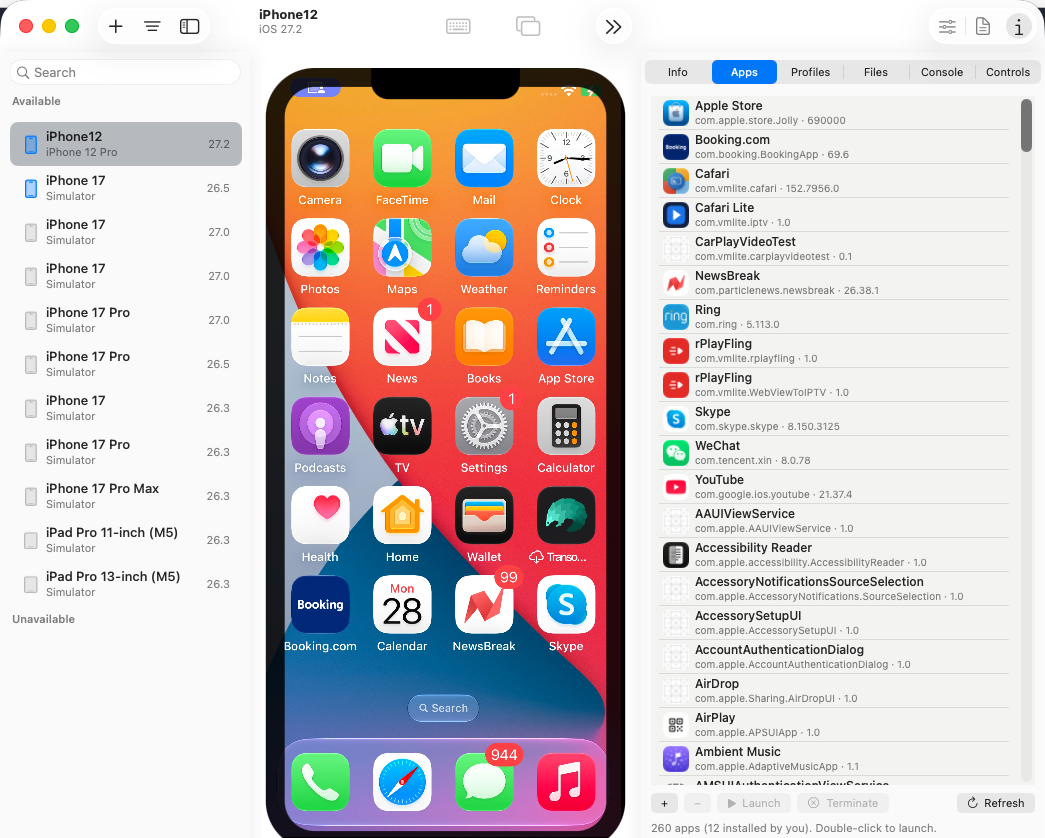
scrcpy for iOS — and a cross-platform clone of Apple's Device Hub. Mirror and control an iPhone from macOS or Linux, with Windows and Raspberry Pi next: live screen and sound, click-to-tap, drag-to-swipe, app and profile management, crash reports and the device's own settings.
Apple's Device Hub ships inside Xcode and runs on macOS only. rPlayHub is a from-scratch
CoreDevice host: it speaks the protocol directly, so there is no Xcode and no Apple daemon
in the runtime path, and the same engine drives a native macOS app or a Linux GUI. Where scrcpy
does this for Android over adb, rPlayHub does it for iPhone over CoreDevice — nothing to install
on the phone.
It is for everyone, not just developers. Use it as an iPhone Mirroring app: your iPhone's screen live in a window on your computer, its sound through your speakers, and your mouse working as your finger — tap, swipe, scroll, open apps. Like Apple's iPhone Mirroring, but on Linux too, and with the phone still usable in your hand while it is mirrored. Plug the phone in, trust the computer once, and it is there. Developers get the rest of Device Hub on top: apps, profiles, logs, crash reports and the device's settings.
rPlayHub is part of rPlay, the universal mirroring project. Its sibling for Android is rPlayHub for Android, which already ships the 3D view and fold view described below.
Not affiliated with or endorsed by Apple. Device Hub, iPhone and iOS are Apple's trademarks.
Requirements
- iOS 27 or later on the iPhone — for every version of rPlayHub, on every platform. rPlayHub speaks the CoreDevice protocol as iOS 27 ships it; earlier iOS releases are not supported.
- The phone paired and trusted with the computer once (the usual "Trust This Computer" prompt).
- Developer Mode on, and Apple's Developer Disk Image. The engine mounts the image itself
after every phone reboot; on a Mac with Xcode it finds the files already, and on Linux you
download them once with
./scripts/fetch-ddi.sh. See doc/DDI.md.
On an older iPhone? Use rPlay, the project rPlayHub belongs to. rPlay mirrors every iOS version, over USB or wireless, and controls the phone over Bluetooth.
Download
A signed and notarized DMG is on the releases page. macOS 14 or later, Apple silicon. Open it and drag rPlayHub to Applications.
The app talks to a small engine (cdhost) that it starts for you. Building that from source is
covered in BUILD.md.
Platforms
| macOS | Swift + AppKit, VideoToolbox — shipping (notarized DMG) |
| Linux | the same C engine, FFmpeg decode, SDL2 + Dear ImGui (client-c/) — working, built in CI on every push; build from source for now |
| Raspberry Pi | the Linux client on arm64 — next, with the Pi's hardware decoder |
| Windows | the same engine over Winsock, FFmpeg or Media Foundation decode — upcoming |
The engine (host-c/, core/) is portable C; what is platform-bound is the tunnel interface,
video decode and the window shell. app/PORTING.md has the seams.
Where it is, and where it is going
Working today, and what the DMG above ships:
- Live mirroring and control — HEVC screen video over the CoreDevice tunnel, with clicks and drags mapped to the device's own coordinate space.
- Sound — the phone's audio plays on the computer, as in Device Hub 27: AAC-ELD over the same tunnel, decoded by AudioToolbox on macOS and FFmpeg on Linux.
- Device management — install and remove apps and configuration profiles, browse the Media partition, read crash reports, spins and logs, stream the console.
- Device settings — appearance, text size, reduce motion, VoiceOver, simulated location and the rest, read and written live.
Planned, and past what Device Hub does — the same features rPlayHub for Android ships today:
- 3D view — the iPhone as a 3D model that turns as the real one turns, driven by the device's motion sensors, with the live mirror mapped onto its glass. Drag to orbit, re-centre to calibrate. (See it on Android.)
- Fold view — for a foldable iPhone: two hinged halves that follow the real hinge, shown face-on for recording, with the moving half drawn as a hard cut, locked, or stylized (blurring to frosted glass as it swings).
- Sensor-aware viewing — orientation and motion from the device, not just its framebuffer.
adb-shaped client/server — one long-running server keeping tunnels warm across many devices, with a thin CLI and the GUIs as clients.- Remote iPhone — a phone on another network usable from here.
A note on the sensor features: CoreDevice exposes no sensor telemetry — screen, HID, apps, profiles and logs, but nothing from the IMU or a hinge. 3D view, fold view and sensor-aware viewing therefore need a small companion app on the device feeding data back over the tunnel. That stays optional: without it everything else still works, and mirroring keeps needing nothing installed on the phone.
Languages
- Swift — the macOS app and its View Screen window (
app/, an Xcode project). - C / C++ — the portable protocol core (
host-c/). - Python (
host/) — prototyping and verification harness only. Wire formats get proven here against a real phone before being committed to in C or Swift. Not a shipping artifact — thoughhost/mirror.pyis currently also the engine the app talks to.
Shipped as a Developer ID signed, notarized DMG from our own site. The Mac App Store is not
possible with the current design: a sandboxed app cannot create the utun interface the tunnel
needs, cannot install a privileged helper, and has no entitlement for /var/run/usbmuxd.
app/DISTRIBUTION.md records what would change that — a userspace TCP stack plus the RemotePairing
transport, both of which we want anyway.
CarPlay is not part of this project; it was only where the earliest experiments happened.
Layout
app/ is split by subsystem, third-party code lives in deps/, tooling in scripts/.
app/— rPlayHub, the native macOS app: an Xcode project, Swift + AppKit, live View Screen with click-to-tap. Builds clean; shipped as a notarized DMG. Seeapp/README.md,app/DISTRIBUTION.md,app/PORTING.md, andapp/api/PROTOCOL.md.host/— Python engine and harness.mirror.pyis the live mirror + control engine; the flat modules are the verified protocol implementation. Start withhost/README.md.core/— the portable video and input path in C: Annex-B parsing, H.264/HEVC classification, access-unit assembly, keyframe gating, and coordinate mapping, withhwdecoder.has the platform decoder seam (VideoToolbox on macOS, ffmpeg/SDL on Linux and Windows).make -C core testruns its tests against real recordings.host-c/— the C host: usbmux and lockdown so far.scripts/—package-dmg.sh(build + sign + notarize),mock_engine.py(replay a recording as if it were the engine, so the app can be developed with no phone and no root),mirror_check.py(verify a running engine).doc/— protocol RE:REMOTEPAIRING-PROTOCOL.md,COREDEVICE-SCREEN-STREAMING.md.AGENTS.md— paste into a new AI session to continue.
Quick start
The app plus the engine — this is the product:
sudo python3 host/mirror.py <udid>       # engine (needs root for the tunnel): :9877 video, :9876 control
xcodebuild -project app/rPlayHub.xcodeproj -scheme rPlayHub build && \
  open build/DerivedData/Build/Products/Debug/rPlayHub.app
Start them in either order — the app retries and shows what it is waiting for in its title bar.
Package it:
./scripts/package-dmg.sh # build/rPlayHub-0.1.1.dmg (ad-hoc; see app/DISTRIBUTION.md)
No phone and no root — replay a recording through the real protocol, which is how the app gets developed and verified:
python3 scripts/mock_engine.py screen3.h265 # serves :9877 + :9876 like the engine does
Engine only, no app:
ffplay -fflags nobuffer -flags low_delay tcp://127.0.0.1:9877    # watch the screen live
python3 scripts/mirror_check.py --tap                            # verify everything, then tap
One-shot actions, no engine needed:
sudo python3 host/tunnel_up.py <udid> shot out.png            # screenshot
sudo python3 host/tunnel_up.py <udid> tap 0.5 0.5             # tap (fractions 0..1)
sudo python3 host/tunnel_up.py <udid> record out.h265 10      # 10s HEVC → ffplay out.h265
Omit <udid> to auto-pick the first attached device. Over wifi the device must be paired with
this Mac with wifi-sync on, so usbmuxd lists it as ConnectionType=Network.
Status — verified live, stated precisely
- Transport → RSD (85 services) on iPhone 12 Pro (USB) and iPhone 13 Pro (iOS 27, wifi). ✅
- Screenshot (PNG). ✅
- Tap / swipe — really moves the UI (opened Safari). ✅
- HEVC screen record → a decodable
.h265of the real screen. ✅ but glitchy: RTP reorder is done, RTCP PLI/RR feedback is not, so residual artifacts are packet loss. - LIVE MIRRORING AND CONTROL WORK. ✅
./scripts/live.sh→ rPlayHub showing the phone's screen live, full quality, low latency, on iPhone 13 Pro (iOS 27) over wifi. Measured on a live session: HEVC, 1170×2532, 0.0% packet loss, 0 queue drops, and uptime past the 30 s mark where the device used to stop sending. An independent decoder (ffmpeg) renders the engine's own bytes to a clean frame — 417 frames from a 10 s capture, no artifacts. - Keyframes are the constraint to remember. The device emits exactly one IDR, at stream
start, and ignores RTCP PLI and FIR (8 of each, measured, no effect). So a viewer must be
attached before the stream starts — the engine therefore defers
startmediastreamuntil the first viewer connects.startmediastreamalso times out if issued later in a session, because RSD's advertised ports go stale, so the displayservice port is re-resolved immediately before use. - RTCP receiver reports are mandatory, not a refinement. The device sends Sender Reports on the RTP port and stops transmitting after ~30 s if nothing answers.
- RemotePairing direct-wifi door: not built. Discovery, plain-TCP connect, and the absence of hardware attestation are all proven; the handshake itself is designed only.
- Relay / remote-Xcode: not built, and the Xcode half is not even verified. Making a relayed
phone visible to Xcode means injecting it into Apple's own discovery, not ours. Two candidate
mechanisms are written up in
host/rplayhub/transport/relay.py; both need a live experiment before anything is designed on top of them.
Architecture
One seam matters more than the rest: everything above the tunnel is transport-agnostic. The tunnel is a stream of raw IPv6 packets, so RSD, RemoteXPC, screen, and HID neither know nor care whether those bytes came over USB, over wifi through Apple's usbmuxd, over our own RemotePairing handshake, or across a relay from another network. Adding a transport is one new file.
transport (usbmux | RemotePairing | relay)  →  TunnelLink (raw IPv6 + addresses)
   →  tun device + packet pump  →  ordinary sockets
   →  RSD service catalog  →  RemoteXPC channels
   →  coredevice.* services: screencapture, displayservice, universalhidservice
Building
See BUILD.md — the daemon (make -C host-c), the app (xcodebuild), and
scripts/live.sh which does both. It also records the two things that reliably go wrong: building
as root breaks code signing, and selecting a signing identity by name can pick a revoked one.
License
GPL-3.0-or-later. See LICENSE.
This project links libimobiledevice (LGPL-2.1+) and builds against FFmpeg, and ships
patches/ffmpeg-rvra.patch against the latter. Those components remain under their own licences;
GPL-3.0 was chosen because the engine links them statically, which obliges us to keep the whole
work under a compatible copyleft licence rather than a permissive one.
Similar repos


Languages
C
33.4%
Python
27.5%
Swift
24.2%
Shell
6.7%
C++
3.1%
Objective-C
2.2%
HTML
1.9%
iPhone Mirroring for macOS and Linux — scrcpy for iOS and a cross-platform Device Hub clone. Mirror and control an iPhone (iOS 27+); Raspberry Pi and Windows next. Part of rPlay.
C
6
0 commits
updated Sep 28, 2026
See what people are saying
README
rPlayHub
scrcpy for iOS — and a cross-platform clone of Apple's Device Hub. Mirror and control an iPhone from macOS or Linux, with Windows and Raspberry Pi next: live screen and sound, click-to-tap, drag-to-swipe, app and profile management, crash reports and the device's own settings.
Apple's Device Hub ships inside Xcode and runs on macOS only. rPlayHub is a from-scratch
CoreDevice host: it speaks the protocol directly, so there is no Xcode and no Apple daemon
in the runtime path, and the same engine drives a native macOS app or a Linux GUI. Where scrcpy
does this for Android over adb, rPlayHub does it for iPhone over CoreDevice — nothing to install
on the phone.
It is for everyone, not just developers. Use it as an iPhone Mirroring app: your iPhone's screen live in a window on your computer, its sound through your speakers, and your mouse working as your finger — tap, swipe, scroll, open apps. Like Apple's iPhone Mirroring, but on Linux too, and with the phone still usable in your hand while it is mirrored. Plug the phone in, trust the computer once, and it is there. Developers get the rest of Device Hub on top: apps, profiles, logs, crash reports and the device's settings.
rPlayHub is part of rPlay, the universal mirroring project. Its sibling for Android is rPlayHub for Android, which already ships the 3D view and fold view described below.
Not affiliated with or endorsed by Apple. Device Hub, iPhone and iOS are Apple's trademarks.
Requirements
- iOS 27 or later on the iPhone — for every version of rPlayHub, on every platform. rPlayHub speaks the CoreDevice protocol as iOS 27 ships it; earlier iOS releases are not supported.
- The phone paired and trusted with the computer once (the usual "Trust This Computer" prompt).
- Developer Mode on, and Apple's Developer Disk Image. The engine mounts the image itself
after every phone reboot; on a Mac with Xcode it finds the files already, and on Linux you
download them once with
./scripts/fetch-ddi.sh. See doc/DDI.md.
On an older iPhone? Use rPlay, the project rPlayHub belongs to. rPlay mirrors every iOS version, over USB or wireless, and controls the phone over Bluetooth.
Download
A signed and notarized DMG is on the releases page. macOS 14 or later, Apple silicon. Open it and drag rPlayHub to Applications.
The app talks to a small engine (cdhost) that it starts for you. Building that from source is
covered in BUILD.md.
Platforms
| macOS | Swift + AppKit, VideoToolbox — shipping (notarized DMG) |
| Linux | the same C engine, FFmpeg decode, SDL2 + Dear ImGui (client-c/) — working, built in CI on every push; build from source for now |
| Raspberry Pi | the Linux client on arm64 — next, with the Pi's hardware decoder |
| Windows | the same engine over Winsock, FFmpeg or Media Foundation decode — upcoming |
The engine (host-c/, core/) is portable C; what is platform-bound is the tunnel interface,
video decode and the window shell. app/PORTING.md has the seams.
Where it is, and where it is going
Working today, and what the DMG above ships:
- Live mirroring and control — HEVC screen video over the CoreDevice tunnel, with clicks and drags mapped to the device's own coordinate space.
- Sound — the phone's audio plays on the computer, as in Device Hub 27: AAC-ELD over the same tunnel, decoded by AudioToolbox on macOS and FFmpeg on Linux.
- Device management — install and remove apps and configuration profiles, browse the Media partition, read crash reports, spins and logs, stream the console.
- Device settings — appearance, text size, reduce motion, VoiceOver, simulated location and the rest, read and written live.
Planned, and past what Device Hub does — the same features rPlayHub for Android ships today:
- 3D view — the iPhone as a 3D model that turns as the real one turns, driven by the device's motion sensors, with the live mirror mapped onto its glass. Drag to orbit, re-centre to calibrate. (See it on Android.)
- Fold view — for a foldable iPhone: two hinged halves that follow the real hinge, shown face-on for recording, with the moving half drawn as a hard cut, locked, or stylized (blurring to frosted glass as it swings).
- Sensor-aware viewing — orientation and motion from the device, not just its framebuffer.
adb-shaped client/server — one long-running server keeping tunnels warm across many devices, with a thin CLI and the GUIs as clients.- Remote iPhone — a phone on another network usable from here.
A note on the sensor features: CoreDevice exposes no sensor telemetry — screen, HID, apps, profiles and logs, but nothing from the IMU or a hinge. 3D view, fold view and sensor-aware viewing therefore need a small companion app on the device feeding data back over the tunnel. That stays optional: without it everything else still works, and mirroring keeps needing nothing installed on the phone.
Languages
- Swift — the macOS app and its View Screen window (
app/, an Xcode project). - C / C++ — the portable protocol core (
host-c/). - Python (
host/) — prototyping and verification harness only. Wire formats get proven here against a real phone before being committed to in C or Swift. Not a shipping artifact — thoughhost/mirror.pyis currently also the engine the app talks to.
Shipped as a Developer ID signed, notarized DMG from our own site. The Mac App Store is not
possible with the current design: a sandboxed app cannot create the utun interface the tunnel
needs, cannot install a privileged helper, and has no entitlement for /var/run/usbmuxd.
app/DISTRIBUTION.md records what would change that — a userspace TCP stack plus the RemotePairing
transport, both of which we want anyway.
CarPlay is not part of this project; it was only where the earliest experiments happened.
Layout
app/ is split by subsystem, third-party code lives in deps/, tooling in scripts/.
app/— rPlayHub, the native macOS app: an Xcode project, Swift + AppKit, live View Screen with click-to-tap. Builds clean; shipped as a notarized DMG. Seeapp/README.md,app/DISTRIBUTION.md,app/PORTING.md, andapp/api/PROTOCOL.md.host/— Python engine and harness.mirror.pyis the live mirror + control engine; the flat modules are the verified protocol implementation. Start withhost/README.md.core/— the portable video and input path in C: Annex-B parsing, H.264/HEVC classification, access-unit assembly, keyframe gating, and coordinate mapping, withhwdecoder.has the platform decoder seam (VideoToolbox on macOS, ffmpeg/SDL on Linux and Windows).make -C core testruns its tests against real recordings.host-c/— the C host: usbmux and lockdown so far.scripts/—package-dmg.sh(build + sign + notarize),mock_engine.py(replay a recording as if it were the engine, so the app can be developed with no phone and no root),mirror_check.py(verify a running engine).doc/— protocol RE:REMOTEPAIRING-PROTOCOL.md,COREDEVICE-SCREEN-STREAMING.md.AGENTS.md— paste into a new AI session to continue.
Quick start
The app plus the engine — this is the product:
sudo python3 host/mirror.py <udid>       # engine (needs root for the tunnel): :9877 video, :9876 control
xcodebuild -project app/rPlayHub.xcodeproj -scheme rPlayHub build && \
  open build/DerivedData/Build/Products/Debug/rPlayHub.app
Start them in either order — the app retries and shows what it is waiting for in its title bar.
Package it:
./scripts/package-dmg.sh # build/rPlayHub-0.1.1.dmg (ad-hoc; see app/DISTRIBUTION.md)
No phone and no root — replay a recording through the real protocol, which is how the app gets developed and verified:
python3 scripts/mock_engine.py screen3.h265 # serves :9877 + :9876 like the engine does
Engine only, no app:
ffplay -fflags nobuffer -flags low_delay tcp://127.0.0.1:9877    # watch the screen live
python3 scripts/mirror_check.py --tap                            # verify everything, then tap
One-shot actions, no engine needed:
sudo python3 host/tunnel_up.py <udid> shot out.png            # screenshot
sudo python3 host/tunnel_up.py <udid> tap 0.5 0.5             # tap (fractions 0..1)
sudo python3 host/tunnel_up.py <udid> record out.h265 10      # 10s HEVC → ffplay out.h265
Omit <udid> to auto-pick the first attached device. Over wifi the device must be paired with
this Mac with wifi-sync on, so usbmuxd lists it as ConnectionType=Network.
Status — verified live, stated precisely
- Transport → RSD (85 services) on iPhone 12 Pro (USB) and iPhone 13 Pro (iOS 27, wifi). ✅
- Screenshot (PNG). ✅
- Tap / swipe — really moves the UI (opened Safari). ✅
- HEVC screen record → a decodable
.h265of the real screen. ✅ but glitchy: RTP reorder is done, RTCP PLI/RR feedback is not, so residual artifacts are packet loss. - LIVE MIRRORING AND CONTROL WORK. ✅
./scripts/live.sh→ rPlayHub showing the phone's screen live, full quality, low latency, on iPhone 13 Pro (iOS 27) over wifi. Measured on a live session: HEVC, 1170×2532, 0.0% packet loss, 0 queue drops, and uptime past the 30 s mark where the device used to stop sending. An independent decoder (ffmpeg) renders the engine's own bytes to a clean frame — 417 frames from a 10 s capture, no artifacts. - Keyframes are the constraint to remember. The device emits exactly one IDR, at stream
start, and ignores RTCP PLI and FIR (8 of each, measured, no effect). So a viewer must be
attached before the stream starts — the engine therefore defers
startmediastreamuntil the first viewer connects.startmediastreamalso times out if issued later in a session, because RSD's advertised ports go stale, so the displayservice port is re-resolved immediately before use. - RTCP receiver reports are mandatory, not a refinement. The device sends Sender Reports on the RTP port and stops transmitting after ~30 s if nothing answers.
- RemotePairing direct-wifi door: not built. Discovery, plain-TCP connect, and the absence of hardware attestation are all proven; the handshake itself is designed only.
- Relay / remote-Xcode: not built, and the Xcode half is not even verified. Making a relayed
phone visible to Xcode means injecting it into Apple's own discovery, not ours. Two candidate
mechanisms are written up in
host/rplayhub/transport/relay.py; both need a live experiment before anything is designed on top of them.
Architecture
One seam matters more than the rest: everything above the tunnel is transport-agnostic. The tunnel is a stream of raw IPv6 packets, so RSD, RemoteXPC, screen, and HID neither know nor care whether those bytes came over USB, over wifi through Apple's usbmuxd, over our own RemotePairing handshake, or across a relay from another network. Adding a transport is one new file.
transport (usbmux | RemotePairing | relay)  →  TunnelLink (raw IPv6 + addresses)
   →  tun device + packet pump  →  ordinary sockets
   →  RSD service catalog  →  RemoteXPC channels
   →  coredevice.* services: screencapture, displayservice, universalhidservice
Building
See BUILD.md — the daemon (make -C host-c), the app (xcodebuild), and
scripts/live.sh which does both. It also records the two things that reliably go wrong: building
as root breaks code signing, and selecting a signing identity by name can pick a revoked one.
License
GPL-3.0-or-later. See LICENSE.
This project links libimobiledevice (LGPL-2.1+) and builds against FFmpeg, and ships
patches/ffmpeg-rvra.patch against the latter. Those components remain under their own licences;
GPL-3.0 was chosen because the engine links them statically, which obliges us to keep the whole
work under a compatible copyleft licence rather than a permissive one.
Similar repos
Languages
C
33.4%
Python
27.5%
Swift
24.2%
Shell
6.7%
C++
3.1%
Objective-C
2.2%
HTML
1.9%