
The open source Unity Dev Agent
Rust
737
748 commits
updated Sep 5, 2026
README
Locus for Unity - Open Source Unity Dev Agent
Scale game development efficiency and free creators from tedious, repetitive work.







English | 简体中文
Overview
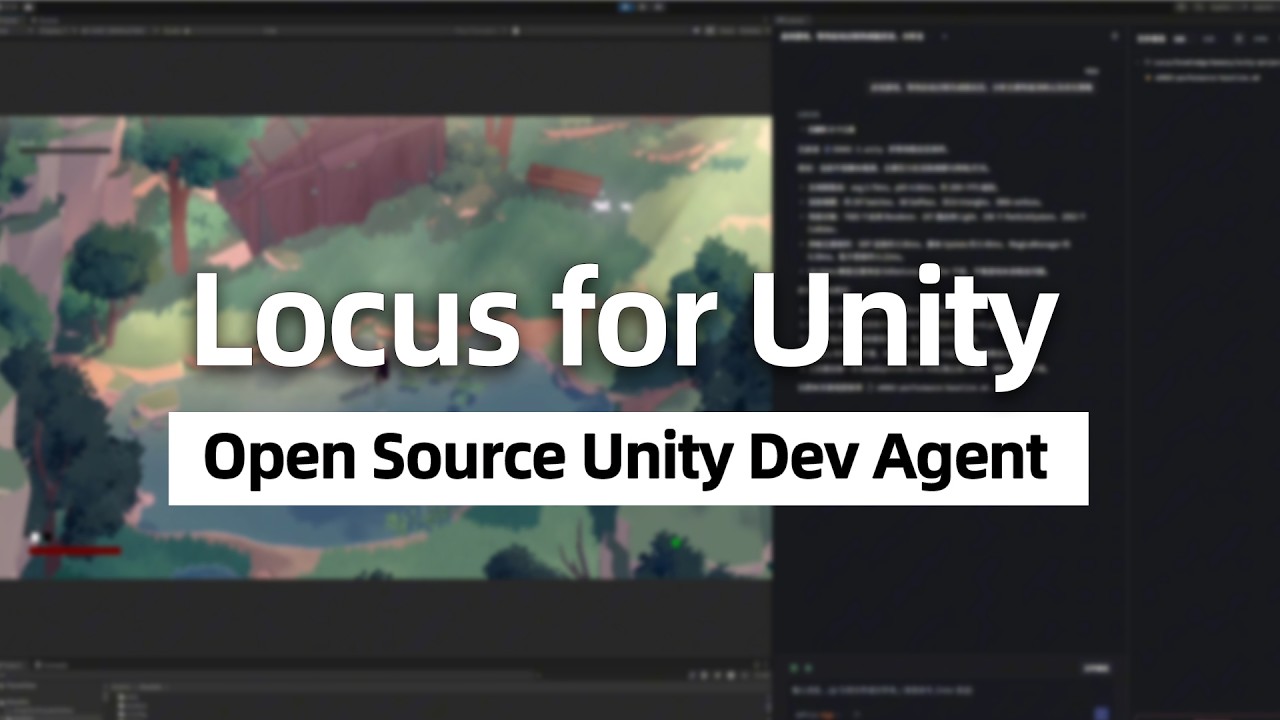
Locus for Unity is an open-source AI Agent for Unity projects.
- In-editor operations: write C# code, read and modify Unity objects and assets, and complete the full feature development workflow
- Built-in hot reload: apply C# changes instantly without domain reloads, keeping Play Mode state intact
- Create editor UI with modern web tech: build Unity editor interfaces with Vue.js through the
/viewcommand, free of IMGUI's constraints - Rider-grade static analysis: surface compiler-grade errors and warnings through built-in Roslyn semantic analysis the moment code changes
- Runtime analysis and debugging: autonomously operate and capture runtime state to help fix bugs and optimize performance
- Automated knowledge system: automatically summarize conversation requirements into design documents and preserve project understanding in long-term memory
- Visual version control: provide a visual version control interface with semantic diff analysis and conflict handling for Unity YAML assets
- Multiple model support: support subscription account sign-in and compatibility with multiple LLM API capabilities
Locus is currently in early testing. We welcome you to try it and share feedback through Issues. Your input is highly valuable to us.
What Makes Locus Technically Different?
Locus is a standalone Rust + Tauri + Vue.js application that runs as an independent process.
- We designed a proprietary intermediate representation that lets agents progressively read large scenes and assets, along with retrieval tools that help agents quickly locate target objects
- With Roslyn, Locus can JIT-compile and execute C# code inside the Unity Editor to make semantic asset edits. Locus also includes agent-side version management handling so users can review and revert asset and code changes the agent makes during a conversation
- Locus ships with built-in C# hot reload on par with commercial plugins. The agent's changes take effect without recompiling the assembly or running a domain reload, so Play Mode state is preserved — and the apply state is fully visible to the agent, which can confirm immediately whether a change actually landed
- Locus runs Roslyn semantic analysis in its own process, providing go-to-definition, find-references, hover info, and live diagnostics. The agent sees compiler-grade errors and warnings the moment it changes code, without waiting for Unity to compile; diagnostic coverage is close to Rider's live inspections, including finding where a field is referenced from UnityEvents, AnimationEvents, and scenes
- Built on Rust's parallel ecosystem, Locus performs highly parallel asset database scans, enabling fast semantic parsing for large scenes and reference queries for arbitrary assets. The Unity Editor API only provides dependency queries
- Locus includes an automated knowledge system. The agent summarizes fragmented conversation requests into design documents and saves working understanding into memory, reducing repeated project exploration
- Documents in the knowledge system support configurable AI maintenance modes and maintenance rules, plus L0/L1/L2 injection control inside context. Users can customize progressive expansion behavior, use native lexical and syntactic retrieval across large document sets, and choose and download embedding runtimes
- We built C# state-machine tools so the agent can sample internal state through reflection at specific frames or events during runtime, output frame-by-frame tables, and dynamically debug multi-frame behavior
- Locus provides a graphical version control interface and supports semantic diff review and conflict resolution for Unity YAML files
- Locus uses Vue.js to deliver a modern frontend experience with better UX than the limited controls provided by the Unity Editor API, then embeds it into the Unity window through Windows APIs. Through the
/viewcommand, the agent can also build Unity editor UI with Vue.js — full HTML and CSS, free of IMGUI's constraints, with data binding and interpreted C# execution built in
If Locus were implemented inside the Unity Editor, or designed as an MCP server, most of these capabilities would be difficult to deliver and some would be nearly impossible technically.
Installation
Windows is currently the only supported platform. We plan to add macOS support soon.
We recommend installing from the Releases build. For the post-installation setup flow, see Quick Start.
Compatibility
Locus currently supports Unity 2021 or later on Windows.
If you encounter compatibility issues on older Unity versions, please report them through Issues. We will try to fix them where practical; compatibility fixes that require substantial changes may be handled as branch-specific solutions.
Build from Source
This repository uses bun + Tauri 2, with Windows as the primary development and build platform.
Run in Development
bun tauri dev
This command starts the Vite development server and opens the Tauri desktop app.
Isolated Test Instance
bun run locus:test:app
This enables WebView2 debugging and Codex MCP, then creates isolated database, configuration, logs, workspace, WebView2 profile, and process-temp directories. Startup prints LOCUS_RUNTIME_JSON so the complete test environment can be located reliably.
The generated runtime parent is resolved in this order: --runtime-base, LOCUS_ISOLATED_RUNTIME_BASE, the Git-ignored .locus-dev.local.json, then the system temp directory. A checkout-specific local config uses this shape:
{
  "isolatedRuntimeBase": "<absolute local directory>"
}
The runtime root and each child directory can also be selected explicitly:
bun run locus:test:app -- --runtime-root <absolute-runtime-root>
The equivalent Tauri entry is bun tauri dev-mcp --isolated. Run bun run locus:test:app -- --help for all options.
Build
Build a fast Windows development installer:
bun run build:installers
This mode uses incremental compilation, 256 codegen units, LTO disabled, and zlib compression. It builds the no-embedded-Python/Git flavor by default and writes an installer with the -dev-without_embed_python_git suffix under src-tauri/target/release/bundle/nsis/.
Use the full embedded runtime flavor when validating bundled Python and Git:
bun run build:installers default
The full embedded development installer uses the -dev suffix.
Releases
See GitHub Releases for published installers and release notes.
To build both ThinLTO-optimized Windows release installers locally:
bun run release:installers
The default installer keeps the standard name, for example locus_0.2.5_x64-setup.exe. The no-embed installer uses locus_0.2.5_x64-without_embed_python_git-setup.exe.
License
The main repository source code is released under GPL-3.0-or-later. See LICENSE for the full text.
Documentation Build Toolchain
docs/ contains the documentation source files and the local documentation build toolchain notes. See docs/BUILD_TOOLCHAIN.md.
The desktop app installer does not include docs/node_modules or the Mint documentation build toolchain.
Third-Party Licenses
See THIRD_PARTY_NOTICES for root-level third-party notices.
For Roslyn and related .NET dependency license and distribution notes inside locus_unity/Editor/Roslyn, see locus_unity/Editor/Roslyn/THIRD_PARTY.md. For the private JSON parser bundle, see locus_unity/Editor/Json/THIRD_PARTY.md.
Published installers include the root license file, the root third-party notices, the generated licenses/third_party/ bundle, and the Unity Editor bundle notices under locus_unity/.
Disclaimer
This project is a free and open-source tool for the Unity Editor, and is not affiliated with Unity Technologies.
Star History
Contributors


Similar repos


Languages
Rust
47.4%
TypeScript
22.1%
Vue
18.0%
C#
10.7%
The open source Unity Dev Agent
Rust
737
748 commits
updated Sep 5, 2026
README
Locus for Unity - Open Source Unity Dev Agent
Scale game development efficiency and free creators from tedious, repetitive work.
English | 简体中文
Overview
Locus for Unity is an open-source AI Agent for Unity projects.
- In-editor operations: write C# code, read and modify Unity objects and assets, and complete the full feature development workflow
- Built-in hot reload: apply C# changes instantly without domain reloads, keeping Play Mode state intact
- Create editor UI with modern web tech: build Unity editor interfaces with Vue.js through the
/viewcommand, free of IMGUI's constraints - Rider-grade static analysis: surface compiler-grade errors and warnings through built-in Roslyn semantic analysis the moment code changes
- Runtime analysis and debugging: autonomously operate and capture runtime state to help fix bugs and optimize performance
- Automated knowledge system: automatically summarize conversation requirements into design documents and preserve project understanding in long-term memory
- Visual version control: provide a visual version control interface with semantic diff analysis and conflict handling for Unity YAML assets
- Multiple model support: support subscription account sign-in and compatibility with multiple LLM API capabilities
Locus is currently in early testing. We welcome you to try it and share feedback through Issues. Your input is highly valuable to us.
What Makes Locus Technically Different?
Locus is a standalone Rust + Tauri + Vue.js application that runs as an independent process.
- We designed a proprietary intermediate representation that lets agents progressively read large scenes and assets, along with retrieval tools that help agents quickly locate target objects
- With Roslyn, Locus can JIT-compile and execute C# code inside the Unity Editor to make semantic asset edits. Locus also includes agent-side version management handling so users can review and revert asset and code changes the agent makes during a conversation
- Locus ships with built-in C# hot reload on par with commercial plugins. The agent's changes take effect without recompiling the assembly or running a domain reload, so Play Mode state is preserved — and the apply state is fully visible to the agent, which can confirm immediately whether a change actually landed
- Locus runs Roslyn semantic analysis in its own process, providing go-to-definition, find-references, hover info, and live diagnostics. The agent sees compiler-grade errors and warnings the moment it changes code, without waiting for Unity to compile; diagnostic coverage is close to Rider's live inspections, including finding where a field is referenced from UnityEvents, AnimationEvents, and scenes
- Built on Rust's parallel ecosystem, Locus performs highly parallel asset database scans, enabling fast semantic parsing for large scenes and reference queries for arbitrary assets. The Unity Editor API only provides dependency queries
- Locus includes an automated knowledge system. The agent summarizes fragmented conversation requests into design documents and saves working understanding into memory, reducing repeated project exploration
- Documents in the knowledge system support configurable AI maintenance modes and maintenance rules, plus L0/L1/L2 injection control inside context. Users can customize progressive expansion behavior, use native lexical and syntactic retrieval across large document sets, and choose and download embedding runtimes
- We built C# state-machine tools so the agent can sample internal state through reflection at specific frames or events during runtime, output frame-by-frame tables, and dynamically debug multi-frame behavior
- Locus provides a graphical version control interface and supports semantic diff review and conflict resolution for Unity YAML files
- Locus uses Vue.js to deliver a modern frontend experience with better UX than the limited controls provided by the Unity Editor API, then embeds it into the Unity window through Windows APIs. Through the
/viewcommand, the agent can also build Unity editor UI with Vue.js — full HTML and CSS, free of IMGUI's constraints, with data binding and interpreted C# execution built in
If Locus were implemented inside the Unity Editor, or designed as an MCP server, most of these capabilities would be difficult to deliver and some would be nearly impossible technically.
Installation
Windows is currently the only supported platform. We plan to add macOS support soon.
We recommend installing from the Releases build. For the post-installation setup flow, see Quick Start.
Compatibility
Locus currently supports Unity 2021 or later on Windows.
If you encounter compatibility issues on older Unity versions, please report them through Issues. We will try to fix them where practical; compatibility fixes that require substantial changes may be handled as branch-specific solutions.
Build from Source
This repository uses bun + Tauri 2, with Windows as the primary development and build platform.
Run in Development
bun tauri dev
This command starts the Vite development server and opens the Tauri desktop app.
Isolated Test Instance
bun run locus:test:app
This enables WebView2 debugging and Codex MCP, then creates isolated database, configuration, logs, workspace, WebView2 profile, and process-temp directories. Startup prints LOCUS_RUNTIME_JSON so the complete test environment can be located reliably.
The generated runtime parent is resolved in this order: --runtime-base, LOCUS_ISOLATED_RUNTIME_BASE, the Git-ignored .locus-dev.local.json, then the system temp directory. A checkout-specific local config uses this shape:
{
  "isolatedRuntimeBase": "<absolute local directory>"
}
The runtime root and each child directory can also be selected explicitly:
bun run locus:test:app -- --runtime-root <absolute-runtime-root>
The equivalent Tauri entry is bun tauri dev-mcp --isolated. Run bun run locus:test:app -- --help for all options.
Build
Build a fast Windows development installer:
bun run build:installers
This mode uses incremental compilation, 256 codegen units, LTO disabled, and zlib compression. It builds the no-embedded-Python/Git flavor by default and writes an installer with the -dev-without_embed_python_git suffix under src-tauri/target/release/bundle/nsis/.
Use the full embedded runtime flavor when validating bundled Python and Git:
bun run build:installers default
The full embedded development installer uses the -dev suffix.
Releases
See GitHub Releases for published installers and release notes.
To build both ThinLTO-optimized Windows release installers locally:
bun run release:installers
The default installer keeps the standard name, for example locus_0.2.5_x64-setup.exe. The no-embed installer uses locus_0.2.5_x64-without_embed_python_git-setup.exe.
License
The main repository source code is released under GPL-3.0-or-later. See LICENSE for the full text.
Documentation Build Toolchain
docs/ contains the documentation source files and the local documentation build toolchain notes. See docs/BUILD_TOOLCHAIN.md.
The desktop app installer does not include docs/node_modules or the Mint documentation build toolchain.
Third-Party Licenses
See THIRD_PARTY_NOTICES for root-level third-party notices.
For Roslyn and related .NET dependency license and distribution notes inside locus_unity/Editor/Roslyn, see locus_unity/Editor/Roslyn/THIRD_PARTY.md. For the private JSON parser bundle, see locus_unity/Editor/Json/THIRD_PARTY.md.
Published installers include the root license file, the root third-party notices, the generated licenses/third_party/ bundle, and the Unity Editor bundle notices under locus_unity/.
Disclaimer
This project is a free and open-source tool for the Unity Editor, and is not affiliated with Unity Technologies.
Star History
Similar repos
Contributors
Languages
Rust
47.4%
TypeScript
22.1%
Vue
18.0%
C#
10.7%