
Bounded Loops & Graphs: 69 agent loops (65 keyless), 7 reference graphs, independent gates, declared bounds, verifiable receipts. Paper: arXiv:2609.27871
See the codeSee what people are saying
README

bounded-loops: Bounded Loops & Graphs
Read the paper · arXiv:2609.27871
Research experiments: v0.6.6 · Current software: v0.7.6
AI agents can claim done. Bounded Loops & Graphs verify the result.
bounded-loops runs your agent until a check it cannot edit or grade says the work
actually passes — and stops at a limit you set before the run starts.
Every run leaves a hash-chained record you can re-verify afterwards.




Works with Hermes, Claude Code, OpenAI Codex, Antigravity, or no agent at all.
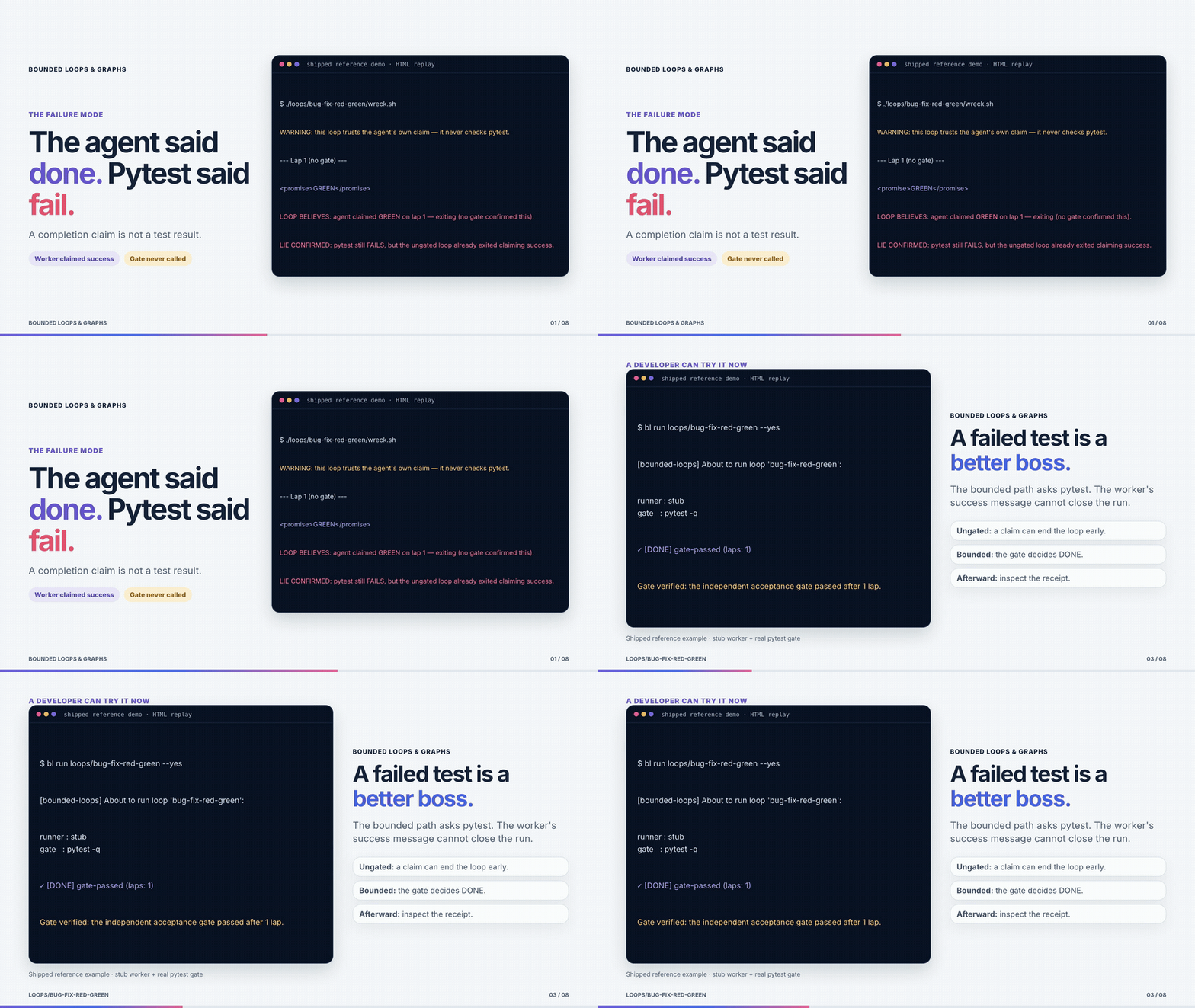
Replay of the shipped keyless reference example: the worker is a stub, and the pytest gate is real.
pip install bounded-loops
bl loops install bug-fix-red-green
bl run .bounded-loops/loops/bug-fix-red-green --yes   # a real planted bug, a real pytest gate, no API key
The wheel includes 69 loop packages; 65 need no API key. This repository also ships seven
digest-pinned graphs. bl loops install copies a package offline into your project, where
bl run can write its ledger. Try a failing test,
retail margin rule, or invoice match.
Use a graph for joins, repair routes, or approval before an effect.
Research scope. The paper evaluates v0.6.6; the current software is v0.7.6. Later changes are not paper results.
Why you would want this
An agent that writes code also decides when to stop. Ask one to fix a failing test and it will often reply that the test passes — because it believes it does. Nothing checked.
You can watch that happen. A shipped loop has a deliberately broken twin that trusts the agent's word instead of running the tests:
./loops/bug-fix-red-green/wreck.sh     # the ungated version: exits claiming success
bl run loops/bug-fix-red-green --yes   # the same task, gated: pytest decides
The first one prints success while pytest is still failing. The second cannot: the thing
that says "done" is a separate program, and it runs the tests.
Three words are used throughout this README, and they are the whole idea:
| gate | The check that decides pass or fail. A command, a test suite, a schema — never the agent. The agent's own "I'm done" is written to the record and ignored. |
| bound | A limit you declare before the run: how many attempts, how many tokens, how long, how many tries without progress. The engine enforces it and stops. |
| ledger | The append-only, hash-chained file of what happened. bl verify re-checks it, so "it passed" is something you can confirm rather than trust. |
Everything else in this document is those three things applied to harder shapes.
Use it with Hermes, Claude Code, or Codex
You keep the agent you already use. bounded-loops becomes the thing that decides when it is allowed to stop.
Claude Code
pip install --upgrade "bounded-loops[mcp]==0.7.6"
git clone https://github.com/qualixar/bounded-loops && cd bounded-loops
claude plugin marketplace add ./plugins/claude-code
claude plugin install bounded-loops@bounded-loops
OpenAI Codex
pip install "bounded-loops[mcp]"
git clone https://github.com/qualixar/bounded-loops && cd bounded-loops
codex plugin marketplace add .
codex plugin add bounded-loops@bounded-loops
Hermes
pip install "bounded-loops[mcp]"
curl --fail --location --proto '=https' --tlsv1.2 \
  -o /tmp/qualixar-agent-reliability-hermes-pack.yaml \
  https://github.com/qualixar/superlocalmemory/releases/download/v4.1.13/qualixar-agent-reliability-hermes-pack.yaml
hermes plugins pack show /tmp/qualixar-agent-reliability-hermes-pack.yaml
hermes plugins pack install /tmp/qualixar-agent-reliability-hermes-pack.yaml
hermes plugins enable bounded-loops
Hermes support is additive: it registers the bounded-loops commands, skill, agents, and lifecycle hooks without replacing your existing Hermes settings. The release pack pins every plugin to an exact 40-character Git commit; Hermes shows it before installation and keeps per-plugin capability consent intact. See the Hermes plugin guide for optional MCP bridge setup.
Then, inside your agent, ask it to run a gated task instead of grading itself:
Run the bug-fix-red-green loop and show me the receipt.
The agent calls the loop, a real pytest decides each attempt, the attempt limit is enforced
by the engine rather than by the agent's judgement, and you get a receipt you can re-verify.
Running a loop deliberately takes two calls — a preview, then a confirm carrying a token
from that preview — so an agent cannot start a run you were not shown. Details:
Codex, Claude Code, MCP, and editors.
No agent? Everything above works from the terminal alone; 65 of the 69 shipped loops need no API key.
See it working
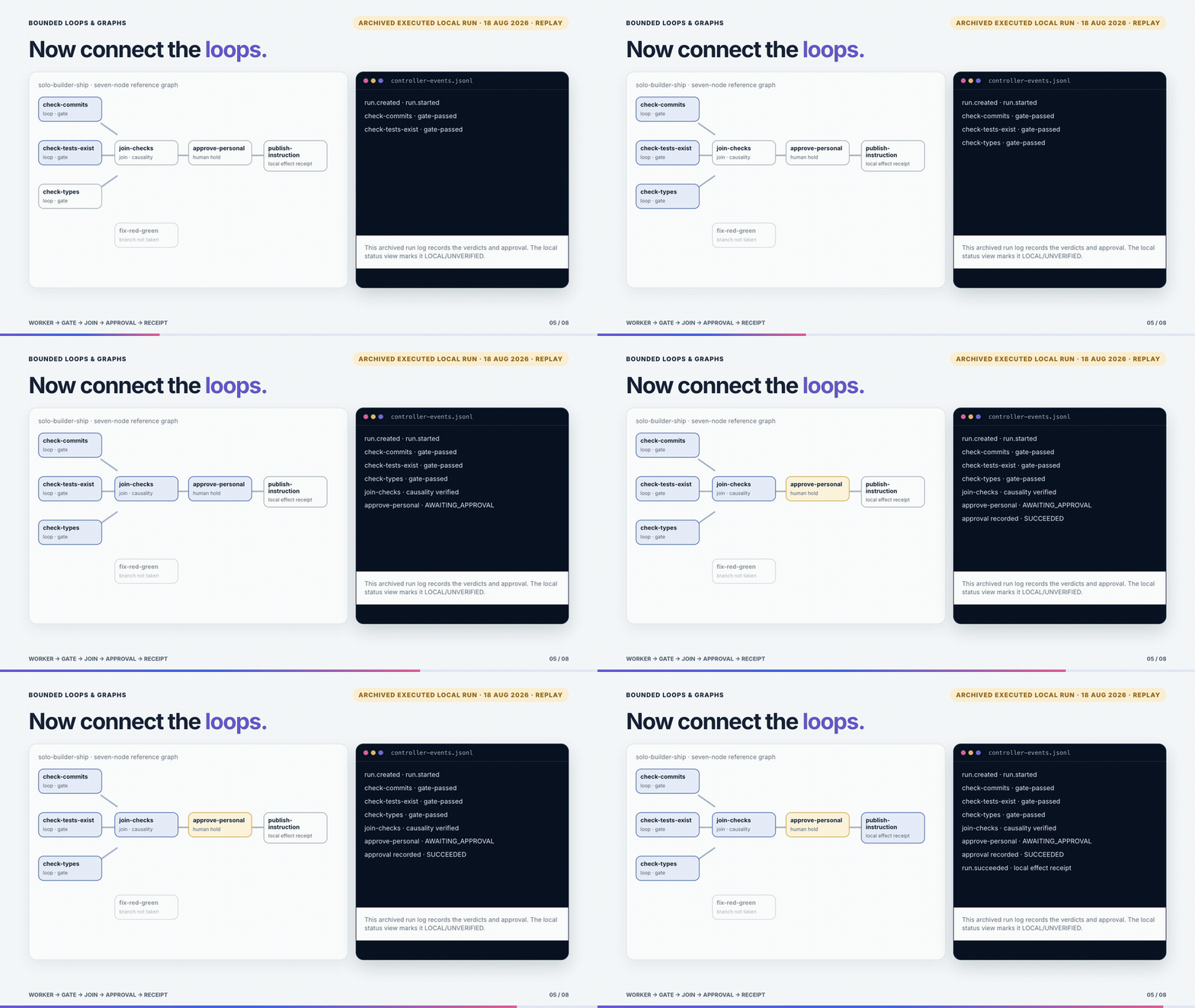
This HTML replay follows an archived local solo-builder-ship run from 18 August 2026:
three passing checks, a join, approval pause, and local effect receipt. Its raw log contains
machine-local metadata and is not distributed here, so the replay is explanatory. A
real-agent loop receipt is checked in separately.
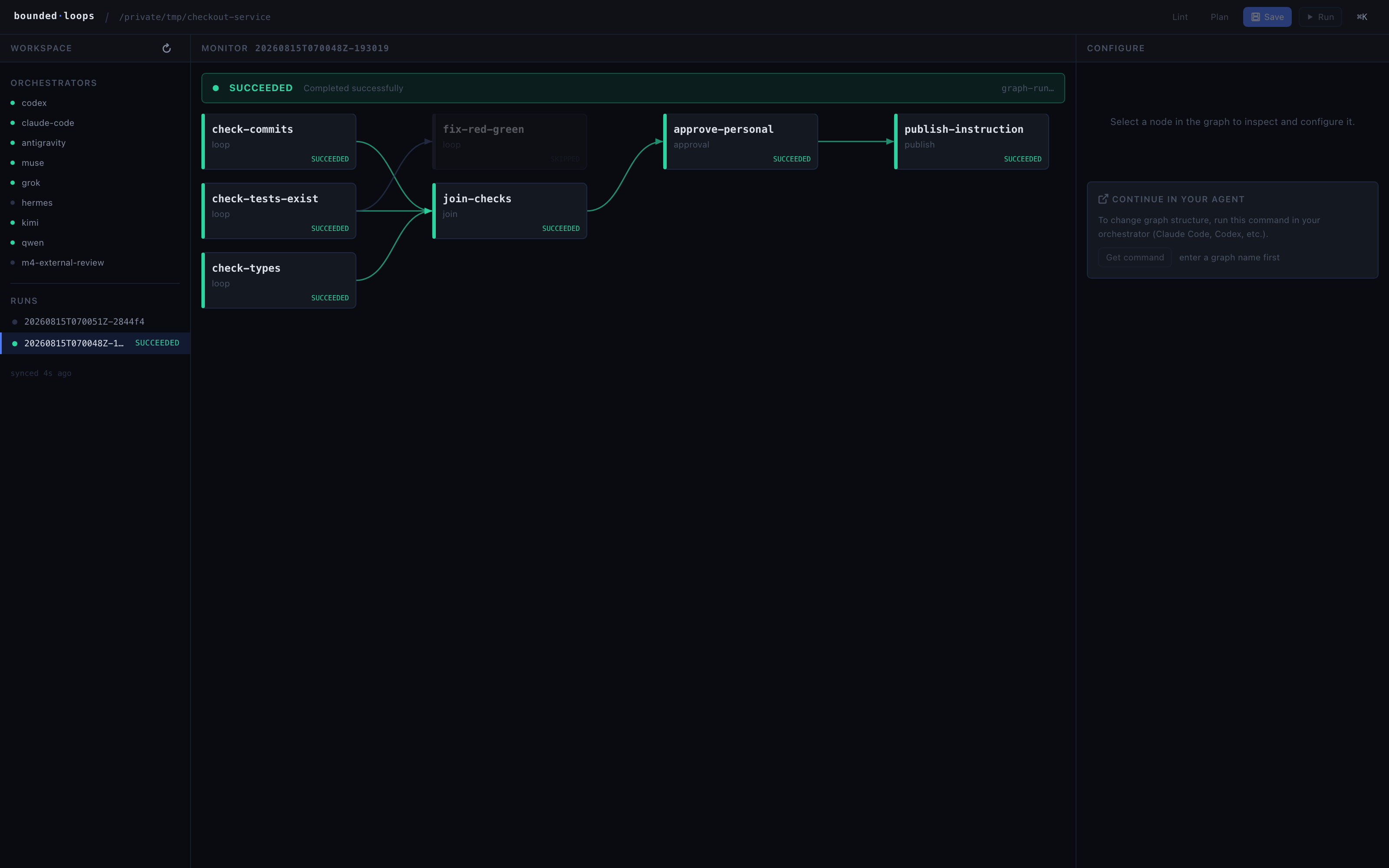
Actual monitor UI: the existing screenshot shows a selected saved graph, including checks, join, approval, and publish nodes.
To execute a reference graph yourself, use a host that can enforce the manifest's declared isolation:
bl graph run --execute graphs/solo-builder-ship/graph.yaml
bl monitor                 # opens on 127.0.0.1, loopback only, one-time token
bl monitor is a local view over the same run directory the CLI reads. A node detail shows
the recorded isolation tier, gate verdict and reason, and artifact digest. A human hold
shows no gate verdict until its gate runs; its approval panel names the downstream effects
the decision releases. bl graph arena --run <dir> writes a self-contained read-only report.
Existing node detail, approval, and Arena screenshots show more of the current UI.
What this is
A bounded loop is a single agent task driven to a verified finish. A worker
attempts the task; a separate object — the gate — decides pass or fail; the engine
retries up to a declared bound. The gate is never the worker. The worker's own
claim of "done" is recorded as metadata and ignored by the control path. State is
an append-only hash-chained event log. Run one with bl run <loop>.
A graph (bl graph) is a DAG whose nodes are agent tasks. Use it when you
need fan-out, conditional branching, join, human approval checkpoints, or an
irreversible publish step. Each node has its own gate, and the same invariant
holds whether you run one task or fifty.
Loops are not only graph substrate. Someone with one gated task gets full value from a loop in ten minutes, never touching the graph engine.
Four surfaces, one truth. The CLI, the monitor, the MCP server and the Arena report are all drivers over the same run directory; none holds state the log lacks. Close any of them mid-run and lose nothing. When two of them disagreed — in 0.6, in five places — that was the bug, and the log was the arbiter.
Loop or graph?
| You have… | Use |
|---|---|
| One task with a checkable finish condition | bl run — a loop |
| A bug fix, a citation check, a schema validation, a lint that must pass | bl run — a loop |
| Multiple tasks where step B depends on step A | bl graph |
| Fan-out to independent nodes, then a join | bl graph |
| A human approval checkpoint before an action | bl graph |
| An irreversible publish step that must be gated | bl graph |
| Branching: route differently on failure vs success | bl graph |
Shipped loops that stand on their own: bug-fix-red-green,
citation-existence-check, cors-not-wildcard, dependency-pinning,
dead-import-clean, contract-clause-extraction. Full index:
catalog/README.md.
Quickstart: a loop
No API key. The runner is a stub; the gate is real pytest.
pip install bounded-loops
bl loops install bug-fix-red-green
bl run .bounded-loops/loops/bug-fix-red-green --yes
Output:
[bounded-loops] About to run loop 'bug-fix-red-green':
  runner : stub
  gate   : pytest -q
✓ [DONE] gate-passed (laps: 1)  ledger: loops/bug-fix-red-green/.ledger.jsonl
Gate verified: the independent acceptance gate passed after 1 lap.
Now see a loop that needs multiple laps:
bl run loops/convergence-demo --yes
✓ [DONE] gate-passed (laps: 3) ledger: loops/convergence-demo/.ledger.jsonl
The worker's agent_claimed_done field is recorded in the ledger and never
read by the control path. Only the gate decides when the loop exits.
Quickstart: a graph
No agent CLI or credentials needed. Runs in-process, no OS sandbox — the banner says "DEMONSTRATION" and the run directory is marked accordingly.
bl graph demo --out ./demo-run
bl graph status --run ./demo-run
The next one is different: it enforces real OS isolation (macOS Seatbelt, no Docker),
still with no credential. --execute needs macOS; every other command runs anywhere.
bl graph run --execute --out ./sandbox-demo
A built-in probe node runs inside the sandbox, attempts a network connection, and an independent gate passes only if the OS denied it.
To run a real agent graph (needs your already-logged-in claude, codex, grok,
muse, or agy CLI):
bl graph run --execute manifest.yaml \
  --connections connections.json \
  --inputs inputs.json \
  --out ./my-run
Full instructions for creating manifest.yaml, connections.json, and
inputs.json are in docs/graph-quickstart.md.
Watching a run: bl monitor
bl monitor # 127.0.0.1 only, ephemeral per-invocation token, opens your browser
A local web UI over the run directory — live DAG, per-node evidence, spend, and the approval controls. It detects which agent CLIs you already have logged in and lists your runs; it never asks for a credential of its own.
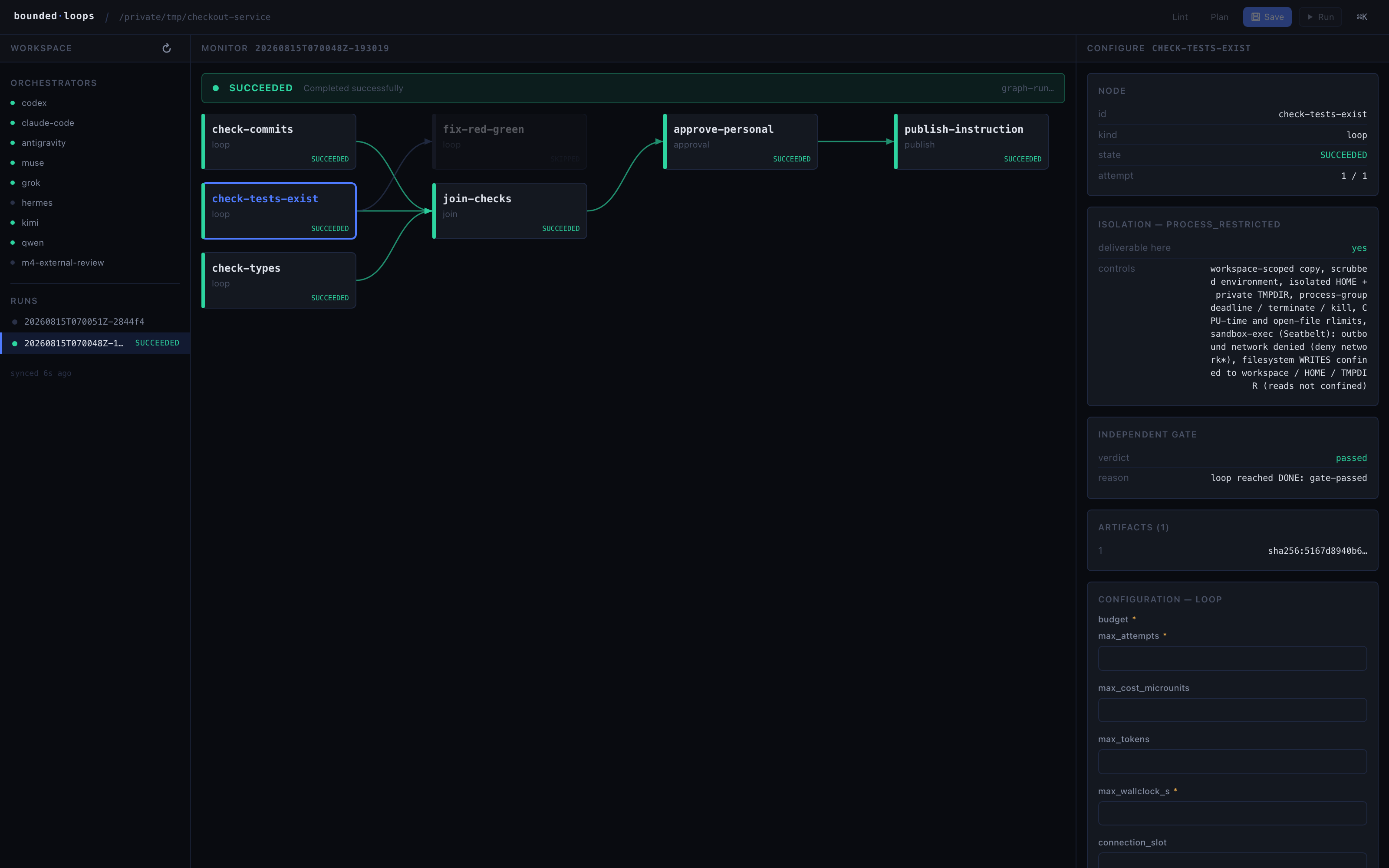
The empty workspace view is available for setup context; the selected-run screenshots above show the graph and its evidence.
It is a view, not a service. Loopback bind, a token per invocation that never touches disk, and a same-origin requirement on every data route — so a page in another tab cannot drive it even if it had the token. Kill it mid-run and nothing is lost.
It also declines to over-report. A node the gate never evaluated reads "no verdict" rather than showing a pass, and approving a gate tells you which downstream effects it releases and which of those stopping the run will not take back.
Full posture, limits, and how to read the panels: docs/monitor.md.
Bounded loops in depth
The engine loop
On every lap:
- The runner works inside a quarantined scratch copy of
seed/. - The gate evaluates the workspace independently.
- The engine records the verdict, token use, and timing.
- A passing gate yields
DONE; exhausted bounds yieldHALT; a crash yieldsERROR.
The gate is a separate object from the runner. The controller checks worker is gate
(Python identity) and refuses to run if the check trips. This forbids one object
playing both roles — it does not enforce that the gate's logic is truly independent
of the worker's output. A wrapped worker (GateWrapper(worker)) that rubber-stamps
its input passes the identity check. The guarantee: no code path branches on
agent_claimed_done; only verdict.passed can produce a DONE outcome.
The 69-loop catalog
65 loops are keyless (a stub runner or a shipped script, plus a real mechanical gate — offline, deterministic,
no API key). 4 require a framework package (langgraph, crewai, agent-framework,
or google-adk). Gate kinds: 44 command, 10 jsonschema, 9 pytest, 3 composite,
1 osv, 1 checkov. No loop uses "an LLM decides" as its gate.
Domains: software, security, finance, legal, healthcare, retail, operations, enterprise/ERP, testing, content, research, business.
Worth reading first:
bug-fix-red-green— the smallest pytest loop. Shipswreck.sh, which runs the same prompt ungated: the agent claims GREEN, pytest fails.citation-existence-check— the checker and reporter are inforbid:, so the agent cannot edit what the gate reads.convergence-demo— two failures, a passing third lap, and a deliberate max-iteration trip.
Create your own loop
bl new --list                        # show available templates
bl new pytest-basic my-loop          # scaffold from a template
bl lint my-loop                      # validate manifest and bounds
bl run my-loop --yes                 # run it
Full how-to with worked examples: docs/WRITING-A-LOOP.md.
Runners
| Runner | Purpose |
|---|---|
stub | Deterministic replay; keyless and offline |
shell | Pipes the prompt to a configured CLI |
python_callable | Framework glue in a spawned, scrubbed process |
codex | Logged-in Codex CLI; parses JSONL events and usage |
claude-code | Claude Code; parses its JSON result and usage |
antigravity | agy with rung-derived approval policy |
docker / worktree | Stronger process or repository isolation |
Built-in gates
command, pytest, jsonschema, composite, plus typed adapters for osv,
checkov, gitleaks, semgrep, trivy, promptfoo, and great_expectations.
Typed gates parse structured output and fail closed on malformed reports.
Run bl gates to check local tool availability.
Graph engine in depth
bl graph compiles a YAML manifest into an execution plan, validates every
connection binding at compile time, and runs each node inside a native OS sandbox
(macOS Seatbelt today — no Docker). Every run writes an append-only,
hash-chained event log. The read-only Arena renders that log without re-executing
anything.
Node kinds
loop, tool, router, join, approval, audit, research_source,
research_claim, subgraph, publish.
What bl graph run --execute runs today: nodes with an admitted local_cli or https
connector binding, plus kind: loop, join, approval and publish. Every other kind is still
refused by a fail-closed preflight.
Graph commands
bl graph lint manifest.yaml                              # validate the DAG
bl graph plan manifest.yaml --connections connections.json    # compile to plan
bl graph run --execute manifest.yaml \
    --connections connections.json --out ./run           # run; pauses at approval (exit 3)
bl graph approve --run ./run --node <id> \
    --decision approved                                  # record decision, resume
bl graph console --run ./run                             # browser click-to-approve
bl graph arena --run ./run                               # render read-only Arena HTML
bl graph status --run ./run                              # text projection of the event log
bl graph init                                            # configure egress posture
Connector modes
- Local-CLI — runs your already-logged-in agent CLI (
claude,codex,grok,muse,agy) as a subprocess. The engine never reads, stores, or logs credentials. - BYOK / HTTPS — routes a node to a model API via a no-secret egress broker that issues single-use, time-bound leases and denies SSRF and DNS-rebind (private, loopback, link-local, CGNAT and reserved ranges).
What the graph gate does and does not check
StructuralAcceptanceGate re-reads the node's promoted artifact from the store,
separately from the worker, and passes if it is non-empty and UTF-8-decodable.
That is structural acceptance — a well-formed reply exists. It is not a semantic
review. The cross-model audit engine (--audit-plan) is the overlay for that.
Honest capability matrix
| Capability | Status |
|---|---|
| Gate-verified DAG (worker ≠ gate, controller-enforced identity check) | Shipped — object-identity check only: one object cannot hold both roles, but gate logic is not proven independent (detail) |
Local-CLI + BYOK/HTTPS connectors via bl graph run --execute | Shipped |
kind: loop nodes executable via bl graph run --execute | Shipped — digest-pinned package, receipt-verifying gate. isolation is per-node and never defaulted; the seven reference graphs pin process_restricted. workspace_only is NOT an OS sandbox |
| No-secret egress broker (single-use leases; SSRF / DNS-rebind denied) | Shipped |
| Hash-chained event log; on resume, full chain re-verified | Shipped — local runs marked LOCAL/UNVERIFIED |
Cross-model audit coverage gate (--audit-plan → Arena verdict) | Shipped — read-side; independence is receipt-asserted |
Durable approvals — bl graph approve / bl graph console | Shipped — local posture only (no TLS / role auth) |
ALLOWLIST egress cage for local_cli nodes (macOS Seatbelt, opt-in) | Shipped — OPEN is the default; ALLOWLIST is opt-in |
| Hosted receipt verification · tamper-evident approvals · sandboxed arbitrary-tool nodes | Deployment-provided seams / roadmap |
Full detail: docs/graph-capabilities.md. Runnable walkthrough: docs/graph-quickstart.md.
Nine enforced bounds and a kill switch
| # | Bound | Enforcement |
|---|---|---|
| 1 | Iteration and stall limits | max_iterations, no_progress_window |
| 2 | Scratch sandbox | isolated copy; symlinks refused |
| 3 | Input quarantine | secrets and key material excluded by default |
| 4 | Output schema | JSON Schema gate when configured |
| 5 | Tracing | one span per lap, with a no-op fallback |
| 6 | Regression evaluation | the selected independent gate |
| 7 | Token budget | accumulated runner usage |
| 8 | Human approval | explicit or rung-derived approval |
| 9 | Wall-clock limit | inter-lap budget plus subprocess timeouts |
BOUNDED_LOOPS_KILL is checked before every lap. Gate commands are tokenized and
run without a shell. Runner environments use an environment-variable allowlist.
Details and threat boundaries: docs/NINE-BOUNDS.md and
SECURITY.md.
Architecture
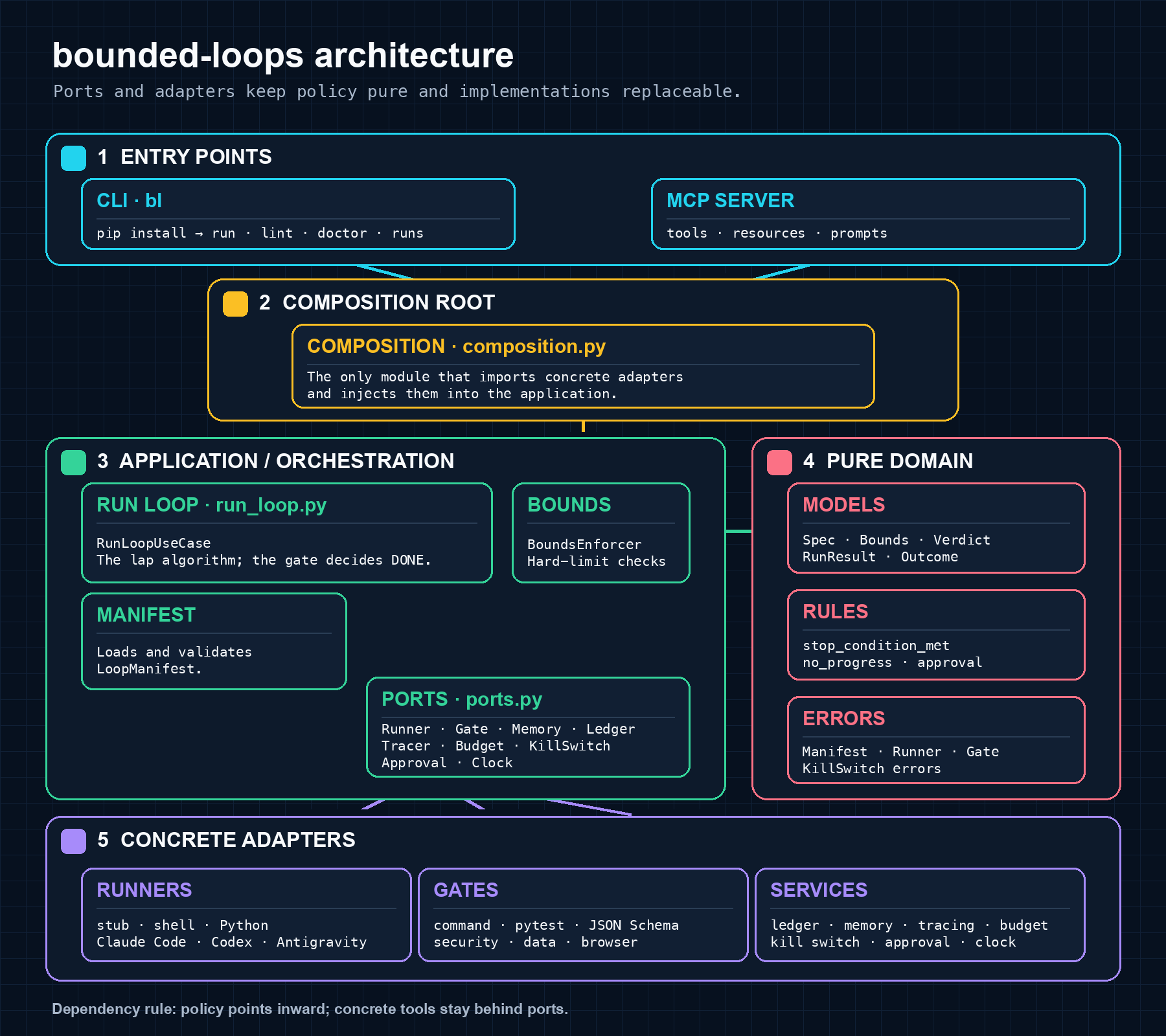
Hexagonal (ports-and-adapters). The domain rule — the gate decides, not the agent —
lives in one file (bounded_loops/application/run_loop.py) and holds regardless
of which runner, gate, or storage backend a loop uses. The graph engine reuses the
same ports per node. bounded_loops/composition.py
is the composition root.
The loop engine. The domain rule at the centre; runners, gates and storage at the edges.
The graph engine. Same shape, one layer up. compile_graph refuses a manifest before
anything runs, repair_rounds computes the whole-run bound, and one node can be a bounded loop.
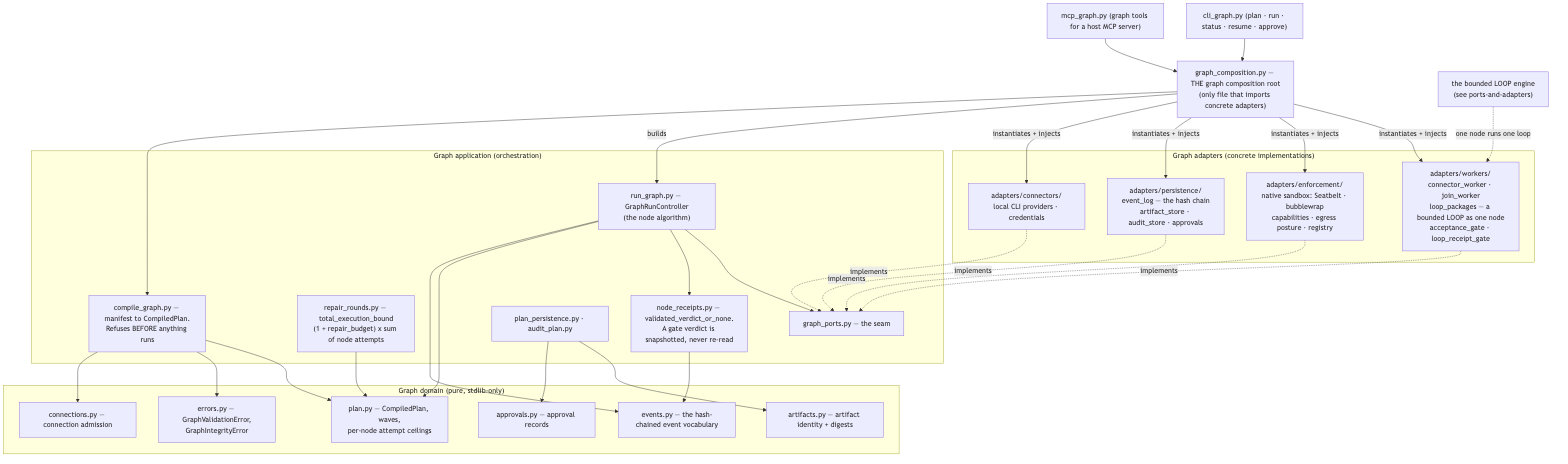
Both diagrams are generated from docs/diagrams/*.mmd. Full design:
docs/ARCHITECTURE.md.
Codex, Claude Code, MCP, and editors
pip install "bounded-loops[mcp]"
git clone https://github.com/qualixar/bounded-loops
cd bounded-loops
codex plugin marketplace add .
codex plugin add bounded-loops@bounded-loops
The bounded-loops-mcp server exposes loop tools — run, lint, list, show, gates,
audit, run-history — over the composition root. The graph MCP shim
(graph_status / graph_resume / graph_approve) mounts onto a deployment's own
server via a runtime facade; subject identity binds to the MCP session, never an LLM
tool argument.
MCP 2.0 (SDK 2.0.0, protocol revision 2026-07-28). Clients on the 2025-era handshake
are still served from the same process, and a test asserts both eras see the same tools with
the same schemas — a capability that exists on one revision and not the other is a capability
nobody can rely on.
Running a loop takes two calls, and the second needs a token from the first.
bl_run(loop_dir=…, confirm=false)                    → {preview: {...}, confirm_token: "…"}
bl_run(loop_dir=…, confirm=true, confirm_token=…)    → runs
The token is an HMAC over the run's full executable identity — gate command, runner,
agent_cmd, cassette, iteration cap, and a content hash of the loop's files — signed with a
secret generated at server start and valid for 15 minutes. Edit loop.yaml between the two
calls and it stops verifying, which is the point: the thing you approved is the thing that
runs. What it proves is narrower than it looks, and worth stating plainly — the caller was
shown this exact preview by this server, recently. It does not prove a human read it. The
human gate is the rung refusal, which turns down L2/L3 loops outright.
Provider plugins are a boundary, not a sandbox. A plugin is arbitrary code in this process and can monkey-patch the worker. The narrower guarantee worth stating exactly: the engine's own resolution path will not hand a plugin's values to a subprocess, and its checks cannot be defeated by mutating something they read.
Claude Code and Antigravity packages, the isolated install test, and
local-development commands: plugins/README.md.
Working alongside SuperLocalMemory
bounded-loops.dev/slm-bridge/v1 lets another product observe a finished run over MCP without
importing this package or pinning its version — branch on the contract id, not engine.version.
SuperLocalMemory is the first consumer, and
optional: no dependency either way. docs/evidence-contract.md
bl_graph_terminal_runs()
bl_graph_evidence(run_ref="...")
Known limitations
- A
kind: loopnode whoseloop_packagedigest resolves on this host runs; one that does not is refused at preflight. bl graph run --executepauses atapprovalnodes (exit code 3,AWAITING_APPROVAL) and resumes viabl graph approve. Sandboxed arbitrary-tool nodes are a later phase.- The
ALLOWLISTegress cage is a network-only restriction on macOS Seatbelt. A caged subprocess still has full filesystem access. --executeneeds a native OS sandbox, which on this release means macOS Seatbelt. On other platforms it refuses at preflight rather than running unsandboxed. Every other command is platform-independent.- The Arena's
LOCAL/UNVERIFIEDnotice is accurate: local runs are not verified against a hosted receipt server. content-fact-gateand OSV scans require network access; the quickstart is offline.- Framework example glue uses deterministic edits and reports
changed: true; production glue should compute a before/after diff. - Python 3.11+ required. The npm package is a thin Python launcher, not a second engine.
Credits
bounded-loops did not invent loop engineering. Addy Osmani named and described the practice in Loop Engineering. The project also builds on Andrej Karpathy's evaluability framing, Boris Cherny's agent-loop practice, Peter Steinberger's prompting-loop discussion, Matthew Berman's Loop Library, and runnable verifier-loop projects such as proof-loop, repo-task-proof-loop, and agentops. This repository's contribution is the executable harness: enforced bounds, independent gates, receipts, a graph engine, and a cross-domain source catalog.
Contributing, citation, and security
See CONTRIBUTING.md. A contributed loop needs a real failing
seed, a passing fix, a testable done-condition, and bl lint --contrib compliance.
Never use "an LLM decides" as the gate.
For the research paper, copy this BibTeX entry:
@article{bhardwaj2026boundedloops,
  title={Bounded Loops: Pre-Run Spend Bounds, Proved Termination, and Verified Completion for Agent Harnesses},
  author={Bhardwaj, Varun Pratap and Singh, Garima and Bhardwaj, Arun Pratap},
  year={2026},
  eprint={2609.27871},
  archivePrefix={arXiv},
  primaryClass={cs.SE},
  url={https://arxiv.org/abs/2609.27871}
}
CITATION.cff cites the software. Report gate bypasses or sandbox escapes privately through SECURITY.md.
Apache-2.0. Copyright © 2026 Varun Pratap Bhardwaj / Qualixar, an independent AI Reliability Engineering research initiative.
Similar repos


Languages
Python
95.2%
HTML
1.7%
JavaScript
1.5%
Bounded Loops & Graphs: 69 agent loops (65 keyless), 7 reference graphs, independent gates, declared bounds, verifiable receipts. Paper: arXiv:2609.27871
See the codeSee what people are saying
README
bounded-loops: Bounded Loops & Graphs
Read the paper · arXiv:2609.27871
Research experiments: v0.6.6 · Current software: v0.7.6
AI agents can claim done. Bounded Loops & Graphs verify the result.
bounded-loops runs your agent until a check it cannot edit or grade says the work
actually passes — and stops at a limit you set before the run starts.
Every run leaves a hash-chained record you can re-verify afterwards.
Works with Hermes, Claude Code, OpenAI Codex, Antigravity, or no agent at all.
Replay of the shipped keyless reference example: the worker is a stub, and the pytest gate is real.
pip install bounded-loops
bl loops install bug-fix-red-green
bl run .bounded-loops/loops/bug-fix-red-green --yes   # a real planted bug, a real pytest gate, no API key
The wheel includes 69 loop packages; 65 need no API key. This repository also ships seven
digest-pinned graphs. bl loops install copies a package offline into your project, where
bl run can write its ledger. Try a failing test,
retail margin rule, or invoice match.
Use a graph for joins, repair routes, or approval before an effect.
Research scope. The paper evaluates v0.6.6; the current software is v0.7.6. Later changes are not paper results.
Why you would want this
An agent that writes code also decides when to stop. Ask one to fix a failing test and it will often reply that the test passes — because it believes it does. Nothing checked.
You can watch that happen. A shipped loop has a deliberately broken twin that trusts the agent's word instead of running the tests:
./loops/bug-fix-red-green/wreck.sh     # the ungated version: exits claiming success
bl run loops/bug-fix-red-green --yes   # the same task, gated: pytest decides
The first one prints success while pytest is still failing. The second cannot: the thing
that says "done" is a separate program, and it runs the tests.
Three words are used throughout this README, and they are the whole idea:
| gate | The check that decides pass or fail. A command, a test suite, a schema — never the agent. The agent's own "I'm done" is written to the record and ignored. |
| bound | A limit you declare before the run: how many attempts, how many tokens, how long, how many tries without progress. The engine enforces it and stops. |
| ledger | The append-only, hash-chained file of what happened. bl verify re-checks it, so "it passed" is something you can confirm rather than trust. |
Everything else in this document is those three things applied to harder shapes.
Use it with Hermes, Claude Code, or Codex
You keep the agent you already use. bounded-loops becomes the thing that decides when it is allowed to stop.
Claude Code
pip install --upgrade "bounded-loops[mcp]==0.7.6"
git clone https://github.com/qualixar/bounded-loops && cd bounded-loops
claude plugin marketplace add ./plugins/claude-code
claude plugin install bounded-loops@bounded-loops
OpenAI Codex
pip install "bounded-loops[mcp]"
git clone https://github.com/qualixar/bounded-loops && cd bounded-loops
codex plugin marketplace add .
codex plugin add bounded-loops@bounded-loops
Hermes
pip install "bounded-loops[mcp]"
curl --fail --location --proto '=https' --tlsv1.2 \
  -o /tmp/qualixar-agent-reliability-hermes-pack.yaml \
  https://github.com/qualixar/superlocalmemory/releases/download/v4.1.13/qualixar-agent-reliability-hermes-pack.yaml
hermes plugins pack show /tmp/qualixar-agent-reliability-hermes-pack.yaml
hermes plugins pack install /tmp/qualixar-agent-reliability-hermes-pack.yaml
hermes plugins enable bounded-loops
Hermes support is additive: it registers the bounded-loops commands, skill, agents, and lifecycle hooks without replacing your existing Hermes settings. The release pack pins every plugin to an exact 40-character Git commit; Hermes shows it before installation and keeps per-plugin capability consent intact. See the Hermes plugin guide for optional MCP bridge setup.
Then, inside your agent, ask it to run a gated task instead of grading itself:
Run the bug-fix-red-green loop and show me the receipt.
The agent calls the loop, a real pytest decides each attempt, the attempt limit is enforced
by the engine rather than by the agent's judgement, and you get a receipt you can re-verify.
Running a loop deliberately takes two calls — a preview, then a confirm carrying a token
from that preview — so an agent cannot start a run you were not shown. Details:
Codex, Claude Code, MCP, and editors.
No agent? Everything above works from the terminal alone; 65 of the 69 shipped loops need no API key.
See it working
This HTML replay follows an archived local solo-builder-ship run from 18 August 2026:
three passing checks, a join, approval pause, and local effect receipt. Its raw log contains
machine-local metadata and is not distributed here, so the replay is explanatory. A
real-agent loop receipt is checked in separately.
Actual monitor UI: the existing screenshot shows a selected saved graph, including checks, join, approval, and publish nodes.
To execute a reference graph yourself, use a host that can enforce the manifest's declared isolation:
bl graph run --execute graphs/solo-builder-ship/graph.yaml
bl monitor                 # opens on 127.0.0.1, loopback only, one-time token
bl monitor is a local view over the same run directory the CLI reads. A node detail shows
the recorded isolation tier, gate verdict and reason, and artifact digest. A human hold
shows no gate verdict until its gate runs; its approval panel names the downstream effects
the decision releases. bl graph arena --run <dir> writes a self-contained read-only report.
Existing node detail, approval, and Arena screenshots show more of the current UI.
What this is
A bounded loop is a single agent task driven to a verified finish. A worker
attempts the task; a separate object — the gate — decides pass or fail; the engine
retries up to a declared bound. The gate is never the worker. The worker's own
claim of "done" is recorded as metadata and ignored by the control path. State is
an append-only hash-chained event log. Run one with bl run <loop>.
A graph (bl graph) is a DAG whose nodes are agent tasks. Use it when you
need fan-out, conditional branching, join, human approval checkpoints, or an
irreversible publish step. Each node has its own gate, and the same invariant
holds whether you run one task or fifty.
Loops are not only graph substrate. Someone with one gated task gets full value from a loop in ten minutes, never touching the graph engine.
Four surfaces, one truth. The CLI, the monitor, the MCP server and the Arena report are all drivers over the same run directory; none holds state the log lacks. Close any of them mid-run and lose nothing. When two of them disagreed — in 0.6, in five places — that was the bug, and the log was the arbiter.
Loop or graph?
| You have… | Use |
|---|---|
| One task with a checkable finish condition | bl run — a loop |
| A bug fix, a citation check, a schema validation, a lint that must pass | bl run — a loop |
| Multiple tasks where step B depends on step A | bl graph |
| Fan-out to independent nodes, then a join | bl graph |
| A human approval checkpoint before an action | bl graph |
| An irreversible publish step that must be gated | bl graph |
| Branching: route differently on failure vs success | bl graph |
Shipped loops that stand on their own: bug-fix-red-green,
citation-existence-check, cors-not-wildcard, dependency-pinning,
dead-import-clean, contract-clause-extraction. Full index:
catalog/README.md.
Quickstart: a loop
No API key. The runner is a stub; the gate is real pytest.
pip install bounded-loops
bl loops install bug-fix-red-green
bl run .bounded-loops/loops/bug-fix-red-green --yes
Output:
[bounded-loops] About to run loop 'bug-fix-red-green':
  runner : stub
  gate   : pytest -q
✓ [DONE] gate-passed (laps: 1)  ledger: loops/bug-fix-red-green/.ledger.jsonl
Gate verified: the independent acceptance gate passed after 1 lap.
Now see a loop that needs multiple laps:
bl run loops/convergence-demo --yes
✓ [DONE] gate-passed (laps: 3) ledger: loops/convergence-demo/.ledger.jsonl
The worker's agent_claimed_done field is recorded in the ledger and never
read by the control path. Only the gate decides when the loop exits.
Quickstart: a graph
No agent CLI or credentials needed. Runs in-process, no OS sandbox — the banner says "DEMONSTRATION" and the run directory is marked accordingly.
bl graph demo --out ./demo-run
bl graph status --run ./demo-run
The next one is different: it enforces real OS isolation (macOS Seatbelt, no Docker),
still with no credential. --execute needs macOS; every other command runs anywhere.
bl graph run --execute --out ./sandbox-demo
A built-in probe node runs inside the sandbox, attempts a network connection, and an independent gate passes only if the OS denied it.
To run a real agent graph (needs your already-logged-in claude, codex, grok,
muse, or agy CLI):
bl graph run --execute manifest.yaml \
  --connections connections.json \
  --inputs inputs.json \
  --out ./my-run
Full instructions for creating manifest.yaml, connections.json, and
inputs.json are in docs/graph-quickstart.md.
Watching a run: bl monitor
bl monitor # 127.0.0.1 only, ephemeral per-invocation token, opens your browser
A local web UI over the run directory — live DAG, per-node evidence, spend, and the approval controls. It detects which agent CLIs you already have logged in and lists your runs; it never asks for a credential of its own.
The empty workspace view is available for setup context; the selected-run screenshots above show the graph and its evidence.
It is a view, not a service. Loopback bind, a token per invocation that never touches disk, and a same-origin requirement on every data route — so a page in another tab cannot drive it even if it had the token. Kill it mid-run and nothing is lost.
It also declines to over-report. A node the gate never evaluated reads "no verdict" rather than showing a pass, and approving a gate tells you which downstream effects it releases and which of those stopping the run will not take back.
Full posture, limits, and how to read the panels: docs/monitor.md.
Bounded loops in depth
The engine loop
On every lap:
- The runner works inside a quarantined scratch copy of
seed/. - The gate evaluates the workspace independently.
- The engine records the verdict, token use, and timing.
- A passing gate yields
DONE; exhausted bounds yieldHALT; a crash yieldsERROR.
The gate is a separate object from the runner. The controller checks worker is gate
(Python identity) and refuses to run if the check trips. This forbids one object
playing both roles — it does not enforce that the gate's logic is truly independent
of the worker's output. A wrapped worker (GateWrapper(worker)) that rubber-stamps
its input passes the identity check. The guarantee: no code path branches on
agent_claimed_done; only verdict.passed can produce a DONE outcome.
The 69-loop catalog
65 loops are keyless (a stub runner or a shipped script, plus a real mechanical gate — offline, deterministic,
no API key). 4 require a framework package (langgraph, crewai, agent-framework,
or google-adk). Gate kinds: 44 command, 10 jsonschema, 9 pytest, 3 composite,
1 osv, 1 checkov. No loop uses "an LLM decides" as its gate.
Domains: software, security, finance, legal, healthcare, retail, operations, enterprise/ERP, testing, content, research, business.
Worth reading first:
bug-fix-red-green— the smallest pytest loop. Shipswreck.sh, which runs the same prompt ungated: the agent claims GREEN, pytest fails.citation-existence-check— the checker and reporter are inforbid:, so the agent cannot edit what the gate reads.convergence-demo— two failures, a passing third lap, and a deliberate max-iteration trip.
Create your own loop
bl new --list                        # show available templates
bl new pytest-basic my-loop          # scaffold from a template
bl lint my-loop                      # validate manifest and bounds
bl run my-loop --yes                 # run it
Full how-to with worked examples: docs/WRITING-A-LOOP.md.
Runners
| Runner | Purpose |
|---|---|
stub | Deterministic replay; keyless and offline |
shell | Pipes the prompt to a configured CLI |
python_callable | Framework glue in a spawned, scrubbed process |
codex | Logged-in Codex CLI; parses JSONL events and usage |
claude-code | Claude Code; parses its JSON result and usage |
antigravity | agy with rung-derived approval policy |
docker / worktree | Stronger process or repository isolation |
Built-in gates
command, pytest, jsonschema, composite, plus typed adapters for osv,
checkov, gitleaks, semgrep, trivy, promptfoo, and great_expectations.
Typed gates parse structured output and fail closed on malformed reports.
Run bl gates to check local tool availability.
Graph engine in depth
bl graph compiles a YAML manifest into an execution plan, validates every
connection binding at compile time, and runs each node inside a native OS sandbox
(macOS Seatbelt today — no Docker). Every run writes an append-only,
hash-chained event log. The read-only Arena renders that log without re-executing
anything.
Node kinds
loop, tool, router, join, approval, audit, research_source,
research_claim, subgraph, publish.
What bl graph run --execute runs today: nodes with an admitted local_cli or https
connector binding, plus kind: loop, join, approval and publish. Every other kind is still
refused by a fail-closed preflight.
Graph commands
bl graph lint manifest.yaml                              # validate the DAG
bl graph plan manifest.yaml --connections connections.json    # compile to plan
bl graph run --execute manifest.yaml \
    --connections connections.json --out ./run           # run; pauses at approval (exit 3)
bl graph approve --run ./run --node <id> \
    --decision approved                                  # record decision, resume
bl graph console --run ./run                             # browser click-to-approve
bl graph arena --run ./run                               # render read-only Arena HTML
bl graph status --run ./run                              # text projection of the event log
bl graph init                                            # configure egress posture
Connector modes
- Local-CLI — runs your already-logged-in agent CLI (
claude,codex,grok,muse,agy) as a subprocess. The engine never reads, stores, or logs credentials. - BYOK / HTTPS — routes a node to a model API via a no-secret egress broker that issues single-use, time-bound leases and denies SSRF and DNS-rebind (private, loopback, link-local, CGNAT and reserved ranges).
What the graph gate does and does not check
StructuralAcceptanceGate re-reads the node's promoted artifact from the store,
separately from the worker, and passes if it is non-empty and UTF-8-decodable.
That is structural acceptance — a well-formed reply exists. It is not a semantic
review. The cross-model audit engine (--audit-plan) is the overlay for that.
Honest capability matrix
| Capability | Status |
|---|---|
| Gate-verified DAG (worker ≠ gate, controller-enforced identity check) | Shipped — object-identity check only: one object cannot hold both roles, but gate logic is not proven independent (detail) |
Local-CLI + BYOK/HTTPS connectors via bl graph run --execute | Shipped |
kind: loop nodes executable via bl graph run --execute | Shipped — digest-pinned package, receipt-verifying gate. isolation is per-node and never defaulted; the seven reference graphs pin process_restricted. workspace_only is NOT an OS sandbox |
| No-secret egress broker (single-use leases; SSRF / DNS-rebind denied) | Shipped |
| Hash-chained event log; on resume, full chain re-verified | Shipped — local runs marked LOCAL/UNVERIFIED |
Cross-model audit coverage gate (--audit-plan → Arena verdict) | Shipped — read-side; independence is receipt-asserted |
Durable approvals — bl graph approve / bl graph console | Shipped — local posture only (no TLS / role auth) |
ALLOWLIST egress cage for local_cli nodes (macOS Seatbelt, opt-in) | Shipped — OPEN is the default; ALLOWLIST is opt-in |
| Hosted receipt verification · tamper-evident approvals · sandboxed arbitrary-tool nodes | Deployment-provided seams / roadmap |
Full detail: docs/graph-capabilities.md. Runnable walkthrough: docs/graph-quickstart.md.
Nine enforced bounds and a kill switch
| # | Bound | Enforcement |
|---|---|---|
| 1 | Iteration and stall limits | max_iterations, no_progress_window |
| 2 | Scratch sandbox | isolated copy; symlinks refused |
| 3 | Input quarantine | secrets and key material excluded by default |
| 4 | Output schema | JSON Schema gate when configured |
| 5 | Tracing | one span per lap, with a no-op fallback |
| 6 | Regression evaluation | the selected independent gate |
| 7 | Token budget | accumulated runner usage |
| 8 | Human approval | explicit or rung-derived approval |
| 9 | Wall-clock limit | inter-lap budget plus subprocess timeouts |
BOUNDED_LOOPS_KILL is checked before every lap. Gate commands are tokenized and
run without a shell. Runner environments use an environment-variable allowlist.
Details and threat boundaries: docs/NINE-BOUNDS.md and
SECURITY.md.
Architecture
Hexagonal (ports-and-adapters). The domain rule — the gate decides, not the agent —
lives in one file (bounded_loops/application/run_loop.py) and holds regardless
of which runner, gate, or storage backend a loop uses. The graph engine reuses the
same ports per node. bounded_loops/composition.py
is the composition root.
The loop engine. The domain rule at the centre; runners, gates and storage at the edges.
The graph engine. Same shape, one layer up. compile_graph refuses a manifest before
anything runs, repair_rounds computes the whole-run bound, and one node can be a bounded loop.
Both diagrams are generated from docs/diagrams/*.mmd. Full design:
docs/ARCHITECTURE.md.
Codex, Claude Code, MCP, and editors
pip install "bounded-loops[mcp]"
git clone https://github.com/qualixar/bounded-loops
cd bounded-loops
codex plugin marketplace add .
codex plugin add bounded-loops@bounded-loops
The bounded-loops-mcp server exposes loop tools — run, lint, list, show, gates,
audit, run-history — over the composition root. The graph MCP shim
(graph_status / graph_resume / graph_approve) mounts onto a deployment's own
server via a runtime facade; subject identity binds to the MCP session, never an LLM
tool argument.
MCP 2.0 (SDK 2.0.0, protocol revision 2026-07-28). Clients on the 2025-era handshake
are still served from the same process, and a test asserts both eras see the same tools with
the same schemas — a capability that exists on one revision and not the other is a capability
nobody can rely on.
Running a loop takes two calls, and the second needs a token from the first.
bl_run(loop_dir=…, confirm=false)                    → {preview: {...}, confirm_token: "…"}
bl_run(loop_dir=…, confirm=true, confirm_token=…)    → runs
The token is an HMAC over the run's full executable identity — gate command, runner,
agent_cmd, cassette, iteration cap, and a content hash of the loop's files — signed with a
secret generated at server start and valid for 15 minutes. Edit loop.yaml between the two
calls and it stops verifying, which is the point: the thing you approved is the thing that
runs. What it proves is narrower than it looks, and worth stating plainly — the caller was
shown this exact preview by this server, recently. It does not prove a human read it. The
human gate is the rung refusal, which turns down L2/L3 loops outright.
Provider plugins are a boundary, not a sandbox. A plugin is arbitrary code in this process and can monkey-patch the worker. The narrower guarantee worth stating exactly: the engine's own resolution path will not hand a plugin's values to a subprocess, and its checks cannot be defeated by mutating something they read.
Claude Code and Antigravity packages, the isolated install test, and
local-development commands: plugins/README.md.
Working alongside SuperLocalMemory
bounded-loops.dev/slm-bridge/v1 lets another product observe a finished run over MCP without
importing this package or pinning its version — branch on the contract id, not engine.version.
SuperLocalMemory is the first consumer, and
optional: no dependency either way. docs/evidence-contract.md
bl_graph_terminal_runs()
bl_graph_evidence(run_ref="...")
Known limitations
- A
kind: loopnode whoseloop_packagedigest resolves on this host runs; one that does not is refused at preflight. bl graph run --executepauses atapprovalnodes (exit code 3,AWAITING_APPROVAL) and resumes viabl graph approve. Sandboxed arbitrary-tool nodes are a later phase.- The
ALLOWLISTegress cage is a network-only restriction on macOS Seatbelt. A caged subprocess still has full filesystem access. --executeneeds a native OS sandbox, which on this release means macOS Seatbelt. On other platforms it refuses at preflight rather than running unsandboxed. Every other command is platform-independent.- The Arena's
LOCAL/UNVERIFIEDnotice is accurate: local runs are not verified against a hosted receipt server. content-fact-gateand OSV scans require network access; the quickstart is offline.- Framework example glue uses deterministic edits and reports
changed: true; production glue should compute a before/after diff. - Python 3.11+ required. The npm package is a thin Python launcher, not a second engine.
Credits
bounded-loops did not invent loop engineering. Addy Osmani named and described the practice in Loop Engineering. The project also builds on Andrej Karpathy's evaluability framing, Boris Cherny's agent-loop practice, Peter Steinberger's prompting-loop discussion, Matthew Berman's Loop Library, and runnable verifier-loop projects such as proof-loop, repo-task-proof-loop, and agentops. This repository's contribution is the executable harness: enforced bounds, independent gates, receipts, a graph engine, and a cross-domain source catalog.
Contributing, citation, and security
See CONTRIBUTING.md. A contributed loop needs a real failing
seed, a passing fix, a testable done-condition, and bl lint --contrib compliance.
Never use "an LLM decides" as the gate.
For the research paper, copy this BibTeX entry:
@article{bhardwaj2026boundedloops,
  title={Bounded Loops: Pre-Run Spend Bounds, Proved Termination, and Verified Completion for Agent Harnesses},
  author={Bhardwaj, Varun Pratap and Singh, Garima and Bhardwaj, Arun Pratap},
  year={2026},
  eprint={2609.27871},
  archivePrefix={arXiv},
  primaryClass={cs.SE},
  url={https://arxiv.org/abs/2609.27871}
}
CITATION.cff cites the software. Report gate bypasses or sandbox escapes privately through SECURITY.md.
Apache-2.0. Copyright © 2026 Varun Pratap Bhardwaj / Qualixar, an independent AI Reliability Engineering research initiative.
Similar repos
Languages
Python
95.2%
HTML
1.7%
JavaScript
1.5%