
Code for the preprint "Cache Me If You Can: How Many KVs Do You Need for Effective Long-Context LMs?"
Python
48
5 commits
updated Jul 29, 2025
README
PruLong
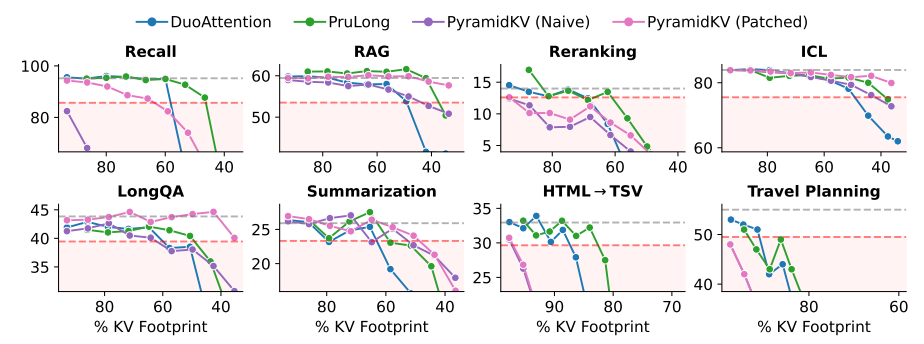
PruLong, an end-to-end training method that learns local and global attention heads. We also adapt PyramidKV to reduce its KV footprint.
This is the homepage for the code release for the preprint "Cache Me If You Can: How Many KVs Do You Need for Effective Long-Context LMs?"
This repository contains code for
- The modeling and training code for PruLong (Pruned Long-Context model), a method that learns 0/1 mask parameters to designate attention heads as local or global. PruLong enables efficient inference with reduced KV cache usage, which we measure in our paper in terms of teh KV footprint.
- Code that evaluates PruLong, along with baselines and our improvements upon them: DuoAttention, PyramidKV, SnapKV, and Locret.
Please refer to our paper (linked above) for more details.
Authors: Adithya Bhaskar*, Alexander Wettig*, Tianyu Gao, Yihe Dong, and Danqi Chen
Release Progress
- PruLong training code
- Evaluation code for PruLong and baselines
- Trained model checkpoints
Setup and usage
We provide separate README files with instructions for setup and usage inside the prulong/ and eval/ directories. You can also find more information on how to prepare the data for training in the ProLong repository. Each of these directories has its own requirements.txt file, so please install the dependencies for each of them separately.
Here is the high-level overview of the codebase:
prulong/: Contains the code for training PruLong. In particular, files underprulong/training/implement the modified Llama class, the training loop, and data-loading utilities. Theprulong/save_prulong_masks.pyscript is to be run after training to save the trained masked values from the model checkpoint (as described in the README insideprulong/). Scripts for launching training runs are provided inprulong/run_scripts/. For now, we only supprt Llama models.eval/: Contains the code for evaluating PruLong and baselines. This directory is structured after HELMET. Please refer to the several run scripts provided insideeval/run_scripts/to see examples of how to run the evaluation. We also provide the utilityeval/viz/plot_kv_footprint.pyfor visualizing the KV footprint of the different methods.MInference/: To evaluate PyramidKV, SnapKV, and Locret, we use the MInference library. Though the steps to install are the same as in the original repository, we provide our modified codebase which implements these methods, as well as improvements described in our paper. You will need to install this in order to evaluate these three with theeval/code.
Contact
Please email Adithya (adithyab@princeton.edu) if you have any questions.
You can also open a GitHub issue if you encounter any bugs or problems.
Citation
If you use this code in your research, please cite our paper:
@misc{bhaskar2025cache,
    title={Cache Me If You Can: How Many {KV}s Do You Need for Effective Long-Context {LM}s?},
    author={Adithya Bhaskar* and Alexander Wettig* and Tianyu Gao and Yihe Dong and Danqi Chen},
    journal={arXiv preprint arXiv:2506.17121},
    year={2025}
}
Similar repos


Languages
Python
92.2%
Shell
7.1%
Code for the preprint "Cache Me If You Can: How Many KVs Do You Need for Effective Long-Context LMs?"
Python
48
5 commits
updated Jul 29, 2025
README
PruLong
PruLong, an end-to-end training method that learns local and global attention heads. We also adapt PyramidKV to reduce its KV footprint.
This is the homepage for the code release for the preprint "Cache Me If You Can: How Many KVs Do You Need for Effective Long-Context LMs?"
This repository contains code for
- The modeling and training code for PruLong (Pruned Long-Context model), a method that learns 0/1 mask parameters to designate attention heads as local or global. PruLong enables efficient inference with reduced KV cache usage, which we measure in our paper in terms of teh KV footprint.
- Code that evaluates PruLong, along with baselines and our improvements upon them: DuoAttention, PyramidKV, SnapKV, and Locret.
Please refer to our paper (linked above) for more details.
Authors: Adithya Bhaskar*, Alexander Wettig*, Tianyu Gao, Yihe Dong, and Danqi Chen
Release Progress
- PruLong training code
- Evaluation code for PruLong and baselines
- Trained model checkpoints
Setup and usage
We provide separate README files with instructions for setup and usage inside the prulong/ and eval/ directories. You can also find more information on how to prepare the data for training in the ProLong repository. Each of these directories has its own requirements.txt file, so please install the dependencies for each of them separately.
Here is the high-level overview of the codebase:
prulong/: Contains the code for training PruLong. In particular, files underprulong/training/implement the modified Llama class, the training loop, and data-loading utilities. Theprulong/save_prulong_masks.pyscript is to be run after training to save the trained masked values from the model checkpoint (as described in the README insideprulong/). Scripts for launching training runs are provided inprulong/run_scripts/. For now, we only supprt Llama models.eval/: Contains the code for evaluating PruLong and baselines. This directory is structured after HELMET. Please refer to the several run scripts provided insideeval/run_scripts/to see examples of how to run the evaluation. We also provide the utilityeval/viz/plot_kv_footprint.pyfor visualizing the KV footprint of the different methods.MInference/: To evaluate PyramidKV, SnapKV, and Locret, we use the MInference library. Though the steps to install are the same as in the original repository, we provide our modified codebase which implements these methods, as well as improvements described in our paper. You will need to install this in order to evaluate these three with theeval/code.
Contact
Please email Adithya (adithyab@princeton.edu) if you have any questions.
You can also open a GitHub issue if you encounter any bugs or problems.
Citation
If you use this code in your research, please cite our paper:
@misc{bhaskar2025cache,
    title={Cache Me If You Can: How Many {KV}s Do You Need for Effective Long-Context {LM}s?},
    author={Adithya Bhaskar* and Alexander Wettig* and Tianyu Gao and Yihe Dong and Danqi Chen},
    journal={arXiv preprint arXiv:2506.17121},
    year={2025}
}
Similar repos
Languages
Python
92.2%
Shell
7.1%