The open-source code for my Medical AI Assistant deployed on Hugging Face Spaces
Python
2
5 commits
updated Apr 6, 2026






A fine-tuned TinyLlama 1.1B medical chatbot trained on a custom medical Q&A dataset using QLoRA — deployed live on HuggingFace Spaces with a Gradio UI.
🤗 Live Demo · ✨ Features · 🧪 Model Details · 🚀 Getting Started
MediBot AI is a domain-specific medical chatbot built by fine-tuning TinyLlama-1.1B-Chat on a custom medical_qa.csv dataset using QLoRA (Quantized Low-Rank Adaptation). It answers medical questions covering symptoms, diseases, drug information, general health advice, and more — all through a clean Gradio web interface deployed on HuggingFace Spaces.
This project demonstrates a full LLM fine-tuning pipeline: from dataset preparation → QLoRA training → adapter merging → Gradio deployment.
🤗 https://huggingface.co/spaces/Prajwal4107k/My-Medical-AI-Assistant
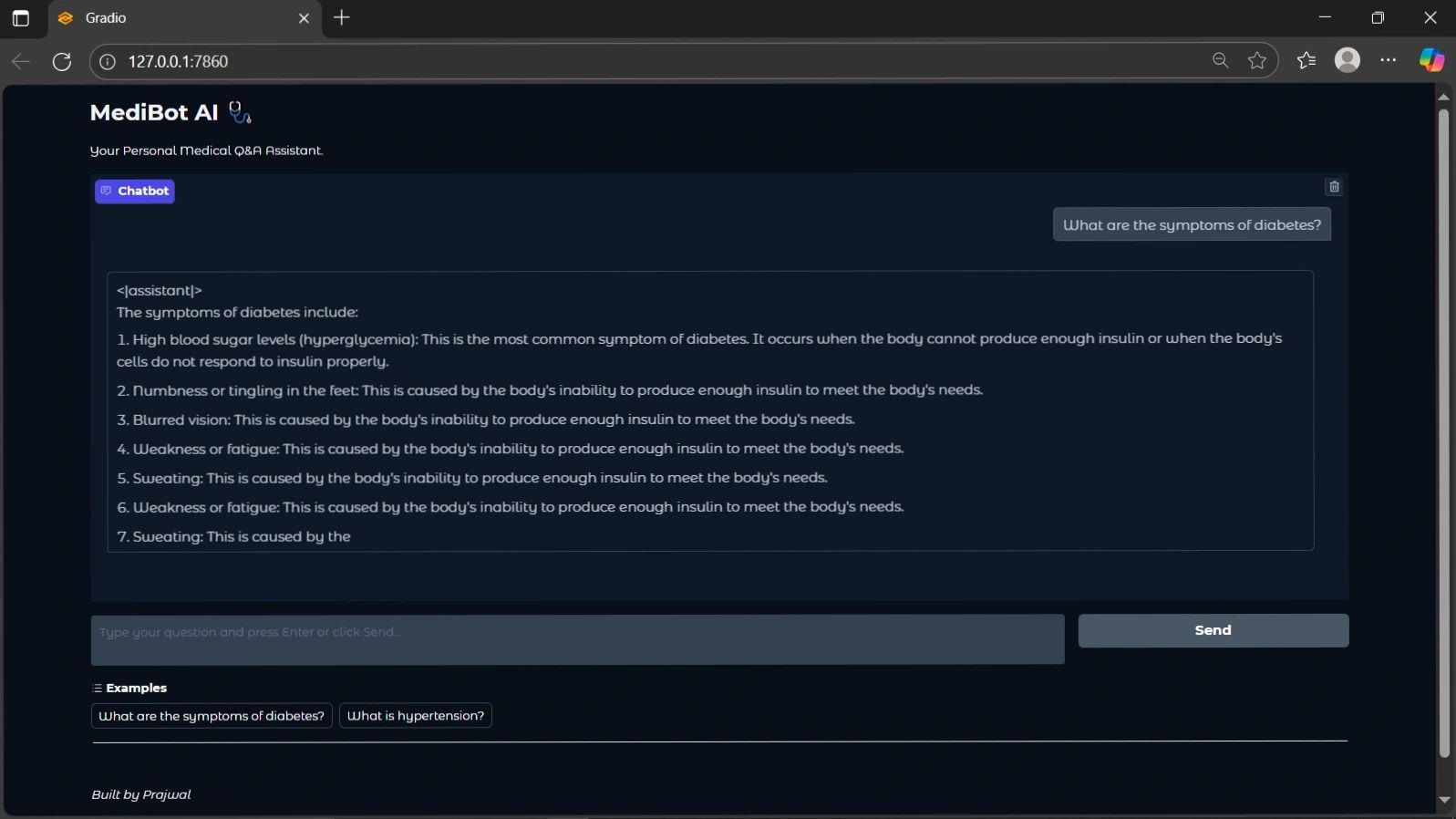
Asking "What are the symptoms of diabetes?" — MediBot responds with a detailed, numbered breakdown of diabetes symptoms including hyperglycemia, numbness, blurred vision, and fatigue.
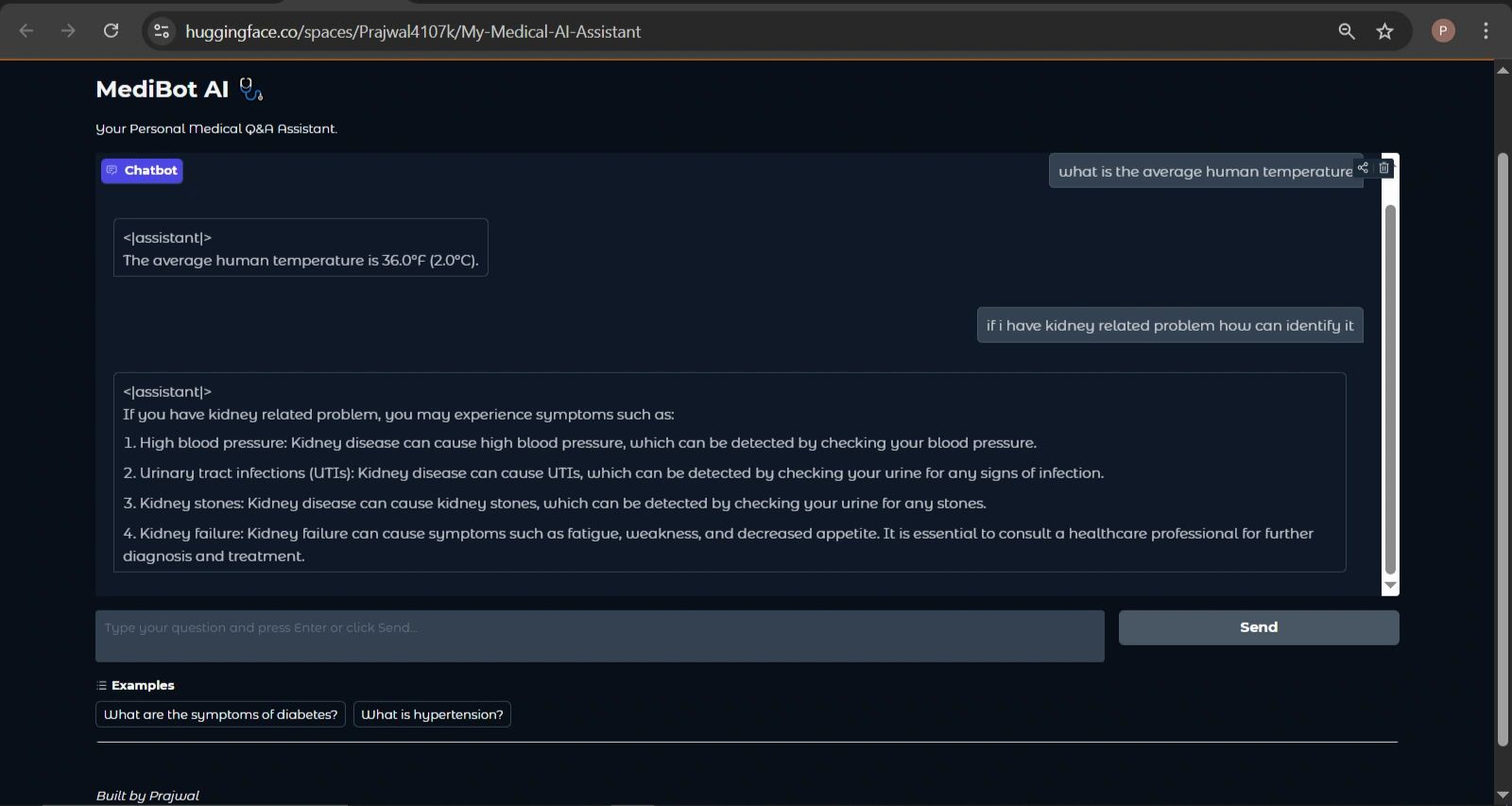
Multi-turn conversation on HuggingFace Spaces — the bot correctly answers "What is the average human temperature?" and provides detailed kidney disease symptom identification when asked.
| Property | Value |
|---|---|
| Base Model | TinyLlama/TinyLlama-1.1B-Chat-v0.6 |
| Fine-tuning Method | QLoRA (4-bit quantization + LoRA adapters) |
| Library | PEFT (Parameter Efficient Fine-Tuning) |
| Pipeline | text-generation |
| Training Data | medical_qa.csv (custom Medical Q&A dataset) |
| Chat Template | Jinja2 (chat_template.jinja) |
| Adapter Format | SafeTensors (adapter_model.safetensors) |
| Tags | lora, transformers, TinyLlama-adapter |
| Component | Technology |
|---|---|
| Base LLM | TinyLlama 1.1B Chat |
| Fine-tuning | QLoRA via PEFT + bitsandbytes |
| Training Script | fine_tune_qlora.py |
| Framework | HuggingFace Transformers |
| UI | Gradio |
| Deployment | HuggingFace Spaces |
| Language | Python 3.10+ |
| Data Format | CSV (medical_qa.csv) + JSON (dataset.json) |
My-Medical-AI-Assistant-Code/
│
├── fine_tuned_model/                   # Trained LoRA adapter files
│   ├── adapter_config.json             # LoRA adapter configuration
│   ├── adapter_model.safetensors       # Fine-tuned adapter weights
│   ├── chat_template.jinja             # Custom chat prompt template
│   ├── special_tokens_map.json         # Special tokens mapping
│   ├── tokenizer.json                  # Tokenizer vocabulary
│   ├── tokenizer.model                 # SentencePiece tokenizer model
│   ├── tokenizer_config.json           # Tokenizer configuration
│   └── README.md                       # Model card
│
├── .gradio/
│   └── certificate.pem                 # Gradio SSL certificate
│
├── app.py                              # Gradio app — chat interface
├── fine_tune_qlora.py                  # QLoRA fine-tuning script
├── medical_qa.csv                      # Medical Q&A training dataset
├── dataset.json                        # Processed dataset in JSON format
├── test_imports.py                     # Dependency verification script
├── requirements.txt                    # Python dependencies
└── README.md
medical_qa.csv  →  dataset.json
      │
      ▼
┌──────────────────────────────┐
│   fine_tune_qlora.py         │
│                              │
│  • Load TinyLlama-1.1B-Chat  │
│  • 4-bit quantization        │
│  • Attach LoRA adapters      │
│  • Train on medical Q&A      │
│  • Save adapter weights      │
└──────────────┬───────────────┘
               │
               ▼
    fine_tuned_model/
    adapter_model.safetensors
               │
               ▼
┌──────────────────────────────┐
│         app.py               │
│                              │
│  • Load base model           │
│  • Merge LoRA adapter        │
│  • Apply chat template       │
│  • Launch Gradio UI          │
└──────────────┬───────────────┘
               │
               ▼
    ┌─────────────────────┐
    │   MediBot AI        │  ←  User asks medical question
    │   Gradio Chat UI    │  →  LLM generates answer
    └─────────────────────┘
               │
               ▼
    HuggingFace Spaces 🤗
    (Public live deployment)
git clone https://github.com/prajwal5065/My-Medical-AI-Assistant-Code.git
cd My-Medical-AI-Assistant-Code
pip install -r requirements.txt
Core packages include:
transformers
peft
bitsandbytes
gradio
torch
accelerate
datasets
python test_imports.py
python fine_tune_qlora.py
⚠️ Requires a CUDA GPU. The script loads
medical_qa.csv, applies 4-bit quantization, trains LoRA adapters, and saves them tofine_tuned_model/.
python app.py
The MediBot AI interface will open at http://127.0.0.1:7860
No setup needed — just visit:
🤗 https://huggingface.co/spaces/Prajwal4107k/My-Medical-AI-Assistant
MediBot AI is for informational and educational purposes only. It is NOT a substitute for professional medical advice, diagnosis, or treatment. Always consult a qualified healthcare professional for medical decisions. Never ignore professional medical advice because of something this AI has said.
This project is licensed under the MIT License — see the LICENSE file for details.
Built with ❤️ by Prajwal
🤗 Try MediBot AI Live on HuggingFace Spaces
⭐ Star this repo if you found it helpful!
The open-source code for my Medical AI Assistant deployed on Hugging Face Spaces
Python
2
5 commits
updated Apr 6, 2026
A fine-tuned TinyLlama 1.1B medical chatbot trained on a custom medical Q&A dataset using QLoRA — deployed live on HuggingFace Spaces with a Gradio UI.
🤗 Live Demo · ✨ Features · 🧪 Model Details · 🚀 Getting Started
MediBot AI is a domain-specific medical chatbot built by fine-tuning TinyLlama-1.1B-Chat on a custom medical_qa.csv dataset using QLoRA (Quantized Low-Rank Adaptation). It answers medical questions covering symptoms, diseases, drug information, general health advice, and more — all through a clean Gradio web interface deployed on HuggingFace Spaces.
This project demonstrates a full LLM fine-tuning pipeline: from dataset preparation → QLoRA training → adapter merging → Gradio deployment.
🤗 https://huggingface.co/spaces/Prajwal4107k/My-Medical-AI-Assistant
Asking "What are the symptoms of diabetes?" — MediBot responds with a detailed, numbered breakdown of diabetes symptoms including hyperglycemia, numbness, blurred vision, and fatigue.
Multi-turn conversation on HuggingFace Spaces — the bot correctly answers "What is the average human temperature?" and provides detailed kidney disease symptom identification when asked.
| Property | Value |
|---|---|
| Base Model | TinyLlama/TinyLlama-1.1B-Chat-v0.6 |
| Fine-tuning Method | QLoRA (4-bit quantization + LoRA adapters) |
| Library | PEFT (Parameter Efficient Fine-Tuning) |
| Pipeline | text-generation |
| Training Data | medical_qa.csv (custom Medical Q&A dataset) |
| Chat Template | Jinja2 (chat_template.jinja) |
| Adapter Format | SafeTensors (adapter_model.safetensors) |
| Tags | lora, transformers, TinyLlama-adapter |
| Component | Technology |
|---|---|
| Base LLM | TinyLlama 1.1B Chat |
| Fine-tuning | QLoRA via PEFT + bitsandbytes |
| Training Script | fine_tune_qlora.py |
| Framework | HuggingFace Transformers |
| UI | Gradio |
| Deployment | HuggingFace Spaces |
| Language | Python 3.10+ |
| Data Format | CSV (medical_qa.csv) + JSON (dataset.json) |
My-Medical-AI-Assistant-Code/
│
├── fine_tuned_model/                   # Trained LoRA adapter files
│   ├── adapter_config.json             # LoRA adapter configuration
│   ├── adapter_model.safetensors       # Fine-tuned adapter weights
│   ├── chat_template.jinja             # Custom chat prompt template
│   ├── special_tokens_map.json         # Special tokens mapping
│   ├── tokenizer.json                  # Tokenizer vocabulary
│   ├── tokenizer.model                 # SentencePiece tokenizer model
│   ├── tokenizer_config.json           # Tokenizer configuration
│   └── README.md                       # Model card
│
├── .gradio/
│   └── certificate.pem                 # Gradio SSL certificate
│
├── app.py                              # Gradio app — chat interface
├── fine_tune_qlora.py                  # QLoRA fine-tuning script
├── medical_qa.csv                      # Medical Q&A training dataset
├── dataset.json                        # Processed dataset in JSON format
├── test_imports.py                     # Dependency verification script
├── requirements.txt                    # Python dependencies
└── README.md
medical_qa.csv  →  dataset.json
      │
      ▼
┌──────────────────────────────┐
│   fine_tune_qlora.py         │
│                              │
│  • Load TinyLlama-1.1B-Chat  │
│  • 4-bit quantization        │
│  • Attach LoRA adapters      │
│  • Train on medical Q&A      │
│  • Save adapter weights      │
└──────────────┬───────────────┘
               │
               ▼
    fine_tuned_model/
    adapter_model.safetensors
               │
               ▼
┌──────────────────────────────┐
│         app.py               │
│                              │
│  • Load base model           │
│  • Merge LoRA adapter        │
│  • Apply chat template       │
│  • Launch Gradio UI          │
└──────────────┬───────────────┘
               │
               ▼
    ┌─────────────────────┐
    │   MediBot AI        │  ←  User asks medical question
    │   Gradio Chat UI    │  →  LLM generates answer
    └─────────────────────┘
               │
               ▼
    HuggingFace Spaces 🤗
    (Public live deployment)
git clone https://github.com/prajwal5065/My-Medical-AI-Assistant-Code.git
cd My-Medical-AI-Assistant-Code
pip install -r requirements.txt
Core packages include:
transformers
peft
bitsandbytes
gradio
torch
accelerate
datasets
python test_imports.py
python fine_tune_qlora.py
⚠️ Requires a CUDA GPU. The script loads
medical_qa.csv, applies 4-bit quantization, trains LoRA adapters, and saves them tofine_tuned_model/.
python app.py
The MediBot AI interface will open at http://127.0.0.1:7860
No setup needed — just visit:
🤗 https://huggingface.co/spaces/Prajwal4107k/My-Medical-AI-Assistant
MediBot AI is for informational and educational purposes only. It is NOT a substitute for professional medical advice, diagnosis, or treatment. Always consult a qualified healthcare professional for medical decisions. Never ignore professional medical advice because of something this AI has said.
This project is licensed under the MIT License — see the LICENSE file for details.
Built with ❤️ by Prajwal
🤗 Try MediBot AI Live on HuggingFace Spaces
⭐ Star this repo if you found it helpful!