
README
FastMSS: Fast Multi-Speaker Simulation
FastMSS is a toolkit for generating realistic multi-speaker meeting scenarios using room impulse response (RIR) simulation and HMM-based turn-taking models. It can dump per-speaker anechoic and reverberant reference signals, making it suitable for training speech separation and enhancement models in addition to speaker-attributed ASR and speaker diarization systems.
Demo
A simulated noisy + reverberant meeting generated by FastMSS (click to play on GitHub):
https://github.com/user-attachments/files/26752329/2efd6b4a-8fda-463e-8829-8cf885960f3d.wav
Speed
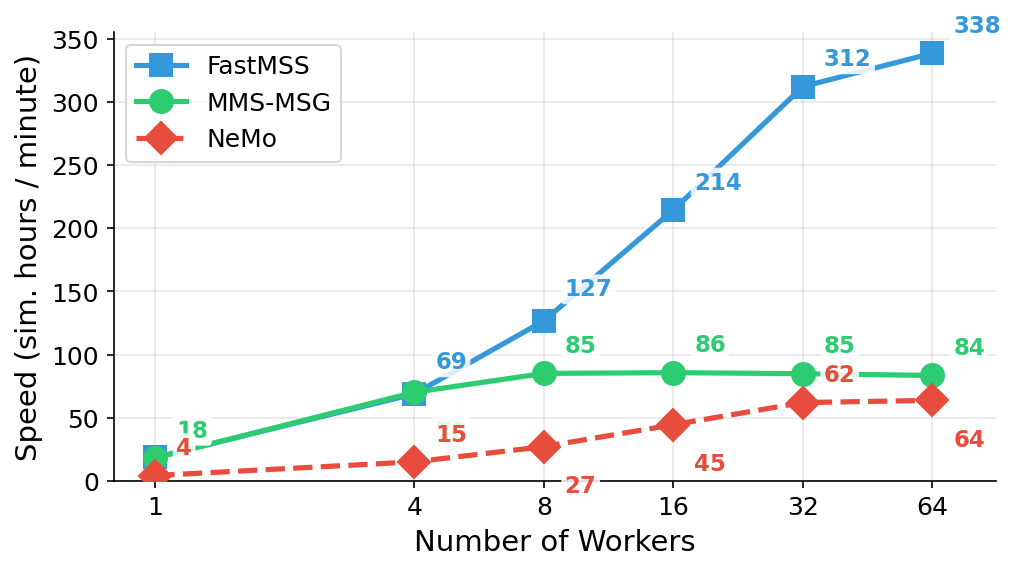
Generation throughput (simulated hours per minute) as a function of the number of parallel workers on a DGX node. FastMSS scales near-linearly and is significantly faster than MMS-MSG and NeMo simulators.
Features
- HMM-based turn-taking — models 4 transition types (turn hold, turn switch, interruption, backchannel) with configurable probabilities; can fit transitions to real corpora (AMI, CallHome, NOTSOFAR-1) or use flat priors
- Overlap control — boost overlap factor to increase/decrease interruption and backchannel rates
- Room simulation — RIR generation via pyroomacoustics with configurable room geometry and RT60
- Per-speaker outputs — optionally save individual speaker streams and anechoic references for separation/enhancement training
- Noise augmentation — add real noise (e.g. WHAM, MUSAN) at configurable SNR ranges
- Lhotse integration — reads source speech from lhotse CutSets with word-level alignments; outputs lhotse-compatible manifests
- RTTM + NeMo manifests — optionally generate RTTM files and NeMo-style diarization manifests
Installation
git clone https://github.com/popcornell/FastMSS.git
cd FastMSS
pip install -e .
Project Structure
FastMSS/
├── fastmss/                     # Core simulation library
│   ├── simulator.py             # Meeting generation engine
│   ├── hmm_turn_taking.py       # HMM turn-taking model
│   ├── rirsimulator.py          # RIR generation via pyroomacoustics
│   └── utils.py                 # Audio splitting, crossfading utilities
├── recipes/
│   ├── sim.py                   # Unified simulation pipeline
│   ├── default.yaml             # Default config with sensible defaults
│   └── paper/                   # Configs to reproduce paper experiments
│       ├── ts_asr/              # TS-ASR experiment configs (Table 1 & 2)
│       └── diarization/         # Diarization experiment configs
├── preprocessing/
│   ├── download_wham.sh         # Download WHAM noise dataset
│   ├── download_otospeech.sh    # Download + prepare otoSpeech dataset
│   └── resample_folder.py       # General audio resampling utility
├── setup.py
└── requirements.txt
Quick Start
1. Prepare source data
FastMSS takes single-speaker audio in lhotse format as input. You can use any speech corpus — here are two common options:
# Option A: LibriSpeech (via lhotse)
lhotse download librispeech --full /path/to/librispeech
lhotse prepare librispeech /path/to/librispeech /path/to/manifests

# Option B: otoSpeech (from HuggingFace)
bash preprocessing/download_otospeech.sh /path/to/manifests /path/to/otospeech

# Optional: download WHAM noise for augmentation
bash preprocessing/download_wham.sh /path/to/wham
2. Generate meetings
All paths are set via Hydra CLI overrides — no config file editing needed:
# Basic: 1000 meetings, 2-4 speakers, 60s each, flat turn-taking priors
python recipes/sim.py \
    output_dir=/path/to/output \
    manifest_dir=/path/to/manifests \
    n_meetings=1000 \
    duration=60 \
    n_jobs=16

# With noise + reverberation
python recipes/sim.py \
    output_dir=/path/to/output \
    manifest_dir=/path/to/manifests \
    noise_folders=[/path/to/wham] \
    add_noise=true \
    reverberate=true \
    n_jobs=16

# Save per-speaker anechoic references (for separation/enhancement)
python recipes/sim.py \
    output_dir=/path/to/output \
    manifest_dir=/path/to/manifests \
    save_spk=true \
    save_anechoic=true \
    reverberate=true \
    n_jobs=16

# Generate RTTM + NeMo manifests (for diarization)
python recipes/sim.py \
    output_dir=/path/to/output \
    manifest_dir=/path/to/manifests \
    save_rttm=true \
    save_nemo_manifest=true \
    n_jobs=16
Key parameters
General:
| Parameter | Description | Default |
|---|---|---|
output_dir | Where to write simulated audio + manifests | — |
manifest_dir | Directory with lhotse source manifests | — |
n_meetings | Number of meetings to generate | 1000 |
duration | Target meeting duration in seconds | 60 |
min_max_spk | Speaker count range [min, max] | [2, 4] |
n_jobs | Parallel workers | 8 |
Augmentation (all independently toggleable):
| Parameter | Description | Default |
|---|---|---|
reverberate | Apply room impulse responses to the mix | false |
reverb_prob | Probability of applying RIR per meeting (if reverberate=true) | 0.5 |
rt60 | RT60 range in seconds | [0.1, 0.7] |
room_sz | Room dimensions range in meters | [5, 10] |
n_rirs | Number of RIRs to pre-simulate | 5000 |
add_noise | Add background noise to the mix | false |
noise_folders | Noise audio directories (list) | null |
noise_rel_gain | Noise gain relative to speech (dB range) | [-20, -3] |
noise_probability_global | Probability of adding noise per meeting | 0.5 |
speed_perturb | Apply speed perturbation to source utterances | false |
speed_perturb_range | Speed perturbation factor range | [0.95, 1.05] |
use_fir | Apply FIR filtering | false |
Output options:
| Parameter | Description | Default |
|---|---|---|
save_spk | Save per-speaker audio streams | false |
save_anechoic | Save anechoic (dry) per-speaker references | false |
save_rttm | Generate RTTM files (Stage 5) | false |
save_nemo_manifest | Generate NeMo-style diarization manifest | false |
Turn-taking:
| Parameter | Description | Default |
|---|---|---|
hmm_params.p_ind | Transition probabilities [hold, switch, interruption, backchannel] | [0.25, 0.25, 0.25, 0.25] |
hmm_fit_transitions_to | Fit HMM to a target corpus (path to lhotse manifest) | null |
boost_overlap_factor | Scale interruption/backchannel rates | null |
use_markov | Use Markov chain for state transitions | false |
stage | Start from this pipeline stage | 0 |
Turn-Taking Model
FastMSS uses a 4-state HMM to model conversational dynamics. At each turn boundary, the model samples one of:
| Transition | Description | Effect |
|---|---|---|
| Turn Hold | Same speaker continues | No overlap, natural pause |
| Turn Switch | New speaker takes the floor | No overlap, speaker change |
| Interruption | New speaker starts before current finishes | Partial overlap |
| Backchannel | Brief interjection while speaker continues | Short overlap |
Transition probabilities can be set to uniform (flat), fitted to a target corpus via hmm_fit_transitions_to, or manually specified via hmm_params.p_ind. The boost_overlap_factor parameter scales the interruption and backchannel probabilities to increase or decrease overall overlap.
Reproducing Paper Experiments
The recipes/paper/ directory contains the exact configs used in the Interspeech 2026 paper. To run them, override the config name:
# TS-ASR Table 1: flat turn-taking priors
python recipes/sim.py \
    --config-name paper/ts_asr/table1/flat \
    output_dir=/path/to/output \
    manifest_dir=/path/to/manifests

# Diarization: 2-speaker clean with overlap boosting
python recipes/sim.py \
    --config-name paper/diarization/clean/librispeech_2spk \
    output_dir=/path/to/output \
    manifest_dir=/path/to/manifests
Citation
If you use FastMSS in your research, please cite:
@unpublished{polok2026mindthegap,
    author = {Polok, Alexander and Medennikov, Ivan and Watanabe, Shinji and {\v{C}}ernock{\'y}, Jan and Burget, Luk{\'a}{\v{s}} and Cornell, Samuele},
    title = {Mind the Gap: Impact of Synthetic Conversational Data on Multi-Talker {ASR} and Speaker Diarization},
    note = {Submitted to INTERSPEECH},
    year = {2026}
}
Contributors


Similar repos


Languages
Python
87.3%
Shell
12.7%
README
FastMSS: Fast Multi-Speaker Simulation
FastMSS is a toolkit for generating realistic multi-speaker meeting scenarios using room impulse response (RIR) simulation and HMM-based turn-taking models. It can dump per-speaker anechoic and reverberant reference signals, making it suitable for training speech separation and enhancement models in addition to speaker-attributed ASR and speaker diarization systems.
Demo
A simulated noisy + reverberant meeting generated by FastMSS (click to play on GitHub):
https://github.com/user-attachments/files/26752329/2efd6b4a-8fda-463e-8829-8cf885960f3d.wav
Speed
Generation throughput (simulated hours per minute) as a function of the number of parallel workers on a DGX node. FastMSS scales near-linearly and is significantly faster than MMS-MSG and NeMo simulators.
Features
- HMM-based turn-taking — models 4 transition types (turn hold, turn switch, interruption, backchannel) with configurable probabilities; can fit transitions to real corpora (AMI, CallHome, NOTSOFAR-1) or use flat priors
- Overlap control — boost overlap factor to increase/decrease interruption and backchannel rates
- Room simulation — RIR generation via pyroomacoustics with configurable room geometry and RT60
- Per-speaker outputs — optionally save individual speaker streams and anechoic references for separation/enhancement training
- Noise augmentation — add real noise (e.g. WHAM, MUSAN) at configurable SNR ranges
- Lhotse integration — reads source speech from lhotse CutSets with word-level alignments; outputs lhotse-compatible manifests
- RTTM + NeMo manifests — optionally generate RTTM files and NeMo-style diarization manifests
Installation
git clone https://github.com/popcornell/FastMSS.git
cd FastMSS
pip install -e .
Project Structure
FastMSS/
├── fastmss/                     # Core simulation library
│   ├── simulator.py             # Meeting generation engine
│   ├── hmm_turn_taking.py       # HMM turn-taking model
│   ├── rirsimulator.py          # RIR generation via pyroomacoustics
│   └── utils.py                 # Audio splitting, crossfading utilities
├── recipes/
│   ├── sim.py                   # Unified simulation pipeline
│   ├── default.yaml             # Default config with sensible defaults
│   └── paper/                   # Configs to reproduce paper experiments
│       ├── ts_asr/              # TS-ASR experiment configs (Table 1 & 2)
│       └── diarization/         # Diarization experiment configs
├── preprocessing/
│   ├── download_wham.sh         # Download WHAM noise dataset
│   ├── download_otospeech.sh    # Download + prepare otoSpeech dataset
│   └── resample_folder.py       # General audio resampling utility
├── setup.py
└── requirements.txt
Quick Start
1. Prepare source data
FastMSS takes single-speaker audio in lhotse format as input. You can use any speech corpus — here are two common options:
# Option A: LibriSpeech (via lhotse)
lhotse download librispeech --full /path/to/librispeech
lhotse prepare librispeech /path/to/librispeech /path/to/manifests

# Option B: otoSpeech (from HuggingFace)
bash preprocessing/download_otospeech.sh /path/to/manifests /path/to/otospeech

# Optional: download WHAM noise for augmentation
bash preprocessing/download_wham.sh /path/to/wham
2. Generate meetings
All paths are set via Hydra CLI overrides — no config file editing needed:
# Basic: 1000 meetings, 2-4 speakers, 60s each, flat turn-taking priors
python recipes/sim.py \
    output_dir=/path/to/output \
    manifest_dir=/path/to/manifests \
    n_meetings=1000 \
    duration=60 \
    n_jobs=16

# With noise + reverberation
python recipes/sim.py \
    output_dir=/path/to/output \
    manifest_dir=/path/to/manifests \
    noise_folders=[/path/to/wham] \
    add_noise=true \
    reverberate=true \
    n_jobs=16

# Save per-speaker anechoic references (for separation/enhancement)
python recipes/sim.py \
    output_dir=/path/to/output \
    manifest_dir=/path/to/manifests \
    save_spk=true \
    save_anechoic=true \
    reverberate=true \
    n_jobs=16

# Generate RTTM + NeMo manifests (for diarization)
python recipes/sim.py \
    output_dir=/path/to/output \
    manifest_dir=/path/to/manifests \
    save_rttm=true \
    save_nemo_manifest=true \
    n_jobs=16
Key parameters
General:
| Parameter | Description | Default |
|---|---|---|
output_dir | Where to write simulated audio + manifests | — |
manifest_dir | Directory with lhotse source manifests | — |
n_meetings | Number of meetings to generate | 1000 |
duration | Target meeting duration in seconds | 60 |
min_max_spk | Speaker count range [min, max] | [2, 4] |
n_jobs | Parallel workers | 8 |
Augmentation (all independently toggleable):
| Parameter | Description | Default |
|---|---|---|
reverberate | Apply room impulse responses to the mix | false |
reverb_prob | Probability of applying RIR per meeting (if reverberate=true) | 0.5 |
rt60 | RT60 range in seconds | [0.1, 0.7] |
room_sz | Room dimensions range in meters | [5, 10] |
n_rirs | Number of RIRs to pre-simulate | 5000 |
add_noise | Add background noise to the mix | false |
noise_folders | Noise audio directories (list) | null |
noise_rel_gain | Noise gain relative to speech (dB range) | [-20, -3] |
noise_probability_global | Probability of adding noise per meeting | 0.5 |
speed_perturb | Apply speed perturbation to source utterances | false |
speed_perturb_range | Speed perturbation factor range | [0.95, 1.05] |
use_fir | Apply FIR filtering | false |
Output options:
| Parameter | Description | Default |
|---|---|---|
save_spk | Save per-speaker audio streams | false |
save_anechoic | Save anechoic (dry) per-speaker references | false |
save_rttm | Generate RTTM files (Stage 5) | false |
save_nemo_manifest | Generate NeMo-style diarization manifest | false |
Turn-taking:
| Parameter | Description | Default |
|---|---|---|
hmm_params.p_ind | Transition probabilities [hold, switch, interruption, backchannel] | [0.25, 0.25, 0.25, 0.25] |
hmm_fit_transitions_to | Fit HMM to a target corpus (path to lhotse manifest) | null |
boost_overlap_factor | Scale interruption/backchannel rates | null |
use_markov | Use Markov chain for state transitions | false |
stage | Start from this pipeline stage | 0 |
Turn-Taking Model
FastMSS uses a 4-state HMM to model conversational dynamics. At each turn boundary, the model samples one of:
| Transition | Description | Effect |
|---|---|---|
| Turn Hold | Same speaker continues | No overlap, natural pause |
| Turn Switch | New speaker takes the floor | No overlap, speaker change |
| Interruption | New speaker starts before current finishes | Partial overlap |
| Backchannel | Brief interjection while speaker continues | Short overlap |
Transition probabilities can be set to uniform (flat), fitted to a target corpus via hmm_fit_transitions_to, or manually specified via hmm_params.p_ind. The boost_overlap_factor parameter scales the interruption and backchannel probabilities to increase or decrease overall overlap.
Reproducing Paper Experiments
The recipes/paper/ directory contains the exact configs used in the Interspeech 2026 paper. To run them, override the config name:
# TS-ASR Table 1: flat turn-taking priors
python recipes/sim.py \
    --config-name paper/ts_asr/table1/flat \
    output_dir=/path/to/output \
    manifest_dir=/path/to/manifests

# Diarization: 2-speaker clean with overlap boosting
python recipes/sim.py \
    --config-name paper/diarization/clean/librispeech_2spk \
    output_dir=/path/to/output \
    manifest_dir=/path/to/manifests
Citation
If you use FastMSS in your research, please cite:
@unpublished{polok2026mindthegap,
    author = {Polok, Alexander and Medennikov, Ivan and Watanabe, Shinji and {\v{C}}ernock{\'y}, Jan and Burget, Luk{\'a}{\v{s}} and Cornell, Samuele},
    title = {Mind the Gap: Impact of Synthetic Conversational Data on Multi-Talker {ASR} and Speaker Diarization},
    note = {Submitted to INTERSPEECH},
    year = {2026}
}
Similar repos
Contributors
Languages
Python
87.3%
Shell
12.7%