
Bottom-up combinatorial gauge and fiber dynamics for Wolfram-model hypergraph rewriting
Python
0
46 commits
updated Sep 10, 2026
See what people are saying (1)
README
Wolfram Physics Engine Exploration:
Gauge Theory & the Standard Model

Stephen Wolfram launched the Wolfram Physics Project around a radical question: could familiar physics emerge from extremely simple computational rules, rather than being programmed into a simulation as the known equations of relativity, quantum mechanics, or the Standard Model? In the Wolfram model, a possible spatial state is represented by a hypergraph, local rules repeatedly replace small pieces of that graph, and a causal graph records which update events depend on earlier events. Following every possible order of updates produces a multiway graph of alternative histories; slices through that structure produce branchial graphs, which the project relates to quantum states and entanglement.
For suitable rules and under additional assumptions—especially locality, causal invariance, and an appropriate large-scale limit—the project argues that structures resembling continuous space, relativistic causal cones, and aspects of quantum mechanics can emerge. These are proposed mathematical correspondences, not yet a demonstrated model of our universe, and quantum probability is not simply the number of nodes in a hypergraph: Wolfram associates amplitude magnitude with path multiplicity in multiway evolution and phase with position in branchial space. The intuition is a little like Conway's Game of Life, except there is no fixed grid—the network of relationships that may become space is itself continually rewritten. This repository investigates whether gauge structure and field-like dynamics can be built at that microscopic level, with the long-term goal of testing for QED-like behavior and simple bound systems without inserting continuum fields or forces by hand; it does not yet derive QED, particles, physical constants, or molecules.
Stephen Wolfram: Can space and time emerge from simple rules?
|
Hands-On Introduction to the Wolfram Physics Project
|
The questions we are trying to answer
This project starts from the interview above. The goal is to take one of Wolfram's unfinished ideas, turn it into a precise computational question, and find an answer—or a specific reason it fails.
Three questions organize the work:
- How does the network become space? Can local rewrites produce a stable large-scale dimension, and what happens when that dimension varies? Wolfram discusses dimension fluctuations at 1:11:17.
- Where would fields and charge come from? Can choices within the rewriting process give rise to internal degrees of freedom and their interactions? He explicitly leaves electric charge unresolved at 1:07:07.
- What could persist as a particle? Can a recognizable structure survive while its underlying network changes, move relative to its surroundings, and interact with another such structure? He identifies the missing particle model at 1:25:38.
Molecules are a later target, not the assumed interpretation of a graph pattern. None of these three questions has been solved here. The calculations below provide starting tools and some restrictions on candidate answers.
1. Start with relationships, not a stage to put particles on
In an ordinary simulation, space is already there. Objects have positions and fields have values at those positions. In the proposal discussed in the interview, the network is what might eventually look like space. There is no separate stage underneath it.
A node is an identifiable abstract element. It is not a voxel, an atom, or a sample of a known field. A hyperedge records a relationship between two or more elements. A rewrite replaces a small pattern of relationships with another, possibly creating new elements.
before = [(0, 1), (0, 2)]
after  = [(0, 2), (0, 3), (1, 3), (2, 3)]
This example replaces two relationships with four, using a fresh node. The integers are IDs, like dictionary keys—not positions or measured values. The tuples list related IDs, not coordinates. Strings could name the same nodes without changing the structure.
It illustrates what a rewrite is; it is not established as a rule that produces matter.
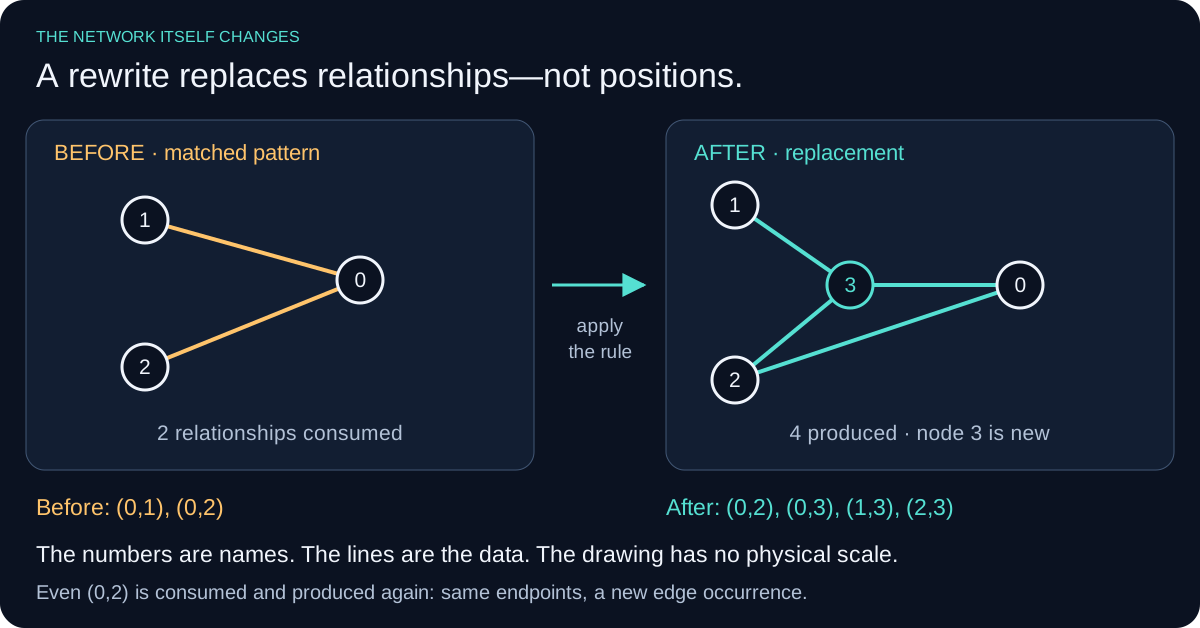
The same rule used by the runnable example below. Node 3 is new. Dot positions help draw the connections; they are not measured positions in space. Even the unchanged endpoint pair (0,2) is a new edge occurrence after this rule consumes and reproduces it.
Details: the state, the rule, and what has units
A state is conceptually a list[tuple[int, ...]]. Repeated relationships
can be distinct occurrences, so the engine also retains their identities.
A rule contains two patterns: the relationships to consume and those to
produce. Repeated names within a pattern identify the same node; fresh
names on the output side introduce new nodes.
Node IDs, adjacency, pattern matching, and event counts are discrete, exact data. There is no required floating-point precision at this layer. The count of nodes is not a length in meters; the count of rewrites is not elapsed time in seconds.
Relabeling a graph changes its written representation, not its connectivity. Canonicalization detects that equivalence. It must preserve whatever additional data an experiment has actually put in the state; two bare graphs can be identical while their attached data differs.
The rewrite engine is the Wolfram Institute's HypergraphRewritingEngine.
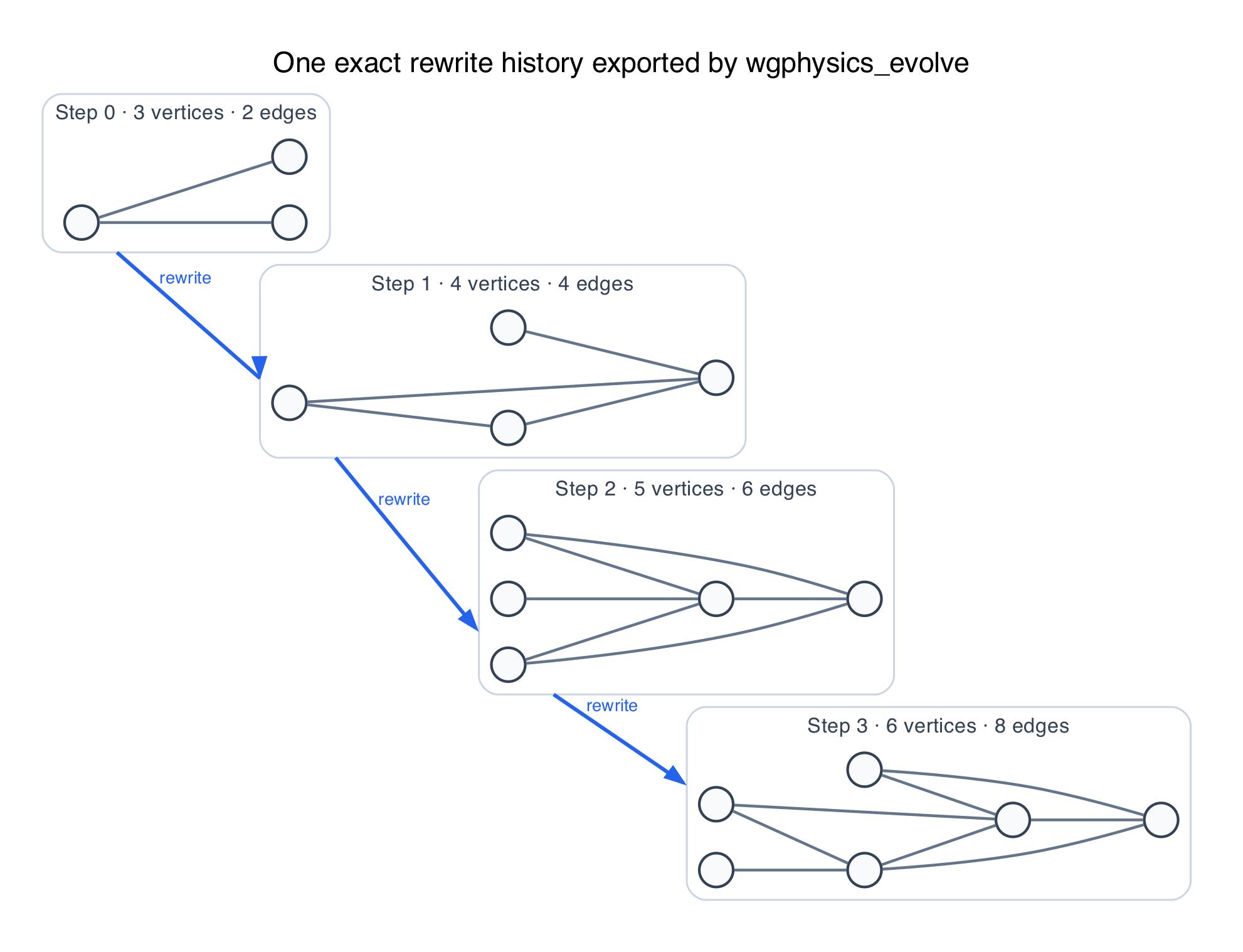
An actual engine history, read top left to bottom right. Each arrow is one rewrite; the layouts are not physical coordinates.
Our engine–gauge integration is more limited: its supported base change is transport-preserving edge subdivision, not arbitrary coupled geometry-and-field evolution.
2. Keep track of what happened—and what else could have happened
A rewrite can use a relationship made by an earlier rewrite. That gives a dependency: the producer must happen before the consumer. Collect those dependencies and you have a causal graph.
There may also be several places where the rule can apply. Following each possibility produces a multiway graph. Histories branch when there are alternatives and merge when they reach equivalent states.
These are different records. A causal edge connects dependent events. A multiway edge connects a state to a possible next state.
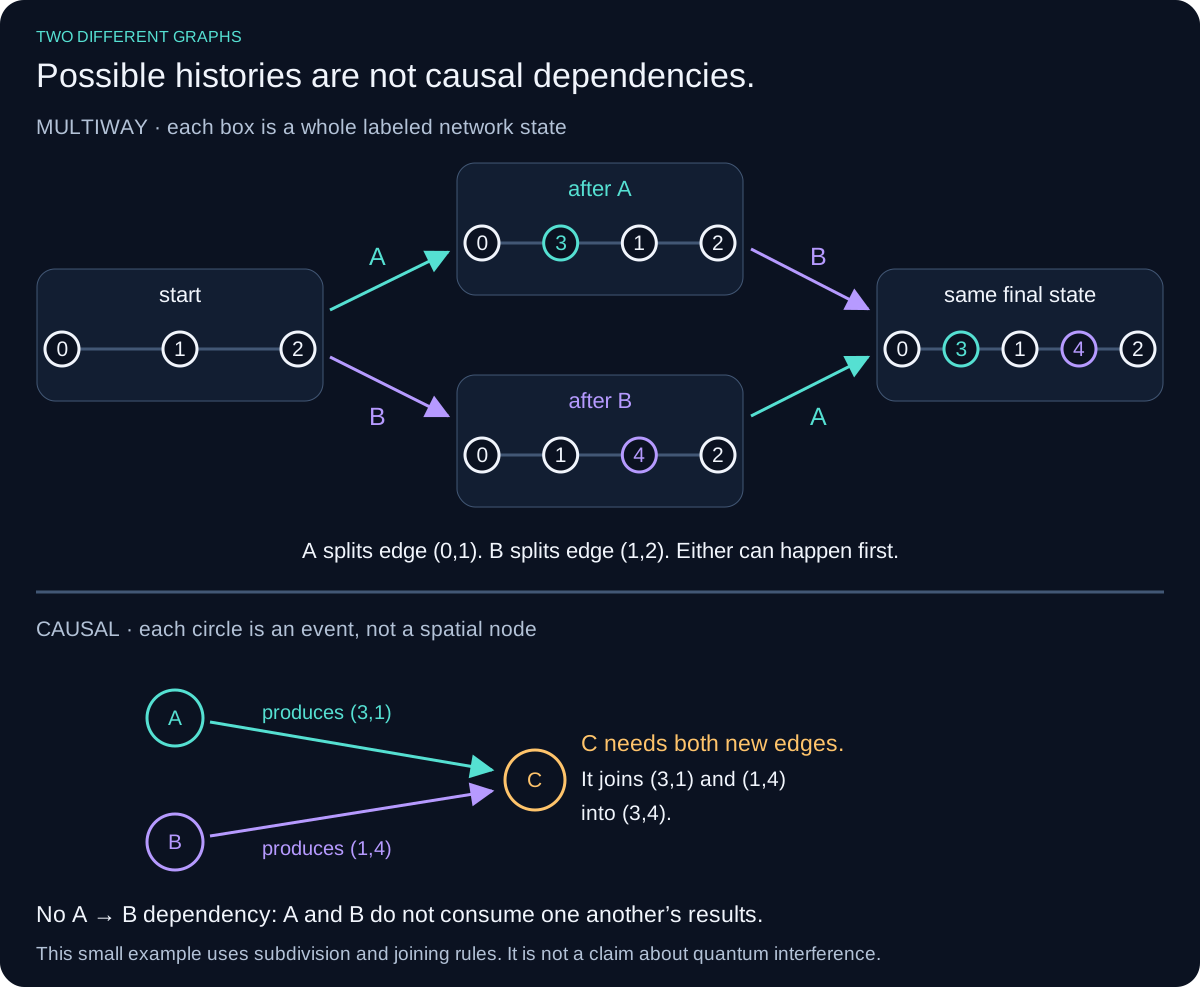
A fully specified small example. Above: A and B can happen in either order and reach the same network. Below: C needs a relationship made by each, so its causal graph has two prerequisites. The colors track events, not fields. Node names are retained here; ignoring names can identify the two intermediate graphs as equivalent too. This illustrates the distinction, not quantum interference.
Why retain the alternatives? Wolfram's proposal makes their structure part of the physics question. Selecting one random history may be useful for some measurements, but it does not reproduce the whole multiway system or establish quantum probabilities.
Details: event dependencies, branching, and quantum claims
An event record identifies consumed and produced hyperedge occurrences. A dependency follows from actual production and consumption; added interaction layers must also account for their read and write supports.
A path can be stored as a tuple[int, ...] of event IDs. Storing
(A, B) instead of (B, A) records order; the rewrite rule determines
whether both orders are possible and whether their results agree.
Order dependence is something to examine, not an extra microscopic
substance.
The engine exports finite multiway and causal structures. A branchial view compares alternatives across a selected slice. Its adjacency is not by itself an entanglement measure. Nor do path counts alone provide complex amplitudes, interference, or the Born rule.
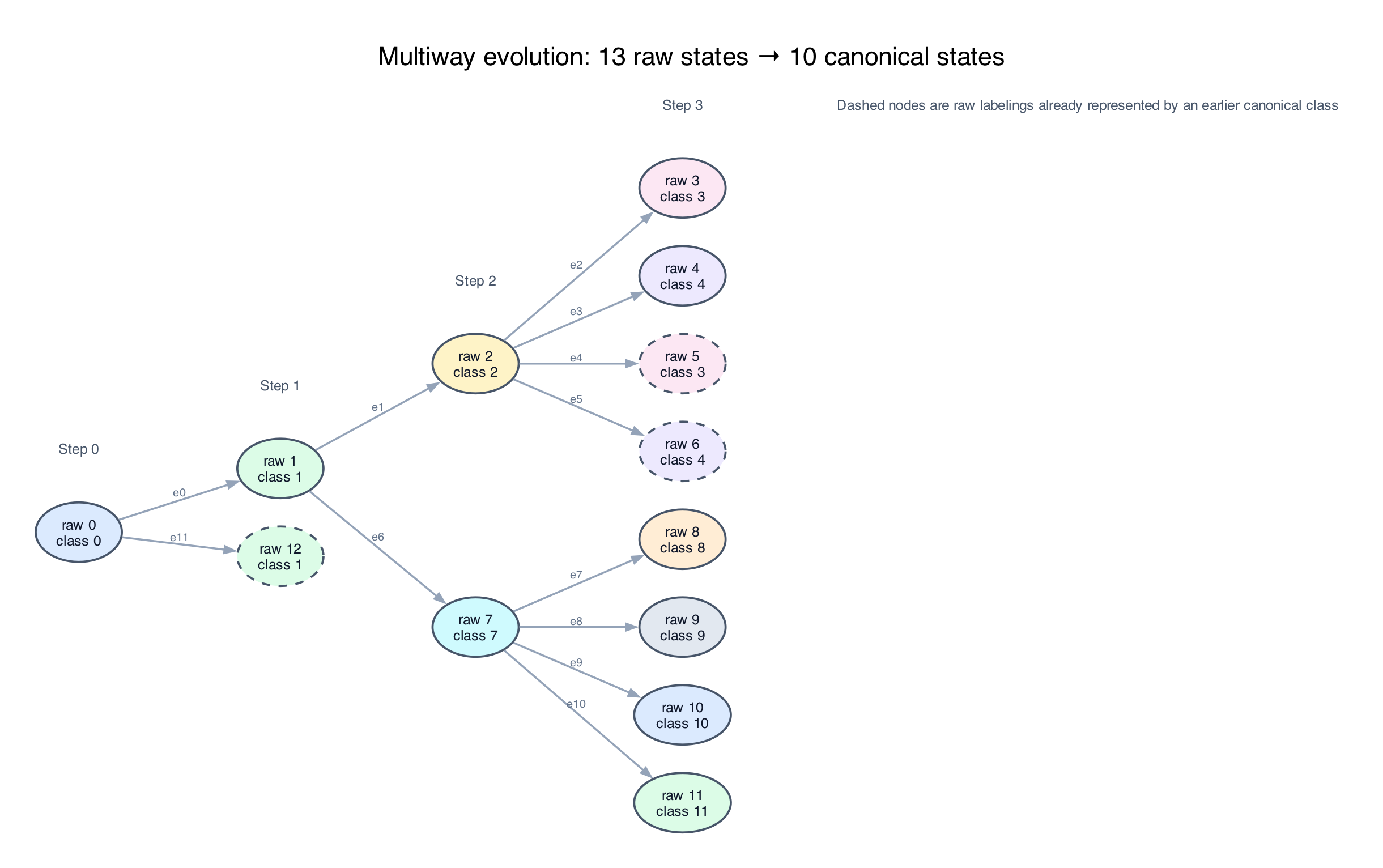
This export has 13 raw states and 10 graph-isomorphism classes. Detecting equivalent node labelings is not a proof that all update orders have equivalent causal histories.
Causal invariance is a stronger question than whether two finite histories end at the same graph. A bounded computation can find a counterexample or establish a bounded result; a general conclusion requires an argument covering the unexamined histories.
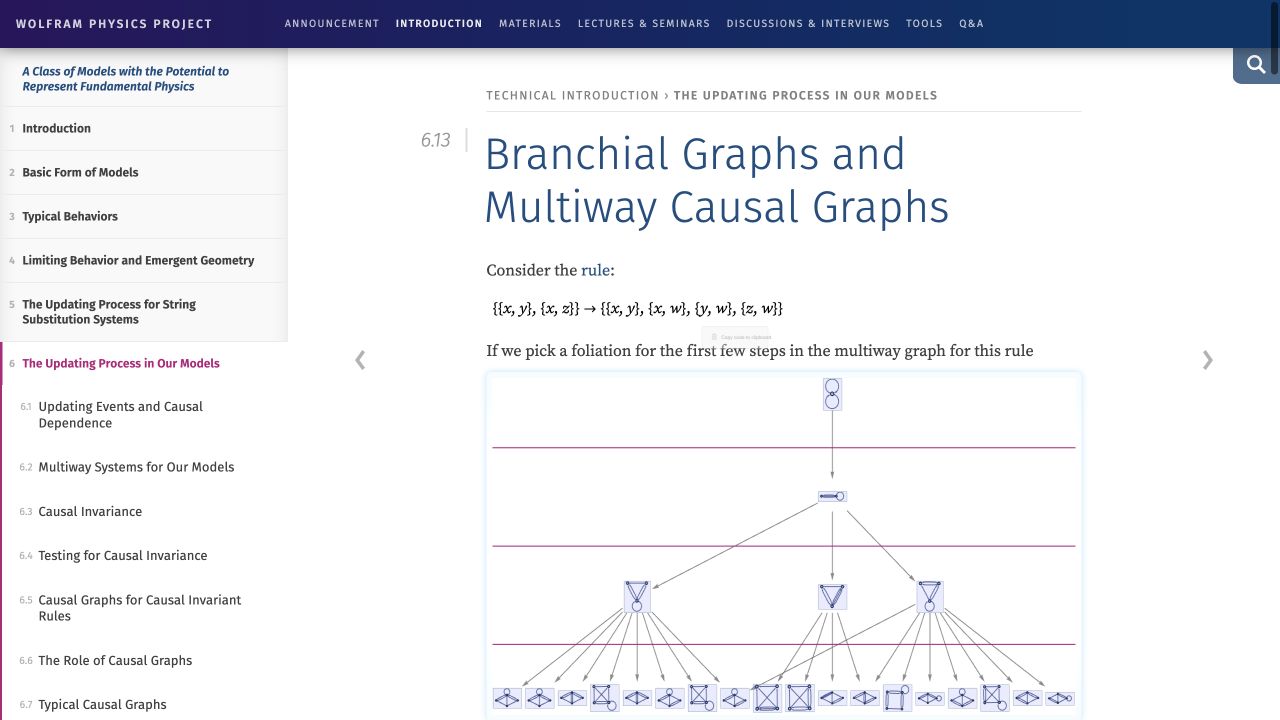
Screenshot of Wolfram's technical introduction. The small blue diagrams are graph states; horizontal lines mark slices through their history. This is an upstream illustration, not our simulation result.
See event-preserving integration and causality, locality, and correlation.
3. Measure whether something like space appears
Stand at a node and count how many other nodes are reachable within one hop, two hops, three hops, and so on. In a region resembling ordinary three-dimensional space, doubling a sufficiently large radius should enclose roughly eight times as many nodes.
That gives a way to ask about dimension without first drawing the graph in 3D. Repeat the measurement at different locations and times: does the same dimension persist, or does the growth pattern change?
This is a direct route into the interview's dimension question. The current probes can make these measurements, but the small rule survey does not establish a three-dimensional regime or physical dimension fluctuations.
flowchart LR
    N["Rewritten network"] --> B["Count nodes within r hops"]
    N --> W["Measure random-walk returns"]
    B --> C["Compare locations, scales, and later states"]
    W --> C
    C --> Q["Does a stable geometric regime appear?"]
Mathematics: dimension measurements and their limits
Let ball_counts be a list[int]: entry r counts nodes within
graph distance r of a selected source. A local scaling estimate is
d_H(r)=\frac{d\log |B(v,r)|}{d\log r}.
An independent probe follows an auxiliary random walk and estimates its return probability. A power-law regime would have
p_t(v,v)\propto t^{-d_s/2}.
The estimated dimensions and probabilities are float values.
The walk's time counts probe steps; it is not the time of the rewrites.
Different dimension notions need not agree on a general graph.
The current probes use the undirected simple 2-section of a hypergraph: nodes sharing a hyperedge are connected. This measurement choice forgets edge ordering and multiplicity. Small graphs, boundaries, the projection, and source sampling can all affect the estimate.
A useful result needs a scaling window that survives larger graphs, different source choices, and continued evolution. Fluctuations must be distinguished from estimator noise. Curvature requires additional geometric information; a changing dimension estimate is not automatically a gravitational wave.
See measurement definitions and limitations. The existing 38-rule, three-step survey selects diverse graph statistics, not a target shape. It is a starting survey, not an exhaustive rule search or a continuum-limit result.
4. Ask where internal structure would come from
In the interview, the starting data are relationships and rewrites. There is no instruction to attach a triangle to every node.
The gauge-theory lead is more specific in Wolfram's technical introduction: different local rewrite choices may serve as equivalent descriptions, while a choice made here affects which choices remain possible later. The proposal connects this structure to gauge freedom and field propagation. That connection is something to construct and test.
A fiber is the collection of detailed states or descriptions that lie over one location in a chosen description. To derive one here, we would first need to specify what that description retains and which underlying distinctions it groups together.
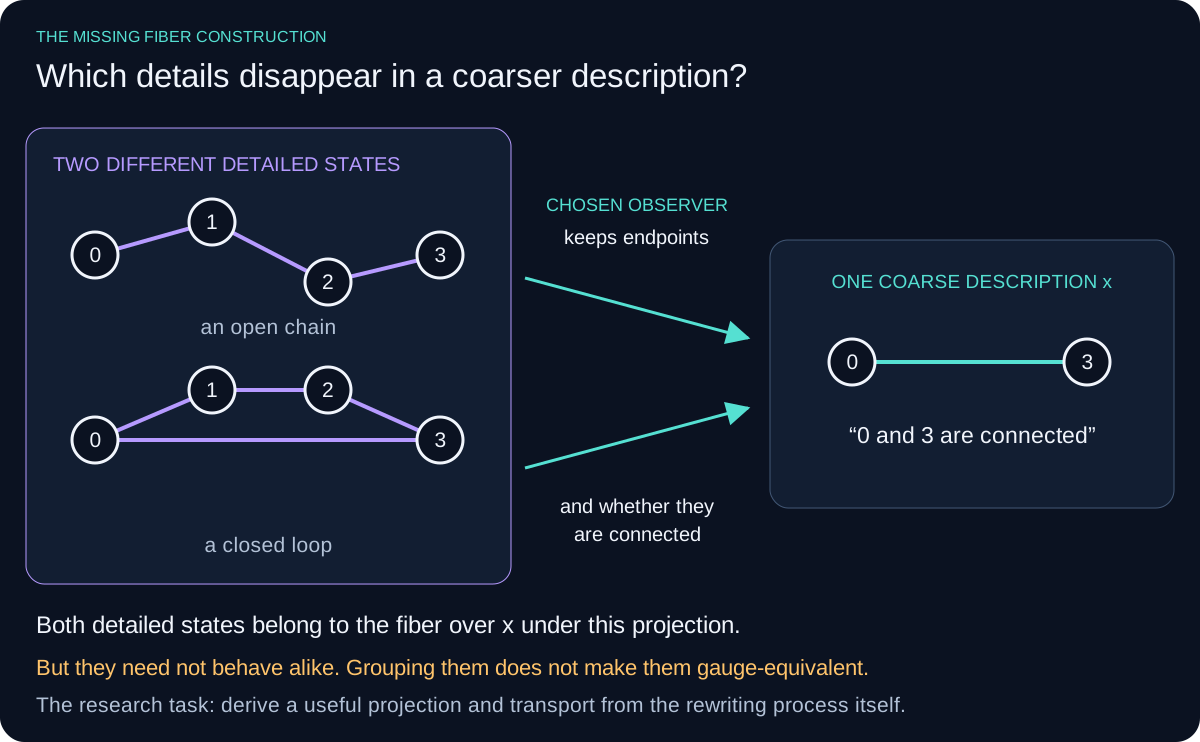
An intentionally simple projection: keep the two endpoints and whether they are connected, but hide the route between them. A chain and a loop then look alike to that observer. They can still evolve differently. This explains a fiber as a set of alternatives; it does not derive a physical observer, a graph connection, or gauge equivalence.
InfraGaugeTheory provides a language for graph fibers, projections, connections, and transport. Its stated goals include natural clustering into fibers and obtaining fibered graphs from hypergraph rewriting. Those are directly relevant open construction problems.
What the triangle experiments do—and do not—supply
Our existing finite-gauge studies work in the opposite direction: choose a fiber, calculate its symmetries, then study specified interactions. This is a controlled laboratory for candidate structures. It has not derived the fiber or its dynamics from the bare rewrite system.
Why three vertices? A triangle is the smallest simple graph whose symmetries can act differently when applied in different orders. It is small enough to enumerate exactly. That is a practical reason for a test case, not a reason that nature must use it.
A five-node ring is another possible choice. So is a fifty-node ring. The connections matter as well as the count: ring-preserving maps are rotations and reflections, not arbitrary permutations. Current cycle-reaction results assume odd ring size; an even ring introduces additional algebraic cases. Adding internal vertices is not automatically increasing spatial resolution.
Mathematics: supplied fibers versus a rewrite-derived construction
For a projection from detailed states or graph elements to a retained description, a fiber is a preimage:
F_x=p^{-1}(x).
This definition alone supplies neither an internal adjacency nor a connection, symmetry group, or evolution law. Those structures need separate derivations. In particular, physically distinct alternatives must not be discarded merely because a selected observer fails to distinguish them.
In the current homogeneous graph-fiber experiments, the internal adjacency is supplied. Its automorphisms are then calculated exactly:
G=\mathrm{Aut}(F).
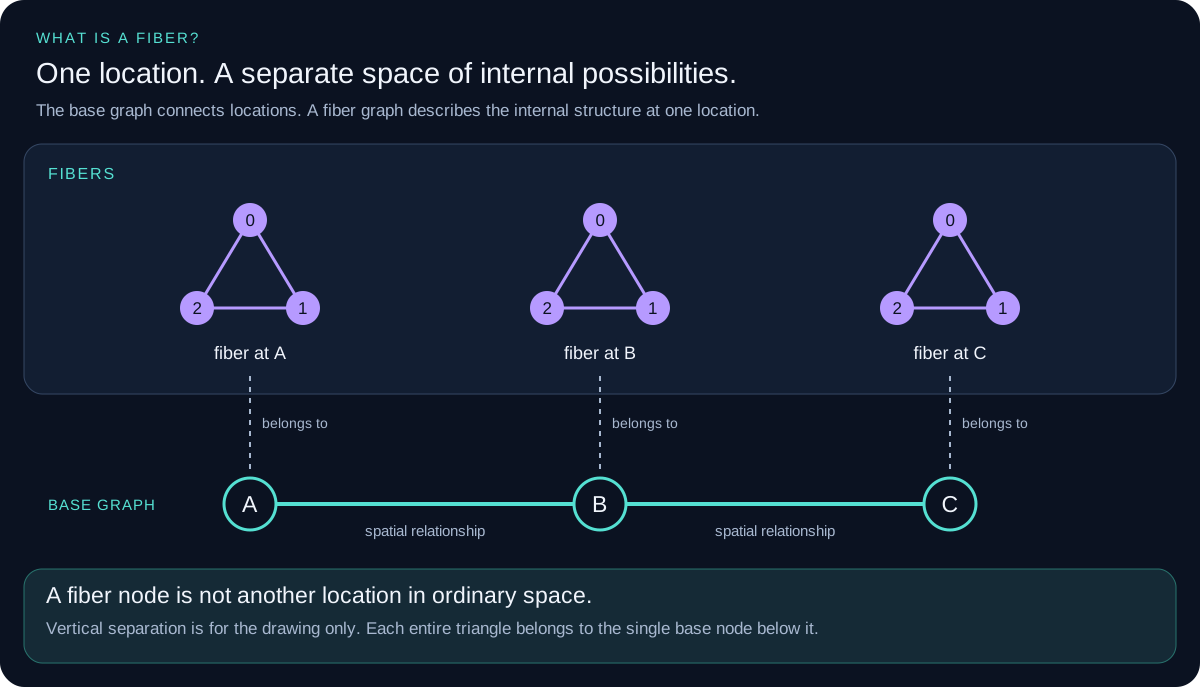
Each upper triangle is a separately supplied internal graph. Dashed lines say which base node it belongs to; they are not extra spatial connections. Unlike the preceding projection example, this construction supplies the fiber's internal adjacency from the start.
For a cycle with n >= 3 vertices, each map has the form
U(v)=sv+a\pmod n,
\qquad s\in\{-1,1\},\quad a\in\mathbb Z_n.
There are 2*n such maps. A map can be represented as a
list[int] of length n, or exactly as a (sign, shift) tuple
for this cycle family. It does not require an n-by-n floating-point
matrix or an angle tolerance.
The triangle allows all six permutations of its three vertices. A link carries one allowed map. Following links composes maps; following a closed loop gives its holonomy—the net internal transformation on return to the starting point.
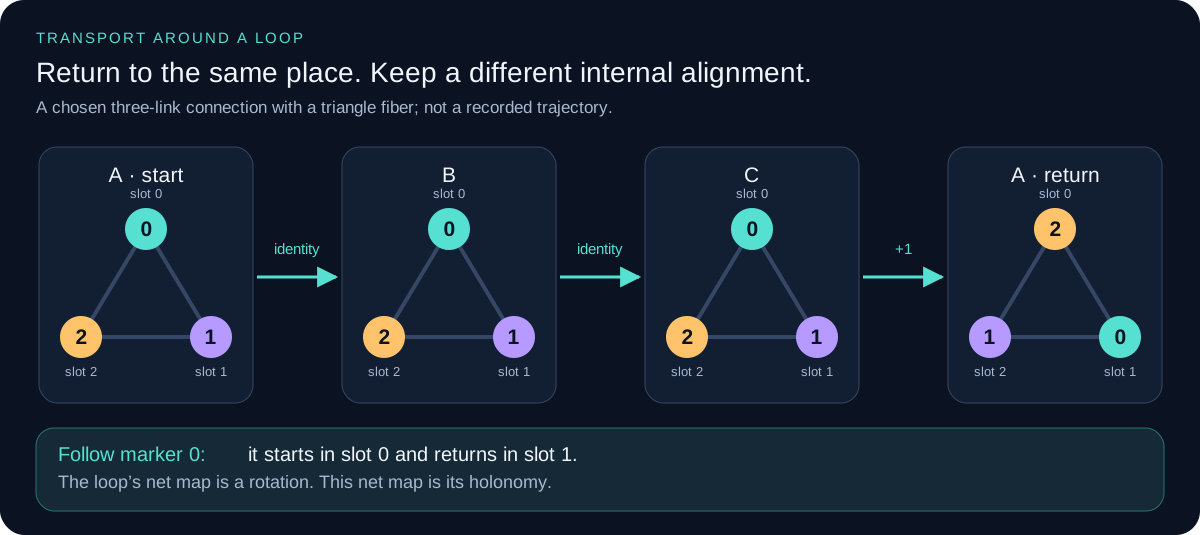
This chosen connection returns to the same base node with the internal labels rotated. It explains the measurement; it is not a particle orbit or evidence that the connection emerged from rewrites.
Changing local fiber labels transforms link maps as
U_{xy}\mapsto g_yU_{xy}g_x^{-1}.
The corresponding loop map changes by conjugation. Measurements that ignore this arbitrary frame choice are gauge invariant within the specified model.
A rewrite-derived construction must explain why its alternatives admit these kinds of maps—or show that a different mathematical structure is needed. It must also distinguish a change of description from a change that affects later invariant measurements.
See finite-fiber assumptions and construction and the research questions and acceptance criteria.
5. Look for something that survives the changing network
Wolfram suggests that particles might be persistent structures in the network, rather than objects placed on it. The useful question is not “does this picture resemble an electron?” It is “what remains the same while the surrounding structure and its constituent nodes change?”
A candidate must survive actual rewrites. Its identity cannot depend on keeping the same node IDs or freezing the region that supports it. Motion must be measured relative to the surrounding network, not the positions assigned by a renderer.
The present fixed-fiber calculations give a useful warning: a prepared defect can support localized graph modes, yet allowed interactions can remove those modes. Localization in one snapshot is not persistence.
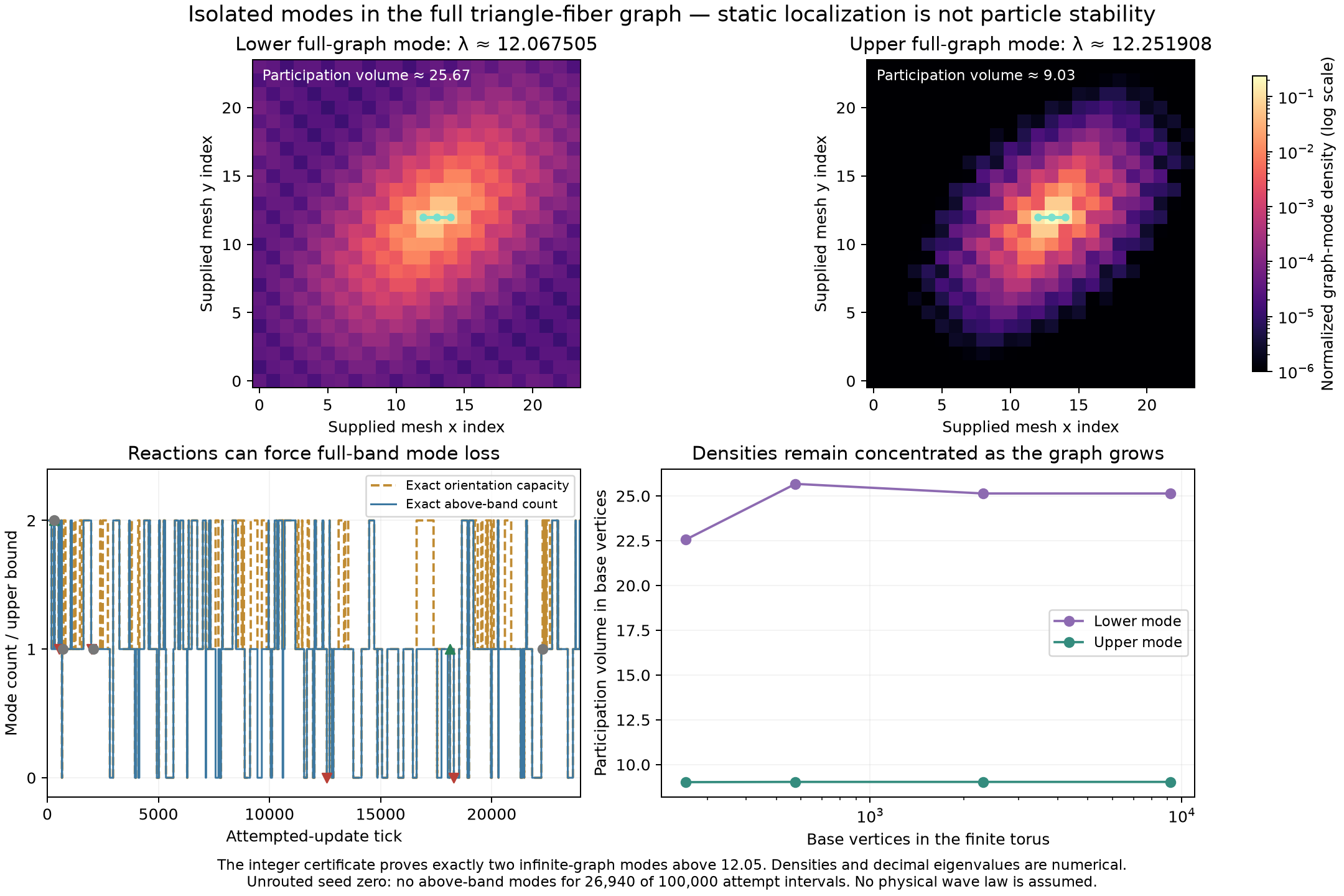
These calculations use a supplied two-dimensional lattice, triangle fibers, and prepared link defects. They concern the graph's spectrum. They are not electron orbitals, and no atomic energy scale is assigned.
Mathematics: localization, persistence, and interaction
For a graph with N vertices, its Laplacian is mathematically an
N-by-N real matrix. A normalized real eigenmode is a
list[float] of length N; its eigenvalue is one float.
A spatially concentrated mode does not by itself define a quantum state
or a physical Hamiltonian.
The specified triangle-fiber defect has an exact certificate for two modes above the full flat background spectrum. The same work bounds the possible mode count using the conserved weight on the two face orientations:
n_+(L_{\mathrm{bundle}}-12I)
\le\min(Q_\uparrow,Q_\downarrow).
Actual reactions can redistribute that weight and force mode loss. This is a reason to test temporal stability rather than infer particles from static eigenvectors.
A stronger candidate would need an invariant descriptor, a tracked causal history, a lifetime measured against local background activity, and survival under encounters. A motif copied by a rule is not automatically a particle; an apparently persistent patch that has never been updated is a separate control.
For a bound pair, compare separation and breakup behavior with isolated candidates and the model's accessible background. No attractive potential, target bond distance, or molecular geometry should be fed into the update law to obtain the desired answer.
See phenomenon-detection criteria and encounter-resolved persistence.
Progress So Far
-
Exact finite rewrite histories and event provenance. We can inspect spatial states, dependencies, and alternative histories using the upstream engine. A restricted connection-aware extension preserves these records through edge subdivision. This is a starting point for the interview's causal and multiway questions, not a general evolving gauge field. Construction.
-
Intrinsic geometry measurements and a bounded rule survey. Graph-ball and random-walk probes measure structure without taking dimension from a drawing. The present short survey has not found or established emergent 3D spacetime. Scope.
-
Exact descriptions of specified finite gauge states. Small-patch results show when local measurements lose information needed to predict an interaction, and how relative alignment restores it. This supplies a concrete test for a future observer-based description; it does not derive that observer or fiber. Patch reconstruction and gluing.
-
Restrictions on proposed routes to matter. In studied models, some apparent internal motion is only relabeling; diffuse large fibers reduce to ordinary exchange diffusion; and localized modes can be destroyed by the permitted dynamics. These delimit particular constructions, not all rewriting models. Unary restriction, refinement limit, localization and loss.
Supporting finite-model work: what it is useful for
The fixed-mesh reaction and memory studies are available as experiments in conditional dynamics. Their relevance is to specific questions: which internal relations affect later changes, whether those relations survive encounters, and when a reduced description loses predictive information.
The triangle reaction bank and its odd-cycle extensions have a conserved integer weight with values 0, 1, and 2 on three holonomy types. Here “charge” names that weight; it has not been identified with electric charge. The rules remain chosen, including the original positive-charge selection criterion.
Reaction construction, relative-angle dependence, reaction bursts, and transported constraints contain the assumptions, derivations, scripts, and saved results.
These studies warrant further compute when they resolve a stated obstacle to the rewrite-based program, not merely because a larger run is possible. A diffusion limit is useful here as a restriction on that model; recovering the known heat equation is not itself progress toward quantum matter.
The research map separates reusable constructions from the missing physical connections. The research direction defines which questions should drive new experiments.
Future Work
-
Construct internal alternatives from actual rewrites. On a small, completely explored example, specify a projection or observer and derive its candidate fibers and the maps between them. Determine which choices are equivalent descriptions and which change later observable behavior. A failure to define consistent transport is a useful result; attaching a preferred fiber is not a substitute.
-
Follow the consequences of a local rewrite choice. Compare alternatives with a common prior state and boundary. Track which later matches become possible or impossible, preserving event dependencies. Determine whether any effect survives relabeling, branch merging, and a change of description. This directly tests Wolfram's proposed route from local choices to gauge-like effects.
-
Find and characterize stable geometric regimes. Extend selected rule families far enough to separate growth, finite-size effects, and local dimension variation. Test several seeds and update schedules. Explain any regularity from the rewrite process before interpreting it as space or curvature.
-
Search for persistent, moving structures. Identify candidates by invariant relationships, follow them through replacement of their constituent nodes, and test encounters. Distinguish genuine survival from inactivity, imposed defects, and renderer artifacts.
-
Connect measured dynamics to an effective physical description. If a reproducible geometric or interaction regime appears, derive its scale dependence and observable laws. Quantum amplitudes, interference, physical charge, and mass each need their own construction. Known physics provides comparison targets, not hidden terms in the microscopic updates.
-
Spend compute on the limiting question. Use parallel enumeration for finite rule/transition problems and longer runs for declared persistence or scaling questions. Optimize the limiting operation only when it unlocks an otherwise inaccessible mathematical test. Keep counterexamples, null results, and incomplete runs.
Inspect the experiments
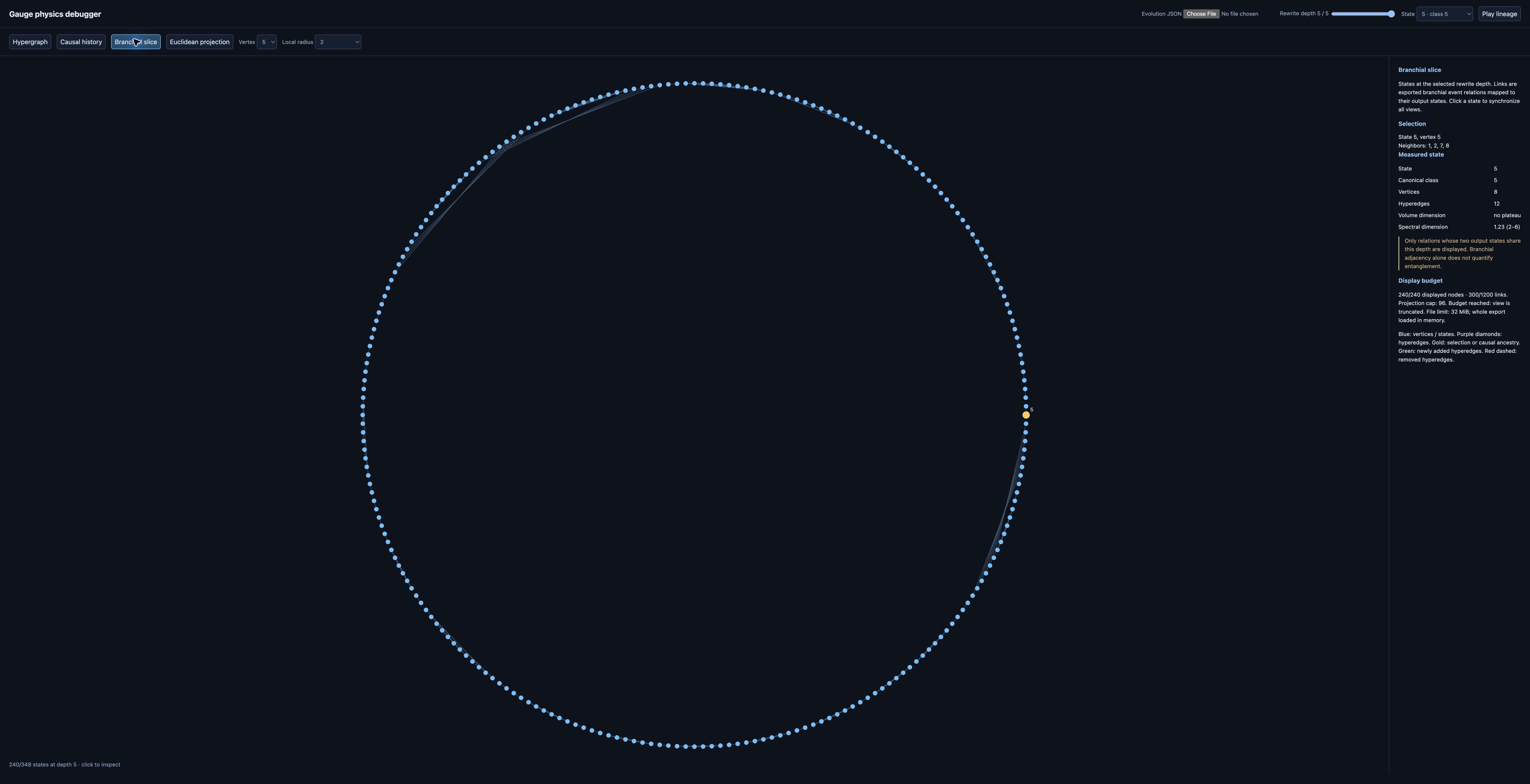
The debugger separates graph state, causal ancestry, branchial slices, and a best-effort spatial projection. It is a way to inspect the calculation—not evidence that the pictured state is three-dimensional.
Commands: build, export a history, and view it
Requirements: CMake 3.20+ and a C++20 compiler.
git clone https://github.com/pirate/wolfram-gauge-physics.git
cd wolfram-gauge-physics
cmake -S . -B build -DCMAKE_BUILD_TYPE=Release
cmake --build build -j
./build/wgphysics_evolve \
  --rule '0,1;0,2->0,2;0,3;1,3;2,3' \
  --init '1,2;1,3' \
  --steps 3 \
  --output out/evolution.json
python3 -m http.server 8765 --bind 127.0.0.1
Open localhost:8765/viewer/ and load the export. See the debugger guide for interpretation. Experiment notes link their own scripts and data; this command exports a rewrite history, not a molecular simulation.
MIT licensed. This is an independent experimental project, not an official Wolfram Institute or Wolfram Research repository. The attributed Wolfram website screenshot remains the original publisher's material, not part of this repository's MIT license. See figure sources.
Contributors

46 commits
Similar repos


Languages
Python
76.6%
C++
20.4%
JavaScript
2.2%
Bottom-up combinatorial gauge and fiber dynamics for Wolfram-model hypergraph rewriting
Python
0
46 commits
updated Sep 10, 2026
See what people are saying (1)
README
Wolfram Physics Engine Exploration:
Gauge Theory & the Standard Model
Stephen Wolfram launched the Wolfram Physics Project around a radical question: could familiar physics emerge from extremely simple computational rules, rather than being programmed into a simulation as the known equations of relativity, quantum mechanics, or the Standard Model? In the Wolfram model, a possible spatial state is represented by a hypergraph, local rules repeatedly replace small pieces of that graph, and a causal graph records which update events depend on earlier events. Following every possible order of updates produces a multiway graph of alternative histories; slices through that structure produce branchial graphs, which the project relates to quantum states and entanglement.
For suitable rules and under additional assumptions—especially locality, causal invariance, and an appropriate large-scale limit—the project argues that structures resembling continuous space, relativistic causal cones, and aspects of quantum mechanics can emerge. These are proposed mathematical correspondences, not yet a demonstrated model of our universe, and quantum probability is not simply the number of nodes in a hypergraph: Wolfram associates amplitude magnitude with path multiplicity in multiway evolution and phase with position in branchial space. The intuition is a little like Conway's Game of Life, except there is no fixed grid—the network of relationships that may become space is itself continually rewritten. This repository investigates whether gauge structure and field-like dynamics can be built at that microscopic level, with the long-term goal of testing for QED-like behavior and simple bound systems without inserting continuum fields or forces by hand; it does not yet derive QED, particles, physical constants, or molecules.
Stephen Wolfram: Can space and time emerge from simple rules?
|
Hands-On Introduction to the Wolfram Physics Project
|
The questions we are trying to answer
This project starts from the interview above. The goal is to take one of Wolfram's unfinished ideas, turn it into a precise computational question, and find an answer—or a specific reason it fails.
Three questions organize the work:
- How does the network become space? Can local rewrites produce a stable large-scale dimension, and what happens when that dimension varies? Wolfram discusses dimension fluctuations at 1:11:17.
- Where would fields and charge come from? Can choices within the rewriting process give rise to internal degrees of freedom and their interactions? He explicitly leaves electric charge unresolved at 1:07:07.
- What could persist as a particle? Can a recognizable structure survive while its underlying network changes, move relative to its surroundings, and interact with another such structure? He identifies the missing particle model at 1:25:38.
Molecules are a later target, not the assumed interpretation of a graph pattern. None of these three questions has been solved here. The calculations below provide starting tools and some restrictions on candidate answers.
1. Start with relationships, not a stage to put particles on
In an ordinary simulation, space is already there. Objects have positions and fields have values at those positions. In the proposal discussed in the interview, the network is what might eventually look like space. There is no separate stage underneath it.
A node is an identifiable abstract element. It is not a voxel, an atom, or a sample of a known field. A hyperedge records a relationship between two or more elements. A rewrite replaces a small pattern of relationships with another, possibly creating new elements.
before = [(0, 1), (0, 2)]
after  = [(0, 2), (0, 3), (1, 3), (2, 3)]
This example replaces two relationships with four, using a fresh node. The integers are IDs, like dictionary keys—not positions or measured values. The tuples list related IDs, not coordinates. Strings could name the same nodes without changing the structure.
It illustrates what a rewrite is; it is not established as a rule that produces matter.
The same rule used by the runnable example below. Node 3 is new. Dot positions help draw the connections; they are not measured positions in space. Even the unchanged endpoint pair (0,2) is a new edge occurrence after this rule consumes and reproduces it.
Details: the state, the rule, and what has units
A state is conceptually a list[tuple[int, ...]]. Repeated relationships
can be distinct occurrences, so the engine also retains their identities.
A rule contains two patterns: the relationships to consume and those to
produce. Repeated names within a pattern identify the same node; fresh
names on the output side introduce new nodes.
Node IDs, adjacency, pattern matching, and event counts are discrete, exact data. There is no required floating-point precision at this layer. The count of nodes is not a length in meters; the count of rewrites is not elapsed time in seconds.
Relabeling a graph changes its written representation, not its connectivity. Canonicalization detects that equivalence. It must preserve whatever additional data an experiment has actually put in the state; two bare graphs can be identical while their attached data differs.
The rewrite engine is the Wolfram Institute's HypergraphRewritingEngine.
An actual engine history, read top left to bottom right. Each arrow is one rewrite; the layouts are not physical coordinates.
Our engine–gauge integration is more limited: its supported base change is transport-preserving edge subdivision, not arbitrary coupled geometry-and-field evolution.
2. Keep track of what happened—and what else could have happened
A rewrite can use a relationship made by an earlier rewrite. That gives a dependency: the producer must happen before the consumer. Collect those dependencies and you have a causal graph.
There may also be several places where the rule can apply. Following each possibility produces a multiway graph. Histories branch when there are alternatives and merge when they reach equivalent states.
These are different records. A causal edge connects dependent events. A multiway edge connects a state to a possible next state.
A fully specified small example. Above: A and B can happen in either order and reach the same network. Below: C needs a relationship made by each, so its causal graph has two prerequisites. The colors track events, not fields. Node names are retained here; ignoring names can identify the two intermediate graphs as equivalent too. This illustrates the distinction, not quantum interference.
Why retain the alternatives? Wolfram's proposal makes their structure part of the physics question. Selecting one random history may be useful for some measurements, but it does not reproduce the whole multiway system or establish quantum probabilities.
Details: event dependencies, branching, and quantum claims
An event record identifies consumed and produced hyperedge occurrences. A dependency follows from actual production and consumption; added interaction layers must also account for their read and write supports.
A path can be stored as a tuple[int, ...] of event IDs. Storing
(A, B) instead of (B, A) records order; the rewrite rule determines
whether both orders are possible and whether their results agree.
Order dependence is something to examine, not an extra microscopic
substance.
The engine exports finite multiway and causal structures. A branchial view compares alternatives across a selected slice. Its adjacency is not by itself an entanglement measure. Nor do path counts alone provide complex amplitudes, interference, or the Born rule.
This export has 13 raw states and 10 graph-isomorphism classes. Detecting equivalent node labelings is not a proof that all update orders have equivalent causal histories.
Causal invariance is a stronger question than whether two finite histories end at the same graph. A bounded computation can find a counterexample or establish a bounded result; a general conclusion requires an argument covering the unexamined histories.
Screenshot of Wolfram's technical introduction. The small blue diagrams are graph states; horizontal lines mark slices through their history. This is an upstream illustration, not our simulation result.
See event-preserving integration and causality, locality, and correlation.
3. Measure whether something like space appears
Stand at a node and count how many other nodes are reachable within one hop, two hops, three hops, and so on. In a region resembling ordinary three-dimensional space, doubling a sufficiently large radius should enclose roughly eight times as many nodes.
That gives a way to ask about dimension without first drawing the graph in 3D. Repeat the measurement at different locations and times: does the same dimension persist, or does the growth pattern change?
This is a direct route into the interview's dimension question. The current probes can make these measurements, but the small rule survey does not establish a three-dimensional regime or physical dimension fluctuations.
flowchart LR
    N["Rewritten network"] --> B["Count nodes within r hops"]
    N --> W["Measure random-walk returns"]
    B --> C["Compare locations, scales, and later states"]
    W --> C
    C --> Q["Does a stable geometric regime appear?"]
Mathematics: dimension measurements and their limits
Let ball_counts be a list[int]: entry r counts nodes within
graph distance r of a selected source. A local scaling estimate is
d_H(r)=\frac{d\log |B(v,r)|}{d\log r}.
An independent probe follows an auxiliary random walk and estimates its return probability. A power-law regime would have
p_t(v,v)\propto t^{-d_s/2}.
The estimated dimensions and probabilities are float values.
The walk's time counts probe steps; it is not the time of the rewrites.
Different dimension notions need not agree on a general graph.
The current probes use the undirected simple 2-section of a hypergraph: nodes sharing a hyperedge are connected. This measurement choice forgets edge ordering and multiplicity. Small graphs, boundaries, the projection, and source sampling can all affect the estimate.
A useful result needs a scaling window that survives larger graphs, different source choices, and continued evolution. Fluctuations must be distinguished from estimator noise. Curvature requires additional geometric information; a changing dimension estimate is not automatically a gravitational wave.
See measurement definitions and limitations. The existing 38-rule, three-step survey selects diverse graph statistics, not a target shape. It is a starting survey, not an exhaustive rule search or a continuum-limit result.
4. Ask where internal structure would come from
In the interview, the starting data are relationships and rewrites. There is no instruction to attach a triangle to every node.
The gauge-theory lead is more specific in Wolfram's technical introduction: different local rewrite choices may serve as equivalent descriptions, while a choice made here affects which choices remain possible later. The proposal connects this structure to gauge freedom and field propagation. That connection is something to construct and test.
A fiber is the collection of detailed states or descriptions that lie over one location in a chosen description. To derive one here, we would first need to specify what that description retains and which underlying distinctions it groups together.
An intentionally simple projection: keep the two endpoints and whether they are connected, but hide the route between them. A chain and a loop then look alike to that observer. They can still evolve differently. This explains a fiber as a set of alternatives; it does not derive a physical observer, a graph connection, or gauge equivalence.
InfraGaugeTheory provides a language for graph fibers, projections, connections, and transport. Its stated goals include natural clustering into fibers and obtaining fibered graphs from hypergraph rewriting. Those are directly relevant open construction problems.
What the triangle experiments do—and do not—supply
Our existing finite-gauge studies work in the opposite direction: choose a fiber, calculate its symmetries, then study specified interactions. This is a controlled laboratory for candidate structures. It has not derived the fiber or its dynamics from the bare rewrite system.
Why three vertices? A triangle is the smallest simple graph whose symmetries can act differently when applied in different orders. It is small enough to enumerate exactly. That is a practical reason for a test case, not a reason that nature must use it.
A five-node ring is another possible choice. So is a fifty-node ring. The connections matter as well as the count: ring-preserving maps are rotations and reflections, not arbitrary permutations. Current cycle-reaction results assume odd ring size; an even ring introduces additional algebraic cases. Adding internal vertices is not automatically increasing spatial resolution.
Mathematics: supplied fibers versus a rewrite-derived construction
For a projection from detailed states or graph elements to a retained description, a fiber is a preimage:
F_x=p^{-1}(x).
This definition alone supplies neither an internal adjacency nor a connection, symmetry group, or evolution law. Those structures need separate derivations. In particular, physically distinct alternatives must not be discarded merely because a selected observer fails to distinguish them.
In the current homogeneous graph-fiber experiments, the internal adjacency is supplied. Its automorphisms are then calculated exactly:
G=\mathrm{Aut}(F).
Each upper triangle is a separately supplied internal graph. Dashed lines say which base node it belongs to; they are not extra spatial connections. Unlike the preceding projection example, this construction supplies the fiber's internal adjacency from the start.
For a cycle with n >= 3 vertices, each map has the form
U(v)=sv+a\pmod n,
\qquad s\in\{-1,1\},\quad a\in\mathbb Z_n.
There are 2*n such maps. A map can be represented as a
list[int] of length n, or exactly as a (sign, shift) tuple
for this cycle family. It does not require an n-by-n floating-point
matrix or an angle tolerance.
The triangle allows all six permutations of its three vertices. A link carries one allowed map. Following links composes maps; following a closed loop gives its holonomy—the net internal transformation on return to the starting point.
This chosen connection returns to the same base node with the internal labels rotated. It explains the measurement; it is not a particle orbit or evidence that the connection emerged from rewrites.
Changing local fiber labels transforms link maps as
U_{xy}\mapsto g_yU_{xy}g_x^{-1}.
The corresponding loop map changes by conjugation. Measurements that ignore this arbitrary frame choice are gauge invariant within the specified model.
A rewrite-derived construction must explain why its alternatives admit these kinds of maps—or show that a different mathematical structure is needed. It must also distinguish a change of description from a change that affects later invariant measurements.
See finite-fiber assumptions and construction and the research questions and acceptance criteria.
5. Look for something that survives the changing network
Wolfram suggests that particles might be persistent structures in the network, rather than objects placed on it. The useful question is not “does this picture resemble an electron?” It is “what remains the same while the surrounding structure and its constituent nodes change?”
A candidate must survive actual rewrites. Its identity cannot depend on keeping the same node IDs or freezing the region that supports it. Motion must be measured relative to the surrounding network, not the positions assigned by a renderer.
The present fixed-fiber calculations give a useful warning: a prepared defect can support localized graph modes, yet allowed interactions can remove those modes. Localization in one snapshot is not persistence.
These calculations use a supplied two-dimensional lattice, triangle fibers, and prepared link defects. They concern the graph's spectrum. They are not electron orbitals, and no atomic energy scale is assigned.
Mathematics: localization, persistence, and interaction
For a graph with N vertices, its Laplacian is mathematically an
N-by-N real matrix. A normalized real eigenmode is a
list[float] of length N; its eigenvalue is one float.
A spatially concentrated mode does not by itself define a quantum state
or a physical Hamiltonian.
The specified triangle-fiber defect has an exact certificate for two modes above the full flat background spectrum. The same work bounds the possible mode count using the conserved weight on the two face orientations:
n_+(L_{\mathrm{bundle}}-12I)
\le\min(Q_\uparrow,Q_\downarrow).
Actual reactions can redistribute that weight and force mode loss. This is a reason to test temporal stability rather than infer particles from static eigenvectors.
A stronger candidate would need an invariant descriptor, a tracked causal history, a lifetime measured against local background activity, and survival under encounters. A motif copied by a rule is not automatically a particle; an apparently persistent patch that has never been updated is a separate control.
For a bound pair, compare separation and breakup behavior with isolated candidates and the model's accessible background. No attractive potential, target bond distance, or molecular geometry should be fed into the update law to obtain the desired answer.
See phenomenon-detection criteria and encounter-resolved persistence.
Progress So Far
-
Exact finite rewrite histories and event provenance. We can inspect spatial states, dependencies, and alternative histories using the upstream engine. A restricted connection-aware extension preserves these records through edge subdivision. This is a starting point for the interview's causal and multiway questions, not a general evolving gauge field. Construction.
-
Intrinsic geometry measurements and a bounded rule survey. Graph-ball and random-walk probes measure structure without taking dimension from a drawing. The present short survey has not found or established emergent 3D spacetime. Scope.
-
Exact descriptions of specified finite gauge states. Small-patch results show when local measurements lose information needed to predict an interaction, and how relative alignment restores it. This supplies a concrete test for a future observer-based description; it does not derive that observer or fiber. Patch reconstruction and gluing.
-
Restrictions on proposed routes to matter. In studied models, some apparent internal motion is only relabeling; diffuse large fibers reduce to ordinary exchange diffusion; and localized modes can be destroyed by the permitted dynamics. These delimit particular constructions, not all rewriting models. Unary restriction, refinement limit, localization and loss.
Supporting finite-model work: what it is useful for
The fixed-mesh reaction and memory studies are available as experiments in conditional dynamics. Their relevance is to specific questions: which internal relations affect later changes, whether those relations survive encounters, and when a reduced description loses predictive information.
The triangle reaction bank and its odd-cycle extensions have a conserved integer weight with values 0, 1, and 2 on three holonomy types. Here “charge” names that weight; it has not been identified with electric charge. The rules remain chosen, including the original positive-charge selection criterion.
Reaction construction, relative-angle dependence, reaction bursts, and transported constraints contain the assumptions, derivations, scripts, and saved results.
These studies warrant further compute when they resolve a stated obstacle to the rewrite-based program, not merely because a larger run is possible. A diffusion limit is useful here as a restriction on that model; recovering the known heat equation is not itself progress toward quantum matter.
The research map separates reusable constructions from the missing physical connections. The research direction defines which questions should drive new experiments.
Future Work
-
Construct internal alternatives from actual rewrites. On a small, completely explored example, specify a projection or observer and derive its candidate fibers and the maps between them. Determine which choices are equivalent descriptions and which change later observable behavior. A failure to define consistent transport is a useful result; attaching a preferred fiber is not a substitute.
-
Follow the consequences of a local rewrite choice. Compare alternatives with a common prior state and boundary. Track which later matches become possible or impossible, preserving event dependencies. Determine whether any effect survives relabeling, branch merging, and a change of description. This directly tests Wolfram's proposed route from local choices to gauge-like effects.
-
Find and characterize stable geometric regimes. Extend selected rule families far enough to separate growth, finite-size effects, and local dimension variation. Test several seeds and update schedules. Explain any regularity from the rewrite process before interpreting it as space or curvature.
-
Search for persistent, moving structures. Identify candidates by invariant relationships, follow them through replacement of their constituent nodes, and test encounters. Distinguish genuine survival from inactivity, imposed defects, and renderer artifacts.
-
Connect measured dynamics to an effective physical description. If a reproducible geometric or interaction regime appears, derive its scale dependence and observable laws. Quantum amplitudes, interference, physical charge, and mass each need their own construction. Known physics provides comparison targets, not hidden terms in the microscopic updates.
-
Spend compute on the limiting question. Use parallel enumeration for finite rule/transition problems and longer runs for declared persistence or scaling questions. Optimize the limiting operation only when it unlocks an otherwise inaccessible mathematical test. Keep counterexamples, null results, and incomplete runs.
Inspect the experiments
The debugger separates graph state, causal ancestry, branchial slices, and a best-effort spatial projection. It is a way to inspect the calculation—not evidence that the pictured state is three-dimensional.
Commands: build, export a history, and view it
Requirements: CMake 3.20+ and a C++20 compiler.
git clone https://github.com/pirate/wolfram-gauge-physics.git
cd wolfram-gauge-physics
cmake -S . -B build -DCMAKE_BUILD_TYPE=Release
cmake --build build -j
./build/wgphysics_evolve \
  --rule '0,1;0,2->0,2;0,3;1,3;2,3' \
  --init '1,2;1,3' \
  --steps 3 \
  --output out/evolution.json
python3 -m http.server 8765 --bind 127.0.0.1
Open localhost:8765/viewer/ and load the export. See the debugger guide for interpretation. Experiment notes link their own scripts and data; this command exports a rewrite history, not a molecular simulation.
MIT licensed. This is an independent experimental project, not an official Wolfram Institute or Wolfram Research repository. The attributed Wolfram website screenshot remains the original publisher's material, not part of this repository's MIT license. See figure sources.
Similar repos
Contributors
46 commits
Languages
Python
76.6%
C++
20.4%
JavaScript
2.2%