
A systems programming language where automatic differentiation is a compiler pass and model parameters are explicit, growable memory.
Rust
27
50 commits
updated Jan 5, 2026
README

NOMA
Neural-Oriented Machine Architecture
A research-driven systems language for machine learning where autodiff is a compiler pass and model parameters are explicit, growable memory.



Language Guide · Contributing · Discord
Table of Contents
- News
- What's NOMA ?
- Where the idea came from (short origin story)
- Dynamic topology growth (what realloc is trying to mean)
- XOR demo (first result, kept short)
- Quick start
- Project status (alpha)
- Scientific context (selected references)
- Contributing
- Citation
🔥 News
- [2026-01-05] Test-Time Adaptation (TTA) demo showing online adaptation on MNIST stream
- [2025-12-31] Jupyter notebook extension with
%%nomacell magic for interactive development - [2025-12-30] Self-growing XOR demo (reproducible)
- [2025-12-25] Initial presentation of NOMA
All informations on changelog
What's NOMA ?
NOMA explores a different boundary between language and ML framework:
- Reverse-mode autodiff as a compiler transformation (LLVM IR)
- Training loops as a language construct (optimize { ... })
- Learnable parameters as explicit buffers you can alloc / realloc / free
- Intent: topology changes (growth, resizing) should be mechanically defined, including what happens to optimizer state
Where the idea came from (short origin story)
I started NOMA after running into the same friction many times: in mainstream ML stacks, changing a model’s topology mid-training often means rebuilding graphs, copying weights, and resetting optimizer state.
Biology suggests a different mental model. Nervous systems remain functional while continuously reshaping their micro-structure. Work on dendritic spine structural plasticity connects local structural remodeling to synaptic efficacy and learning/memory. That makes it a reasonable working hypothesis (not a claim of equivalence) that some forms of “local learning” can be preserved while the global structure changes.
On the ML side, there is also prior work showing that you can change network structure while preserving function (or at least reusing learned information) to reduce the cost of re-training (e.g., Net2Net, Network Morphism).
NOMA is my attempt to make these topology changes explicit and well-defined at the language level.
Dynamic topology growth (what realloc is trying to mean)
realloc grows a learnable parameter buffer while preserving existing values. The goal is to also preserve optimizer state for the existing portion (e.g., Adam moments), so training can continue without a full restart.
fn main() {
    learn W = tensor [[0.1], [0.2]];  // start small

    optimize(W) with adam(0.01) until loss < 0.01 {
        let pred = matmul(X, W);
        let loss = mean((pred - Y) * (pred - Y));

        if loss > 0.5 {
            realloc W = [10, 1];      // grow capacity, keep training
        }

        minimize loss;
    }

    return W;
}
XOR demo (first result, kept short)
We include a small, fully reproducible self-growing XOR toy benchmark to sanity-check the semantics.
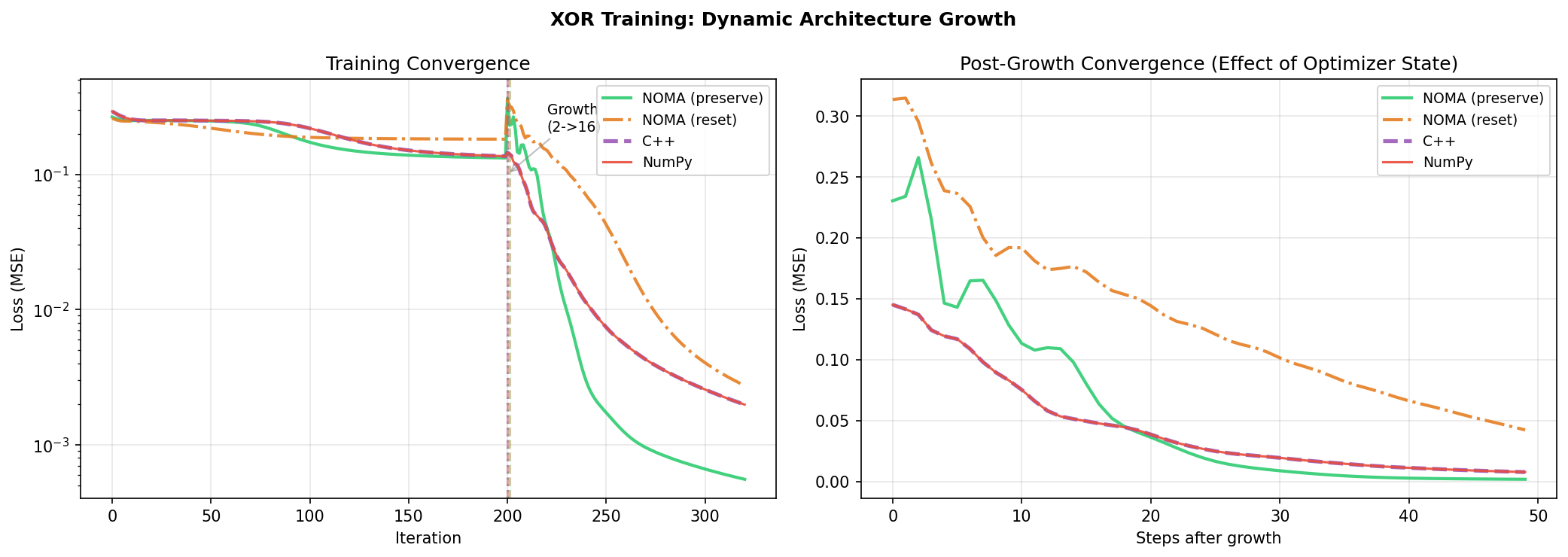
In this demo, after the growth step, the configuration that preserves optimizer state across realloc reconverges faster than a baseline that resets state. This is an early, limited result on a toy task useful as a first signal, not a performance claim.
Full scripts, plots, and notes are in demo_self_growing_xor/.
Quick start
git clone https://github.com/pierridotite/Noma.git
cd Noma
cargo build --release

# Interpreter mode
cargo run -- run examples/03_gradient_descent.noma

# Compile to a standalone binary
cargo run -- build-exe examples/12_linear_regression.noma -o model
./model
Project status (alpha)
Working today (high level):
- parser + AST
- reverse-mode autodiff
- LLVM IR codegen (basic tensor ops)
- SGD / Adam / RMSprop
- alloc / realloc / free
- user-defined functions with autodiff support
- batch processing + I/O (CSV, Safetensors)
Known limitations (high level):
- single numeric type (f64)
- no module system (single-file programs)
- control flow is limited
- debugging is minimal
Scientific context (selected references)
Topology changes while reusing learned information
- Net2Net: Accelerating Learning via Knowledge Transfer Chen, Goodfellow, Shlens (2015). https://arxiv.org/abs/1511.05641
- Network Morphism Wei, Wang, Rui, Chen (2016). https://arxiv.org/abs/1603.01670
- Lifelong Learning with Dynamically Expandable Networks (DEN) Yoon et al. (2017/2018). https://arxiv.org/abs/1708.01547
Biological inspiration: structural plasticity and stability
- Structural and functional plasticity of dendritic spines Gipson & Olive (2016, review). https://pmc.ncbi.nlm.nih.gov/articles/PMC5243184/
- Dendritic Spines: The Locus of Structural and Functional Plasticity Sala & Segal (2014, review). https://pubmed.ncbi.nlm.nih.gov/24382885/
Compiler-level / IR-level autodiff (adjacent area)
- Enzyme (LLVM IR automatic differentiation; project site). https://enzyme.mit.edu/
- Instead of rewriting foreign code for machine learning, automatically synthesize fast gradients Moses & Churavy (2020). https://arxiv.org/abs/2010.01709
- Don't Unroll Adjoint: Differentiating SSA-Form Programs Innes (2018). https://arxiv.org/abs/1810.07951
Contributing
Issues and PRs are welcome ! Especially around ops, diagnostics, optimizers, docs, and backend work.
See: CONTRIBUTING.md
Citation
If you want to cite NOMA in a scientific paper, please use the following reference; BibTeX snippet below :
@software{NOMA,
  author  = {NOMA Authors},
  title   = {NOMA: Neural-Oriented Machine Architecture},
  year    = {2025},
  version = {alpha},
  url     = {https://github.com/pierridotite/NOMA},
  note    = {Accessed: [date you accessed, e.g. 12/30/2025]}
}
Contributors

50 commits
Similar repos


Languages
Rust
50.2%
Python
25.9%
Jupyter Notebook
20.1%
C++
1.8%
Shell
1.4%
A systems programming language where automatic differentiation is a compiler pass and model parameters are explicit, growable memory.
Rust
27
50 commits
updated Jan 5, 2026
README
NOMA
Neural-Oriented Machine Architecture
A research-driven systems language for machine learning where autodiff is a compiler pass and model parameters are explicit, growable memory.
Language Guide · Contributing · Discord
Table of Contents
- News
- What's NOMA ?
- Where the idea came from (short origin story)
- Dynamic topology growth (what realloc is trying to mean)
- XOR demo (first result, kept short)
- Quick start
- Project status (alpha)
- Scientific context (selected references)
- Contributing
- Citation
🔥 News
- [2026-01-05] Test-Time Adaptation (TTA) demo showing online adaptation on MNIST stream
- [2025-12-31] Jupyter notebook extension with
%%nomacell magic for interactive development - [2025-12-30] Self-growing XOR demo (reproducible)
- [2025-12-25] Initial presentation of NOMA
All informations on changelog
What's NOMA ?
NOMA explores a different boundary between language and ML framework:
- Reverse-mode autodiff as a compiler transformation (LLVM IR)
- Training loops as a language construct (optimize { ... })
- Learnable parameters as explicit buffers you can alloc / realloc / free
- Intent: topology changes (growth, resizing) should be mechanically defined, including what happens to optimizer state
Where the idea came from (short origin story)
I started NOMA after running into the same friction many times: in mainstream ML stacks, changing a model’s topology mid-training often means rebuilding graphs, copying weights, and resetting optimizer state.
Biology suggests a different mental model. Nervous systems remain functional while continuously reshaping their micro-structure. Work on dendritic spine structural plasticity connects local structural remodeling to synaptic efficacy and learning/memory. That makes it a reasonable working hypothesis (not a claim of equivalence) that some forms of “local learning” can be preserved while the global structure changes.
On the ML side, there is also prior work showing that you can change network structure while preserving function (or at least reusing learned information) to reduce the cost of re-training (e.g., Net2Net, Network Morphism).
NOMA is my attempt to make these topology changes explicit and well-defined at the language level.
Dynamic topology growth (what realloc is trying to mean)
realloc grows a learnable parameter buffer while preserving existing values. The goal is to also preserve optimizer state for the existing portion (e.g., Adam moments), so training can continue without a full restart.
fn main() {
    learn W = tensor [[0.1], [0.2]];  // start small

    optimize(W) with adam(0.01) until loss < 0.01 {
        let pred = matmul(X, W);
        let loss = mean((pred - Y) * (pred - Y));

        if loss > 0.5 {
            realloc W = [10, 1];      // grow capacity, keep training
        }

        minimize loss;
    }

    return W;
}
XOR demo (first result, kept short)
We include a small, fully reproducible self-growing XOR toy benchmark to sanity-check the semantics.
In this demo, after the growth step, the configuration that preserves optimizer state across realloc reconverges faster than a baseline that resets state. This is an early, limited result on a toy task useful as a first signal, not a performance claim.
Full scripts, plots, and notes are in demo_self_growing_xor/.
Quick start
git clone https://github.com/pierridotite/Noma.git
cd Noma
cargo build --release

# Interpreter mode
cargo run -- run examples/03_gradient_descent.noma

# Compile to a standalone binary
cargo run -- build-exe examples/12_linear_regression.noma -o model
./model
Project status (alpha)
Working today (high level):
- parser + AST
- reverse-mode autodiff
- LLVM IR codegen (basic tensor ops)
- SGD / Adam / RMSprop
- alloc / realloc / free
- user-defined functions with autodiff support
- batch processing + I/O (CSV, Safetensors)
Known limitations (high level):
- single numeric type (f64)
- no module system (single-file programs)
- control flow is limited
- debugging is minimal
Scientific context (selected references)
Topology changes while reusing learned information
- Net2Net: Accelerating Learning via Knowledge Transfer Chen, Goodfellow, Shlens (2015). https://arxiv.org/abs/1511.05641
- Network Morphism Wei, Wang, Rui, Chen (2016). https://arxiv.org/abs/1603.01670
- Lifelong Learning with Dynamically Expandable Networks (DEN) Yoon et al. (2017/2018). https://arxiv.org/abs/1708.01547
Biological inspiration: structural plasticity and stability
- Structural and functional plasticity of dendritic spines Gipson & Olive (2016, review). https://pmc.ncbi.nlm.nih.gov/articles/PMC5243184/
- Dendritic Spines: The Locus of Structural and Functional Plasticity Sala & Segal (2014, review). https://pubmed.ncbi.nlm.nih.gov/24382885/
Compiler-level / IR-level autodiff (adjacent area)
- Enzyme (LLVM IR automatic differentiation; project site). https://enzyme.mit.edu/
- Instead of rewriting foreign code for machine learning, automatically synthesize fast gradients Moses & Churavy (2020). https://arxiv.org/abs/2010.01709
- Don't Unroll Adjoint: Differentiating SSA-Form Programs Innes (2018). https://arxiv.org/abs/1810.07951
Contributing
Issues and PRs are welcome ! Especially around ops, diagnostics, optimizers, docs, and backend work.
See: CONTRIBUTING.md
Citation
If you want to cite NOMA in a scientific paper, please use the following reference; BibTeX snippet below :
@software{NOMA,
  author  = {NOMA Authors},
  title   = {NOMA: Neural-Oriented Machine Architecture},
  year    = {2025},
  version = {alpha},
  url     = {https://github.com/pierridotite/NOMA},
  note    = {Accessed: [date you accessed, e.g. 12/30/2025]}
}
Similar repos
Contributors
50 commits
Languages
Rust
50.2%
Python
25.9%
Jupyter Notebook
20.1%
C++
1.8%
Shell
1.4%