
A perfect clone of 1993 game SimTower.
See the codeSee what people are saying
README
towers.world
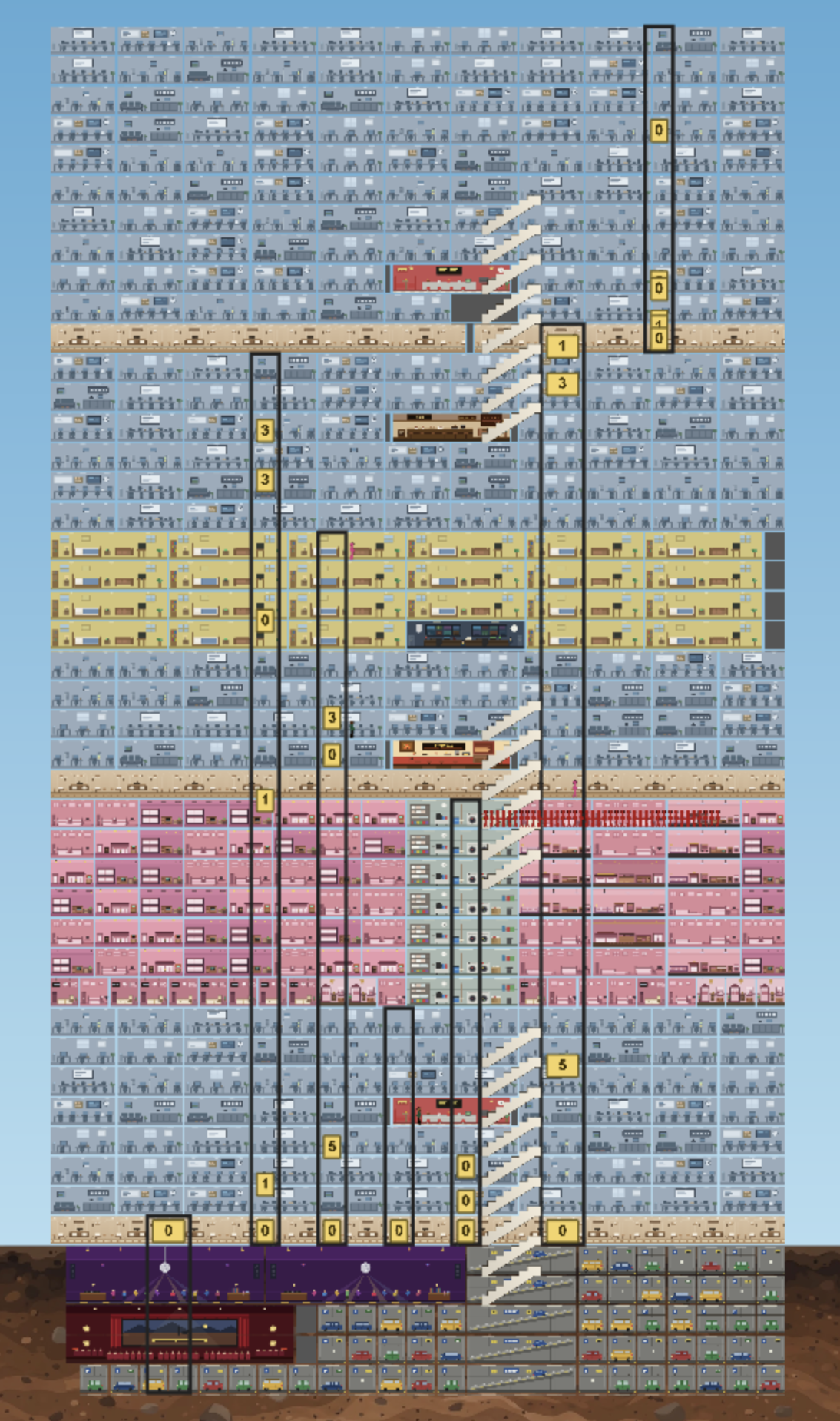
A tick-for-tick clone of SimTower (Yoot Saito / Maxis, 1993), reimplemented as a multiplayer browser game. The simulation matches the original Windows 3.1 binary tick-for-tick — crucially, the sim state machine and elevator dispatch code aims to match exactly.
Live at towers.world.
What this is
The original SimTower is a single-player game where you build a 100-story tower out of offices, hotel suites, condos, restaurants, shops, and elevators, and try not to go bankrupt servicing the simulated tenants who move in. tower-together puts that simulation behind a Cloudflare Worker so several people can build the same tower together in real time.
The fidelity goal is strict: given the same input sequence, the reimplementation produces byte-identical state to the original binary on every tick. The trace test in apps/worker/src/sim/trace.test.ts replays gameplay traces captured from the original DOS binary running under emulation and asserts the TypeScript sim produces the same state at every tick.
Architecture
- apps/client — React 19 + Vite + Phaser 4 frontend. Lobby, tower create/join, and the canvas rendering the tower grid. The client runs the same simulation locally in lockstep with the server, so rendering doesn't wait on the network.
- apps/worker — Cloudflare Workers backend with one Durable Object (
TowerRoom) per tower. The DO is the authoritative input sequencer; clients submit inputs, the DO orders them into batches, and every client steps the same sim against the same input stream. - apps/worker/src/sim — Pure TypeScript simulation core. Should be independent of runtime environment and able to run entirely headless. Runs identically in the worker, the client, and the test suite. See apps/worker/src/sim/AGENTS.md for a tour.
- specs/ — Reverse-engineered notes on the binary's behavior: time, demand, elevators, routing, economy, people. Partial and not always right; the trace test is the ground truth.
- analysis-2825a3c53f/ — Ghidra project for static analysis of
SIMTOWER.EX_.
Running it
You need Node 20+ and npm 10. Install once:
npm install
Then run both apps:
npm run dev
That starts the Vite dev server for the client and wrangler dev for the worker via turbo. Open the URL Vite prints.
To run just one side:
npm run dev -- --filter=tower-together-client
npm run dev -- --filter=tower-together-worker
Tests
The interesting test is the trace replay:
cd apps/worker
npx vitest run src/sim/trace.test.ts --testTimeout=30000
Each fixture in apps/worker/src/sim/fixtures is a .jsonl file of (tick, input, expected_state) tuples captured from the original binary. The test feeds the inputs into TowerSim and diffs the resulting state against the binary's state on every tick. A divergence on tick N usually means a bug on some earlier tick whose effect only became observable at N — fix the earliest divergence first.
To regenerate fixtures, see simtower/emulator.py (requires the original SIMTOWER.EX_, which is not in this repo).
Other useful targets:
npm run typecheck
node_modules/.bin/biome check .
Run both before committing.
Deploying
npm run deploy
Builds the client into the worker's dist/, then wrangler deploys the worker. The client is served as static assets from the same worker that hosts the Durable Objects.
License
MIT. SimTower itself is © Maxis / OPeNBooK / Yoot Saito; this project is a clean-room reimplementation and ships none of the original assets or code.
Contributors

461 commits
Similar repos


Languages
TypeScript
99.9%
A perfect clone of 1993 game SimTower.
See the codeSee what people are saying
README
towers.world
A tick-for-tick clone of SimTower (Yoot Saito / Maxis, 1993), reimplemented as a multiplayer browser game. The simulation matches the original Windows 3.1 binary tick-for-tick — crucially, the sim state machine and elevator dispatch code aims to match exactly.
Live at towers.world.
What this is
The original SimTower is a single-player game where you build a 100-story tower out of offices, hotel suites, condos, restaurants, shops, and elevators, and try not to go bankrupt servicing the simulated tenants who move in. tower-together puts that simulation behind a Cloudflare Worker so several people can build the same tower together in real time.
The fidelity goal is strict: given the same input sequence, the reimplementation produces byte-identical state to the original binary on every tick. The trace test in apps/worker/src/sim/trace.test.ts replays gameplay traces captured from the original DOS binary running under emulation and asserts the TypeScript sim produces the same state at every tick.
Architecture
- apps/client — React 19 + Vite + Phaser 4 frontend. Lobby, tower create/join, and the canvas rendering the tower grid. The client runs the same simulation locally in lockstep with the server, so rendering doesn't wait on the network.
- apps/worker — Cloudflare Workers backend with one Durable Object (
TowerRoom) per tower. The DO is the authoritative input sequencer; clients submit inputs, the DO orders them into batches, and every client steps the same sim against the same input stream. - apps/worker/src/sim — Pure TypeScript simulation core. Should be independent of runtime environment and able to run entirely headless. Runs identically in the worker, the client, and the test suite. See apps/worker/src/sim/AGENTS.md for a tour.
- specs/ — Reverse-engineered notes on the binary's behavior: time, demand, elevators, routing, economy, people. Partial and not always right; the trace test is the ground truth.
- analysis-2825a3c53f/ — Ghidra project for static analysis of
SIMTOWER.EX_.
Running it
You need Node 20+ and npm 10. Install once:
npm install
Then run both apps:
npm run dev
That starts the Vite dev server for the client and wrangler dev for the worker via turbo. Open the URL Vite prints.
To run just one side:
npm run dev -- --filter=tower-together-client
npm run dev -- --filter=tower-together-worker
Tests
The interesting test is the trace replay:
cd apps/worker
npx vitest run src/sim/trace.test.ts --testTimeout=30000
Each fixture in apps/worker/src/sim/fixtures is a .jsonl file of (tick, input, expected_state) tuples captured from the original binary. The test feeds the inputs into TowerSim and diffs the resulting state against the binary's state on every tick. A divergence on tick N usually means a bug on some earlier tick whose effect only became observable at N — fix the earliest divergence first.
To regenerate fixtures, see simtower/emulator.py (requires the original SIMTOWER.EX_, which is not in this repo).
Other useful targets:
npm run typecheck
node_modules/.bin/biome check .
Run both before committing.
Deploying
npm run deploy
Builds the client into the worker's dist/, then wrangler deploys the worker. The client is served as static assets from the same worker that hosts the Durable Objects.
License
MIT. SimTower itself is © Maxis / OPeNBooK / Yoot Saito; this project is a clean-room reimplementation and ships none of the original assets or code.
Similar repos
Contributors
461 commits
Languages
TypeScript
99.9%