Question Answering in Vietnamese. In a nutshell, this project helps us answer a Question of a given Context in Vietnamese. [UPDATED] This won me a Top 2 Graduates of VietAI Advanced NLP 02.
Jupyter Notebook
29
15 commits
updated Nov 17, 2022
My project is called Question Answering. This is a project carried out by me when I was studying at VietAI Advanced NLP Class 02. In a nutshell, the system in this project helps us answer a Question of a given Context.
To get started, you should have prior knowledge on Python and Pytorch at first. A few resources to get you started if this is your first Python or Tensorflow project:
Data: UIT-ViQuAD2.0 dataset from VLSP2021.
Model: question_answering_bartpho_phobert is based on BARTpho and PhoBERT models.
According to the orginal paper, it is stated that BARTpho-syllable and BARTpho-word are the first public large-scale monolingual sequence-to-sequence models pre-trained for Vietnamese. BARTpho uses the "large" architecture and the pre-training scheme of the sequence-to-sequence denoising autoencoder BART, thus it is especially suitable for generative NLP tasks. Especially in this downstream task, based on our experiments, we choose BARTpho-syllable in preference to BARTpho-word, and PhoBERT-large in preference to PhoBERT-base.
Clone the repo
git clone https://github.com/phkhanhtrinh23/question_answering_bartpho_phobert.git
Use any code editor to open the folder question_answering_bartpho_phobert.
Run pip install -r requirements.txt to install the required packages.
Note: You can install transformer as follows:
git clone --single-branch --branch fast_tokenizers_BARTpho_PhoBERT_BERTweet https://github.com/datquocnguyen/transformers.git

cd transformers

pip3 install -e .
├── data
|  └── demo.json (not from UIT-ViQuAD2.0)
|  └── test.json
|  └── train.json
Run python data.py to split the train.json into new_train.json and valid.json with 9:1 ratio respectively.
Now you can easily train the model with this command python train.py.
You can validate the model by python validate.py. This file validates the score of the trained model based on valid.json
Note: Of course, you can parse any arguments given in the ArgumentParser in both train.py and validate.py for better results.
test.json by python inference.py.Note: Because the model cannot load and infer the whole dataset at once, validate.py and inference.py only supports inferring in batches.
python api.py. The UI of the website is originated from templates folder. If possible, run this and share your results with me!Some results:
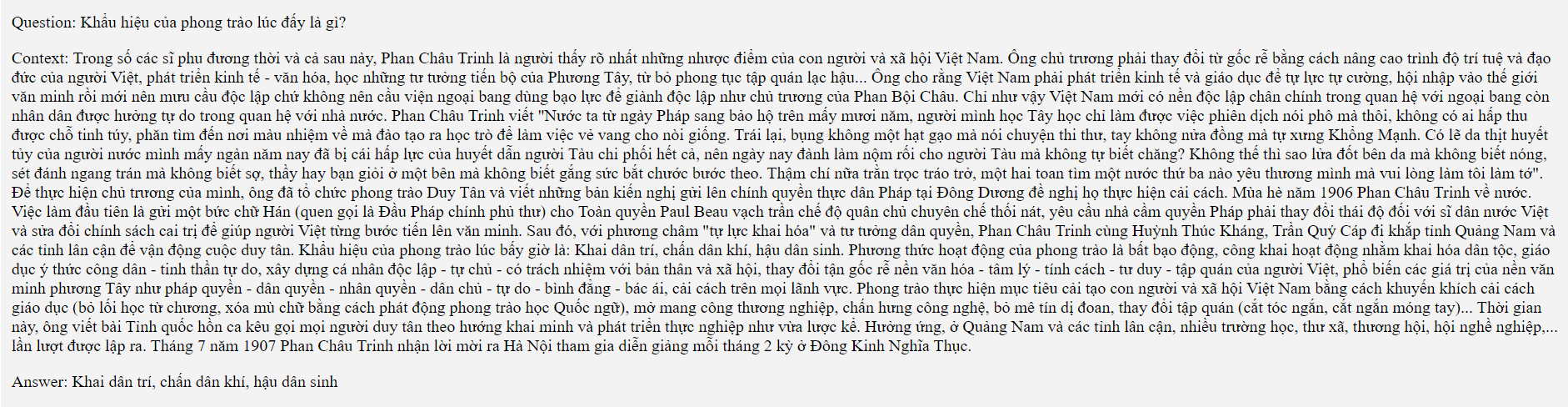
Image 1 (from BARTPho-syllable)
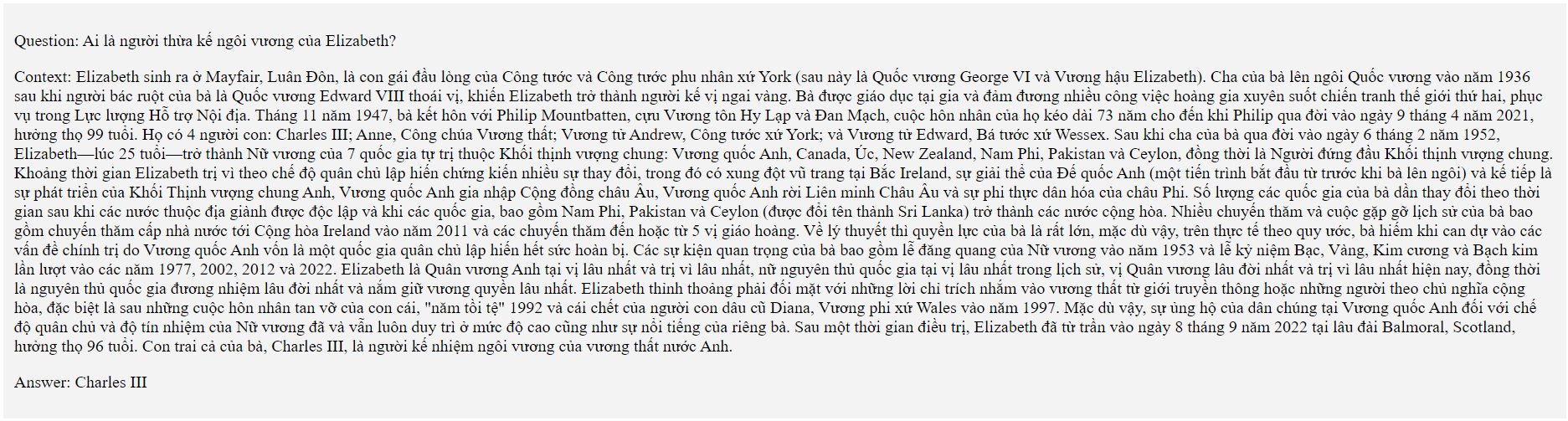
Image 2 (from PhoBERT-large)
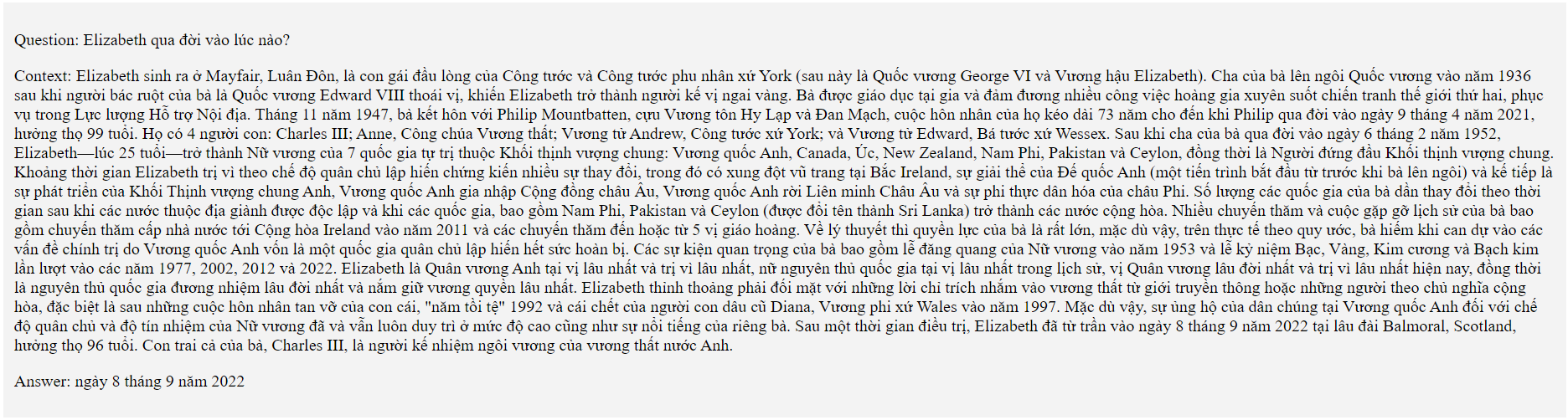
Image 3 (from PhoBERT-large)
Contributions are what make GitHub such an amazing place to be learn, inspire, and create. Any contributions you make are greatly appreciated.
git checkout -b contribute/Contributegit commit -m 'add your messages'git push origin contribute/ContributeEmail: [email protected]
Question Answering in Vietnamese. In a nutshell, this project helps us answer a Question of a given Context in Vietnamese. [UPDATED] This won me a Top 2 Graduates of VietAI Advanced NLP 02.
Jupyter Notebook
29
15 commits
updated Nov 17, 2022
My project is called Question Answering. This is a project carried out by me when I was studying at VietAI Advanced NLP Class 02. In a nutshell, the system in this project helps us answer a Question of a given Context.
To get started, you should have prior knowledge on Python and Pytorch at first. A few resources to get you started if this is your first Python or Tensorflow project:
Data: UIT-ViQuAD2.0 dataset from VLSP2021.
Model: question_answering_bartpho_phobert is based on BARTpho and PhoBERT models.
According to the orginal paper, it is stated that BARTpho-syllable and BARTpho-word are the first public large-scale monolingual sequence-to-sequence models pre-trained for Vietnamese. BARTpho uses the "large" architecture and the pre-training scheme of the sequence-to-sequence denoising autoencoder BART, thus it is especially suitable for generative NLP tasks. Especially in this downstream task, based on our experiments, we choose BARTpho-syllable in preference to BARTpho-word, and PhoBERT-large in preference to PhoBERT-base.
Clone the repo
git clone https://github.com/phkhanhtrinh23/question_answering_bartpho_phobert.git
Use any code editor to open the folder question_answering_bartpho_phobert.
Run pip install -r requirements.txt to install the required packages.
Note: You can install transformer as follows:
git clone --single-branch --branch fast_tokenizers_BARTpho_PhoBERT_BERTweet https://github.com/datquocnguyen/transformers.git

cd transformers

pip3 install -e .
├── data
|  └── demo.json (not from UIT-ViQuAD2.0)
|  └── test.json
|  └── train.json
Run python data.py to split the train.json into new_train.json and valid.json with 9:1 ratio respectively.
Now you can easily train the model with this command python train.py.
You can validate the model by python validate.py. This file validates the score of the trained model based on valid.json
Note: Of course, you can parse any arguments given in the ArgumentParser in both train.py and validate.py for better results.
test.json by python inference.py.Note: Because the model cannot load and infer the whole dataset at once, validate.py and inference.py only supports inferring in batches.
python api.py. The UI of the website is originated from templates folder. If possible, run this and share your results with me!Some results:
Image 1 (from BARTPho-syllable)
Image 2 (from PhoBERT-large)
Image 3 (from PhoBERT-large)
Contributions are what make GitHub such an amazing place to be learn, inspire, and create. Any contributions you make are greatly appreciated.
git checkout -b contribute/Contributegit commit -m 'add your messages'git push origin contribute/ContributeEmail: [email protected]



