
Learn Agentic AI using Dapr Agentic Cloud Ascent (DACA) Design Pattern and Agent-Native Cloud Technologies: OpenAI Agents SDK, Memory, MCP, A2A, Knowledge Graphs, Dapr, Rancher Desktop, and Kubernetes.
Jupyter Notebook
4,378
2,076 commits
updated Oct 26, 2025
README
Learn Agentic AI using Dapr Agentic Cloud Ascent (DACA) Design Pattern: From Start to Scale
This repo is part of the Panaversity Certified Agentic & Robotic AI Engineer program. You can also review the certification and course details in the program guide. This repo provides learning material for Agentic AI and Cloud courses.
Here’s a polished, professional rewrite you can use as a one-pager or slide—tight on wording, clear on stakes, and just a touch playful so it doesn’t read like it was written by a committee (no offense to committees 😄).
Our Agentic Strategy for Pakistan: Four Working Hypotheses
Pakistan must place smart, early bets on the technologies and talent that will define the agentic AI era—because we intend to train millions of agentic-AI developers across the country and abroad, and launch startups at scale (ambitious, yes—but coffee is cheaper than regret).
Hypothesis 1 — Agentic AI is the trajectory
We believe the future of AI is agentic: systems that plan, coordinate tools, and take actions to deliver outcomes, not just answers (aka “from chat to getting things done”—and ideally without breaking anything valuable). This hypothesis guides our curriculum design, tooling choices, and venture focus.
Hypothesis 2 — Cloud-native rails: Kubernetes × Dapr × Ray
Our bet for large-scale agentic systems is a cloud-native stack: Kubernetes for orchestration, Dapr (Actors, Workflows, and Agents) for reliable micro-primitives, and Ray for elastic distributed compute. Together, these provide the building blocks for durable, observable, horizontally scalable agent swarms.
Hypothesis 3 — The real blocker is the learning gap
Most AI pilots fail not because the models are incapable, but because teams don’t know how to integrate AI into workflows, controls, and economics. Recent coverage of an MIT study reports that ~95% of enterprise gen-AI implementations show no measurable P&L impact—largely due to poor problem selection and integration practices, not model quality. Our program is designed to close this gap with workflow design, safety guardrails, and ROI-first delivery. An MIT report that 95% of AI pilots fail spooked investors. But it’s the reason why those pilots failed that should make the C-suite anxious
Hypothesis 4 — The web is becoming agentic and interoperable
The next web is a fabric of interoperable agents coordinating via open protocols—MCP for standardized tool/context access, A2A for authenticated agent-to-agent collaboration, and NANDA for identity, authorization, and verifiable audit. These emerging standards enable composable automation across apps, devices, and clouds—shifting the browser from a tab list to an outcome orchestrator with trust and consent built in (finally, fewer tabs, more results).
What this means for execution
- Talent engine: hands-on training in agentic patterns (planning, tools, memory, evaluation), workflow design, and safety—tied to real industry use-cases (because “Hello, World” doesn’t move P&L).
- Reference stack: Kubernetes + Dapr + Ray blueprints with observability, guardrails, and cost controls—shippable by small teams (and auditable by large ones).
- Protocol readiness: MCP/A2A/NANDA-aware agent designs to ensure our solutions interoperate as the standards mature (future-proof beats future-guess).
If any hypothesis is wrong, we’ll measure, publish, and pivot fast—because the only unforgivable error is not learning.
This Panaversity Initiative Tackles the Critical Challenge:
“How do we design AI Agents that can handle 10 million concurrent AI Agents without failing?”
Note: The challenge is intensified as we must guide our students to solve this issue with minimal financial resources available during training.
Kubernetes with Dapr can theoretically handle 10 million concurrent agents in an agentic AI system without failing, but achieving this requires extensive optimization, significant infrastructure, and careful engineering. While direct evidence at this scale is limited, logical extrapolation from existing benchmarks, Kubernetes’ scalability, and Dapr’s actor model supports feasibility, especially with rigorous tuning and resource allocation.
Condensed Argument with Proof and Logic:
-
Kubernetes Scalability:
- Evidence: Kubernetes supports up to 5,000 nodes and 150,000 pods per cluster (Kubernetes docs), with real-world examples like PayPal scaling to 4,000 nodes and 200,000 pods (InfoQ, 2023) and KubeEdge managing 100,000 edge nodes and 1 million pods (KubeEdge case studies). OpenAI’s 2,500-node cluster for AI workloads (OpenAI blog, 2022) shows Kubernetes can handle compute-intensive tasks.
- Logic: For 10 million users, a cluster of 5,000–10,000 nodes (e.g., AWS g5 instances with GPUs) can distribute workloads. Each node can run hundreds of pods, and Kubernetes’ horizontal pod autoscaling (HPA) dynamically adjusts to demand. Bottlenecks (e.g., API server, networking) can be mitigated by tuning etcd, using high-performance CNIs like Cilium, and optimizing DNS.
-
Dapr’s Efficiency for Agentic AI:
- Evidence: Dapr’s actor model supports thousands of virtual actors per CPU core with double-digit millisecond latency (Dapr docs, 2024). Case studies show Dapr handling millions of events, e.g., Tempestive’s IoT platform processing billions of messages (Dapr blog, 2023) and DeFacto’s system managing 3,700 events/second (320 million daily) on Kubernetes with Kafka (Microsoft case study, 2022).
- Logic: Agentic AI relies on stateful, low-latency agents. Dapr Agents, built on the actor model, can represent 10 million users as actors, distributed across a Kubernetes cluster. Dapr’s state management (e.g., Redis) and pub/sub messaging (e.g., Kafka) ensure efficient coordination and resilience, with automatic retries preventing failures. Sharding state stores and message brokers scales to millions of operations/second.
-
Handling AI Workloads:
- Evidence: LLM inference frameworks like vLLM and TGI serve thousands of requests/second per GPU (vLLM benchmarks, 2024). Kubernetes orchestrates GPU workloads effectively, as seen Kubernetes manages GPU workloads, as seen in NVIDIA’s AI platform scaling to thousands of GPUs (NVIDIA case study, 2023).
- Logic: Assuming each user generates 1 request/second requiring 0.01 GPU, 10 million users need ~100,000 GPUs. Batching, caching, and model parallelism reduce this to a feasible ~10,000–20,000 GPUs, achievable in hyperscale clouds (e.g., AWS). Kubernetes’ resource scheduling ensures optimal GPU utilization.
-
Networking and Storage:
- Evidence: EMQX on Kubernetes handled 1 million concurrent connections with tuning (EMQX blog, 2024). C10M benchmarks (2013) achieved 10 million connections using optimized stacks. Dapr’s state stores (e.g., Redis) support millions of operations/second (Redis benchmarks, 2024).
- Logic: 10 million connections require ~100–1,000 Gbps bandwidth, supported by modern clouds. High-throughput databases (e.g., CockroachDB) and caching (e.g., Redis Cluster) handle 10 TB of state data for 10 million users (1 KB/user). Kernel bypass (e.g., DPDK) and eBPF-based CNIs (e.g., Cilium) minimize networking latency.
-
Resilience and Monitoring:
- Evidence: Dapr’s resiliency policies (retries, circuit breakers) and Kubernetes’ self-healing (pod restarts) ensure reliability (Dapr docs, 2024). Dapr’s OpenTelemetry integration scales monitoring for millions of agents (Prometheus case studies, 2023).
- Logic: Real-time metrics (e.g., latency, error rates) and distributed tracing prevent cascading failures. Kubernetes’ liveness probes and Dapr’s workflow engine recover from crashes, ensuring 99.999% uptime.
Feasibility with Constraints:
- Challenge: No direct benchmark exists for 10 million concurrent users with Dapr/Kubernetes in an agentic AI context. Infrastructure costs (e.g., $10M–$100M for 10,000 nodes) are prohibitive for low-budget scenarios.
- Solution: Use open-source tools (e.g., Minikube, kind) for local testing and cloud credits (e.g., AWS Educate) for students. Simulate 10 million users with tools like Locust on smaller clusters (e.g., 100 nodes), extrapolating results. Optimize Dapr’s actor placement and Kubernetes’ resource quotas to maximize efficiency on limited hardware. Leverage free-tier databases (e.g., MongoDB Atlas) and message brokers (e.g., RabbitMQ).
Conclusion: Kubernetes with Dapr can handle 10 million concurrent users in an agentic AI system, supported by their proven scalability, real-world case studies, and logical extrapolation. For students with minimal budgets, small-scale simulations, open-source tools, and cloud credits make the problem tractable, though production-scale deployment requires hyperscale resources and expertise.
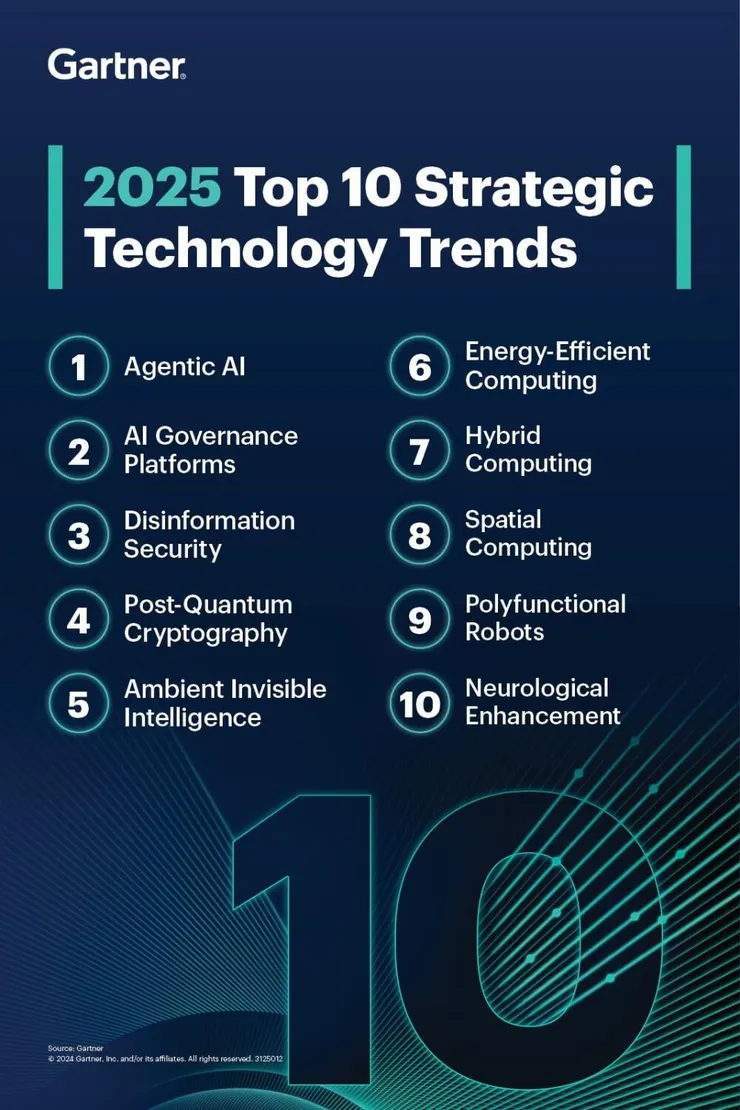
Agentic AI Top Trend of 2025
The Dapr Agentic Cloud Ascent (DACA) Design Pattern Addresses 10 Million AI Agents Challenge
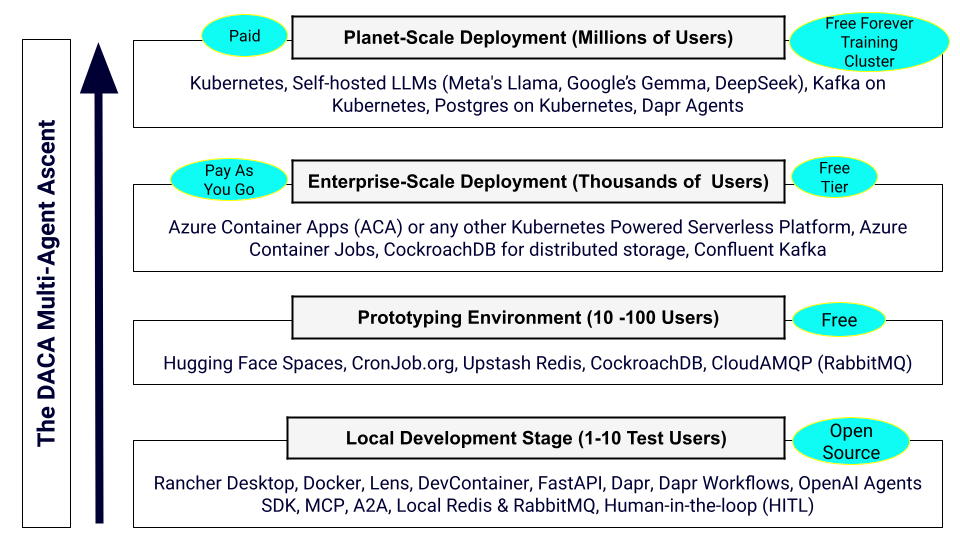
Let's understand and learn about "Dapr Agentic Cloud Ascent (DACA)", our winning design pattern for developing and deploying planet scale multi-agent systems.
Executive Summary: Dapr Agentic Cloud Ascent (DACA)
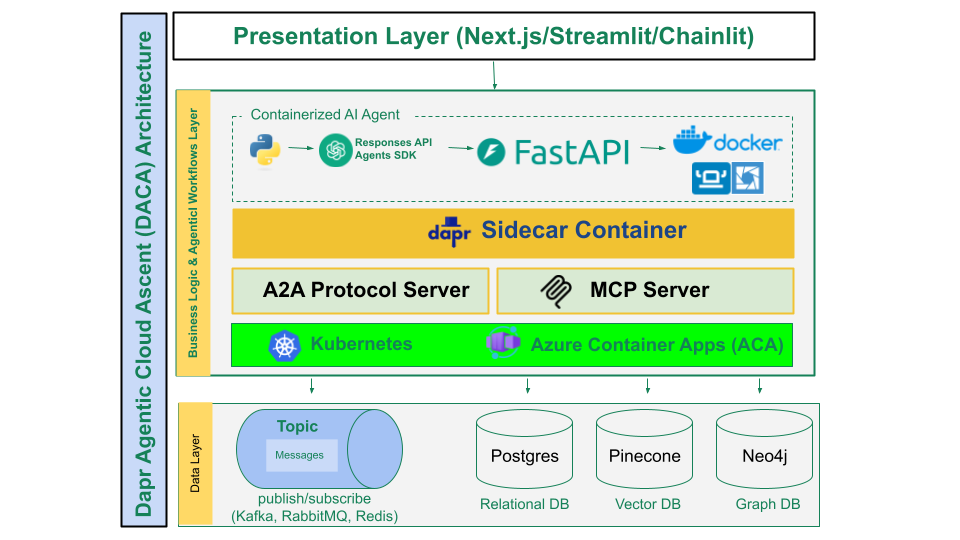
The Dapr Agentic Cloud Ascent (DACA) guide introduces a strategic design pattern for building and deploying sophisticated, scalable, and resilient agentic AI systems. Addressing the complexities of modern AI development, DACA integrates the OpenAI Agents SDK for core agent logic with the Model Context Protocol (MCP) for standardized tool use and the Agent2Agent (A2A) protocol for seamless inter-agent communication, all underpinned by the distributed capabilities of Dapr. Grounded in AI-first and cloud-first principles, DACA promotes the use of stateless, containerized applications deployed on platforms like Azure Container Apps (Serverless Containers) or Kubernetes, enabling efficient scaling from local development to planetary-scale production, potentially leveraging free-tier cloud services and self-hosted LLMs for cost optimization. The pattern emphasizes modularity, context-awareness, and standardized communication, envisioning an Agentia World where diverse AI agents collaborate intelligently. Ultimately, DACA offers a robust, flexible, and cost-effective framework for developers and architects aiming to create complex, cloud-native agentic AI applications that are built for scalability and resilience from the ground up.
Comprehensive Guide to Dapr Agentic Cloud Ascent (DACA) Design Pattern
Target User
- Agentic AI Developer and AgentOps Professionals
Why OpenAI Agents SDK should be the main framework for agentic development for most use cases?
Table 1: Comparison of Abstraction Levels in AI Agent Frameworks
| Framework | Abstraction Level | Key Characteristics | Learning Curve | Control Level | Simplicity |
|---|---|---|---|---|---|
| OpenAI Agents SDK | Minimal | Python-first, core primitives (Agents, Handoffs, Guardrails), direct control | Low | High | High |
| CrewAI | Moderate | Role-based agents, crews, tasks, focus on collaboration | Low-Medium | Medium | Medium |
| AutoGen | High | Conversational agents, flexible conversation patterns, human-in-the-loop support | Medium | Medium | Medium |
| Google ADK | Moderate | Multi-agent hierarchies, Google Cloud integration (Gemini, Vertex AI), rich tool ecosystem, bidirectional streaming | Medium | Medium-High | Medium |
| LangGraph | Low-Moderate | Graph-based workflows, nodes, edges, explicit state management | Very High | Very High | Low |
| Dapr Agents | Moderate | Stateful virtual actors, event-driven multi-agent workflows, Kubernetes integration, 50+ data connectors, built-in resiliency | Medium | Medium-High | Medium |
The table clearly identifies why OpenAI Agents SDK should be the main framework for agentic development for most use cases:
- It excels in simplicity and ease of use, making it the best choice for rapid development and broad accessibility.
- It offers high control with minimal abstraction, providing the flexibility needed for agentic development without the complexity of frameworks like LangGraph.
- It outperforms most alternatives (CrewAI, AutoGen, Google ADK, Dapr Agents) in balancing usability and power, and while LangGraph offers more control, its complexity makes it less practical for general use.
If your priority is ease of use, flexibility, and quick iteration in agentic development, OpenAI Agents SDK is the clear winner based on the table. However, if your project requires enterprise-scale features (e.g., Dapr Agents) or maximum control for complex workflows (e.g., LangGraph), you might consider those alternatives despite their added complexity.
Core DACA Agentic AI Courses:
AI-201: Fundamentals of Agentic AI and DACA AI-First Development (14 weeks)
- Agentic & DACA Theory - 1 week
- UV & OpenAI Agents SDK - 5 weeks
- Agentic Design Patterns - 2 weeks
- Memory [LangMem & mem0] 1 week
- Postgres/Redis (Managed Cloud) - 1 week
- FastAPI (Basic) - 2 weeks
- Containerization (Rancher Desktop) - 1 week
- Hugging Face Docker Spaces - 1 week
Note: These videos are for additional learning, and do not cover all the material taught in the onsite classes.
Prerequisite: Successful completion of AI-101: Modern AI Python Programming - Your Launchpad into Intelligent Systems
AI-202: DACA Cloud-First Agentic AI Development (14 weeks)
- Rancher Desktop with Local Kubernetes - 4 weeks
- Advanced FastAPI with Kubernetes - 2 weeks
- Dapr [workflows, state, pubsub, secrets] - 3 Week
- CockRoachdb & RabbitMQ Managed Services - 2 weeks
- Model Context Protocol - 2 weeks
- Serverless Containers Deployment (ACA) - 2 weeks
Prerequisite: Successful completion of AI-201
AI-301 DACA Planet-Scale Distributed AI Agents (14 Weeks)
- Certified Kubernetes Application Developer (CKAD) - 4 weeks
- A2A Protocol - 2 weeks
- Voice Agents - 2 weeks
- Dapr Agents/Google ADK - 2 weeks
- Self-LLMs Hosting - 1 week
- Finetuning LLMs - 3 weeks
Prerequisite: Successful completion of AI-201 & AI-202
Evaluations
Quizzes + Hackathons (Everything is Onsite)
- Advanced Modern Python (including asyncio) [Q1]
- OpenAI Agents SDK (48 MCQ in 2 hour) [01_ai_agents_first]
- Protocols & Design Patterns (A2A and MCP) [05_ai_protocols]
- Hackathon1 - 8 Hours (Using Above Quiz Stack)
- Containerization + FastAPI [05_daca_agent_native_dev = 01 + 02 ]
- Kubernetes (Rancher Desktop) [Stimulations] [05_daca_agent_native_dev = 02 ]
- Dapr-1 - State, PubSub, Bindings, Invocation [05_daca_agent_native_dev = 03 ]
- Dapr-2 - Workflows, Virtual Actors [04_agent_native = 04, 05, 06]
- Hackathon2 - 8 Hours (Agent Native Startup)
- CKAD + DAPR + ArgoCD (Simulations) [06_daca_deployment_guide + 07_ckad]
Quiz Details
Fundamentals of Agentic AI Quiz
Total Questions: 48 MCQs
Duration: 120 Minutes
Difficulty Level: Intermediate or Advanced (NOT beginner-level)
This is a well-constructed, comprehensive quiz that accurately tests deep knowledge of the OpenAI Agents SDK. However, it's significantly more challenging than typical beginner-level assessments.
Difficulty Level for Beginners
The quiz is challenging for beginners due to the following factors:
-
Technical Depth: Questions require understanding the OpenAI Agents SDK’s architecture (e.g., Agents, Tools, Handoffs, Runner), Pydantic models, async programming, and prompt engineering. These are advanced topics for someone new to AI or Python.
-
Conceptual Complexity: Topics like dynamic instructions, context management, error handling, and Chain-of-Thought prompting require familiarity with both theoretical and practical aspects of agentic AI.
-
Code Analysis: Many questions involve analyzing code snippets, understanding execution paths, and predicting outcomes, which demand strong Python and debugging skills. Domain Knowledge: Questions on Markdown are simpler, but the majority focus on niche SDK features, making the quiz specialized.
-
Beginner Challenges: Beginners (e.g., those with basic Python knowledge and minimal AI experience) would struggle with SDK-specific concepts like Runner.run_sync, tool_choice, and Pydantic validation, as well as async programming and multi-agent workflows.
-
Difficulty Rating: Advanced (not beginner-friendly). Beginners would need foundational knowledge in Python, async programming, and LLMs, plus specific training on the OpenAI Agents SDK to perform well.
To excel in this quiz, focus on understanding the core components and philosophy of the OpenAI Agents SDK, such as its "Python-first" design for orchestration, the roles of Agents and Tools, and how primitives like "Handoffs" facilitate multi-agent collaboration. Pay close attention to how the SDK manages the agent loop, handles tool calls and Pydantic models for typed inputs/outputs, and uses context objects. Review concepts like dynamic instructions, agent cloning, error handling during tool execution, and the nuances of Runner.run_sync() versus streaming. Additionally, refresh your knowledge of prompt engineering techniques, including crafting clear instructions, guiding the agent's reasoning (e.g., Chain-of-Thought), and managing sensitive data through persona and careful prompting. Finally, ensure you're comfortable with basic Markdown syntax for links and images.
Preparation Guide for Beginner Students
This OpenAI Agents SDK quiz is designed for intermediate to advanced learners and requires substantial preparation to succeed. Before attempting this assessment, ensure you have a solid foundation in Python programming, including object-oriented concepts, async/await patterns, decorators, and error handling. You'll need to thoroughly study Pydantic models for data validation, understanding field definitions, default values, and validation behavior. Dedicate significant time to the OpenAI Agents SDK documentation (https://openai.github.io/openai-agents-python/), focusing on core concepts like Agents, Tools, Handoffs, context management, and the agent execution loop. Practice writing and analyzing code that uses the @function_tool decorator, Runner.run_sync(), agent cloning, and multi-agent orchestration patterns. Review prompt engineering techniques from the OpenAI cookbook, particularly Chain-of-Thought prompting, system message design, and handling sensitive data. Finally, familiarize yourself with basic Markdown syntax for links and images. Plan to spend at least 2-3 weeks studying these materials, complete hands-on coding exercises with the SDK. Consider this quiz a capstone assessment that requires comprehensive understanding rather than a beginner-level introduction to the concepts.
Quiz Covers:
https://openai.github.io/openai-agents-python/
https://cookbook.openai.com/examples/gpt4-1_prompting_guide
https://www.markdownguide.org/basic-syntax/
https://www.markdownguide.org/cheat-sheet/
https://github.com/panaversity/learn-agentic-ai/tree/main/01_ai_agents_first
You Can Generate Mock Quizzes for Practice using LLMs from this Prompt:
Create a comprehensive quiz covering OpenAI Agents SDK. It should include as many MCQ Quiz Questions as required to test the material, the questions should be difficult and at the graduate level and should test both concepts and include code were required. From the following following documentation:
Contributors


Similar repos


Languages
Jupyter Notebook
90.9%
Python
8.3%
Learn Agentic AI using Dapr Agentic Cloud Ascent (DACA) Design Pattern and Agent-Native Cloud Technologies: OpenAI Agents SDK, Memory, MCP, A2A, Knowledge Graphs, Dapr, Rancher Desktop, and Kubernetes.
Jupyter Notebook
4,378
2,076 commits
updated Oct 26, 2025
README
Learn Agentic AI using Dapr Agentic Cloud Ascent (DACA) Design Pattern: From Start to Scale
This repo is part of the Panaversity Certified Agentic & Robotic AI Engineer program. You can also review the certification and course details in the program guide. This repo provides learning material for Agentic AI and Cloud courses.
Here’s a polished, professional rewrite you can use as a one-pager or slide—tight on wording, clear on stakes, and just a touch playful so it doesn’t read like it was written by a committee (no offense to committees 😄).
Our Agentic Strategy for Pakistan: Four Working Hypotheses
Pakistan must place smart, early bets on the technologies and talent that will define the agentic AI era—because we intend to train millions of agentic-AI developers across the country and abroad, and launch startups at scale (ambitious, yes—but coffee is cheaper than regret).
Hypothesis 1 — Agentic AI is the trajectory
We believe the future of AI is agentic: systems that plan, coordinate tools, and take actions to deliver outcomes, not just answers (aka “from chat to getting things done”—and ideally without breaking anything valuable). This hypothesis guides our curriculum design, tooling choices, and venture focus.
Hypothesis 2 — Cloud-native rails: Kubernetes × Dapr × Ray
Our bet for large-scale agentic systems is a cloud-native stack: Kubernetes for orchestration, Dapr (Actors, Workflows, and Agents) for reliable micro-primitives, and Ray for elastic distributed compute. Together, these provide the building blocks for durable, observable, horizontally scalable agent swarms.
Hypothesis 3 — The real blocker is the learning gap
Most AI pilots fail not because the models are incapable, but because teams don’t know how to integrate AI into workflows, controls, and economics. Recent coverage of an MIT study reports that ~95% of enterprise gen-AI implementations show no measurable P&L impact—largely due to poor problem selection and integration practices, not model quality. Our program is designed to close this gap with workflow design, safety guardrails, and ROI-first delivery. An MIT report that 95% of AI pilots fail spooked investors. But it’s the reason why those pilots failed that should make the C-suite anxious
Hypothesis 4 — The web is becoming agentic and interoperable
The next web is a fabric of interoperable agents coordinating via open protocols—MCP for standardized tool/context access, A2A for authenticated agent-to-agent collaboration, and NANDA for identity, authorization, and verifiable audit. These emerging standards enable composable automation across apps, devices, and clouds—shifting the browser from a tab list to an outcome orchestrator with trust and consent built in (finally, fewer tabs, more results).
What this means for execution
- Talent engine: hands-on training in agentic patterns (planning, tools, memory, evaluation), workflow design, and safety—tied to real industry use-cases (because “Hello, World” doesn’t move P&L).
- Reference stack: Kubernetes + Dapr + Ray blueprints with observability, guardrails, and cost controls—shippable by small teams (and auditable by large ones).
- Protocol readiness: MCP/A2A/NANDA-aware agent designs to ensure our solutions interoperate as the standards mature (future-proof beats future-guess).
If any hypothesis is wrong, we’ll measure, publish, and pivot fast—because the only unforgivable error is not learning.
This Panaversity Initiative Tackles the Critical Challenge:
“How do we design AI Agents that can handle 10 million concurrent AI Agents without failing?”
Note: The challenge is intensified as we must guide our students to solve this issue with minimal financial resources available during training.
Kubernetes with Dapr can theoretically handle 10 million concurrent agents in an agentic AI system without failing, but achieving this requires extensive optimization, significant infrastructure, and careful engineering. While direct evidence at this scale is limited, logical extrapolation from existing benchmarks, Kubernetes’ scalability, and Dapr’s actor model supports feasibility, especially with rigorous tuning and resource allocation.
Condensed Argument with Proof and Logic:
-
Kubernetes Scalability:
- Evidence: Kubernetes supports up to 5,000 nodes and 150,000 pods per cluster (Kubernetes docs), with real-world examples like PayPal scaling to 4,000 nodes and 200,000 pods (InfoQ, 2023) and KubeEdge managing 100,000 edge nodes and 1 million pods (KubeEdge case studies). OpenAI’s 2,500-node cluster for AI workloads (OpenAI blog, 2022) shows Kubernetes can handle compute-intensive tasks.
- Logic: For 10 million users, a cluster of 5,000–10,000 nodes (e.g., AWS g5 instances with GPUs) can distribute workloads. Each node can run hundreds of pods, and Kubernetes’ horizontal pod autoscaling (HPA) dynamically adjusts to demand. Bottlenecks (e.g., API server, networking) can be mitigated by tuning etcd, using high-performance CNIs like Cilium, and optimizing DNS.
-
Dapr’s Efficiency for Agentic AI:
- Evidence: Dapr’s actor model supports thousands of virtual actors per CPU core with double-digit millisecond latency (Dapr docs, 2024). Case studies show Dapr handling millions of events, e.g., Tempestive’s IoT platform processing billions of messages (Dapr blog, 2023) and DeFacto’s system managing 3,700 events/second (320 million daily) on Kubernetes with Kafka (Microsoft case study, 2022).
- Logic: Agentic AI relies on stateful, low-latency agents. Dapr Agents, built on the actor model, can represent 10 million users as actors, distributed across a Kubernetes cluster. Dapr’s state management (e.g., Redis) and pub/sub messaging (e.g., Kafka) ensure efficient coordination and resilience, with automatic retries preventing failures. Sharding state stores and message brokers scales to millions of operations/second.
-
Handling AI Workloads:
- Evidence: LLM inference frameworks like vLLM and TGI serve thousands of requests/second per GPU (vLLM benchmarks, 2024). Kubernetes orchestrates GPU workloads effectively, as seen Kubernetes manages GPU workloads, as seen in NVIDIA’s AI platform scaling to thousands of GPUs (NVIDIA case study, 2023).
- Logic: Assuming each user generates 1 request/second requiring 0.01 GPU, 10 million users need ~100,000 GPUs. Batching, caching, and model parallelism reduce this to a feasible ~10,000–20,000 GPUs, achievable in hyperscale clouds (e.g., AWS). Kubernetes’ resource scheduling ensures optimal GPU utilization.
-
Networking and Storage:
- Evidence: EMQX on Kubernetes handled 1 million concurrent connections with tuning (EMQX blog, 2024). C10M benchmarks (2013) achieved 10 million connections using optimized stacks. Dapr’s state stores (e.g., Redis) support millions of operations/second (Redis benchmarks, 2024).
- Logic: 10 million connections require ~100–1,000 Gbps bandwidth, supported by modern clouds. High-throughput databases (e.g., CockroachDB) and caching (e.g., Redis Cluster) handle 10 TB of state data for 10 million users (1 KB/user). Kernel bypass (e.g., DPDK) and eBPF-based CNIs (e.g., Cilium) minimize networking latency.
-
Resilience and Monitoring:
- Evidence: Dapr’s resiliency policies (retries, circuit breakers) and Kubernetes’ self-healing (pod restarts) ensure reliability (Dapr docs, 2024). Dapr’s OpenTelemetry integration scales monitoring for millions of agents (Prometheus case studies, 2023).
- Logic: Real-time metrics (e.g., latency, error rates) and distributed tracing prevent cascading failures. Kubernetes’ liveness probes and Dapr’s workflow engine recover from crashes, ensuring 99.999% uptime.
Feasibility with Constraints:
- Challenge: No direct benchmark exists for 10 million concurrent users with Dapr/Kubernetes in an agentic AI context. Infrastructure costs (e.g., $10M–$100M for 10,000 nodes) are prohibitive for low-budget scenarios.
- Solution: Use open-source tools (e.g., Minikube, kind) for local testing and cloud credits (e.g., AWS Educate) for students. Simulate 10 million users with tools like Locust on smaller clusters (e.g., 100 nodes), extrapolating results. Optimize Dapr’s actor placement and Kubernetes’ resource quotas to maximize efficiency on limited hardware. Leverage free-tier databases (e.g., MongoDB Atlas) and message brokers (e.g., RabbitMQ).
Conclusion: Kubernetes with Dapr can handle 10 million concurrent users in an agentic AI system, supported by their proven scalability, real-world case studies, and logical extrapolation. For students with minimal budgets, small-scale simulations, open-source tools, and cloud credits make the problem tractable, though production-scale deployment requires hyperscale resources and expertise.
Agentic AI Top Trend of 2025
The Dapr Agentic Cloud Ascent (DACA) Design Pattern Addresses 10 Million AI Agents Challenge
Let's understand and learn about "Dapr Agentic Cloud Ascent (DACA)", our winning design pattern for developing and deploying planet scale multi-agent systems.
Executive Summary: Dapr Agentic Cloud Ascent (DACA)
The Dapr Agentic Cloud Ascent (DACA) guide introduces a strategic design pattern for building and deploying sophisticated, scalable, and resilient agentic AI systems. Addressing the complexities of modern AI development, DACA integrates the OpenAI Agents SDK for core agent logic with the Model Context Protocol (MCP) for standardized tool use and the Agent2Agent (A2A) protocol for seamless inter-agent communication, all underpinned by the distributed capabilities of Dapr. Grounded in AI-first and cloud-first principles, DACA promotes the use of stateless, containerized applications deployed on platforms like Azure Container Apps (Serverless Containers) or Kubernetes, enabling efficient scaling from local development to planetary-scale production, potentially leveraging free-tier cloud services and self-hosted LLMs for cost optimization. The pattern emphasizes modularity, context-awareness, and standardized communication, envisioning an Agentia World where diverse AI agents collaborate intelligently. Ultimately, DACA offers a robust, flexible, and cost-effective framework for developers and architects aiming to create complex, cloud-native agentic AI applications that are built for scalability and resilience from the ground up.
Comprehensive Guide to Dapr Agentic Cloud Ascent (DACA) Design Pattern
Target User
- Agentic AI Developer and AgentOps Professionals
Why OpenAI Agents SDK should be the main framework for agentic development for most use cases?
Table 1: Comparison of Abstraction Levels in AI Agent Frameworks
| Framework | Abstraction Level | Key Characteristics | Learning Curve | Control Level | Simplicity |
|---|---|---|---|---|---|
| OpenAI Agents SDK | Minimal | Python-first, core primitives (Agents, Handoffs, Guardrails), direct control | Low | High | High |
| CrewAI | Moderate | Role-based agents, crews, tasks, focus on collaboration | Low-Medium | Medium | Medium |
| AutoGen | High | Conversational agents, flexible conversation patterns, human-in-the-loop support | Medium | Medium | Medium |
| Google ADK | Moderate | Multi-agent hierarchies, Google Cloud integration (Gemini, Vertex AI), rich tool ecosystem, bidirectional streaming | Medium | Medium-High | Medium |
| LangGraph | Low-Moderate | Graph-based workflows, nodes, edges, explicit state management | Very High | Very High | Low |
| Dapr Agents | Moderate | Stateful virtual actors, event-driven multi-agent workflows, Kubernetes integration, 50+ data connectors, built-in resiliency | Medium | Medium-High | Medium |
The table clearly identifies why OpenAI Agents SDK should be the main framework for agentic development for most use cases:
- It excels in simplicity and ease of use, making it the best choice for rapid development and broad accessibility.
- It offers high control with minimal abstraction, providing the flexibility needed for agentic development without the complexity of frameworks like LangGraph.
- It outperforms most alternatives (CrewAI, AutoGen, Google ADK, Dapr Agents) in balancing usability and power, and while LangGraph offers more control, its complexity makes it less practical for general use.
If your priority is ease of use, flexibility, and quick iteration in agentic development, OpenAI Agents SDK is the clear winner based on the table. However, if your project requires enterprise-scale features (e.g., Dapr Agents) or maximum control for complex workflows (e.g., LangGraph), you might consider those alternatives despite their added complexity.
Core DACA Agentic AI Courses:
AI-201: Fundamentals of Agentic AI and DACA AI-First Development (14 weeks)
- Agentic & DACA Theory - 1 week
- UV & OpenAI Agents SDK - 5 weeks
- Agentic Design Patterns - 2 weeks
- Memory [LangMem & mem0] 1 week
- Postgres/Redis (Managed Cloud) - 1 week
- FastAPI (Basic) - 2 weeks
- Containerization (Rancher Desktop) - 1 week
- Hugging Face Docker Spaces - 1 week
Note: These videos are for additional learning, and do not cover all the material taught in the onsite classes.
Prerequisite: Successful completion of AI-101: Modern AI Python Programming - Your Launchpad into Intelligent Systems
AI-202: DACA Cloud-First Agentic AI Development (14 weeks)
- Rancher Desktop with Local Kubernetes - 4 weeks
- Advanced FastAPI with Kubernetes - 2 weeks
- Dapr [workflows, state, pubsub, secrets] - 3 Week
- CockRoachdb & RabbitMQ Managed Services - 2 weeks
- Model Context Protocol - 2 weeks
- Serverless Containers Deployment (ACA) - 2 weeks
Prerequisite: Successful completion of AI-201
AI-301 DACA Planet-Scale Distributed AI Agents (14 Weeks)
- Certified Kubernetes Application Developer (CKAD) - 4 weeks
- A2A Protocol - 2 weeks
- Voice Agents - 2 weeks
- Dapr Agents/Google ADK - 2 weeks
- Self-LLMs Hosting - 1 week
- Finetuning LLMs - 3 weeks
Prerequisite: Successful completion of AI-201 & AI-202
Evaluations
Quizzes + Hackathons (Everything is Onsite)
- Advanced Modern Python (including asyncio) [Q1]
- OpenAI Agents SDK (48 MCQ in 2 hour) [01_ai_agents_first]
- Protocols & Design Patterns (A2A and MCP) [05_ai_protocols]
- Hackathon1 - 8 Hours (Using Above Quiz Stack)
- Containerization + FastAPI [05_daca_agent_native_dev = 01 + 02 ]
- Kubernetes (Rancher Desktop) [Stimulations] [05_daca_agent_native_dev = 02 ]
- Dapr-1 - State, PubSub, Bindings, Invocation [05_daca_agent_native_dev = 03 ]
- Dapr-2 - Workflows, Virtual Actors [04_agent_native = 04, 05, 06]
- Hackathon2 - 8 Hours (Agent Native Startup)
- CKAD + DAPR + ArgoCD (Simulations) [06_daca_deployment_guide + 07_ckad]
Quiz Details
Fundamentals of Agentic AI Quiz
Total Questions: 48 MCQs
Duration: 120 Minutes
Difficulty Level: Intermediate or Advanced (NOT beginner-level)
This is a well-constructed, comprehensive quiz that accurately tests deep knowledge of the OpenAI Agents SDK. However, it's significantly more challenging than typical beginner-level assessments.
Difficulty Level for Beginners
The quiz is challenging for beginners due to the following factors:
-
Technical Depth: Questions require understanding the OpenAI Agents SDK’s architecture (e.g., Agents, Tools, Handoffs, Runner), Pydantic models, async programming, and prompt engineering. These are advanced topics for someone new to AI or Python.
-
Conceptual Complexity: Topics like dynamic instructions, context management, error handling, and Chain-of-Thought prompting require familiarity with both theoretical and practical aspects of agentic AI.
-
Code Analysis: Many questions involve analyzing code snippets, understanding execution paths, and predicting outcomes, which demand strong Python and debugging skills. Domain Knowledge: Questions on Markdown are simpler, but the majority focus on niche SDK features, making the quiz specialized.
-
Beginner Challenges: Beginners (e.g., those with basic Python knowledge and minimal AI experience) would struggle with SDK-specific concepts like Runner.run_sync, tool_choice, and Pydantic validation, as well as async programming and multi-agent workflows.
-
Difficulty Rating: Advanced (not beginner-friendly). Beginners would need foundational knowledge in Python, async programming, and LLMs, plus specific training on the OpenAI Agents SDK to perform well.
To excel in this quiz, focus on understanding the core components and philosophy of the OpenAI Agents SDK, such as its "Python-first" design for orchestration, the roles of Agents and Tools, and how primitives like "Handoffs" facilitate multi-agent collaboration. Pay close attention to how the SDK manages the agent loop, handles tool calls and Pydantic models for typed inputs/outputs, and uses context objects. Review concepts like dynamic instructions, agent cloning, error handling during tool execution, and the nuances of Runner.run_sync() versus streaming. Additionally, refresh your knowledge of prompt engineering techniques, including crafting clear instructions, guiding the agent's reasoning (e.g., Chain-of-Thought), and managing sensitive data through persona and careful prompting. Finally, ensure you're comfortable with basic Markdown syntax for links and images.
Preparation Guide for Beginner Students
This OpenAI Agents SDK quiz is designed for intermediate to advanced learners and requires substantial preparation to succeed. Before attempting this assessment, ensure you have a solid foundation in Python programming, including object-oriented concepts, async/await patterns, decorators, and error handling. You'll need to thoroughly study Pydantic models for data validation, understanding field definitions, default values, and validation behavior. Dedicate significant time to the OpenAI Agents SDK documentation (https://openai.github.io/openai-agents-python/), focusing on core concepts like Agents, Tools, Handoffs, context management, and the agent execution loop. Practice writing and analyzing code that uses the @function_tool decorator, Runner.run_sync(), agent cloning, and multi-agent orchestration patterns. Review prompt engineering techniques from the OpenAI cookbook, particularly Chain-of-Thought prompting, system message design, and handling sensitive data. Finally, familiarize yourself with basic Markdown syntax for links and images. Plan to spend at least 2-3 weeks studying these materials, complete hands-on coding exercises with the SDK. Consider this quiz a capstone assessment that requires comprehensive understanding rather than a beginner-level introduction to the concepts.
Quiz Covers:
https://openai.github.io/openai-agents-python/
https://cookbook.openai.com/examples/gpt4-1_prompting_guide
https://www.markdownguide.org/basic-syntax/
https://www.markdownguide.org/cheat-sheet/
https://github.com/panaversity/learn-agentic-ai/tree/main/01_ai_agents_first
You Can Generate Mock Quizzes for Practice using LLMs from this Prompt:
Create a comprehensive quiz covering OpenAI Agents SDK. It should include as many MCQ Quiz Questions as required to test the material, the questions should be difficult and at the graduate level and should test both concepts and include code were required. From the following following documentation:
Similar repos
Contributors
Languages
Jupyter Notebook
90.9%
Python
8.3%