
Write Language Servers that comply with 3.17 of the LSP Specification
See the codeREADME
go-lsp
go-lsp is a Go library for building Language Server Protocol servers in Go without reimplementing JSON-RPC transport, handler dispatch, document sync, or protocol types.
Why use go-lsp?
- Typed LSP handlers instead of hand-rolled JSON-RPC plumbing
- Auto-detected capabilities from the interfaces your handler implements
- Built-in document store with full and incremental sync support
servertestharness for end-to-end LSP tests over in-memory pipes- Project scaffold generator to bootstrap a server quickly
- Optional debug UI for inspecting live LSP traffic
Install
go get github.com/owenrumney/go-lsp
Minimal server
package main

import (
    "context"
    "log"

    "github.com/owenrumney/go-lsp/lsp"
    "github.com/owenrumney/go-lsp/server"
)

type Handler struct{}

func (h *Handler) Initialize(_ context.Context, _ *lsp.InitializeParams) (*lsp.InitializeResult, error) {
    return &lsp.InitializeResult{
        ServerInfo: &lsp.ServerInfo{Name: "example", Version: "0.1.0"},
    }, nil
}

func (h *Handler) Shutdown(_ context.Context) error { return nil }

func (h *Handler) Hover(_ context.Context, _ *lsp.HoverParams) (*lsp.Hover, error) {
    return &lsp.Hover{
        Contents: lsp.NewHoverContents(lsp.Markdown, "**hello**"),
    }, nil
}

func main() {
    srv := server.NewServer(&Handler{})
    if err := srv.Run(context.Background(), server.RunStdio()); err != nil {
        log.Fatal(err)
    }
}
Implement server.HoverHandler, server.CompletionHandler, server.TextDocumentSyncHandler, and other interfaces as needed. go-lsp registers methods and advertises capabilities automatically.
Quick start
Generate a starter server:
go run github.com/owenrumney/go-lsp/cmd/scaffold@latest \
  --name mylang \
  --module github.com/you/mylang-lsp \
  --lang mylang \
  --features hover,completion,diagnostics
Run tests with the included harness:
func TestHover(t *testing.T) {
    h := servertest.New(t, &Handler{})

    h.DidOpen("file:///test.txt", "plaintext", "hello")
    hover, err := h.Hover("file:///test.txt", 0, 0)
    if err != nil {
        t.Fatal(err)
    }
    if hover == nil {
        t.Fatal("expected hover result")
    }
}
Feature highlights
Server-to-client APIs
server.Client includes helpers for common outbound LSP calls, including:
PublishDiagnosticsShowMessage,LogMessage,ShowMessageRequestShowDocumentConfigurationApplyEditRegisterCapability,UnregisterCapability- progress and refresh requests
Middleware and request controls
Server supports optional inbound middleware and request concurrency controls:
server.WithMethodMiddleware(...)server.WithNotificationMiddleware(...)server.WithMaxConcurrentRequests(n)server.WithRequestTimeout(d)
These are opt-in. Default behavior stays simple.
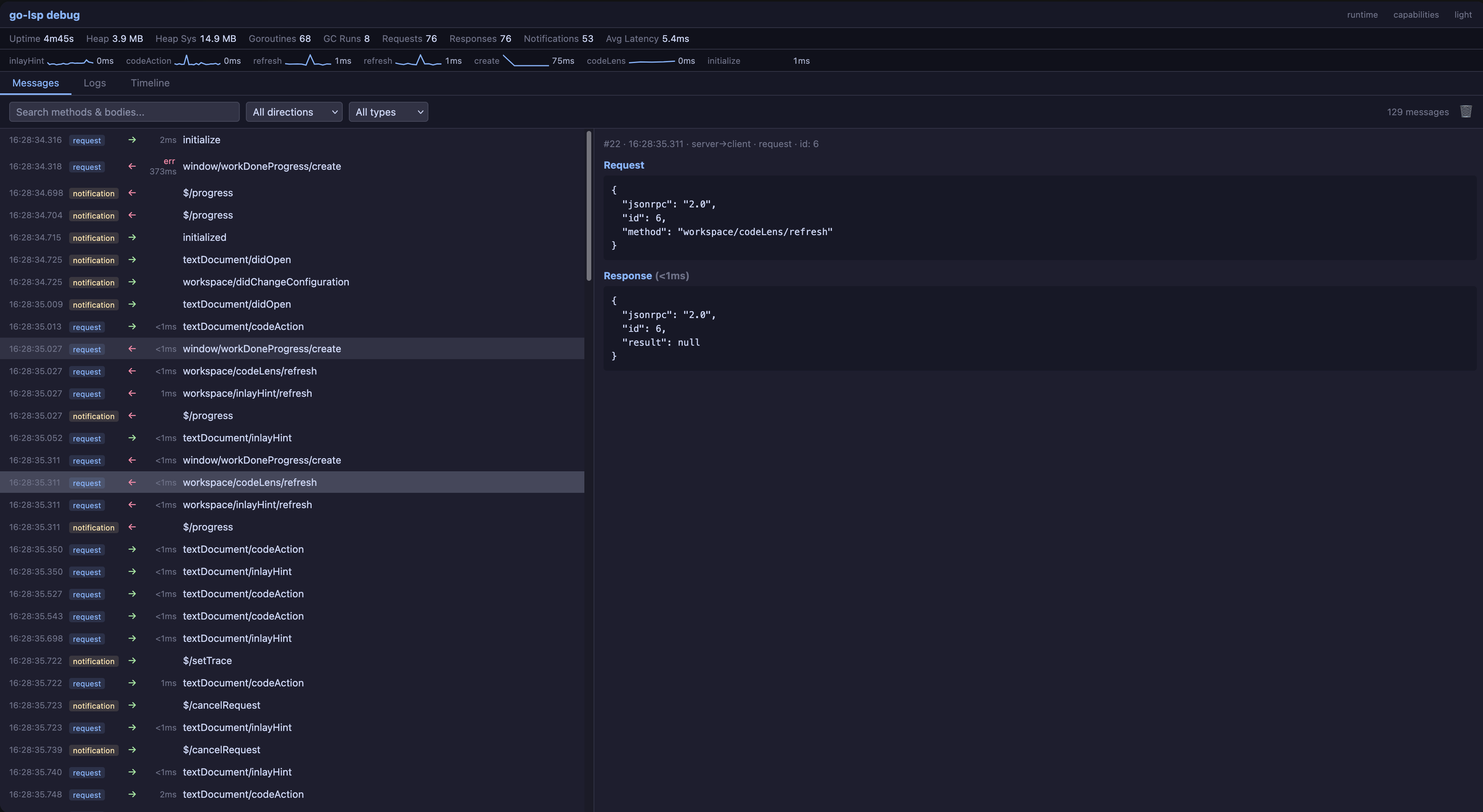
Debug UI
The optional debug UI helps inspect LSP traffic while developing and testing.
Start here
- Getting started:
docs/getting-started.md - Testing guide:
docs/testing.md - Examples:
examples/ - Package docs site: https://www.owenrumney.co.uk/go-lsp
Examples
examples/hover/— basic hover providerexamples/completion/— completion + resolveexamples/diagnostics/— publish diagnostics on saveexamples/codeactions/— quick fixes and code actionsexamples/symbols/— document symbolsexamples/toylang/— multi-feature toy language server
Contributors



Similar repos


Languages
Go
84.2%
HTML
12.8%
CSS
1.2%
Write Language Servers that comply with 3.17 of the LSP Specification
See the codeREADME
go-lsp
go-lsp is a Go library for building Language Server Protocol servers in Go without reimplementing JSON-RPC transport, handler dispatch, document sync, or protocol types.
Why use go-lsp?
- Typed LSP handlers instead of hand-rolled JSON-RPC plumbing
- Auto-detected capabilities from the interfaces your handler implements
- Built-in document store with full and incremental sync support
servertestharness for end-to-end LSP tests over in-memory pipes- Project scaffold generator to bootstrap a server quickly
- Optional debug UI for inspecting live LSP traffic
Install
go get github.com/owenrumney/go-lsp
Minimal server
package main

import (
    "context"
    "log"

    "github.com/owenrumney/go-lsp/lsp"
    "github.com/owenrumney/go-lsp/server"
)

type Handler struct{}

func (h *Handler) Initialize(_ context.Context, _ *lsp.InitializeParams) (*lsp.InitializeResult, error) {
    return &lsp.InitializeResult{
        ServerInfo: &lsp.ServerInfo{Name: "example", Version: "0.1.0"},
    }, nil
}

func (h *Handler) Shutdown(_ context.Context) error { return nil }

func (h *Handler) Hover(_ context.Context, _ *lsp.HoverParams) (*lsp.Hover, error) {
    return &lsp.Hover{
        Contents: lsp.NewHoverContents(lsp.Markdown, "**hello**"),
    }, nil
}

func main() {
    srv := server.NewServer(&Handler{})
    if err := srv.Run(context.Background(), server.RunStdio()); err != nil {
        log.Fatal(err)
    }
}
Implement server.HoverHandler, server.CompletionHandler, server.TextDocumentSyncHandler, and other interfaces as needed. go-lsp registers methods and advertises capabilities automatically.
Quick start
Generate a starter server:
go run github.com/owenrumney/go-lsp/cmd/scaffold@latest \
  --name mylang \
  --module github.com/you/mylang-lsp \
  --lang mylang \
  --features hover,completion,diagnostics
Run tests with the included harness:
func TestHover(t *testing.T) {
    h := servertest.New(t, &Handler{})

    h.DidOpen("file:///test.txt", "plaintext", "hello")
    hover, err := h.Hover("file:///test.txt", 0, 0)
    if err != nil {
        t.Fatal(err)
    }
    if hover == nil {
        t.Fatal("expected hover result")
    }
}
Feature highlights
Server-to-client APIs
server.Client includes helpers for common outbound LSP calls, including:
PublishDiagnosticsShowMessage,LogMessage,ShowMessageRequestShowDocumentConfigurationApplyEditRegisterCapability,UnregisterCapability- progress and refresh requests
Middleware and request controls
Server supports optional inbound middleware and request concurrency controls:
server.WithMethodMiddleware(...)server.WithNotificationMiddleware(...)server.WithMaxConcurrentRequests(n)server.WithRequestTimeout(d)
These are opt-in. Default behavior stays simple.
Debug UI
The optional debug UI helps inspect LSP traffic while developing and testing.
Start here
- Getting started:
docs/getting-started.md - Testing guide:
docs/testing.md - Examples:
examples/ - Package docs site: https://www.owenrumney.co.uk/go-lsp
Examples
examples/hover/— basic hover providerexamples/completion/— completion + resolveexamples/diagnostics/— publish diagnostics on saveexamples/codeactions/— quick fixes and code actionsexamples/symbols/— document symbolsexamples/toylang/— multi-feature toy language server
Similar repos
Contributors
Languages
Go
84.2%
HTML
12.8%
CSS
1.2%