Talus: a 23M-parameter diffusion model that generates game terrain heightmaps. Weights, training and benchmark code (Apache-2.0).
Python
7
29 commits
updated Oct 9, 2026
Talus generates terrain heightmaps for games. You pick a terrain type and any of five measurable properties (mean elevation, relief, slope, water coverage, roughness), and Talus draws a 64x64 map covering 4 x 4 km with heights up to 1,200 m. It is a 23M-parameter conditional diffusion model that we trained from scratch on 45,000 procedural maps generated by the code in this repository. It runs on an 8 GB consumer GPU, and on a CPU if you can wait a few seconds per map.
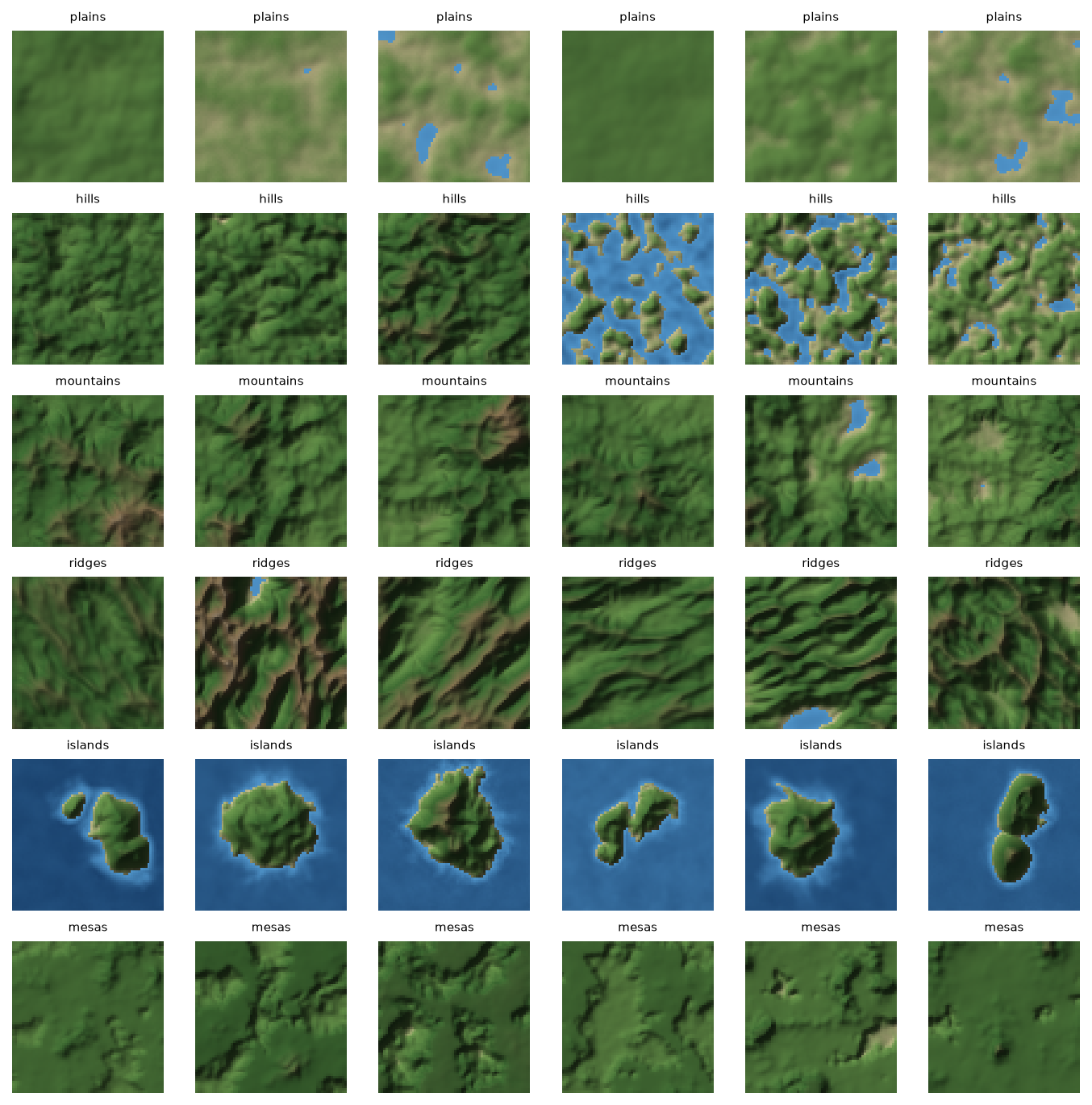
Try it without installing anything at talus.tersa.tech: the model runs in your browser on WebGPU (or the CPU) and exports PNG, Unity RAW and OBJ.
Talus-3 is the default model. Talus-3.1 is a variant for flatter maps: better plains, islands and
mesas, worse ridges and mountains (which one to use). Code and weights are under the
Apache-2.0 license.
Talus is the terrain model of NULLSCAPE, a game in development; the Python package and command-line
tool keep that name (nullscape).
You need Python 3.11+ and PyTorch 2.7+. Pick the PyTorch build for your machine at pytorch.org; RTX 50-series cards need a CUDA 12.8 build.
git clone https://github.com/osfv/talus
cd talus
pip install torch --index-url https://download.pytorch.org/whl/cu128
pip install -e .
Download the weights (93 MB) into checkpoints/:
gh release download v3.0.0 --repo osfv/talus --pattern talus-3.pt --dir checkpoints
# without the GitHub CLI:
curl -L --create-dirs -o checkpoints/talus-3.pt https://github.com/osfv/talus/releases/download/v3.0.0/talus-3.pt
SHA-256 of talus-3.pt: 13b4297bd57b2305cfc30cdf934d22fb21bb241703b0565eacd7a76062b6a6d9
For the flat-terrain variant, download talus-3.1.pt from release v3.1.0 the same way and use
--checkpoint talus-3.1:
gh release download v3.1.0 --repo osfv/talus --pattern talus-3.1.pt --dir checkpoints
SHA-256 of talus-3.1.pt: 7d7d7e4181c36b16298821f54bc987cd625aad73dae2581b17eebeb52a5f98e0
Generate 16 island maps with 60% water and export them for Unity, Unreal or Godot:
nullscape sample --checkpoint talus-3 --archetype islands --prop water_fraction=0.6 \
    --n 16 --formats png16,r16,obj --unity --out exports/islands
Add --device cpu if you have no CUDA GPU. Each run writes the maps, a preview grid and samples.json
with every map's seed, settings and measured properties.
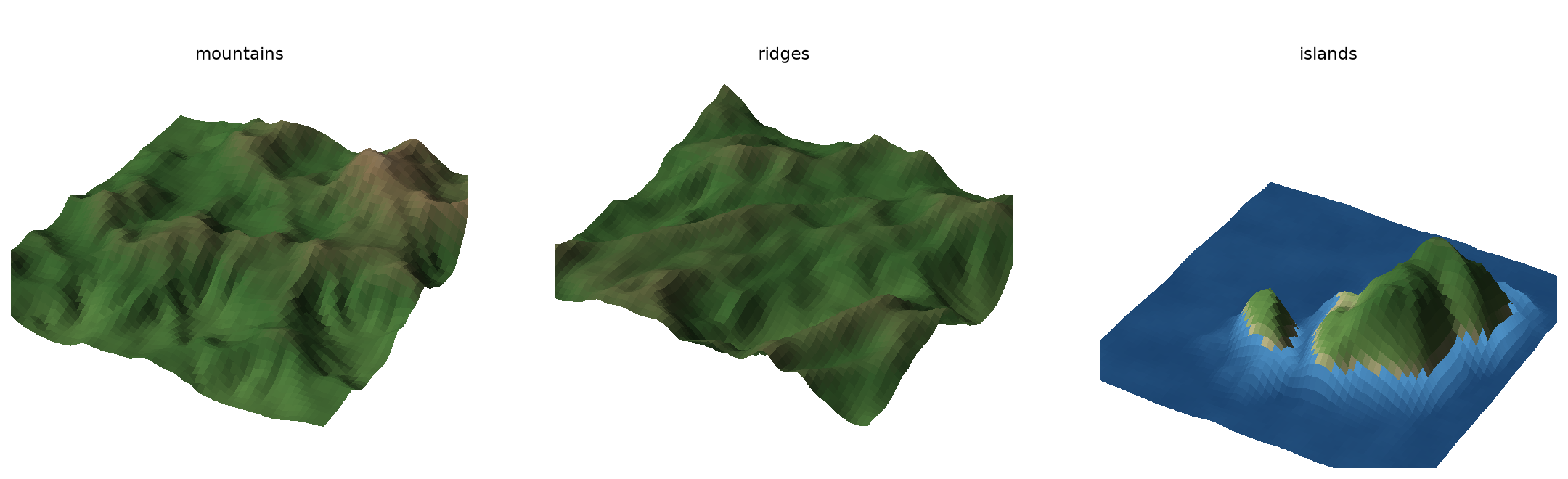
--archetype): plains, hills, mountains, ridges, islands, mesas.
Leave it out and Talus picks one.--prop key=value, any subset): mean_elevation and relief in normalized height
(1.0 = 1,200 m), mean_slope_deg, water_fraction (share of cells below sea level), and
spectral_beta (roughness: higher is smoother). Talus fills in whatever you leave open.--seed sets a batch's root seed and --seeds 42,99 sets per-map seeds. The same seed,
settings and checkpoint give the same map.--reference terrain.npy --preserve-mask keep.npy, lay out routes and flat areas with --layout layout.json, and grow seamless neighbors
with --neighbor-west tile.npy --overlap 4 (also north, east, south). See
Spatial editing..r16, Unity), .npy and OBJ meshes, each with a JSON
sidecar giving the physical size. --unity resamples to Unity's 2^n+1 sizes.
docs/ENGINE_EXPORT.md has import steps for each engine.nullscape checkpoint-info --checkpoint talus-3 prints the model's world scale, sampler preset and
property statistics without sampling.
| You are making | Use | Why |
|---|---|---|
| A mix of terrain, or ridges, hills and mountains | Talus-3 | Highest overall realism; best on rugged types |
| Plains, islands and coasts, or mesas and plateaus | Talus-3.1 | Closer to real maps on those three types |
Per-type realism on TEST (distance to real maps over the noise floor, lower is better):
| plains | islands | mesas | hills | mountains | ridges | |
|---|---|---|---|---|---|---|
| Talus-3 | 1.17 | 1.21 | 1.43 | 1.16 | 1.71 | 1.80 |
| Talus-3.1 | 1.13 | 1.16 | 1.33 | 1.20 | 1.75 | 1.93 |
docs/TALUS31.md explains how Talus-3.1 was trained and chosen.
Scores on the held-out TEST split, 1,000 maps per half. Each score runs from 0 to 100, where 100 means indistinguishable from real procedural terrain at this sample size. Each version fine-tunes the one before it (docs/TALUS.md lists them all).
| Benchmark | What it measures | Talus-1 | Talus-2 | Talus-3 | Talus-3.1 |
|---|---|---|---|---|---|
| Realism | 25 terrain metrics vs real maps | 34.4 | 56.5 | 66.2 | 64.5 |
| Spectrum | detail at every scale (power spectrum) | 3.6 | 7.6 | 11.0 | 11.3 |
| Heights | elevation distribution | 88.5 | 98.3 | 99.1 | 98.3 |
| Slopes | slope distribution | 41.2 | 56.4 | 60.5 | 59.0 |
| Control | requested vs measured properties | 81.8 | 90.4 | 92.1 | 92.4 |
| Playability | walkable-route pass rate vs real maps | 98.4 | 97.6 | 99.9 | 99.3 |
| Diversity | variety vs real maps | 96.9 | 94.4 | 95.0 | 94.6 |
| Originality | distance from the training maps | 100 | 98.1 | 99.1 | 98.4 |
| Clean detail | no excess micro-bumps | 58.4 | 97.7 | 99.4 | 99.5 |
| Average | 67.0 | 77.5 | 80.3 | 79.7 |
Both sample about 5.6 to 5.8 maps/s at batch 128 on an RTX 5060 (8 GB), or one map in 1.3 s.
src/nullscape/terrain builds each map
from fBm, billow or ridged multifractal noise, then runs stream-power erosion, hillslope diffusion and
thermal erosion. Each map is a pure function of its seed. The base64 dataset has 50,000 maps, split
45,000 / 2,500 / 2,500 into train, validation and test.
docs/DATASET.md describes the pipeline.spectral_beta) is the loosest of the five properties.The rest of this file is the reference for training and evaluating your own models.
Keep the virtual environment outside synced folders such as OneDrive:
py -3.13 -m venv "$env:USERPROFILE\.venvs\nullscape"
& "$env:USERPROFILE\.venvs\nullscape\Scripts\Activate.ps1"
pip install torch --index-url https://download.pytorch.org/whl/cu128
pip install -e .[dev]
Data lands in data/ and runs in runs/; override with NULLSCAPE_DATA_ROOT and
NULLSCAPE_RUNS_ROOT.
# 1. Procedural datasets (deterministic, parallel)
nullscape gen-dataset --config configs/dataset/smoke.yaml              # 512 maps, sanity
nullscape gen-dataset --config configs/dataset/base64.yaml --workers 8 # 50k, 64x64
nullscape gen-dataset --config configs/dataset/base128.yaml            # 50k, 128x128

# 2. Inspect a dataset
nullscape viz --dataset base64 --split val --n 36 --out reports/base64

# 3. Train
nullscape train --config configs/train/smoke.yaml                      # tiny sanity run
nullscape train --config configs/train/diffusion64.yaml                # the Talus-1 recipe
nullscape train --config configs/train/diffusion64.yaml --set train.lr=1e-4
nullscape train --config configs/train/diffusion64.yaml \
    --resume runs/<run>/checkpoints/last.pt
tensorboard --logdir runs

# 4. Sample from a checkpoint (self-contained: weights + world + normalization)
nullscape sample --checkpoint talus-3 --n 16
nullscape sample --checkpoint ... --archetype islands \
    --prop relief=0.3 --prop water_fraction=0.4   # any subset of properties

# 5. Evaluate against held-out procedural data (noise-floor protocol)
nullscape evaluate --checkpoint ... --n 1000 \
    --modes conditional,label_only,unconditional \
    --guidance-sweep 1,1.5,2,3 --out reports/eval

# 6. Per-checkpoint visual artifacts (grids, 3D, spectra, histograms, adherence,
#    memorization, fixed-seed progression) -> artifacts/<run>/index.md
nullscape artifacts --run runs/<run>                 # render all step_*.pt snapshots
nullscape artifacts --run runs/<run> --watch         # follow a live run
nullscape sampler-sweep --checkpoint ... --out reports/sweep   # choose steps/spacing/eta/guidance

# 7. Side-by-side figures and engine exports
nullscape compare --checkpoint ... --n 6 --seeds 3 --out reports/compare
nullscape export --dataset base64 --index 123 --unity --out exports/
To fine-tune from the released weights, set train.init_from: checkpoints/talus-3.pt in a training
config. Release checkpoints contain the EMA weights only, which then seed both the raw and EMA copies.
nullscape checkpoints --limit 5
nullscape checkpoint-info --checkpoint talus-3
nullscape release-checkpoint --checkpoint runs/<run>/checkpoints/step_0012000.pt \
    --out checkpoints/my-model.pt --name My-Model --version 1.0.0
Checkpoint arguments accept an alias (talus-3, talus-3.1, plus talus-1, talus-1.1 and talus-2 on the
machine that trained them), a .pt file, or a run folder. Sampling a run folder prefers best.pt,
then last.pt, then its last numbered snapshot. train --resume prefers last.pt.
Every checkpoint loads with torch.load(weights_only=True), so opening one cannot run code from the
file. Training checkpoints also allow numpy arrays (RNG state). release-checkpoint writes a smaller
file for sharing: EMA weights, configs and dataset statistics, without the optimizer, raw weights,
training state or local paths.
--seed sets a batch's root seed; --seeds supplies per-map seeds. Sample metadata includes
sample_seed for replay with the same checkpoint, properties, sampling settings, and spatial inputs.
The number of explicit seeds determines --n unless you supply a matching count. --no-previews skips
the grid and inspection plots but keeps exports and metadata.
Without --out, sampling creates a timestamped folder under outputs/samples. Sample, evaluate,
compare, sampler-sweep, and benchmark-sampling commands reject non-empty output folders. A
.nullscape-output marker reserves each folder; choose a fresh folder for a new attempt.
Sampling, evaluation, comparison, sweeps, and timing support --device cpu|cuda and
--gpu-memory-fraction (default 0.6). Input errors include suggested corrections where available; add
--debug for a traceback. Training rejects unknown option names and invalid step counts before
loading the dataset or allocating GPU memory.
Checkpoints carry a sampling preset; older ones default to 50 quadratic DDIM steps, guidance 2,
eta 0. Explicit CLI options override the preset. A guidance interval uses normalized noise timesteps:
0 is clean, 1 is noisy; outside the interval, guidance is 1. The default [0,1] keeps full guidance.
sample --reference terrain.npy --preserve-mask keep.npy preserves true cells of a [R,R]
boolean/0-1 mask during denoising. Both inputs use the checkpoint's resolution and physical scale.
Preserved heights remain exact float32 values. Hard spatial constraints can override requested global
properties; inspect the measured properties and transitions afterward.
sample --layout layout.json accepts cell-coordinate routes and flat areas, for example:
{"routes": [{"points": [[32,4],[32,59]], "height": 0.3, "width_cells": 5}],
 "flat_areas": [{"center": [32,8], "height": 0.3, "radius_cells": 4}]}
Use --neighbor-west tile.npy (also north/east/south) with --overlap 4 for matching tile strips.
Adjacent tile origins differ by (resolution - overlap) * cell_size_m; these are overlapping tiles,
not extra border padding. Conflicting constraints fail rather than silently changing preserved cells.
Seam heights match; check transition quality yourself.
nullscape queue runs matched experiments one stage at a time, each in its own process, so GPU
memory is released between stages:
nullscape queue --plan configs/queue/talus31.yaml --check    # list stages; runs nothing
nullscape queue --plan configs/queue/talus31.yaml            # run; rerun the same command to continue
nullscape queue --plan configs/queue/talus31.yaml --status   # progress, from any terminal
The queue preflights each recipe, evaluates the baseline once on VAL, then trains, evaluates, and
builds a comparison page for each experiment in order. Output goes to reports/queues/<name>/:
summary.md (VAL table with mountains/ridges/plains ratios and links),
comparisons/<experiment>/index.html, evaluations/, logs/, and a snapshot of each training config
taken when the queue started. It does not select a winner, promote a checkpoint, or touch TEST.
--retry-failed; training retries resume from their latest checkpoint.--out.train --dry-run checks three forward/backward/optimizer/EMA steps, including optimizer-state memory,
without creating a run or writing a checkpoint.
Checkpoints are written atomically (a crash mid-save leaves the previous file intact) and carry the
full training state: scheduler, RNG, batch sampler, and best score. Resume with
train --config <same config> --resume <run folder or last.pt>. Resuming continues in a new run
folder; the source run is never modified. Resume refuses a changed dataset, model, seed, or training
recipe; use train.init_from for intentional changes. Older checkpoints without this state need
--allow-inexact-resume. Ctrl+C during training finishes the current step, saves last.pt, and
prints the resume command; a second Ctrl+C stops immediately. Each run writes status.json (running,
completed, interrupted or failed).
last.pt is refreshed every train.recovery_every steps (default 1000), and always before that
step's previews and evaluation. Numbered step_*.pt snapshots still follow checkpoint_every. If a
failure happens outside the weight update (for example running out of GPU memory while previewing),
the trainer saves the completed step before exiting.
nullscape comparison-report --baseline <evaluation A> --candidate <evaluation B> `
    --baseline-name Talus-2 --candidate-name Talus-3 --out reports/compare_talus3
Inputs are evaluate output folders (fully conditioned mode) or official artifact step folders such
as benchmarks/v2/talus2/artifacts_official/step_0010000. Both must use the same dataset, split,
reference halves, requests, seeds, and sampler settings; otherwise the command refuses. The
self-contained index.html shows both terrains in synchronized 3D views, whole-set metric changes,
spectra, slope distributions, and a gallery of representative cases, the candidate's worst control
adherence, and its largest regressions. It samples nothing and works offline.
nullscape sampler-sweep --checkpoint <checkpoint> --n 500 --steps-list 50,25 --spacings quadratic --etas 0 --guidances 2 --guidance-intervals 0:1,0.05:0.8 --out reports/new_sweep
nullscape evaluate --checkpoint <checkpoint> --n 500 --repeat-seeds 0,1,2 --out reports/new_eval
nullscape compare --checkpoint <checkpoint> --blind --out reports/new_blind
nullscape benchmark-sampling --checkpoint <checkpoint> --batches 1,32,64,128 --out reports/new_perf
Evaluation includes fully conditioned, label-only, unconditional, and each property-only request by
default. Gameplay results measure fixed-endpoint reachability, route width, bottlenecks, and flat
combat space, separately from the frozen scorecard. Keep the blind comparison's blind_key.json away
from reviewers. Speed measurements belong to the measured checkpoint; pass
--perf-json .../performance.json to benchmarks/v2/score_test.py or leave speed unmeasured. The
first sampler-sweep configuration is the regression-gate baseline.
nullscape.data.earth builds datasets from the Copernicus GLO-30 elevation model in the standard
dataset format. It needs tifffile (pip install -e .[earth]).
python -m nullscape.data.earth tiles --config configs/dataset/earth64_sample.yaml
python -m nullscape.data.earth build --config configs/dataset/earth64_sample.yaml --workers 2
Train, validation and test are split by geographic region. Downloads go to
%LOCALAPPDATA%\nullscape\dem_cache and are refused above --max-gb. Anything shared from this data
must carry the Copernicus attribution. Details, findings and required Talus-4 changes:
docs/EARTH_DATA.md.
configs/dataset/game64.yaml defines a separate 512 m, 64-cell dataset experiment (8 m/cell). It does
not replace base64 or change existing checkpoints' scale.
site/ is the static page that runs Talus in the browser with ONNX Runtime Web. The JavaScript sampler
(site/src/js/sampler.js) reproduces the PyTorch sampler: npm test compares both on reference samples.
pip install -e .[web]
python scripts/export_web.py --checkpoint talus-3 --out site/public/model   # ONNX model, metadata, test fixtures
cd site
npm install
npm test             # sampler parity with PyTorch, exports
npm run dev          # http://127.0.0.1:4173/
Pushes to master that touch site/ deploy it with GitHub Actions (.github/workflows/site.yml). The workflow
downloads talus-3.fp16.onnx, talus-3.json and talus-3.prior.bin from the v3.0.0 release. The fp16 file stores
weights at half precision but computes in fp32; its samples stay within 6 m of PyTorch's.
demo/nullscape-demo.html is a self-contained first-person "daily run" through 30 maps generated by
Talus-1. Open it in a browser (WebGL2): the date picks the daily map, cyan beacons mark the walkable
route, and a pillar of light marks the goal. Rebuild it with python demo/build_demo.py.
configs/dataset/    dataset build configs (smoke, base64, base128, earth, game64)
configs/train/      training recipes (smoke, diffusion64, Talus-2/3/3.1 fine-tunes)
configs/queue/      experiment queue plans
benchmarks/         TEST scoring scripts, results and scorecards
docs/               model reports, dataset/evaluation/export docs, blog posts
src/nullscape/
  world.py          WorldSpec: physical meaning of normalized heightmaps
  terrain/          noise, erosion, archetypes, generate()
  metrics/          per-map quality metrics, traversability, distribution distances
  data/             dataset build (multiprocessing), storage, splits, real-terrain builder
  models/           UNet, GaussianDiffusion, EMA, height parameterization
  train/            training loop, recovery, experiment queue
  inference/        TerrainSampler (checkpoint -> heightmaps), spatial constraints
  eval/             evaluation protocol, artifacts, comparison pages, timing
  viz/              hillshade/color/traversability/3D rendering
  export/           png16 / r16 / npy / OBJ engine exports
  utils/            config, seeds, run tracking, paths, checkpoint loading
tests/              pytest suite (CPU)
(seed, index, world, generator config) via
np.random.SeedSequence([seed, index]), identical regardless of worker count or order.runs/<timestamp>_<name>/ with config.yaml, env.json, model.json,
metrics.jsonl, TensorBoard events, samples, eval reports, and checkpoints.python -m pytest # full suite (CPU)
python -m pytest -m "not slow" # skip the end-to-end train/eval tests
Code and model weights: Apache License 2.0. The procedural training data comes from this repository's generator. The Talus-4 tooling downloads Copernicus GLO-30 data, which has its own attribution terms (docs/EARTH_DATA.md).
Talus: a 23M-parameter diffusion model that generates game terrain heightmaps. Weights, training and benchmark code (Apache-2.0).
Python
7
29 commits
updated Oct 9, 2026
Talus generates terrain heightmaps for games. You pick a terrain type and any of five measurable properties (mean elevation, relief, slope, water coverage, roughness), and Talus draws a 64x64 map covering 4 x 4 km with heights up to 1,200 m. It is a 23M-parameter conditional diffusion model that we trained from scratch on 45,000 procedural maps generated by the code in this repository. It runs on an 8 GB consumer GPU, and on a CPU if you can wait a few seconds per map.
Try it without installing anything at talus.tersa.tech: the model runs in your browser on WebGPU (or the CPU) and exports PNG, Unity RAW and OBJ.
Talus-3 is the default model. Talus-3.1 is a variant for flatter maps: better plains, islands and
mesas, worse ridges and mountains (which one to use). Code and weights are under the
Apache-2.0 license.
Talus is the terrain model of NULLSCAPE, a game in development; the Python package and command-line
tool keep that name (nullscape).
You need Python 3.11+ and PyTorch 2.7+. Pick the PyTorch build for your machine at pytorch.org; RTX 50-series cards need a CUDA 12.8 build.
git clone https://github.com/osfv/talus
cd talus
pip install torch --index-url https://download.pytorch.org/whl/cu128
pip install -e .
Download the weights (93 MB) into checkpoints/:
gh release download v3.0.0 --repo osfv/talus --pattern talus-3.pt --dir checkpoints
# without the GitHub CLI:
curl -L --create-dirs -o checkpoints/talus-3.pt https://github.com/osfv/talus/releases/download/v3.0.0/talus-3.pt
SHA-256 of talus-3.pt: 13b4297bd57b2305cfc30cdf934d22fb21bb241703b0565eacd7a76062b6a6d9
For the flat-terrain variant, download talus-3.1.pt from release v3.1.0 the same way and use
--checkpoint talus-3.1:
gh release download v3.1.0 --repo osfv/talus --pattern talus-3.1.pt --dir checkpoints
SHA-256 of talus-3.1.pt: 7d7d7e4181c36b16298821f54bc987cd625aad73dae2581b17eebeb52a5f98e0
Generate 16 island maps with 60% water and export them for Unity, Unreal or Godot:
nullscape sample --checkpoint talus-3 --archetype islands --prop water_fraction=0.6 \
    --n 16 --formats png16,r16,obj --unity --out exports/islands
Add --device cpu if you have no CUDA GPU. Each run writes the maps, a preview grid and samples.json
with every map's seed, settings and measured properties.
--archetype): plains, hills, mountains, ridges, islands, mesas.
Leave it out and Talus picks one.--prop key=value, any subset): mean_elevation and relief in normalized height
(1.0 = 1,200 m), mean_slope_deg, water_fraction (share of cells below sea level), and
spectral_beta (roughness: higher is smoother). Talus fills in whatever you leave open.--seed sets a batch's root seed and --seeds 42,99 sets per-map seeds. The same seed,
settings and checkpoint give the same map.--reference terrain.npy --preserve-mask keep.npy, lay out routes and flat areas with --layout layout.json, and grow seamless neighbors
with --neighbor-west tile.npy --overlap 4 (also north, east, south). See
Spatial editing..r16, Unity), .npy and OBJ meshes, each with a JSON
sidecar giving the physical size. --unity resamples to Unity's 2^n+1 sizes.
docs/ENGINE_EXPORT.md has import steps for each engine.nullscape checkpoint-info --checkpoint talus-3 prints the model's world scale, sampler preset and
property statistics without sampling.
| You are making | Use | Why |
|---|---|---|
| A mix of terrain, or ridges, hills and mountains | Talus-3 | Highest overall realism; best on rugged types |
| Plains, islands and coasts, or mesas and plateaus | Talus-3.1 | Closer to real maps on those three types |
Per-type realism on TEST (distance to real maps over the noise floor, lower is better):
| plains | islands | mesas | hills | mountains | ridges | |
|---|---|---|---|---|---|---|
| Talus-3 | 1.17 | 1.21 | 1.43 | 1.16 | 1.71 | 1.80 |
| Talus-3.1 | 1.13 | 1.16 | 1.33 | 1.20 | 1.75 | 1.93 |
docs/TALUS31.md explains how Talus-3.1 was trained and chosen.
Scores on the held-out TEST split, 1,000 maps per half. Each score runs from 0 to 100, where 100 means indistinguishable from real procedural terrain at this sample size. Each version fine-tunes the one before it (docs/TALUS.md lists them all).
| Benchmark | What it measures | Talus-1 | Talus-2 | Talus-3 | Talus-3.1 |
|---|---|---|---|---|---|
| Realism | 25 terrain metrics vs real maps | 34.4 | 56.5 | 66.2 | 64.5 |
| Spectrum | detail at every scale (power spectrum) | 3.6 | 7.6 | 11.0 | 11.3 |
| Heights | elevation distribution | 88.5 | 98.3 | 99.1 | 98.3 |
| Slopes | slope distribution | 41.2 | 56.4 | 60.5 | 59.0 |
| Control | requested vs measured properties | 81.8 | 90.4 | 92.1 | 92.4 |
| Playability | walkable-route pass rate vs real maps | 98.4 | 97.6 | 99.9 | 99.3 |
| Diversity | variety vs real maps | 96.9 | 94.4 | 95.0 | 94.6 |
| Originality | distance from the training maps | 100 | 98.1 | 99.1 | 98.4 |
| Clean detail | no excess micro-bumps | 58.4 | 97.7 | 99.4 | 99.5 |
| Average | 67.0 | 77.5 | 80.3 | 79.7 |
Both sample about 5.6 to 5.8 maps/s at batch 128 on an RTX 5060 (8 GB), or one map in 1.3 s.
src/nullscape/terrain builds each map
from fBm, billow or ridged multifractal noise, then runs stream-power erosion, hillslope diffusion and
thermal erosion. Each map is a pure function of its seed. The base64 dataset has 50,000 maps, split
45,000 / 2,500 / 2,500 into train, validation and test.
docs/DATASET.md describes the pipeline.spectral_beta) is the loosest of the five properties.The rest of this file is the reference for training and evaluating your own models.
Keep the virtual environment outside synced folders such as OneDrive:
py -3.13 -m venv "$env:USERPROFILE\.venvs\nullscape"
& "$env:USERPROFILE\.venvs\nullscape\Scripts\Activate.ps1"
pip install torch --index-url https://download.pytorch.org/whl/cu128
pip install -e .[dev]
Data lands in data/ and runs in runs/; override with NULLSCAPE_DATA_ROOT and
NULLSCAPE_RUNS_ROOT.
# 1. Procedural datasets (deterministic, parallel)
nullscape gen-dataset --config configs/dataset/smoke.yaml              # 512 maps, sanity
nullscape gen-dataset --config configs/dataset/base64.yaml --workers 8 # 50k, 64x64
nullscape gen-dataset --config configs/dataset/base128.yaml            # 50k, 128x128

# 2. Inspect a dataset
nullscape viz --dataset base64 --split val --n 36 --out reports/base64

# 3. Train
nullscape train --config configs/train/smoke.yaml                      # tiny sanity run
nullscape train --config configs/train/diffusion64.yaml                # the Talus-1 recipe
nullscape train --config configs/train/diffusion64.yaml --set train.lr=1e-4
nullscape train --config configs/train/diffusion64.yaml \
    --resume runs/<run>/checkpoints/last.pt
tensorboard --logdir runs

# 4. Sample from a checkpoint (self-contained: weights + world + normalization)
nullscape sample --checkpoint talus-3 --n 16
nullscape sample --checkpoint ... --archetype islands \
    --prop relief=0.3 --prop water_fraction=0.4   # any subset of properties

# 5. Evaluate against held-out procedural data (noise-floor protocol)
nullscape evaluate --checkpoint ... --n 1000 \
    --modes conditional,label_only,unconditional \
    --guidance-sweep 1,1.5,2,3 --out reports/eval

# 6. Per-checkpoint visual artifacts (grids, 3D, spectra, histograms, adherence,
#    memorization, fixed-seed progression) -> artifacts/<run>/index.md
nullscape artifacts --run runs/<run>                 # render all step_*.pt snapshots
nullscape artifacts --run runs/<run> --watch         # follow a live run
nullscape sampler-sweep --checkpoint ... --out reports/sweep   # choose steps/spacing/eta/guidance

# 7. Side-by-side figures and engine exports
nullscape compare --checkpoint ... --n 6 --seeds 3 --out reports/compare
nullscape export --dataset base64 --index 123 --unity --out exports/
To fine-tune from the released weights, set train.init_from: checkpoints/talus-3.pt in a training
config. Release checkpoints contain the EMA weights only, which then seed both the raw and EMA copies.
nullscape checkpoints --limit 5
nullscape checkpoint-info --checkpoint talus-3
nullscape release-checkpoint --checkpoint runs/<run>/checkpoints/step_0012000.pt \
    --out checkpoints/my-model.pt --name My-Model --version 1.0.0
Checkpoint arguments accept an alias (talus-3, talus-3.1, plus talus-1, talus-1.1 and talus-2 on the
machine that trained them), a .pt file, or a run folder. Sampling a run folder prefers best.pt,
then last.pt, then its last numbered snapshot. train --resume prefers last.pt.
Every checkpoint loads with torch.load(weights_only=True), so opening one cannot run code from the
file. Training checkpoints also allow numpy arrays (RNG state). release-checkpoint writes a smaller
file for sharing: EMA weights, configs and dataset statistics, without the optimizer, raw weights,
training state or local paths.
--seed sets a batch's root seed; --seeds supplies per-map seeds. Sample metadata includes
sample_seed for replay with the same checkpoint, properties, sampling settings, and spatial inputs.
The number of explicit seeds determines --n unless you supply a matching count. --no-previews skips
the grid and inspection plots but keeps exports and metadata.
Without --out, sampling creates a timestamped folder under outputs/samples. Sample, evaluate,
compare, sampler-sweep, and benchmark-sampling commands reject non-empty output folders. A
.nullscape-output marker reserves each folder; choose a fresh folder for a new attempt.
Sampling, evaluation, comparison, sweeps, and timing support --device cpu|cuda and
--gpu-memory-fraction (default 0.6). Input errors include suggested corrections where available; add
--debug for a traceback. Training rejects unknown option names and invalid step counts before
loading the dataset or allocating GPU memory.
Checkpoints carry a sampling preset; older ones default to 50 quadratic DDIM steps, guidance 2,
eta 0. Explicit CLI options override the preset. A guidance interval uses normalized noise timesteps:
0 is clean, 1 is noisy; outside the interval, guidance is 1. The default [0,1] keeps full guidance.
sample --reference terrain.npy --preserve-mask keep.npy preserves true cells of a [R,R]
boolean/0-1 mask during denoising. Both inputs use the checkpoint's resolution and physical scale.
Preserved heights remain exact float32 values. Hard spatial constraints can override requested global
properties; inspect the measured properties and transitions afterward.
sample --layout layout.json accepts cell-coordinate routes and flat areas, for example:
{"routes": [{"points": [[32,4],[32,59]], "height": 0.3, "width_cells": 5}],
 "flat_areas": [{"center": [32,8], "height": 0.3, "radius_cells": 4}]}
Use --neighbor-west tile.npy (also north/east/south) with --overlap 4 for matching tile strips.
Adjacent tile origins differ by (resolution - overlap) * cell_size_m; these are overlapping tiles,
not extra border padding. Conflicting constraints fail rather than silently changing preserved cells.
Seam heights match; check transition quality yourself.
nullscape queue runs matched experiments one stage at a time, each in its own process, so GPU
memory is released between stages:
nullscape queue --plan configs/queue/talus31.yaml --check    # list stages; runs nothing
nullscape queue --plan configs/queue/talus31.yaml            # run; rerun the same command to continue
nullscape queue --plan configs/queue/talus31.yaml --status   # progress, from any terminal
The queue preflights each recipe, evaluates the baseline once on VAL, then trains, evaluates, and
builds a comparison page for each experiment in order. Output goes to reports/queues/<name>/:
summary.md (VAL table with mountains/ridges/plains ratios and links),
comparisons/<experiment>/index.html, evaluations/, logs/, and a snapshot of each training config
taken when the queue started. It does not select a winner, promote a checkpoint, or touch TEST.
--retry-failed; training retries resume from their latest checkpoint.--out.train --dry-run checks three forward/backward/optimizer/EMA steps, including optimizer-state memory,
without creating a run or writing a checkpoint.
Checkpoints are written atomically (a crash mid-save leaves the previous file intact) and carry the
full training state: scheduler, RNG, batch sampler, and best score. Resume with
train --config <same config> --resume <run folder or last.pt>. Resuming continues in a new run
folder; the source run is never modified. Resume refuses a changed dataset, model, seed, or training
recipe; use train.init_from for intentional changes. Older checkpoints without this state need
--allow-inexact-resume. Ctrl+C during training finishes the current step, saves last.pt, and
prints the resume command; a second Ctrl+C stops immediately. Each run writes status.json (running,
completed, interrupted or failed).
last.pt is refreshed every train.recovery_every steps (default 1000), and always before that
step's previews and evaluation. Numbered step_*.pt snapshots still follow checkpoint_every. If a
failure happens outside the weight update (for example running out of GPU memory while previewing),
the trainer saves the completed step before exiting.
nullscape comparison-report --baseline <evaluation A> --candidate <evaluation B> `
    --baseline-name Talus-2 --candidate-name Talus-3 --out reports/compare_talus3
Inputs are evaluate output folders (fully conditioned mode) or official artifact step folders such
as benchmarks/v2/talus2/artifacts_official/step_0010000. Both must use the same dataset, split,
reference halves, requests, seeds, and sampler settings; otherwise the command refuses. The
self-contained index.html shows both terrains in synchronized 3D views, whole-set metric changes,
spectra, slope distributions, and a gallery of representative cases, the candidate's worst control
adherence, and its largest regressions. It samples nothing and works offline.
nullscape sampler-sweep --checkpoint <checkpoint> --n 500 --steps-list 50,25 --spacings quadratic --etas 0 --guidances 2 --guidance-intervals 0:1,0.05:0.8 --out reports/new_sweep
nullscape evaluate --checkpoint <checkpoint> --n 500 --repeat-seeds 0,1,2 --out reports/new_eval
nullscape compare --checkpoint <checkpoint> --blind --out reports/new_blind
nullscape benchmark-sampling --checkpoint <checkpoint> --batches 1,32,64,128 --out reports/new_perf
Evaluation includes fully conditioned, label-only, unconditional, and each property-only request by
default. Gameplay results measure fixed-endpoint reachability, route width, bottlenecks, and flat
combat space, separately from the frozen scorecard. Keep the blind comparison's blind_key.json away
from reviewers. Speed measurements belong to the measured checkpoint; pass
--perf-json .../performance.json to benchmarks/v2/score_test.py or leave speed unmeasured. The
first sampler-sweep configuration is the regression-gate baseline.
nullscape.data.earth builds datasets from the Copernicus GLO-30 elevation model in the standard
dataset format. It needs tifffile (pip install -e .[earth]).
python -m nullscape.data.earth tiles --config configs/dataset/earth64_sample.yaml
python -m nullscape.data.earth build --config configs/dataset/earth64_sample.yaml --workers 2
Train, validation and test are split by geographic region. Downloads go to
%LOCALAPPDATA%\nullscape\dem_cache and are refused above --max-gb. Anything shared from this data
must carry the Copernicus attribution. Details, findings and required Talus-4 changes:
docs/EARTH_DATA.md.
configs/dataset/game64.yaml defines a separate 512 m, 64-cell dataset experiment (8 m/cell). It does
not replace base64 or change existing checkpoints' scale.
site/ is the static page that runs Talus in the browser with ONNX Runtime Web. The JavaScript sampler
(site/src/js/sampler.js) reproduces the PyTorch sampler: npm test compares both on reference samples.
pip install -e .[web]
python scripts/export_web.py --checkpoint talus-3 --out site/public/model   # ONNX model, metadata, test fixtures
cd site
npm install
npm test             # sampler parity with PyTorch, exports
npm run dev          # http://127.0.0.1:4173/
Pushes to master that touch site/ deploy it with GitHub Actions (.github/workflows/site.yml). The workflow
downloads talus-3.fp16.onnx, talus-3.json and talus-3.prior.bin from the v3.0.0 release. The fp16 file stores
weights at half precision but computes in fp32; its samples stay within 6 m of PyTorch's.
demo/nullscape-demo.html is a self-contained first-person "daily run" through 30 maps generated by
Talus-1. Open it in a browser (WebGL2): the date picks the daily map, cyan beacons mark the walkable
route, and a pillar of light marks the goal. Rebuild it with python demo/build_demo.py.
configs/dataset/    dataset build configs (smoke, base64, base128, earth, game64)
configs/train/      training recipes (smoke, diffusion64, Talus-2/3/3.1 fine-tunes)
configs/queue/      experiment queue plans
benchmarks/         TEST scoring scripts, results and scorecards
docs/               model reports, dataset/evaluation/export docs, blog posts
src/nullscape/
  world.py          WorldSpec: physical meaning of normalized heightmaps
  terrain/          noise, erosion, archetypes, generate()
  metrics/          per-map quality metrics, traversability, distribution distances
  data/             dataset build (multiprocessing), storage, splits, real-terrain builder
  models/           UNet, GaussianDiffusion, EMA, height parameterization
  train/            training loop, recovery, experiment queue
  inference/        TerrainSampler (checkpoint -> heightmaps), spatial constraints
  eval/             evaluation protocol, artifacts, comparison pages, timing
  viz/              hillshade/color/traversability/3D rendering
  export/           png16 / r16 / npy / OBJ engine exports
  utils/            config, seeds, run tracking, paths, checkpoint loading
tests/              pytest suite (CPU)
(seed, index, world, generator config) via
np.random.SeedSequence([seed, index]), identical regardless of worker count or order.runs/<timestamp>_<name>/ with config.yaml, env.json, model.json,
metrics.jsonl, TensorBoard events, samples, eval reports, and checkpoints.python -m pytest # full suite (CPU)
python -m pytest -m "not slow" # skip the end-to-end train/eval tests
Code and model weights: Apache License 2.0. The procedural training data comes from this repository's generator. The Talus-4 tooling downloads Copernicus GLO-30 data, which has its own attribution terms (docs/EARTH_DATA.md).



