
constanos: an experimental x86-64 OS in Rust — SMP, UEFI, Linux syscall ABI, mlibc + BusyBox, its own compositor, and an NVIDIA GA106 driver up to Vulkan via Mesa NVK
Rust
2
479 commits
updated Oct 7, 2026
See what people are saying
README
🦀 constanos — an x86-64 operating system in Rust
English · Español
Status: experimental. A personal project, developed by one person with a lot of help from Claude Code. Everything listed below runs today, in QEMU and on one real machine; the gaps are listed under What's missing.
A kernel written from scratch in Rust (no_std, UEFI, SMP) with a Linux-numbered
syscall ABI, mlibc as its libc, BusyBox as its
userland, a desktop with its own compositor, and a driver for an NVIDIA RTX 3050
(GA106) that goes all the way up to Vulkan through Mesa's NVK. It runs in QEMU and
on a physical machine (AM4 / Ryzen 9 5900X) that has no serial port, where
everything — keyboard, mouse, disk — comes in over USB.
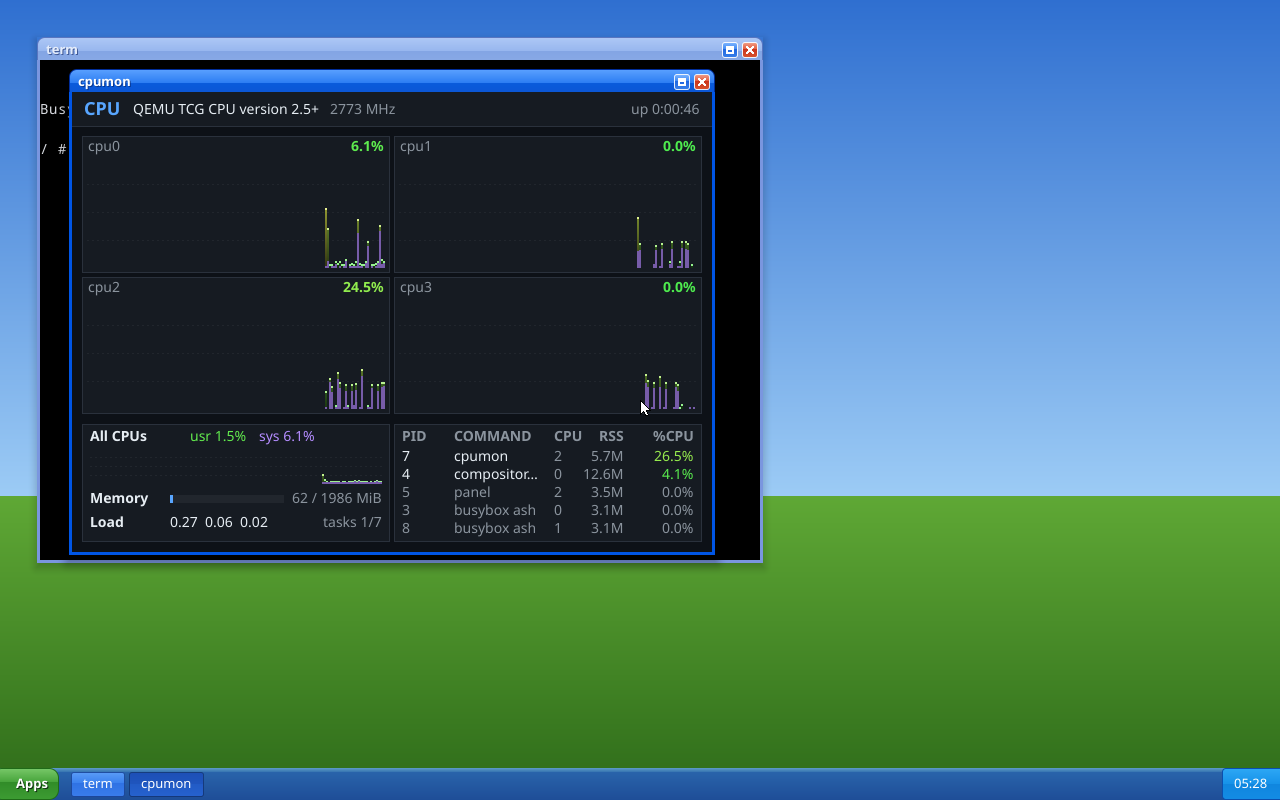
The desktop with the Luna 2026 theme: term (BusyBox ash) and cpumon in
windows, a taskbar with buttons for the open windows and the clock. A real QEMU
screenshot with 4 CPUs.
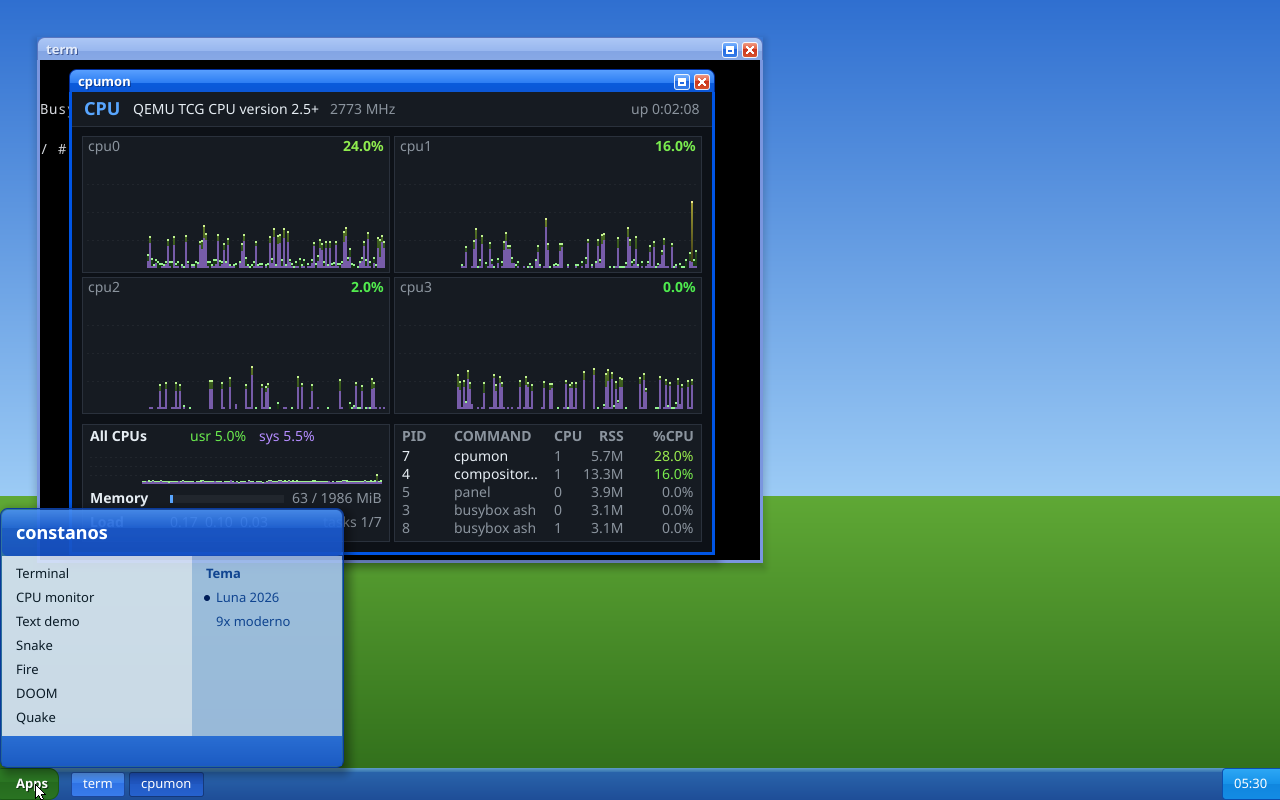 | 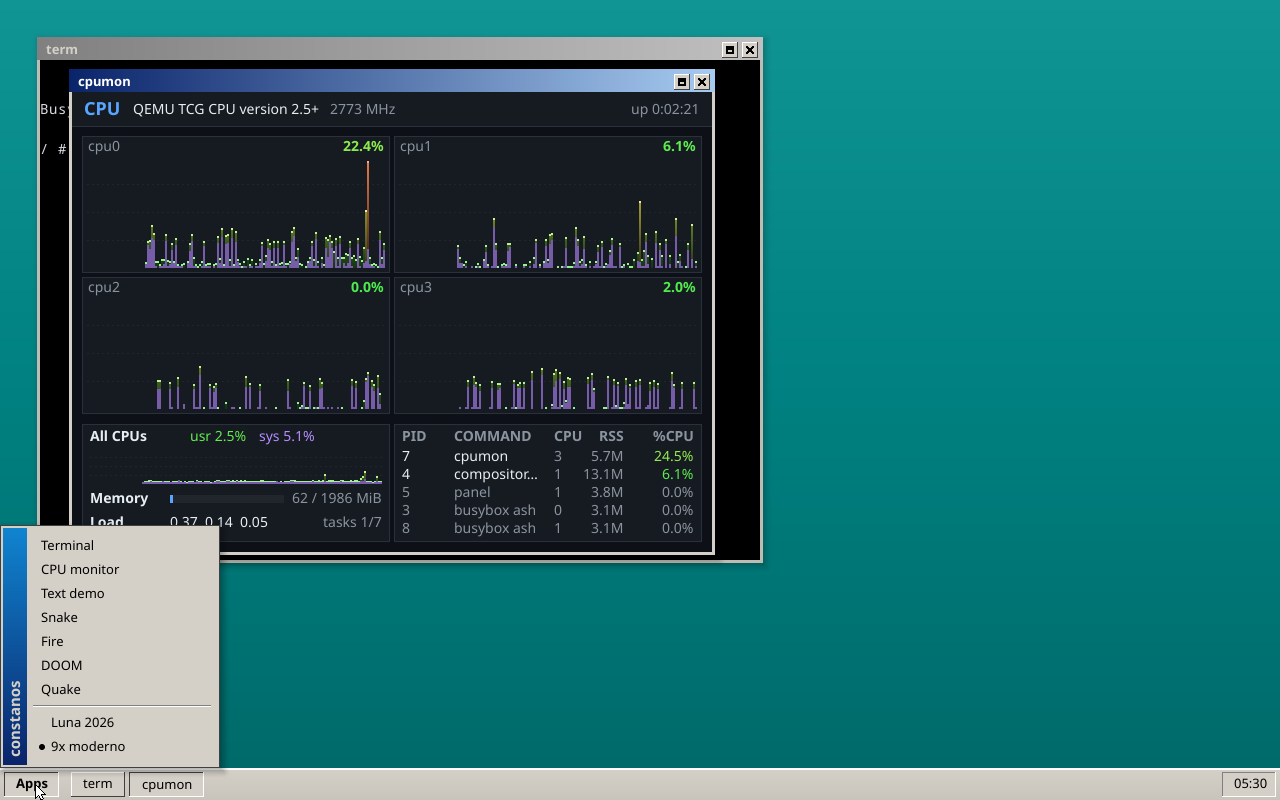 |
Start menu (Luna): the applications from /mnt/etc/gui/apps and the theme picker. | The same desktop in modern 9x, switched from the menu (or with F12). |
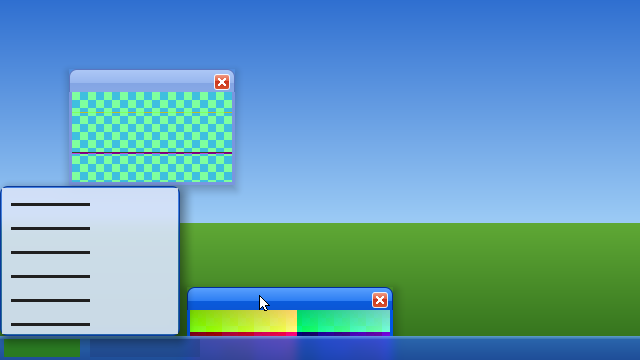
Glass in the GPU compositor (vk_comp): the taskbar and the menu copy what is
behind them, blur it with a Gaussian blur in a compute shader and draw on top. This
frame comes from the probes/nvk/host-comp.sh harness, which runs the real renderer
on lavapipe and compares it pixel by pixel with the CPU rasterizer.
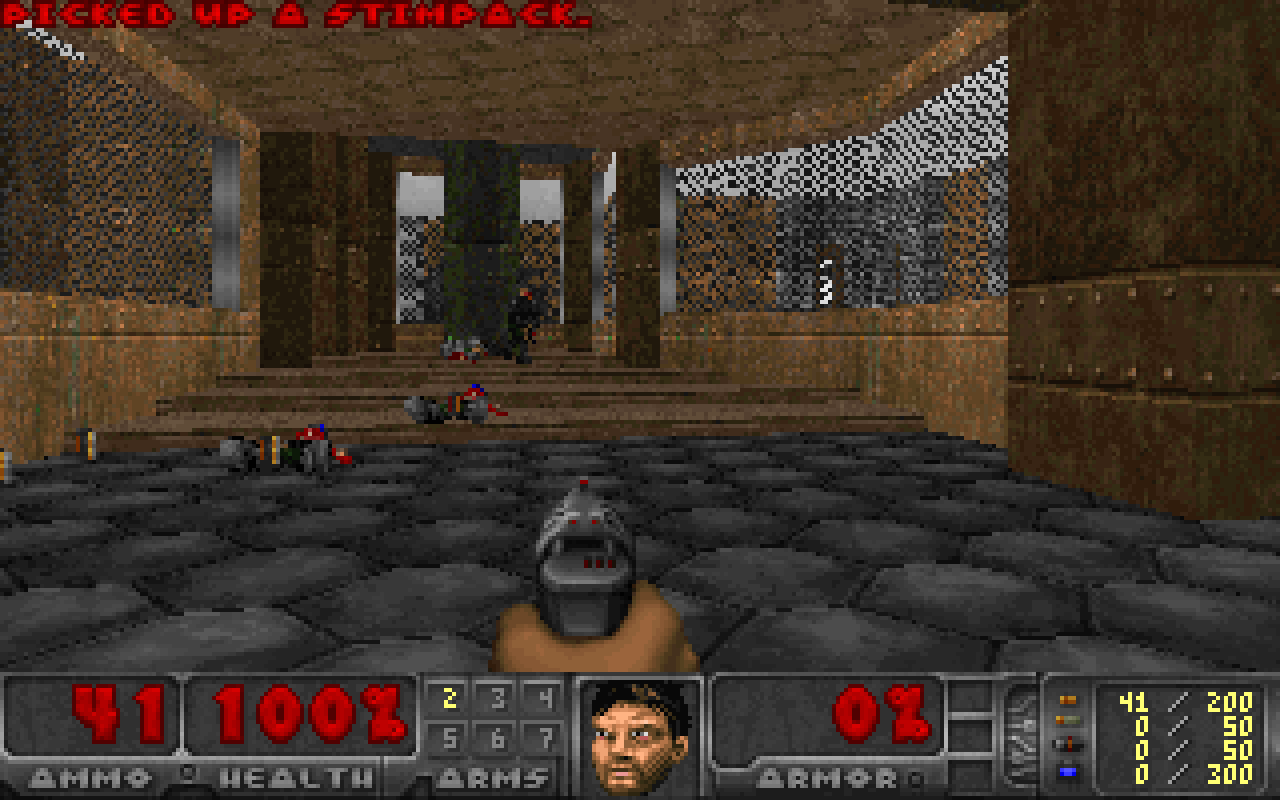 | 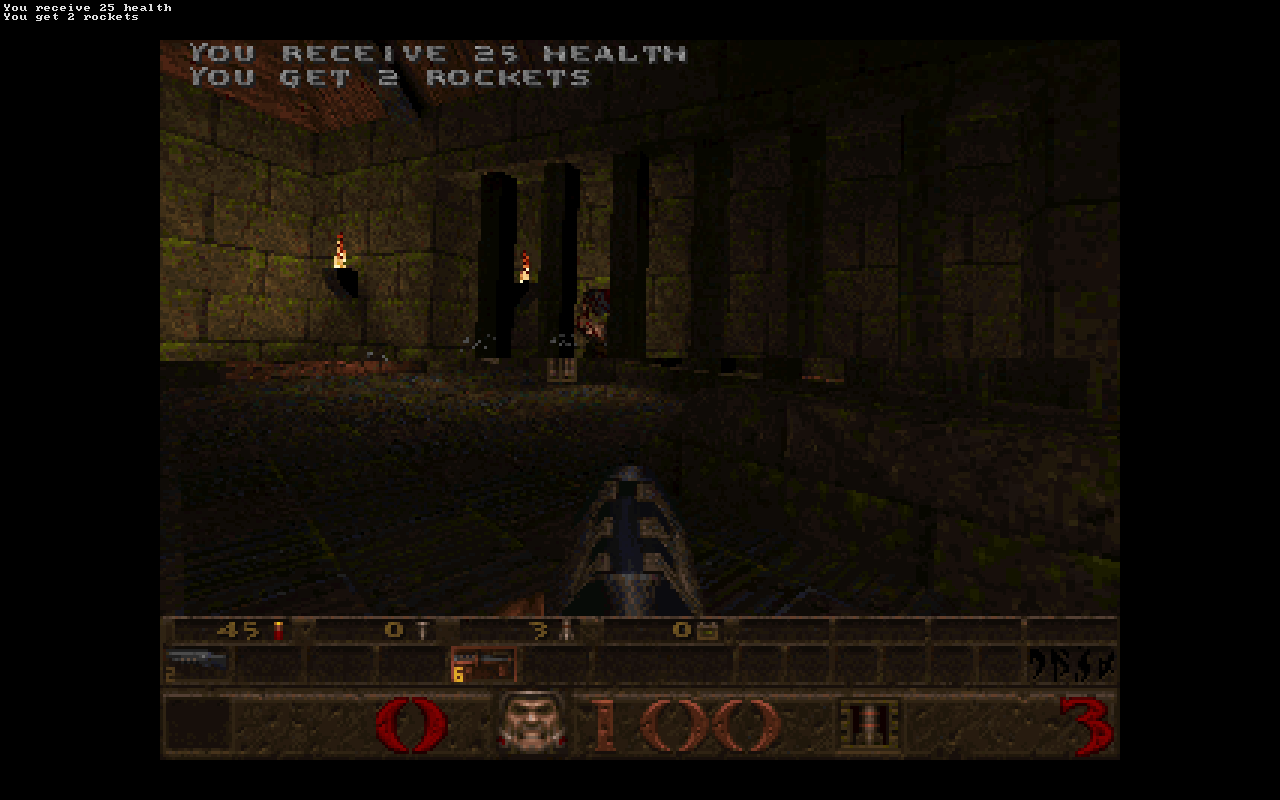 | 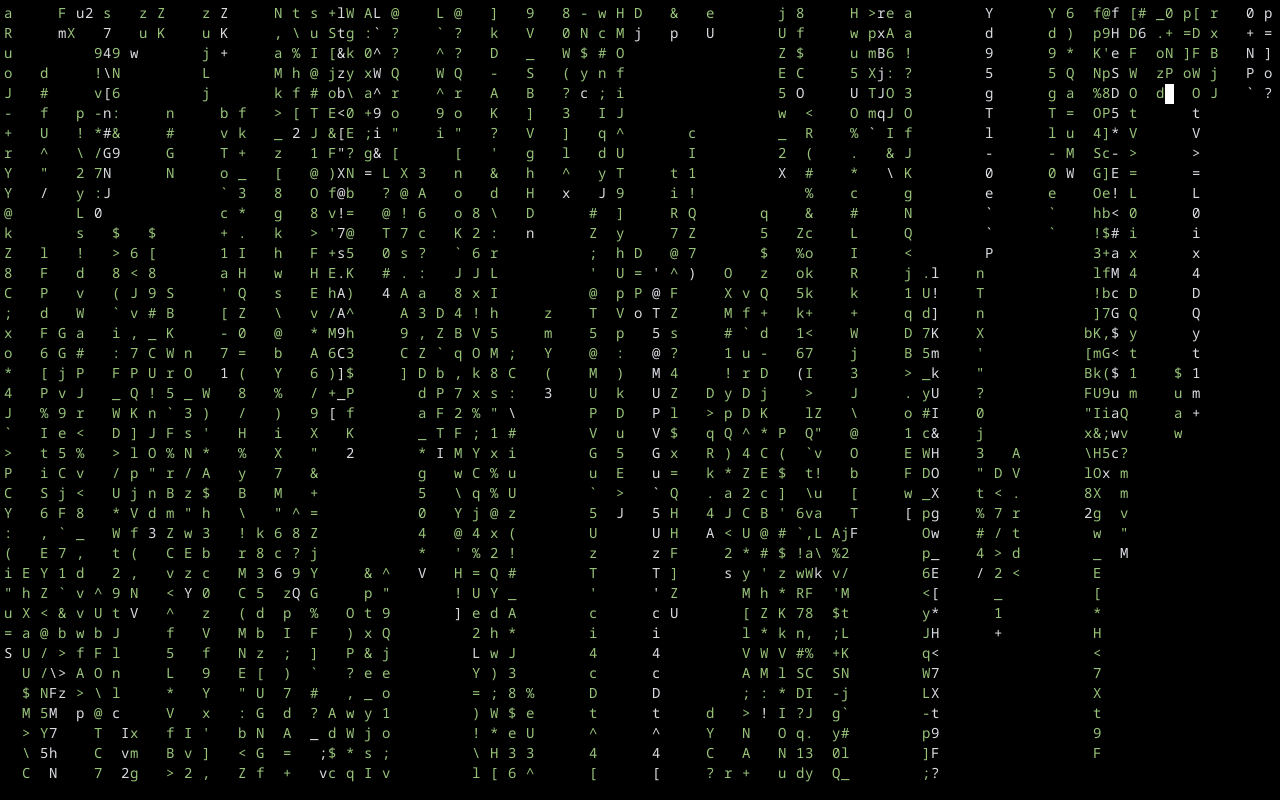 |
| DOOM, with mouse and sound. | Quake, a real game with QuakeC. | cmatrix on a port of ncurses. |
🚀 What it has
Kernel
- UEFI boot (the
bootloadercrate), GOP framebuffer, kernel log on serial, in/proc/dmesgand — on the real machine — in a partition of the USB stick. - SMP: up to 32 CPUs (APs via a trampoline, one-shot LAPIC timer, I/O APIC,
MSI/MSI-X), a preemptive multilevel priority scheduler shared by all CPUs
(processes migrate between them), cross-CPU TLB shootdown. The lock and interrupt
rules that make it work are in
CLAUDE.md. - Memory: the buddy allocator as the only frame allocator, slab for the heap,
per-process page tables, VMAs, demand paging, copy-on-write, a stack that grows on
demand, shared memory (
memfd_create,MAP_SHARED), DMA for drivers. - Processes and threads:
forkwith COW,execveof static ELF64 binaries (static-pie included),clonewith real threads, futex, POSIX signals withsigaltstackanducontext, job control,wait4,pidfd_open, credentials, CPU time accounting. - IPC: pipes, AF_UNIX sockets (stream, dgram, seqpacket,
SCM_RIGHTS), ptys,poll/epoll/eventfd. - File systems: a VFS with mounts, ramfs on
/tmp, devfs, procfs (BusyBox'spsandtopread it), and read-write ext2 on/mnt(ATA or the USB stick), with a block cache and repair at mount time.
Linux compatibility
- The syscall numbers and mlibc's
abi-bitsheaders are Linux's, so what compiles against Linux usually runs unchanged. - C: a port of mlibc (
mlibc-port/), with a few upstream bugs patched (one fix sent upstream: managarm/mlibc#1925). Unmodified BusyBox 1.36.1:ashis the shell, with ~60 applets (vi,less,grep,awk,tar,ps,top,wget,nc,ping,httpd...). - Rust std on musl: ordinary
x86_64-unknown-linux-muslprograms run as they are, tokio included (multi-threaded runtime, timers, sockets,tokio::fs, processes); tested with loads of 10,000 tasks (scripts/run-tokio-probe.sh).
Networking
- virtio-net (QEMU) and Realtek RTL8168 (the Ryzen's board, gigabit verified), with MSI-X interrupts.
- The smoltcp stack: DHCP, AF_INET TCP
(client and server), UDP and raw ICMP sockets; BusyBox's
wget,ncandpingwork.
Desktop
- Its own Wayland-style protocol (the
guicrate): shared or GPU buffers,commit, frame callbacks, popups, panel roles. The window manager (move, resize, maximize, F11 fullscreen, focus) is pure logic with ~90 host tests. - Two compositors with the same display list:
compositor: paints on the CPU into/dev/fb0— works anywhere (QEMU included);vk_comp: composites on the GPU with Vulkan on NVK on the RTX 3050 — rounded-box SDFs, gradients, borders, shadows, premultiplied transparency and blurred glass. The same frame is rasterized on the CPU and compared pixel by pixel in the tests.
- Themes (
gui::theme): Luna 2026 and modern 9x, switched live from the start menu or with F12. - Programs:
panel(taskbar and start menu),term(a terminal emulator with its own VT parser, thevtcrate),cpumon(per-CPU graphs, memory, processes),textdemo(antialiased TrueType text, thetextcrate),imgview(PNG),snake,fire, and DOOM and Quake in windows. scripts/gui-e2e.shdrives the desktop in QEMU with keyboard and mouse and checks the screenshots pixel by pixel.
GPU: NVIDIA RTX 3050 (GA106)
Behind the gpu= boot option (off by default), in steps that are tested one at a
time on the real machine (docs/reference/gpu.md, plan in docs/gpu/gpu-plan.md):
- VBIOS, DCB, EDID over AUX/I2C, modes, DisplayPort and HDMI link training, its own scanout;
- booting GSP-RM (the NVIDIA firmware that runs the GPU from the inside), GPU page tables, GPFIFO channels, the copy engine and compute;
/dev/nvgpu: the interface for a port of Mesa's NVK driver (mesa-port/). Vulkan works: compute, 3D, a swapchain on the display, buffers and timelines shared between processes.snake3d(Vulkan, 60 fps) andvk_comprun on it.
Real hardware
The Ryzen has no serial port, no PS/2 and no IDE. That is why there are:
- its own xHCI driver: USB keyboard, mouse and mass storage (the ext2 for
/mntlives in a partition of the boot stick); - a log partition on the stick (the kernel ring is copied every 5 s and on a
panic;
scripts/usb-log.sh readreads it from Linux); - unattended runs (
scripts/metal-run.sh): a job on the stick, a watchdog, the verdict in the log; - a framebuffer console with a shadow buffer and write-combining (
seq 1 400: from 875 s down to 0.75 s on metal;docs/fb/console-perf.md); - CPU sensors (frequency, temperature, energy) shown by
cpumon.
Games
- DOOM (doomgeneric +
doom-port/): the Freedoom IWAD from/mnt, mouse-look and sound effects through its own AC97 driver. - Quake (quakegeneric +
quake-port/): the sharewarepak0.pak, a new game with QuakeC and sound.
🧪 Tests
The kernel can't run cargo test, so all the logic that can be written against plain
types lives in separate crates with host tests (hal, mm, vfs, ext2, sched,
usock, tty, net, nvgpu, gui, vt, text, ...). The rest is tested in QEMU:
| What | How |
|---|---|
| Pure crates | cd <crate> && cargo test |
| Kernel in QEMU | scripts/run-kernel-tests.sh |
| Linux ABI (raw C tests) | scripts/run-abi-suite.sh |
| Rust std / tokio | scripts/run-std-probe.sh, scripts/run-tokio-probe.sh |
| Desktop | scripts/gui-e2e.sh [term|wm|text] |
| GPU renderer (lavapipe) | probes/nvk/host-comp.sh |
| Networking | scripts/net-e2e.sh |
A test counts only once it fails when the code it covers is sabotaged; several
subsystems have mutation scripts (scripts/gpu-mutate*.py, nvgpu/mutations/).
🏗️ Layout
kernel/            the kernel (no_std): init, memory, processes, syscalls, fs, drivers,
                   usb, networking, gpu, cpu/smp, interrupts, time
hal/ mm/ sched/    pure logic with host tests: hardware (xHCI, virtio, APIC, ACPI,
vfs/ ext2/ usock/  GPT...), memory, scheduler, VFS, ext2, AF_UNIX, ptys,
tty/ net/ diag/    networking, lock diagnostics
nvgpu/             the GA106 driver (pure logic) + the /dev/nvgpu uapi
gui/ gui-capi/     protocol, window manager and themes; its C API
draw/ text/ img/   drawing primitives, TrueType text, PNG
vt/                terminal parser
vk-comp/           the GPU compositor (Rust std on musl)
probes/            test programs: NVK/Vulkan, compositor renderer, std, tokio
userspace/         programs in Rust (shell, compositor, panel, term, cpumon...) and C
mlibc-port/ mesa-port/ doom-port/ quake-port/   the ports
mlibc/ busybox/ doomgeneric/ quakegeneric/      upstream submodules
disk-image-root/   contents of /mnt (disk.img)
docs/              per-subsystem reference (docs/reference/) and plans
scripts/           QEMU, tests, deploying to the stick, metal runs
build.rs src/      host side: builds the UEFI image and disk.img, launches QEMU
The per-subsystem reference (docs/reference/) is in English; many of the design
plans elsewhere in docs/ are still in Spanish.
▶️ Running it
Requirements: Rust nightly (pinned in rust-toolchain.toml),
qemu-system-x86_64, OVMF, clang/llvm/lld, meson, ninja, make,
e2fsprogs, and curl/unzip to download Freedoom and the Quake shareware.
On Arch:
sudo pacman -S qemu-system-x86 qemu-img qemu-ui-gtk edk2-ovmf clang llvm meson ninja lld e2fsprogs
cargo run       # builds everything (mlibc, BusyBox, programs, kernel) and boots in QEMU
cargo build     # just the UEFI image and disk.img
From the shell, compositor opens the desktop (Ctrl+Alt+Backspace closes it), and
doom, quake, cmatrix, cpumon... run from there or in a window.
scripts/qemu-debug.sh boots QEMU headless for debugging (keyboard, mouse,
screenshots, gdb).
On the real machine
The USB stick has three GPT partitions: boot (FAT, the kernel), constanos-data
(ext2, /mnt) and constanos-log (the log).
scripts/deploy-usb-boot.sh   # kernel → boot
scripts/sync-usb-data.sh     # disk-image-root/ → constanos-data
scripts/usb-log.sh read      # afterwards: the log of that boot
Never dd the whole image onto the stick: it replaces the GPT and takes the other
two partitions with it. Boot options (gpu=, nic=) go in /mnt/etc/kernel.conf.
🎯 What's missing
- Dynamic linking: the loader rejects
PT_INTERP; file-backedmmapandmmapaddress hints are missing. It comes next after an HTTPS client (docs/userland/roadmap.md). - Isolation between processes on the GPU: all
/dev/nvgpusessions share page tables. - A single compositor:
vk_compwith a software backend instead of two programs (docs/gui/compositor-visual-plan.md, step 2e); icons. - Networking: IPv6, loopback, TLS.
📜 License
The code in this repository is free software, licensed under your choice of
MIT or Apache 2.0 (MIT OR Apache-2.0, like the
Rust ecosystem). Unless you say otherwise, any contribution you submit is licensed
the same way.
Submodules and third-party files keep their own licenses: mlibc (MIT), BusyBox
(GPLv2), doomgeneric and quakegeneric (GPLv2), ncurses (MIT-X11), cmatrix (GPLv3),
Mesa (MIT) and Freedoom (disk-image-root/freedoom-COPYING.txt). Binaries that link
GPL code (BusyBox, DOOM, Quake, cmatrix) are distributed under the corresponding
GPL.
A personal project to learn how to build an operating system in Rust, with plenty of help from Claude Code along the way.
Similar repos


constanos: an experimental x86-64 OS in Rust — SMP, UEFI, Linux syscall ABI, mlibc + BusyBox, its own compositor, and an NVIDIA GA106 driver up to Vulkan via Mesa NVK
Rust
2
479 commits
updated Oct 7, 2026
See what people are saying
README
🦀 constanos — an x86-64 operating system in Rust
English · Español
Status: experimental. A personal project, developed by one person with a lot of help from Claude Code. Everything listed below runs today, in QEMU and on one real machine; the gaps are listed under What's missing.
A kernel written from scratch in Rust (no_std, UEFI, SMP) with a Linux-numbered
syscall ABI, mlibc as its libc, BusyBox as its
userland, a desktop with its own compositor, and a driver for an NVIDIA RTX 3050
(GA106) that goes all the way up to Vulkan through Mesa's NVK. It runs in QEMU and
on a physical machine (AM4 / Ryzen 9 5900X) that has no serial port, where
everything — keyboard, mouse, disk — comes in over USB.
The desktop with the Luna 2026 theme: term (BusyBox ash) and cpumon in
windows, a taskbar with buttons for the open windows and the clock. A real QEMU
screenshot with 4 CPUs.
| |
Start menu (Luna): the applications from /mnt/etc/gui/apps and the theme picker. | The same desktop in modern 9x, switched from the menu (or with F12). |
Glass in the GPU compositor (vk_comp): the taskbar and the menu copy what is
behind them, blur it with a Gaussian blur in a compute shader and draw on top. This
frame comes from the probes/nvk/host-comp.sh harness, which runs the real renderer
on lavapipe and compares it pixel by pixel with the CPU rasterizer.
| | |
| DOOM, with mouse and sound. | Quake, a real game with QuakeC. | cmatrix on a port of ncurses. |
🚀 What it has
Kernel
- UEFI boot (the
bootloadercrate), GOP framebuffer, kernel log on serial, in/proc/dmesgand — on the real machine — in a partition of the USB stick. - SMP: up to 32 CPUs (APs via a trampoline, one-shot LAPIC timer, I/O APIC,
MSI/MSI-X), a preemptive multilevel priority scheduler shared by all CPUs
(processes migrate between them), cross-CPU TLB shootdown. The lock and interrupt
rules that make it work are in
CLAUDE.md. - Memory: the buddy allocator as the only frame allocator, slab for the heap,
per-process page tables, VMAs, demand paging, copy-on-write, a stack that grows on
demand, shared memory (
memfd_create,MAP_SHARED), DMA for drivers. - Processes and threads:
forkwith COW,execveof static ELF64 binaries (static-pie included),clonewith real threads, futex, POSIX signals withsigaltstackanducontext, job control,wait4,pidfd_open, credentials, CPU time accounting. - IPC: pipes, AF_UNIX sockets (stream, dgram, seqpacket,
SCM_RIGHTS), ptys,poll/epoll/eventfd. - File systems: a VFS with mounts, ramfs on
/tmp, devfs, procfs (BusyBox'spsandtopread it), and read-write ext2 on/mnt(ATA or the USB stick), with a block cache and repair at mount time.
Linux compatibility
- The syscall numbers and mlibc's
abi-bitsheaders are Linux's, so what compiles against Linux usually runs unchanged. - C: a port of mlibc (
mlibc-port/), with a few upstream bugs patched (one fix sent upstream: managarm/mlibc#1925). Unmodified BusyBox 1.36.1:ashis the shell, with ~60 applets (vi,less,grep,awk,tar,ps,top,wget,nc,ping,httpd...). - Rust std on musl: ordinary
x86_64-unknown-linux-muslprograms run as they are, tokio included (multi-threaded runtime, timers, sockets,tokio::fs, processes); tested with loads of 10,000 tasks (scripts/run-tokio-probe.sh).
Networking
- virtio-net (QEMU) and Realtek RTL8168 (the Ryzen's board, gigabit verified), with MSI-X interrupts.
- The smoltcp stack: DHCP, AF_INET TCP
(client and server), UDP and raw ICMP sockets; BusyBox's
wget,ncandpingwork.
Desktop
- Its own Wayland-style protocol (the
guicrate): shared or GPU buffers,commit, frame callbacks, popups, panel roles. The window manager (move, resize, maximize, F11 fullscreen, focus) is pure logic with ~90 host tests. - Two compositors with the same display list:
compositor: paints on the CPU into/dev/fb0— works anywhere (QEMU included);vk_comp: composites on the GPU with Vulkan on NVK on the RTX 3050 — rounded-box SDFs, gradients, borders, shadows, premultiplied transparency and blurred glass. The same frame is rasterized on the CPU and compared pixel by pixel in the tests.
- Themes (
gui::theme): Luna 2026 and modern 9x, switched live from the start menu or with F12. - Programs:
panel(taskbar and start menu),term(a terminal emulator with its own VT parser, thevtcrate),cpumon(per-CPU graphs, memory, processes),textdemo(antialiased TrueType text, thetextcrate),imgview(PNG),snake,fire, and DOOM and Quake in windows. scripts/gui-e2e.shdrives the desktop in QEMU with keyboard and mouse and checks the screenshots pixel by pixel.
GPU: NVIDIA RTX 3050 (GA106)
Behind the gpu= boot option (off by default), in steps that are tested one at a
time on the real machine (docs/reference/gpu.md, plan in docs/gpu/gpu-plan.md):
- VBIOS, DCB, EDID over AUX/I2C, modes, DisplayPort and HDMI link training, its own scanout;
- booting GSP-RM (the NVIDIA firmware that runs the GPU from the inside), GPU page tables, GPFIFO channels, the copy engine and compute;
/dev/nvgpu: the interface for a port of Mesa's NVK driver (mesa-port/). Vulkan works: compute, 3D, a swapchain on the display, buffers and timelines shared between processes.snake3d(Vulkan, 60 fps) andvk_comprun on it.
Real hardware
The Ryzen has no serial port, no PS/2 and no IDE. That is why there are:
- its own xHCI driver: USB keyboard, mouse and mass storage (the ext2 for
/mntlives in a partition of the boot stick); - a log partition on the stick (the kernel ring is copied every 5 s and on a
panic;
scripts/usb-log.sh readreads it from Linux); - unattended runs (
scripts/metal-run.sh): a job on the stick, a watchdog, the verdict in the log; - a framebuffer console with a shadow buffer and write-combining (
seq 1 400: from 875 s down to 0.75 s on metal;docs/fb/console-perf.md); - CPU sensors (frequency, temperature, energy) shown by
cpumon.
Games
- DOOM (doomgeneric +
doom-port/): the Freedoom IWAD from/mnt, mouse-look and sound effects through its own AC97 driver. - Quake (quakegeneric +
quake-port/): the sharewarepak0.pak, a new game with QuakeC and sound.
🧪 Tests
The kernel can't run cargo test, so all the logic that can be written against plain
types lives in separate crates with host tests (hal, mm, vfs, ext2, sched,
usock, tty, net, nvgpu, gui, vt, text, ...). The rest is tested in QEMU:
| What | How |
|---|---|
| Pure crates | cd <crate> && cargo test |
| Kernel in QEMU | scripts/run-kernel-tests.sh |
| Linux ABI (raw C tests) | scripts/run-abi-suite.sh |
| Rust std / tokio | scripts/run-std-probe.sh, scripts/run-tokio-probe.sh |
| Desktop | scripts/gui-e2e.sh [term|wm|text] |
| GPU renderer (lavapipe) | probes/nvk/host-comp.sh |
| Networking | scripts/net-e2e.sh |
A test counts only once it fails when the code it covers is sabotaged; several
subsystems have mutation scripts (scripts/gpu-mutate*.py, nvgpu/mutations/).
🏗️ Layout
kernel/            the kernel (no_std): init, memory, processes, syscalls, fs, drivers,
                   usb, networking, gpu, cpu/smp, interrupts, time
hal/ mm/ sched/    pure logic with host tests: hardware (xHCI, virtio, APIC, ACPI,
vfs/ ext2/ usock/  GPT...), memory, scheduler, VFS, ext2, AF_UNIX, ptys,
tty/ net/ diag/    networking, lock diagnostics
nvgpu/             the GA106 driver (pure logic) + the /dev/nvgpu uapi
gui/ gui-capi/     protocol, window manager and themes; its C API
draw/ text/ img/   drawing primitives, TrueType text, PNG
vt/                terminal parser
vk-comp/           the GPU compositor (Rust std on musl)
probes/            test programs: NVK/Vulkan, compositor renderer, std, tokio
userspace/         programs in Rust (shell, compositor, panel, term, cpumon...) and C
mlibc-port/ mesa-port/ doom-port/ quake-port/   the ports
mlibc/ busybox/ doomgeneric/ quakegeneric/      upstream submodules
disk-image-root/   contents of /mnt (disk.img)
docs/              per-subsystem reference (docs/reference/) and plans
scripts/           QEMU, tests, deploying to the stick, metal runs
build.rs src/      host side: builds the UEFI image and disk.img, launches QEMU
The per-subsystem reference (docs/reference/) is in English; many of the design
plans elsewhere in docs/ are still in Spanish.
▶️ Running it
Requirements: Rust nightly (pinned in rust-toolchain.toml),
qemu-system-x86_64, OVMF, clang/llvm/lld, meson, ninja, make,
e2fsprogs, and curl/unzip to download Freedoom and the Quake shareware.
On Arch:
sudo pacman -S qemu-system-x86 qemu-img qemu-ui-gtk edk2-ovmf clang llvm meson ninja lld e2fsprogs
cargo run       # builds everything (mlibc, BusyBox, programs, kernel) and boots in QEMU
cargo build     # just the UEFI image and disk.img
From the shell, compositor opens the desktop (Ctrl+Alt+Backspace closes it), and
doom, quake, cmatrix, cpumon... run from there or in a window.
scripts/qemu-debug.sh boots QEMU headless for debugging (keyboard, mouse,
screenshots, gdb).
On the real machine
The USB stick has three GPT partitions: boot (FAT, the kernel), constanos-data
(ext2, /mnt) and constanos-log (the log).
scripts/deploy-usb-boot.sh   # kernel → boot
scripts/sync-usb-data.sh     # disk-image-root/ → constanos-data
scripts/usb-log.sh read      # afterwards: the log of that boot
Never dd the whole image onto the stick: it replaces the GPT and takes the other
two partitions with it. Boot options (gpu=, nic=) go in /mnt/etc/kernel.conf.
🎯 What's missing
- Dynamic linking: the loader rejects
PT_INTERP; file-backedmmapandmmapaddress hints are missing. It comes next after an HTTPS client (docs/userland/roadmap.md). - Isolation between processes on the GPU: all
/dev/nvgpusessions share page tables. - A single compositor:
vk_compwith a software backend instead of two programs (docs/gui/compositor-visual-plan.md, step 2e); icons. - Networking: IPv6, loopback, TLS.
📜 License
The code in this repository is free software, licensed under your choice of
MIT or Apache 2.0 (MIT OR Apache-2.0, like the
Rust ecosystem). Unless you say otherwise, any contribution you submit is licensed
the same way.
Submodules and third-party files keep their own licenses: mlibc (MIT), BusyBox
(GPLv2), doomgeneric and quakegeneric (GPLv2), ncurses (MIT-X11), cmatrix (GPLv3),
Mesa (MIT) and Freedoom (disk-image-root/freedoom-COPYING.txt). Binaries that link
GPL code (BusyBox, DOOM, Quake, cmatrix) are distributed under the corresponding
GPL.
A personal project to learn how to build an operating system in Rust, with plenty of help from Claude Code along the way.