
An open-source, offline-capable agentic IoT runtime with physical actuation trust. Ori gives physical devices the brain to reason about sensor data via tiered LLM reasoning + graduated authority model for safe autonomous physical action. Runs on a Pi.
See the codeREADME

Give your devices a brain.




Ori — the agentic IoT runtime for infrastructure intelligence
IoT devices do not need more data. They need to reason about that data — and act on it.
Ori is an open-source agentic IoT runtime that gives physical devices tiered autonomous reasoning — from deterministic safety rules to local SLMs. This reasoning is governed by a Physical Actuation Trust framework that defines exactly what an AI agent is permitted to do in the physical world, at what consequence level, and with what human oversight. Offline-first with an offline-capable safety core; gateway escalation is optional. Runs on a $55 Raspberry Pi.
Built for the world's majority condition — unreliable power, intermittent connectivity, constrained hardware. Systems designed for constraint work everywhere.
Ori is the operating layer for infrastructure intelligence. Most tools that carry that label stop at a dashboard: sensor readings, a threshold, an alert, a human. Ori is built to also decide what a site is permitted to do, act on commissioned equipment locally under graduated authority tiers (A inform → B act within policy → C ask before acting → D protect immediately), keep working without the internet, and preserve a record of what happened that can be reconstructed afterwards.
The platform story is at oriplatform.dev. Every term used in this README — infrastructure intelligence, operating layer, agentic IoT runtime, Physical Actuation Trust, authority tiers, Agent of Things — is defined in the Ori glossary.
See it decide
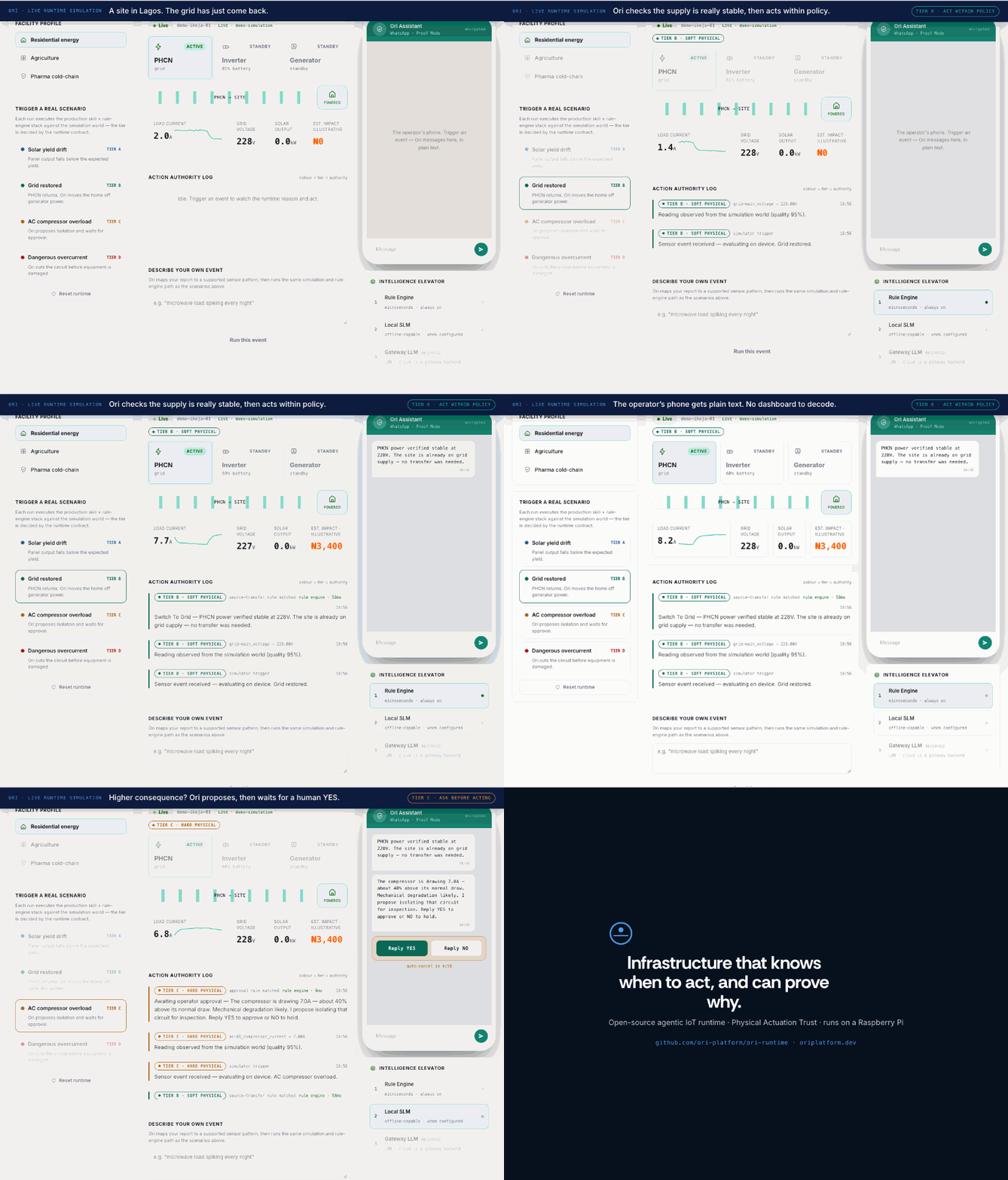
Real footage from the runtime-backed simulation, not a mock-up: a grid-restoration event handled at Tier B (act within policy, then tell the operator in plain text), followed by a compressor fault that is only proposed and waits for a human YES (Tier C). Every value is simulated; no physical equipment is operated. Try it yourself at energy.oriplatform.dev/demo.
The Difference
Every existing IoT platform does the same thing: collect data, apply a threshold, fire an alert, wait for a human. Sensors report numbers. Ori reasons about them — and acts.
❌ Traditional IoT: "Current draw: 8.2A"
❌ Traditional IoT: "ALERT: threshold exceeded. Please investigate."

✅ Ori (Tier A): "Your AC unit has drawn 40% above baseline for three afternoons.
        Pattern: refrigerant depletion, not usage change.
        Estimated failure: 2 weeks.
        I've sent a service reminder to your WhatsApp."

         — sent autonomously from a $55 Pi, without requiring cloud inference for safety decisions

✅ Ori (Tier B): "Grid voltage dropped to 174V. I have switched to
inverter power automatically." ← Acted. Then told you.

✅ Ori (Tier C): "Critical fault detected on main circuit. I am
proposing to open the protected-load safety circuit. Reply YES-AB12CD34
to approve or NO-AB12CD34 to cancel. Auto-cancel in 5 minutes."
← Reasoned. Proposed. Awaiting you.

✅ Ori (Tier D): [Installer-wired relay/contactor opens immediately]
"Dangerous overcurrent (52A on 10A circuit). Emergency
cutoff executed at 14:32." ← Safety. No waiting.
Ori is not a monitoring system with a language model attached. It is an agent that reasons and acts — and trust is won by proving that human correction permanently alters the machine's future behaviour.
What Ori Is Not
- Not a monitoring dashboard like Grafana — Ori acts, not just displays
- Not a cloud IoT platform like AWS IoT Core — Ori keeps an offline-capable safety core (Tier 1 + local Tier 2), with optional gateway escalation when connected
- Not a notification system — alerts are Tier A, the least of what Ori does
- Not just a rules engine — Ori pairs deterministic safety rules with LLM reasoning
- Not the other "Ori"s — this is Ori by Ori Nexus Systems, Lagos (oriplatform.dev, ori-runtime). It is unrelated to ORI at useori.africa, Ori Industries / ori.co, ori.io, or the Ori video games
Quick Start — No Hardware Needed
Ori's pc-system-health skill runs on any laptop using psutil. No Raspberry Pi, no sensors, no wiring.
Linux users: To deploy a signed release as a service, see docs/linux-install.md. To run from source for development, see docs/linux-setup.md for a step-by-step setup guide, including a minimal validated config (
ori.linux.yaml.example), Linux model paths, and troubleshooting for common Linux-specific issues.
# Clone and install
git clone https://github.com/ori-platform/ori-runtime.git
cd ori-runtime
python3 -m venv .venv
source .venv/bin/activate

# One-command dev bootstrap (deps + hooks + formatting baseline)
bash scripts/bootstrap.sh

# Verify everything works
pytest tests/ -v

# Validate a skill loads cleanly
python -c "
import asyncio
from ori.skills.loader import SkillLoader
skill = asyncio.run(SkillLoader().load_one('skills/pc-system-health'))
print(f'Loaded: {skill.name} v{skill.version}')
for t in skill.triggers:
    print(f'  Trigger: {t.name} tier={t.action_tier}')
"
How It Works
Ori runs a paired decision system on every sensor event:
The Intelligence Elevator — What does this mean?
Tier 1  RULE ENGINE    microseconds · always available  · safety triggers
Tier 2  LOCAL SLM      3-8 seconds  · offline-capable   · everyday reasoning
Tier 3  GATEWAY LLM    1-3 seconds  · LAN only          · cross-device or cloud-backed reasoning
- Tier 1 (Rule Engine) and Tier 2 (Local SLM) are fully implemented and available offline.
- Tier 3 (Gateway LLM) is implemented over MQTT request/response and remains optional.
- Cloud reasoning, when used, is a gateway backend, not a runtime dependency.
- Production runtime-gateway MQTT deployments should follow
docs/MQTT_SECURITY.mdfor broker ACLs, network isolation, and HMAC envelope configuration. - Public SMS webhook deployments should follow
docs/SMS_WEBHOOK_SECURITY.md. Runtime sender allowlisting is necessary, but carrier-level sender spoofing requires deployment controls such as a signing bridge, source CIDR allowlisting, or a trusted reverse proxy. - The runtime is correctly described as an offline-capable safety runtime. Tier 1 and Tier D safety paths are available with zero network dependency.
The Action Tier Framework — What should I do about it?
Tier A  INFORMATIONAL       Always autonomous
        Alerts, logs, reports — the agent acts without asking

Tier B  SOFT PHYSICAL        Explicit approval or post-action policy
        Power source switching, thermostat adjustments, irrigation valves
        The agent either asks first or acts first and explains after

Tier C  HARD PHYSICAL        Approval workflow — always
        Relay/contactor-controlled shutdown, high-consequence control
        The agent reasons, proposes, and waits for your YES or NO

Tier D  SAFETY-CRITICAL      Always autonomous, cannot be overridden
        Dangerous overcurrent, thermal runaway, hazardous gas
        The agent acts first, notifies you immediately
The runtime picks the cheapest reasoning tier that can answer. The action tier determines whether it acts, asks, or moves immediately.
Architecture

┌──────────────────────────────────────────────────────────────┐
│  Runtime L6  Business     ori-cloud · dashboard · fleet      │
├──────────────────────────────────────────────────────────────┤
│  Runtime L5  Application  Skills · Skills Hub · SDK          │
├──────────────────────────────────────────────────────────────┤
│  Runtime L4  Reasoning+Action  Intelligence Elevator         │
│                                + Action Tier Framework       │
├──────────────────────────────────────────────────────────────┤
│  Runtime L3  Middleware   Runtime · Event Loop · Dispatcher  │
├──────────────────────────────────────────────────────────────┤
│  Runtime L2  Network      EventBus · Protocol Normaliser     │
├──────────────────────────────────────────────────────────────┤
│  Runtime L1  Perception   HAL · GPIO · I2C · RS485 · psutil  │
└──────────────────────────────────────────────────────────────┘
These are runtime architecture layers, not evidence protocol layers. Runtime Layers 1–4 run on the device. Runtime Layers 3 and 4 are inseparable — the runtime always pairs a reasoning decision with an action decision. Runtime Layer 5 is the community. Runtime Layer 6 is the business.
ori-edge-firmware is a Layer 1 companion, not a second runtime. Firmware nodes
are evidence Layer 1 producers: they sign sensor-origin telemetry at the
point of measurement. This runtime verifies and normalises those readings,
reasons over them, acts through the Action Tier Framework, and records Tier C/D
action evidence through the runtime's own signed chain as evidence Layer 2.
For the full architectural specification, read CLAUDE.md. For the design philosophy, read PRINCIPLES.md.
Hardware Support
| Protocol | Status | Coverage |
|---|---|---|
| GPIO (Raspberry Pi) | ✅ | Wired sensors and relay control |
| I2C / SPI | ✅ | Precision sensors: BME280, ADS1115, SCD40 |
| Modbus RTU (RS485) | ✅ | Industrial energy meters, PLCs, motor drives |
| psutil | ✅ | PC and server health monitoring (any laptop) |
| MQTT | ✅ | WiFi-connected sensors/devices via an MQTT broker (commonly Mosquitto) |
| CoAP (actuation) | ✅ | Constrained-device command path for low-overhead control endpoints |
| OPC-UA | ✅ | Industrial PLCs (IEC 62541) |
| SolarmanV5 (Growatt) | ✅ | Smart inverter integration |
| Zigbee | ✅ | Smart-home sensors via MQTT bridge (for example zigbee2mqtt) |
| LoRaWAN | ✅ | Rural long-range uplink sensors via MQTT brokers (TTN/ChirpStack) |
✅ = Implemented
All adapters include a hardware circuit breaker that auto-isolates failing buses to protect the rest of the system.
Hardware Requirements
| Configuration | Hardware | RAM | Notes |
|---|---|---|---|
| Rule engine only (Tier 1) | Raspberry Pi 3B+ or equivalent | 1GB | No local SLM. Full safety framework active. |
| Full stack with local SLM | Raspberry Pi 4 4GB | 4GB | Validated reference hardware. 3–8s inference. |
| Development / laptop | Any modern machine | 4GB+ | psutil adapter. No Pi required. |
The model file (Qwen2.5-0.5B Q4) is 500MB. The SQLite state store stays bounded under 80MB via the compaction pyramid regardless of deployment duration. Production/staging deployments must place the SQLite state path on an encrypted filesystem or mount and declare that posture under state.encryption; the runtime uses standard sqlite3, not SQLCipher.
Safety Architecture
Ori is designed for physical actuation trust. The safety architecture enforces invariants at every layer:
-
Tier D rules fire before any LLM — deterministic, microsecond-latency cutoffs that cannot be disabled or overridden
-
AST whitelist validation — skill condition expressions are parsed into abstract syntax trees and only safe constructs are permitted (comparisons, arithmetic,
history.method()calls). No string-pattern blacklist that can be bypassed -
Runtime-owned action floors — the minimum tier an action may be dispatched at comes from the runtime's own action registry, not from the skill file. A skill may raise an action's tier, never lower it, and only non-actuating actions may be a Tier C safe default
-
Tier D is never package-granted — Tier D is the one tier that removes the operator. A signature proves who wrote a skill, not that it holds autonomous safety authority, so today Tier D is accepted only from skills shipped with the runtime. That is containment of the legacy path, not the final model: under the release-owned safety profile that replaces it, packages do not participate in the decision at all
-
Community hooks do not execute — the in-process hook sandbox was removed rather than hardened, because it could be escaped and half of it was inert on Python 3.12. There is no in-process fallback; isolated execution is being specified before it is built. First-party skills packaged with the runtime are unaffected
-
Hardware circuit breakers — failing sensor buses are auto-isolated using a three-state (CLOSED → OPEN → HALF_OPEN) circuit breaker so one bad sensor doesn't crash the runtime
-
Approval workflows for hard physical actions — Tier C actions always require operator approval via WhatsApp/SMS. No config flag to skip it
-
Alert transport failover — approval requests use the configured primary channel first, then fail over to the secondary channel if delivery fails
-
Evidence chain for high-authority actions — when configured, the Ori runtime signs Tier C/D dispatch records into its own local hash-chained store, in the publicly specified
evidence/v2format, and seals each row into a delivery envelope. Health exposes the chain head, the attestation gap count, the action-event vocabulary, and a count of envelopes no courier has yet acknowledged holding.protocol_versionnames the chain format this device writes, which is what tells a reader whether its evidence can be verified;availablesays whether this device can sign at all.The device produces and locally retains verifiable evidence. Delivery is not built, so the count of unacknowledged envelopes only rises — which is the honest signal that this half is incomplete rather than idle. This is runtime action evidence; device-origin telemetry attestation is the firmware/Layer 1 contract.
For constrained deployments, a common pattern is MQTT for continuous telemetry plus CoAP for low-overhead command delivery.
For the full set of security invariants, see AGENTS.md.
Skills
Everything Ori does is a skill. A skill is a packaged agent behaviour with explicit action authority declarations written in YAML.
# skills/energy-anomaly-detector/skill.yaml
triggers:
  - name: anomalous_draw
    condition: "load_current > (history.avg_24h('load_current') * 1.4)"
    action_tier: A # → autonomous WhatsApp with reasoning

  - name: grid_instability
    condition: "grid_voltage < 180 and inverter_battery > 0.4"
    action_tier: B
    reasoning_policy: post_action # → switches source, explains after

  - name: critical_fault
    condition: "load_current > rated_capacity * 3.0"
    action_tier: C # → "Open protected load safety circuit? Reply YES-<proposal_id>/NO-<proposal_id>"

  - name: dangerous_overcurrent
    condition: "load_current > rated_capacity * 5.0"
    bypass_llm: true
    action_tier: D # → cuts power. no waiting.
Bundled skills: pc-system-health (runs on any laptop), pc-network-threat-monitor, energy-anomaly-detector, prosumer-energy-advisor, retail-occupancy-optimizer, solar-performance-monitor, battery-lifecycle-observer, hvac-refrigerant-monitor, and site-safety-ppe.
Community skills live at ori-platform/ori-skills. The runtime enforces strict skill validation and verified Ed25519 signatures for skills that do not ship with it. Community hooks.py execution is disabled pending the isolated-worker contract, so community skills are YAML-only in this release.
The Tier C Approval Workflow
When Ori proposes a hard physical action, this is what the operator receives:
ORI ALERT — Action Required
Device: energy-monitor-ikeja-office-01
Proposal ID: AB12CD34
Time: Wednesday 14:32

OBSERVATION:
Load current has reached 38.4A — 3.8x the rated 10A capacity.
Sustained for 45 seconds and climbing.

REASONING:
Pattern consistent with a short circuit, not a temporary surge.
Active fault propagation detected.

PROPOSED ACTION:
Open the installer-wired safety circuit to cut power to the protected load.

CONFIDENCE: 94%

Reply YES-AB12CD34 to approve  |  Reply NO-AB12CD34 to cancel
Auto-cancel in 5 minutes if no response.
The message is delivered over SMS (primary for Nigeria deployments) with automatic failover to WhatsApp when SMS is unavailable, or WhatsApp-first when configured. The same message format is used on both channels.
The agent does the diagnosis. The operator approves or rejects a specific, fully-reasoned proposal.
Install Targets
Deploying to a Linux device? Use the signed release installer — see docs/linux-install.md. It verifies a KMS-signed bundle before anything is unpacked, installs the runtime as a managed systemd service, and rolls back automatically if the new release is not healthy. The install shapes below are for development and downstream consumers, not for field deployment.
ori-runtime has two intentionally different install shapes:
# Product/demo consumers: typed rule-evaluation boundary only.
# This is what downstream FastAPI product/demo services should use for proof evaluation.
python -m pip install "ori-runtime[eval] @ git+https://github.com/ori-platform/ori-runtime.git@<commit-or-tag>"

# Runtime/device development: full transport, security, provider, and HAL deps.
python -m pip install -e ".[runtime,dev]"

# Edge deployment still uses the signed wheelhouse / hash-locked requirements path.
bash scripts/build-wheelhouse.sh
The base package deliberately installs only the dependency needed by
ori.integration (PyYAML) plus the packaged bundled skills. MQTT, SMS,
WhatsApp, OPC-UA, HTTP adapters, crypto transports, and hardware/provider
libraries live behind extras or the deployment wheelhouse. This keeps
product/demo consumers from inheriting the full device
runtime dependency surface while still using the real rule engine.
Quick Local SLM Setup (Qwen GGUF)
# 1) Activate your venv
source .venv/bin/activate

# 2) Install llama-cpp-python (CPU path; stable across laptops)
pip install --no-cache-dir llama-cpp-python

# 3) Download a local GGUF model
mkdir -p ~/models
curl -L https://huggingface.co/Qwen/Qwen2.5-0.5B-Instruct-GGUF/resolve/main/qwen2.5-0.5b-instruct-q4_k_m.gguf \
  -o ~/models/qwen2.5-0.5b-instruct-q4_k_m.gguf

# 4) Point your config to the local model
# reasoning:
#   default_tier: local
#   local_model: qwen2.5-0.5b-instruct-q4_k_m
#   model_path: /Users/<you>/models       # macOS
#   # model_path: /home/<you>/models     # Linux

# 5) Optional dev convenience: auto-load .env before config parse
export ORI_AUTOLOAD_DOTENV=true

# 6) Start runtime
python -m ori.runtime --config ori.local.yaml

# 7) Optional: hot-reload skills without restart (Unix only)
# Reload applies to new events only; in-flight actions keep previous skill config.
kill -HUP "$(pgrep -f 'python -m ori.runtime' | head -n 1)"
Smoke Tests
# Full runtime smoke test (auto-selects config by platform if arg #1 is omitted)
bash scripts/smoke-runtime-local.sh

# Linux explicit config (recommended)
bash scripts/smoke-runtime-local.sh ori.yaml

# Force pretty console output
ORI_PRETTY_LOGS=true bash scripts/smoke-runtime-local.sh

# Disable ANSI colors (CI/plain terminals)
ORI_PRETTY_LOGS=false bash scripts/smoke-runtime-local.sh

# Live host-health report (real psutil readings + skill trigger evaluation)
ORI_PRETTY_LOGS=true .venv/bin/python scripts/pc_health_report.py

# Release wheel smoke test
# Builds the wheel, installs it into a clean venv, verifies PEP 561 typing,
# bundled skill packaging, and a real Tier D rule evaluation through
# ori.integration.
bash scripts/smoke-release-wheel.sh

# Local SLM quality smoke test (without starting full runtime)
python - <<'PY'
import asyncio
from ori.reasoning.local_llm import LocalLLM

async def main():
    llm = LocalLLM(
        model_path="/Users/<you>/models/qwen2.5-0.5b-instruct-q4_k_m.gguf",  # macOS
        # model_path="/home/<you>/models/qwen2.5-0.5b-instruct-q4_k_m.gguf",  # Linux
        context_window=2048,
    )
    result = await llm.reason("CPU at 96% for 10 minutes. Give 2 short operator actions.")
    print(result.tier, result.model)
    print(result.text)

asyncio.run(main())
PY
Troubleshooting:
ori-runtime: command not found:- install entrypoint into the active venv:
python -m pip install -e . - or run directly:
python -m ori.runtime --config ori.local.yaml
- install entrypoint into the active venv:
- Config fails with
Environment variable not set: ${...}:- export required vars into shell or set
ORI_AUTOLOAD_DOTENV=truewith a valid.envfile
- export required vars into shell or set
Failed to create llama_contexton macOS:- reinstall
llama-cpp-pythonwithout Metal (CPU path), then retry
- reinstall
- VS Code uses wrong interpreter:
- select
${workspaceFolder}/.venv/bin/pythonviaPython: Select Interpreter
- select
Testing
pytest tests/ -v                              # Full suite
pytest tests/test_rule_engine.py -v           # Specific module
pytest tests/ --cov=ori --cov-report=term-missing  # With coverage
bash scripts/typecheck-boundaries.sh          # Scoped mypy gate for public/runtime contracts
bash scripts/smoke-release-wheel.sh           # Installed-wheel release readiness smoke
The test suite covers all layers — HAL adapters, event bus, rule engine (with AST safety validation), action dispatcher (all four tiers), skill loader, state store, and runtime.
Run scripts/smoke-release-wheel.sh before tagging a runtime release. It is
deliberately stricter than an editable install: it builds the wheel, verifies
the wheel metadata keeps the base install slim for product/demo consumers,
installs runtime dependencies from hash-locked requirements, installs the wheel
with --no-deps, then verifies the public ori.integration rule-evaluation
boundary is typed (ori/py.typed) and can resolve bundled skill data from the
installed artifact. This protects downstream product/demo API paths from
type-checker ignores, accidental dependency bloat, and source-checkout-only
packaging mistakes.
Security
See SECURITY.md for vulnerability reporting, supported versions, and disclosure policy.
Release Status
Current channel: Stable (2.4.x)
- Runtime core is stable for PoC, demo API, and controlled field deployment, with a fail-closed production security posture: staging/production configs must meet the hardened gateway, remote-command, webhook, skill-signing, state-encryption, and signed-config requirements or the runtime refuses to start. Development-profile deployments remain warning-only.
- High-authority action evidence is implemented behind
evidence.enabled: Tier C/D dispatch records are signed into the runtime's own local evidence chain, reconciled after restart, and surfaced through runtime health and gateway heartbeat evidence. Delivery is not built: the device retains its evidence locally, and nothing yet consumes it. Device-origin telemetry is now consumed by the runtime verification gate: firmware signs readings at the physical edge, the runtime verifies and trust-grades them, and the runtime's own evidence chain verifies the shared golden bytes/signatures without owning firmware canonicalization. - Safety invariants (tier guards, the runtime action registry, strict skill validation, skill provenance) are CI-enforced on every PR.
- Public runtime contracts used by companion repos are the MQTT gateway/export contracts and the typed
ori.integrationrule-evaluation boundary — unchanged from v1.0.0. The runtime health payload is also read by companion repos and is versioned separately:2.4.xservesori-specs/runtime-health/v1, and the next release servesv2, which removes the evidence artifact version, a field that no longer has a source now that the private artifact is retired. - Recommended use today: pilots, PoCs, controlled deployments, product provisioning, and downstream demo/API integration.
- Upgrading from
2.3.xand scripting the Linux installer?2.4.0makes--scopeexplicit, prints a human summary unless--jsonis passed, and drops--service-user. See Migration. - Release notes:
docs/releases/v2.4.0.md
Related public repos in the org:
- Runtime:
ori-platform/ori-runtime(this repo) - Skills registry:
ori-platform/ori-skills-hub - CLI:
ori-platform/ori-cli - Gateway:
ori-platform/ori-gateway - SDK (Python):
ori-platform/ori-sdk-python - Specs/RFCs:
ori-platform/ori-specs
Edge-firmware artifacts integrate through the public
contracts in ori-specs; their source coordinates are intentionally not part of
this public runtime repository.
Roadmap
| Phase | Status | Milestone |
|---|---|---|
| Runtime core | ✅ Stable v2.4 | Production posture, typed integration boundary, and evidence Layer 2 hooks |
| Product wedge | ✅ Shipping | Product demo/API integration, private APK path, and Phone Starter flows |
| Evidence hardware | 🔨 In Progress | Evidence Layer 1 contract and ori-edge-firmware bootstrap |
| Safety kernel | 🗓️ Planned | Rust-owned Tier D kernel after shadow-mode evidence, not a broad rewrite |
| Growth | 🗓️ Planned | Skills Hub, Edge Node hardware, ori-cloud, and enterprise pilots |
Contributing
We welcome contributions! Start here:
- Read the design philosophy:
PRINCIPLES.md - Read the contributor guide:
CONTRIBUTING.md - Understand the extension points:
AGENTS.md
pip install -e ".[runtime,dev]"
pytest tests/ -v
First PR suggestions: new psutil sensor types — testable on any laptop, no hardware required.
Apache 2.0. Forever free.
ori-cloud — the managed service — is how the project sustains itself.
Contributing · Architecture · Design Principles · Issues
Ori Nexus Systems LTD · Lagos, Nigeria · 2026
Contributors


See what people are saying
Similar repos


Languages
Python
95.5%
Rust
2.7%
Shell
1.7%
An open-source, offline-capable agentic IoT runtime with physical actuation trust. Ori gives physical devices the brain to reason about sensor data via tiered LLM reasoning + graduated authority model for safe autonomous physical action. Runs on a Pi.
See the codeREADME
Give your devices a brain.
Ori — the agentic IoT runtime for infrastructure intelligence
IoT devices do not need more data. They need to reason about that data — and act on it.
Ori is an open-source agentic IoT runtime that gives physical devices tiered autonomous reasoning — from deterministic safety rules to local SLMs. This reasoning is governed by a Physical Actuation Trust framework that defines exactly what an AI agent is permitted to do in the physical world, at what consequence level, and with what human oversight. Offline-first with an offline-capable safety core; gateway escalation is optional. Runs on a $55 Raspberry Pi.
Built for the world's majority condition — unreliable power, intermittent connectivity, constrained hardware. Systems designed for constraint work everywhere.
Ori is the operating layer for infrastructure intelligence. Most tools that carry that label stop at a dashboard: sensor readings, a threshold, an alert, a human. Ori is built to also decide what a site is permitted to do, act on commissioned equipment locally under graduated authority tiers (A inform → B act within policy → C ask before acting → D protect immediately), keep working without the internet, and preserve a record of what happened that can be reconstructed afterwards.
The platform story is at oriplatform.dev. Every term used in this README — infrastructure intelligence, operating layer, agentic IoT runtime, Physical Actuation Trust, authority tiers, Agent of Things — is defined in the Ori glossary.
See it decide
Real footage from the runtime-backed simulation, not a mock-up: a grid-restoration event handled at Tier B (act within policy, then tell the operator in plain text), followed by a compressor fault that is only proposed and waits for a human YES (Tier C). Every value is simulated; no physical equipment is operated. Try it yourself at energy.oriplatform.dev/demo.
The Difference
Every existing IoT platform does the same thing: collect data, apply a threshold, fire an alert, wait for a human. Sensors report numbers. Ori reasons about them — and acts.
❌ Traditional IoT: "Current draw: 8.2A"
❌ Traditional IoT: "ALERT: threshold exceeded. Please investigate."

✅ Ori (Tier A): "Your AC unit has drawn 40% above baseline for three afternoons.
        Pattern: refrigerant depletion, not usage change.
        Estimated failure: 2 weeks.
        I've sent a service reminder to your WhatsApp."

         — sent autonomously from a $55 Pi, without requiring cloud inference for safety decisions

✅ Ori (Tier B): "Grid voltage dropped to 174V. I have switched to
inverter power automatically." ← Acted. Then told you.

✅ Ori (Tier C): "Critical fault detected on main circuit. I am
proposing to open the protected-load safety circuit. Reply YES-AB12CD34
to approve or NO-AB12CD34 to cancel. Auto-cancel in 5 minutes."
← Reasoned. Proposed. Awaiting you.

✅ Ori (Tier D): [Installer-wired relay/contactor opens immediately]
"Dangerous overcurrent (52A on 10A circuit). Emergency
cutoff executed at 14:32." ← Safety. No waiting.
Ori is not a monitoring system with a language model attached. It is an agent that reasons and acts — and trust is won by proving that human correction permanently alters the machine's future behaviour.
What Ori Is Not
- Not a monitoring dashboard like Grafana — Ori acts, not just displays
- Not a cloud IoT platform like AWS IoT Core — Ori keeps an offline-capable safety core (Tier 1 + local Tier 2), with optional gateway escalation when connected
- Not a notification system — alerts are Tier A, the least of what Ori does
- Not just a rules engine — Ori pairs deterministic safety rules with LLM reasoning
- Not the other "Ori"s — this is Ori by Ori Nexus Systems, Lagos (oriplatform.dev, ori-runtime). It is unrelated to ORI at useori.africa, Ori Industries / ori.co, ori.io, or the Ori video games
Quick Start — No Hardware Needed
Ori's pc-system-health skill runs on any laptop using psutil. No Raspberry Pi, no sensors, no wiring.
Linux users: To deploy a signed release as a service, see docs/linux-install.md. To run from source for development, see docs/linux-setup.md for a step-by-step setup guide, including a minimal validated config (
ori.linux.yaml.example), Linux model paths, and troubleshooting for common Linux-specific issues.
# Clone and install
git clone https://github.com/ori-platform/ori-runtime.git
cd ori-runtime
python3 -m venv .venv
source .venv/bin/activate

# One-command dev bootstrap (deps + hooks + formatting baseline)
bash scripts/bootstrap.sh

# Verify everything works
pytest tests/ -v

# Validate a skill loads cleanly
python -c "
import asyncio
from ori.skills.loader import SkillLoader
skill = asyncio.run(SkillLoader().load_one('skills/pc-system-health'))
print(f'Loaded: {skill.name} v{skill.version}')
for t in skill.triggers:
    print(f'  Trigger: {t.name} tier={t.action_tier}')
"
How It Works
Ori runs a paired decision system on every sensor event:
The Intelligence Elevator — What does this mean?
Tier 1  RULE ENGINE    microseconds · always available  · safety triggers
Tier 2  LOCAL SLM      3-8 seconds  · offline-capable   · everyday reasoning
Tier 3  GATEWAY LLM    1-3 seconds  · LAN only          · cross-device or cloud-backed reasoning
- Tier 1 (Rule Engine) and Tier 2 (Local SLM) are fully implemented and available offline.
- Tier 3 (Gateway LLM) is implemented over MQTT request/response and remains optional.
- Cloud reasoning, when used, is a gateway backend, not a runtime dependency.
- Production runtime-gateway MQTT deployments should follow
docs/MQTT_SECURITY.mdfor broker ACLs, network isolation, and HMAC envelope configuration. - Public SMS webhook deployments should follow
docs/SMS_WEBHOOK_SECURITY.md. Runtime sender allowlisting is necessary, but carrier-level sender spoofing requires deployment controls such as a signing bridge, source CIDR allowlisting, or a trusted reverse proxy. - The runtime is correctly described as an offline-capable safety runtime. Tier 1 and Tier D safety paths are available with zero network dependency.
The Action Tier Framework — What should I do about it?
Tier A  INFORMATIONAL       Always autonomous
        Alerts, logs, reports — the agent acts without asking

Tier B  SOFT PHYSICAL        Explicit approval or post-action policy
        Power source switching, thermostat adjustments, irrigation valves
        The agent either asks first or acts first and explains after

Tier C  HARD PHYSICAL        Approval workflow — always
        Relay/contactor-controlled shutdown, high-consequence control
        The agent reasons, proposes, and waits for your YES or NO

Tier D  SAFETY-CRITICAL      Always autonomous, cannot be overridden
        Dangerous overcurrent, thermal runaway, hazardous gas
        The agent acts first, notifies you immediately
The runtime picks the cheapest reasoning tier that can answer. The action tier determines whether it acts, asks, or moves immediately.
Architecture
┌──────────────────────────────────────────────────────────────┐
│  Runtime L6  Business     ori-cloud · dashboard · fleet      │
├──────────────────────────────────────────────────────────────┤
│  Runtime L5  Application  Skills · Skills Hub · SDK          │
├──────────────────────────────────────────────────────────────┤
│  Runtime L4  Reasoning+Action  Intelligence Elevator         │
│                                + Action Tier Framework       │
├──────────────────────────────────────────────────────────────┤
│  Runtime L3  Middleware   Runtime · Event Loop · Dispatcher  │
├──────────────────────────────────────────────────────────────┤
│  Runtime L2  Network      EventBus · Protocol Normaliser     │
├──────────────────────────────────────────────────────────────┤
│  Runtime L1  Perception   HAL · GPIO · I2C · RS485 · psutil  │
└──────────────────────────────────────────────────────────────┘
These are runtime architecture layers, not evidence protocol layers. Runtime Layers 1–4 run on the device. Runtime Layers 3 and 4 are inseparable — the runtime always pairs a reasoning decision with an action decision. Runtime Layer 5 is the community. Runtime Layer 6 is the business.
ori-edge-firmware is a Layer 1 companion, not a second runtime. Firmware nodes
are evidence Layer 1 producers: they sign sensor-origin telemetry at the
point of measurement. This runtime verifies and normalises those readings,
reasons over them, acts through the Action Tier Framework, and records Tier C/D
action evidence through the runtime's own signed chain as evidence Layer 2.
For the full architectural specification, read CLAUDE.md. For the design philosophy, read PRINCIPLES.md.
Hardware Support
| Protocol | Status | Coverage |
|---|---|---|
| GPIO (Raspberry Pi) | ✅ | Wired sensors and relay control |
| I2C / SPI | ✅ | Precision sensors: BME280, ADS1115, SCD40 |
| Modbus RTU (RS485) | ✅ | Industrial energy meters, PLCs, motor drives |
| psutil | ✅ | PC and server health monitoring (any laptop) |
| MQTT | ✅ | WiFi-connected sensors/devices via an MQTT broker (commonly Mosquitto) |
| CoAP (actuation) | ✅ | Constrained-device command path for low-overhead control endpoints |
| OPC-UA | ✅ | Industrial PLCs (IEC 62541) |
| SolarmanV5 (Growatt) | ✅ | Smart inverter integration |
| Zigbee | ✅ | Smart-home sensors via MQTT bridge (for example zigbee2mqtt) |
| LoRaWAN | ✅ | Rural long-range uplink sensors via MQTT brokers (TTN/ChirpStack) |
✅ = Implemented
All adapters include a hardware circuit breaker that auto-isolates failing buses to protect the rest of the system.
Hardware Requirements
| Configuration | Hardware | RAM | Notes |
|---|---|---|---|
| Rule engine only (Tier 1) | Raspberry Pi 3B+ or equivalent | 1GB | No local SLM. Full safety framework active. |
| Full stack with local SLM | Raspberry Pi 4 4GB | 4GB | Validated reference hardware. 3–8s inference. |
| Development / laptop | Any modern machine | 4GB+ | psutil adapter. No Pi required. |
The model file (Qwen2.5-0.5B Q4) is 500MB. The SQLite state store stays bounded under 80MB via the compaction pyramid regardless of deployment duration. Production/staging deployments must place the SQLite state path on an encrypted filesystem or mount and declare that posture under state.encryption; the runtime uses standard sqlite3, not SQLCipher.
Safety Architecture
Ori is designed for physical actuation trust. The safety architecture enforces invariants at every layer:
-
Tier D rules fire before any LLM — deterministic, microsecond-latency cutoffs that cannot be disabled or overridden
-
AST whitelist validation — skill condition expressions are parsed into abstract syntax trees and only safe constructs are permitted (comparisons, arithmetic,
history.method()calls). No string-pattern blacklist that can be bypassed -
Runtime-owned action floors — the minimum tier an action may be dispatched at comes from the runtime's own action registry, not from the skill file. A skill may raise an action's tier, never lower it, and only non-actuating actions may be a Tier C safe default
-
Tier D is never package-granted — Tier D is the one tier that removes the operator. A signature proves who wrote a skill, not that it holds autonomous safety authority, so today Tier D is accepted only from skills shipped with the runtime. That is containment of the legacy path, not the final model: under the release-owned safety profile that replaces it, packages do not participate in the decision at all
-
Community hooks do not execute — the in-process hook sandbox was removed rather than hardened, because it could be escaped and half of it was inert on Python 3.12. There is no in-process fallback; isolated execution is being specified before it is built. First-party skills packaged with the runtime are unaffected
-
Hardware circuit breakers — failing sensor buses are auto-isolated using a three-state (CLOSED → OPEN → HALF_OPEN) circuit breaker so one bad sensor doesn't crash the runtime
-
Approval workflows for hard physical actions — Tier C actions always require operator approval via WhatsApp/SMS. No config flag to skip it
-
Alert transport failover — approval requests use the configured primary channel first, then fail over to the secondary channel if delivery fails
-
Evidence chain for high-authority actions — when configured, the Ori runtime signs Tier C/D dispatch records into its own local hash-chained store, in the publicly specified
evidence/v2format, and seals each row into a delivery envelope. Health exposes the chain head, the attestation gap count, the action-event vocabulary, and a count of envelopes no courier has yet acknowledged holding.protocol_versionnames the chain format this device writes, which is what tells a reader whether its evidence can be verified;availablesays whether this device can sign at all.The device produces and locally retains verifiable evidence. Delivery is not built, so the count of unacknowledged envelopes only rises — which is the honest signal that this half is incomplete rather than idle. This is runtime action evidence; device-origin telemetry attestation is the firmware/Layer 1 contract.
For constrained deployments, a common pattern is MQTT for continuous telemetry plus CoAP for low-overhead command delivery.
For the full set of security invariants, see AGENTS.md.
Skills
Everything Ori does is a skill. A skill is a packaged agent behaviour with explicit action authority declarations written in YAML.
# skills/energy-anomaly-detector/skill.yaml
triggers:
  - name: anomalous_draw
    condition: "load_current > (history.avg_24h('load_current') * 1.4)"
    action_tier: A # → autonomous WhatsApp with reasoning

  - name: grid_instability
    condition: "grid_voltage < 180 and inverter_battery > 0.4"
    action_tier: B
    reasoning_policy: post_action # → switches source, explains after

  - name: critical_fault
    condition: "load_current > rated_capacity * 3.0"
    action_tier: C # → "Open protected load safety circuit? Reply YES-<proposal_id>/NO-<proposal_id>"

  - name: dangerous_overcurrent
    condition: "load_current > rated_capacity * 5.0"
    bypass_llm: true
    action_tier: D # → cuts power. no waiting.
Bundled skills: pc-system-health (runs on any laptop), pc-network-threat-monitor, energy-anomaly-detector, prosumer-energy-advisor, retail-occupancy-optimizer, solar-performance-monitor, battery-lifecycle-observer, hvac-refrigerant-monitor, and site-safety-ppe.
Community skills live at ori-platform/ori-skills. The runtime enforces strict skill validation and verified Ed25519 signatures for skills that do not ship with it. Community hooks.py execution is disabled pending the isolated-worker contract, so community skills are YAML-only in this release.
The Tier C Approval Workflow
When Ori proposes a hard physical action, this is what the operator receives:
ORI ALERT — Action Required
Device: energy-monitor-ikeja-office-01
Proposal ID: AB12CD34
Time: Wednesday 14:32

OBSERVATION:
Load current has reached 38.4A — 3.8x the rated 10A capacity.
Sustained for 45 seconds and climbing.

REASONING:
Pattern consistent with a short circuit, not a temporary surge.
Active fault propagation detected.

PROPOSED ACTION:
Open the installer-wired safety circuit to cut power to the protected load.

CONFIDENCE: 94%

Reply YES-AB12CD34 to approve  |  Reply NO-AB12CD34 to cancel
Auto-cancel in 5 minutes if no response.
The message is delivered over SMS (primary for Nigeria deployments) with automatic failover to WhatsApp when SMS is unavailable, or WhatsApp-first when configured. The same message format is used on both channels.
The agent does the diagnosis. The operator approves or rejects a specific, fully-reasoned proposal.
Install Targets
Deploying to a Linux device? Use the signed release installer — see docs/linux-install.md. It verifies a KMS-signed bundle before anything is unpacked, installs the runtime as a managed systemd service, and rolls back automatically if the new release is not healthy. The install shapes below are for development and downstream consumers, not for field deployment.
ori-runtime has two intentionally different install shapes:
# Product/demo consumers: typed rule-evaluation boundary only.
# This is what downstream FastAPI product/demo services should use for proof evaluation.
python -m pip install "ori-runtime[eval] @ git+https://github.com/ori-platform/ori-runtime.git@<commit-or-tag>"

# Runtime/device development: full transport, security, provider, and HAL deps.
python -m pip install -e ".[runtime,dev]"

# Edge deployment still uses the signed wheelhouse / hash-locked requirements path.
bash scripts/build-wheelhouse.sh
The base package deliberately installs only the dependency needed by
ori.integration (PyYAML) plus the packaged bundled skills. MQTT, SMS,
WhatsApp, OPC-UA, HTTP adapters, crypto transports, and hardware/provider
libraries live behind extras or the deployment wheelhouse. This keeps
product/demo consumers from inheriting the full device
runtime dependency surface while still using the real rule engine.
Quick Local SLM Setup (Qwen GGUF)
# 1) Activate your venv
source .venv/bin/activate

# 2) Install llama-cpp-python (CPU path; stable across laptops)
pip install --no-cache-dir llama-cpp-python

# 3) Download a local GGUF model
mkdir -p ~/models
curl -L https://huggingface.co/Qwen/Qwen2.5-0.5B-Instruct-GGUF/resolve/main/qwen2.5-0.5b-instruct-q4_k_m.gguf \
  -o ~/models/qwen2.5-0.5b-instruct-q4_k_m.gguf

# 4) Point your config to the local model
# reasoning:
#   default_tier: local
#   local_model: qwen2.5-0.5b-instruct-q4_k_m
#   model_path: /Users/<you>/models       # macOS
#   # model_path: /home/<you>/models     # Linux

# 5) Optional dev convenience: auto-load .env before config parse
export ORI_AUTOLOAD_DOTENV=true

# 6) Start runtime
python -m ori.runtime --config ori.local.yaml

# 7) Optional: hot-reload skills without restart (Unix only)
# Reload applies to new events only; in-flight actions keep previous skill config.
kill -HUP "$(pgrep -f 'python -m ori.runtime' | head -n 1)"
Smoke Tests
# Full runtime smoke test (auto-selects config by platform if arg #1 is omitted)
bash scripts/smoke-runtime-local.sh

# Linux explicit config (recommended)
bash scripts/smoke-runtime-local.sh ori.yaml

# Force pretty console output
ORI_PRETTY_LOGS=true bash scripts/smoke-runtime-local.sh

# Disable ANSI colors (CI/plain terminals)
ORI_PRETTY_LOGS=false bash scripts/smoke-runtime-local.sh

# Live host-health report (real psutil readings + skill trigger evaluation)
ORI_PRETTY_LOGS=true .venv/bin/python scripts/pc_health_report.py

# Release wheel smoke test
# Builds the wheel, installs it into a clean venv, verifies PEP 561 typing,
# bundled skill packaging, and a real Tier D rule evaluation through
# ori.integration.
bash scripts/smoke-release-wheel.sh

# Local SLM quality smoke test (without starting full runtime)
python - <<'PY'
import asyncio
from ori.reasoning.local_llm import LocalLLM

async def main():
    llm = LocalLLM(
        model_path="/Users/<you>/models/qwen2.5-0.5b-instruct-q4_k_m.gguf",  # macOS
        # model_path="/home/<you>/models/qwen2.5-0.5b-instruct-q4_k_m.gguf",  # Linux
        context_window=2048,
    )
    result = await llm.reason("CPU at 96% for 10 minutes. Give 2 short operator actions.")
    print(result.tier, result.model)
    print(result.text)

asyncio.run(main())
PY
Troubleshooting:
ori-runtime: command not found:- install entrypoint into the active venv:
python -m pip install -e . - or run directly:
python -m ori.runtime --config ori.local.yaml
- install entrypoint into the active venv:
- Config fails with
Environment variable not set: ${...}:- export required vars into shell or set
ORI_AUTOLOAD_DOTENV=truewith a valid.envfile
- export required vars into shell or set
Failed to create llama_contexton macOS:- reinstall
llama-cpp-pythonwithout Metal (CPU path), then retry
- reinstall
- VS Code uses wrong interpreter:
- select
${workspaceFolder}/.venv/bin/pythonviaPython: Select Interpreter
- select
Testing
pytest tests/ -v                              # Full suite
pytest tests/test_rule_engine.py -v           # Specific module
pytest tests/ --cov=ori --cov-report=term-missing  # With coverage
bash scripts/typecheck-boundaries.sh          # Scoped mypy gate for public/runtime contracts
bash scripts/smoke-release-wheel.sh           # Installed-wheel release readiness smoke
The test suite covers all layers — HAL adapters, event bus, rule engine (with AST safety validation), action dispatcher (all four tiers), skill loader, state store, and runtime.
Run scripts/smoke-release-wheel.sh before tagging a runtime release. It is
deliberately stricter than an editable install: it builds the wheel, verifies
the wheel metadata keeps the base install slim for product/demo consumers,
installs runtime dependencies from hash-locked requirements, installs the wheel
with --no-deps, then verifies the public ori.integration rule-evaluation
boundary is typed (ori/py.typed) and can resolve bundled skill data from the
installed artifact. This protects downstream product/demo API paths from
type-checker ignores, accidental dependency bloat, and source-checkout-only
packaging mistakes.
Security
See SECURITY.md for vulnerability reporting, supported versions, and disclosure policy.
Release Status
Current channel: Stable (2.4.x)
- Runtime core is stable for PoC, demo API, and controlled field deployment, with a fail-closed production security posture: staging/production configs must meet the hardened gateway, remote-command, webhook, skill-signing, state-encryption, and signed-config requirements or the runtime refuses to start. Development-profile deployments remain warning-only.
- High-authority action evidence is implemented behind
evidence.enabled: Tier C/D dispatch records are signed into the runtime's own local evidence chain, reconciled after restart, and surfaced through runtime health and gateway heartbeat evidence. Delivery is not built: the device retains its evidence locally, and nothing yet consumes it. Device-origin telemetry is now consumed by the runtime verification gate: firmware signs readings at the physical edge, the runtime verifies and trust-grades them, and the runtime's own evidence chain verifies the shared golden bytes/signatures without owning firmware canonicalization. - Safety invariants (tier guards, the runtime action registry, strict skill validation, skill provenance) are CI-enforced on every PR.
- Public runtime contracts used by companion repos are the MQTT gateway/export contracts and the typed
ori.integrationrule-evaluation boundary — unchanged from v1.0.0. The runtime health payload is also read by companion repos and is versioned separately:2.4.xservesori-specs/runtime-health/v1, and the next release servesv2, which removes the evidence artifact version, a field that no longer has a source now that the private artifact is retired. - Recommended use today: pilots, PoCs, controlled deployments, product provisioning, and downstream demo/API integration.
- Upgrading from
2.3.xand scripting the Linux installer?2.4.0makes--scopeexplicit, prints a human summary unless--jsonis passed, and drops--service-user. See Migration. - Release notes:
docs/releases/v2.4.0.md
Related public repos in the org:
- Runtime:
ori-platform/ori-runtime(this repo) - Skills registry:
ori-platform/ori-skills-hub - CLI:
ori-platform/ori-cli - Gateway:
ori-platform/ori-gateway - SDK (Python):
ori-platform/ori-sdk-python - Specs/RFCs:
ori-platform/ori-specs
Edge-firmware artifacts integrate through the public
contracts in ori-specs; their source coordinates are intentionally not part of
this public runtime repository.
Roadmap
| Phase | Status | Milestone |
|---|---|---|
| Runtime core | ✅ Stable v2.4 | Production posture, typed integration boundary, and evidence Layer 2 hooks |
| Product wedge | ✅ Shipping | Product demo/API integration, private APK path, and Phone Starter flows |
| Evidence hardware | 🔨 In Progress | Evidence Layer 1 contract and ori-edge-firmware bootstrap |
| Safety kernel | 🗓️ Planned | Rust-owned Tier D kernel after shadow-mode evidence, not a broad rewrite |
| Growth | 🗓️ Planned | Skills Hub, Edge Node hardware, ori-cloud, and enterprise pilots |
Contributing
We welcome contributions! Start here:
- Read the design philosophy:
PRINCIPLES.md - Read the contributor guide:
CONTRIBUTING.md - Understand the extension points:
AGENTS.md
pip install -e ".[runtime,dev]"
pytest tests/ -v
First PR suggestions: new psutil sensor types — testable on any laptop, no hardware required.
Apache 2.0. Forever free.
ori-cloud — the managed service — is how the project sustains itself.
Contributing · Architecture · Design Principles · Issues
Ori Nexus Systems LTD · Lagos, Nigeria · 2026
See what people are saying
Similar repos
Contributors
Languages
Python
95.5%
Rust
2.7%
Shell
1.7%