Tools for inspecting sparse circuit models from Gao et al. 2025. Provides code for running inference as well as a Streamlit dashboard that allows you to interact with task-specific circuits found by pruning. Note: this README was AI-generated and lightly edited.
pip install -e .
Start the Streamlit app from the project root:
streamlit run circuit_sparsity/viz.py
The app loads data from the openaipublic webpage and caches locally. When the
visualizer loads you can choose a model, dataset, pruning sweep, and node budget k
using the controls in the left column. The plots are rendered with Plotly; most
elements are interactive and support hover/click exploration.
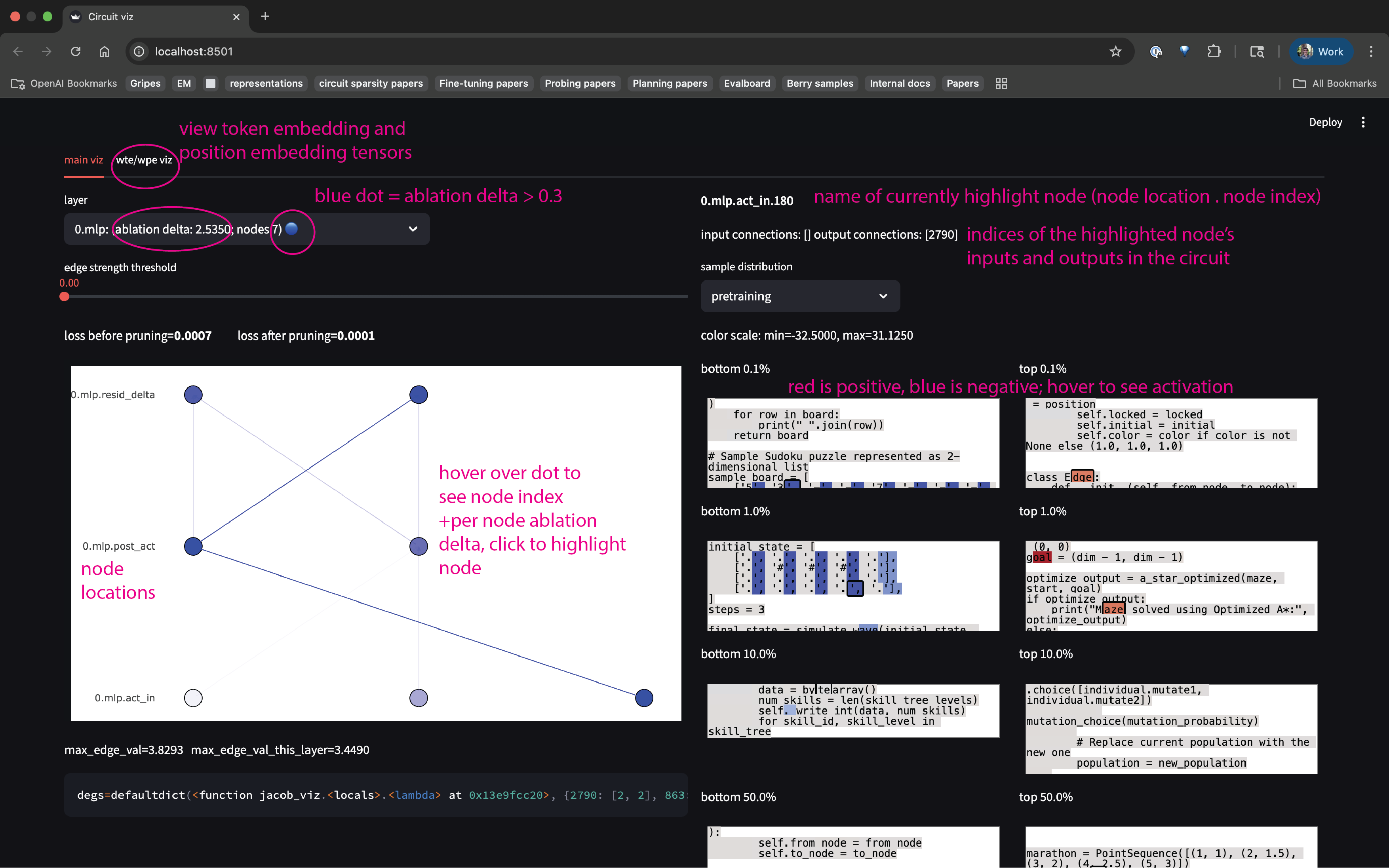
Example view of the Streamlit circuit visualizer (wte/wpe tab) with node ablation deltas and activation previews:
Transformer definitions live in circuit_sparsity.inference.gpt. The module
exports:
GPTConfig / GPT: lightweight GPT implementation suitable for CPU/GPU
inference.load_model(model_dir, cuda=False): convenience loader that expects the
beeg_config.json and final_model.pt pair found in models/....Example usage (adapted from tests/test_gpt.py):
from circuit_sparsity.inference.gpt import GPT, GPTConfig, load_model
from circuit_sparsity.inference.hook_utils import hook_recorder
from circuit_sparsity.registries import MODEL_BASE_DIR

config = GPTConfig(block_size=8, vocab_size=16, n_layer=1, n_head=1, d_model=8)
model = GPT(config)
logits, loss, _ = model(idx, targets=targets)

# to get activations
with hook_recorder() as rec:
    model(idx)

# rec is a dict that looks like {"0.attn.act_in": tensor(...), ...}

pretrained = load_model(f"{MODEL_BASE_DIR}/models/<model_name>", cuda=False)
Run tests with:
pytest tests/test_gpt.py
Project assets live under https://openaipublic.blob.core.windows.net/circuit-sparsity with the following structure:
models/<model_name>/
beeg_config.json: serialized GPTConfig used to rebuild the model.final_model.pt: checkpoint used by circuit_sparsity.inference.gpt.load_model.viz/<experiment>/<model_name>/<task_name>/<sweep>/<k>/
viz_data.pkl: primary payload loaded by viz.py (contains circuit masks,
activations, samples, importances, etc.).train_curves/<model_name>/progress.json: training metrics consumed by
the dashboard’s summary table.csp_yolo1/, csp_yolo2/) hold raw artifacts
produced while preparing pruning runs.The file paths surfaced in viz.py and registries.py assume this layout.
Update registries.py if you relocate the data.
We release all of the models used to obtain the results in the paper. See registries.py for a list of all models. Exact training hyperparameters can be found in [todo]
csp_yolo1: This is the model used in the single_double_quote qualitative results. This is a 118M total param model. This is a somewhat older model that was trained with methods not exactly the same as in the paper; in particular, a method for training with multiple L0 values at the same time.csp_yolo2: This is the model used in the bracket_counting and set_or_string_fixedvarname qualitative results. This is a 475M total param model.csp_sweep1_*: These models are used to obtain the figure 3 results. The name indicates the model size (in terms of ``expansion factor'' relative to an arbitrary baseline size), weight L0, and activation sparsity level (afrac).csp_bridge1: The bridge model used to obtain the results in the paper.csp_bridge2: Another bridge model.dense1_1x: A dense model trained on our dataset.dense1_2x: A dense model trained on our dataset. 2x wider.dense1_4x: A dense model trained on our dataset. 4x wider.prune_v2: 256 CARBS iters, bs=16, very old (unpublished) pruning algorithm. targeting fixed k rather than fixed target lossprune_v3: 256 CARBS iters, bs=64, epochs=32, old (unpublished) algorithm. targeting fixed target lossprune_v4: 768 CARBS iters, bs=64, epochs=48, published algorithm. targeting fixed target lossprune_v5_logitscaling: 256 CARBS iters, bs=32, epochs=32, published algorithm with logit scaling. targeting fixed target lossper_token_viz_demo.py: minimal examples for token-level visualizations.clear_cache.py: deletes locally cached copies of blobstore files (Streamlit/viz caches and the tiktoken cache); run if you need to re-fetch fresh artifacts.The project relies on Streamlit, Plotly, matplotlib, seaborn, and torch (see
pyproject.toml for the full dependency list).
1,841 followers · starred Dec 2025
830 followers · starred Dec 2025
629 followers · starred Nov 2025
758 followers · starred Dec 2025
Tools for inspecting sparse circuit models from Gao et al. 2025. Provides code for running inference as well as a Streamlit dashboard that allows you to interact with task-specific circuits found by pruning. Note: this README was AI-generated and lightly edited.
pip install -e .
Start the Streamlit app from the project root:
streamlit run circuit_sparsity/viz.py
The app loads data from the openaipublic webpage and caches locally. When the
visualizer loads you can choose a model, dataset, pruning sweep, and node budget k
using the controls in the left column. The plots are rendered with Plotly; most
elements are interactive and support hover/click exploration.
Example view of the Streamlit circuit visualizer (wte/wpe tab) with node ablation deltas and activation previews:
Transformer definitions live in circuit_sparsity.inference.gpt. The module
exports:
GPTConfig / GPT: lightweight GPT implementation suitable for CPU/GPU
inference.load_model(model_dir, cuda=False): convenience loader that expects the
beeg_config.json and final_model.pt pair found in models/....Example usage (adapted from tests/test_gpt.py):
from circuit_sparsity.inference.gpt import GPT, GPTConfig, load_model
from circuit_sparsity.inference.hook_utils import hook_recorder
from circuit_sparsity.registries import MODEL_BASE_DIR

config = GPTConfig(block_size=8, vocab_size=16, n_layer=1, n_head=1, d_model=8)
model = GPT(config)
logits, loss, _ = model(idx, targets=targets)

# to get activations
with hook_recorder() as rec:
    model(idx)

# rec is a dict that looks like {"0.attn.act_in": tensor(...), ...}

pretrained = load_model(f"{MODEL_BASE_DIR}/models/<model_name>", cuda=False)
Run tests with:
pytest tests/test_gpt.py
Project assets live under https://openaipublic.blob.core.windows.net/circuit-sparsity with the following structure:
models/<model_name>/
beeg_config.json: serialized GPTConfig used to rebuild the model.final_model.pt: checkpoint used by circuit_sparsity.inference.gpt.load_model.viz/<experiment>/<model_name>/<task_name>/<sweep>/<k>/
viz_data.pkl: primary payload loaded by viz.py (contains circuit masks,
activations, samples, importances, etc.).train_curves/<model_name>/progress.json: training metrics consumed by
the dashboard’s summary table.csp_yolo1/, csp_yolo2/) hold raw artifacts
produced while preparing pruning runs.The file paths surfaced in viz.py and registries.py assume this layout.
Update registries.py if you relocate the data.
We release all of the models used to obtain the results in the paper. See registries.py for a list of all models. Exact training hyperparameters can be found in [todo]
csp_yolo1: This is the model used in the single_double_quote qualitative results. This is a 118M total param model. This is a somewhat older model that was trained with methods not exactly the same as in the paper; in particular, a method for training with multiple L0 values at the same time.csp_yolo2: This is the model used in the bracket_counting and set_or_string_fixedvarname qualitative results. This is a 475M total param model.csp_sweep1_*: These models are used to obtain the figure 3 results. The name indicates the model size (in terms of ``expansion factor'' relative to an arbitrary baseline size), weight L0, and activation sparsity level (afrac).csp_bridge1: The bridge model used to obtain the results in the paper.csp_bridge2: Another bridge model.dense1_1x: A dense model trained on our dataset.dense1_2x: A dense model trained on our dataset. 2x wider.dense1_4x: A dense model trained on our dataset. 4x wider.prune_v2: 256 CARBS iters, bs=16, very old (unpublished) pruning algorithm. targeting fixed k rather than fixed target lossprune_v3: 256 CARBS iters, bs=64, epochs=32, old (unpublished) algorithm. targeting fixed target lossprune_v4: 768 CARBS iters, bs=64, epochs=48, published algorithm. targeting fixed target lossprune_v5_logitscaling: 256 CARBS iters, bs=32, epochs=32, published algorithm with logit scaling. targeting fixed target lossper_token_viz_demo.py: minimal examples for token-level visualizations.clear_cache.py: deletes locally cached copies of blobstore files (Streamlit/viz caches and the tiktoken cache); run if you need to re-fetch fresh artifacts.The project relies on Streamlit, Plotly, matplotlib, seaborn, and torch (see
pyproject.toml for the full dependency list).
1,841 followers · starred Dec 2025
830 followers · starred Dec 2025
629 followers · starred Nov 2025
758 followers · starred Dec 2025