A cli that exposes your local resources to kubernetes
Go
1,057
271 commits
updated Sep 2, 2026





Expose your local resources to kubernetes
| Distribution | Command / Link |
|---|---|
| Pre-built binaries for macOS, Linux, and Windows | GitHub releases |
| Homebrew (macOS and Linux) | brew tap omrikiei/ktunnel && brew install omrikiei/ktunnel/ktunnel |
| Krew | kubectl krew install tunnel |
Clone the project
git clone https://github.com/omrikiei/ktunnel; cd ktunnel
Build the binary
CGO_ENABLED=0 go build -ldflags="-s -w"
You can them move it to your bin path
sudo mv ./ktunnel /usr/local/bin/ktunnel
Test the command
ktunnel -h
Ktunnel is a CLI tool that establishes a reverse tunnel between a kubernetes cluster and your local machine. It lets you expose your machine as a service in the cluster or expose it to a specific deployment. You can also use the client and server without the orchestration part. Although ktunnel is identified with kubernetes, it can also be used as a reverse tunnel on any other remote system
Ktunnel was born out of the need to access my development host when running applications on kubernetes. The aim of this project is to be a holistic solution to this specific problem (accessing the local machine from a kubernetes pod). If you found this tool to be helpful on other scenarios, or have any suggesstions for new features - I would love to get in touch.
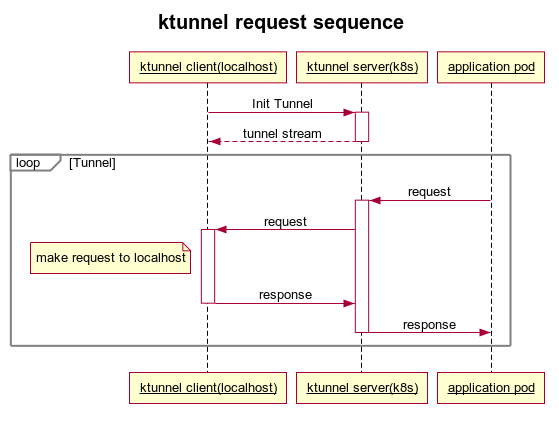
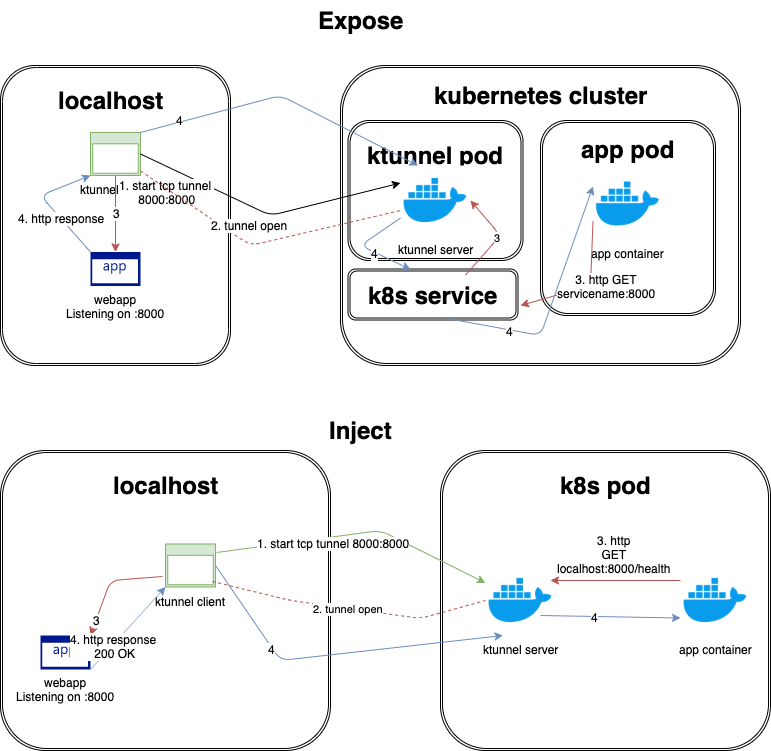
This will allow pods in the cluster to access your local web app (listening on port 8000) via http (i.e kubernetes applications can send requests to myapp:80)
ktunnel expose myapp 80:8000
ktunnel expose myapp 80:8000 -r # use an existing deployment & service as they are, or create them
--reuse adopts. If the Deployment and Service are already there — because you
wrote them yourself for a private registry or a security context your cluster
admits — ktunnel uses them exactly as they stand and does not modify them, and
does not delete them on exit either. If they are not there, it creates them, and
removes what it created when you stop it. --force deletes and recreates
instead.
This opens a listening port inside the deployment's own pods, tunnelled to your
local machine, so the application reaches your laptop at localhost:3306.
ktunnel inject deployment mydeployment 3306
The sidecar's listeners are pod-local: only containers in an injected pod reach
your machine through them. So every replica is injected and every replica is
tunnelled — forwarding to one arbitrary pod of several would leave the rest with
the port closed, and nothing to say which pod was the working one. A deployment
with three replicas takes three local ports, counting up from --port, and
opens three streams to your machine.
Replicas added while the tunnel is up are picked up the next time it is rebuilt, since the set of pods is resolved once per connection attempt.
Same thing for an application that is a StatefulSet rather than a Deployment — a PHP app with xdebug, say, which is where this was asked for:
ktunnel inject statefulset owl-app 9003
Every ordinal is injected and every ordinal is tunnelled, and local ports are
handed out in ordinal order: with --port 28688, owl-app-0 is on 28688,
owl-app-1 on 28689, and it stays that way across reconnects. A StatefulSet's
pods are identities rather than interchangeable replicas, so the port a pod is
reached on has to keep meaning that pod.
A StatefulSet whose updateStrategy is OnDelete does not restart its pods
when its template changes. ktunnel says so before it patches anything, and then
waits for you to delete them.
--print-manifests writes the Deployment and Service ktunnel would create, as
YAML, and exits without contacting the cluster — useful for checking them into
a repo, adapting them for a private registry, or applying them yourself:
ktunnel expose myapp 80:8000 --print-manifests > ktunnel.yaml
ktunnel expose myapp 80:8000 --print-manifests | kubectl apply -f -
The manifests come from the same code the command runs, so they cannot drift
from what ktunnel expose actually creates. Everything else goes to stderr, so
the pipe stays clean.
--namespace if you pass it; otherwise the namespace of your kubeconfig
context (--context selects which context); otherwise default. It is
resolved once, at startup, and printed with its source, so there is no guessing
which namespace the objects went to:
Using namespace team-a (kubeconfig context "dev")
Both commands print their plan before the first write, and say what happens when you stop them:
In namespace team-a, ktunnel will:
  use the existing deployment team-a/myapp as it is (2 replica(s), image nexus.corp.example/ktunnel:v2.1.0); it will be neither modified nor deleted
  create service team-a/myapp (ClusterIP, port(s) 80->8080)
On exit it will remove service myapp, and leave deployment myapp as it was.
inject says the same about the container it adds, how many pods that
restarts, and which local ports the replicas take.
expose, inject and client reconnect on their own when a tunnel drops -- a
dropped VPN, a suspended laptop, a rescheduled pod. Each attempt rebuilds the
whole local side: it re-resolves the tunnel server's pod, rebuilds the
port-forward and reopens the stream, with an exponential backoff from 1s up to
30s that resets once a tunnel has stayed up for a minute.
Open connections do not survive a reconnect. The cluster-side listener is closed and every connection through it is dropped, exactly as any TCP proxy restart does; a fresh listener binds the same port when the tunnel comes back.
Cluster resources are never recreated by a reconnect. If the deployment is deleted mid-session, ktunnel keeps retrying and says why, rather than quietly recreating what you removed.
The default is to retry forever, which is what an interactive session wants. Under a process supervisor, ask for an exit code instead:
# exit non-zero the moment the tunnel drops, and let systemd restart it
ktunnel expose myapp 80:8000 --exit-on-disconnect

# or give up after 10 consecutive failed attempts
ktunnel expose myapp 80:8000 --max-reconnect-attempts 10
ktunnel exits 0 on Ctrl+C and 1 when it gives up.
ktunnel now automatically tracks and cleans up resources (deployments and services) when the process exits. This ensures no orphaned resources are left in your cluster, even after unexpected shutdowns.
-v flag for verbose logging to see cleanup operationsktunnel expose myapp 80:8000 -v
The tunnel is not authenticated. Anything in the cluster that can reach a
tunnelled port reaches whatever is listening behind it on your machine, and
--tls is not available for expose or inject yet. That is the trade for a
tool that installs no operator and needs no cluster-wide permissions, and it
makes ktunnel a development-cluster tool.
docs/security.md has the whole picture: what is reachable from where, what is encrypted, what authenticates what, the Kubernetes permissions ktunnel uses, and how to narrow the exposure in the meantime.
Made with ❤️ in Gedera!
Overall
Maintained
Code review
Go module
Latest release
Releases this year
504 followers · starred Feb 2020
434 followers · starred Aug 2021
312 followers · starred Aug 2020
66 followers · starred Sep 2023
A cli that exposes your local resources to kubernetes
Go
1,057
271 commits
updated Sep 2, 2026
Expose your local resources to kubernetes
| Distribution | Command / Link |
|---|---|
| Pre-built binaries for macOS, Linux, and Windows | GitHub releases |
| Homebrew (macOS and Linux) | brew tap omrikiei/ktunnel && brew install omrikiei/ktunnel/ktunnel |
| Krew | kubectl krew install tunnel |
Clone the project
git clone https://github.com/omrikiei/ktunnel; cd ktunnel
Build the binary
CGO_ENABLED=0 go build -ldflags="-s -w"
You can them move it to your bin path
sudo mv ./ktunnel /usr/local/bin/ktunnel
Test the command
ktunnel -h
Ktunnel is a CLI tool that establishes a reverse tunnel between a kubernetes cluster and your local machine. It lets you expose your machine as a service in the cluster or expose it to a specific deployment. You can also use the client and server without the orchestration part. Although ktunnel is identified with kubernetes, it can also be used as a reverse tunnel on any other remote system
Ktunnel was born out of the need to access my development host when running applications on kubernetes. The aim of this project is to be a holistic solution to this specific problem (accessing the local machine from a kubernetes pod). If you found this tool to be helpful on other scenarios, or have any suggesstions for new features - I would love to get in touch.
This will allow pods in the cluster to access your local web app (listening on port 8000) via http (i.e kubernetes applications can send requests to myapp:80)
ktunnel expose myapp 80:8000
ktunnel expose myapp 80:8000 -r # use an existing deployment & service as they are, or create them
--reuse adopts. If the Deployment and Service are already there — because you
wrote them yourself for a private registry or a security context your cluster
admits — ktunnel uses them exactly as they stand and does not modify them, and
does not delete them on exit either. If they are not there, it creates them, and
removes what it created when you stop it. --force deletes and recreates
instead.
This opens a listening port inside the deployment's own pods, tunnelled to your
local machine, so the application reaches your laptop at localhost:3306.
ktunnel inject deployment mydeployment 3306
The sidecar's listeners are pod-local: only containers in an injected pod reach
your machine through them. So every replica is injected and every replica is
tunnelled — forwarding to one arbitrary pod of several would leave the rest with
the port closed, and nothing to say which pod was the working one. A deployment
with three replicas takes three local ports, counting up from --port, and
opens three streams to your machine.
Replicas added while the tunnel is up are picked up the next time it is rebuilt, since the set of pods is resolved once per connection attempt.
Same thing for an application that is a StatefulSet rather than a Deployment — a PHP app with xdebug, say, which is where this was asked for:
ktunnel inject statefulset owl-app 9003
Every ordinal is injected and every ordinal is tunnelled, and local ports are
handed out in ordinal order: with --port 28688, owl-app-0 is on 28688,
owl-app-1 on 28689, and it stays that way across reconnects. A StatefulSet's
pods are identities rather than interchangeable replicas, so the port a pod is
reached on has to keep meaning that pod.
A StatefulSet whose updateStrategy is OnDelete does not restart its pods
when its template changes. ktunnel says so before it patches anything, and then
waits for you to delete them.
--print-manifests writes the Deployment and Service ktunnel would create, as
YAML, and exits without contacting the cluster — useful for checking them into
a repo, adapting them for a private registry, or applying them yourself:
ktunnel expose myapp 80:8000 --print-manifests > ktunnel.yaml
ktunnel expose myapp 80:8000 --print-manifests | kubectl apply -f -
The manifests come from the same code the command runs, so they cannot drift
from what ktunnel expose actually creates. Everything else goes to stderr, so
the pipe stays clean.
--namespace if you pass it; otherwise the namespace of your kubeconfig
context (--context selects which context); otherwise default. It is
resolved once, at startup, and printed with its source, so there is no guessing
which namespace the objects went to:
Using namespace team-a (kubeconfig context "dev")
Both commands print their plan before the first write, and say what happens when you stop them:
In namespace team-a, ktunnel will:
  use the existing deployment team-a/myapp as it is (2 replica(s), image nexus.corp.example/ktunnel:v2.1.0); it will be neither modified nor deleted
  create service team-a/myapp (ClusterIP, port(s) 80->8080)
On exit it will remove service myapp, and leave deployment myapp as it was.
inject says the same about the container it adds, how many pods that
restarts, and which local ports the replicas take.
expose, inject and client reconnect on their own when a tunnel drops -- a
dropped VPN, a suspended laptop, a rescheduled pod. Each attempt rebuilds the
whole local side: it re-resolves the tunnel server's pod, rebuilds the
port-forward and reopens the stream, with an exponential backoff from 1s up to
30s that resets once a tunnel has stayed up for a minute.
Open connections do not survive a reconnect. The cluster-side listener is closed and every connection through it is dropped, exactly as any TCP proxy restart does; a fresh listener binds the same port when the tunnel comes back.
Cluster resources are never recreated by a reconnect. If the deployment is deleted mid-session, ktunnel keeps retrying and says why, rather than quietly recreating what you removed.
The default is to retry forever, which is what an interactive session wants. Under a process supervisor, ask for an exit code instead:
# exit non-zero the moment the tunnel drops, and let systemd restart it
ktunnel expose myapp 80:8000 --exit-on-disconnect

# or give up after 10 consecutive failed attempts
ktunnel expose myapp 80:8000 --max-reconnect-attempts 10
ktunnel exits 0 on Ctrl+C and 1 when it gives up.
ktunnel now automatically tracks and cleans up resources (deployments and services) when the process exits. This ensures no orphaned resources are left in your cluster, even after unexpected shutdowns.
-v flag for verbose logging to see cleanup operationsktunnel expose myapp 80:8000 -v
The tunnel is not authenticated. Anything in the cluster that can reach a
tunnelled port reaches whatever is listening behind it on your machine, and
--tls is not available for expose or inject yet. That is the trade for a
tool that installs no operator and needs no cluster-wide permissions, and it
makes ktunnel a development-cluster tool.
docs/security.md has the whole picture: what is reachable from where, what is encrypted, what authenticates what, the Kubernetes permissions ktunnel uses, and how to narrow the exposure in the meantime.
Made with ❤️ in Gedera!
Overall
Maintained
Code review
Go module
Latest release
Releases this year
504 followers · starred Feb 2020
434 followers · starred Aug 2021
312 followers · starred Aug 2020
66 followers · starred Sep 2023