
Open Job Context Protocol -- an open standard for agent-consumable job feeds built on MCP
55
stars
24
commits
Bikeshed
primary language
Sep 3, 2026
updated
README
OJCP — Open Job Context Protocol
An open standard for agent-consumable job data, built on MCP.




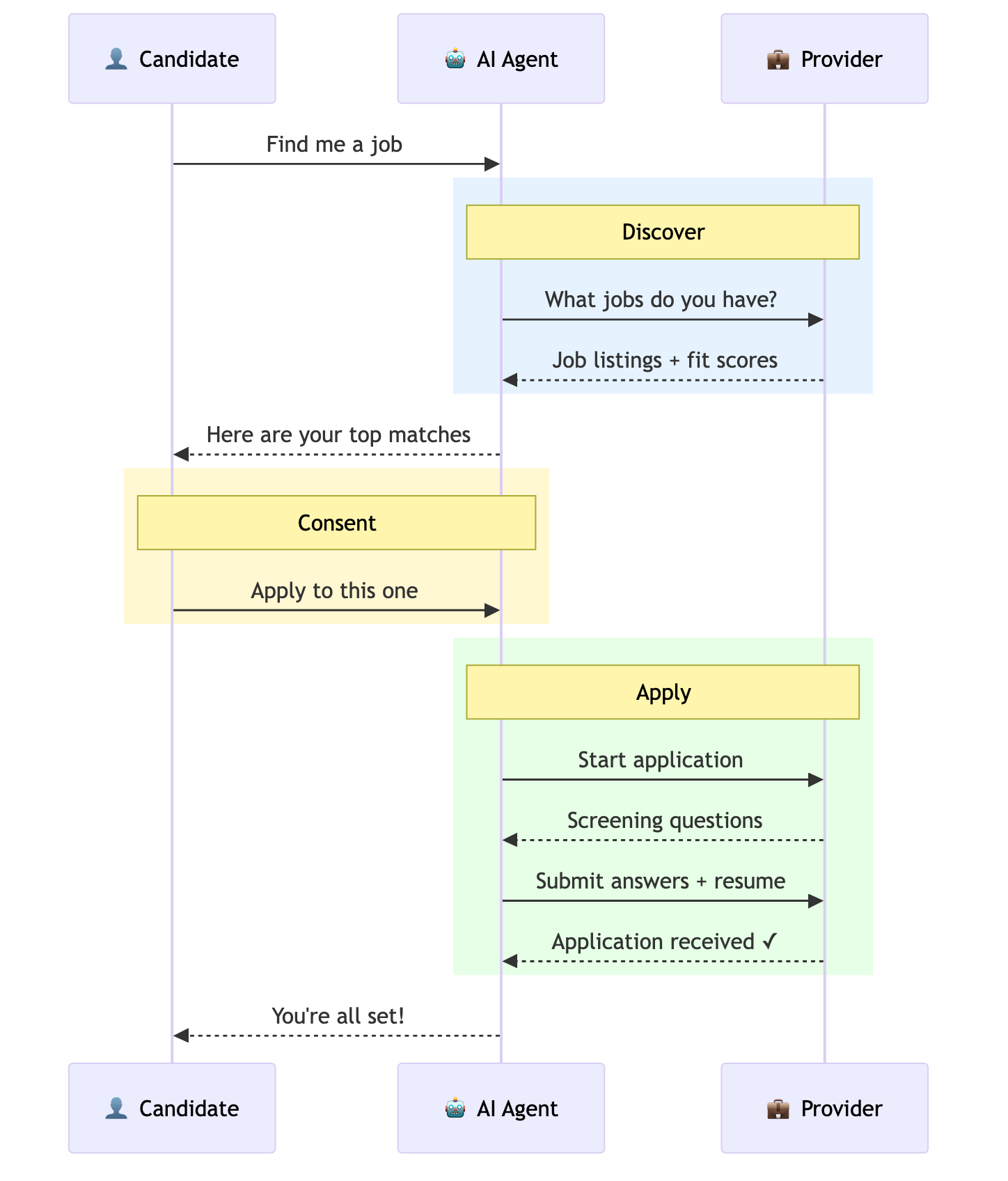
AI agents are beginning to search for jobs, evaluate opportunities, and submit applications on behalf of candidates. The infrastructure they're trying to use — job feeds, careers pages, ATS apply flows — was never designed for them.
OJCP defines how job opportunities, employer context, and application affordances are expressed so that AI agents can discover, reason over, and act on them. It composes with the Model Context Protocol (MCP), WebMCP, and schema.org/JobPosting.
- 📖 Spec: spec.ojcp.dev
- 🌐 Site: ojcp.dev
- ✅ Conformance suite: ojcp-org/conformance
- 🗂️ Provider registry: ojcp-org/registry
Governed by a founding steering committee
OJCP is a community standard, not a single-vendor project. It is governed by a nine-seat founding steering committee whose members share equal authority over the protocol's direction. Seats are held by people across the ecosystem — ATS vendors, job boards, auto-apply tools, agent platforms, and staffing — so that no single party can steer the spec to its own advantage.








Workday · CrossCountry Healthcare · Recruitics · LoopCV · Hiring.cafe · aiApply · scale.jobs · Tink, with an invited-expert seat held by Andrew Nolan (WebMCP co-creator).
See GOVERNANCE.md for the seat table, term rules, and the RFC decision process, and ADOPTERS.md for organizations building on OJCP.
The OJCP project
| Repo | What it is |
|---|---|
| ojcp (this repo) | The specification, JSON Schemas, examples, diagrams, and governance |
| conformance | Test suite that validates a provider implementation against the published schemas |
| registry | The provider registry — one reviewed JSON entry per provider, added by PR |
What's in this repo
/spec
  ojcp-v0.1.bs              # Bikeshed spec source (compiles to spec.ojcp.dev)
/schemas
  README.md                 # $id convention + how to validate offline
  manifest.json             # ojcp.json manifest schema
  job-posting.json          # JobPosting JSON schema
  candidate-context.json    # CandidateContext JSON schema
  agent-declaration.json    # AgentDeclaration JSON schema
  eeo-data.json             # EEO data schema (EEOC/OFCCP/GDPR)
  verification-step.json    # VerificationStep schema
  verification-proof.json   # VerificationProof schema
  verifier-manifest.json    # Verifier discovery manifest schema
  tools/                    # Tool input schemas
  responses/                # Tool response schemas
/examples                   # Worked manifests, job postings, tool responses,
                            #   and a signed agent request (agent-signed-request.http)
/diagrams                   # Mermaid diagram sources (*.mmd)
/content
  images/                   # Rendered diagram PNGs
  logos/members/            # Steering-member logos
/docs
  proposal.md               # Original proposal
  rfcs/                     # Change proposals (RFC 0001 agent identity, …)
  decisions/                # Architecture Decision Records (ADRs)
GOVERNANCE.md               # Governance charter, steering committee, IP policy
CONTRIBUTING.md             # How to contribute, RFC process, DCO, licensing
CODE_OF_CONDUCT.md          # Contributor Covenant
ADOPTERS.md                 # Organizations using or evaluating OJCP
CHANGELOG.md                # Notable spec + governance changes
Quick Start
For job boards and employer career sites
Add a manifest at /.well-known/ojcp.json:
{
  "ojcp_version": "0.1",
  "provider": {
    "name": "Acme Corp Careers",
    "employer_id": "acme-corp"
  },
  "mcp_endpoint": "https://careers.acme.com/ojcp/mcp",
  "tools": ["search_jobs", "get_job_detail", "get_employer_context", "begin_application", "submit_application", "check_application_status"]
}
Then expose the standard OJCP tools via any MCP-compatible transport, and check your implementation against the conformance suite. See the full spec for tool and data schemas.
For browser-native agents (WebMCP)
OJCP supports WebMCP via two complementary APIs.
Imperative API — register OJCP tools directly on your careers page:
if ("modelContext" in document) {
  document.modelContext.registerTool({
    name: "search_jobs",
    description: "Search open roles at Acme Corp.",
    inputSchema: {
      type: "object",
      properties: {
        query: { type: "string", description: "Search query" },
        location: { type: "string", description: "Location filter" }
      },
      required: ["query"]
    },
    execute: async (params) => {
      const results = await fetchJobs(params);
      return { content: [{ type: "text", text: JSON.stringify(results) }] };
    }
  });
}
Declarative API — annotate apply forms so agents can submit applications natively:
<form toolname="begin_application"
      tooldescription="Apply to this role at Acme Corp."
      action="/apply" method="POST">
  <input name="full_name" toolparamdescription="Candidate full name" />
  <input name="email" type="email" toolparamdescription="Contact email" />
  <textarea name="cover_letter" toolparamdescription="Cover letter" />
  <button type="submit">Apply</button>
</form>
See the WebMCP integration section of the spec for the full guide.
For agent developers
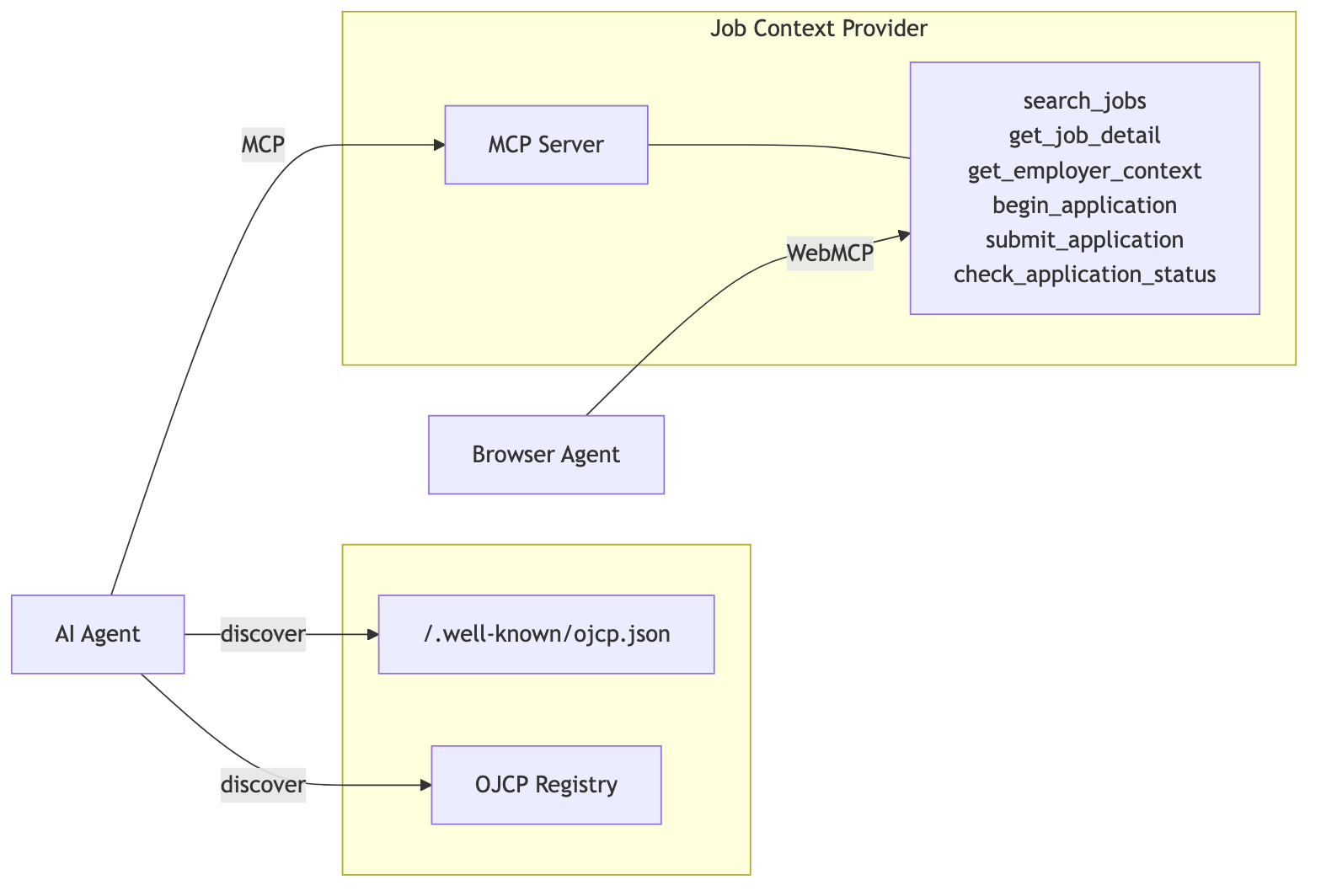
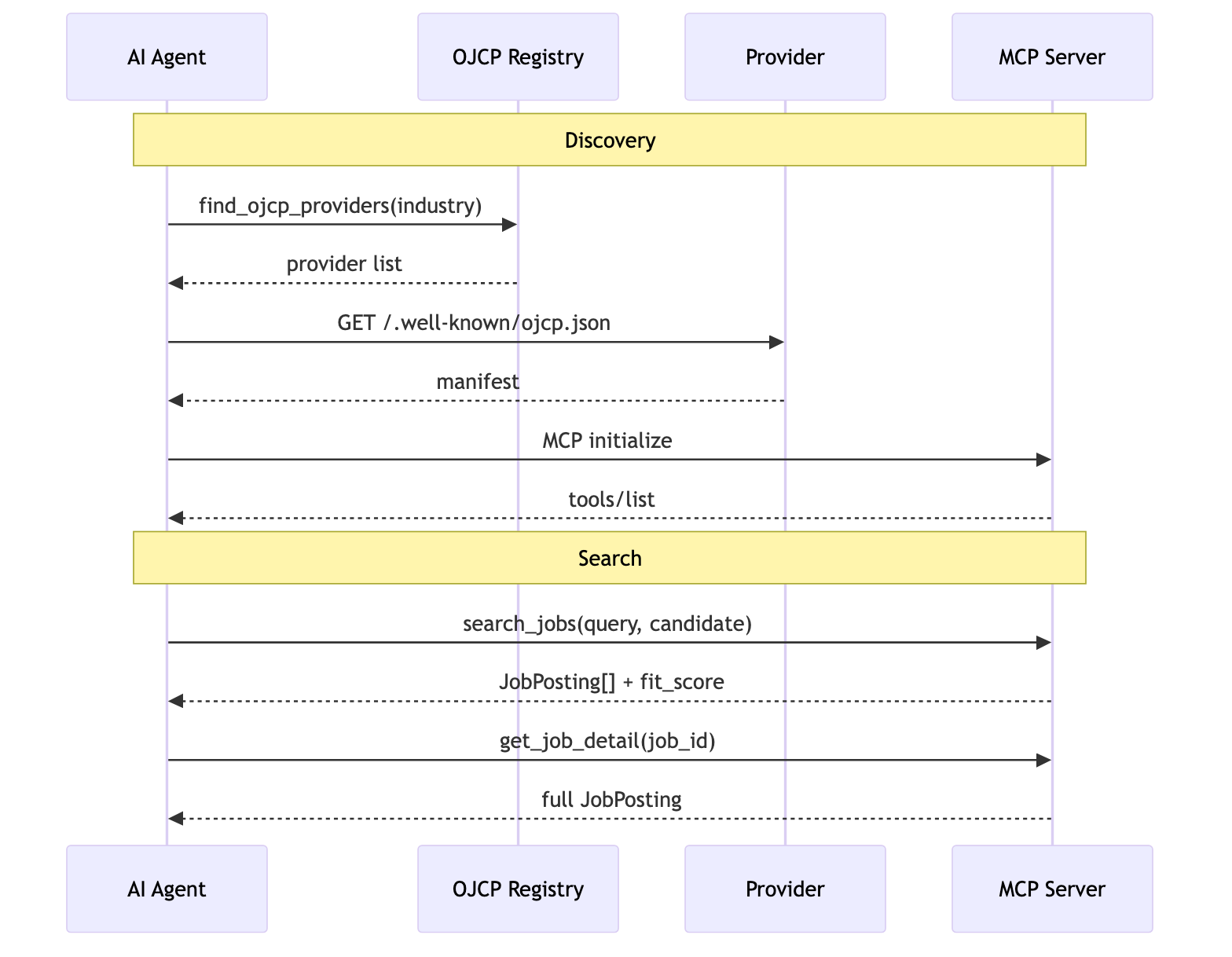
Discover providers from the registry — a Git-backed directory with one reviewed JSON entry per provider. Each entry points at a provider's /.well-known/ojcp.json; from there, probe the manifest and call the standard OJCP tools over MCP. To be listed, open a PR adding your entry (domain control is proven per the registry README).
Core Concepts
Job Manifest — Every OJCP provider exposes /.well-known/ojcp.json declaring its tools, endpoints, apply paths, and (optionally) which requests require a verified agent identity. Agents and browsers probe this to discover capabilities without navigating the full site.
Job Tools — MCP-compatible callable functions: search_jobs, get_job_detail, get_employer_context, begin_application, submit_application, check_application_status. Any MCP client can call them directly.
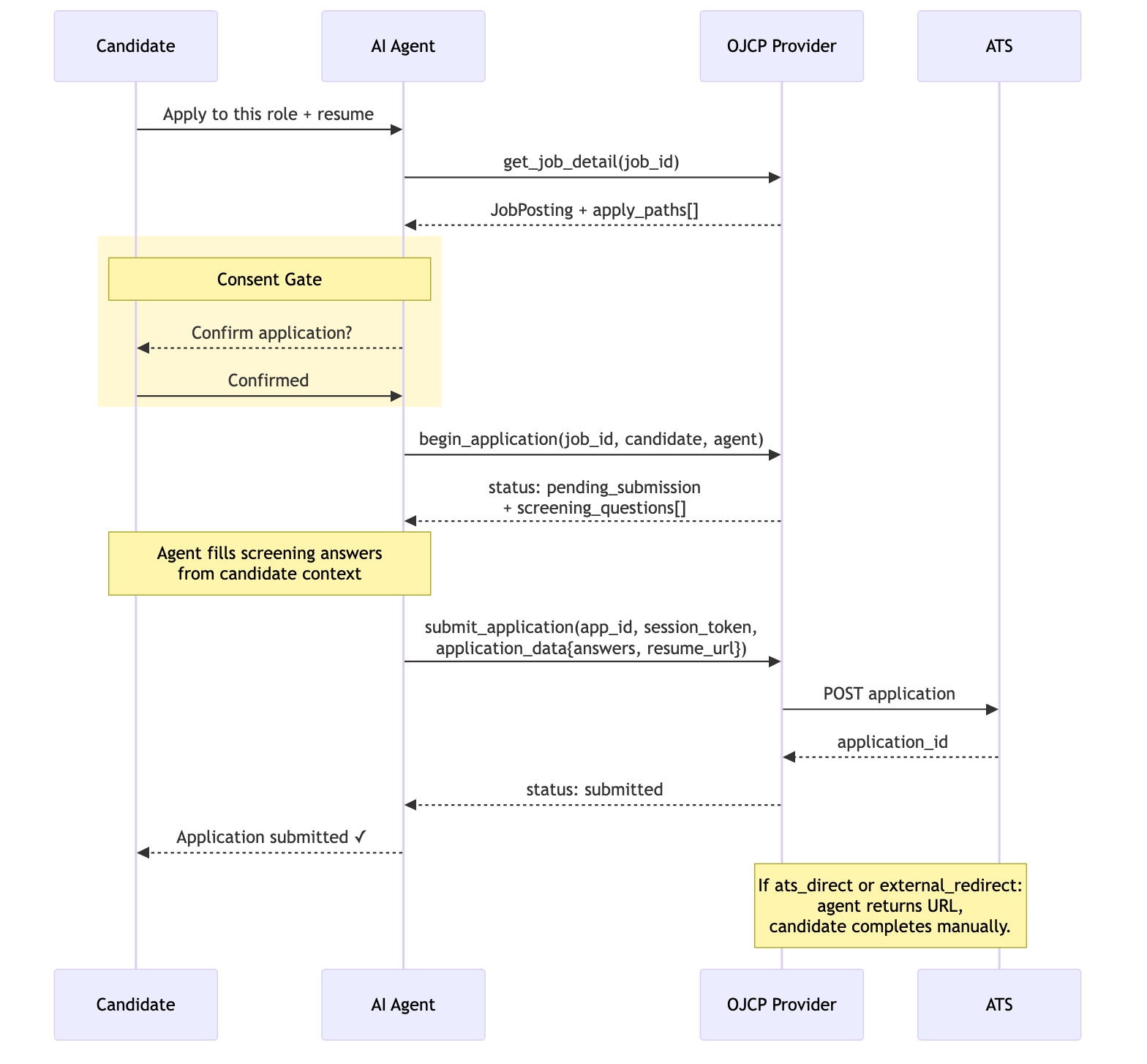
Apply Paths — A normalized taxonomy of how candidates can apply (ats_direct, provider_hosted, platform_native, email, external_redirect, custom), each declaring whether it supports_agent_submission.

Candidate Context — A minimal, consent-scoped candidate profile passed by agents for personalized search and fit scoring. PII-minimized by design.
Agent Identity (RFC 0001, accepted) — Agents can prove who they are with verifiable request signatures, so providers can distinguish a real, accountable agent from an anonymous scraper without gatekeeping through a central authority. OJCP uses RFC 9421 HTTP Message Signatures on the Web Bot Auth wire profile: the agent publishes its keys at a signatures directory, signs each request (Ed25519 recommended) and names its key via the Signature-Agent header. Providers declare support and which contexts require it under auth.agent_signatures in their manifest. A verified identity is a hint about the agent, not proof a human authorized the action — for that, an agent_declaration can carry an optional user-rooted user_mandate. See the Agent Identity section of the spec and RFC 0001.
Agent Declaration — Agents identify themselves and who they act for on every application initiation. Enables employer audit trails, rate limiting, and abuse prevention.
Identity Verification — For roles that require verified human identity (finance, government, healthcare), OJCP integrates with third-party verifiers like ID.me and Clear. Two delivery models are supported: provider-managed (verification embedded in the apply form, proof delivered directly to the provider via callback) and agent-submitted (agent collects the proof and includes it in submit_application). In both cases a cryptographic proof is validated — no raw PII flows through the protocol.
How it works
An agent discovers a provider, searches for jobs, and initiates an application — all through standard MCP tool calls:
When the agent applies on behalf of a candidate, OJCP enforces a consent gate before submission:
Interoperability
| Standard | Relationship |
|---|---|
| MCP | OJCP tools are valid MCP tools — callable by any MCP client |
| WebMCP | Imperative API (document.modelContext.registerTool()) and declarative form annotations |
| RFC 9421 / Web Bot Auth | HTTP Message Signatures provide verifiable agent identity (see Agent Identity) |
| schema.org/JobPosting | OJCP extends it; existing structured data stays valid |
| Indeed / Zip XML Feeds | OJCP layers over existing feeds via adapter; no replacement required |
Project status
Draft v0.1 — a living draft. Accepted RFCs land in 0.1; a versioned release will be cut once a batch of changes is ready to migrate to together. Track changes in CHANGELOG.md.
Shipped:
- ✅ v0.1 draft specification and JSON Schemas, published at spec.ojcp.dev
- ✅ Reference provider live at ojcp.dev
- ✅ Nine-seat founding steering committee seated (GOVERNANCE.md)
- ✅ RFC 0001 — verifiable agent identity via RFC 9421 — accepted and specified
- ✅ Conformance suite (ojcp-org/conformance) and provider registry (ojcp-org/registry)
- ✅ First independent provider (FoundRole) live and listed in ADOPTERS.md
In progress:
- 🚧 RFC 0002 (
official_job_url) and RFC 0003 (action-bound user mandates) in the RFC pipeline - 🔜 Growing the registry and adopter set; a consent/authorization RFC to finalize the
user_mandateclaim set
Contributing
OJCP is built in the open, and external contributions are already shaping it — the RFCs and providers above came from the community. We especially welcome:
- Job boards, aggregators & ATS vendors who want their inventory reachable by candidate agents
- Agent & browser platform developers building the candidate-side experience
- Employers with high-volume hiring who want their apply flows agent-ready
Start with CONTRIBUTING.md for the RFC process, DCO sign-off, and licensing. Propose changes as an RFC, validate implementations with the conformance suite, and add yourself to ADOPTERS.md.
Discuss: GitHub Discussions · ojcp-discuss@recruitics.com
License
Dual-licensed by content type (see CONTRIBUTING.md):
- Specification, schemas, examples, docs — CC BY 4.0
- Code, tooling, CI — Apache License 2.0
OJCP was authored by Austin Anderson (CTO, Recruitics) and is now governed by its steering committee.
Contributors


See what people are saying
Similar repos


Languages
Bikeshed
94.8%
Mermaid
4.7%
Open Job Context Protocol -- an open standard for agent-consumable job feeds built on MCP
55
stars
24
commits
Bikeshed
primary language
Sep 3, 2026
updated
README
OJCP — Open Job Context Protocol
An open standard for agent-consumable job data, built on MCP.
AI agents are beginning to search for jobs, evaluate opportunities, and submit applications on behalf of candidates. The infrastructure they're trying to use — job feeds, careers pages, ATS apply flows — was never designed for them.
OJCP defines how job opportunities, employer context, and application affordances are expressed so that AI agents can discover, reason over, and act on them. It composes with the Model Context Protocol (MCP), WebMCP, and schema.org/JobPosting.
- 📖 Spec: spec.ojcp.dev
- 🌐 Site: ojcp.dev
- ✅ Conformance suite: ojcp-org/conformance
- 🗂️ Provider registry: ojcp-org/registry
Governed by a founding steering committee
OJCP is a community standard, not a single-vendor project. It is governed by a nine-seat founding steering committee whose members share equal authority over the protocol's direction. Seats are held by people across the ecosystem — ATS vendors, job boards, auto-apply tools, agent platforms, and staffing — so that no single party can steer the spec to its own advantage.
Workday · CrossCountry Healthcare · Recruitics · LoopCV · Hiring.cafe · aiApply · scale.jobs · Tink, with an invited-expert seat held by Andrew Nolan (WebMCP co-creator).
See GOVERNANCE.md for the seat table, term rules, and the RFC decision process, and ADOPTERS.md for organizations building on OJCP.
The OJCP project
| Repo | What it is |
|---|---|
| ojcp (this repo) | The specification, JSON Schemas, examples, diagrams, and governance |
| conformance | Test suite that validates a provider implementation against the published schemas |
| registry | The provider registry — one reviewed JSON entry per provider, added by PR |
What's in this repo
/spec
  ojcp-v0.1.bs              # Bikeshed spec source (compiles to spec.ojcp.dev)
/schemas
  README.md                 # $id convention + how to validate offline
  manifest.json             # ojcp.json manifest schema
  job-posting.json          # JobPosting JSON schema
  candidate-context.json    # CandidateContext JSON schema
  agent-declaration.json    # AgentDeclaration JSON schema
  eeo-data.json             # EEO data schema (EEOC/OFCCP/GDPR)
  verification-step.json    # VerificationStep schema
  verification-proof.json   # VerificationProof schema
  verifier-manifest.json    # Verifier discovery manifest schema
  tools/                    # Tool input schemas
  responses/                # Tool response schemas
/examples                   # Worked manifests, job postings, tool responses,
                            #   and a signed agent request (agent-signed-request.http)
/diagrams                   # Mermaid diagram sources (*.mmd)
/content
  images/                   # Rendered diagram PNGs
  logos/members/            # Steering-member logos
/docs
  proposal.md               # Original proposal
  rfcs/                     # Change proposals (RFC 0001 agent identity, …)
  decisions/                # Architecture Decision Records (ADRs)
GOVERNANCE.md               # Governance charter, steering committee, IP policy
CONTRIBUTING.md             # How to contribute, RFC process, DCO, licensing
CODE_OF_CONDUCT.md          # Contributor Covenant
ADOPTERS.md                 # Organizations using or evaluating OJCP
CHANGELOG.md                # Notable spec + governance changes
Quick Start
For job boards and employer career sites
Add a manifest at /.well-known/ojcp.json:
{
  "ojcp_version": "0.1",
  "provider": {
    "name": "Acme Corp Careers",
    "employer_id": "acme-corp"
  },
  "mcp_endpoint": "https://careers.acme.com/ojcp/mcp",
  "tools": ["search_jobs", "get_job_detail", "get_employer_context", "begin_application", "submit_application", "check_application_status"]
}
Then expose the standard OJCP tools via any MCP-compatible transport, and check your implementation against the conformance suite. See the full spec for tool and data schemas.
For browser-native agents (WebMCP)
OJCP supports WebMCP via two complementary APIs.
Imperative API — register OJCP tools directly on your careers page:
if ("modelContext" in document) {
  document.modelContext.registerTool({
    name: "search_jobs",
    description: "Search open roles at Acme Corp.",
    inputSchema: {
      type: "object",
      properties: {
        query: { type: "string", description: "Search query" },
        location: { type: "string", description: "Location filter" }
      },
      required: ["query"]
    },
    execute: async (params) => {
      const results = await fetchJobs(params);
      return { content: [{ type: "text", text: JSON.stringify(results) }] };
    }
  });
}
Declarative API — annotate apply forms so agents can submit applications natively:
<form toolname="begin_application"
      tooldescription="Apply to this role at Acme Corp."
      action="/apply" method="POST">
  <input name="full_name" toolparamdescription="Candidate full name" />
  <input name="email" type="email" toolparamdescription="Contact email" />
  <textarea name="cover_letter" toolparamdescription="Cover letter" />
  <button type="submit">Apply</button>
</form>
See the WebMCP integration section of the spec for the full guide.
For agent developers
Discover providers from the registry — a Git-backed directory with one reviewed JSON entry per provider. Each entry points at a provider's /.well-known/ojcp.json; from there, probe the manifest and call the standard OJCP tools over MCP. To be listed, open a PR adding your entry (domain control is proven per the registry README).
Core Concepts
Job Manifest — Every OJCP provider exposes /.well-known/ojcp.json declaring its tools, endpoints, apply paths, and (optionally) which requests require a verified agent identity. Agents and browsers probe this to discover capabilities without navigating the full site.
Job Tools — MCP-compatible callable functions: search_jobs, get_job_detail, get_employer_context, begin_application, submit_application, check_application_status. Any MCP client can call them directly.
Apply Paths — A normalized taxonomy of how candidates can apply (ats_direct, provider_hosted, platform_native, email, external_redirect, custom), each declaring whether it supports_agent_submission.
Candidate Context — A minimal, consent-scoped candidate profile passed by agents for personalized search and fit scoring. PII-minimized by design.
Agent Identity (RFC 0001, accepted) — Agents can prove who they are with verifiable request signatures, so providers can distinguish a real, accountable agent from an anonymous scraper without gatekeeping through a central authority. OJCP uses RFC 9421 HTTP Message Signatures on the Web Bot Auth wire profile: the agent publishes its keys at a signatures directory, signs each request (Ed25519 recommended) and names its key via the Signature-Agent header. Providers declare support and which contexts require it under auth.agent_signatures in their manifest. A verified identity is a hint about the agent, not proof a human authorized the action — for that, an agent_declaration can carry an optional user-rooted user_mandate. See the Agent Identity section of the spec and RFC 0001.
Agent Declaration — Agents identify themselves and who they act for on every application initiation. Enables employer audit trails, rate limiting, and abuse prevention.
Identity Verification — For roles that require verified human identity (finance, government, healthcare), OJCP integrates with third-party verifiers like ID.me and Clear. Two delivery models are supported: provider-managed (verification embedded in the apply form, proof delivered directly to the provider via callback) and agent-submitted (agent collects the proof and includes it in submit_application). In both cases a cryptographic proof is validated — no raw PII flows through the protocol.
How it works
An agent discovers a provider, searches for jobs, and initiates an application — all through standard MCP tool calls:
When the agent applies on behalf of a candidate, OJCP enforces a consent gate before submission:
Interoperability
| Standard | Relationship |
|---|---|
| MCP | OJCP tools are valid MCP tools — callable by any MCP client |
| WebMCP | Imperative API (document.modelContext.registerTool()) and declarative form annotations |
| RFC 9421 / Web Bot Auth | HTTP Message Signatures provide verifiable agent identity (see Agent Identity) |
| schema.org/JobPosting | OJCP extends it; existing structured data stays valid |
| Indeed / Zip XML Feeds | OJCP layers over existing feeds via adapter; no replacement required |
Project status
Draft v0.1 — a living draft. Accepted RFCs land in 0.1; a versioned release will be cut once a batch of changes is ready to migrate to together. Track changes in CHANGELOG.md.
Shipped:
- ✅ v0.1 draft specification and JSON Schemas, published at spec.ojcp.dev
- ✅ Reference provider live at ojcp.dev
- ✅ Nine-seat founding steering committee seated (GOVERNANCE.md)
- ✅ RFC 0001 — verifiable agent identity via RFC 9421 — accepted and specified
- ✅ Conformance suite (ojcp-org/conformance) and provider registry (ojcp-org/registry)
- ✅ First independent provider (FoundRole) live and listed in ADOPTERS.md
In progress:
- 🚧 RFC 0002 (
official_job_url) and RFC 0003 (action-bound user mandates) in the RFC pipeline - 🔜 Growing the registry and adopter set; a consent/authorization RFC to finalize the
user_mandateclaim set
Contributing
OJCP is built in the open, and external contributions are already shaping it — the RFCs and providers above came from the community. We especially welcome:
- Job boards, aggregators & ATS vendors who want their inventory reachable by candidate agents
- Agent & browser platform developers building the candidate-side experience
- Employers with high-volume hiring who want their apply flows agent-ready
Start with CONTRIBUTING.md for the RFC process, DCO sign-off, and licensing. Propose changes as an RFC, validate implementations with the conformance suite, and add yourself to ADOPTERS.md.
Discuss: GitHub Discussions · ojcp-discuss@recruitics.com
License
Dual-licensed by content type (see CONTRIBUTING.md):
- Specification, schemas, examples, docs — CC BY 4.0
- Code, tooling, CI — Apache License 2.0
OJCP was authored by Austin Anderson (CTO, Recruitics) and is now governed by its steering committee.
See what people are saying
Similar repos
Contributors
Languages
Bikeshed
94.8%
Mermaid
4.7%