
Complete AI Governance Platform from Obot AI
1,004
stars
3,244
commits
Go
primary language
Sep 12, 2026
updated
README
Obot
Obot is an open-source platform for organizations to manage, secure, and govern their AI ecosystems. It provides shared infrastructure for connecting AI clients to models and tools, distributing approved MCP servers and skills, managing agent access and credentials, running hosted AI workloads, and recording activity across hosted services and user devices.
Obot does not require an organization to standardize on a single AI client, model provider, or tool ecosystem. Desktop agents and tools such as Claude Code, Codex, Cursor, VS Code, and other IDEs and CLIs can use the parts of the platform that apply to them.
Architecture
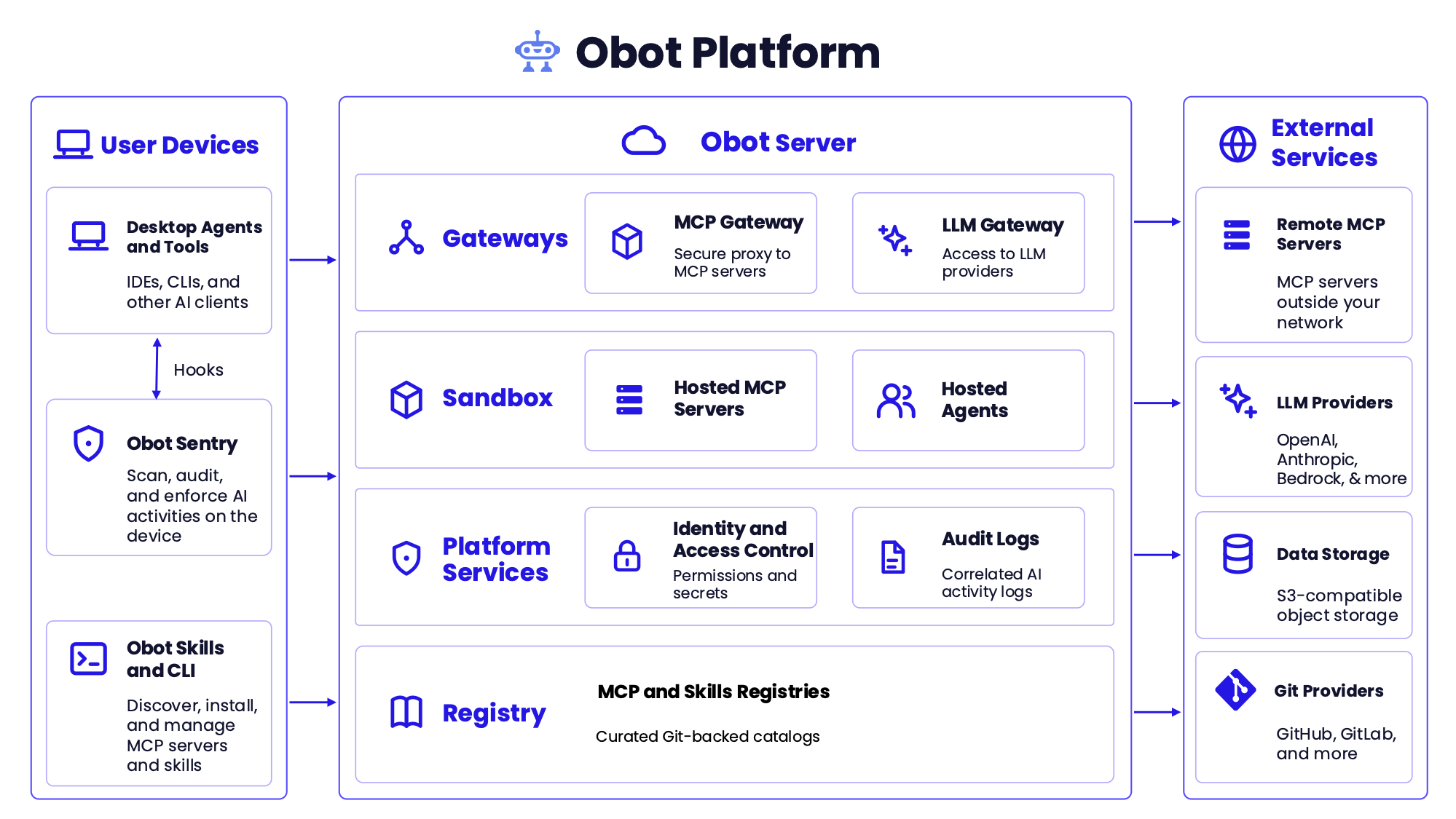
The Obot Platform connects AI activity on user devices with services managed by or proxied through Obot Server.
On user devices, desktop agents and tools connect to Obot gateways, while Obot Sentry scans, audits, and enforces policy on AI activity taking place on the device. The Obot CLI lets users and AI clients discover, install, and manage approved MCP servers and skills.
Obot Server provides:
- MCP and LLM gateways for controlled access to MCP servers and model providers.
- Sandboxed execution for hosted MCP servers and agents.
- Platform services for identity and access control, including permissions and secrets.
- Correlated audit logs of AI activity across the platform.
- MCP and Skills registries built on curated Git-backed catalogs.
Obot integrates with remote MCP servers, LLM providers, S3-compatible object storage, Git providers, and auth providers.
Core Capabilities
MCP Gateway
The MCP Gateway is a single governed entry point to every MCP server a user is allowed to reach.
- Proxy MCP servers, whether hosted by Obot or running outside it.
- Create composite MCP servers that expose selected tools from multiple servers.
- Control server and tool access by user or identity-provider group.
- Manage MCP OAuth, user and shared credentials, and Kubernetes secret bindings.
- Inspect, reject, or modify MCP requests and responses with MCP or webhook filters.
LLM Gateway
The LLM Gateway presents provider-compatible endpoints that AI clients use to reach approved models.
- Connect external AI clients to OpenAI, Anthropic, Amazon Bedrock, Azure, and Generic Responses Compatible providers.
- Keep provider credentials in Obot instead of distributing them to individual users or clients.
- Authenticate clients with scoped Obot API keys.
- Restrict the models visible and callable by each user through Model Access Policies.
- Record requests and responses, client and session metadata, token usage, and estimated model cost.
Sandboxed MCP Servers and Agents
Obot can run agents and MCP servers itself, in isolated execution environments outside the main Obot Server process.
- Host
npx,uvx, and containerized MCP servers as Docker containers or Kubernetes workloads. - Run hosted agents in the same isolated environments.
- Apply domain-based egress rules to hosted MCP servers through a configured network-policy provider.
MCP and Skills Registries
The MCP and Skills Registries centralize the discovery, installation, and management of MCP servers and Agent Skills.
- Curate MCP and Skills catalogs in Obot or index them from Git-backed repositories.
- Expose MCP catalogs through the standard MCP Registry API.
- Publish approved MCP servers and skills to users and AI clients.
- Control access to individual entries, repositories, or complete catalogs with MCP and skill access policies.
- Reuse centrally managed Git credentials across MCP and Skills catalog sources.
- Integrate with GitHub, GitLab, and other Git providers.
Obot CLI and Skill
The Obot CLI brings approved MCP servers and skills to users and their local AI clients, and the Obot skill teaches an agent to use the CLI itself.
- Search for and install approved skills.
- Search for approved MCP servers.
- Run and manage skills from the command line.
- Install the Obot skill so an agent can work with Obot on its own.
Obot Sentry
Obot Sentry extends Obot governance to AI activity occurring directly on user devices. Device Management is currently beta.
- Enroll devices with the Obot Platform.
- Inventory installed AI clients, MCP servers, skills, and plugins.
- Install hooks for Claude Code, Codex, Cursor, and VS Code.
- Record local tool calls alongside activity passing through Obot gateways.
- Support monitoring and enforcement policies for AI activity on managed devices.
- Install manually or deploy through MDMs such as Microsoft Intune.
Identity and Access Control
Obot governs who can reach each part of the platform, and with which credentials.
- Authenticate users through configured identity providers.
- Assign platform roles and permissions.
- Control access to MCP servers, MCP tools, skills, models, and administrative APIs.
- Apply policies based on individual users or identity-provider groups.
- Issue scoped credentials for AI clients and agent workloads.
- Restrict sensitive audit content to users with the appropriate role.
Audit Logs and Visibility
Obot correlates activity across MCP servers, LLM providers, hosted workloads, and user devices.
- Record MCP requests and responses.
- Record LLM Gateway requests, responses, token usage, and model cost.
- Record local AI-client tool calls captured by Obot Sentry.
- Filter activity by user, server, tool, provider, model, client, device, or session.
- Track MCP and LLM usage across users and resources.
- Export audit data once or on a schedule.
Getting Started
For local development or evaluation, run Obot with Docker:
docker run -d \
  --name obot \
  -p 8080:8080 \
  -v obot-data:/data \
  -v /var/run/docker.sock:/var/run/docker.sock \
  -e OBOT_SERVER_ENABLE_AUTHENTICATION=true \
  -e OBOT_BOOTSTRAP_TOKEN=<token> \
  ghcr.io/obot-platform/obot:latest
The bootstrap token must be at least six characters. If you omit OBOT_BOOTSTRAP_TOKEN, Obot generates one and prints it in the container logs.
Open http://localhost:8080, sign in with the bootstrap token, and configure an authentication provider. A model provider is required only when using the LLM Gateway.
This Docker configuration mounts the host Docker socket so Obot can launch hosted MCP servers as sibling containers. Use it only for development, evaluation, or trusted single-tenant environments. Use the Kubernetes deployment for production or multi-tenant installations.
See the Installation Guide for Kubernetes, external PostgreSQL, encryption, authentication, and production configuration.
Design and architecture
Significant changes begin as Obot Design Proposals so the architecture can be discussed before implementation. Architectural decisions that ship are recorded as concise Architecture Decision Records in this repository.
An ODP captures the proposed design and the discussion that shaped it. An ADR records the durable decision reflected in the implementation.
Documentation and Community
- Documentation: https://docs.obot.ai
- Discord: https://discord.com/invite/9sSf4UyAMC
License
Obot is licensed under the MIT License.
Contributors


Similar repos


Languages
Go
60.5%
Svelte
27.0%
TypeScript
11.8%
Complete AI Governance Platform from Obot AI
1,004
stars
3,244
commits
Go
primary language
Sep 12, 2026
updated
README
Obot
Obot is an open-source platform for organizations to manage, secure, and govern their AI ecosystems. It provides shared infrastructure for connecting AI clients to models and tools, distributing approved MCP servers and skills, managing agent access and credentials, running hosted AI workloads, and recording activity across hosted services and user devices.
Obot does not require an organization to standardize on a single AI client, model provider, or tool ecosystem. Desktop agents and tools such as Claude Code, Codex, Cursor, VS Code, and other IDEs and CLIs can use the parts of the platform that apply to them.
Architecture
The Obot Platform connects AI activity on user devices with services managed by or proxied through Obot Server.
On user devices, desktop agents and tools connect to Obot gateways, while Obot Sentry scans, audits, and enforces policy on AI activity taking place on the device. The Obot CLI lets users and AI clients discover, install, and manage approved MCP servers and skills.
Obot Server provides:
- MCP and LLM gateways for controlled access to MCP servers and model providers.
- Sandboxed execution for hosted MCP servers and agents.
- Platform services for identity and access control, including permissions and secrets.
- Correlated audit logs of AI activity across the platform.
- MCP and Skills registries built on curated Git-backed catalogs.
Obot integrates with remote MCP servers, LLM providers, S3-compatible object storage, Git providers, and auth providers.
Core Capabilities
MCP Gateway
The MCP Gateway is a single governed entry point to every MCP server a user is allowed to reach.
- Proxy MCP servers, whether hosted by Obot or running outside it.
- Create composite MCP servers that expose selected tools from multiple servers.
- Control server and tool access by user or identity-provider group.
- Manage MCP OAuth, user and shared credentials, and Kubernetes secret bindings.
- Inspect, reject, or modify MCP requests and responses with MCP or webhook filters.
LLM Gateway
The LLM Gateway presents provider-compatible endpoints that AI clients use to reach approved models.
- Connect external AI clients to OpenAI, Anthropic, Amazon Bedrock, Azure, and Generic Responses Compatible providers.
- Keep provider credentials in Obot instead of distributing them to individual users or clients.
- Authenticate clients with scoped Obot API keys.
- Restrict the models visible and callable by each user through Model Access Policies.
- Record requests and responses, client and session metadata, token usage, and estimated model cost.
Sandboxed MCP Servers and Agents
Obot can run agents and MCP servers itself, in isolated execution environments outside the main Obot Server process.
- Host
npx,uvx, and containerized MCP servers as Docker containers or Kubernetes workloads. - Run hosted agents in the same isolated environments.
- Apply domain-based egress rules to hosted MCP servers through a configured network-policy provider.
MCP and Skills Registries
The MCP and Skills Registries centralize the discovery, installation, and management of MCP servers and Agent Skills.
- Curate MCP and Skills catalogs in Obot or index them from Git-backed repositories.
- Expose MCP catalogs through the standard MCP Registry API.
- Publish approved MCP servers and skills to users and AI clients.
- Control access to individual entries, repositories, or complete catalogs with MCP and skill access policies.
- Reuse centrally managed Git credentials across MCP and Skills catalog sources.
- Integrate with GitHub, GitLab, and other Git providers.
Obot CLI and Skill
The Obot CLI brings approved MCP servers and skills to users and their local AI clients, and the Obot skill teaches an agent to use the CLI itself.
- Search for and install approved skills.
- Search for approved MCP servers.
- Run and manage skills from the command line.
- Install the Obot skill so an agent can work with Obot on its own.
Obot Sentry
Obot Sentry extends Obot governance to AI activity occurring directly on user devices. Device Management is currently beta.
- Enroll devices with the Obot Platform.
- Inventory installed AI clients, MCP servers, skills, and plugins.
- Install hooks for Claude Code, Codex, Cursor, and VS Code.
- Record local tool calls alongside activity passing through Obot gateways.
- Support monitoring and enforcement policies for AI activity on managed devices.
- Install manually or deploy through MDMs such as Microsoft Intune.
Identity and Access Control
Obot governs who can reach each part of the platform, and with which credentials.
- Authenticate users through configured identity providers.
- Assign platform roles and permissions.
- Control access to MCP servers, MCP tools, skills, models, and administrative APIs.
- Apply policies based on individual users or identity-provider groups.
- Issue scoped credentials for AI clients and agent workloads.
- Restrict sensitive audit content to users with the appropriate role.
Audit Logs and Visibility
Obot correlates activity across MCP servers, LLM providers, hosted workloads, and user devices.
- Record MCP requests and responses.
- Record LLM Gateway requests, responses, token usage, and model cost.
- Record local AI-client tool calls captured by Obot Sentry.
- Filter activity by user, server, tool, provider, model, client, device, or session.
- Track MCP and LLM usage across users and resources.
- Export audit data once or on a schedule.
Getting Started
For local development or evaluation, run Obot with Docker:
docker run -d \
  --name obot \
  -p 8080:8080 \
  -v obot-data:/data \
  -v /var/run/docker.sock:/var/run/docker.sock \
  -e OBOT_SERVER_ENABLE_AUTHENTICATION=true \
  -e OBOT_BOOTSTRAP_TOKEN=<token> \
  ghcr.io/obot-platform/obot:latest
The bootstrap token must be at least six characters. If you omit OBOT_BOOTSTRAP_TOKEN, Obot generates one and prints it in the container logs.
Open http://localhost:8080, sign in with the bootstrap token, and configure an authentication provider. A model provider is required only when using the LLM Gateway.
This Docker configuration mounts the host Docker socket so Obot can launch hosted MCP servers as sibling containers. Use it only for development, evaluation, or trusted single-tenant environments. Use the Kubernetes deployment for production or multi-tenant installations.
See the Installation Guide for Kubernetes, external PostgreSQL, encryption, authentication, and production configuration.
Design and architecture
Significant changes begin as Obot Design Proposals so the architecture can be discussed before implementation. Architectural decisions that ship are recorded as concise Architecture Decision Records in this repository.
An ODP captures the proposed design and the discussion that shaped it. An ADR records the durable decision reflected in the implementation.
Documentation and Community
- Documentation: https://docs.obot.ai
- Discord: https://discord.com/invite/9sSf4UyAMC
License
Obot is licensed under the MIT License.
Similar repos
Contributors
Languages
Go
60.5%
Svelte
27.0%
TypeScript
11.8%