
Multiplayer Reversi Game on Internet Computer
See the codeREADME
Multiplayer Reversi Game on Internet Computer
Read about how the game was made!
This game runs on Internet Computer as a canister. Users can communicate with this canister by sending messages, which are just asynchronous function calls.
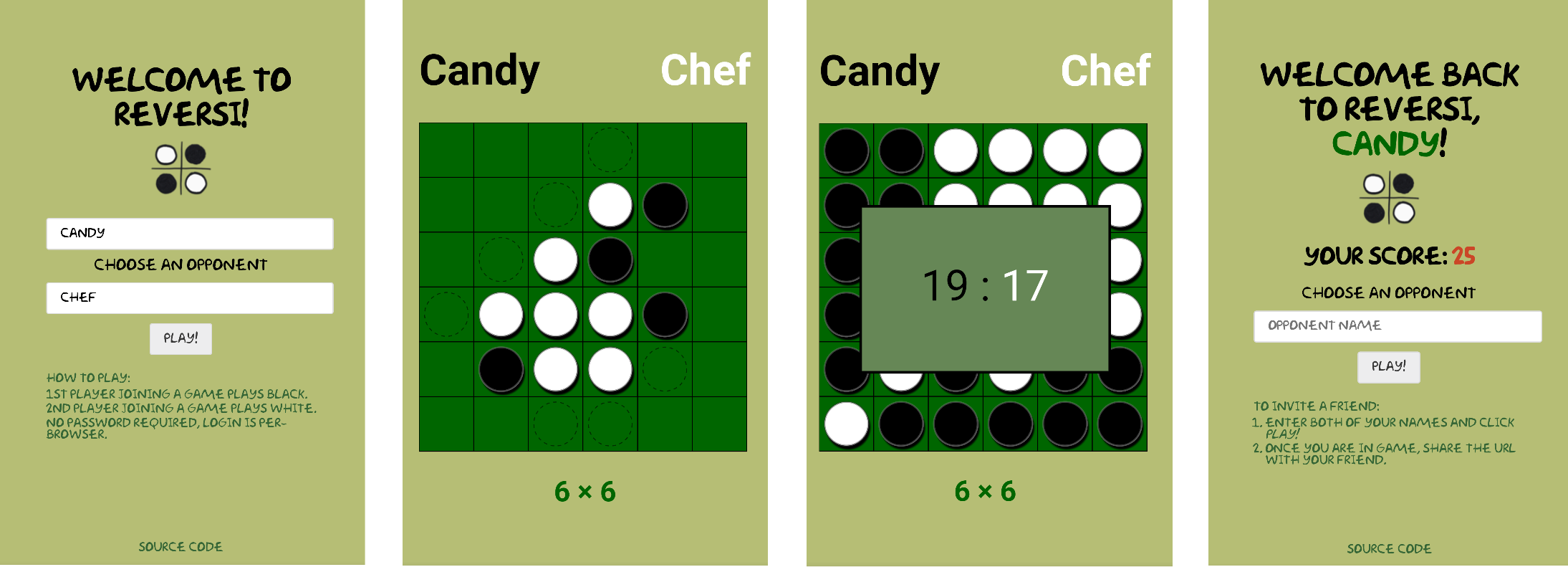
Play it at https://ivg37-qiaaa-aaaab-aaaga-cai.ic0.app
Backend
The game backend is written in Motoko.
register(player_name) - Register the caller using the player name.
start(opponent_name) - Start a game expecting an opponent.
If the name is empty string, the game will accept whoever joins next.
The first player starting a game will play black, and the second player will play white.
view() - Get the up-to-date game state.
move(row, col) - Place a piece at the given row and column (caller must be a registered player and has started a game).
The game will also keep player scores across all games.
Frontend
The GUI frontend is build with Javascript and Mithril. It is stored as a separate asset canister directly on Internet Computer, and can be loaded at the game URL into a browser.
The terminal-based frontend no longer works with the new multiplayer API.
The DFINITY SDK currently lacks a way to switch or use different keypairs, which means the caller identity cannot change, so we don't have a way to run the game using the dfx command.
Installation
To run the game locally, you need to install DFINITY SDK first, which also requires Node.js and npm.
After starting dfx (dfx start --background), run the following to build and install the canister:
dfx deploy
echo "http://localhost:8000/?canisterId=$(dfx canister id reversi_assets)"
The last command prints a URL, load it in a browser, and enjoy!
License
All original code is released under MIT license. The game UI also uses a free font Akbar-Plain made by Jon Bernhardt.


Similar repos




Languages
JavaScript
48.9%
Modelica
41.2%
CSS
6.8%
Shell
2.4%
Multiplayer Reversi Game on Internet Computer
See the codeREADME
Multiplayer Reversi Game on Internet Computer
Read about how the game was made!
This game runs on Internet Computer as a canister. Users can communicate with this canister by sending messages, which are just asynchronous function calls.
Play it at https://ivg37-qiaaa-aaaab-aaaga-cai.ic0.app
Backend
The game backend is written in Motoko.
register(player_name) - Register the caller using the player name.
start(opponent_name) - Start a game expecting an opponent.
If the name is empty string, the game will accept whoever joins next.
The first player starting a game will play black, and the second player will play white.
view() - Get the up-to-date game state.
move(row, col) - Place a piece at the given row and column (caller must be a registered player and has started a game).
The game will also keep player scores across all games.
Frontend
The GUI frontend is build with Javascript and Mithril. It is stored as a separate asset canister directly on Internet Computer, and can be loaded at the game URL into a browser.
The terminal-based frontend no longer works with the new multiplayer API.
The DFINITY SDK currently lacks a way to switch or use different keypairs, which means the caller identity cannot change, so we don't have a way to run the game using the dfx command.
Installation
To run the game locally, you need to install DFINITY SDK first, which also requires Node.js and npm.
After starting dfx (dfx start --background), run the following to build and install the canister:
dfx deploy
echo "http://localhost:8000/?canisterId=$(dfx canister id reversi_assets)"
The last command prints a URL, load it in a browser, and enjoy!
License
All original code is released under MIT license. The game UI also uses a free font Akbar-Plain made by Jon Bernhardt.
Similar repos
Languages
JavaScript
48.9%
Modelica
41.2%
CSS
6.8%
Shell
2.4%