
An in development statically typed systems programming language; with sustainability at its core. We, the community of users, maintain it.
See the codeREADME

Nimskull
The Nimskull compiler, stdlib, tools, and documentation repository.
Code of Conduct
·
Code of Ethics
·
Documentation




This repository contains the Nimskull compiler, stdlib, tools, and documentation.
About the Project
Nimskull (temporary name) is a statically typed structured programming language to create software (itself included) that is sustainable, it aims to be:
- Safe: statically typed, nil safe, with structured approach to resources and concurrency
- Scalable: target a variety of hardware architectures, with zero or low cost abstractions to run in constrained environments.
- Adaptable: producing native executables, running via the built-in VM, or using a JS runtime.
- Evolving: developed and maintained by its community of users, with a self- hosted compiler, support for metaprogramming to safely attempt language extension outside of the core, and support code migration to avoid legacy.
The project was started as a fork of Nim as it provides a bootstrapped compiler as a starting point. The overall language will be evolved into something entirely different and incompatible.
We are currently working on the first phase of this, by slimming down the language and compiler to a workable core and increasing compiler development productivity. The following phase will starting with one of the following possible features:
- Introduce Continuation Passing Style transform and Structured Concurrency into the language, this will undoubtedly lead to dramatic changes in memory management and FFI
- Ease Data Oriented Design through memory regions to support the common handle instead of reference approach
Near-Term Development
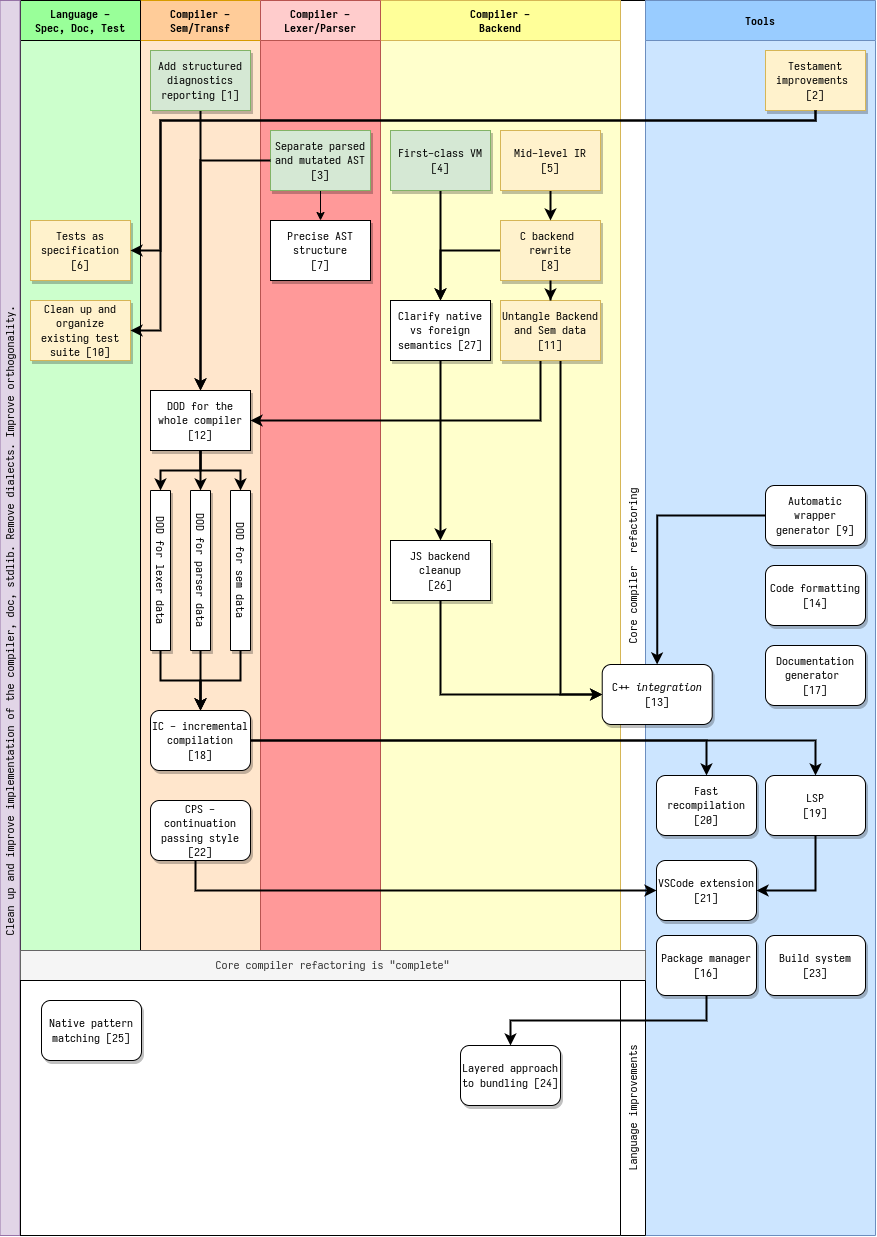
For updates on the progress refer to the milestones. The current ones are used as a way to track progress on a topic, rather than for representing fixed milestones. The old, out-of-date thread about roadmap progress can be found here.
The current and key areas of development are as follows:
- decouple the data types used by the different compilation stages
- simplify the code generators - perform much of the transformation and lowering via passes over the mid-end IR (Project)
- improve tests - core specification as tests (see
slim the corebelow). Reorganize existing tests. (Project) - nkError/tyError/skerror - replace
localErroretc approach with an AST (nkError) one (Project) - comments - incrementally document compiler source for easier learning
- slim the core - remove dialects, backwards compatibility, etc (Discussion)
There are more, the above have been carefully chosen based on the direction of the language; moreover, their impact goes beyond what's been described and intends to create a virtuous cycle. Examples:
- clarifying the language specification will identify bugs and design flaws that in turn will be fixed.
- moving decision making out of the code generators will make behaviour of the backends consistent with each other
- changes introduced via nkError result in more pure code (
func) as control- flow and effects are no longer intertwined; lead to bug and language design fixes due to a broad audit, ease compiler as a library usage for tools
Community
Currently, this repository and our matrix/irc are our primary community hubs; we'll introduce more as things grow. At this time our community is small but passionate We welcome any who are able and eager to collaborate on improving the compiler and associated tools.
Check the FAQ, or Project Board for an idea of where to help.
There's plenty to be done, and we appreciate even the smallest contribution to documentation! We look forward to seeing introductions and pull requests!
Compiling
The compiler currently aims to support the following platform and architecture combinations:
- Linux (most, if not all, distributions) - x86, x86_64, ppc64 and armv6l
- Mac OS X (10.04 or greater) - x86, x86_64, ppc64 and Apple Silicon (based on the ARM64 architecture)
- Windows (Windows XP or later) - x86 and x86_64
Other platforms may work but aren't regularly tested.
Compiling the compiler is quite straightforward if you follow these steps:
Show
To build from source you will need:
- A C compiler such as
gcc3.x/later or an alternative such asclang,Visual C++orIntel C++. It is recommended to usegcc3.x or later. - Either
gitorwgetto download the needed source repositories. - The
build-essentialpackage when usinggccon Ubuntu (and likely other distros as well). - On Windows MinGW 4.3.0 (GCC 8.10) is the minimum recommended compiler.
- Nim hosts a known working MinGW distribution:
Windows Note: Cygwin and similar POSIX runtime environments are not supported.
Then, if you are on a *nix system or Windows, the following steps should compile
Nimskull from source using gcc, git, and the koch build tool.
git clone https://github.com/nim-works/nimskull.git
cd nimskull
./koch.py boot -d:release
./koch.py tools -d:release
Finally, once you have finished the build steps (on Windows, Mac, or Linux) you
should add the bin directory to your PATH.
Contributing
Contributing is simplified thanks to our contribution guide. Right now, the easiest and most important contribution is test suite improvement, also described in the guide.
Koch
koch is the build tool used to build various parts of Nim and to generate
documentation, among other things. The koch tool can also
be used to run the Nim test suite.
Show
You may execute the tests using ./koch.py tests. The tests take a while to
run, but you can run a subset of tests by specifying a category (for example
./koch.py tests cat lang).
For more information on the koch build tool please see the documentation
within the doc/koch.rst file.
Direction
A language (community, compiler, etc) that is sustained through the collective efforts of its practitioners and their diverse backgrounds.
Attracting practitioners with diversity of experience and perspectives requires a language with broad applicability, from Web to Systems Programming all the while remaining efficient.
Onboarding practitioners requires a language that is familiar enough to get started in terms of syntax and initial concepts such as structured and modular programming.
Supporting practitioner-driven innovation requires a language that allows for experimentation without necessarily being an expert in all aspects of language development. Compile time facilities integrated into the language, such as compile time evaluation and a macro system provide an extension sandbox.
Practitioner collaborating and combining their software is assisted by a static type system that supports local inference, tuples, sum, and generic types, along with effect analysis.
A language that develops in such a manner is going to encounter what some might term as 'instability' via numerous backwards incompatible changes. We consider this a feature, instead we:
- favour designs (language or API) that are resilient in the face of change
- employ tools that automatically migrate legacy code or assist in migration
- not cement poor choices and be honest that we can't make such guarantees
Popular languages are maintained through incredible amounts of funding from various entities; we do not see, nor seek, this happening for us. Alternatively, there are a number of languages that require unhealthy amounts of free labour from a few, we're not interested in that either. Instead as is described this language will focus on practitioners able to affect their tools and community.
FAQ
Why start with Nim?
It's convenient. Creating a compiler from scratch is labour intensive and the existing contributors are already familiar with the current code base. We chose to evolve it.
Will this break my Nim code?
This project aims to become a different programming language, if you want Nim go use that.
Can I help somehow?
There is lots to do, and we're very interested in people contributing to the compiler. First step is getting a development environment setup, then join the matrix chat and introduce yourself. It's a small community so time zones might not align, so please be patient.
We're presently reworking much of the compiler, removing dialects and half-baked features to end up with a slim down core. Some areas of contribution:
- reworking the internal error handling
- improving the compiler internal debugging and tracing tools
- "language spec as tests" effort
Any chat room on matrix/irc/discord?
Yes! Feel free to join us on our nim-works channel or nim.works discord server! Please have a read of our Code of Conduct.
License
MIT
Contributors
(top 30 of 328)



Similar repos


Languages
Nim
97.6%
HTML
1.2%
An in development statically typed systems programming language; with sustainability at its core. We, the community of users, maintain it.
See the codeREADME
Nimskull
The Nimskull compiler, stdlib, tools, and documentation repository.
Code of Conduct
·
Code of Ethics
·
Documentation
This repository contains the Nimskull compiler, stdlib, tools, and documentation.
About the Project
Nimskull (temporary name) is a statically typed structured programming language to create software (itself included) that is sustainable, it aims to be:
- Safe: statically typed, nil safe, with structured approach to resources and concurrency
- Scalable: target a variety of hardware architectures, with zero or low cost abstractions to run in constrained environments.
- Adaptable: producing native executables, running via the built-in VM, or using a JS runtime.
- Evolving: developed and maintained by its community of users, with a self- hosted compiler, support for metaprogramming to safely attempt language extension outside of the core, and support code migration to avoid legacy.
The project was started as a fork of Nim as it provides a bootstrapped compiler as a starting point. The overall language will be evolved into something entirely different and incompatible.
We are currently working on the first phase of this, by slimming down the language and compiler to a workable core and increasing compiler development productivity. The following phase will starting with one of the following possible features:
- Introduce Continuation Passing Style transform and Structured Concurrency into the language, this will undoubtedly lead to dramatic changes in memory management and FFI
- Ease Data Oriented Design through memory regions to support the common handle instead of reference approach
Near-Term Development
For updates on the progress refer to the milestones. The current ones are used as a way to track progress on a topic, rather than for representing fixed milestones. The old, out-of-date thread about roadmap progress can be found here.
The current and key areas of development are as follows:
- decouple the data types used by the different compilation stages
- simplify the code generators - perform much of the transformation and lowering via passes over the mid-end IR (Project)
- improve tests - core specification as tests (see
slim the corebelow). Reorganize existing tests. (Project) - nkError/tyError/skerror - replace
localErroretc approach with an AST (nkError) one (Project) - comments - incrementally document compiler source for easier learning
- slim the core - remove dialects, backwards compatibility, etc (Discussion)
There are more, the above have been carefully chosen based on the direction of the language; moreover, their impact goes beyond what's been described and intends to create a virtuous cycle. Examples:
- clarifying the language specification will identify bugs and design flaws that in turn will be fixed.
- moving decision making out of the code generators will make behaviour of the backends consistent with each other
- changes introduced via nkError result in more pure code (
func) as control- flow and effects are no longer intertwined; lead to bug and language design fixes due to a broad audit, ease compiler as a library usage for tools
Community
Currently, this repository and our matrix/irc are our primary community hubs; we'll introduce more as things grow. At this time our community is small but passionate We welcome any who are able and eager to collaborate on improving the compiler and associated tools.
Check the FAQ, or Project Board for an idea of where to help.
There's plenty to be done, and we appreciate even the smallest contribution to documentation! We look forward to seeing introductions and pull requests!
Compiling
The compiler currently aims to support the following platform and architecture combinations:
- Linux (most, if not all, distributions) - x86, x86_64, ppc64 and armv6l
- Mac OS X (10.04 or greater) - x86, x86_64, ppc64 and Apple Silicon (based on the ARM64 architecture)
- Windows (Windows XP or later) - x86 and x86_64
Other platforms may work but aren't regularly tested.
Compiling the compiler is quite straightforward if you follow these steps:
Show
To build from source you will need:
- A C compiler such as
gcc3.x/later or an alternative such asclang,Visual C++orIntel C++. It is recommended to usegcc3.x or later. - Either
gitorwgetto download the needed source repositories. - The
build-essentialpackage when usinggccon Ubuntu (and likely other distros as well). - On Windows MinGW 4.3.0 (GCC 8.10) is the minimum recommended compiler.
- Nim hosts a known working MinGW distribution:
Windows Note: Cygwin and similar POSIX runtime environments are not supported.
Then, if you are on a *nix system or Windows, the following steps should compile
Nimskull from source using gcc, git, and the koch build tool.
git clone https://github.com/nim-works/nimskull.git
cd nimskull
./koch.py boot -d:release
./koch.py tools -d:release
Finally, once you have finished the build steps (on Windows, Mac, or Linux) you
should add the bin directory to your PATH.
Contributing
Contributing is simplified thanks to our contribution guide. Right now, the easiest and most important contribution is test suite improvement, also described in the guide.
Koch
koch is the build tool used to build various parts of Nim and to generate
documentation, among other things. The koch tool can also
be used to run the Nim test suite.
Show
You may execute the tests using ./koch.py tests. The tests take a while to
run, but you can run a subset of tests by specifying a category (for example
./koch.py tests cat lang).
For more information on the koch build tool please see the documentation
within the doc/koch.rst file.
Direction
A language (community, compiler, etc) that is sustained through the collective efforts of its practitioners and their diverse backgrounds.
Attracting practitioners with diversity of experience and perspectives requires a language with broad applicability, from Web to Systems Programming all the while remaining efficient.
Onboarding practitioners requires a language that is familiar enough to get started in terms of syntax and initial concepts such as structured and modular programming.
Supporting practitioner-driven innovation requires a language that allows for experimentation without necessarily being an expert in all aspects of language development. Compile time facilities integrated into the language, such as compile time evaluation and a macro system provide an extension sandbox.
Practitioner collaborating and combining their software is assisted by a static type system that supports local inference, tuples, sum, and generic types, along with effect analysis.
A language that develops in such a manner is going to encounter what some might term as 'instability' via numerous backwards incompatible changes. We consider this a feature, instead we:
- favour designs (language or API) that are resilient in the face of change
- employ tools that automatically migrate legacy code or assist in migration
- not cement poor choices and be honest that we can't make such guarantees
Popular languages are maintained through incredible amounts of funding from various entities; we do not see, nor seek, this happening for us. Alternatively, there are a number of languages that require unhealthy amounts of free labour from a few, we're not interested in that either. Instead as is described this language will focus on practitioners able to affect their tools and community.
FAQ
Why start with Nim?
It's convenient. Creating a compiler from scratch is labour intensive and the existing contributors are already familiar with the current code base. We chose to evolve it.
Will this break my Nim code?
This project aims to become a different programming language, if you want Nim go use that.
Can I help somehow?
There is lots to do, and we're very interested in people contributing to the compiler. First step is getting a development environment setup, then join the matrix chat and introduce yourself. It's a small community so time zones might not align, so please be patient.
We're presently reworking much of the compiler, removing dialects and half-baked features to end up with a slim down core. Some areas of contribution:
- reworking the internal error handling
- improving the compiler internal debugging and tracing tools
- "language spec as tests" effort
Any chat room on matrix/irc/discord?
Yes! Feel free to join us on our nim-works channel or nim.works discord server! Please have a read of our Code of Conduct.
License
MIT
Similar repos
Contributors
(top 30 of 328)
Languages
Nim
97.6%
HTML
1.2%