中华传统色演示、色卡浏览与颜色知识科普开源项目
See the codeNot another color-value list that looks beautiful but leaves you wondering what to do next.
This is a practical workspace for moving from finding a Chinese color to pairing, testing, and shipping it: 742 high-resolution cards, 8,904 harmony sets, real-scene previews, shadcn themes, and terminal palettes.
Explore the colors → · Build a palette from one color · Download every high-resolution card
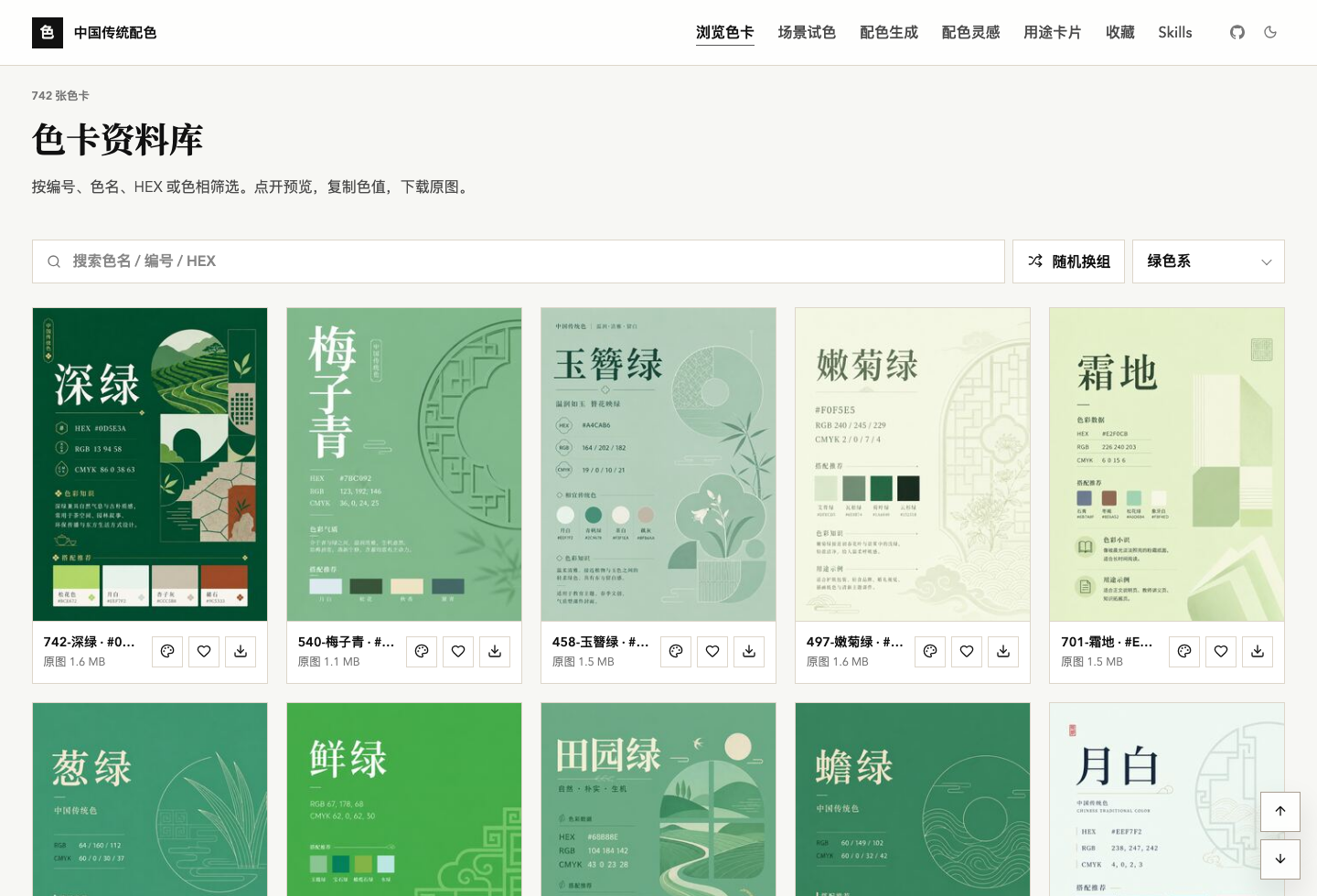
A real project rarely needs just one HEX value. You also need to know whether the color belongs in a background, headline, button, or accent; what can sit beside it; whether the text remains readable; and how the choice becomes a theme your developer can actually use.
This project connects those decisions in one place. It helps you find a color, then judge whether it survives a real layout.
| What you are trying to do | Open | What you get |
|---|---|---|
| Find a named Chinese color with the right character | Color gallery | Search by name, number, HEX, or hue; copy values or download the source card |
| Turn one anchor color into a usable set | Palette generator | Five-color schemes you can lock, replace, rotate, copy, and export |
| See whether a color works beyond the swatch | Scene testing | Web, slide, cover, poster, and brand-board previews |
| Explore adjacent, complementary, or tonal relationships | Palette inspiration | 8,904 harmony sets to browse, shuffle, copy, and save |
| Pair backgrounds, text, and buttons | Usage cards | Layout previews and contrast checks for two-color combinations |
| Move a Chinese color into a product UI | Theme Forge | A light/dark shadcn semantic theme, OKLCH values, and globals.css |
| Give your terminal a coherent Chinese palette | Terminal palette | 16 ANSI colors plus configs for Ghostty, Alacritty, kitty, and more |
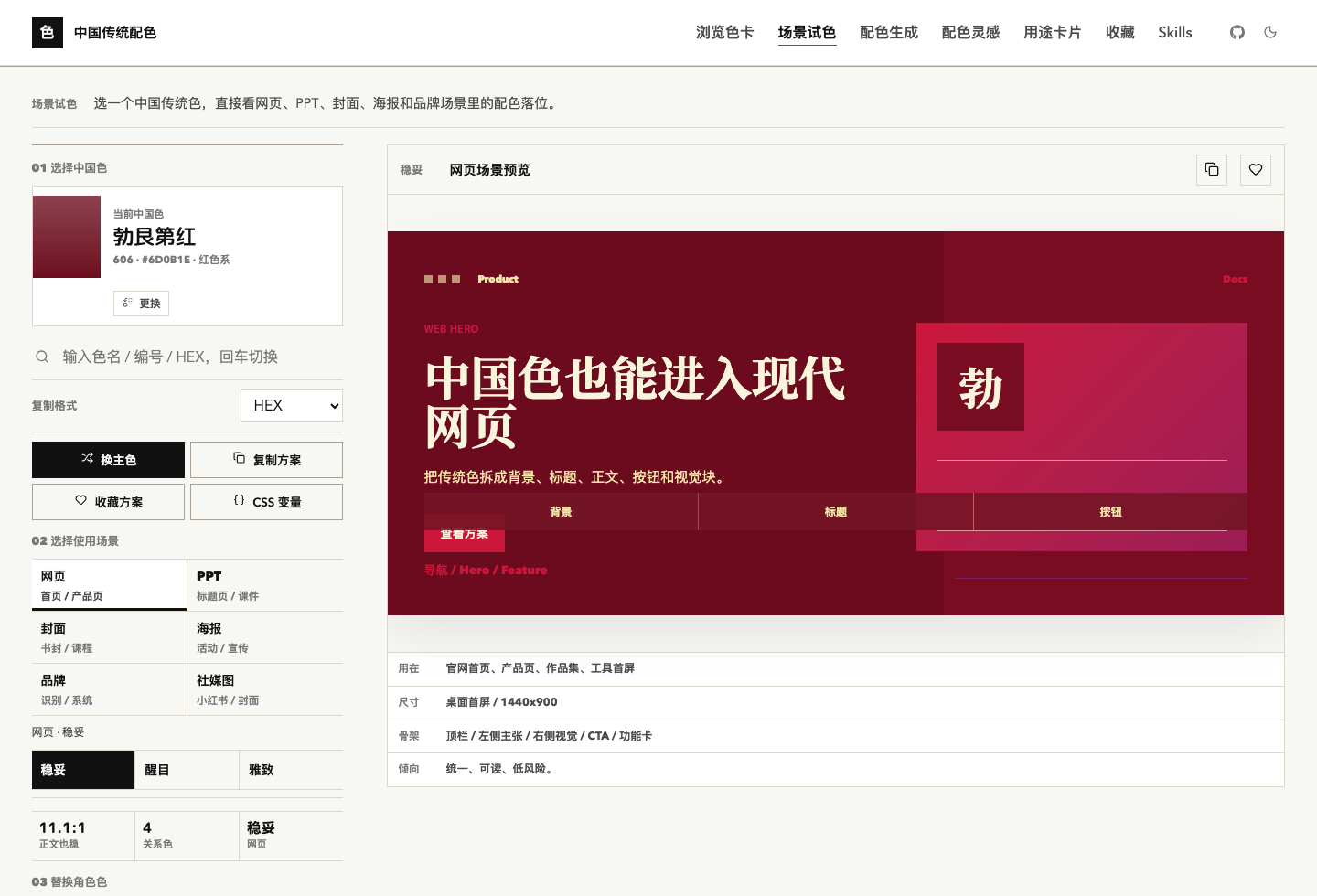
One anchor color is placed into background, headline, body, button, and accent roles across actual design scenes. You evaluate a layout, not an isolated square.
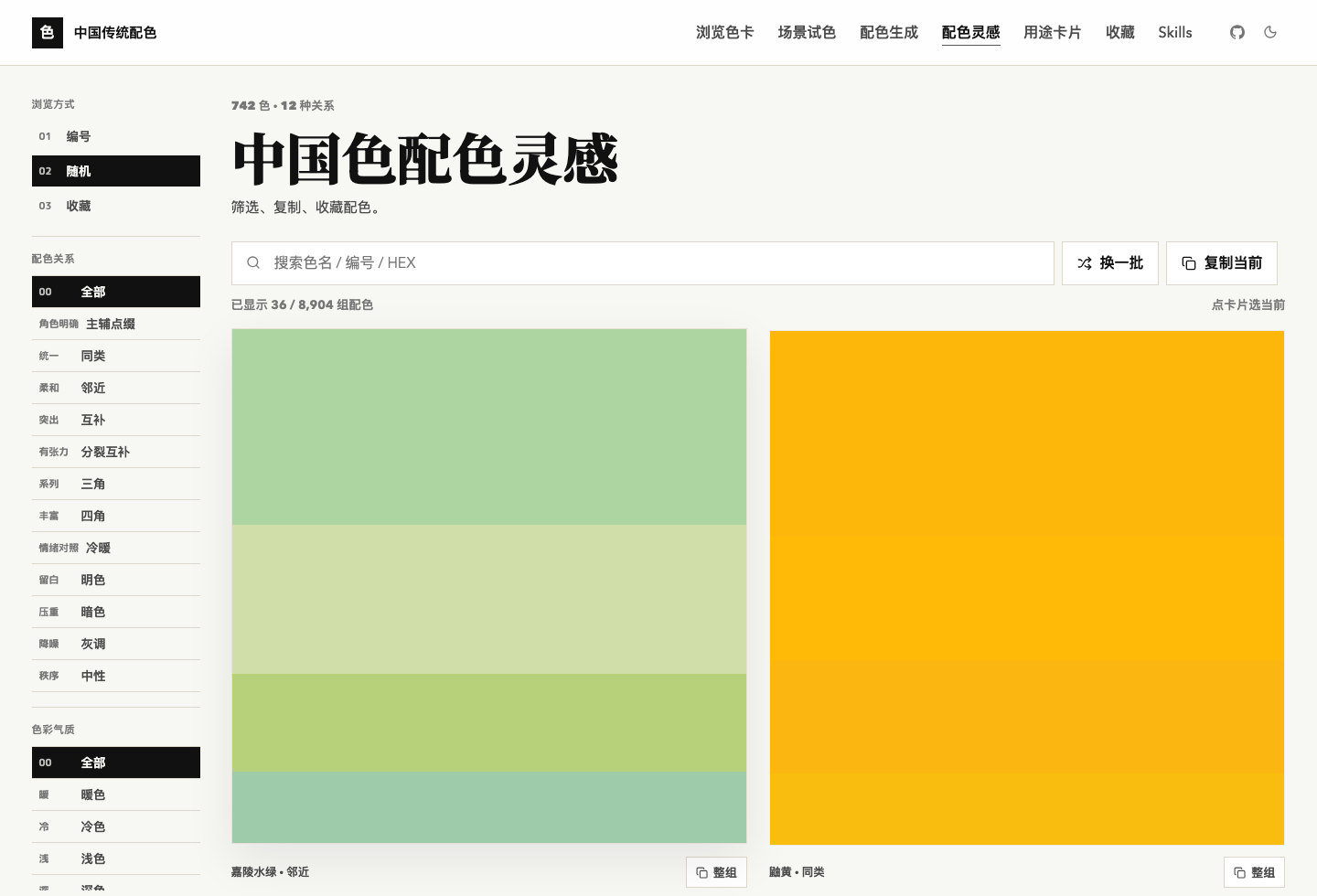
Harmony relationships narrow the search before trial and error takes over: same-family, analogous, complementary, triadic, warm/cool, light/dark, gray-tone, and neutral combinations are ready to inspect.
Theme Forge turns one named anchor into a full set of shadcn semantic roles, handles light and dark modes, previews real components, checks foreground contrast, and exports globals.css.
Each xxd-* skill bundles the full color list and harmony data, so it can work independently without fetching reference data from the network.
git clone https://github.com/nevertoday/zhongguo-traditional-colors.git
cp -r zhongguo-traditional-colors/skills/xxd-palette-builder ~/.claude/skills/
| Where the work is stuck | Skill to use |
|---|---|
| The direction is still vague: “premium, Eastern, young, restrained” | xxd-color-brief |
| One anchor color needs to become a role-based palette | xxd-palette-builder |
| A palette exists, but its layout roles are unclear | xxd-palette-applier |
| Development needs semantic UI tokens | xxd-ui-token |
| Text, buttons, or charts may not be readable | xxd-accessible-color |
| The work extends to branding, charts, content systems, or print | Browse all 10 skills |
The README shows 12 representative cards. Browse all 742 in the online gallery, the images/ directory, or the Release ZIP.


The source image set is about 998 MB, so the complete archive is distributed through GitHub Releases instead of bloating the repository.
This is a static site. To preview it locally:
npm run manifest
npm run readme
npm run start
Then open http://localhost:5173. After adding or replacing cards, run npm run manifest && npm run readme to update the manifest and README gallery.
Traditional color values vary across sources, screens, print processes, inks, and materials. Use this project to search, compare, prototype, and communicate; verify against the real medium before production printing.
Issues and pull requests are welcome. New cards, corrected values, better sourcing, tool improvements, and clearer documentation are all useful; please read CONTRIBUTING.md first.
Released under the MIT License. If the project saves you a round of hunting for references and repeatedly testing colors, consider starring it or sharing it with another maker.
421 followers · starred Jun 2026
336 followers · starred Jun 2026
86 followers · starred Jun 2026
1,833 followers · starred Jun 2026
中华传统色演示、色卡浏览与颜色知识科普开源项目
See the codeNot another color-value list that looks beautiful but leaves you wondering what to do next.
This is a practical workspace for moving from finding a Chinese color to pairing, testing, and shipping it: 742 high-resolution cards, 8,904 harmony sets, real-scene previews, shadcn themes, and terminal palettes.
Explore the colors → · Build a palette from one color · Download every high-resolution card
A real project rarely needs just one HEX value. You also need to know whether the color belongs in a background, headline, button, or accent; what can sit beside it; whether the text remains readable; and how the choice becomes a theme your developer can actually use.
This project connects those decisions in one place. It helps you find a color, then judge whether it survives a real layout.
| What you are trying to do | Open | What you get |
|---|---|---|
| Find a named Chinese color with the right character | Color gallery | Search by name, number, HEX, or hue; copy values or download the source card |
| Turn one anchor color into a usable set | Palette generator | Five-color schemes you can lock, replace, rotate, copy, and export |
| See whether a color works beyond the swatch | Scene testing | Web, slide, cover, poster, and brand-board previews |
| Explore adjacent, complementary, or tonal relationships | Palette inspiration | 8,904 harmony sets to browse, shuffle, copy, and save |
| Pair backgrounds, text, and buttons | Usage cards | Layout previews and contrast checks for two-color combinations |
| Move a Chinese color into a product UI | Theme Forge | A light/dark shadcn semantic theme, OKLCH values, and globals.css |
| Give your terminal a coherent Chinese palette | Terminal palette | 16 ANSI colors plus configs for Ghostty, Alacritty, kitty, and more |
One anchor color is placed into background, headline, body, button, and accent roles across actual design scenes. You evaluate a layout, not an isolated square.
Harmony relationships narrow the search before trial and error takes over: same-family, analogous, complementary, triadic, warm/cool, light/dark, gray-tone, and neutral combinations are ready to inspect.
Theme Forge turns one named anchor into a full set of shadcn semantic roles, handles light and dark modes, previews real components, checks foreground contrast, and exports globals.css.
Each xxd-* skill bundles the full color list and harmony data, so it can work independently without fetching reference data from the network.
git clone https://github.com/nevertoday/zhongguo-traditional-colors.git
cp -r zhongguo-traditional-colors/skills/xxd-palette-builder ~/.claude/skills/
| Where the work is stuck | Skill to use |
|---|---|
| The direction is still vague: “premium, Eastern, young, restrained” | xxd-color-brief |
| One anchor color needs to become a role-based palette | xxd-palette-builder |
| A palette exists, but its layout roles are unclear | xxd-palette-applier |
| Development needs semantic UI tokens | xxd-ui-token |
| Text, buttons, or charts may not be readable | xxd-accessible-color |
| The work extends to branding, charts, content systems, or print | Browse all 10 skills |
The README shows 12 representative cards. Browse all 742 in the online gallery, the images/ directory, or the Release ZIP.
The source image set is about 998 MB, so the complete archive is distributed through GitHub Releases instead of bloating the repository.
This is a static site. To preview it locally:
npm run manifest
npm run readme
npm run start
Then open http://localhost:5173. After adding or replacing cards, run npm run manifest && npm run readme to update the manifest and README gallery.
Traditional color values vary across sources, screens, print processes, inks, and materials. Use this project to search, compare, prototype, and communicate; verify against the real medium before production printing.
Issues and pull requests are welcome. New cards, corrected values, better sourcing, tool improvements, and clearer documentation are all useful; please read CONTRIBUTING.md first.
Released under the MIT License. If the project saves you a round of hunting for references and repeatedly testing colors, consider starring it or sharing it with another maker.
421 followers · starred Jun 2026
336 followers · starred Jun 2026
86 followers · starred Jun 2026
1,833 followers · starred Jun 2026