Dataflow programming language where you write a program as a message-passing graph and everything runs in parallel by default. It has strong static types, compiles to machine code, interoperates with Go, and supports visual programming with a node editor. Extremely LLM-friendly too.
See the code


Neva is a statically typed, compiled dataflow programming language.
Instead of writing step-by-step instructions, you create networks of nodes that exchange messages through ports.
import {
  fmt
  runtime
}

def Main(start any) (stop any) {
	println fmt.Println
	panic runtime.Panic
	---
	:start -> 'Hello, World!' -> println:data
	println:res -> :stop
	println:err -> panic
}
This code imports fmt and runtime to use Println and Panic components, and defines Main with one input (start) and one output (stop). The two nodes are connected: when the program starts, 'Hello, World!' is sent to println; if printing fails, errors go to panic; after printing, the program ends.
Neva compiles to clean, dependency-free Go code using goroutines and channels for message passing. The Go compiler then produces optimized binaries for any supported platform.
flowchart LR
  source_code-->compiler-->|go_code| go_compiler

  subgraph compiler
    parser-->analyzer-->backend
  end

  go_compiler-->machine_code
  go_compiler-->wasm
Your support by donating to our open collective or joining us will show interest and motivate us to continue.


We’re exploring a future of programming that few dare to build. If you believe in this direction, backing us on Open Collective keeps the work alive: https://opencollective.com/nevalang
Also give us a star to increase our chances of getting into GitHub trends. The more developers we reach, the more likely we are to build this future together.
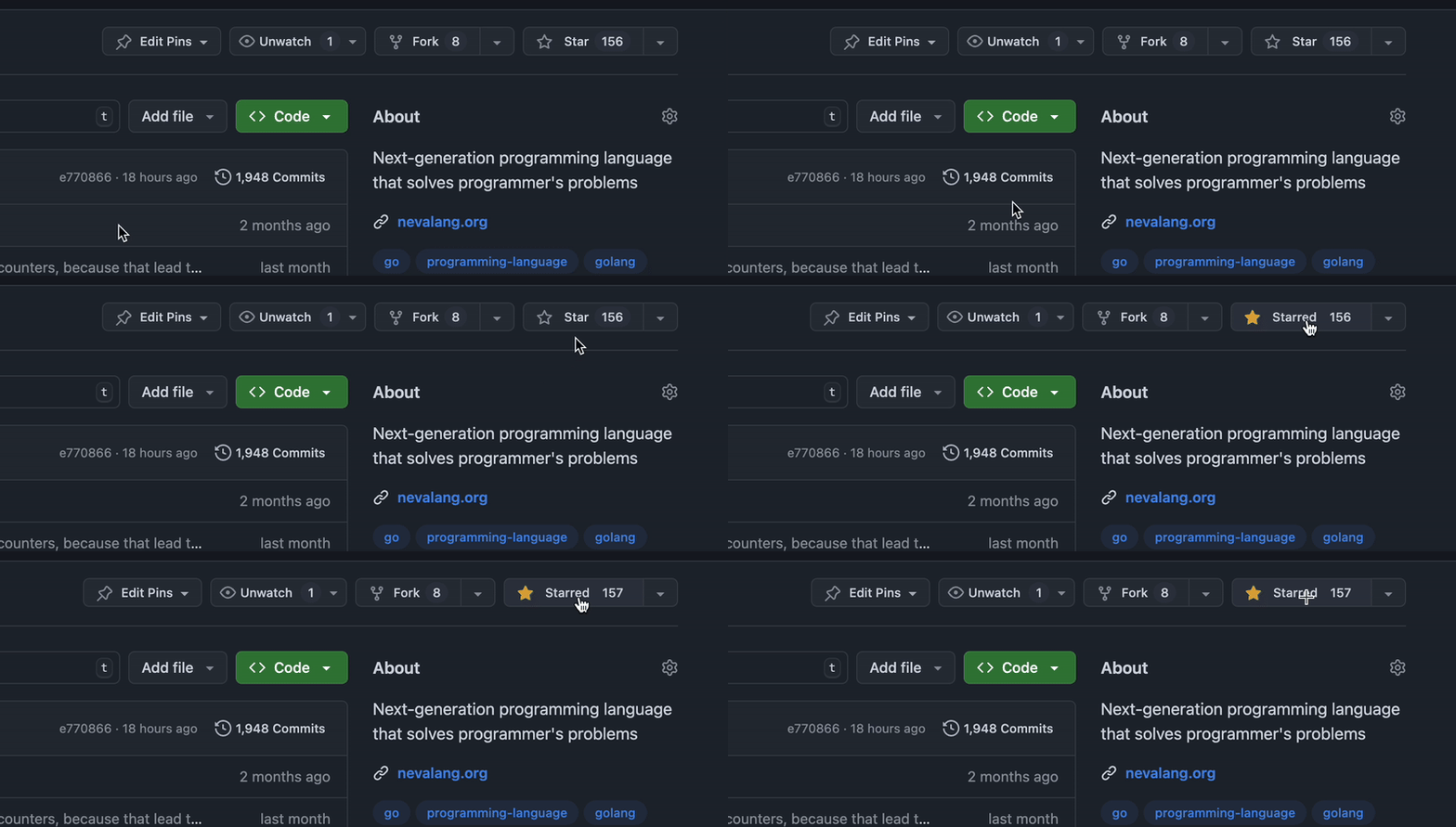
And tell the world about Neva! Every share helps us grow our community.


194 followers · starred Mar 2024
260 followers · starred Mar 2024
710 followers · starred Jan 2025
356 followers · starred Jan 2025
Dataflow programming language where you write a program as a message-passing graph and everything runs in parallel by default. It has strong static types, compiles to machine code, interoperates with Go, and supports visual programming with a node editor. Extremely LLM-friendly too.
See the code
Neva is a statically typed, compiled dataflow programming language.
Instead of writing step-by-step instructions, you create networks of nodes that exchange messages through ports.
import {
  fmt
  runtime
}

def Main(start any) (stop any) {
	println fmt.Println
	panic runtime.Panic
	---
	:start -> 'Hello, World!' -> println:data
	println:res -> :stop
	println:err -> panic
}
This code imports fmt and runtime to use Println and Panic components, and defines Main with one input (start) and one output (stop). The two nodes are connected: when the program starts, 'Hello, World!' is sent to println; if printing fails, errors go to panic; after printing, the program ends.
Neva compiles to clean, dependency-free Go code using goroutines and channels for message passing. The Go compiler then produces optimized binaries for any supported platform.
flowchart LR
  source_code-->compiler-->|go_code| go_compiler

  subgraph compiler
    parser-->analyzer-->backend
  end

  go_compiler-->machine_code
  go_compiler-->wasm
Your support by donating to our open collective or joining us will show interest and motivate us to continue.
We’re exploring a future of programming that few dare to build. If you believe in this direction, backing us on Open Collective keeps the work alive: https://opencollective.com/nevalang
Also give us a star to increase our chances of getting into GitHub trends. The more developers we reach, the more likely we are to build this future together.
And tell the world about Neva! Every share helps us grow our community.
194 followers · starred Mar 2024
260 followers · starred Mar 2024
710 followers · starred Jan 2025
356 followers · starred Jan 2025