Fused codebook (K-means) weight-quant CUDA kernels: decode GEMV beats cuBLAS x2.34, fused prefill Tensor-Core GEMM. Measured on A40.
Rust
1
243 commits
updated Jul 16, 2026
Press the model, keep the oil. A trapetum is the Roman olive press: it crushes the
whole fruit to extract the concentrated essence. This project does the same to an LLM,
pressing the weights down to a small codebook and decoding them straight inside the
matmul, so the dequantized weight matrix W is never materialized in global memory.
It is fused CUDA kernels for codebook (non-uniform / k-means) weight quantization plus
a pure-Rust runtime. A real Llama-2-7B, quantized to 4-bit, runs end-to-end in Rust with
no Python at runtime, reproducing HuggingFace token for token (16/16) at 135 tok/s on
an RTX 4090, in 3.5 GB instead of 13, at 2.1x less energy per token than fp16
(see bench/PARETO.md).
W_deq[i, j] = codebook[ indices[i, j], j ]            # per-output-channel codebooks
Y[m, j]     = sum_i  X[m, i] * W_deq[i, j]
indices : [IC, OC], one cluster id per weight (uint8, or packed 4-bit)codebook: [K, OC], fp16 (small per-column table, K in 16..256)X : activations fp16; Y: output fp16kernels/: the CUDA kernels (scalar decode, prefill, and the additive
vector-quantization kernel avq_gemv*.cu), their PyTorch binding (quant_demo.py),
and the build/run harness (benchmark.py, shapes_test.py).model/: model-level scripts on Llama-2: the cast-free CUDA-graph serving
integration that realizes the 2.0x/2.45x end-to-end decode speedup, the AQLM-style
additive-VQ training that beats the scalar codebook, the accuracy probes, and the
torch-free exporter (export_safetensors.py): it reads safetensors directly
(no PyTorch, no transformers) and compresses any Llama- or Phi-3-architecture model
to the runtime's format: this is how Phi-4 (14B) was exported and run at 79.9 tok/s.
Nine architectures run end-to-end in pure Rust, including Gemma-2-9B, Phi-4 and
DeepSeek-V2-Lite (MLA + MoE); see bench/RESULTS_models.md.
Scale result: DeepSeek-R1 671B (full V3 architecture), 1.34 TB bf16 compressed to
a 350 GB 4-bit artifact, serves the full model at 2.46 tok/s on a single commodity
node (64 vCPU, one L40S, 497 GB RAM), a x10.2 gain over the 0.24 tok/s disk-offload
baseline. The lever is inversion: the routed experts stay resident in host RAM and
are decoded in place on the CPU (one vpshufb per 32 weights on AVX2), while the GPU
holds only MLA attention and the dense layers (20.9 GB VRAM). At batch one only the
~10 GB of routed-expert bytes per token matter, and they no longer travel to the GPU.
The gain came from removing eight measured walls: 0.24, 0.44, 0.96, 1.31, 1.35, 1.67,
1.84, 2.46 tok/s. Routed decode reaches ~67 GB/s aggregate, near the memory read floor.
Quality (wikitext-2 PPL): full 8-bit is essentially lossless at +0.03% vs fp16 (5.70);
4-bit costs +7.1% (6.10); a mixed-precision variant (shared experts + lm_head at 8-bit)
captures most of the recovery at +1.5% (5.78) for +0.7% size.
See bench/RESULTS_deepseek.md.bench/: a fair single-harness speed vs accuracy vs memory benchmark of
fp16, AWQ and AQLM (the pareto/mem70 figures and results*.json).paper/: the write-up (trapetum.pdf).runtime/: a minimal Rust runtime that hosts the CUDA kernel with no
Python in the loop (the bootstrap of a deployable, single-binary inference path).This repository is a kernel-level study, not a quantization method paper.
The contribution is the fused-decode kernel (and now its end-to-end memory / speed on a real model); the value is memory and decode speed, not accuracy.
Storing each weight as a small cluster index shrinks the layer 2x (uint8) to 4x
(4-bit). Dequantizing in a separate pass (write W, then GEMM) wastes the
bandwidth the quantization just saved. These kernels fold the lookup into the
matmul so the dequantization adds no extra global traffic.
Trapetum is CUDA, so it runs on any modern NVIDIA GPU. Recompile the kernel for your
architecture with one -arch flag, or ship a multi-arch build that covers them all in a
single binary. The 4-bit memory saving is universal; only the speedup depends on the card
(the bandwidth law: largest on bandwidth-bound consumer GPUs, parity on an H100).
| Your GPU | Arch | Memory win | Decode speed |
|---|---|---|---|
| RTX 30 / 40 (3060, 3090, 4070, 4090, ...) | sm_86 / sm_89 | 3.9x disk / 2.9x VRAM | largest, up to 2.2x |
| A100 / A40 / L40 | sm_80 / sm_86 / sm_89 | 3.9x disk / 2.9x VRAM | strong, 2.34x on A40 |
| H100 / H200 | sm_90 | 3.9x disk / 2.9x VRAM | parity (fp16 already near roofline) |
| Turing and older (GTX 16, RTX 20, V100) | sm_70 / sm_75 | 3.9x disk / 2.9x VRAM | untested, rebuild needed |
| AMD, Apple Silicon, CPU | - | - | not supported (CUDA only) |
Memory, labeled (both hold, they measure different things): 3.9x smaller on disk
(3.5 GB .cbk codebook file vs 13.5 GB fp16) and 2.9x less VRAM at runtime
(13.6 GB -> 4.7 GB peak).
The memory win (a 7B in ~3.5 GB, so it fits an 8 GB card) holds on every NVIDIA GPU.
Validated on Ampere, Ada and Hopper (sm_80 to sm_90); pre-Ampere is untested, and the
mma.sync / cp.async prefill paths require sm_80+.
Unless a row says otherwise, reference numbers below were measured on a single
NVIDIA A40 (sm_86, CUDA 11.8) with matrices IC = OC = 4096, fp16
activations/output (the cross-GPU section adds RTX 4090 and H100). Every kernel is
checked for numerical correctness against cuBLAS on the same data.
Reproducibility. All randomness is generated by std::mt19937(0) in the CUDA
sources (fixed seed = 0). Timings use cudaEvent over 50..500 iterations after
a warm-up. Regenerate the full table on your own GPU with python kernels/benchmark.py
(auto-detects arch; writes results.json + results.md with the GPU, driver and
CUDA version captured).
| Kernel | scheme | latency | vs cuBLAS | max rel. err |
|---|---|---|---|---|
| cuBLAS fp16 dense (baseline) | dense fp16 | 0.0612 ms | 1.00x | - |
gemv_codebook.cu | uint8, K = 256 | 0.0562 ms | 1.09x | 2.9e-5 |
gemv_codebook.cu | uint8, K = 64 | 0.0389 ms | 1.57x | 2.4e-5 |
gemv_codebook_4bit.cu | 4-bit, K = 16 | 0.0261 ms | 2.34x | 2.6e-5 |
Decode is memory-bound, so reading fewer weight bytes directly buys latency. The dominant cost is streaming the index matrix; the lever is bits per index.
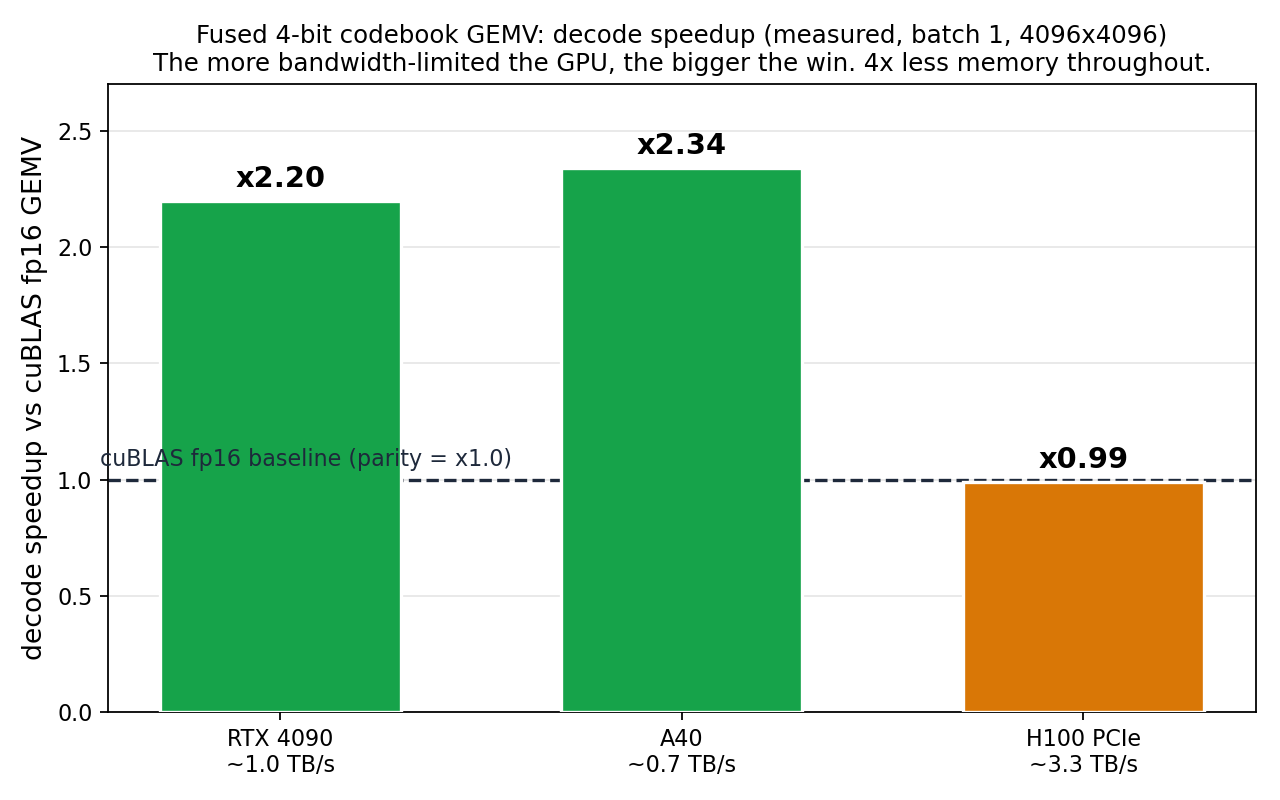
The 4-bit fused GEMV (gemv_codebook_hopper_v2.cu) was re-measured against a live
cuBLAS fp16 GEMV on three GPUs (same 4096x4096, batch 1, seed 0, rel. err ~3e-4):
| GPU | bandwidth class | speedup vs cuBLAS fp16 |
|---|---|---|
RTX 4090 (sm_89) | ~1.0 TB/s | x2.20 |
A40 (sm_86) | ~0.7 TB/s | x2.34 |
H100 PCIe (sm_90) | ~3.3 TB/s | x0.99 (tie) |
The more bandwidth-limited the GPU, the bigger the win, because the kernel reads 1/4 the weight bytes. On consumer / bandwidth-bound GPUs that is a ~2.2-2.3x decode speedup for 4x less memory. On a bandwidth-rich H100, fp16 GEMV is already near-roofline, so the kernel only ties cuBLAS and the gain there is memory, not speed.
A recorded negative result: a Hopper variant that staged the codebook in
thread-block-cluster distributed shared memory (gemv_codebook_hopper.cu) came out
~100x slower. A small codebook wants local shared-memory reads in the hot loop, not
remote DSMEM. Kept in the repo as a documented dead end, alongside an L2-codebook /
X-staging sweep (gemv_codebook_hopper_v3.cu) where every variant regressed.
quant_demo.py wraps the kernel as a torch custom op (codebook_gemv) plus a
per-column k-means quantize recipe, verified end to end on a real weight (rel. err
2.3e-7 vs the reconstruction). The decode speedup vs a torch dense fp16 mat-vec
(torch.mv, the batch-1 path a real fp16 Linear runs) grows with layer size,
measured on an RTX 4090:
| layer (IC x OC) | speedup vs torch dense fp16 |
|---|---|
| 3072 x 768 (small) | x0.58 (loses, overhead bound) |
| 4096 x 4096 | x2.10 |
| 11008 x 4096 (MLP down) | x3.70 |
| 4096 x 11008 (MLP up) | x3.77 |
Tiny matrices are overhead bound and lose; the large MLP layers that dominate an
LLM parameter count win x3.7. Apply the kernel selectively to the large layers.
Reproduce with python kernels/shapes_test.py.
The scheme was taken all the way to a real model (scripts in model/; full
write-up in paper/trapetum.pdf).
Memory. Quantizing all 224 projection layers to 4-bit drops peak VRAM from 13.56 GB to 4.63 GB (2.9x); the 7B model runs in under 5 GB on a consumer card.
Decode speed vs the real cuBLAS path. Against F.linear (cuBLAS GEMV, not the
weak torch.mv), the kernel runs the 224-GEMV decode work of one token at 172
tok/s versus 70 (x2.4), both CUDA-graph captured, so the kernel genuinely beats
cuBLAS at batch 1. A naive per-layer custom-op swap loses end to end (x0.73) only
because of per-op float32->float16 casts in the wrapper, not the kernel. Building
the clean integration (kernel writes fp16 into preallocated buffers, decode step
captured as one CUDA graph over a static-cache loop) realizes the win: the codebook
model decodes 123.4 vs 61.6 tok/s vs fp16 (x2.0 end-to-end) at 4.73 vs 13.58 GB. The
arc is x0.73 (naive) -> x0.85 (cast-free eager) -> x2.0 (CUDA-graphed). The win
grows with size and bandwidth-boundedness: Llama-2 13B on an A40 decodes 49.0 vs 20.0
tok/s (x2.45) at 8.50 vs 26.17 GB (3.08x less).
Accuracy, and its ceiling. wikitext-2 PPL goes 5.83 (fp16, custom codebook evaluation harness used for the ablations) -> 6.34 (4-bit codebook). Three attempts to close the gap to AWQ all fail: a simple activation-aware calibration reaches 6.17, the full AWQ pipeline (output-error scale search + weight clipping) does not improve on it (6.21), a naive vector quantizer is catastrophic (diverges, with or without per-channel normalization), and incoherence processing (a random orthogonal rotation before quantizing, the QuIP# lever) moves it only marginally (6.34 -> 6.29). AWQ's scaling assumes a uniform grid while a codebook is already adaptive; real vector/trellis accuracy needs AQLM/QuIP#-level machinery (residual codebooks, incoherence paired with vector quantization, fine-tuning). The value of this scheme is memory and kernel speed, not accuracy.
The scalar codebook's accuracy ceiling is structural (above). The accuracy frontier is
vector quantization (AQLM, QuIP#): a group of D weights is reconstructed as a SUM of
M codebook vectors, w_group = sum_m C_m[code_m], which reaches near-fp16 quality at
2 bits. Their kernels are the bottleneck. avq_gemv.cu is a first fused decode kernel
for exactly this scheme. The trick: in y[o] = sum_g <x_g, w_group>, the dot
<x_g, C_m[k]> is independent of the output, so a per-group LUT LUT[m][k] = <x_g, C_m[k]> is built once in shared memory, then y[o] = sum_g sum_m LUT[m][code_m[o,g]].
The kernel reads the codes, never the dense weight: at 2 bits (M=2, K=256, D=8) that
is 4.2 MB of codes vs 33.6 MB of fp16 weight.
Measured at 4096x4096, batch 1, vs a live cuBLAS fp16 GEMV (rel. err 2.3e-4, all
verified):
| GPU | additive-VQ 2-bit vs cuBLAS fp16 |
|---|---|
| RTX 4090 (~1.0 TB/s) | x1.71 |
| A40 (~0.7 TB/s) | x4.30 |
So a fused 2-bit decode kernel beats cuBLAS by up to 4.3x, more so on bandwidth-bound GPUs (the same bandwidth law), at a bit rate where accuracy is near fp16. This is the combination the scalar scheme could not reach (accuracy and speed).
Tuning trail (avq_gemv.cu v1 -> avq_gemv2.cu -> avq_gemv3.cu): the first cut sat
at ~22% of the memory roofline. Reducing syncs (v2, group-tile LUT) did not help, the
bottleneck was the 1-byte code reads, not synchronization. Reading 4 codes per thread as
one uint32 (v3) lifted the A40 from x2.35 to x4.30 (153 -> 277 GB/s effective,
~40% roofline). Optimal group tile GT=16 (GT>=20 overflows static shared memory and
silently fails to launch, an easy trap). Still uses random codebooks (no real AQLM
codebooks / model yet); wiring those in and closing the remaining roofline gap is the
path to a Pareto-dominant result (2-bit, near-fp16 accuracy, faster decode, less memory).
Reproduce with nvcc -O3 -arch=sm_86 -DGT=16 kernels/avq_gemv3.cu -lcublas -o avq3 && ./avq3.
Real AQLM codebooks (validated). This kernel's scheme is exactly AQLM's 2x8
format. Loading the real ISTA-DASLab/Llama-2-7b-AQLM-2Bit-2x8-hf checkpoint, its
codebooks are [2, 256, 1, 8] (M=2, K=256, group 8), codes [4096, 512, 2], with a
per-output scales [4096], all mapping one-to-one onto this kernel (add the per-output
scale at the end). So the kernel decodes real AQLM weights, not just random data. The
honest tension: that 2x8 config (the one a shared-memory LUT can decode) gives PPL 7.63
on Llama-2 7B, worse than scalar 4-bit (6.34) though at half the bits, and far better
than scalar 2-bit which diverges. The accuracy-competitive AQLM is 1x16
(K = 65536), whose 256 KB-per-group LUT does not fit shared memory and needs a different,
slower kernel (which is why AQLM decode is slow). We tested the 4x8 path (M=4, 4 bits). The kernel stays fast (M=4 decodes at x2.39
on the A40, GT=4, verified). On accuracy, a greedy additive fit only ties the scalar
4-bit codebook (PPL 6.32 vs 6.34): the additive structure alone does not beat scalar,
AQLM's edge is its training. So we reproduced the core of that training (per-output
scale + beam-search code assignment + least-squares codebook updates, alternating;
no block fine-tuning), in llama_aqlm_train.py. That wins: at M=4 it reaches PPL
6.13, beating the scalar 4-bit codebook (6.34) at equal bits, while the kernel still
decodes it at x2.39 on the A40. And that is one alternating round with no calibration
or block fine-tuning, the levers the full AQLM pipeline adds to push further toward fp16
(5.83). So the Pareto point holds: trained additive VQ is more accurate than the scalar
codebook at the same bits and the same decode speed, and this kernel is the fast-decode
path that makes it usable (it also makes 2-bit usable and fast, x4.27, where the scalar
2-bit codebook diverges).
| Kernel | effective bandwidth |
|---|---|
| naive (redundant shared-memory staging) | 31.8 GB/s |
dequant_l2 (L2-cached gather) | 213 GB/s (6.7x) |
| Kernel | TFLOP/s | vs cuBLAS | rel. err |
|---|---|---|---|
| naive wmma (1 warp / tile) | 2.3 | 0.02x | 2.6e-4 |
| tiled fused | 9.5 | 0.09x | 2.6e-4 |
| cp.async double-buffering, 128x128 tiles | 12.3 | 0.12x | 2.6e-4 |
+ register-pipelined dequant (prof10.cu) | 22.4 | 0.21x | 2.6e-4 |
raw mma.sync m16n8k16 (prof11.cu) | 22.0 | 0.21x | 2.6e-4 |
| cuBLAS fp16 (baseline) | ~105 | 1.00x | - |
Prefill is compute-bound: cuBLAS already runs near the Tensor-Core peak, so a
fused-dequant kernel can at best match it. Here the best fused kernel reaches
~10x the naive baseline but ~0.21x of cuBLAS; in the prefill regime, codebook
quantization buys memory, not speed. Closing the remaining gap requires
ldmatrix + shared-memory swizzling (production-Marlin engineering); a separate
experiment (prof11.cu) shows the wmma API is not the bottleneck (raw
mma.sync matches it), so the remaining gap is occupancy + bank conflicts.
# one kernel
nvcc -O3 -arch=sm_90 kernels/gemv_codebook_4bit.cu -o gemv4 && ./gemv4   # adjust -arch

# full reference table on your GPU (writes results.json + results.md)
python kernels/benchmark.py --arch sm_90
-arch: sm_80 (A100), sm_86 (A40/A10/RTX30), sm_89 (L4/RTX40), sm_90
(H100/H200). The mma.sync and cp.async paths require sm_80+.
This work is not directly comparable to accuracy-focused quantization methods, because it reports kernel throughput rather than model accuracy. For context, here is what those methods actually optimize:
| Method | Quantizes | Bit regime | Core idea | Evaluated on | Ships kernels |
|---|---|---|---|---|---|
| GPTQ | weights | 3-4b | Hessian error compensation | accuracy (PPL) | via others |
| AWQ | weights | 4b (W4A16) | activation-aware scaling | accuracy | yes |
| SqueezeLLM | weights | 3-4b | k-means non-uniform + dense&sparse | accuracy | LUT |
| QuIP# | weights | 2b | incoherence (Hadamard) + E8 lattice VQ | accuracy | yes |
| QTIP | weights | 2-3b | trellis-coded quant + incoherence | accuracy (SOTA low-bit) | yes |
| AQLM | weights | 2-3b | additive vector quantization | accuracy | yes |
| QuaRot | W+A+KV | 4b (W4A4) | Hadamard rotations remove outliers | accuracy | yes |
| SpinQuant | W+A | 4b | learned rotations | accuracy | yes |
| Atom | W+A+KV | 4b (W4A4) | mixed-precision outliers + group quant | accuracy | yes |
| this repo | weights | uint8 / 4b | scalar codebook, fused decode kernel | kernel throughput vs cuBLAS | this is the kernel |
The scheme implemented here is closest to SqueezeLLM (scalar k-means), which is not the accuracy frontier (QTIP/AQLM/QuIP# are). The relevant peers for this work are kernel/systems papers, not the accuracy methods above:
A fair speed comparison would benchmark this kernel against those at matched accuracy on a real model. That is not done here: the only baseline used is cuBLAS fp16 dense (an upper bound on dense throughput) on synthetic data.
lm-eval-harness is still not run.mt19937(0)). Real
weight/index distributions (and their effect on cache behaviour and bank
conflicts) may differ.4096x4096. Numbers will
differ on H100/H200 and at other shapes; re-run benchmark.py.To turn this into a defensible research comparison:
lm-eval-harness zero-shot, at matched effective bits. Partly done: Llama-2 7B
is quantized to 4-bit (PPL 5.83 -> 6.34, memory 2.9x); calibration and VQ attempts
to lift accuracy are documented negative results. lm-eval-harness still pending.sm_89/sm_90 (see the cross-GPU table). The cluster +
distributed-shared-memory route was tried and lost (~100x slower). What remains is
TMA-based streaming, FP8 Tensor Cores, and an mma/wgmma prefill path; on H100
the decode kernel currently only ties cuBLAS, so closing that needs an atomic-free
reduction, not the tweaks already swept.gemv_codebook_4bit.cu - decode GEMV, 4-bit packed indices (K <= 16). Fastest scalar.avq_gemv.cu / avq_gemv2.cu / avq_gemv3.cu - fused additive vector-quantization
(AVQ = Additive Vector Quantization, AQLM-style) decode GEMV, LUT-based, 2-bit. v1 (split-K) -> v2 (group-tile LUT, sync
reduction, no help) -> v3 (vectorized uint32 code reads, x4.30 on A40). The
accuracy-frontier + speed direction (preliminary, random codebooks).gemv_codebook_hopper_v2.cu - the 4-bit decode GEMV with a live cuBLAS baseline,
built per-arch (sm_89/sm_90/...); prints the device name + speedup. Source of
the cross-GPU table above.gemv_codebook_hopper.cu - cluster + distributed-shared-memory variant (negative
result, ~100x slower; documented dead end).gemv_codebook_hopper_v3.cu - H100 tuning sweep (L2 codebook / X-staging); all
knobs regress vs v2.plot_speedup.py - renders gpu_speedup.png from the measured per-GPU numbers.quant_demo.py - PyTorch custom op (codebook_gemv) + per-column quantize recipe,
verified end to end on a real GPT-2 weight.shapes_test.py - speedup of the torch op vs dense fp16 across layer shapes.gemv_codebook_v2decode.cu - atomic-free two-pass decode experiment (recorded
negative result: even with the atomic version, the atomic was not the bottleneck).gemv_codebook.cu - decode GEMV, uint8 indices (K <= 256).codebook_quant.cu - reference on-the-fly dequant kernel + first fused GEMV.bench.cu - decode + dequant benchmark harness vs cuBLAS.prof2.cu .. prof11.cu - the measured optimization trail (ablation, vectorized
indices, split-K, 4-bit packing, Tensor-Core prefill, cp.async, raw mma.sync).benchmark.py - reproducible build/run/parse harness (writes results.json).Licensed under the Business Source License 1.1 (see LICENSE): the source is
available to read, audit, modify and use for non-production and internal
production purposes. Offering it to third parties as a commercial product or
hosted service requires a commercial license from the Licensor
([email protected]). The license converts to Apache 2.0 on the Change
Date (2030-06-30). If you use this work, please cite it via CITATION.cff.
Trapetum is an independent personal project by Azziz Mimouni. It was designed and built outside working hours, on my own personal computer at home, and is unrelated to my professional duties.
Fused codebook (K-means) weight-quant CUDA kernels: decode GEMV beats cuBLAS x2.34, fused prefill Tensor-Core GEMM. Measured on A40.
Rust
1
243 commits
updated Jul 16, 2026
Press the model, keep the oil. A trapetum is the Roman olive press: it crushes the
whole fruit to extract the concentrated essence. This project does the same to an LLM,
pressing the weights down to a small codebook and decoding them straight inside the
matmul, so the dequantized weight matrix W is never materialized in global memory.
It is fused CUDA kernels for codebook (non-uniform / k-means) weight quantization plus
a pure-Rust runtime. A real Llama-2-7B, quantized to 4-bit, runs end-to-end in Rust with
no Python at runtime, reproducing HuggingFace token for token (16/16) at 135 tok/s on
an RTX 4090, in 3.5 GB instead of 13, at 2.1x less energy per token than fp16
(see bench/PARETO.md).
W_deq[i, j] = codebook[ indices[i, j], j ]            # per-output-channel codebooks
Y[m, j]     = sum_i  X[m, i] * W_deq[i, j]
indices : [IC, OC], one cluster id per weight (uint8, or packed 4-bit)codebook: [K, OC], fp16 (small per-column table, K in 16..256)X : activations fp16; Y: output fp16kernels/: the CUDA kernels (scalar decode, prefill, and the additive
vector-quantization kernel avq_gemv*.cu), their PyTorch binding (quant_demo.py),
and the build/run harness (benchmark.py, shapes_test.py).model/: model-level scripts on Llama-2: the cast-free CUDA-graph serving
integration that realizes the 2.0x/2.45x end-to-end decode speedup, the AQLM-style
additive-VQ training that beats the scalar codebook, the accuracy probes, and the
torch-free exporter (export_safetensors.py): it reads safetensors directly
(no PyTorch, no transformers) and compresses any Llama- or Phi-3-architecture model
to the runtime's format: this is how Phi-4 (14B) was exported and run at 79.9 tok/s.
Nine architectures run end-to-end in pure Rust, including Gemma-2-9B, Phi-4 and
DeepSeek-V2-Lite (MLA + MoE); see bench/RESULTS_models.md.
Scale result: DeepSeek-R1 671B (full V3 architecture), 1.34 TB bf16 compressed to
a 350 GB 4-bit artifact, serves the full model at 2.46 tok/s on a single commodity
node (64 vCPU, one L40S, 497 GB RAM), a x10.2 gain over the 0.24 tok/s disk-offload
baseline. The lever is inversion: the routed experts stay resident in host RAM and
are decoded in place on the CPU (one vpshufb per 32 weights on AVX2), while the GPU
holds only MLA attention and the dense layers (20.9 GB VRAM). At batch one only the
~10 GB of routed-expert bytes per token matter, and they no longer travel to the GPU.
The gain came from removing eight measured walls: 0.24, 0.44, 0.96, 1.31, 1.35, 1.67,
1.84, 2.46 tok/s. Routed decode reaches ~67 GB/s aggregate, near the memory read floor.
Quality (wikitext-2 PPL): full 8-bit is essentially lossless at +0.03% vs fp16 (5.70);
4-bit costs +7.1% (6.10); a mixed-precision variant (shared experts + lm_head at 8-bit)
captures most of the recovery at +1.5% (5.78) for +0.7% size.
See bench/RESULTS_deepseek.md.bench/: a fair single-harness speed vs accuracy vs memory benchmark of
fp16, AWQ and AQLM (the pareto/mem70 figures and results*.json).paper/: the write-up (trapetum.pdf).runtime/: a minimal Rust runtime that hosts the CUDA kernel with no
Python in the loop (the bootstrap of a deployable, single-binary inference path).This repository is a kernel-level study, not a quantization method paper.
The contribution is the fused-decode kernel (and now its end-to-end memory / speed on a real model); the value is memory and decode speed, not accuracy.
Storing each weight as a small cluster index shrinks the layer 2x (uint8) to 4x
(4-bit). Dequantizing in a separate pass (write W, then GEMM) wastes the
bandwidth the quantization just saved. These kernels fold the lookup into the
matmul so the dequantization adds no extra global traffic.
Trapetum is CUDA, so it runs on any modern NVIDIA GPU. Recompile the kernel for your
architecture with one -arch flag, or ship a multi-arch build that covers them all in a
single binary. The 4-bit memory saving is universal; only the speedup depends on the card
(the bandwidth law: largest on bandwidth-bound consumer GPUs, parity on an H100).
| Your GPU | Arch | Memory win | Decode speed |
|---|---|---|---|
| RTX 30 / 40 (3060, 3090, 4070, 4090, ...) | sm_86 / sm_89 | 3.9x disk / 2.9x VRAM | largest, up to 2.2x |
| A100 / A40 / L40 | sm_80 / sm_86 / sm_89 | 3.9x disk / 2.9x VRAM | strong, 2.34x on A40 |
| H100 / H200 | sm_90 | 3.9x disk / 2.9x VRAM | parity (fp16 already near roofline) |
| Turing and older (GTX 16, RTX 20, V100) | sm_70 / sm_75 | 3.9x disk / 2.9x VRAM | untested, rebuild needed |
| AMD, Apple Silicon, CPU | - | - | not supported (CUDA only) |
Memory, labeled (both hold, they measure different things): 3.9x smaller on disk
(3.5 GB .cbk codebook file vs 13.5 GB fp16) and 2.9x less VRAM at runtime
(13.6 GB -> 4.7 GB peak).
The memory win (a 7B in ~3.5 GB, so it fits an 8 GB card) holds on every NVIDIA GPU.
Validated on Ampere, Ada and Hopper (sm_80 to sm_90); pre-Ampere is untested, and the
mma.sync / cp.async prefill paths require sm_80+.
Unless a row says otherwise, reference numbers below were measured on a single
NVIDIA A40 (sm_86, CUDA 11.8) with matrices IC = OC = 4096, fp16
activations/output (the cross-GPU section adds RTX 4090 and H100). Every kernel is
checked for numerical correctness against cuBLAS on the same data.
Reproducibility. All randomness is generated by std::mt19937(0) in the CUDA
sources (fixed seed = 0). Timings use cudaEvent over 50..500 iterations after
a warm-up. Regenerate the full table on your own GPU with python kernels/benchmark.py
(auto-detects arch; writes results.json + results.md with the GPU, driver and
CUDA version captured).
| Kernel | scheme | latency | vs cuBLAS | max rel. err |
|---|---|---|---|---|
| cuBLAS fp16 dense (baseline) | dense fp16 | 0.0612 ms | 1.00x | - |
gemv_codebook.cu | uint8, K = 256 | 0.0562 ms | 1.09x | 2.9e-5 |
gemv_codebook.cu | uint8, K = 64 | 0.0389 ms | 1.57x | 2.4e-5 |
gemv_codebook_4bit.cu | 4-bit, K = 16 | 0.0261 ms | 2.34x | 2.6e-5 |
Decode is memory-bound, so reading fewer weight bytes directly buys latency. The dominant cost is streaming the index matrix; the lever is bits per index.
The 4-bit fused GEMV (gemv_codebook_hopper_v2.cu) was re-measured against a live
cuBLAS fp16 GEMV on three GPUs (same 4096x4096, batch 1, seed 0, rel. err ~3e-4):
| GPU | bandwidth class | speedup vs cuBLAS fp16 |
|---|---|---|
RTX 4090 (sm_89) | ~1.0 TB/s | x2.20 |
A40 (sm_86) | ~0.7 TB/s | x2.34 |
H100 PCIe (sm_90) | ~3.3 TB/s | x0.99 (tie) |
The more bandwidth-limited the GPU, the bigger the win, because the kernel reads 1/4 the weight bytes. On consumer / bandwidth-bound GPUs that is a ~2.2-2.3x decode speedup for 4x less memory. On a bandwidth-rich H100, fp16 GEMV is already near-roofline, so the kernel only ties cuBLAS and the gain there is memory, not speed.
A recorded negative result: a Hopper variant that staged the codebook in
thread-block-cluster distributed shared memory (gemv_codebook_hopper.cu) came out
~100x slower. A small codebook wants local shared-memory reads in the hot loop, not
remote DSMEM. Kept in the repo as a documented dead end, alongside an L2-codebook /
X-staging sweep (gemv_codebook_hopper_v3.cu) where every variant regressed.
quant_demo.py wraps the kernel as a torch custom op (codebook_gemv) plus a
per-column k-means quantize recipe, verified end to end on a real weight (rel. err
2.3e-7 vs the reconstruction). The decode speedup vs a torch dense fp16 mat-vec
(torch.mv, the batch-1 path a real fp16 Linear runs) grows with layer size,
measured on an RTX 4090:
| layer (IC x OC) | speedup vs torch dense fp16 |
|---|---|
| 3072 x 768 (small) | x0.58 (loses, overhead bound) |
| 4096 x 4096 | x2.10 |
| 11008 x 4096 (MLP down) | x3.70 |
| 4096 x 11008 (MLP up) | x3.77 |
Tiny matrices are overhead bound and lose; the large MLP layers that dominate an
LLM parameter count win x3.7. Apply the kernel selectively to the large layers.
Reproduce with python kernels/shapes_test.py.
The scheme was taken all the way to a real model (scripts in model/; full
write-up in paper/trapetum.pdf).
Memory. Quantizing all 224 projection layers to 4-bit drops peak VRAM from 13.56 GB to 4.63 GB (2.9x); the 7B model runs in under 5 GB on a consumer card.
Decode speed vs the real cuBLAS path. Against F.linear (cuBLAS GEMV, not the
weak torch.mv), the kernel runs the 224-GEMV decode work of one token at 172
tok/s versus 70 (x2.4), both CUDA-graph captured, so the kernel genuinely beats
cuBLAS at batch 1. A naive per-layer custom-op swap loses end to end (x0.73) only
because of per-op float32->float16 casts in the wrapper, not the kernel. Building
the clean integration (kernel writes fp16 into preallocated buffers, decode step
captured as one CUDA graph over a static-cache loop) realizes the win: the codebook
model decodes 123.4 vs 61.6 tok/s vs fp16 (x2.0 end-to-end) at 4.73 vs 13.58 GB. The
arc is x0.73 (naive) -> x0.85 (cast-free eager) -> x2.0 (CUDA-graphed). The win
grows with size and bandwidth-boundedness: Llama-2 13B on an A40 decodes 49.0 vs 20.0
tok/s (x2.45) at 8.50 vs 26.17 GB (3.08x less).
Accuracy, and its ceiling. wikitext-2 PPL goes 5.83 (fp16, custom codebook evaluation harness used for the ablations) -> 6.34 (4-bit codebook). Three attempts to close the gap to AWQ all fail: a simple activation-aware calibration reaches 6.17, the full AWQ pipeline (output-error scale search + weight clipping) does not improve on it (6.21), a naive vector quantizer is catastrophic (diverges, with or without per-channel normalization), and incoherence processing (a random orthogonal rotation before quantizing, the QuIP# lever) moves it only marginally (6.34 -> 6.29). AWQ's scaling assumes a uniform grid while a codebook is already adaptive; real vector/trellis accuracy needs AQLM/QuIP#-level machinery (residual codebooks, incoherence paired with vector quantization, fine-tuning). The value of this scheme is memory and kernel speed, not accuracy.
The scalar codebook's accuracy ceiling is structural (above). The accuracy frontier is
vector quantization (AQLM, QuIP#): a group of D weights is reconstructed as a SUM of
M codebook vectors, w_group = sum_m C_m[code_m], which reaches near-fp16 quality at
2 bits. Their kernels are the bottleneck. avq_gemv.cu is a first fused decode kernel
for exactly this scheme. The trick: in y[o] = sum_g <x_g, w_group>, the dot
<x_g, C_m[k]> is independent of the output, so a per-group LUT LUT[m][k] = <x_g, C_m[k]> is built once in shared memory, then y[o] = sum_g sum_m LUT[m][code_m[o,g]].
The kernel reads the codes, never the dense weight: at 2 bits (M=2, K=256, D=8) that
is 4.2 MB of codes vs 33.6 MB of fp16 weight.
Measured at 4096x4096, batch 1, vs a live cuBLAS fp16 GEMV (rel. err 2.3e-4, all
verified):
| GPU | additive-VQ 2-bit vs cuBLAS fp16 |
|---|---|
| RTX 4090 (~1.0 TB/s) | x1.71 |
| A40 (~0.7 TB/s) | x4.30 |
So a fused 2-bit decode kernel beats cuBLAS by up to 4.3x, more so on bandwidth-bound GPUs (the same bandwidth law), at a bit rate where accuracy is near fp16. This is the combination the scalar scheme could not reach (accuracy and speed).
Tuning trail (avq_gemv.cu v1 -> avq_gemv2.cu -> avq_gemv3.cu): the first cut sat
at ~22% of the memory roofline. Reducing syncs (v2, group-tile LUT) did not help, the
bottleneck was the 1-byte code reads, not synchronization. Reading 4 codes per thread as
one uint32 (v3) lifted the A40 from x2.35 to x4.30 (153 -> 277 GB/s effective,
~40% roofline). Optimal group tile GT=16 (GT>=20 overflows static shared memory and
silently fails to launch, an easy trap). Still uses random codebooks (no real AQLM
codebooks / model yet); wiring those in and closing the remaining roofline gap is the
path to a Pareto-dominant result (2-bit, near-fp16 accuracy, faster decode, less memory).
Reproduce with nvcc -O3 -arch=sm_86 -DGT=16 kernels/avq_gemv3.cu -lcublas -o avq3 && ./avq3.
Real AQLM codebooks (validated). This kernel's scheme is exactly AQLM's 2x8
format. Loading the real ISTA-DASLab/Llama-2-7b-AQLM-2Bit-2x8-hf checkpoint, its
codebooks are [2, 256, 1, 8] (M=2, K=256, group 8), codes [4096, 512, 2], with a
per-output scales [4096], all mapping one-to-one onto this kernel (add the per-output
scale at the end). So the kernel decodes real AQLM weights, not just random data. The
honest tension: that 2x8 config (the one a shared-memory LUT can decode) gives PPL 7.63
on Llama-2 7B, worse than scalar 4-bit (6.34) though at half the bits, and far better
than scalar 2-bit which diverges. The accuracy-competitive AQLM is 1x16
(K = 65536), whose 256 KB-per-group LUT does not fit shared memory and needs a different,
slower kernel (which is why AQLM decode is slow). We tested the 4x8 path (M=4, 4 bits). The kernel stays fast (M=4 decodes at x2.39
on the A40, GT=4, verified). On accuracy, a greedy additive fit only ties the scalar
4-bit codebook (PPL 6.32 vs 6.34): the additive structure alone does not beat scalar,
AQLM's edge is its training. So we reproduced the core of that training (per-output
scale + beam-search code assignment + least-squares codebook updates, alternating;
no block fine-tuning), in llama_aqlm_train.py. That wins: at M=4 it reaches PPL
6.13, beating the scalar 4-bit codebook (6.34) at equal bits, while the kernel still
decodes it at x2.39 on the A40. And that is one alternating round with no calibration
or block fine-tuning, the levers the full AQLM pipeline adds to push further toward fp16
(5.83). So the Pareto point holds: trained additive VQ is more accurate than the scalar
codebook at the same bits and the same decode speed, and this kernel is the fast-decode
path that makes it usable (it also makes 2-bit usable and fast, x4.27, where the scalar
2-bit codebook diverges).
| Kernel | effective bandwidth |
|---|---|
| naive (redundant shared-memory staging) | 31.8 GB/s |
dequant_l2 (L2-cached gather) | 213 GB/s (6.7x) |
| Kernel | TFLOP/s | vs cuBLAS | rel. err |
|---|---|---|---|
| naive wmma (1 warp / tile) | 2.3 | 0.02x | 2.6e-4 |
| tiled fused | 9.5 | 0.09x | 2.6e-4 |
| cp.async double-buffering, 128x128 tiles | 12.3 | 0.12x | 2.6e-4 |
+ register-pipelined dequant (prof10.cu) | 22.4 | 0.21x | 2.6e-4 |
raw mma.sync m16n8k16 (prof11.cu) | 22.0 | 0.21x | 2.6e-4 |
| cuBLAS fp16 (baseline) | ~105 | 1.00x | - |
Prefill is compute-bound: cuBLAS already runs near the Tensor-Core peak, so a
fused-dequant kernel can at best match it. Here the best fused kernel reaches
~10x the naive baseline but ~0.21x of cuBLAS; in the prefill regime, codebook
quantization buys memory, not speed. Closing the remaining gap requires
ldmatrix + shared-memory swizzling (production-Marlin engineering); a separate
experiment (prof11.cu) shows the wmma API is not the bottleneck (raw
mma.sync matches it), so the remaining gap is occupancy + bank conflicts.
# one kernel
nvcc -O3 -arch=sm_90 kernels/gemv_codebook_4bit.cu -o gemv4 && ./gemv4   # adjust -arch

# full reference table on your GPU (writes results.json + results.md)
python kernels/benchmark.py --arch sm_90
-arch: sm_80 (A100), sm_86 (A40/A10/RTX30), sm_89 (L4/RTX40), sm_90
(H100/H200). The mma.sync and cp.async paths require sm_80+.
This work is not directly comparable to accuracy-focused quantization methods, because it reports kernel throughput rather than model accuracy. For context, here is what those methods actually optimize:
| Method | Quantizes | Bit regime | Core idea | Evaluated on | Ships kernels |
|---|---|---|---|---|---|
| GPTQ | weights | 3-4b | Hessian error compensation | accuracy (PPL) | via others |
| AWQ | weights | 4b (W4A16) | activation-aware scaling | accuracy | yes |
| SqueezeLLM | weights | 3-4b | k-means non-uniform + dense&sparse | accuracy | LUT |
| QuIP# | weights | 2b | incoherence (Hadamard) + E8 lattice VQ | accuracy | yes |
| QTIP | weights | 2-3b | trellis-coded quant + incoherence | accuracy (SOTA low-bit) | yes |
| AQLM | weights | 2-3b | additive vector quantization | accuracy | yes |
| QuaRot | W+A+KV | 4b (W4A4) | Hadamard rotations remove outliers | accuracy | yes |
| SpinQuant | W+A | 4b | learned rotations | accuracy | yes |
| Atom | W+A+KV | 4b (W4A4) | mixed-precision outliers + group quant | accuracy | yes |
| this repo | weights | uint8 / 4b | scalar codebook, fused decode kernel | kernel throughput vs cuBLAS | this is the kernel |
The scheme implemented here is closest to SqueezeLLM (scalar k-means), which is not the accuracy frontier (QTIP/AQLM/QuIP# are). The relevant peers for this work are kernel/systems papers, not the accuracy methods above:
A fair speed comparison would benchmark this kernel against those at matched accuracy on a real model. That is not done here: the only baseline used is cuBLAS fp16 dense (an upper bound on dense throughput) on synthetic data.
lm-eval-harness is still not run.mt19937(0)). Real
weight/index distributions (and their effect on cache behaviour and bank
conflicts) may differ.4096x4096. Numbers will
differ on H100/H200 and at other shapes; re-run benchmark.py.To turn this into a defensible research comparison:
lm-eval-harness zero-shot, at matched effective bits. Partly done: Llama-2 7B
is quantized to 4-bit (PPL 5.83 -> 6.34, memory 2.9x); calibration and VQ attempts
to lift accuracy are documented negative results. lm-eval-harness still pending.sm_89/sm_90 (see the cross-GPU table). The cluster +
distributed-shared-memory route was tried and lost (~100x slower). What remains is
TMA-based streaming, FP8 Tensor Cores, and an mma/wgmma prefill path; on H100
the decode kernel currently only ties cuBLAS, so closing that needs an atomic-free
reduction, not the tweaks already swept.gemv_codebook_4bit.cu - decode GEMV, 4-bit packed indices (K <= 16). Fastest scalar.avq_gemv.cu / avq_gemv2.cu / avq_gemv3.cu - fused additive vector-quantization
(AVQ = Additive Vector Quantization, AQLM-style) decode GEMV, LUT-based, 2-bit. v1 (split-K) -> v2 (group-tile LUT, sync
reduction, no help) -> v3 (vectorized uint32 code reads, x4.30 on A40). The
accuracy-frontier + speed direction (preliminary, random codebooks).gemv_codebook_hopper_v2.cu - the 4-bit decode GEMV with a live cuBLAS baseline,
built per-arch (sm_89/sm_90/...); prints the device name + speedup. Source of
the cross-GPU table above.gemv_codebook_hopper.cu - cluster + distributed-shared-memory variant (negative
result, ~100x slower; documented dead end).gemv_codebook_hopper_v3.cu - H100 tuning sweep (L2 codebook / X-staging); all
knobs regress vs v2.plot_speedup.py - renders gpu_speedup.png from the measured per-GPU numbers.quant_demo.py - PyTorch custom op (codebook_gemv) + per-column quantize recipe,
verified end to end on a real GPT-2 weight.shapes_test.py - speedup of the torch op vs dense fp16 across layer shapes.gemv_codebook_v2decode.cu - atomic-free two-pass decode experiment (recorded
negative result: even with the atomic version, the atomic was not the bottleneck).gemv_codebook.cu - decode GEMV, uint8 indices (K <= 256).codebook_quant.cu - reference on-the-fly dequant kernel + first fused GEMV.bench.cu - decode + dequant benchmark harness vs cuBLAS.prof2.cu .. prof11.cu - the measured optimization trail (ablation, vectorized
indices, split-K, 4-bit packing, Tensor-Core prefill, cp.async, raw mma.sync).benchmark.py - reproducible build/run/parse harness (writes results.json).Licensed under the Business Source License 1.1 (see LICENSE): the source is
available to read, audit, modify and use for non-production and internal
production purposes. Offering it to third parties as a commercial product or
hosted service requires a commercial license from the Licensor
([email protected]). The license converts to Apache 2.0 on the Change
Date (2030-06-30). If you use this work, please cite it via CITATION.cff.
Trapetum is an independent personal project by Azziz Mimouni. It was designed and built outside working hours, on my own personal computer at home, and is unrelated to my professional duties.



