
README
NeoLDM Benchmark — Reproduce the Cortex Fraud Score



Financial transaction data is one of the richest signals in the enterprise. Every swipe, transfer, and payment encodes a pattern of behavior — daily spending habits, and the subtle shifts that precede fraud. Traditional fraud systems lean on hand-crafted features and rules: brittle, slow to adapt, and blind to the deep sequential structure of a transaction history. Transaction foundation models change the equation — pretrained on raw, unlabeled transaction sequences, they learn general representations of financial behavior that transfer to downstream tasks like fraud detection.
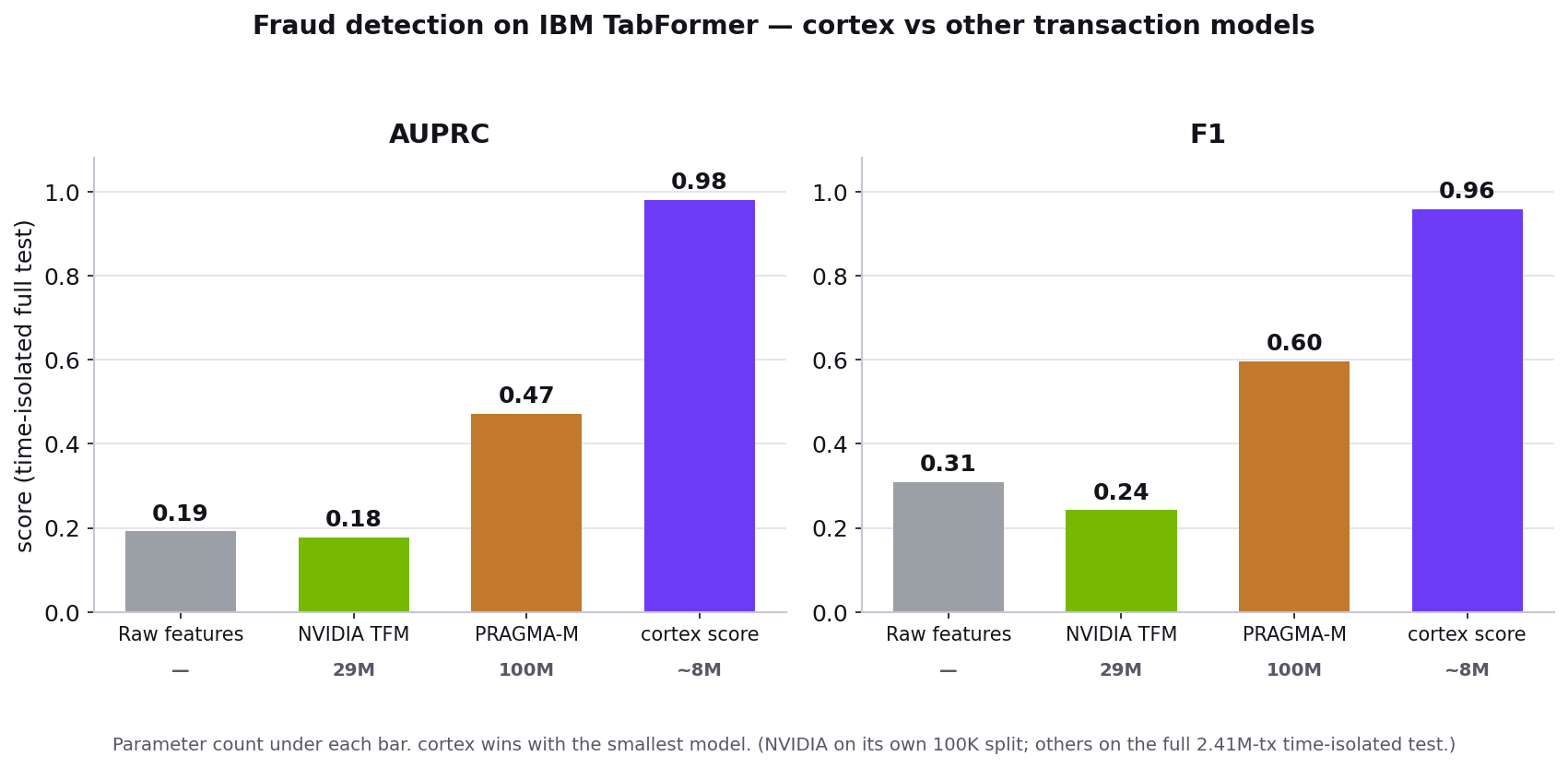
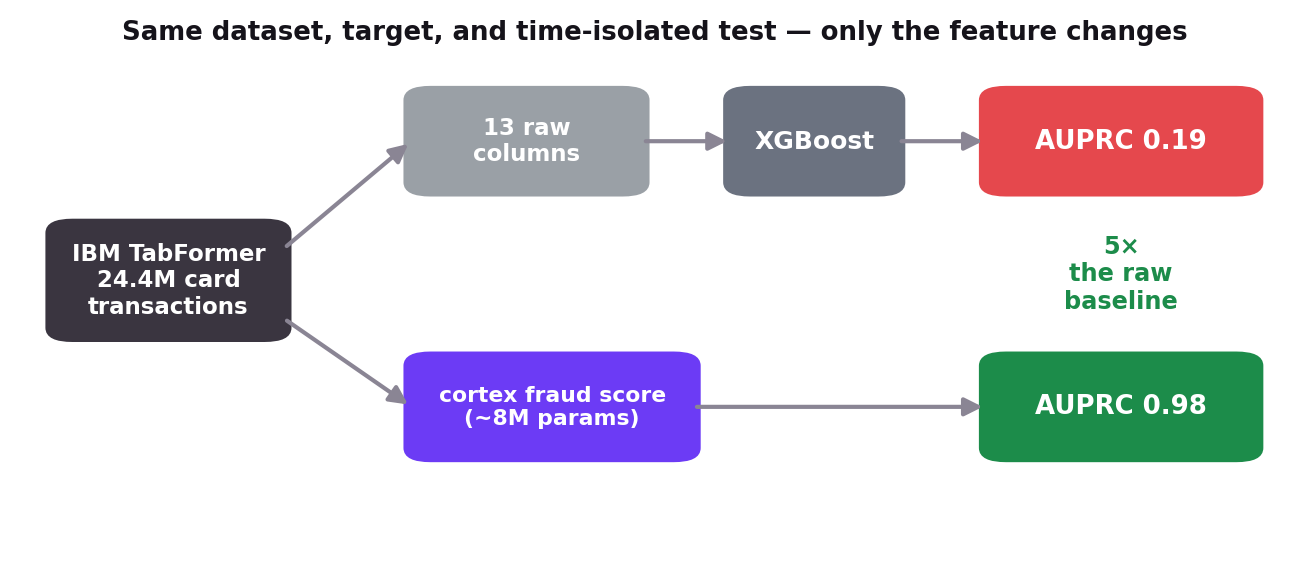
Cortex is NeoSpace's transaction language model. It reads a raw stream of card transactions and emits a per-transaction fraud score — a calibrated probability — directly, with no downstream classifier. On the full IBM TabFormer test, held out by time (train 1991–2017, test 2018–2020), that score reaches AUPRC 0.98 and F1 0.96 — far above the raw-feature baseline and the other transaction foundation models on the same task — from a ~8M-parameter model, several times smaller than the models it beats.
This repository is a runnable benchmark: it downloads the published per-transaction Cortex scores and recomputes the time-isolated fraud metrics live, so the headline numbers can be verified rather than taken on trust. Launch it in your browser with the Binder badge above — no install, no login, no GPU.
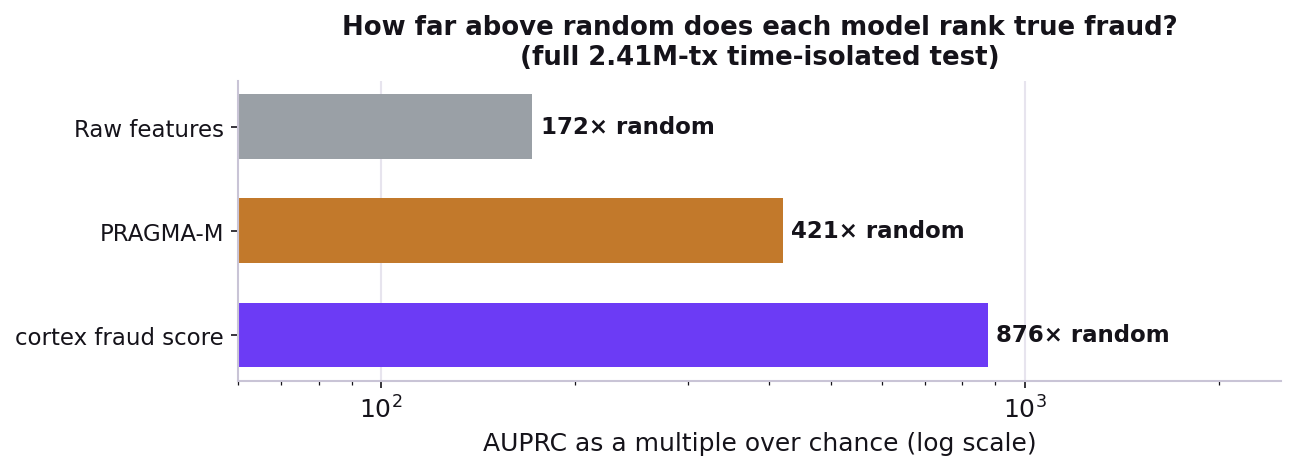
How to read this: fraud is ~0.11% of transactions, so a coin-flip classifier scores AUPRC ≈ 0.0011. The raw transaction columns reach ~170× that. Cortex's fraud score reaches ~875× random. We report AUPRC and F1 — at this prevalence AUROC saturates near 1.0 and can't separate good models from great ones.
Software Components
NeoSpace Technology
- Cortex — NeoSpace's transaction language model; emits a calibrated per-transaction fraud score directly (~8M parameters). The per-transaction scores it produces over the full IBM TabFormer dataset are published at embeddings.neospace.ai and consumed by this benchmark.
3rd-Party Software
- scikit-learn — AUPRC / precision-recall metrics for the evaluation
- pandas — dataframe interop while streaming the score shards
- NumPy — array operations for the score / label vectors
- PyArrow — reads the published Parquet score shards
Third-Party Software Notice. This project downloads published Cortex scores derived from the IBM TabFormer dataset and installs third-party open-source packages. Review their respective license terms before use.
Table of Contents
Quickstart
Run it in your browser — no install, no GPU. Two options:
- — no login. First launch builds the environment (~1–3 min; cached afterward).
- — faster, but requires a Google login to execute. Deps come pre-installed; the notebook fetches what it needs from this repo at runtime.
Then choose Run ▸ Run All Cells. The notebook downloads ~423 MB of published scores from embeddings.neospace.ai and computes the time-isolated metrics in a few seconds. Peak memory stays around ~0.5 GB.
Notebooks
| # | Notebook | Description |
|---|---|---|
| 1 | cortex_score.ipynb | Download the published per-transaction Cortex scores, recompute the fraud metrics on the full time-isolated IBM TabFormer test (AUPRC, F1, lift over random), and compare against the raw 13-feature XGBoost baseline. |
Run Locally
If you'd rather run outside Binder:
git clone https://github.com/neospace-ai/NeoLDMBenchmark.git
cd NeoLDMBenchmark
pip install -r requirements.txt
jupyter notebook        # open cortex_score.ipynb and "Run All"
On first run the scores are fetched into artifacts/scores/cortex_score/
(git-ignored). The full computation peaks around ~0.5 GB of RAM and takes a
few seconds once the data is downloaded.
Remote host? Forward the Jupyter port first —
ssh -L 8888:localhost:8888 user@host — then open the printed
http://localhost:8888/?token=… URL.
What It Computes
The test set is the entire held-out split, isolated by time: train on
1991–2017, evaluate on 2018–2020 — 2.41M transactions, ~2,700 fraud (0.11%)
— not a sample. Each row's fraud score is P(fraud) = softmax(is_fraud_logits)[1].
| Model | Readout | Parameters | AUPRC | F1 |
|---|---|---|---|---|
| Raw features | 13 columns → XGBoost | — | 0.19 | 0.31 |
| NVIDIA Transaction Foundation Model (own split) | embedding + raw → XGBoost | 29M | 0.18 | 0.24 |
| PRAGMA-M | embedding + raw → XGBoost | 100M | 0.47 | 0.60 |
| Cortex | fraud score (no raw needed) | ~8M | 0.98 | 0.96 |
Every model is shown at its strongest configuration. Cortex's score is a
standalone detector — a calibrated per-transaction probability fed straight to
the metric, with no downstream classifier. Numbers are read from the committed
results/fulltest_score.json, so they never drift from the benchmark.
Model Architecture
Cortex is a compact transaction language model: it reads each cardholder's raw transaction sequence in its native bucketed format and models the interactions between fields directly — the combinations (amount × merchant type × hour × location) where fraud actually surfaces — rather than relating fields only implicitly through general-purpose attention. Its output is a calibrated per-transaction fraud probability, so the score is the detector; there is no embedding-plus-classifier stack to build and maintain.
It reaches the strongest fraud detection on this benchmark while being the smallest model by a wide margin:
| Model | Parameters |
|---|---|
| Cortex | ~8M |
| NVIDIA TFM (Llama decoder) | 29M |
| Revolut PRAGMA-M (encoder-only) | 100M |
That's ~4× smaller than NVIDIA's model and ~12× smaller than PRAGMA-M — the result is the representation, not scale. Training Cortex is out of scope for this benchmark repository; it reproduces the evaluation from the published scores.
Dataset
IBM TabFormer — Padhi et al., Tabular Transformers for Modeling Multivariate Time Series (arXiv:2011.01843, github.com/IBM/TabFormer) — IBM's synthetic credit-card transaction dataset: 24,386,900 transactions, 2,000 cardholders, 1991–2020, 0.11% fraud. Evaluated on a strict time-isolated 80/10/10 split (train 1991–2017, validation 2017–2018, test 2018–2020).
The raw CSV is not redistributed here (IBM TabFormer terms). This benchmark uses
only the published per-transaction Cortex scores
(embeddings.neospace.ai), which carry the
columns needed for evaluation: timestamp__orig, is_fraud, is_fraud_logits.
Prerequisites
| Component | Requirement |
|---|---|
| Compute | CPU only — no GPU required |
| System RAM | ~2 GB (computation peaks ~0.5 GB) |
| Python | 3.10+ (Binder pins 3.11 via runtime.txt) |
| Network | ~423 MB download from embeddings.neospace.ai on first run |
| Dependencies | pandas, numpy, pyarrow, scikit-learn (see requirements.txt) |
License
Unless otherwise noted, the contents of this repository are licensed under the Apache License, Version 2.0.
The benchmark uses scores derived from the IBM TabFormer dataset, governed by its own terms. Third-party packages are governed by their respective licenses.
Contributors

2 commits
Similar repos


Languages
Python
51.0%
Jupyter Notebook
49.0%
README
NeoLDM Benchmark — Reproduce the Cortex Fraud Score
Financial transaction data is one of the richest signals in the enterprise. Every swipe, transfer, and payment encodes a pattern of behavior — daily spending habits, and the subtle shifts that precede fraud. Traditional fraud systems lean on hand-crafted features and rules: brittle, slow to adapt, and blind to the deep sequential structure of a transaction history. Transaction foundation models change the equation — pretrained on raw, unlabeled transaction sequences, they learn general representations of financial behavior that transfer to downstream tasks like fraud detection.
Cortex is NeoSpace's transaction language model. It reads a raw stream of card transactions and emits a per-transaction fraud score — a calibrated probability — directly, with no downstream classifier. On the full IBM TabFormer test, held out by time (train 1991–2017, test 2018–2020), that score reaches AUPRC 0.98 and F1 0.96 — far above the raw-feature baseline and the other transaction foundation models on the same task — from a ~8M-parameter model, several times smaller than the models it beats.
This repository is a runnable benchmark: it downloads the published per-transaction Cortex scores and recomputes the time-isolated fraud metrics live, so the headline numbers can be verified rather than taken on trust. Launch it in your browser with the Binder badge above — no install, no login, no GPU.
How to read this: fraud is ~0.11% of transactions, so a coin-flip classifier scores AUPRC ≈ 0.0011. The raw transaction columns reach ~170× that. Cortex's fraud score reaches ~875× random. We report AUPRC and F1 — at this prevalence AUROC saturates near 1.0 and can't separate good models from great ones.
Software Components
NeoSpace Technology
- Cortex — NeoSpace's transaction language model; emits a calibrated per-transaction fraud score directly (~8M parameters). The per-transaction scores it produces over the full IBM TabFormer dataset are published at embeddings.neospace.ai and consumed by this benchmark.
3rd-Party Software
- scikit-learn — AUPRC / precision-recall metrics for the evaluation
- pandas — dataframe interop while streaming the score shards
- NumPy — array operations for the score / label vectors
- PyArrow — reads the published Parquet score shards
Third-Party Software Notice. This project downloads published Cortex scores derived from the IBM TabFormer dataset and installs third-party open-source packages. Review their respective license terms before use.
Table of Contents
Quickstart
Run it in your browser — no install, no GPU. Two options:
- — no login. First launch builds the environment (~1–3 min; cached afterward).
- — faster, but requires a Google login to execute. Deps come pre-installed; the notebook fetches what it needs from this repo at runtime.
Then choose Run ▸ Run All Cells. The notebook downloads ~423 MB of published scores from embeddings.neospace.ai and computes the time-isolated metrics in a few seconds. Peak memory stays around ~0.5 GB.
Notebooks
| # | Notebook | Description |
|---|---|---|
| 1 | cortex_score.ipynb | Download the published per-transaction Cortex scores, recompute the fraud metrics on the full time-isolated IBM TabFormer test (AUPRC, F1, lift over random), and compare against the raw 13-feature XGBoost baseline. |
Run Locally
If you'd rather run outside Binder:
git clone https://github.com/neospace-ai/NeoLDMBenchmark.git
cd NeoLDMBenchmark
pip install -r requirements.txt
jupyter notebook        # open cortex_score.ipynb and "Run All"
On first run the scores are fetched into artifacts/scores/cortex_score/
(git-ignored). The full computation peaks around ~0.5 GB of RAM and takes a
few seconds once the data is downloaded.
Remote host? Forward the Jupyter port first —
ssh -L 8888:localhost:8888 user@host — then open the printed
http://localhost:8888/?token=… URL.
What It Computes
The test set is the entire held-out split, isolated by time: train on
1991–2017, evaluate on 2018–2020 — 2.41M transactions, ~2,700 fraud (0.11%)
— not a sample. Each row's fraud score is P(fraud) = softmax(is_fraud_logits)[1].
| Model | Readout | Parameters | AUPRC | F1 |
|---|---|---|---|---|
| Raw features | 13 columns → XGBoost | — | 0.19 | 0.31 |
| NVIDIA Transaction Foundation Model (own split) | embedding + raw → XGBoost | 29M | 0.18 | 0.24 |
| PRAGMA-M | embedding + raw → XGBoost | 100M | 0.47 | 0.60 |
| Cortex | fraud score (no raw needed) | ~8M | 0.98 | 0.96 |
Every model is shown at its strongest configuration. Cortex's score is a
standalone detector — a calibrated per-transaction probability fed straight to
the metric, with no downstream classifier. Numbers are read from the committed
results/fulltest_score.json, so they never drift from the benchmark.
Model Architecture
Cortex is a compact transaction language model: it reads each cardholder's raw transaction sequence in its native bucketed format and models the interactions between fields directly — the combinations (amount × merchant type × hour × location) where fraud actually surfaces — rather than relating fields only implicitly through general-purpose attention. Its output is a calibrated per-transaction fraud probability, so the score is the detector; there is no embedding-plus-classifier stack to build and maintain.
It reaches the strongest fraud detection on this benchmark while being the smallest model by a wide margin:
| Model | Parameters |
|---|---|
| Cortex | ~8M |
| NVIDIA TFM (Llama decoder) | 29M |
| Revolut PRAGMA-M (encoder-only) | 100M |
That's ~4× smaller than NVIDIA's model and ~12× smaller than PRAGMA-M — the result is the representation, not scale. Training Cortex is out of scope for this benchmark repository; it reproduces the evaluation from the published scores.
Dataset
IBM TabFormer — Padhi et al., Tabular Transformers for Modeling Multivariate Time Series (arXiv:2011.01843, github.com/IBM/TabFormer) — IBM's synthetic credit-card transaction dataset: 24,386,900 transactions, 2,000 cardholders, 1991–2020, 0.11% fraud. Evaluated on a strict time-isolated 80/10/10 split (train 1991–2017, validation 2017–2018, test 2018–2020).
The raw CSV is not redistributed here (IBM TabFormer terms). This benchmark uses
only the published per-transaction Cortex scores
(embeddings.neospace.ai), which carry the
columns needed for evaluation: timestamp__orig, is_fraud, is_fraud_logits.
Prerequisites
| Component | Requirement |
|---|---|
| Compute | CPU only — no GPU required |
| System RAM | ~2 GB (computation peaks ~0.5 GB) |
| Python | 3.10+ (Binder pins 3.11 via runtime.txt) |
| Network | ~423 MB download from embeddings.neospace.ai on first run |
| Dependencies | pandas, numpy, pyarrow, scikit-learn (see requirements.txt) |
License
Unless otherwise noted, the contents of this repository are licensed under the Apache License, Version 2.0.
The benchmark uses scores derived from the IBM TabFormer dataset, governed by its own terms. Third-party packages are governed by their respective licenses.
Similar repos
Contributors
2 commits
Languages
Python
51.0%
Jupyter Notebook
49.0%