
README


navis-flybrains
Transforms to map between different Drosophila template brains and datasets. Intended to be used with navis.
This library is analogous to Greg Jefferis' nat.templatebrains, nat.jrcbrains and nat.flybrains for R.
flybrains ships with:
- meta data + surface meshes for 31 light-level templates and connectome datasets
- Elastix transforms from/to the
FANCandBANCconnectomes and template spaces (by Jasper Phelps) - various landmark-based transforms (e.g. between
MANCandFANCor betweenBANCandFLYWIRE) - mirror transforms for many brain spaces/datasets (e.g.
FAFB14,FANCandBANC)
[!IMPORTANT] There are many additional transforms that need to be downloaded separately as a one-off (see below).
Installation
You can install flybrains from PyPI:
pip3 install flybrains
To install the dev version from Github:
pip3 install git+https://github.com/navis-org/navis-flybrains.git
External dependencies
In order to use the Jefferis lab or VFB transforms, you will need to have CMTK installed.
For FANC and BANC transforms, you will need to download
elastix and make sure that the path
to the binaries is in your PATH variable.
Usage
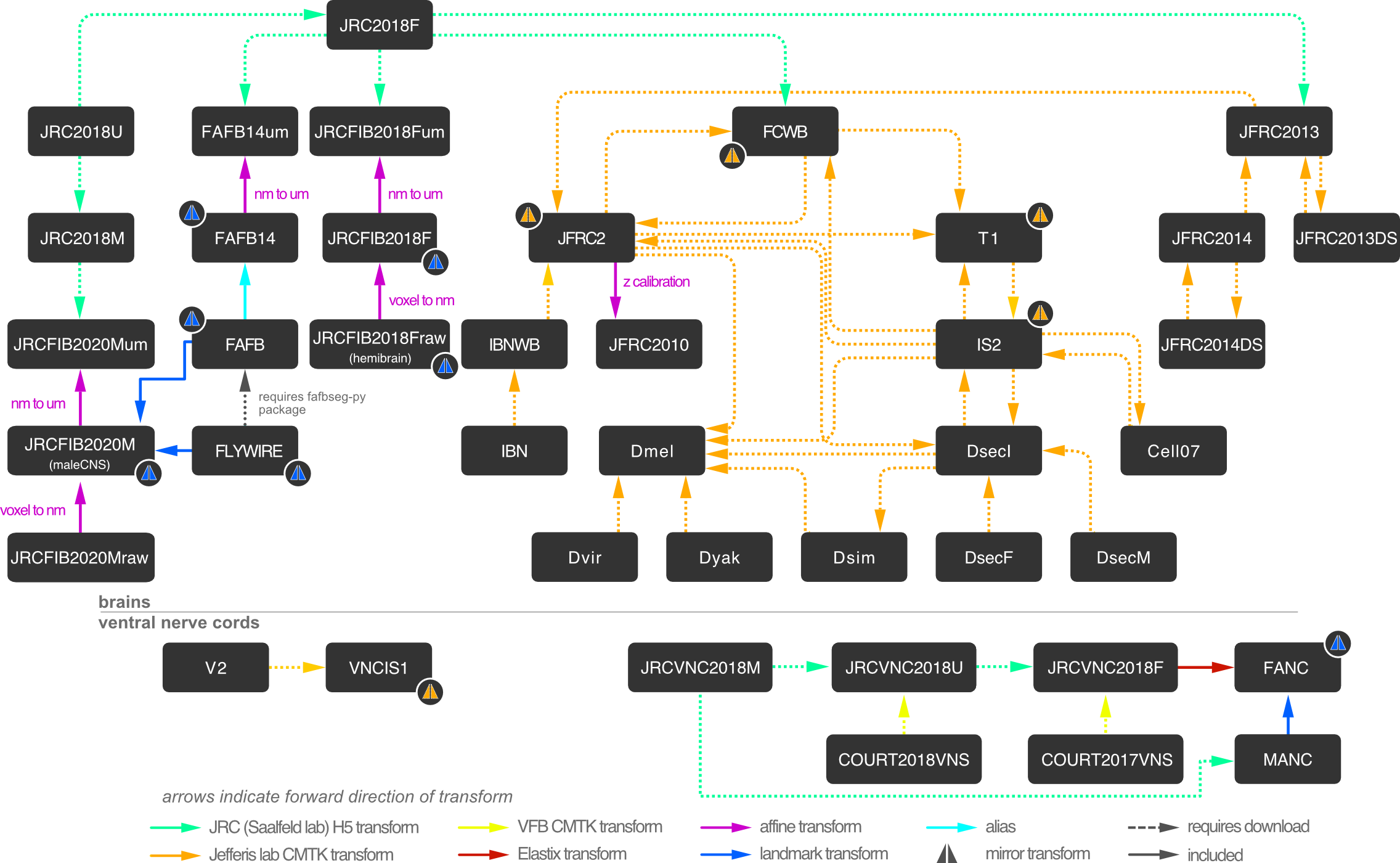
It's highly recommended that after install, you download the (optional) bridging transforms to map between template brains/nerve cords.
[!TIP] If you already have downloaded these registrations via
nat.jrcbrainsand/ornat.flybrainsyou can skip this:flybrainsshould be able to find the registrations downloaded via R and register them for you. See also code below for generating a report of available transforms.
>>> import flybrains

# This downloads (or updates) various CMTK bridging and mirror transforms
# generated or collated by the Jefferis lab - see docstring for details
>>> flybrains.download_jefferislab_transforms()

# This downloads H5 bridging transforms between Janelia brain datasets
# (templates and connectomes) - see docstring for details
>>> flybrains.download_jrc_transforms()

# This downloads H5 bridging transforms between Janelia ventral nerve cord (VNC)
# datasets (templates and connectomes) - see docstring for details
>>> flybrains.download_jrc_vnc_transforms()

# This downloads (or updates) various CMTK bridging and mirror transforms
# generated or collated by VirtualFlyBrain.org - see docstring for details
>>> flybrains.download_vfb_transforms()

# Register the transforms - this is only necessary if you just downloaded them.
# Alternatively, just restart your Python session and import flybrains again.
>>> flybrains.register_transforms()
[!CAUTION] The URL for the JRC2018F <-> JRC2018M transform (
JRC2018U_JRC2018M.h5) was incorrect inflybrainsversion0.2.6. If you downloaded it using that version of flybrains you need to manually remove the file, update flybrains and download again using a newer version.
In the future, simply importing flybrains is sufficient to make the
transforms available to navis:
>>> import navis
>>> import flybrains
>>> import numpy as np
>>> points = np.array([[429536, 205240,  38400]])
>>> navis.xform_brain(points, source='FAFB', target='JRC2018F')
array([[241.53969657, 100.99399233,  35.96977733]])
Please see the transform tutorial
for navis to learn how to transform more complex data.
To check which transforms are available (either downloaded or via R) you can run this:
>>> # Generate a report - note the mix of transforms downloaded via Python and R
>>> flybrains.report()
Flybrains Status Report
=======================
Data Home: /Users/philipps/flybrain-data

CMTK registrations (Jefferis lab/VFB): 45 of 45
H5 registrations (JRC/Saalfeld lab): 11 of 11

nat regdirs
-----------
~/Library/Application Support/rpkg-nat.templatebrains/regfolders: 41 CMTK | 0 H5 transforms
/Library/Frameworks/R.framework/Versions/3.6/Resources/library/nat.flybrains/extdata/bridgingregistrations: 5 CMTK | 0 H5 transforms
/Library/Frameworks/R.framework/Versions/3.6/Resources/library/nat.flybrains/extdata/mirroringregistrations: 5 CMTK | 0 H5 transforms
~/Library/Application Support/R/nat.jrcbrains: 0 CMTK | 5 H5 transforms
Meta data and surface meshes for the template brains/VNCs are readily accessible:
>>> flybrains.FAFB14
Template brain
--------------
Name: Full Adult Fly Brain
Short Name: FAFB14
Type: None
Sex:  female
Dimensions: 165372 x 80745 x 6730 voxels
Voxel size:
  x = 4 nanometers
  y = 4 nanometers
  z = 40 nanometers
Bounding box (nanometers):
  x = 192200, y = 75853, z = 2007,
  x = 853686, y = 398832, z = 271205,
Description: SSTEM volume comprising an entire female Drosophila brain was imaged at
 4x4x40nm by Zheng et al. (2018) and is availabe for download at
https://temca2data.org/. The meta data and associated mesh represent
version 14 (FAFB14) of this data set.
DOI: 10.1016/j.cell.2018.06.019
Most templates come with a mesh e.g. for plotting via navis:
>>> flybrains.FAFB14.mesh
<trimesh.Trimesh(vertices.shape=(25047, 3), faces.shape=(50416, 3))>
>>> # You can pass the template object directly to navis' plotting functions
>>> navis.plot3d(flybrains.FAFB14)
Changes
0.6.0(29/10/25):- added the BANC (brain and nerve cord) connectome: template, meshes, transforms to/from JFCR2018F and maleCNS, mirror transform
- fix normals for the Male CNS VNC mesh
0.5.2(08/08/25):- renamed
JRCFIB2022Mtilt->JRCFIB2022Mplot - improved
JRCFIB2022Mplottransform to also correct for a tilt along the z-axis
- renamed
0.5.1(17/07/25):- small fix for FANC transform weights
0.5.0(17/07/25):- added a
JRCFIB2022Mtiltmesh + transform where the VNC is tilted forward for visualization - reduced weights for internal FANC transform (fixes #15)
- added a
0.4.0(19/05/25):- improved the
FLYWIRE/FAFB14<->JRCFIB2022M(maleCNS) transform - added support for two-step CMTK transforms
- improved the
0.3.0(01/08/24):- potentially breaking as it may change transform paths:
- weights for
AliasTransformsare now set to 0 (i.e. no cost) - weights for simple
AffineTransformsare set to 0.1
- weights for
- improved the mirror transforms for
FAFB14andFLYWIREbased on a newJRC2018F-FLYWIRECMTK transform (S. Cachero, Jefferis lab) - added a symmetrizing transform for
FLYWIRE - added VNC mesh to
JRCFIB2022M; it now has.mesh,.mesh_brain,.mesh_vnc - fixed stray vertex in
FLYWIRE.mesh_whole_brain - some under-the-hood refactoring
- potentially breaking as it may change transform paths:
0.2.11(23/07/24): fixed bounding box forJRCFIB2022Mraw0.2.10(16/04/24):- added download for
JRCFIB2022M(maleCNS) <->JRC2018Mtransform (via Saalfeld lab) - added mirror transform for
JRCFIB2022M(maleCNS) - dropped VFB transforms between JRC VNC templates (use Saalfeld transforms instead)
- added download for
0.2.9(08/08/23): added MANC template brain and transform to/fromJRCVNC2018M0.2.8(02/04/23): added transform betweenJRCFIB2022M(maleCNS) andFLYWIRE0.2.7(05/01/23): fixedJRC2018M<->JRC2018Utransform download0.2.6(06/09/22): addedJRC2018M<->JRC2018Utransform0.2.5(22/05/22): addedJRCFIB2022Mmesh and transform to/fromFAFB140.2.4(12/05/22): addedFLYWIREtemplate brain and landmark-based mirror transform0.2.0(02/02/22): added VirtualFlyBrain.org's (CMTK) and Janelia's (H5) VNC transforms; renamed some download function0.1.14(21/10/21): addedFANC<->JRCVNC2018Ftransform (requires Elastix and navis >=1.0.0)0.1.13(14/10/21): add template and mirror transform for FANC0.1.12(18/09/21): fixed directionality of Jefferis lab CMTK transforms0.1.11(02/08/21): make downloads work if file size unknown0.1.10(01/08/21): fix bug that led to warnings during transform registration on Windows systems0.1.9(05/05/21): fixed mesh normals; fixed JRCFIB2018F units to nm and added JRCFIB2018Fum template;0.1.8(10/04/21): add a simple symmetrization transform for FAFB:FAFB14sym0.1.7(30/03/21): better deal with systems without nat libraries0.1.6(25/03/21): fix bug that led to excessive recursive scanning of directories0.1.5(03/03/21): fix bug that led to meshes not being packaged0.1.4(24/02/21): added "hemibrain" alias for "JRCFIB2018F"; added hemibrain bounding box mesh0.1.3(12/01/21): improved the warp mirror registration forFAFB140.1.2(10/01/21): added a warp mirror registration forFAFB140.1.1(06/01/21): addedum(for microns) suffix toJRCFIB2018Ftransforms; added affineJRCFIB2018Fraw->JRCFIB2018F->JRCFIB2018Fumtransforms0.1.0(03/01/21): first working version
Contributing
Contributions are very welcome! Want to use navis-flybrains to distribute your own transforms, meshes or
templates? Found a bug, bad transform or incorrect information? Feel free to open a pull request or an issue
to discuss details!
Acknowledgements
navis-flybrains is critically based on nat.flybrains and nat.jrcbrains by Greg Jefferis
et al. for both inspiration regarding the implementation as well as template brain meta data.
Citing
If you use navis-flybrains in your research please make sure to cite us
(see Zenodo DOI badge at the top of this page), navis and
most importantly the people who generated the meshes & registrations distributed with flybrains!
As reference for the Jefferis lab registrations please use:
The natverse, a versatile toolbox for combining and analysing neuroanatomical data.
A.S. Bates, J.D. Manton, S.R. Jagannathan, M. Costa, P. Schlegel, T. Rohlfing, G.S. Jefferis
eLife (2020); doi: https://doi:10.7554/eLife.53350
As (partial) reference for the Saalfeld lab registrations please see:
An unbiased template of the Drosophila brain and ventral nerve cord.
John A Bogovic, Hideo Otsuna, Larissa Heinrich, Masayoshi Ito, Jennifer Jeter, Geoffrey Meissner, Aljoscha Nern, Jennifer Colonell, Oz Malkesman, Kei Ito, Stephan Saalfeld
PLOS One (2018); doi: https://doi.org/10.1371/journal.pone.0236495
As reference for the JRCFIB022M registrations please use:
Sexual dimorphism in the complete connectome of the Drosophila male central nervous system
Stuart Berg, Isabella R Beckett, Marta Costa, Philipp Schlegel, [...] Gerald M Rubin, Gregory SXE Jefferis
bioRxiv 2025.10.09.680999; doi: https://doi.org/10.1101/2025.10.09.680999
As reference for the VFB CMTK transforms please use:
A Systematic Nomenclature for the Drosophila Ventral Nerve Cord.
Robert Court, Shigehiro Namiki, J. Douglas Armstrong, Jana Börner, Gwyneth Card, Marta Costa, Michael Dickinson, Carsten Duch, Wyatt Korff, Richard Mann, David Merritt, Rod K. Murphey, Andrew M. Seeds, Troy Shirangi, Julie H. Simpson, James W. Truman, John C. Tuthill, Darren W. Williams, David Shepherd
Neuron (2020); doi: https://doi.org/10.1016/j.neuron.2020.08.005.
As reference for the FANC<->JRCVNC2018F transform by Jasper Phelps please use:
Reconstruction of motor control circuits in adult Drosophila using automated transmission electron microscopy.
Phelps JS, Hildebrand DGC, Graham BJ, Kuan AT, Thomas LA, Nguyen TM, Buhmann J, Azevedo AW, Sustar A, Agrawal S, Liu M, Shanny BL, Funke J, Tuthill JC, Lee WA
Cell (2021); doi: 10.1016/j.cell.2020.12.013
As reference for the BANC<->JRC2018F/JRCVNC2018F transforms by Jasper Phelps please use:
Distributed control circuits across a brain-and-cord connectome
Alexander Shakeel Bates, Jasper S. Phelps, Minsu Kim, Helen H. Yang, [...] Rachel I. Wilson, Wei-Chung Allen Lee
bioRxiv 2025.07.31.667571; doi: https://doi.org/10.1101/2025.07.31.667571
For references on individual template brains, please see their docstrings:
>>> help(flybrains.IBN)
When in doubt, feel free to open an issue to ask for advice.
Troubleshooting
OSError when reading HDF5 deformation fields
OSError: Can't synchronously read data (minimum number of bits exceeds size of type)
This error is likely caused by an incompatability between the hdf5 version on your machine and the one used
to encode the data files. For example, on my MacBook with h5py 3.12.1 and HDF5 1.12.2 it works just fine
but on a Linux machine with h5py 3.12.1 and HDF5 1.14.4 I get the above error.
My current workaround is to create a new conda environment to force an older hdf5 version:
conda create -n hdf5_112 \
  -c conda-forge \
  python=3.11 \
  hdf5=1.12.* \
  h5py=3.12.1
Downloads fail on Google Colab (and other cloud machines)
download_jrc_transforms and download_jrc_vnc_transforms fetch their H5 files from figshare.
On Google Colab - and likely on other cloud VMs, CI runners or compute clusters - these downloads
tend to fail with an HTTPError:
requests.exceptions.HTTPError: Server returned an HTML page instead of a file for
https://ndownloader.figshare.com/files/... This typically means the request was blocked [...]
The figshare download endpoint sits behind a web application firewall which appears to refuse requests coming from datacenter IP ranges. The request never reaches figshare itself, so there is nothing to fix on our end: no combination of headers, retries or tokens will get past it. You can confirm this is what you are seeing by checking which server answers:
!curl -sL "https://ndownloader.figshare.com/files/42106125" -o /dev/null -D - -r 0-99 | head
A 403 with server: awselb/2.0 and no location: header means you have been blocked.
Colab hands out a different IP for every session, so restarting the runtime and trying again is
worth a shot. If that doesn't help, download the transforms on a machine that does work, copy
them to Google Drive, and point flybrains at that directory:
import os
from google.colab import drive
drive.mount('/content/drive')

# NOTE: this must be set *before* importing flybrains
os.environ['FLYBRAINS_DATA'] = '/content/drive/MyDrive/flybrain-data'

import flybrains
The environment variable has to be set first because flybrains registers the transforms at import.
Note that a failed download will never leave a partial or corrupt file behind: incomplete downloads
are kept as .part files and only moved into place once complete. If you are on an older version of
flybrains this was not the case - check for suspiciously small .h5 files in your data directory
(they should be at least ~100Mb each) and delete them.
Contributors

197 commits

28 commits
Similar repos


Languages
Jupyter Notebook
70.1%
Python
29.9%
README
navis-flybrains
Transforms to map between different Drosophila template brains and datasets. Intended to be used with navis.
This library is analogous to Greg Jefferis' nat.templatebrains, nat.jrcbrains and nat.flybrains for R.
flybrains ships with:
- meta data + surface meshes for 31 light-level templates and connectome datasets
- Elastix transforms from/to the
FANCandBANCconnectomes and template spaces (by Jasper Phelps) - various landmark-based transforms (e.g. between
MANCandFANCor betweenBANCandFLYWIRE) - mirror transforms for many brain spaces/datasets (e.g.
FAFB14,FANCandBANC)
[!IMPORTANT] There are many additional transforms that need to be downloaded separately as a one-off (see below).
Installation
You can install flybrains from PyPI:
pip3 install flybrains
To install the dev version from Github:
pip3 install git+https://github.com/navis-org/navis-flybrains.git
External dependencies
In order to use the Jefferis lab or VFB transforms, you will need to have CMTK installed.
For FANC and BANC transforms, you will need to download
elastix and make sure that the path
to the binaries is in your PATH variable.
Usage
It's highly recommended that after install, you download the (optional) bridging transforms to map between template brains/nerve cords.
[!TIP] If you already have downloaded these registrations via
nat.jrcbrainsand/ornat.flybrainsyou can skip this:flybrainsshould be able to find the registrations downloaded via R and register them for you. See also code below for generating a report of available transforms.
>>> import flybrains

# This downloads (or updates) various CMTK bridging and mirror transforms
# generated or collated by the Jefferis lab - see docstring for details
>>> flybrains.download_jefferislab_transforms()

# This downloads H5 bridging transforms between Janelia brain datasets
# (templates and connectomes) - see docstring for details
>>> flybrains.download_jrc_transforms()

# This downloads H5 bridging transforms between Janelia ventral nerve cord (VNC)
# datasets (templates and connectomes) - see docstring for details
>>> flybrains.download_jrc_vnc_transforms()

# This downloads (or updates) various CMTK bridging and mirror transforms
# generated or collated by VirtualFlyBrain.org - see docstring for details
>>> flybrains.download_vfb_transforms()

# Register the transforms - this is only necessary if you just downloaded them.
# Alternatively, just restart your Python session and import flybrains again.
>>> flybrains.register_transforms()
[!CAUTION] The URL for the JRC2018F <-> JRC2018M transform (
JRC2018U_JRC2018M.h5) was incorrect inflybrainsversion0.2.6. If you downloaded it using that version of flybrains you need to manually remove the file, update flybrains and download again using a newer version.
In the future, simply importing flybrains is sufficient to make the
transforms available to navis:
>>> import navis
>>> import flybrains
>>> import numpy as np
>>> points = np.array([[429536, 205240,  38400]])
>>> navis.xform_brain(points, source='FAFB', target='JRC2018F')
array([[241.53969657, 100.99399233,  35.96977733]])
Please see the transform tutorial
for navis to learn how to transform more complex data.
To check which transforms are available (either downloaded or via R) you can run this:
>>> # Generate a report - note the mix of transforms downloaded via Python and R
>>> flybrains.report()
Flybrains Status Report
=======================
Data Home: /Users/philipps/flybrain-data

CMTK registrations (Jefferis lab/VFB): 45 of 45
H5 registrations (JRC/Saalfeld lab): 11 of 11

nat regdirs
-----------
~/Library/Application Support/rpkg-nat.templatebrains/regfolders: 41 CMTK | 0 H5 transforms
/Library/Frameworks/R.framework/Versions/3.6/Resources/library/nat.flybrains/extdata/bridgingregistrations: 5 CMTK | 0 H5 transforms
/Library/Frameworks/R.framework/Versions/3.6/Resources/library/nat.flybrains/extdata/mirroringregistrations: 5 CMTK | 0 H5 transforms
~/Library/Application Support/R/nat.jrcbrains: 0 CMTK | 5 H5 transforms
Meta data and surface meshes for the template brains/VNCs are readily accessible:
>>> flybrains.FAFB14
Template brain
--------------
Name: Full Adult Fly Brain
Short Name: FAFB14
Type: None
Sex:  female
Dimensions: 165372 x 80745 x 6730 voxels
Voxel size:
  x = 4 nanometers
  y = 4 nanometers
  z = 40 nanometers
Bounding box (nanometers):
  x = 192200, y = 75853, z = 2007,
  x = 853686, y = 398832, z = 271205,
Description: SSTEM volume comprising an entire female Drosophila brain was imaged at
 4x4x40nm by Zheng et al. (2018) and is availabe for download at
https://temca2data.org/. The meta data and associated mesh represent
version 14 (FAFB14) of this data set.
DOI: 10.1016/j.cell.2018.06.019
Most templates come with a mesh e.g. for plotting via navis:
>>> flybrains.FAFB14.mesh
<trimesh.Trimesh(vertices.shape=(25047, 3), faces.shape=(50416, 3))>
>>> # You can pass the template object directly to navis' plotting functions
>>> navis.plot3d(flybrains.FAFB14)
Changes
0.6.0(29/10/25):- added the BANC (brain and nerve cord) connectome: template, meshes, transforms to/from JFCR2018F and maleCNS, mirror transform
- fix normals for the Male CNS VNC mesh
0.5.2(08/08/25):- renamed
JRCFIB2022Mtilt->JRCFIB2022Mplot - improved
JRCFIB2022Mplottransform to also correct for a tilt along the z-axis
- renamed
0.5.1(17/07/25):- small fix for FANC transform weights
0.5.0(17/07/25):- added a
JRCFIB2022Mtiltmesh + transform where the VNC is tilted forward for visualization - reduced weights for internal FANC transform (fixes #15)
- added a
0.4.0(19/05/25):- improved the
FLYWIRE/FAFB14<->JRCFIB2022M(maleCNS) transform - added support for two-step CMTK transforms
- improved the
0.3.0(01/08/24):- potentially breaking as it may change transform paths:
- weights for
AliasTransformsare now set to 0 (i.e. no cost) - weights for simple
AffineTransformsare set to 0.1
- weights for
- improved the mirror transforms for
FAFB14andFLYWIREbased on a newJRC2018F-FLYWIRECMTK transform (S. Cachero, Jefferis lab) - added a symmetrizing transform for
FLYWIRE - added VNC mesh to
JRCFIB2022M; it now has.mesh,.mesh_brain,.mesh_vnc - fixed stray vertex in
FLYWIRE.mesh_whole_brain - some under-the-hood refactoring
- potentially breaking as it may change transform paths:
0.2.11(23/07/24): fixed bounding box forJRCFIB2022Mraw0.2.10(16/04/24):- added download for
JRCFIB2022M(maleCNS) <->JRC2018Mtransform (via Saalfeld lab) - added mirror transform for
JRCFIB2022M(maleCNS) - dropped VFB transforms between JRC VNC templates (use Saalfeld transforms instead)
- added download for
0.2.9(08/08/23): added MANC template brain and transform to/fromJRCVNC2018M0.2.8(02/04/23): added transform betweenJRCFIB2022M(maleCNS) andFLYWIRE0.2.7(05/01/23): fixedJRC2018M<->JRC2018Utransform download0.2.6(06/09/22): addedJRC2018M<->JRC2018Utransform0.2.5(22/05/22): addedJRCFIB2022Mmesh and transform to/fromFAFB140.2.4(12/05/22): addedFLYWIREtemplate brain and landmark-based mirror transform0.2.0(02/02/22): added VirtualFlyBrain.org's (CMTK) and Janelia's (H5) VNC transforms; renamed some download function0.1.14(21/10/21): addedFANC<->JRCVNC2018Ftransform (requires Elastix and navis >=1.0.0)0.1.13(14/10/21): add template and mirror transform for FANC0.1.12(18/09/21): fixed directionality of Jefferis lab CMTK transforms0.1.11(02/08/21): make downloads work if file size unknown0.1.10(01/08/21): fix bug that led to warnings during transform registration on Windows systems0.1.9(05/05/21): fixed mesh normals; fixed JRCFIB2018F units to nm and added JRCFIB2018Fum template;0.1.8(10/04/21): add a simple symmetrization transform for FAFB:FAFB14sym0.1.7(30/03/21): better deal with systems without nat libraries0.1.6(25/03/21): fix bug that led to excessive recursive scanning of directories0.1.5(03/03/21): fix bug that led to meshes not being packaged0.1.4(24/02/21): added "hemibrain" alias for "JRCFIB2018F"; added hemibrain bounding box mesh0.1.3(12/01/21): improved the warp mirror registration forFAFB140.1.2(10/01/21): added a warp mirror registration forFAFB140.1.1(06/01/21): addedum(for microns) suffix toJRCFIB2018Ftransforms; added affineJRCFIB2018Fraw->JRCFIB2018F->JRCFIB2018Fumtransforms0.1.0(03/01/21): first working version
Contributing
Contributions are very welcome! Want to use navis-flybrains to distribute your own transforms, meshes or
templates? Found a bug, bad transform or incorrect information? Feel free to open a pull request or an issue
to discuss details!
Acknowledgements
navis-flybrains is critically based on nat.flybrains and nat.jrcbrains by Greg Jefferis
et al. for both inspiration regarding the implementation as well as template brain meta data.
Citing
If you use navis-flybrains in your research please make sure to cite us
(see Zenodo DOI badge at the top of this page), navis and
most importantly the people who generated the meshes & registrations distributed with flybrains!
As reference for the Jefferis lab registrations please use:
The natverse, a versatile toolbox for combining and analysing neuroanatomical data.
A.S. Bates, J.D. Manton, S.R. Jagannathan, M. Costa, P. Schlegel, T. Rohlfing, G.S. Jefferis
eLife (2020); doi: https://doi:10.7554/eLife.53350
As (partial) reference for the Saalfeld lab registrations please see:
An unbiased template of the Drosophila brain and ventral nerve cord.
John A Bogovic, Hideo Otsuna, Larissa Heinrich, Masayoshi Ito, Jennifer Jeter, Geoffrey Meissner, Aljoscha Nern, Jennifer Colonell, Oz Malkesman, Kei Ito, Stephan Saalfeld
PLOS One (2018); doi: https://doi.org/10.1371/journal.pone.0236495
As reference for the JRCFIB022M registrations please use:
Sexual dimorphism in the complete connectome of the Drosophila male central nervous system
Stuart Berg, Isabella R Beckett, Marta Costa, Philipp Schlegel, [...] Gerald M Rubin, Gregory SXE Jefferis
bioRxiv 2025.10.09.680999; doi: https://doi.org/10.1101/2025.10.09.680999
As reference for the VFB CMTK transforms please use:
A Systematic Nomenclature for the Drosophila Ventral Nerve Cord.
Robert Court, Shigehiro Namiki, J. Douglas Armstrong, Jana Börner, Gwyneth Card, Marta Costa, Michael Dickinson, Carsten Duch, Wyatt Korff, Richard Mann, David Merritt, Rod K. Murphey, Andrew M. Seeds, Troy Shirangi, Julie H. Simpson, James W. Truman, John C. Tuthill, Darren W. Williams, David Shepherd
Neuron (2020); doi: https://doi.org/10.1016/j.neuron.2020.08.005.
As reference for the FANC<->JRCVNC2018F transform by Jasper Phelps please use:
Reconstruction of motor control circuits in adult Drosophila using automated transmission electron microscopy.
Phelps JS, Hildebrand DGC, Graham BJ, Kuan AT, Thomas LA, Nguyen TM, Buhmann J, Azevedo AW, Sustar A, Agrawal S, Liu M, Shanny BL, Funke J, Tuthill JC, Lee WA
Cell (2021); doi: 10.1016/j.cell.2020.12.013
As reference for the BANC<->JRC2018F/JRCVNC2018F transforms by Jasper Phelps please use:
Distributed control circuits across a brain-and-cord connectome
Alexander Shakeel Bates, Jasper S. Phelps, Minsu Kim, Helen H. Yang, [...] Rachel I. Wilson, Wei-Chung Allen Lee
bioRxiv 2025.07.31.667571; doi: https://doi.org/10.1101/2025.07.31.667571
For references on individual template brains, please see their docstrings:
>>> help(flybrains.IBN)
When in doubt, feel free to open an issue to ask for advice.
Troubleshooting
OSError when reading HDF5 deformation fields
OSError: Can't synchronously read data (minimum number of bits exceeds size of type)
This error is likely caused by an incompatability between the hdf5 version on your machine and the one used
to encode the data files. For example, on my MacBook with h5py 3.12.1 and HDF5 1.12.2 it works just fine
but on a Linux machine with h5py 3.12.1 and HDF5 1.14.4 I get the above error.
My current workaround is to create a new conda environment to force an older hdf5 version:
conda create -n hdf5_112 \
  -c conda-forge \
  python=3.11 \
  hdf5=1.12.* \
  h5py=3.12.1
Downloads fail on Google Colab (and other cloud machines)
download_jrc_transforms and download_jrc_vnc_transforms fetch their H5 files from figshare.
On Google Colab - and likely on other cloud VMs, CI runners or compute clusters - these downloads
tend to fail with an HTTPError:
requests.exceptions.HTTPError: Server returned an HTML page instead of a file for
https://ndownloader.figshare.com/files/... This typically means the request was blocked [...]
The figshare download endpoint sits behind a web application firewall which appears to refuse requests coming from datacenter IP ranges. The request never reaches figshare itself, so there is nothing to fix on our end: no combination of headers, retries or tokens will get past it. You can confirm this is what you are seeing by checking which server answers:
!curl -sL "https://ndownloader.figshare.com/files/42106125" -o /dev/null -D - -r 0-99 | head
A 403 with server: awselb/2.0 and no location: header means you have been blocked.
Colab hands out a different IP for every session, so restarting the runtime and trying again is
worth a shot. If that doesn't help, download the transforms on a machine that does work, copy
them to Google Drive, and point flybrains at that directory:
import os
from google.colab import drive
drive.mount('/content/drive')

# NOTE: this must be set *before* importing flybrains
os.environ['FLYBRAINS_DATA'] = '/content/drive/MyDrive/flybrain-data'

import flybrains
The environment variable has to be set first because flybrains registers the transforms at import.
Note that a failed download will never leave a partial or corrupt file behind: incomplete downloads
are kept as .part files and only moved into place once complete. If you are on an older version of
flybrains this was not the case - check for suspiciously small .h5 files in your data directory
(they should be at least ~100Mb each) and delete them.
Similar repos
Contributors
197 commits
28 commits
Languages
Jupyter Notebook
70.1%
Python
29.9%