
An unbounded n-gram language model on Tiny Shakespeare
Python
23
21 commits
updated Jan 21, 2026
README
Tiny Infini-Gram
A minimal implementation of the Infini-gram language model using Go's built-in suffix array, plus a character-level GPT for comparison.
How it works
Instead of using a fixed n-gram size, infini-gram finds multiple suffix matches of varying lengths in the training data and combines their next-token distributions using exponential decay weighting. Longer matches (higher n) are weighted more heavily. The k parameter controls how many n-gram levels to use (k=2 by default, k=-1 uses all levels).
Setup
# Download the dataset (Shakespeare text)
wget https://github.com/nathan-barry/tiny-diffusion/releases/download/v2.0.0/data.txt

# Download the trained GPT weights (optional - can train from scratch)
mkdir -p weights && wget -P weights https://github.com/nathan-barry/tiny-diffusion/releases/download/v2.0.0/gpt.pt
Usage
# Run infini-gram
go run infini-gram.go

# Run GPT (uses pre-trained weights if available)
uv run gpt.py

# Train GPT from scratch
uv run gpt.py --train

# Run side-by-side visualization comparing both models
uv run visualization.py
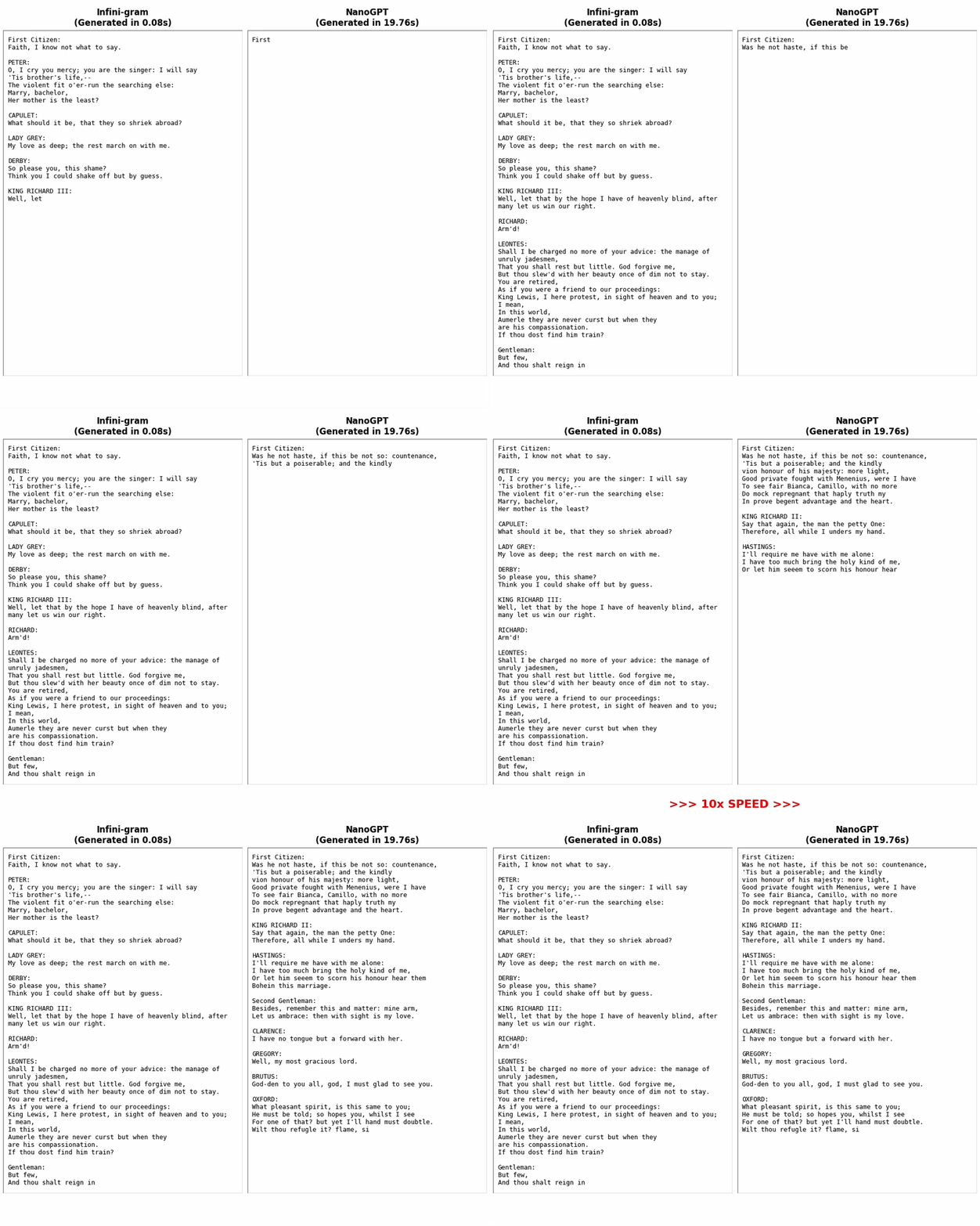
Both models generate 1000 characters with temperature 0.8 by default. The visualization shows an animated comparison with generation speed proportional to actual inference time.
Similar repos





Languages
Python
76.9%
Go
23.1%
An unbounded n-gram language model on Tiny Shakespeare
Python
23
21 commits
updated Jan 21, 2026
README
Tiny Infini-Gram
A minimal implementation of the Infini-gram language model using Go's built-in suffix array, plus a character-level GPT for comparison.
How it works
Instead of using a fixed n-gram size, infini-gram finds multiple suffix matches of varying lengths in the training data and combines their next-token distributions using exponential decay weighting. Longer matches (higher n) are weighted more heavily. The k parameter controls how many n-gram levels to use (k=2 by default, k=-1 uses all levels).
Setup
# Download the dataset (Shakespeare text)
wget https://github.com/nathan-barry/tiny-diffusion/releases/download/v2.0.0/data.txt

# Download the trained GPT weights (optional - can train from scratch)
mkdir -p weights && wget -P weights https://github.com/nathan-barry/tiny-diffusion/releases/download/v2.0.0/gpt.pt
Usage
# Run infini-gram
go run infini-gram.go

# Run GPT (uses pre-trained weights if available)
uv run gpt.py

# Train GPT from scratch
uv run gpt.py --train

# Run side-by-side visualization comparing both models
uv run visualization.py
Both models generate 1000 characters with temperature 0.8 by default. The visualization shows an animated comparison with generation speed proportional to actual inference time.
Similar repos
Languages
Python
76.9%
Go
23.1%