A tool for analyzing the security and parameters of a solidity smart contract
Rust
796
112 commits
updated Feb 14, 2025
Pyrometer is a work-in-progress security tool currently in BETA. It should work on most solidity 0.8.x contracts, but there are some limitations and language edge cases not yet covered.
Effectively, Pyrometer is a mix of symbolic execution, abstract interpretation, and static analysis - we take ideas from each and apply them with an engineering first mindset to create an effective tool (and avoid nerdsnipes by academic papers) aiming to help both auditors and developers.
Pyrometer may eventually be language agnostic, but for now it is targeting Solidity. The code isn't currently entirely structured for multi-language support, but it has some of the bones to be able to support other EVM-targeting languages.
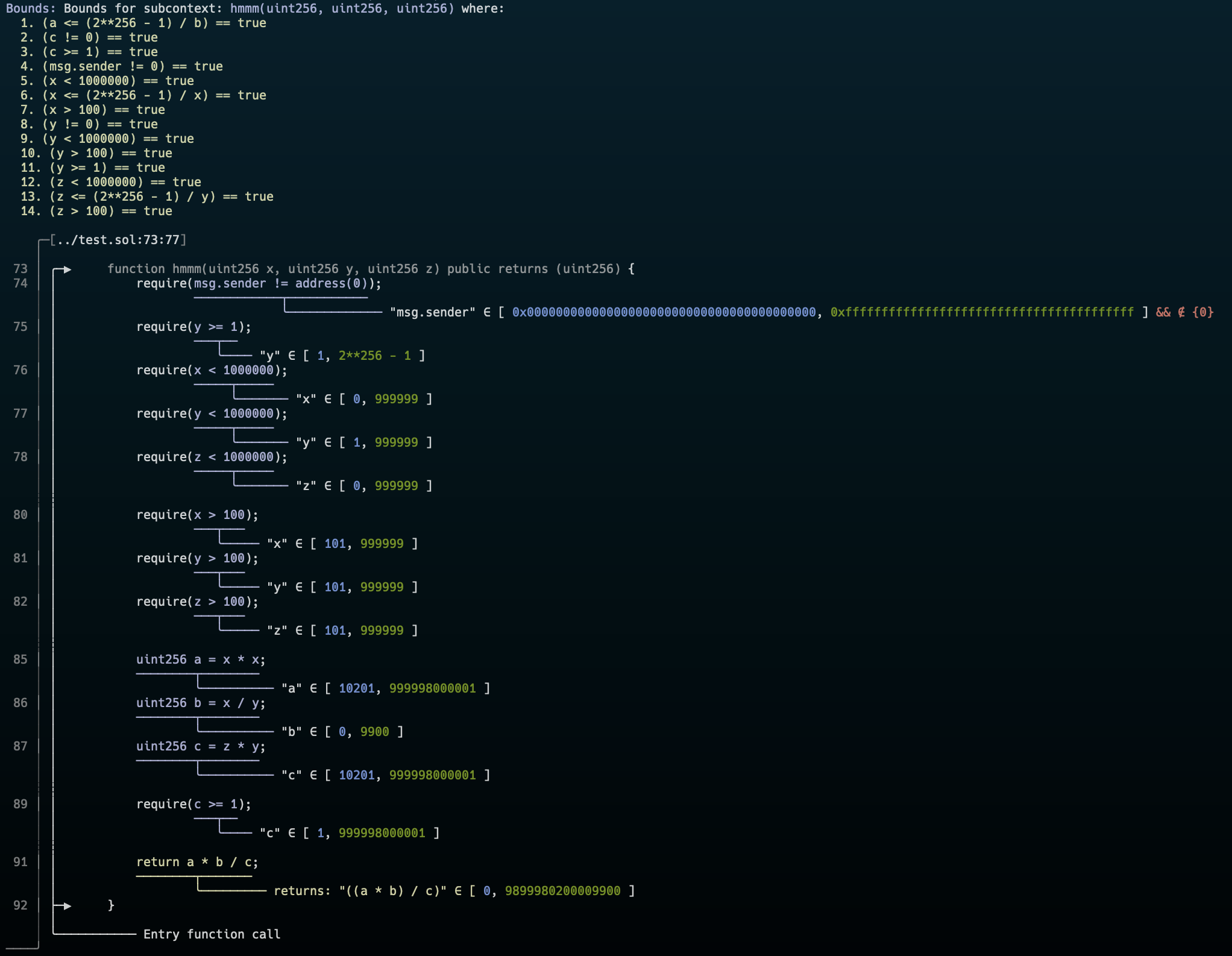
Here is an example output:
First, make sure rust is installed:
curl --proto '=https' --tlsv1.2 -sSf https://sh.rustup.rs | sh
Then:
git clone https://github.com/nascentxyz/pyrometer
cd pyrometer/crates/cli
cargo install --path . --locked
pyrometer <PATH_TO_SOLIDITY_FILE> --help
If your project imports contracts via node_modules or uses remappings, be sure to pass the --remappings remappings.txt flag after running forge remappings > remappings.txt.
Make sure $CARGO_HOME/bin is in your $PATH.
Binaries will eventually be built and released for version upgrades.
Run pyrometer --help for more details.
pyrometer ./myContract.sol --remappings remappings.txt: the --remappings flag is generally needed otherwise you will get a crash with file does not exist.pyrometer ./myContract.sol -vv: -vv is generally the sweet spot in terms of verbositypyrometer ./myContract.sol --funcs "myFunc": the --funcs flag can help narrow the down the output to only the function you care about. You can repeat the flag as many times as you like to match more functionspyrometer ./myContract.sol --contracts "myContract": the --contracts flag can help narrow the down the output to only the contract you care about. You can repeat the flag as many times as you like to match more functionsThere are two main uses of pyrometer as it stands today.
The target users of the binary (i.e. the CLI application) are developers and auditors. A suggested use case is for manual verification of a function or functions. A video tutorial around getting the most out of pyrometer is in the works.
Pyrometer's graph intermediate representation and bound analysis can be useful for a whole host of solidity based tooling. It could be used as:
dot via the --dot flag)You will generally see a line underlined followed by the ∈ symbol followed by [ minimum possible value, maximum possible value ]. ∈ indicates set membership and means "is an element of", and the brackets indicate an interval - so for example, if you see:
"x" ∈ [ 0, 10 ] && ∉ { 5 }, you can read this as "x is in the range 0 to 10, excluding 5". Each solidity type has their own default bounds. If you see "x" == 3, x must be 3 at that point in the program.
See the Theory page for details.
See the Architecture page for details.
Read the Architecture page first, then start hacking. Hop in the telegram (see badge above) to ask questions.
See the TODO for top priorities.
98 followers · starred Oct 2025
1,746 followers · starred Feb 2025
210 followers · starred Aug 2023
513 followers · starred Mar 2023
A tool for analyzing the security and parameters of a solidity smart contract
Rust
796
112 commits
updated Feb 14, 2025
Pyrometer is a work-in-progress security tool currently in BETA. It should work on most solidity 0.8.x contracts, but there are some limitations and language edge cases not yet covered.
Effectively, Pyrometer is a mix of symbolic execution, abstract interpretation, and static analysis - we take ideas from each and apply them with an engineering first mindset to create an effective tool (and avoid nerdsnipes by academic papers) aiming to help both auditors and developers.
Pyrometer may eventually be language agnostic, but for now it is targeting Solidity. The code isn't currently entirely structured for multi-language support, but it has some of the bones to be able to support other EVM-targeting languages.
Here is an example output:
First, make sure rust is installed:
curl --proto '=https' --tlsv1.2 -sSf https://sh.rustup.rs | sh
Then:
git clone https://github.com/nascentxyz/pyrometer
cd pyrometer/crates/cli
cargo install --path . --locked
pyrometer <PATH_TO_SOLIDITY_FILE> --help
If your project imports contracts via node_modules or uses remappings, be sure to pass the --remappings remappings.txt flag after running forge remappings > remappings.txt.
Make sure $CARGO_HOME/bin is in your $PATH.
Binaries will eventually be built and released for version upgrades.
Run pyrometer --help for more details.
pyrometer ./myContract.sol --remappings remappings.txt: the --remappings flag is generally needed otherwise you will get a crash with file does not exist.pyrometer ./myContract.sol -vv: -vv is generally the sweet spot in terms of verbositypyrometer ./myContract.sol --funcs "myFunc": the --funcs flag can help narrow the down the output to only the function you care about. You can repeat the flag as many times as you like to match more functionspyrometer ./myContract.sol --contracts "myContract": the --contracts flag can help narrow the down the output to only the contract you care about. You can repeat the flag as many times as you like to match more functionsThere are two main uses of pyrometer as it stands today.
The target users of the binary (i.e. the CLI application) are developers and auditors. A suggested use case is for manual verification of a function or functions. A video tutorial around getting the most out of pyrometer is in the works.
Pyrometer's graph intermediate representation and bound analysis can be useful for a whole host of solidity based tooling. It could be used as:
dot via the --dot flag)You will generally see a line underlined followed by the ∈ symbol followed by [ minimum possible value, maximum possible value ]. ∈ indicates set membership and means "is an element of", and the brackets indicate an interval - so for example, if you see:
"x" ∈ [ 0, 10 ] && ∉ { 5 }, you can read this as "x is in the range 0 to 10, excluding 5". Each solidity type has their own default bounds. If you see "x" == 3, x must be 3 at that point in the program.
See the Theory page for details.
See the Architecture page for details.
Read the Architecture page first, then start hacking. Hop in the telegram (see badge above) to ask questions.
See the TODO for top priorities.
98 followers · starred Oct 2025
1,746 followers · starred Feb 2025
210 followers · starred Aug 2023
513 followers · starred Mar 2023



