JMangaBench_Read: a Japanese manga OCR benchmark (accuracy and speed)
Python
3
4 commits
updated Oct 15, 2026
English | 中文 · Appendix · Interactive leaderboard · Dataset (images)
JMangaBench_Read evaluates the accuracy and speed of OCR models on text boxes cropped from Japanese manga pages. The main set contains the text a reader reads and a translation pipeline translates: speech, narration and asides. Sound effects are excluded.
Found an error in a label, a score or the docs? Please open an issue. Corrections are welcome.
v1.3 changes. 4,660 new boxes from 1,116 new pages; 13 v1.2 boxes removed (rules in Box selection and labeling); scoring normalization renamed RIN v1 with two added symbol rules; all models re-measured on an RTX 2080 Ti in fp16. The authors used Read v1.2 and 1,021 of the new boxes during model development (see Development use); scores on the 4,660 new boxes are reported separately in the appendix. Full list: appendix A6.
Ranked by composite score (defined in Scoring). 7,789 boxes, RTX 2080 Ti, fp16.
| # | Model | Arch | Params | Composite ↑ | CER % ↓ | EM % ↑ | EM NFKC % ↑ | Per-image ms ↓ | Per-page ms (p50) ↓ | Max img/s ↑ |
|---|---|---|---|---|---|---|---|---|---|---|
| 1 | MangaOCR-Nar-Small † | NAR | 54M | 97.26 | 1.73 | 91.09 | 80.34 | 9.1 | 35.5 | 299 (b48) |
| 2 | Hayai v2.5 Nova p384 | AR | 157M | 96.62 | 2.40 | 88.00 | 75.59 | 54.0 | 252.0 | 175 (b48) |
| 3 | Hayai v2.5 Nova p256 | AR | 157M | 96.58 | 2.97 | 86.99 | 74.84 | 53.0 | 249.1 | 194 (b40) |
| 4 | Hayai v2.5 Nova p512 | AR | 157M | 96.56 | 2.37 | 87.91 | 75.27 | 55.4 | 264.4 | 111 (b40) |
| 5 | Preview † | NAR | 196M | 95.81 | 2.95 | 85.40 | 78.51 | 31.9 | 103.0 | 91 (b16) |
| 6 | Hayai v2.1 | AR | 156M | 95.44 | 2.70 | 84.49 | 77.99 | 141.7 | 300.6 | 87 (b128) |
| 7 | PaddleOCR-VL-For-Manga | AR (VLM) | 959M | 94.98 | 2.03 | 87.52 | 53.15 | 366.6 | 1024.4 | 6.6 (b10) |
| 8 | LoopNAR-α L2 † ‡ | NAR | 50M | 94.72 | 3.33 | 83.62 | 74.09 | 35.6 | 70.8 | 243 (b48) |
| 9 | LoopNAR-α L3 † ‡ | NAR | 50M | 94.70 | 3.23 | 83.62 | 74.21 | 42.7 | 76.9 | 224 (b48) |
| 10 | LoopNAR-α L1 † ‡ | NAR | 50M | 94.13 | 3.95 | 81.95 | 72.64 | 29.0 | 63.2 | 259 (b56) |
| 11 | baberuOCR v1.1 | AR | 113M | 93.34 | 3.66 | 81.60 | 70.89 | 123.6 | 278.3 | 105 (b256) |
| 12 | mangaOCR | AR | 111M | 90.23 | 4.84 | 78.25 | 67.90 | 84.9 | 242.4 | 42 (b56) |
| – | GPT-6 Astra * | LLM | — | 99.47 | 0.24 | 98.04 | 93.40 | — | — | — |
| – | GPT-6.1 Sol * | LLM | — | 99.35 | 0.28 | 97.75 | 97.71 | — | — | — |
| – | Claude Opus 5.5 * | LLM | — | 98.05 | 0.59 | 95.58 | 88.33 | — | — | — |
| # | Model | Arch | Params | Composite ↑ | CER % ↓ | EM % ↑ | EM NFKC % ↑ | Per-image ms ↓ | Per-page ms (p50) ↓ | Max img/s ↑ |
|---|---|---|---|---|---|---|---|---|---|---|
| – | e4 L3 † § | NAR | 54M | 97.29 | 1.73 | 90.97 | 80.07 | 42.8 | 71.9 | 227 (b32) |
| – | e4 L2 † § | NAR | 54M | 97.28 | 1.75 | 90.92 | 80.06 | 35.5 | 64.3 | 267 (b48) |
| – | e4 L1 † § | NAR | 54M | 97.14 | 1.96 | 90.40 | 79.66 | 28.3 | 58.1 | 282 (b24) |
bN: batch size at maximum throughput.Click a chart to open the interactive version (subsets: all / new / printed / non-printed / gold / hard; e4 under "More models").
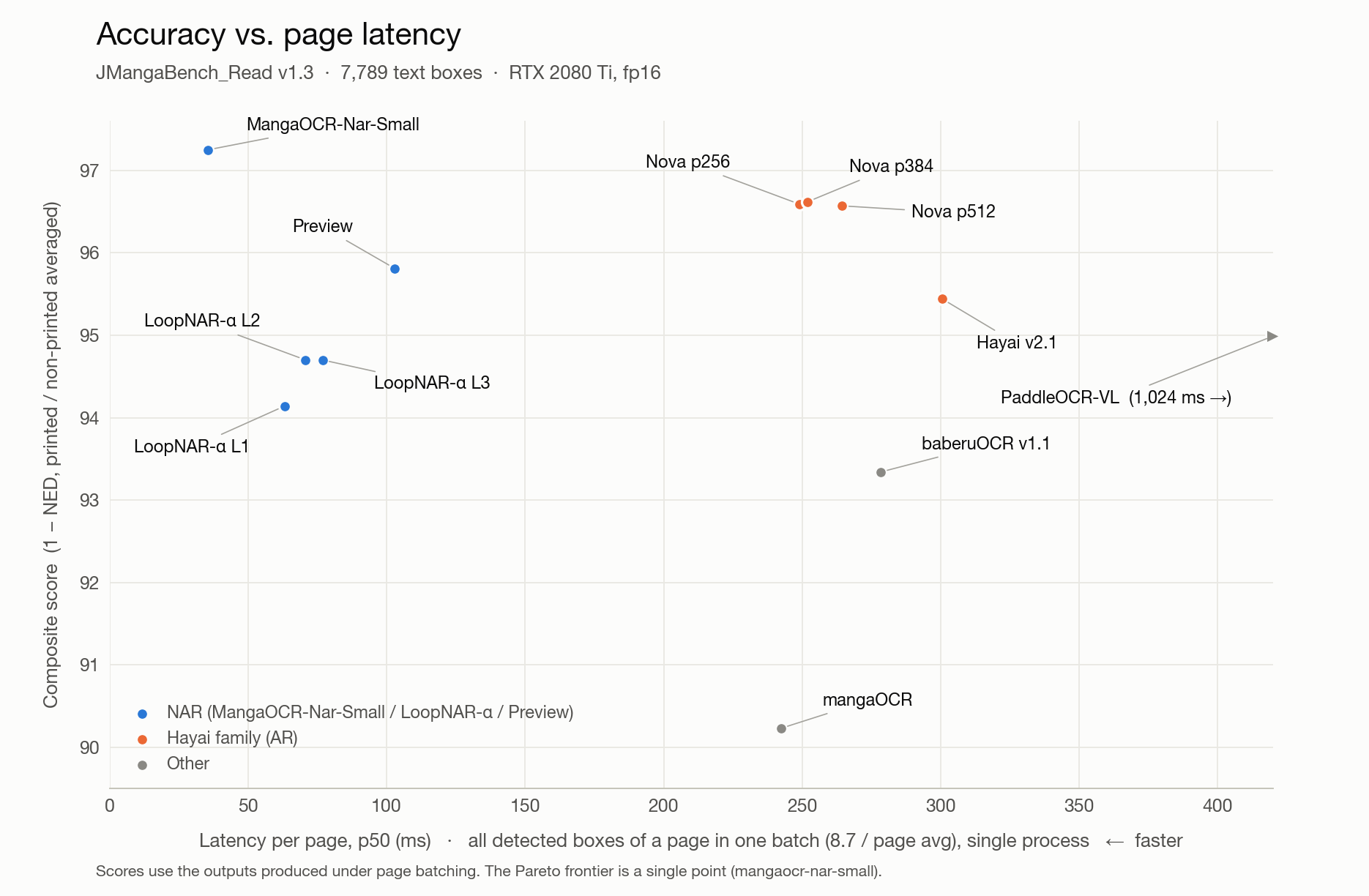
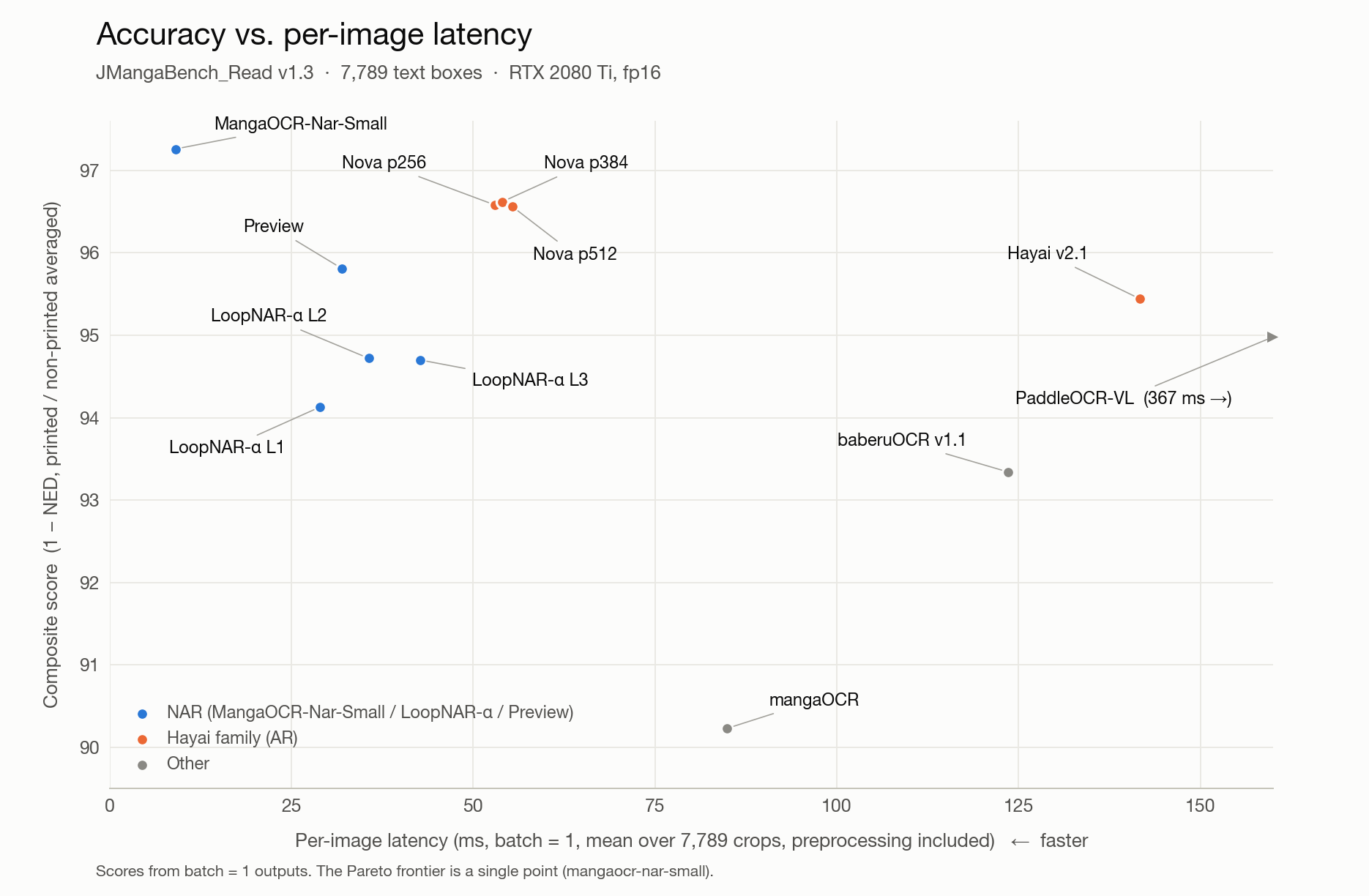
Reading one page at a time with no wait between pages, the median time per page is 37 ms for MangaOCR-Nar-Small, 245 ms for Hayai v2.5 Nova p384 and 345 ms for Hayai v2.1 (appendix A2).
Black-and-white Japanese comic pages posted publicly online by independent artists, collected for research use. Source type and license follow AnimeText.
| Rule | Value |
|---|---|
| Posting date | 2025-10-01 to 2026-10-01 (v1.2 pages up to 2026-03-10, new pages from 2026-03-10) |
| Artists | one page per artist, 1,847 artists |
| Color | black-and-white |
| Content rating | general (6,229 boxes), sensitive (1,560 boxes) |
| Language | Japanese |
| Excluded artists | those who publicly prohibit reposting or AI use |
All 1,847 pages were checked by image ID (dataset revisions of 2026-10-04).
Boxes come from one candidate pool. Pages were processed in a fixed order; v1.2 covers the pages up to a cut-off and v1.3 adds the pages after it.
1. Detection. AnimeText YOLO12x detector, confidence ≥ 0.425. For nested boxes the smaller box is kept. General pages keep all boxes; sensitive pages keep up to 8 random boxes. Result: about 21,500 candidate boxes on 2,524 pages.
2. LLM readers. Each reader worked independently and did not see the other readers' outputs. Prompts: appendix A3.
| Reader | Task | Boxes read |
|---|---|---|
| GPT-6.1 Sol | OCR of the full pool; font class (printed / handwritten / artistic); text role; first screening | 21,305 |
| GPT-6 Astra | OCR; admission decision; text role; language label | about 11,900 |
| Claude Opus 5.5 | final review: OCR from the crop only; text role; flags for boxes cut by the frame, mixed with other text, or not body text | 9,083 |
3. Exclusions (Sol screening and Astra admission):
Hard-to-read, rare or deformed characters, long text, artistic lettering and low reader confidence are not exclusion criteria.
4. Main-set rules. Applied to all v1.3 boxes:
| Rule | Removed |
|---|---|
| Sound effects and mimetic words drawn outside balloons (majority role label of the three readers; v1.2 page-checked overrides kept) | not in the candidate set |
| Label contains a voicing mark on a character without a voiced form (e.g. あ゛, ん゛) | 16 (8 from v1.2, 8 new) |
| Moans or emphasis only, with no lexical content. Candidates: boxes without kanji that contain ♡, a small vowel, ゔ or a doubled character; each candidate judged by a human | 8 (5 from v1.2, 3 new) |
5. Labels of the new boxes.
| Case | Label | Boxes |
|---|---|---|
| Three readings identical after normalization, no Opus flag | agreed reading (Sol's spelling) | 4,232 |
| Readings differ (232 kept); readings agree but Opus flagged the box (151 kept); both (45 kept) | human decision: choose a reading, enter a new one, or drop the box (63 dropped) | 428 (hard) |
| Uniform random sample of agreed boxes, re-checked by a human | 300/300 correct | (included in the 4,232) |
v1.2 labels are unchanged. The review interface showed the three LLM readings only, never an OCR model's output.
Label quality. 0 errors in 300 audited new agreed boxes gives a one-sided 95% upper bound of 0.99% on their error rate (Clopper–Pearson); v1.2's audit gave 0 errors in 200 (bound 1.49%). The 6,523 labels without per-box human confirmation are verified by sampling only.
| Subset | Definition | Boxes |
|---|---|---|
| all | all boxes | 7,789 |
| new | boxes added in v1.3 | 4,660 |
| v1.2 kept | boxes carried over from v1.2 | 3,129 |
| hard | readers disagreed or Opus flagged the box; human-decided label | 784 |
| gold | all human-confirmed boxes (hard + random audits of v1.2 and v1.3) | 1,266 |
| printed | majority font label of the three readers is printed | 5,877 |
| non-printed | handwritten, artistic or mixed | 1,912 |
The authors used Read v1.2 (3,142 boxes) as a development set for MangaOCR-Nar-Small and its predecessors: model selection, comparisons and error analysis. A second development set, "Sol handwriting" (2,248 boxes from the same candidate pool that GPT-6.1 Sol classified as handwritten, with LLM-reading labels), was used from 2026-10-09 for training-time validation, data and architecture comparisons and error analysis. It shares 1,021 boxes with the v1.3 new boxes: 1,004 of the 1,110 new non-printed boxes and 17 printed boxes. Aggregate statistics measured on the candidate pool, minus the v1.2 pages, informed the design of synthetic training data; those pool pages include the pages of the 4,660 new boxes. The statistics are released in docs/pool_stats/. No image from the candidate pool or the benchmark was used for training. Scores on the new boxes are in appendix A1; their non-printed part largely overlaps the Sol handwriting set.
Predictions and labels are normalized with the same rules, RIN v1 (reading-invariant normalization). RIN merges spelling variants that do not change what a reader reads.
| Rule | Example |
|---|---|
| width folding (full-width ASCII → half-width, half-width kana → full-width) | ! → !, テスト → テスト |
| remove whitespace | あ い → あい |
pause-dot runs → … | ・・・, ..., …… → … |
long dashes → ー; ー runs → one ー | ── → ー |
wave marks → 〜; 〜 runs → one 〜 | ~~ → 〜 |
quote forms → " / ' | 〝 〟 → " |
| voicing marks unified | う゛ → ゔ, あ゙ → あ゛ |
compatibility symbols (new in v1.3: ⁇, ⊠) | ⁉ → !?, ⁇ → ??, ⊠ → ☒ |
Characters, small kana, brackets 「」『』, 〇 / ○ and the presence of a voicing mark are kept. Labels use ♡; ♥ is not mapped. RIN v1 equals Read v1.2's r7 plus the two v1.3 symbol rules; no v1.3 label changes between the two.
Why RIN. The labels follow the readers' spelling, which varies for the same glyph: ~ in 326 boxes and 〜 in 112, … in 1,832 boxes and ・・ runs in 260, ! in 868 and ! in 560. A model that writes each symbol one way cannot match all labels without normalization. EM after NFKC alone is listed for reference.
Metrics
$$s_i = 1 - \frac{\mathrm{ED}(p_i, g_i)}{\max(|p_i|, |g_i|)}$$
$$\text{Composite} = 100 \times \tfrac{1}{2}\left(\overline{s}{\text{printed}} + \overline{s}{\text{non-printed}}\right)$$
One RTX 2080 Ti (11 GB) per model, all models in fp16 (the card has no fast bf16). Each run is pinned to 8–10 CPU cores of a 2× Xeon Gold 6148 host, with library threads capped at 8; up to four models run at the same time, one per GPU. Images are pre-decoded in memory. Timings include the model's preprocessing and decoding and are GPU-synchronized.
| Measure | Method |
|---|---|
| Per-image latency | batch size 1, single process; mean over all 7,789 crops after warm-up |
| Per-page latency | 896 batches with sizes drawn from the real per-page box counts (mean 8.7, max 45); single process, preprocessing included; p50 of batch time |
| Max throughput | 512 crops; preprocessing in 4 worker processes in parallel with the GPU (main process: 3 threads); batch size searched up to the memory limit; median of 3 runs at the best batch size |
| One page at a time, first crop | appendix A2 |
Read v1.2 was timed on an RTX 3080 Ti with each model's default precision. Speeds of the two versions are not comparable.
After the GPU has been idle for several seconds, the driver lowers its clock and the next request is slower (for Hayai v2.5 Nova p384 51.5 → 81.7 ms on the first crop after 20 s idle). This applies to every model; see appendix A2.
| Model | Weights | Settings |
|---|---|---|
| MangaOCR-Nar-Small † | to be released | fp16; the inference code released with the model |
| e4 † | to be released | fp16; 1/2/3 decoder loops |
| LoopNAR-α † | not released | fp16; 1/2/3 decoder loops |
| Preview † | muscgab/manga-ocr-nar-preview | fp16 |
| Hayai v2.1 | JustANormalTinkerer/hayai-ocr-v2 (main branch = v2.1) | 256 patches; greedy; fp16 |
| Hayai v2.5 Nova | JustANormalTinkerer/hayai-ocr-v2.5-nova | 256 / 384 / 512 patches; otherwise as above |
| PaddleOCR-VL-For-Manga | jzhang533/PaddleOCR-VL-For-Manga | fp16; greedy; prompt OCR:; batched with per-image vision attention, at most 16 crops per batch |
| baberuOCR v1.1 | genshiai-daichi/baberu-ocr (weights = tag v1.1) | fp16; README generation defaults (up to 256 tokens) |
| mangaOCR | kha-white/manga-ocr-base | fp16; package defaults otherwise |
fp16 against fp32 on the same inputs: identical outputs for Preview (260/260), PaddleOCR-VL-For-Manga (65/65) and MangaOCR-Nar-Small (7,788/7,789); LoopNAR-α L3 EM 83.61 (fp16) vs 83.62 (fp32). The other models were not compared.
MangaOCR-Nar-Small, e4, LoopNAR-α and Preview are made by the authors of this benchmark.
pip install regex
python eval/score.py --pred my_preds.jsonl --name my_model --out results/my_model.json
my_preds.jsonl: one line per box, {"key": "10053471_0", "pred": "作戦を続行する"}. Missing keys count as empty predictions.
| Location | Content |
|---|---|
data/gt.jsonl | labels and metadata, 7,789 boxes |
data/llm_readings.jsonl | three LLM readings per box |
data/predictions/ | outputs of all listed models (batch size 1 and per-page) |
data/gt_sfx.jsonl | v1.2 SFX set (380 boxes), unchanged and not rescored in v1.3 |
eval/ | scoring script and RIN normalization code |
speed/ | speed scripts |
| Hugging Face | crop images at original resolution: main/<key>.png (split test) |
gt.jsonl fields: key, file, text, text_rin, n_chars, gold, gold_hard, gold_random_audit, printed, non_printed, font, role, orientation, crop_wh, page_id, box, rating, origin (v1.2 / new), review.
For evaluation only. Do not use for training.
If you find any error (a wrong label, a box that should not be in the set, a scoring or speed problem), please open an issue. Fixes go into the next version and are listed in appendix A6.
CC BY-NC-SA 4.0 for data and code.
@misc{jmangabench_read,
  title  = {JMangaBench\_Read: A Japanese Manga OCR Benchmark},
  year   = {2026},
  url    = {https://github.com/muscgab/JMangaBench_Read}
}
JMangaBench_Read: a Japanese manga OCR benchmark (accuracy and speed)
Python
3
4 commits
updated Oct 15, 2026
English | 中文 · Appendix · Interactive leaderboard · Dataset (images)
JMangaBench_Read evaluates the accuracy and speed of OCR models on text boxes cropped from Japanese manga pages. The main set contains the text a reader reads and a translation pipeline translates: speech, narration and asides. Sound effects are excluded.
Found an error in a label, a score or the docs? Please open an issue. Corrections are welcome.
v1.3 changes. 4,660 new boxes from 1,116 new pages; 13 v1.2 boxes removed (rules in Box selection and labeling); scoring normalization renamed RIN v1 with two added symbol rules; all models re-measured on an RTX 2080 Ti in fp16. The authors used Read v1.2 and 1,021 of the new boxes during model development (see Development use); scores on the 4,660 new boxes are reported separately in the appendix. Full list: appendix A6.
Ranked by composite score (defined in Scoring). 7,789 boxes, RTX 2080 Ti, fp16.
| # | Model | Arch | Params | Composite ↑ | CER % ↓ | EM % ↑ | EM NFKC % ↑ | Per-image ms ↓ | Per-page ms (p50) ↓ | Max img/s ↑ |
|---|---|---|---|---|---|---|---|---|---|---|
| 1 | MangaOCR-Nar-Small † | NAR | 54M | 97.26 | 1.73 | 91.09 | 80.34 | 9.1 | 35.5 | 299 (b48) |
| 2 | Hayai v2.5 Nova p384 | AR | 157M | 96.62 | 2.40 | 88.00 | 75.59 | 54.0 | 252.0 | 175 (b48) |
| 3 | Hayai v2.5 Nova p256 | AR | 157M | 96.58 | 2.97 | 86.99 | 74.84 | 53.0 | 249.1 | 194 (b40) |
| 4 | Hayai v2.5 Nova p512 | AR | 157M | 96.56 | 2.37 | 87.91 | 75.27 | 55.4 | 264.4 | 111 (b40) |
| 5 | Preview † | NAR | 196M | 95.81 | 2.95 | 85.40 | 78.51 | 31.9 | 103.0 | 91 (b16) |
| 6 | Hayai v2.1 | AR | 156M | 95.44 | 2.70 | 84.49 | 77.99 | 141.7 | 300.6 | 87 (b128) |
| 7 | PaddleOCR-VL-For-Manga | AR (VLM) | 959M | 94.98 | 2.03 | 87.52 | 53.15 | 366.6 | 1024.4 | 6.6 (b10) |
| 8 | LoopNAR-α L2 † ‡ | NAR | 50M | 94.72 | 3.33 | 83.62 | 74.09 | 35.6 | 70.8 | 243 (b48) |
| 9 | LoopNAR-α L3 † ‡ | NAR | 50M | 94.70 | 3.23 | 83.62 | 74.21 | 42.7 | 76.9 | 224 (b48) |
| 10 | LoopNAR-α L1 † ‡ | NAR | 50M | 94.13 | 3.95 | 81.95 | 72.64 | 29.0 | 63.2 | 259 (b56) |
| 11 | baberuOCR v1.1 | AR | 113M | 93.34 | 3.66 | 81.60 | 70.89 | 123.6 | 278.3 | 105 (b256) |
| 12 | mangaOCR | AR | 111M | 90.23 | 4.84 | 78.25 | 67.90 | 84.9 | 242.4 | 42 (b56) |
| – | GPT-6 Astra * | LLM | — | 99.47 | 0.24 | 98.04 | 93.40 | — | — | — |
| – | GPT-6.1 Sol * | LLM | — | 99.35 | 0.28 | 97.75 | 97.71 | — | — | — |
| – | Claude Opus 5.5 * | LLM | — | 98.05 | 0.59 | 95.58 | 88.33 | — | — | — |
| # | Model | Arch | Params | Composite ↑ | CER % ↓ | EM % ↑ | EM NFKC % ↑ | Per-image ms ↓ | Per-page ms (p50) ↓ | Max img/s ↑ |
|---|---|---|---|---|---|---|---|---|---|---|
| – | e4 L3 † § | NAR | 54M | 97.29 | 1.73 | 90.97 | 80.07 | 42.8 | 71.9 | 227 (b32) |
| – | e4 L2 † § | NAR | 54M | 97.28 | 1.75 | 90.92 | 80.06 | 35.5 | 64.3 | 267 (b48) |
| – | e4 L1 † § | NAR | 54M | 97.14 | 1.96 | 90.40 | 79.66 | 28.3 | 58.1 | 282 (b24) |
bN: batch size at maximum throughput.Click a chart to open the interactive version (subsets: all / new / printed / non-printed / gold / hard; e4 under "More models").
Reading one page at a time with no wait between pages, the median time per page is 37 ms for MangaOCR-Nar-Small, 245 ms for Hayai v2.5 Nova p384 and 345 ms for Hayai v2.1 (appendix A2).
Black-and-white Japanese comic pages posted publicly online by independent artists, collected for research use. Source type and license follow AnimeText.
| Rule | Value |
|---|---|
| Posting date | 2025-10-01 to 2026-10-01 (v1.2 pages up to 2026-03-10, new pages from 2026-03-10) |
| Artists | one page per artist, 1,847 artists |
| Color | black-and-white |
| Content rating | general (6,229 boxes), sensitive (1,560 boxes) |
| Language | Japanese |
| Excluded artists | those who publicly prohibit reposting or AI use |
All 1,847 pages were checked by image ID (dataset revisions of 2026-10-04).
Boxes come from one candidate pool. Pages were processed in a fixed order; v1.2 covers the pages up to a cut-off and v1.3 adds the pages after it.
1. Detection. AnimeText YOLO12x detector, confidence ≥ 0.425. For nested boxes the smaller box is kept. General pages keep all boxes; sensitive pages keep up to 8 random boxes. Result: about 21,500 candidate boxes on 2,524 pages.
2. LLM readers. Each reader worked independently and did not see the other readers' outputs. Prompts: appendix A3.
| Reader | Task | Boxes read |
|---|---|---|
| GPT-6.1 Sol | OCR of the full pool; font class (printed / handwritten / artistic); text role; first screening | 21,305 |
| GPT-6 Astra | OCR; admission decision; text role; language label | about 11,900 |
| Claude Opus 5.5 | final review: OCR from the crop only; text role; flags for boxes cut by the frame, mixed with other text, or not body text | 9,083 |
3. Exclusions (Sol screening and Astra admission):
Hard-to-read, rare or deformed characters, long text, artistic lettering and low reader confidence are not exclusion criteria.
4. Main-set rules. Applied to all v1.3 boxes:
| Rule | Removed |
|---|---|
| Sound effects and mimetic words drawn outside balloons (majority role label of the three readers; v1.2 page-checked overrides kept) | not in the candidate set |
| Label contains a voicing mark on a character without a voiced form (e.g. あ゛, ん゛) | 16 (8 from v1.2, 8 new) |
| Moans or emphasis only, with no lexical content. Candidates: boxes without kanji that contain ♡, a small vowel, ゔ or a doubled character; each candidate judged by a human | 8 (5 from v1.2, 3 new) |
5. Labels of the new boxes.
| Case | Label | Boxes |
|---|---|---|
| Three readings identical after normalization, no Opus flag | agreed reading (Sol's spelling) | 4,232 |
| Readings differ (232 kept); readings agree but Opus flagged the box (151 kept); both (45 kept) | human decision: choose a reading, enter a new one, or drop the box (63 dropped) | 428 (hard) |
| Uniform random sample of agreed boxes, re-checked by a human | 300/300 correct | (included in the 4,232) |
v1.2 labels are unchanged. The review interface showed the three LLM readings only, never an OCR model's output.
Label quality. 0 errors in 300 audited new agreed boxes gives a one-sided 95% upper bound of 0.99% on their error rate (Clopper–Pearson); v1.2's audit gave 0 errors in 200 (bound 1.49%). The 6,523 labels without per-box human confirmation are verified by sampling only.
| Subset | Definition | Boxes |
|---|---|---|
| all | all boxes | 7,789 |
| new | boxes added in v1.3 | 4,660 |
| v1.2 kept | boxes carried over from v1.2 | 3,129 |
| hard | readers disagreed or Opus flagged the box; human-decided label | 784 |
| gold | all human-confirmed boxes (hard + random audits of v1.2 and v1.3) | 1,266 |
| printed | majority font label of the three readers is printed | 5,877 |
| non-printed | handwritten, artistic or mixed | 1,912 |
The authors used Read v1.2 (3,142 boxes) as a development set for MangaOCR-Nar-Small and its predecessors: model selection, comparisons and error analysis. A second development set, "Sol handwriting" (2,248 boxes from the same candidate pool that GPT-6.1 Sol classified as handwritten, with LLM-reading labels), was used from 2026-10-09 for training-time validation, data and architecture comparisons and error analysis. It shares 1,021 boxes with the v1.3 new boxes: 1,004 of the 1,110 new non-printed boxes and 17 printed boxes. Aggregate statistics measured on the candidate pool, minus the v1.2 pages, informed the design of synthetic training data; those pool pages include the pages of the 4,660 new boxes. The statistics are released in docs/pool_stats/. No image from the candidate pool or the benchmark was used for training. Scores on the new boxes are in appendix A1; their non-printed part largely overlaps the Sol handwriting set.
Predictions and labels are normalized with the same rules, RIN v1 (reading-invariant normalization). RIN merges spelling variants that do not change what a reader reads.
| Rule | Example |
|---|---|
| width folding (full-width ASCII → half-width, half-width kana → full-width) | ! → !, テスト → テスト |
| remove whitespace | あ い → あい |
pause-dot runs → … | ・・・, ..., …… → … |
long dashes → ー; ー runs → one ー | ── → ー |
wave marks → 〜; 〜 runs → one 〜 | ~~ → 〜 |
quote forms → " / ' | 〝 〟 → " |
| voicing marks unified | う゛ → ゔ, あ゙ → あ゛ |
compatibility symbols (new in v1.3: ⁇, ⊠) | ⁉ → !?, ⁇ → ??, ⊠ → ☒ |
Characters, small kana, brackets 「」『』, 〇 / ○ and the presence of a voicing mark are kept. Labels use ♡; ♥ is not mapped. RIN v1 equals Read v1.2's r7 plus the two v1.3 symbol rules; no v1.3 label changes between the two.
Why RIN. The labels follow the readers' spelling, which varies for the same glyph: ~ in 326 boxes and 〜 in 112, … in 1,832 boxes and ・・ runs in 260, ! in 868 and ! in 560. A model that writes each symbol one way cannot match all labels without normalization. EM after NFKC alone is listed for reference.
Metrics
$$s_i = 1 - \frac{\mathrm{ED}(p_i, g_i)}{\max(|p_i|, |g_i|)}$$
$$\text{Composite} = 100 \times \tfrac{1}{2}\left(\overline{s}{\text{printed}} + \overline{s}{\text{non-printed}}\right)$$
One RTX 2080 Ti (11 GB) per model, all models in fp16 (the card has no fast bf16). Each run is pinned to 8–10 CPU cores of a 2× Xeon Gold 6148 host, with library threads capped at 8; up to four models run at the same time, one per GPU. Images are pre-decoded in memory. Timings include the model's preprocessing and decoding and are GPU-synchronized.
| Measure | Method |
|---|---|
| Per-image latency | batch size 1, single process; mean over all 7,789 crops after warm-up |
| Per-page latency | 896 batches with sizes drawn from the real per-page box counts (mean 8.7, max 45); single process, preprocessing included; p50 of batch time |
| Max throughput | 512 crops; preprocessing in 4 worker processes in parallel with the GPU (main process: 3 threads); batch size searched up to the memory limit; median of 3 runs at the best batch size |
| One page at a time, first crop | appendix A2 |
Read v1.2 was timed on an RTX 3080 Ti with each model's default precision. Speeds of the two versions are not comparable.
After the GPU has been idle for several seconds, the driver lowers its clock and the next request is slower (for Hayai v2.5 Nova p384 51.5 → 81.7 ms on the first crop after 20 s idle). This applies to every model; see appendix A2.
| Model | Weights | Settings |
|---|---|---|
| MangaOCR-Nar-Small † | to be released | fp16; the inference code released with the model |
| e4 † | to be released | fp16; 1/2/3 decoder loops |
| LoopNAR-α † | not released | fp16; 1/2/3 decoder loops |
| Preview † | muscgab/manga-ocr-nar-preview | fp16 |
| Hayai v2.1 | JustANormalTinkerer/hayai-ocr-v2 (main branch = v2.1) | 256 patches; greedy; fp16 |
| Hayai v2.5 Nova | JustANormalTinkerer/hayai-ocr-v2.5-nova | 256 / 384 / 512 patches; otherwise as above |
| PaddleOCR-VL-For-Manga | jzhang533/PaddleOCR-VL-For-Manga | fp16; greedy; prompt OCR:; batched with per-image vision attention, at most 16 crops per batch |
| baberuOCR v1.1 | genshiai-daichi/baberu-ocr (weights = tag v1.1) | fp16; README generation defaults (up to 256 tokens) |
| mangaOCR | kha-white/manga-ocr-base | fp16; package defaults otherwise |
fp16 against fp32 on the same inputs: identical outputs for Preview (260/260), PaddleOCR-VL-For-Manga (65/65) and MangaOCR-Nar-Small (7,788/7,789); LoopNAR-α L3 EM 83.61 (fp16) vs 83.62 (fp32). The other models were not compared.
MangaOCR-Nar-Small, e4, LoopNAR-α and Preview are made by the authors of this benchmark.
pip install regex
python eval/score.py --pred my_preds.jsonl --name my_model --out results/my_model.json
my_preds.jsonl: one line per box, {"key": "10053471_0", "pred": "作戦を続行する"}. Missing keys count as empty predictions.
| Location | Content |
|---|---|
data/gt.jsonl | labels and metadata, 7,789 boxes |
data/llm_readings.jsonl | three LLM readings per box |
data/predictions/ | outputs of all listed models (batch size 1 and per-page) |
data/gt_sfx.jsonl | v1.2 SFX set (380 boxes), unchanged and not rescored in v1.3 |
eval/ | scoring script and RIN normalization code |
speed/ | speed scripts |
| Hugging Face | crop images at original resolution: main/<key>.png (split test) |
gt.jsonl fields: key, file, text, text_rin, n_chars, gold, gold_hard, gold_random_audit, printed, non_printed, font, role, orientation, crop_wh, page_id, box, rating, origin (v1.2 / new), review.
For evaluation only. Do not use for training.
If you find any error (a wrong label, a box that should not be in the set, a scoring or speed problem), please open an issue. Fixes go into the next version and are listed in appendix A6.
CC BY-NC-SA 4.0 for data and code.
@misc{jmangabench_read,
  title  = {JMangaBench\_Read: A Japanese Manga OCR Benchmark},
  year   = {2026},
  url    = {https://github.com/muscgab/JMangaBench_Read}
}



