
Prove your AI agent is injection-safe, in-spec, and won't act out of bounds — before you ship it.
A design-time verifier for LLM agents — not a runtime guardrail. Import your LangGraph / CrewAI / AutoGen / MCP agent and Aura proves five things about the agent you already wrote, then hands you the exact counterexample or a certificate. Z3 · CTL model checking · information-flow/taint · conformal calibration. Runs locally, in CI, no API key.




Verify a design → import a real agent from its code → the lethal trifecta lights up with the exact path → save a baseline and gate regressions. · ▶ watch the full walkthrough
pip install aura-state # or: uv pip install aura-state · uv add aura-state
$ aura-state demo          # no keys, no config, no agent of your own needed

  aura-state check · support-ticket-agent · 4 nodes

  ✗ trifecta [send]: lethal trifecta closed — prompt injection at 'fetch' (untrusted)
    can reach external sink 'send' unsanitized while 'draft' brings private data into
    scope. Path: fetch → lookup → draft → send. Break it with a sanitizer between
    'fetch' and 'send', or remove one of the three capabilities.

  ✗ NOT PROVEN — 1 blocking finding(s)          # exit 1 → CI fails
  checked: trifecta closed · taint proven · reachability proven · obligations proven · policy 0 flagged
Prompt injection is only one of them.
| Property | In plain words | |
|---|---|---|
| 🔒 | Safe — taint + lethal trifecta | can't be tricked into leaking data |
| ✅ | Correct — Z3/SMT obligations | outputs obey your rules (amount ≤ limit) |
| ♻️ | Live — CTL model checking | terminates, every step reachable, no dead ends |
| 📊 | Calibrated — split-conformal intervals | knows how confident it actually is |
| 🛑 | Governed — risk-controlled abstention | refuses to act when it's unsure |
aura-state check my_agent.json      # a studio export
aura-state check your_agent.py      # a LangGraph / CrewAI / AutoGen source file — parsed, never executed
aura-state check ./my-agent-repo/   # a whole directory
uvx aura-state check agents/*.json  # zero-install via uv — perfect for CI
Beyond the trifecta, check also proves:
"manifest": { "side_effects": ["read"] } to your flow:
✗ least-privilege [Pay]: 'Pay' can external 'payment.charge', outside the declared manifest
~/.cursor/mcp.json and pass it as a parameter"). Static — it never connects to a server.Prove it — then prove the proof. Emit a verifiable certificate and re-check it without trusting whoever issued it:
aura-state certify your_agent.py --out cert.json   # design + verdict, content-hashed
aura-state verify-cert cert.json                   # re-runs the verifier — catches any tamper
Maps to EU AI Act Art. 12 / ISO 42001 (evidence, not just documentation).
Benchmark it. aura-state bench runs a labeled corpus (accuracy on safe/vulnerable pairs — sound, so recall is 100% by construction; the measured number is precision) plus import coverage on real MCP/framework agents ingested unmodified.
Pre-execution agent verifiers exist — but each does one thing and makes you rewrite your agent into their formalism. Aura's edge is being the shipped tool that ingests the agent you already wrote and runs the whole set:
| Static (before it runs)? | Security dataflow? | Imports your real agent? | |
|---|---|---|---|
| AgentProof | ✅ | ❌ topology only | ✅ |
| AgentFlow | ✅ | ✅ | ❌ its own policy DSL |
| FIDES (Microsoft) | ❌ runtime | ✅ | ❌ build-with-it planner |
| Aura-State | ✅ | ✅ | ✅ LangGraph / CrewAI / AutoGen / MCP |
We didn't invent these methods — the research is rich and some of it is more rigorous than ours. We're the one you can pip install and point at your existing agent today. And it's sound / fail-closed: an unknown capability is surfaced as an advisory, never silently passed.
Drop it into CI and every PR is checked:
# .github/workflows/aura.yml
- uses: your-org/aura-state@v0
  with: { paths: "agents/*.json" }
The lethal trifecta is the scariest failure mode for a tool-using agent: the moment it can (1) read private data, (2) ingest untrusted content, and (3) communicate externally — all on one reachable path — a prompt injection hidden in that content can read your data and ship it out. Everyone warns about it. Aura proves your agent can't close it, statically, before you ship:
$ aura-state check dev_assistant.tools.json   # ← your MCP tools/list export

  ✗ trifecta [slack_post_message]: lethal trifecta closed — prompt injection at 'fetch'
    (untrusted) can reach external sink 'slack_post_message' unsanitized while 'read_file'
    brings private data into scope. Path: fetch → Agent → slack_post_message.
    Break it with a sanitizer between 'fetch' and 'slack_post_message'.
Point it straight at your MCP setup. Export your agent's tools/list (or hand it your client config) and Aura models the worst case — the LLM can call any tool in any order — then decides whether fetch + filesystem + slack together form an exfiltration channel. It never connects to or runs a server.
Or point it at your agent's code. Aura statically imports the tool surface from a LangGraph / CrewAI / LangChain source file or repo — no install, and it never runs your code:
aura-state check your_agent.py          # extracts @tool functions & framework tools
aura-state check ./my-agent-repo/       # a whole directory
✗ trifecta [post_to_slack]: prompt injection at 'fetch_url' (untrusted) can reach
  'post_to_slack' unsanitized while 'read_customer_file' brings private data into scope.
We audited real MCP-server compositions and agent frameworks (GitHub, filesystem, fetch, Slack, Postgres · CrewAI, AutoGPT) modeled from their published tool surfaces. 5 of 6 can close the lethal trifecta — including the exact shape of the Invariant Labs GitHub-MCP exploit. Full writeup + sources: docs/AUDIT.md. Reproduce it:
python examples/audit/run.py.
(Also
python examples/audit.py: 9 hand-built agent patterns, 5 with an unguarded injection path, 4 closing the trifecta — each fixable with one sanitizer via Aura's auto-repair.)
Absolute checks are noisy on a legacy agent. Give check a baseline and it fails only on paths this change newly opened — the line that gets Aura into every agent repo's CI:
$ aura-state check agents/*.json --baseline main-baseline.json

  ✗ taint [send_email] [NEW]: untrusted data from 'read_web' can reach sink 'send_email'…
  ✗ REGRESSION — 1 new blocking finding this change      # exit 1 → PR fails
aura-state check agents/*.json --json > main-baseline.json   # on main
aura-state check agents/*.json --baseline main-baseline.json # on the PR
Paste this after installing — Z3 rejects a hallucinated value and accepts a correct one, in the loop:
from aura_state import prove_extraction

print(prove_extraction({"area": 100, "rate": 3, "total": 999}, ["total == area * rate"]).verified)  # False
print(prove_extraction({"area": 100, "rate": 3, "total": 300}, ["total == area * rate"]).verified)  # True
For the full runnable proofs against the real solvers — each ~10s, no API key — clone the repo:
git clone https://github.com/munshi007/Aura-State && cd Aura-State
pip install -e .
| Demo | What it proves |
|---|---|
aura-state check examples/agents/*.json | statically audits 9 common agent designs — 5 have injection paths |
python examples/audit.py | the audit table you can drop in a launch post |
python examples/verified_loop_demo.py | Z3 rejects a hallucinated extraction in the loop, retries, accepts |
python examples/taint_proof_demo.py | untrusted input provably can't reach a dangerous tool |
python examples/risk_abstention_demo.py | acts only within a calibrated risk budget, else escalates to a human |
python examples/emit_contract_demo.py | a portable contract compiled faithfully from the design |
python examples/replan_demo.py | the verifier repairs the plan until it's proven-safe |
python examples/pasc_demo.py | pipeline-aware conformal calibrates the end-to-end answer, not just each step |
Prefer a console to code? Launch a local web app that runs the real verifiers on your own machine. One command, nothing leaves your laptop:
pip install "aura-state[ui]" && aura-state ui     # opens http://127.0.0.1:8155
# or zero-install:  uvx --from "aura-state[ui]" aura-state ui
A full agent IDE — design an agent, prove it, run it, watch it execute, and hand it off to code — all in one local console. Not a sandbox you type into: every check is the actual framework verifier. Zero setup: it opens on a built-in demo provider that simulates the LLM steps, so you can hit Run and watch the agent execute end-to-end with no key and no Ollama. Paste an OpenAI / Gemini / DeepSeek key (or point at a local Ollama) — right by the Run button — for a real run.
An agent is a typed graph of four node kinds — you name them anything:
eval)db.write, http.get, payment.refund, …). Aura proves its preconditions; it does not execute it — you bind the real tool in your code / aura-runtime
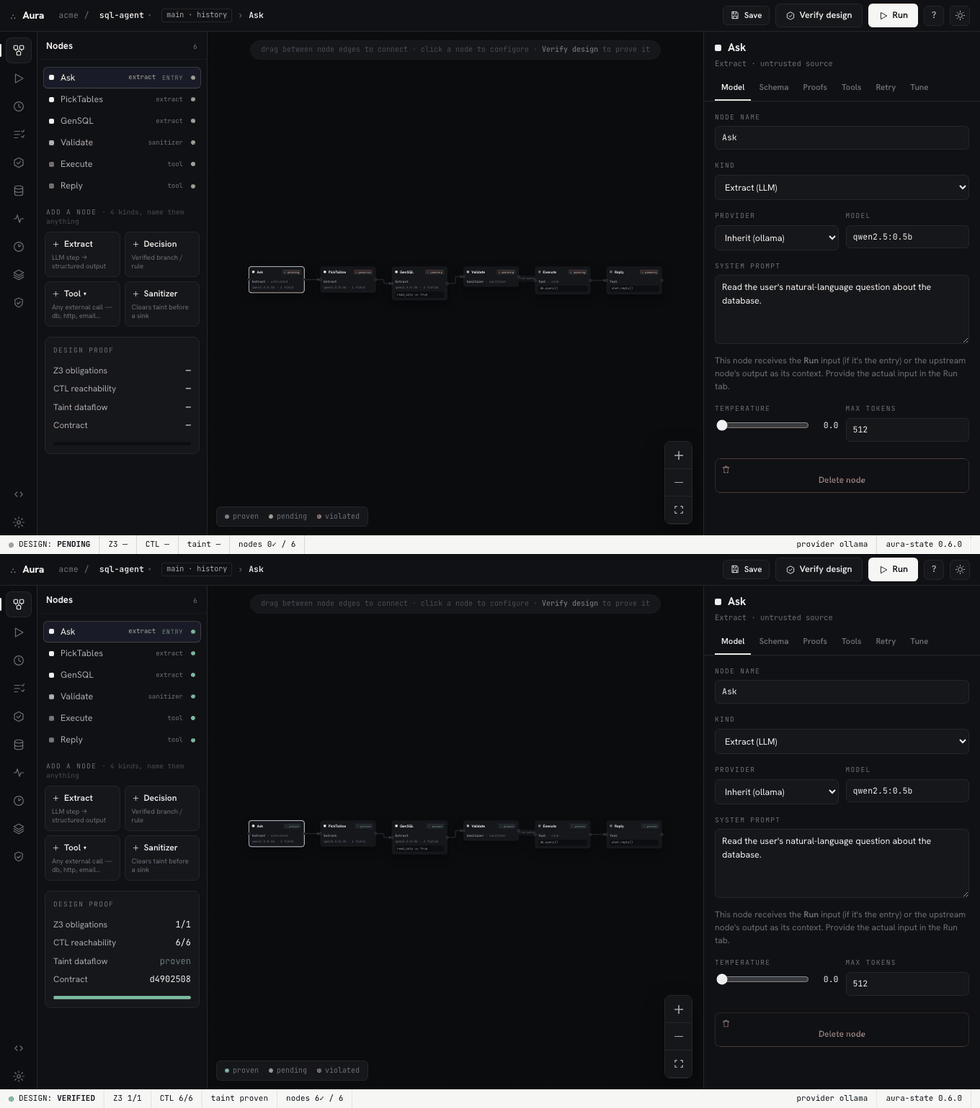
A real OSS agent — the LangGraph SQL agent — modeled in Aura and proven read-only + injection-safe.
| Module | What you do |
|---|---|
| Build | drag a typed graph; configure each node (model · prompt · schema · Z3 obligations · tool + side-effect · retry · consensus); Verify runs Z3 + CTL + taint; Auto-repair fixes a taint violation in one click |
| Run | feed input (text · URL fetch · file); Extract/Decision nodes run for real, Tool nodes show a proven boundary with a mock return; watch the path light up on the canvas with a step scrubber and a plain-English "why" |
| Runs · Evals | every run persisted for replay; test-case suites with assertions |
| Prove · Dataset | Z3 point-check any record; bulk-verify a dataset |
| Monitor | live feed of your real agent's outputs (via the SDK), verified as they happen, with pass-rate charts |
| Calibrate · Memory | conformal intervals + risk-controlled abstention; context-pruning preview |
| Audit | a tamper-evident, hash-chained log of every action, exportable for compliance |
| Versions · Certify | snapshot + diff designs; export a signed proof certificate (SHA-256) or the whole agent as runnable Python |
| SDK | copy-paste snippets to use the library in code — the studio is optional |
Bring any model. A local Ollama model needs no key. For OpenAI / Gemini / DeepSeek, paste your key in Settings → Providers — it's held in memory for the session (never written to disk) and works immediately, no restart. Keys set in your environment before launch are picked up too. Nothing leaves your laptop.
You don't rebuild your agent in the studio — you verify it where it already runs, and stream the results in. A tiny SDK does both:
from aura_state.hooks import Monitor, verified

mon = Monitor()   # points at a local `aura-state ui`

# verify + stream any output:
mon.record({"refund_amount": 180, "order_total": 200},
           ["refund_amount <= order_total"], node="RefundAgent")

# or decorate your extraction / CrewAI task / LangGraph node (fail-closed):
@verified(["total == area * rate"], monitor=mon, strict=True)
def extract_quote(text) -> dict:
    ...        # your LLM call
    return {"area": 100, "rate": 3, "total": 300}
Verification runs in your code even if the studio is closed; when it's open, the Monitor shows every output proven or rejected, live.
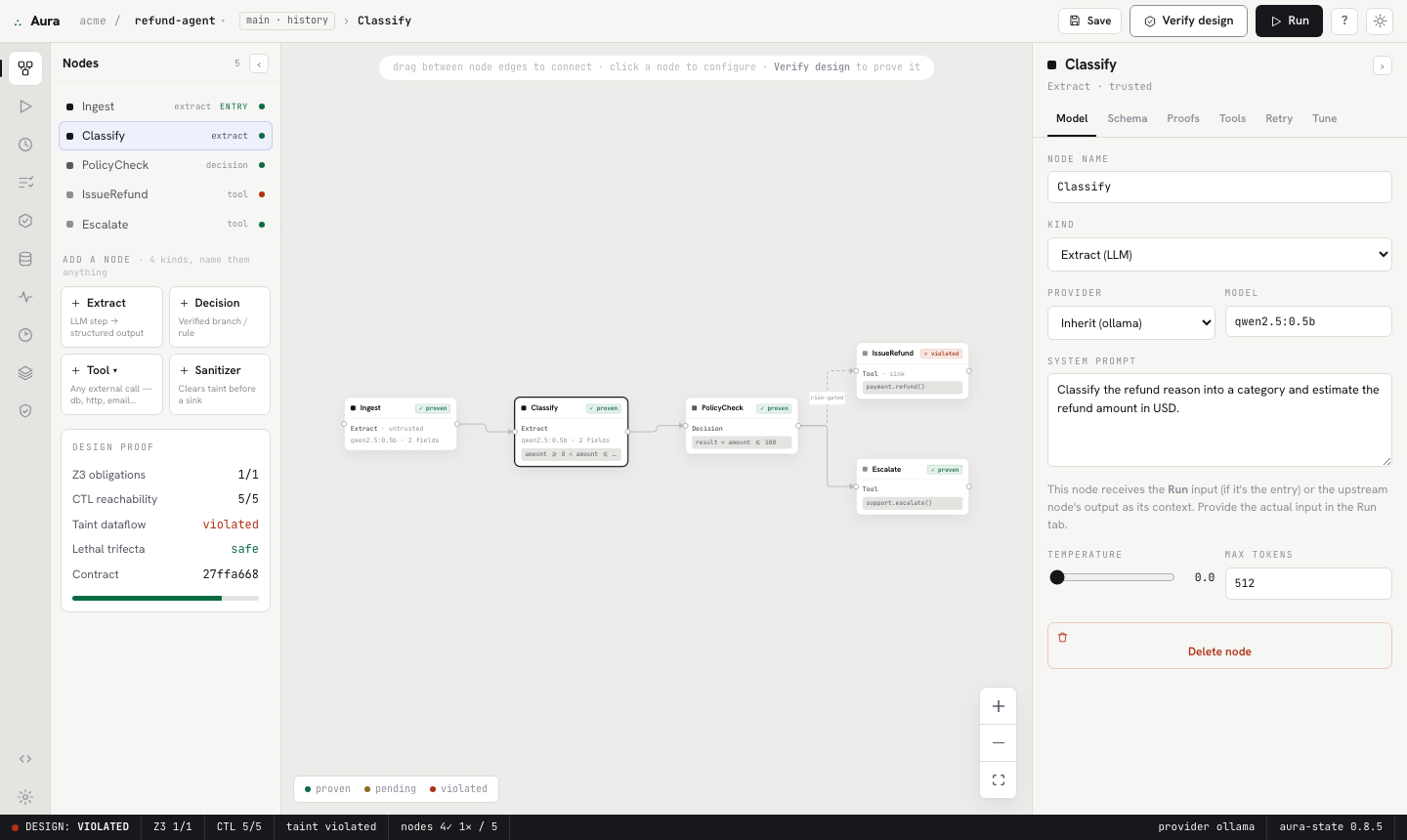
Build — click a node, configure everything (prompt, model, schema, obligations, transitions)
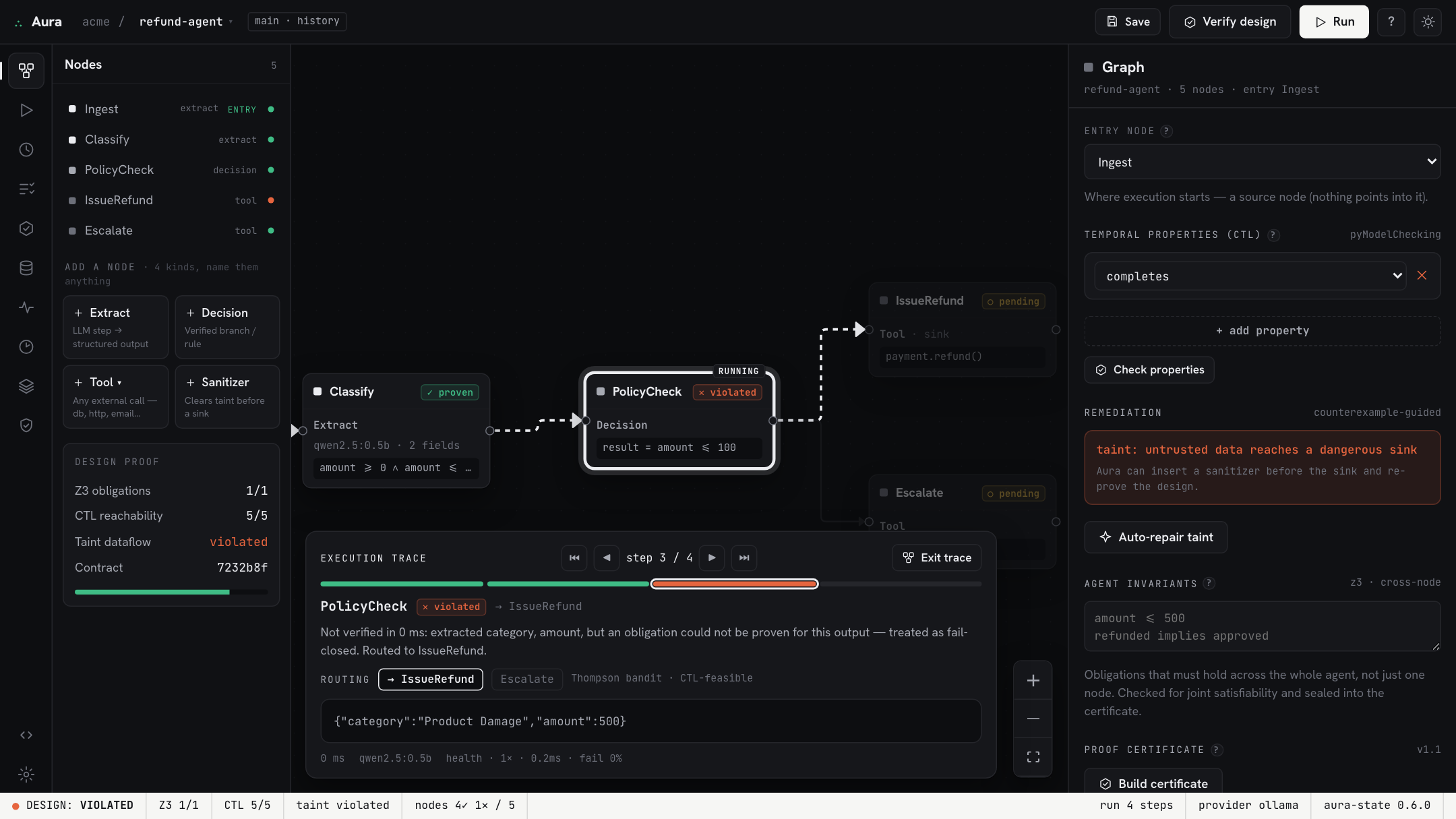
Run — the real engine executes the whole agent; each step extracted, Z3-verified, and a contract emitted
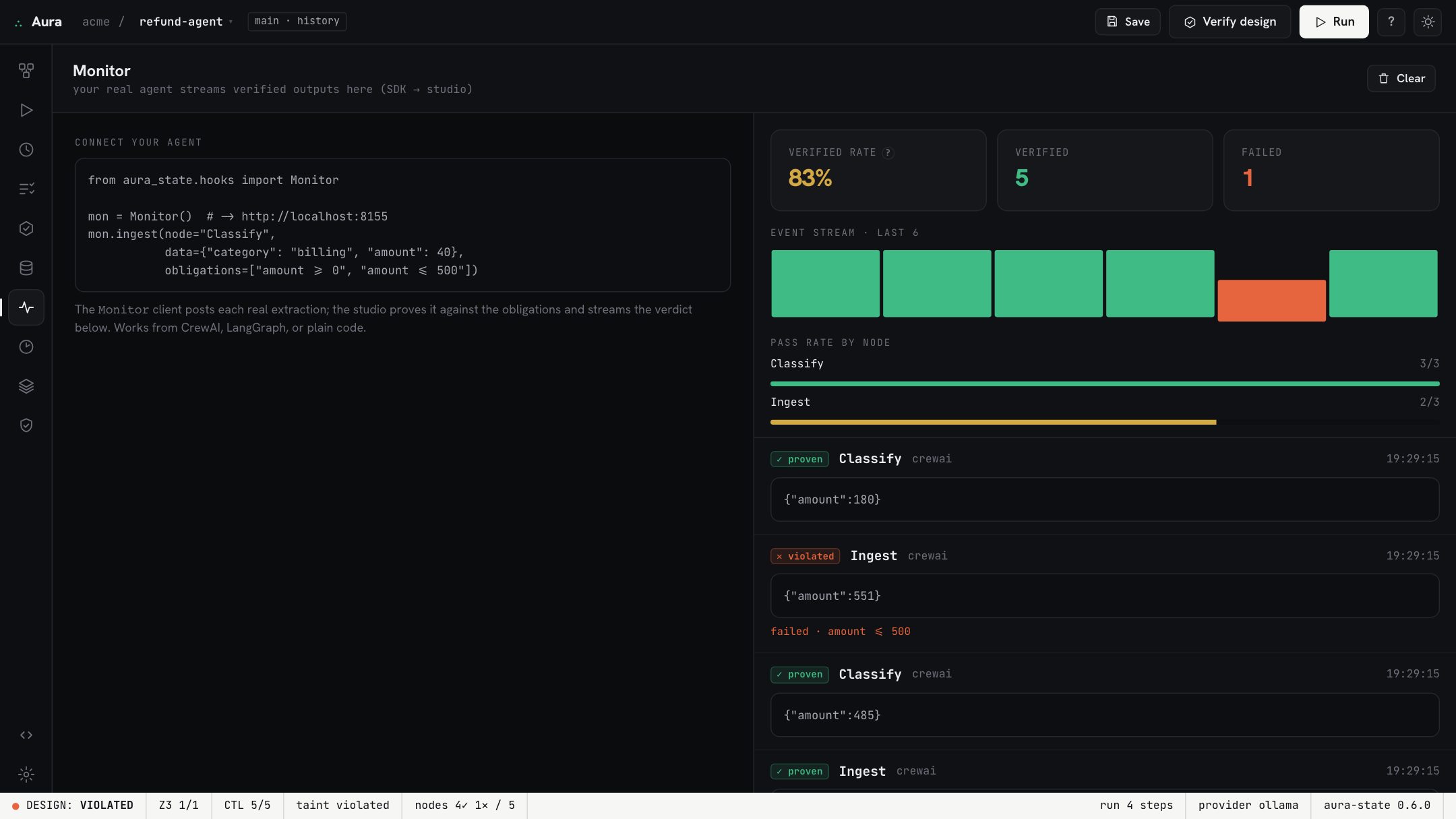
Monitor — your real agent (via the SDK hook) streams outputs in, proven or rejected live
Most LLM frameworks let you chain API calls and hope for the best. Aura-State takes a different approach: you define your workflow as a typed graph of nodes, and verification runs inside the loop — every extraction must satisfy its formal contract before the workflow moves on.
The key difference is what happens between nodes:
exec sandboxed interpreter, never hallucinatedeval) — the agent branches on real state, not an LLM guess (an ambiguous/invalid edge falls back to a CTL-feasible bandit choice)Aura-State is a design-time verifier, and worth being precise about:
data_class / exfil override. It is not a semantic proof that a specific injection string succeeds.from aura_state import AuraEngine, Node, CompiledTransition
from pydantic import BaseModel, Field
from openai import OpenAI
# Define what you want to extract
class LeadData(BaseModel):
name: str = Field(description="Full name")
budget: int = Field(description="Budget in USD")
timeline: str = Field(description="Buying timeline")
# Define a node that extracts it — with a Z3 obligation the value must satisfy
class ExtractLead(Node):
system_prompt = "Extract lead info from a sales call transcript."
extracts = LeadData
obligations = ["budget > 0"] # proven in the loop; unprovable -> not accepted
def handle(self, user_text, extracted_data=None, memory=None):
return "QualifyBudget", extracted_data.model_dump()
# Define a decision node that does deterministic math (no LLM). Its rule runs
# even though the node does no extraction — it reads prior state from memory.
class QualifyBudget(Node):
system_prompt = "Score the lead."
sandbox_rule = "result = budget > 100000" # runs in the no-exec sandbox
def handle(self, user_text, extracted_data=None, memory=None):
return "END", memory
# Wire it up
engine = AuraEngine(llm_client=OpenAI())
engine.register(ExtractLead, QualifyBudget)
engine.connect([
CompiledTransition(from_node=ExtractLead, to_node=QualifyBudget),
])
# Run
next_state, data = engine.process("ExtractLead", user_text="Hi, I'm Sarah. Budget is $450k.")
When you call engine.process(), it runs through these steps in order:
1. Few-shot injection      →  optional: inject similar past successes as examples.
2. Verification loop       →  extract → check (sandbox rule + Z3 obligations) → retry.
                              A value that fails its contract is not accepted (fail-closed).
3. Consensus dispersion    →  with consensus > 1, measure agreement across the runs
                              (dispersion, not a calibrated coverage guarantee).
4. Your handle() method    →  your routing / business logic runs here.
5. Bandit router           →  if handle() returns an invalid edge, Thompson-sample a feasible one.
6. State serialization     →  save state (JSON, tamper-evident) for time-travel debugging.
Graph-level properties (reachability, completion, ordering) are checked separately
at design time with engine.verify([...]) — CTL model checking over the whole
graph, which per-transition checks can't do. Everything above happens in the loop;
engine.verification_reports() returns the proof results and intervals per step.
This is what actually makes Aura-State different from other frameworks.
Your node graph gets compiled into a Kripke structure and checked against temporal logic properties:
from aura_state import verify_engine, reachability, mutual_exclusion, eventual_completion

results = verify_engine(engine, [
    {"description": "QualifyBudget is reachable", "formula": reachability("QualifyBudget")},
    {"description": "All paths terminate", "formula": eventual_completion("QualifyBudget")},
])
# Result: PROVEN or VIOLATED, with the exact states that satisfy/violate
This is the same technique used to verify hardware circuits and flight control systems (CTL model checking, Clarke et al. 1986).
After the LLM extracts values, Z3 (a theorem prover from Microsoft Research) can formally prove they satisfy your constraints:
from aura_state import prove_extraction

result = prove_extraction(
    {"budget": 450000, "cost_per_sqft": 3, "total": 1350000},
    obligations=["budget > 0", "total == budget * cost_per_sqft"],
)
# result.verified = True
# If False, Z3 gives you a counterexample showing exactly what broke
It also proves your obligations aren't self-contradictory. ["x > 5", "x < 3"]
can never hold — Z3 catches that symbolically (variables ranging freely over the
declared field bounds, not pinned to one value), and the design→contract compiler
flags it per node before you ship.
Run the extraction multiple times and get distribution-free confidence intervals:
from aura_state import conformal_interval

budgets = [450000, 452000, 448000, 450000, 451000]
ci = conformal_interval(budgets, confidence=0.95)
# ci.lower = 447800, ci.upper = 452200
This uses conformal prediction (Vovk et al., 2005) — no distributional assumptions required.
Pipeline-aware (PASC): a 95% guarantee at each node is not 95% end-to-end —
errors compound. PipelineConformal calibrates on the composed output so the
guarantee holds for the final answer. In the demo, per-step conformal covers the
end-to-end result only ~48%; PASC hits the nominal 90%. See
python examples/pasc_demo.py.
The obligations, CTL verdicts, and confidence a workflow was proven against compile into a single portable, versioned contract. Because it's derived from the same typed design the engine runs, the specification is faithful by construction — spec and implementation are one artifact and can't drift.
contract = engine.compile_contract(properties=[
    {"description": "RouteLead is reachable", "formula": reachability("RouteLead")},
])
contract.to_json()                        # portable, content-addressable
check_faithfulness(contract, "QualifyLead", extracted)   # contract agrees with the loop
diff_contracts(old, contract)             # design-time regression gate
Every other assurance system consumes a behavioral contract it can't author —
and hand-written policy drifts from the code (and is only 24–35% faithful when
translated from prose). Here the contract is emitted from the design that was
proven. See python examples/emit_contract_demo.py.
Label nodes with capability types and the compiler statically proves — over the
typed graph — that no untrusted source can reach a dangerous sink without
passing a sanitizer. It tracks provenance, not content, so it can't be fooled
by the encodings that defeat runtime scanners. The verdict compiles into the
contract, so a runtime can refuse to deploy a VIOLATED graph.
class Ingest(Node):    untrusted_source = True     # LLM / external tool output
class Review(Node):    sanitizer = True            # clears taint
class SendEmail(Node): dangerous_sink = True       # irreversible action

analyze_taint(engine)   # -> VIOLATED (Ingest -> SendEmail) unless Review is in the path
It's field-level: label individual fields, and a clean field passes a sink untouched while only a tainted field reaching it is a violation — with the exact field and its origin named. A field-specific sanitizer clears just its field.
class Ingest(Node): untrusted_fields = ["note"]   # free text is untrusted
class Send(Node):   sink_fields = ["account_id"]  # the action consumes account_id

analyze_field_taint(engine)   # PROVEN — the tainted `note` never reaches the sink arg
Everyone else sells injection detection (probabilistic). This is
impossibility over the design. See python examples/taint_proof_demo.py.
The "knows when it doesn't know" story made into an actual gate. Calibrate a controller on a labeled set and the agent auto-acts only when its false-action rate is provably within budget — everything below the threshold escalates to a human, never a silent guess.
ctrl = RiskController(epsilon=0.05).calibrate(scores, correct)   # false-action rate ≤ 5%

class Decide(Node):
    risk_controller = ctrl
    escalation_node = "HumanReview"
    def risk_score(self, extracted_data=None, conformal=None, memory=None):
        return confidence   # in [0,1]
Uses Conformal Risk Control (arXiv:2208.02814); Learn-Then-Test
(arXiv:2110.01052) for tuning several thresholds. Abstention is a first-class
engine outcome. See python examples/risk_abstention_demo.py.
Verification is usually a gate that says VIOLATED and stops. Here the counterexample — a tainted path, a CTL violating state, a Z3 assignment — is fed back to a replanner, which edits the plan and re-verifies, until it's proven or a budget is hit. The plan is provably correct because the verifier drove it there.
result = engine.repair()          # verify → counterexample → repair → re-verify
result.verified                   # True: driven to PROVEN (e.g. a sanitizer inserted)
result.unresolved                 # if it aborts: the explicit remaining violations
Never a silent pass — an unrepairable design aborts with the violation named.
Refs: PAT-Agent (arXiv:2509.23675), VERIMAP (arXiv:2510.17109). See
python examples/replan_demo.py.
Every number below comes from running Aura-State on real, public data (or a real local model). Nothing here is simulated.
| What | Real subject | Result | Reproduce |
|---|---|---|---|
| Z3 verifies invariants at scale | 1,000 real public sales records (3 arithmetic invariants each) | 1,000/1,000 verified, 3,000 obligations, ~1,200 records/sec; rejects a corrupted record with the exact failing obligation | python examples/real_data/verify_real_dataset.py |
| Conformal coverage on real data | 442 real diabetes patient records (scikit-learn) | requested 90% → 91.3% empirical coverage on held-out patients | python examples/real_data/conformal_on_real_data.py |
| A real LangGraph agent, local model | qwen2.5:0.5b via Ollama — no key, no cloud | agent's extraction Z3-verified, tool graph proven injection-safe, audit contract emitted | python examples/integrations/langgraph_verified.py |
# real data through the verifier — no LLM, no key
python examples/real_data/verify_real_dataset.py
pip install scikit-learn && python examples/real_data/conformal_on_real_data.py

# a real LangGraph agent on a local model — no key, no cloud
ollama pull qwen2.5:0.5b && pip install langgraph
OLLAMA_MODEL=qwen2.5:0.5b python examples/integrations/langgraph_verified.py

# verification rejects a hallucination in the loop — no key
python examples/verified_loop_demo.py
See examples/real_data/ and
examples/integrations/ for the full runs.
aura_state/
├── core/
│   ├── engine.py              # Main engine — verified process() loop + bandit router
│   ├── adaptive_graph.py      # Node health metrics + per-edge Beta-Bernoulli posteriors
│   ├── verification_loop.py   # Extract → verify (sandbox + Z3) → retry loop
│   └── providers.py           # Multi-model routing + cost tracking
├── verification/             # ← the core: correct, adversarially-tested primitives
│   ├── proof_engine.py        # Z3 proofs (fail-closed AST→Z3 compiler, no eval)
│   ├── conformal.py           # jackknife+ prediction intervals (order statistic)
│   └── temporal_verifier.py   # Kripke + CTL model checking (init-state, structural deadlocks)
├── execution/
│   ├── sandbox.py             # No-exec allowlist AST evaluator (deny-by-default)
│   └── tracer.py              # State serialization, tamper-evident JSON (time-travel debug)
├── compiler/
│   ├── schema_compiler.py     # JSON Schema → Node classes
│   └── dspy_tuner.py          # KNN few-shot selection (real embedder required)
├── memory/
│   └── pruner.py              # Context window optimization
└── consensus/
    └── auto_vote.py           # Multi-run extraction with voting
pip install aura-state
Or the latest from source:
pip install git+https://github.com/munshi007/Aura-State.git
Python 3.10+ required. Dependencies: pydantic, instructor, openai, networkx, pyModelChecking, z3-solver, pyyaml.
python -m pytest tests/ -v
# 238 tests passing
Aura-State's verification is independent of the model — only extraction calls one, and nearly every provider speaks the OpenAI-compatible API. Point the client anywhere; the Z3/CTL/taint/conformal code is identical:
from openai import OpenAI
# Gemini, DeepSeek, Together, or a local model via Ollama/vLLM — just the base_url
engine = AuraEngine(llm_client=OpenAI(api_key=key, base_url="https://api.deepseek.com"))
See examples/cookbook/ for OpenAI / Gemini / DeepSeek /
local recipes. Your API key is read from your environment — never hard-coded.
MIT
Prove your AI agent is injection-safe, in-spec, and won't act out of bounds — before you ship it.
A design-time verifier for LLM agents — not a runtime guardrail. Import your LangGraph / CrewAI / AutoGen / MCP agent and Aura proves five things about the agent you already wrote, then hands you the exact counterexample or a certificate. Z3 · CTL model checking · information-flow/taint · conformal calibration. Runs locally, in CI, no API key.
Verify a design → import a real agent from its code → the lethal trifecta lights up with the exact path → save a baseline and gate regressions. · ▶ watch the full walkthrough
pip install aura-state # or: uv pip install aura-state · uv add aura-state
$ aura-state demo          # no keys, no config, no agent of your own needed

  aura-state check · support-ticket-agent · 4 nodes

  ✗ trifecta [send]: lethal trifecta closed — prompt injection at 'fetch' (untrusted)
    can reach external sink 'send' unsanitized while 'draft' brings private data into
    scope. Path: fetch → lookup → draft → send. Break it with a sanitizer between
    'fetch' and 'send', or remove one of the three capabilities.

  ✗ NOT PROVEN — 1 blocking finding(s)          # exit 1 → CI fails
  checked: trifecta closed · taint proven · reachability proven · obligations proven · policy 0 flagged
Prompt injection is only one of them.
| Property | In plain words | |
|---|---|---|
| 🔒 | Safe — taint + lethal trifecta | can't be tricked into leaking data |
| ✅ | Correct — Z3/SMT obligations | outputs obey your rules (amount ≤ limit) |
| ♻️ | Live — CTL model checking | terminates, every step reachable, no dead ends |
| 📊 | Calibrated — split-conformal intervals | knows how confident it actually is |
| 🛑 | Governed — risk-controlled abstention | refuses to act when it's unsure |
aura-state check my_agent.json      # a studio export
aura-state check your_agent.py      # a LangGraph / CrewAI / AutoGen source file — parsed, never executed
aura-state check ./my-agent-repo/   # a whole directory
uvx aura-state check agents/*.json  # zero-install via uv — perfect for CI
Beyond the trifecta, check also proves:
"manifest": { "side_effects": ["read"] } to your flow:
✗ least-privilege [Pay]: 'Pay' can external 'payment.charge', outside the declared manifest
~/.cursor/mcp.json and pass it as a parameter"). Static — it never connects to a server.Prove it — then prove the proof. Emit a verifiable certificate and re-check it without trusting whoever issued it:
aura-state certify your_agent.py --out cert.json   # design + verdict, content-hashed
aura-state verify-cert cert.json                   # re-runs the verifier — catches any tamper
Maps to EU AI Act Art. 12 / ISO 42001 (evidence, not just documentation).
Benchmark it. aura-state bench runs a labeled corpus (accuracy on safe/vulnerable pairs — sound, so recall is 100% by construction; the measured number is precision) plus import coverage on real MCP/framework agents ingested unmodified.
Pre-execution agent verifiers exist — but each does one thing and makes you rewrite your agent into their formalism. Aura's edge is being the shipped tool that ingests the agent you already wrote and runs the whole set:
| Static (before it runs)? | Security dataflow? | Imports your real agent? | |
|---|---|---|---|
| AgentProof | ✅ | ❌ topology only | ✅ |
| AgentFlow | ✅ | ✅ | ❌ its own policy DSL |
| FIDES (Microsoft) | ❌ runtime | ✅ | ❌ build-with-it planner |
| Aura-State | ✅ | ✅ | ✅ LangGraph / CrewAI / AutoGen / MCP |
We didn't invent these methods — the research is rich and some of it is more rigorous than ours. We're the one you can pip install and point at your existing agent today. And it's sound / fail-closed: an unknown capability is surfaced as an advisory, never silently passed.
Drop it into CI and every PR is checked:
# .github/workflows/aura.yml
- uses: your-org/aura-state@v0
  with: { paths: "agents/*.json" }
The lethal trifecta is the scariest failure mode for a tool-using agent: the moment it can (1) read private data, (2) ingest untrusted content, and (3) communicate externally — all on one reachable path — a prompt injection hidden in that content can read your data and ship it out. Everyone warns about it. Aura proves your agent can't close it, statically, before you ship:
$ aura-state check dev_assistant.tools.json   # ← your MCP tools/list export

  ✗ trifecta [slack_post_message]: lethal trifecta closed — prompt injection at 'fetch'
    (untrusted) can reach external sink 'slack_post_message' unsanitized while 'read_file'
    brings private data into scope. Path: fetch → Agent → slack_post_message.
    Break it with a sanitizer between 'fetch' and 'slack_post_message'.
Point it straight at your MCP setup. Export your agent's tools/list (or hand it your client config) and Aura models the worst case — the LLM can call any tool in any order — then decides whether fetch + filesystem + slack together form an exfiltration channel. It never connects to or runs a server.
Or point it at your agent's code. Aura statically imports the tool surface from a LangGraph / CrewAI / LangChain source file or repo — no install, and it never runs your code:
aura-state check your_agent.py          # extracts @tool functions & framework tools
aura-state check ./my-agent-repo/       # a whole directory
✗ trifecta [post_to_slack]: prompt injection at 'fetch_url' (untrusted) can reach
  'post_to_slack' unsanitized while 'read_customer_file' brings private data into scope.
We audited real MCP-server compositions and agent frameworks (GitHub, filesystem, fetch, Slack, Postgres · CrewAI, AutoGPT) modeled from their published tool surfaces. 5 of 6 can close the lethal trifecta — including the exact shape of the Invariant Labs GitHub-MCP exploit. Full writeup + sources: docs/AUDIT.md. Reproduce it:
python examples/audit/run.py.
(Also
python examples/audit.py: 9 hand-built agent patterns, 5 with an unguarded injection path, 4 closing the trifecta — each fixable with one sanitizer via Aura's auto-repair.)
Absolute checks are noisy on a legacy agent. Give check a baseline and it fails only on paths this change newly opened — the line that gets Aura into every agent repo's CI:
$ aura-state check agents/*.json --baseline main-baseline.json

  ✗ taint [send_email] [NEW]: untrusted data from 'read_web' can reach sink 'send_email'…
  ✗ REGRESSION — 1 new blocking finding this change      # exit 1 → PR fails
aura-state check agents/*.json --json > main-baseline.json   # on main
aura-state check agents/*.json --baseline main-baseline.json # on the PR
Paste this after installing — Z3 rejects a hallucinated value and accepts a correct one, in the loop:
from aura_state import prove_extraction

print(prove_extraction({"area": 100, "rate": 3, "total": 999}, ["total == area * rate"]).verified)  # False
print(prove_extraction({"area": 100, "rate": 3, "total": 300}, ["total == area * rate"]).verified)  # True
For the full runnable proofs against the real solvers — each ~10s, no API key — clone the repo:
git clone https://github.com/munshi007/Aura-State && cd Aura-State
pip install -e .
| Demo | What it proves |
|---|---|
aura-state check examples/agents/*.json | statically audits 9 common agent designs — 5 have injection paths |
python examples/audit.py | the audit table you can drop in a launch post |
python examples/verified_loop_demo.py | Z3 rejects a hallucinated extraction in the loop, retries, accepts |
python examples/taint_proof_demo.py | untrusted input provably can't reach a dangerous tool |
python examples/risk_abstention_demo.py | acts only within a calibrated risk budget, else escalates to a human |
python examples/emit_contract_demo.py | a portable contract compiled faithfully from the design |
python examples/replan_demo.py | the verifier repairs the plan until it's proven-safe |
python examples/pasc_demo.py | pipeline-aware conformal calibrates the end-to-end answer, not just each step |
Prefer a console to code? Launch a local web app that runs the real verifiers on your own machine. One command, nothing leaves your laptop:
pip install "aura-state[ui]" && aura-state ui     # opens http://127.0.0.1:8155
# or zero-install:  uvx --from "aura-state[ui]" aura-state ui
A full agent IDE — design an agent, prove it, run it, watch it execute, and hand it off to code — all in one local console. Not a sandbox you type into: every check is the actual framework verifier. Zero setup: it opens on a built-in demo provider that simulates the LLM steps, so you can hit Run and watch the agent execute end-to-end with no key and no Ollama. Paste an OpenAI / Gemini / DeepSeek key (or point at a local Ollama) — right by the Run button — for a real run.
An agent is a typed graph of four node kinds — you name them anything:
eval)db.write, http.get, payment.refund, …). Aura proves its preconditions; it does not execute it — you bind the real tool in your code / aura-runtime
A real OSS agent — the LangGraph SQL agent — modeled in Aura and proven read-only + injection-safe.
| Module | What you do |
|---|---|
| Build | drag a typed graph; configure each node (model · prompt · schema · Z3 obligations · tool + side-effect · retry · consensus); Verify runs Z3 + CTL + taint; Auto-repair fixes a taint violation in one click |
| Run | feed input (text · URL fetch · file); Extract/Decision nodes run for real, Tool nodes show a proven boundary with a mock return; watch the path light up on the canvas with a step scrubber and a plain-English "why" |
| Runs · Evals | every run persisted for replay; test-case suites with assertions |
| Prove · Dataset | Z3 point-check any record; bulk-verify a dataset |
| Monitor | live feed of your real agent's outputs (via the SDK), verified as they happen, with pass-rate charts |
| Calibrate · Memory | conformal intervals + risk-controlled abstention; context-pruning preview |
| Audit | a tamper-evident, hash-chained log of every action, exportable for compliance |
| Versions · Certify | snapshot + diff designs; export a signed proof certificate (SHA-256) or the whole agent as runnable Python |
| SDK | copy-paste snippets to use the library in code — the studio is optional |
Bring any model. A local Ollama model needs no key. For OpenAI / Gemini / DeepSeek, paste your key in Settings → Providers — it's held in memory for the session (never written to disk) and works immediately, no restart. Keys set in your environment before launch are picked up too. Nothing leaves your laptop.
You don't rebuild your agent in the studio — you verify it where it already runs, and stream the results in. A tiny SDK does both:
from aura_state.hooks import Monitor, verified

mon = Monitor()   # points at a local `aura-state ui`

# verify + stream any output:
mon.record({"refund_amount": 180, "order_total": 200},
           ["refund_amount <= order_total"], node="RefundAgent")

# or decorate your extraction / CrewAI task / LangGraph node (fail-closed):
@verified(["total == area * rate"], monitor=mon, strict=True)
def extract_quote(text) -> dict:
    ...        # your LLM call
    return {"area": 100, "rate": 3, "total": 300}
Verification runs in your code even if the studio is closed; when it's open, the Monitor shows every output proven or rejected, live.
Build — click a node, configure everything (prompt, model, schema, obligations, transitions)
Run — the real engine executes the whole agent; each step extracted, Z3-verified, and a contract emitted
Monitor — your real agent (via the SDK hook) streams outputs in, proven or rejected live
Most LLM frameworks let you chain API calls and hope for the best. Aura-State takes a different approach: you define your workflow as a typed graph of nodes, and verification runs inside the loop — every extraction must satisfy its formal contract before the workflow moves on.
The key difference is what happens between nodes:
exec sandboxed interpreter, never hallucinatedeval) — the agent branches on real state, not an LLM guess (an ambiguous/invalid edge falls back to a CTL-feasible bandit choice)Aura-State is a design-time verifier, and worth being precise about:
data_class / exfil override. It is not a semantic proof that a specific injection string succeeds.from aura_state import AuraEngine, Node, CompiledTransition
from pydantic import BaseModel, Field
from openai import OpenAI
# Define what you want to extract
class LeadData(BaseModel):
name: str = Field(description="Full name")
budget: int = Field(description="Budget in USD")
timeline: str = Field(description="Buying timeline")
# Define a node that extracts it — with a Z3 obligation the value must satisfy
class ExtractLead(Node):
system_prompt = "Extract lead info from a sales call transcript."
extracts = LeadData
obligations = ["budget > 0"] # proven in the loop; unprovable -> not accepted
def handle(self, user_text, extracted_data=None, memory=None):
return "QualifyBudget", extracted_data.model_dump()
# Define a decision node that does deterministic math (no LLM). Its rule runs
# even though the node does no extraction — it reads prior state from memory.
class QualifyBudget(Node):
system_prompt = "Score the lead."
sandbox_rule = "result = budget > 100000" # runs in the no-exec sandbox
def handle(self, user_text, extracted_data=None, memory=None):
return "END", memory
# Wire it up
engine = AuraEngine(llm_client=OpenAI())
engine.register(ExtractLead, QualifyBudget)
engine.connect([
CompiledTransition(from_node=ExtractLead, to_node=QualifyBudget),
])
# Run
next_state, data = engine.process("ExtractLead", user_text="Hi, I'm Sarah. Budget is $450k.")
When you call engine.process(), it runs through these steps in order:
1. Few-shot injection      →  optional: inject similar past successes as examples.
2. Verification loop       →  extract → check (sandbox rule + Z3 obligations) → retry.
                              A value that fails its contract is not accepted (fail-closed).
3. Consensus dispersion    →  with consensus > 1, measure agreement across the runs
                              (dispersion, not a calibrated coverage guarantee).
4. Your handle() method    →  your routing / business logic runs here.
5. Bandit router           →  if handle() returns an invalid edge, Thompson-sample a feasible one.
6. State serialization     →  save state (JSON, tamper-evident) for time-travel debugging.
Graph-level properties (reachability, completion, ordering) are checked separately
at design time with engine.verify([...]) — CTL model checking over the whole
graph, which per-transition checks can't do. Everything above happens in the loop;
engine.verification_reports() returns the proof results and intervals per step.
This is what actually makes Aura-State different from other frameworks.
Your node graph gets compiled into a Kripke structure and checked against temporal logic properties:
from aura_state import verify_engine, reachability, mutual_exclusion, eventual_completion

results = verify_engine(engine, [
    {"description": "QualifyBudget is reachable", "formula": reachability("QualifyBudget")},
    {"description": "All paths terminate", "formula": eventual_completion("QualifyBudget")},
])
# Result: PROVEN or VIOLATED, with the exact states that satisfy/violate
This is the same technique used to verify hardware circuits and flight control systems (CTL model checking, Clarke et al. 1986).
After the LLM extracts values, Z3 (a theorem prover from Microsoft Research) can formally prove they satisfy your constraints:
from aura_state import prove_extraction

result = prove_extraction(
    {"budget": 450000, "cost_per_sqft": 3, "total": 1350000},
    obligations=["budget > 0", "total == budget * cost_per_sqft"],
)
# result.verified = True
# If False, Z3 gives you a counterexample showing exactly what broke
It also proves your obligations aren't self-contradictory. ["x > 5", "x < 3"]
can never hold — Z3 catches that symbolically (variables ranging freely over the
declared field bounds, not pinned to one value), and the design→contract compiler
flags it per node before you ship.
Run the extraction multiple times and get distribution-free confidence intervals:
from aura_state import conformal_interval

budgets = [450000, 452000, 448000, 450000, 451000]
ci = conformal_interval(budgets, confidence=0.95)
# ci.lower = 447800, ci.upper = 452200
This uses conformal prediction (Vovk et al., 2005) — no distributional assumptions required.
Pipeline-aware (PASC): a 95% guarantee at each node is not 95% end-to-end —
errors compound. PipelineConformal calibrates on the composed output so the
guarantee holds for the final answer. In the demo, per-step conformal covers the
end-to-end result only ~48%; PASC hits the nominal 90%. See
python examples/pasc_demo.py.
The obligations, CTL verdicts, and confidence a workflow was proven against compile into a single portable, versioned contract. Because it's derived from the same typed design the engine runs, the specification is faithful by construction — spec and implementation are one artifact and can't drift.
contract = engine.compile_contract(properties=[
    {"description": "RouteLead is reachable", "formula": reachability("RouteLead")},
])
contract.to_json()                        # portable, content-addressable
check_faithfulness(contract, "QualifyLead", extracted)   # contract agrees with the loop
diff_contracts(old, contract)             # design-time regression gate
Every other assurance system consumes a behavioral contract it can't author —
and hand-written policy drifts from the code (and is only 24–35% faithful when
translated from prose). Here the contract is emitted from the design that was
proven. See python examples/emit_contract_demo.py.
Label nodes with capability types and the compiler statically proves — over the
typed graph — that no untrusted source can reach a dangerous sink without
passing a sanitizer. It tracks provenance, not content, so it can't be fooled
by the encodings that defeat runtime scanners. The verdict compiles into the
contract, so a runtime can refuse to deploy a VIOLATED graph.
class Ingest(Node):    untrusted_source = True     # LLM / external tool output
class Review(Node):    sanitizer = True            # clears taint
class SendEmail(Node): dangerous_sink = True       # irreversible action

analyze_taint(engine)   # -> VIOLATED (Ingest -> SendEmail) unless Review is in the path
It's field-level: label individual fields, and a clean field passes a sink untouched while only a tainted field reaching it is a violation — with the exact field and its origin named. A field-specific sanitizer clears just its field.
class Ingest(Node): untrusted_fields = ["note"]   # free text is untrusted
class Send(Node):   sink_fields = ["account_id"]  # the action consumes account_id

analyze_field_taint(engine)   # PROVEN — the tainted `note` never reaches the sink arg
Everyone else sells injection detection (probabilistic). This is
impossibility over the design. See python examples/taint_proof_demo.py.
The "knows when it doesn't know" story made into an actual gate. Calibrate a controller on a labeled set and the agent auto-acts only when its false-action rate is provably within budget — everything below the threshold escalates to a human, never a silent guess.
ctrl = RiskController(epsilon=0.05).calibrate(scores, correct)   # false-action rate ≤ 5%

class Decide(Node):
    risk_controller = ctrl
    escalation_node = "HumanReview"
    def risk_score(self, extracted_data=None, conformal=None, memory=None):
        return confidence   # in [0,1]
Uses Conformal Risk Control (arXiv:2208.02814); Learn-Then-Test
(arXiv:2110.01052) for tuning several thresholds. Abstention is a first-class
engine outcome. See python examples/risk_abstention_demo.py.
Verification is usually a gate that says VIOLATED and stops. Here the counterexample — a tainted path, a CTL violating state, a Z3 assignment — is fed back to a replanner, which edits the plan and re-verifies, until it's proven or a budget is hit. The plan is provably correct because the verifier drove it there.
result = engine.repair()          # verify → counterexample → repair → re-verify
result.verified                   # True: driven to PROVEN (e.g. a sanitizer inserted)
result.unresolved                 # if it aborts: the explicit remaining violations
Never a silent pass — an unrepairable design aborts with the violation named.
Refs: PAT-Agent (arXiv:2509.23675), VERIMAP (arXiv:2510.17109). See
python examples/replan_demo.py.
Every number below comes from running Aura-State on real, public data (or a real local model). Nothing here is simulated.
| What | Real subject | Result | Reproduce |
|---|---|---|---|
| Z3 verifies invariants at scale | 1,000 real public sales records (3 arithmetic invariants each) | 1,000/1,000 verified, 3,000 obligations, ~1,200 records/sec; rejects a corrupted record with the exact failing obligation | python examples/real_data/verify_real_dataset.py |
| Conformal coverage on real data | 442 real diabetes patient records (scikit-learn) | requested 90% → 91.3% empirical coverage on held-out patients | python examples/real_data/conformal_on_real_data.py |
| A real LangGraph agent, local model | qwen2.5:0.5b via Ollama — no key, no cloud | agent's extraction Z3-verified, tool graph proven injection-safe, audit contract emitted | python examples/integrations/langgraph_verified.py |
# real data through the verifier — no LLM, no key
python examples/real_data/verify_real_dataset.py
pip install scikit-learn && python examples/real_data/conformal_on_real_data.py

# a real LangGraph agent on a local model — no key, no cloud
ollama pull qwen2.5:0.5b && pip install langgraph
OLLAMA_MODEL=qwen2.5:0.5b python examples/integrations/langgraph_verified.py

# verification rejects a hallucination in the loop — no key
python examples/verified_loop_demo.py
See examples/real_data/ and
examples/integrations/ for the full runs.
aura_state/
├── core/
│   ├── engine.py              # Main engine — verified process() loop + bandit router
│   ├── adaptive_graph.py      # Node health metrics + per-edge Beta-Bernoulli posteriors
│   ├── verification_loop.py   # Extract → verify (sandbox + Z3) → retry loop
│   └── providers.py           # Multi-model routing + cost tracking
├── verification/             # ← the core: correct, adversarially-tested primitives
│   ├── proof_engine.py        # Z3 proofs (fail-closed AST→Z3 compiler, no eval)
│   ├── conformal.py           # jackknife+ prediction intervals (order statistic)
│   └── temporal_verifier.py   # Kripke + CTL model checking (init-state, structural deadlocks)
├── execution/
│   ├── sandbox.py             # No-exec allowlist AST evaluator (deny-by-default)
│   └── tracer.py              # State serialization, tamper-evident JSON (time-travel debug)
├── compiler/
│   ├── schema_compiler.py     # JSON Schema → Node classes
│   └── dspy_tuner.py          # KNN few-shot selection (real embedder required)
├── memory/
│   └── pruner.py              # Context window optimization
└── consensus/
    └── auto_vote.py           # Multi-run extraction with voting
pip install aura-state
Or the latest from source:
pip install git+https://github.com/munshi007/Aura-State.git
Python 3.10+ required. Dependencies: pydantic, instructor, openai, networkx, pyModelChecking, z3-solver, pyyaml.
python -m pytest tests/ -v
# 238 tests passing
Aura-State's verification is independent of the model — only extraction calls one, and nearly every provider speaks the OpenAI-compatible API. Point the client anywhere; the Z3/CTL/taint/conformal code is identical:
from openai import OpenAI
# Gemini, DeepSeek, Together, or a local model via Ollama/vLLM — just the base_url
engine = AuraEngine(llm_client=OpenAI(api_key=key, base_url="https://api.deepseek.com"))
See examples/cookbook/ for OpenAI / Gemini / DeepSeek /
local recipes. Your API key is read from your environment — never hard-coded.
MIT
55 followers · starred Mar 2026



