Online reinforcement learning fine tuning for a flow matching vision language action policy, on a single 12GB consumer GPU.
See the code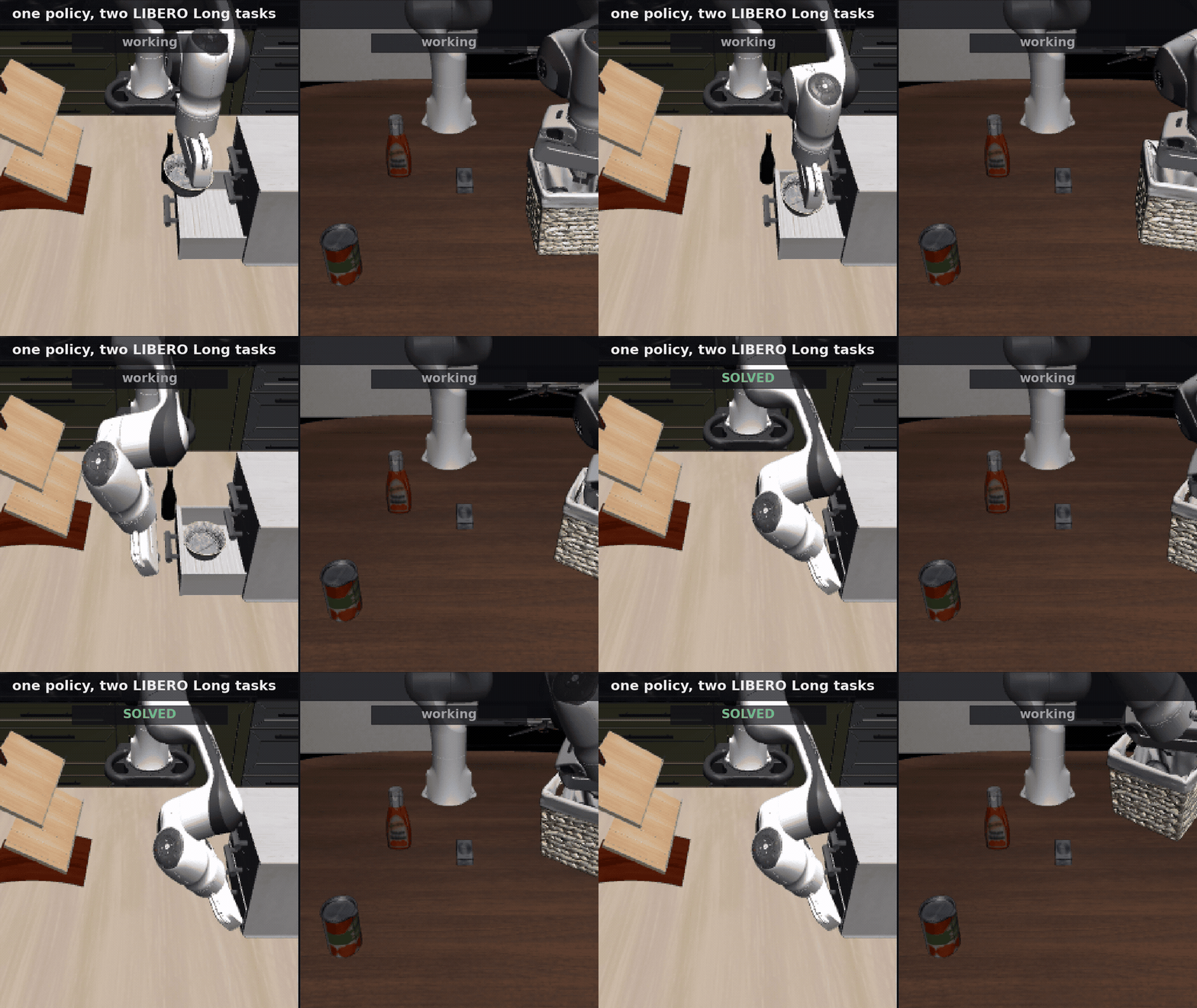
Two LIBERO Long episodes from the author's own runs, side by side. It is footage, not a measurement: two episodes, chosen, with no repetition and no statistics behind either panel.
Online reinforcement learning fine tuning for a flow matching vision language action policy, on a single consumer GPU.
Project page: https://mturan33.github.io/smolvla_flow_rl/
A flow matching policy produces an action chunk by integrating a learned velocity field from noise. Integrating
it deterministically gives no action likelihood, so there is nothing for a policy gradient to act on. This
repository takes the standard route around that, following the approach of pi_RL (see CITATION.cff): one step
of the integration is treated as stochastic, so the sampled chunk has a tractable log probability. Around that it
builds the machinery such a run needs in order to be trustworthy rather than merely runnable.
No results are reported here. Every number in this repository describes the machinery, what it trains, what it weighs and how long it takes, and none describes how well it works. The clip above is two episodes of footage and is not evidence of anything, whatever either panel appears to show. Measurements made with this substrate will be released with the accompanying paper.
This is the engineering substrate. It stands on its own as a starting point for anyone doing reinforcement learning fine tuning of a flow matching policy on limited hardware.
A vision language action policy has two things that a fine tuning run can change: the representation that reads the instruction and the scene, and the decoder that turns that representation into an action. This repository offers four trainable surfaces, and the choice among them is the single argument most likely to decide whether a run does anything at all.
The recommended default is expert_full_vlm_lora: the action expert trains at full rank, low rank adapters on
the language backbone train alongside it, and the flow action head trains at full rank. The vision tower and the
connector stay frozen.
The reasoning is that the other three each leave out one of the two things that have to move.
frozen adapts the language side and leaves the action decoder exactly as it was. Whatever the representation
learns has to be expressed through a decoder that cannot change how it expresses anything.lora opens the decoder through adapters and leaves the backbone bare. The decoder can shift, but only by as
much as a low rank correction allows, and the representation feeding it never adapts to the new objective.full opens the decoder at full rank and still leaves the backbone bare, so a changed instruction has no path
to a changed representation.Adapting the language side with low rank adapters while training the action decoder at full rank is the combination that the recent fine tuning literature reports as the one that works, and the same references also report that leaving the action head untouched is a common way to spend a training run without moving the policy:
Two things this section is not. It is not a report of a measurement made here: this repository publishes no
results, and the recommendation above is a statement about published practice and about which surfaces are
structurally capable of changing what. And it is not a claim that the other three regimes are useless. They are
kept precisely because a comparison needs controls: full is the adapter free control, lora is the adapter only
decoder, and frozen is the decoder untouched control. A run in any of them has to say so, with
--control_arm and a reason, and the reason is recorded.
Before the first update, build_model prints the manifest and then refuses to continue unless the action
expert's own parameters are at least 99 percent trainable, or the run declared itself a control. The fraction is
computed rather than compared against a fixed parameter count, so it survives a change of model size, of layer
count or of naming.
The check deliberately asks whether the expert's own body trains, not whether the expert appears anywhere in the trainable set. An adapter attached to the expert satisfies the second and not the first, and the difference between those two is invisible in a casually read parameter total.
In frozen, lora and full the pretrained action head does not train, and the protocol's behavioural parity
check rests on that: before any parameter has moved, the wrapper must reproduce the pretrained action. The
manifest's action head group reads zero in those three, and a nonzero reading is the fault.
In expert_full_vlm_lora the head trains at full rank, so the same reading inverts: nonzero is correct there
and a zero is the fault. Parity with the pretrained policy is a statement about a surface that leaves the action
path alone, and this regime does not. Asking it of a regime that deliberately changes the head would produce a red
line that is waived on every run, which teaches a reader to ignore red lines. The scope of the invariant is
therefore written into protocol/VERIFICATION_PROTOCOL.md, into src/model_setup.py, and into an executable test
that fails if the scope is widened again.
The KL anchor recovers the pretrained policy by switching the adapters off in place, which avoids holding a second
copy of the weights. That trick is only valid when every trainable parameter lives in an adapter. In
expert_full_vlm_lora the expert and the head are trained in place, so switching the adapters off returns the
trained policy with its adapters disabled, not the pretrained one; the anchor would pull toward the current policy
and log a penalty that means nothing.
The entry point therefore refuses --kl_coef other than zero in this regime and says why. The alternative, a full
second copy of the weights held for the reference, would roughly double the memory that this regime was chosen to
fit inside, so it is not offered. This is a documented refusal rather than a silent fallback, which is the whole
distinction: the check that used to guard this counted adapter layers and would have passed here, since adapters
are present, while the requirement it was meant to enforce was not met.
Several parts of this repository exist because the corresponding mistake was made and cost real time. They are kept because the failures share a shape: the run keeps going, the loss goes down, and nothing reports an error.
Developed and tested on a single RTX 5070 Ti laptop GPU (12GB VRAM), under WSL2. Anything with 12GB or more should behave the same; less is untested.
Linux, with a CUDA card and an EGL capable driver. EGL is the simulator's headless path, and the two run
wrappers select it. The evaluation entry point is invoked directly rather than through a wrapper, so it inherits
whatever the shell already has; export MUJOCO_GL=egl and PYOPENGL_PLATFORM=egl when scoring a checkpoint
outside a training run.
Install the dependencies, fetch the pretrained policy, then run the single task contact test before anything else. The contact test answers whether the setup can learn at all, which is worth establishing before reading anything into what a run produces.
conda env create -f environment.yml
conda activate smolvla-flow-rl

# or, into an environment you already have:
# pip install -r requirements.txt
python -c "import libero.libero"          # answer the prompt once, see below
python scripts/download_base_policy.py --out /path/to/base
bash examples/single_task_contact.sh /path/to/base
The middle line is there because the simulator package asks an interactive question the first time it is
imported, before this repository gets a say, and writes the answer to ~/.libero/config.yaml. Under a shell
with no terminal attached, which is what nohup, cron and most continuous integration give it, the question
cannot be answered and the import dies with an EOFError naming neither this repository nor the cause. Run it
once by hand and the rest is unattended. Keep a network available for the first run beyond fetching the policy.
A source checkout of the simulator carries its assets in the package; a wheel may not, in which case the first
environment built fetches them. Which of those applies to the distribution declared here was not established on
the machine this was developed on, where the source checkout is what is installed.
The policy must be one conditioned on this task suite. The harness supplies two camera images under particular keys, an eight dimensional state, and expects seven dimensional actions; a checkpoint declaring anything else cannot be driven by it. The generic SmolVLA base checkpoint is such a case, so the helper does not default to it. Passing a checkpoint that does not fit stops the run at construction with a message naming the mismatch, rather than failing later inside a simulator worker.
Fourteen arguments are required. Nine of them describe the run: the task list, the two paths, the number of update cycles, the rollout length, the episode length, the number of integration steps, the seed, and which part of the policy trains. The other five are tuning knobs: the exploration noise scale, the discount, the trace decay and the two learning rates.
None of the fourteen has a default, and the reason is the same in both groups. A default silently becomes a project wide constant that nobody chose and everybody inherits. The trainable surface is in that list for the same reason and not as an oversight: opening a surface other than the one intended produces a run whose arguments look right and whose manifest is the only place the difference shows.
python src/train_flow_rl.py --help
To score a checkpoint on its own, outside a training run, use the evaluation entry point. It refuses to print a rate until the completeness gate passes, then reads the same evaluation at every budget asked for.
python src/eval_cli.py --help
The mechanical checks run from one entry point.
bash scripts/run_gates.sh
That entry point runs three: a syntax and artefact check over the tree, an import closure walk that fails if any
entry point reaches a module this repository does not contain, and the invariant tests. The protocol contains
further rules that are stated but not automated here; each is marked in the document with how far it is taken.
See protocol/VERIFICATION_PROTOCOL.md for what each rule is and why it exists.
These are the parts that decide whether a number produced by this substrate can be trusted. None of them is an experiment and none reports a result.
src/reference_ops.py): the policy loss with a dual clip at 3.0, the
value loss with a trust region of 0.2 and a Huber delta of 10.0, and truncation compensation on the reward
side. Each cites the reference file and configuration key it follows. They live in one module because two
PPO paths that each write their own clip drift apart, and a drift between two runs you intend to compare is
not a bug in one of them, it is a confound in the comparison.src/ppo_step.py): the optimiser steps once per global batch rather than once
per micro batch. The failure this prevents is silent. A loop that calls zero_grad and step on every
micro batch trains at the micro batch size while every banner and log line reports the pooled figure;
nothing errors and the curves look ordinary. accum_total=1 reproduces the old behaviour exactly.src/seeding.py): a per-outer, per-environment stream from SeedSequence. Without it a
second unseeded reset at the top of the outer loop makes two same-seed runs diverge at the first rollout
step, on the observation side, before the sampler is called once.src/horizon_gate.py): training, in-training evaluation and the final
canonical evaluation must read one horizon field, or the run does not start. A series measured at two
horizons is not a series.src/run_config.py, scripts/diff_run_config.py): every run writes what
it was, with claimed arithmetic and measured arithmetic in separate blocks, and the diff tool names which
fields make two runs incomparable. Module constants and environment flags are recorded too, because the
field that turns out to matter is usually the one that is not an argparse argument.scripts/canon_scan.sh): an interrupted scan relaunched
into an appending file holds two scans, and any completeness check that counts lines will call that file
complete. Completeness is the shape of the scan, not the number of lines in it.Stated because a substrate that only advertises its gates is advertising.
python -c "import torch; print(torch.cuda.is_bf16_supported())" rather than inferring from the model name.Apache License 2.0, see LICENSE. Four files are derivative works of RLinf: the sampler, the critic head, the
update, and the action model wrapper. Two of those, the sampler and the wrapper, additionally follow LeRobot's own
policy implementation, so they have two upstreams each. All four carry notices of modification in their headers.
See NOTICE and CHANGES_FROM_UPSTREAM.md. LeRobot is therefore both a dependency and an upstream. No LIBERO
code is adapted here, though its scenes and objects are what the clip at the top renders; NOTICE covers that.
No source file from any of them is redistributed here.
No model weights are distributed. The download helper fetches two repositories from the Hugging Face Hub: the
policy, HuggingFaceVLA/smolvla_libero, and the backbone that policy asks for, which it reads out of the
policy's own configuration rather than assuming. Both state the Apache License 2.0 on their model cards at the
revisions recorded in NOTICE.
Those terms are theirs and not this repository's. If you point --repo somewhere else, the helper fetches
whatever backbone that policy asks for and says nothing about the terms of either, because it cannot know them.
If you use this, please cite it and the upstream work, see CITATION.cff.
Online reinforcement learning fine tuning for a flow matching vision language action policy, on a single 12GB consumer GPU.
See the code
Two LIBERO Long episodes from the author's own runs, side by side. It is footage, not a measurement: two episodes, chosen, with no repetition and no statistics behind either panel.
Online reinforcement learning fine tuning for a flow matching vision language action policy, on a single consumer GPU.
Project page: https://mturan33.github.io/smolvla_flow_rl/
A flow matching policy produces an action chunk by integrating a learned velocity field from noise. Integrating
it deterministically gives no action likelihood, so there is nothing for a policy gradient to act on. This
repository takes the standard route around that, following the approach of pi_RL (see CITATION.cff): one step
of the integration is treated as stochastic, so the sampled chunk has a tractable log probability. Around that it
builds the machinery such a run needs in order to be trustworthy rather than merely runnable.
No results are reported here. Every number in this repository describes the machinery, what it trains, what it weighs and how long it takes, and none describes how well it works. The clip above is two episodes of footage and is not evidence of anything, whatever either panel appears to show. Measurements made with this substrate will be released with the accompanying paper.
This is the engineering substrate. It stands on its own as a starting point for anyone doing reinforcement learning fine tuning of a flow matching policy on limited hardware.
A vision language action policy has two things that a fine tuning run can change: the representation that reads the instruction and the scene, and the decoder that turns that representation into an action. This repository offers four trainable surfaces, and the choice among them is the single argument most likely to decide whether a run does anything at all.
The recommended default is expert_full_vlm_lora: the action expert trains at full rank, low rank adapters on
the language backbone train alongside it, and the flow action head trains at full rank. The vision tower and the
connector stay frozen.
The reasoning is that the other three each leave out one of the two things that have to move.
frozen adapts the language side and leaves the action decoder exactly as it was. Whatever the representation
learns has to be expressed through a decoder that cannot change how it expresses anything.lora opens the decoder through adapters and leaves the backbone bare. The decoder can shift, but only by as
much as a low rank correction allows, and the representation feeding it never adapts to the new objective.full opens the decoder at full rank and still leaves the backbone bare, so a changed instruction has no path
to a changed representation.Adapting the language side with low rank adapters while training the action decoder at full rank is the combination that the recent fine tuning literature reports as the one that works, and the same references also report that leaving the action head untouched is a common way to spend a training run without moving the policy:
Two things this section is not. It is not a report of a measurement made here: this repository publishes no
results, and the recommendation above is a statement about published practice and about which surfaces are
structurally capable of changing what. And it is not a claim that the other three regimes are useless. They are
kept precisely because a comparison needs controls: full is the adapter free control, lora is the adapter only
decoder, and frozen is the decoder untouched control. A run in any of them has to say so, with
--control_arm and a reason, and the reason is recorded.
Before the first update, build_model prints the manifest and then refuses to continue unless the action
expert's own parameters are at least 99 percent trainable, or the run declared itself a control. The fraction is
computed rather than compared against a fixed parameter count, so it survives a change of model size, of layer
count or of naming.
The check deliberately asks whether the expert's own body trains, not whether the expert appears anywhere in the trainable set. An adapter attached to the expert satisfies the second and not the first, and the difference between those two is invisible in a casually read parameter total.
In frozen, lora and full the pretrained action head does not train, and the protocol's behavioural parity
check rests on that: before any parameter has moved, the wrapper must reproduce the pretrained action. The
manifest's action head group reads zero in those three, and a nonzero reading is the fault.
In expert_full_vlm_lora the head trains at full rank, so the same reading inverts: nonzero is correct there
and a zero is the fault. Parity with the pretrained policy is a statement about a surface that leaves the action
path alone, and this regime does not. Asking it of a regime that deliberately changes the head would produce a red
line that is waived on every run, which teaches a reader to ignore red lines. The scope of the invariant is
therefore written into protocol/VERIFICATION_PROTOCOL.md, into src/model_setup.py, and into an executable test
that fails if the scope is widened again.
The KL anchor recovers the pretrained policy by switching the adapters off in place, which avoids holding a second
copy of the weights. That trick is only valid when every trainable parameter lives in an adapter. In
expert_full_vlm_lora the expert and the head are trained in place, so switching the adapters off returns the
trained policy with its adapters disabled, not the pretrained one; the anchor would pull toward the current policy
and log a penalty that means nothing.
The entry point therefore refuses --kl_coef other than zero in this regime and says why. The alternative, a full
second copy of the weights held for the reference, would roughly double the memory that this regime was chosen to
fit inside, so it is not offered. This is a documented refusal rather than a silent fallback, which is the whole
distinction: the check that used to guard this counted adapter layers and would have passed here, since adapters
are present, while the requirement it was meant to enforce was not met.
Several parts of this repository exist because the corresponding mistake was made and cost real time. They are kept because the failures share a shape: the run keeps going, the loss goes down, and nothing reports an error.
Developed and tested on a single RTX 5070 Ti laptop GPU (12GB VRAM), under WSL2. Anything with 12GB or more should behave the same; less is untested.
Linux, with a CUDA card and an EGL capable driver. EGL is the simulator's headless path, and the two run
wrappers select it. The evaluation entry point is invoked directly rather than through a wrapper, so it inherits
whatever the shell already has; export MUJOCO_GL=egl and PYOPENGL_PLATFORM=egl when scoring a checkpoint
outside a training run.
Install the dependencies, fetch the pretrained policy, then run the single task contact test before anything else. The contact test answers whether the setup can learn at all, which is worth establishing before reading anything into what a run produces.
conda env create -f environment.yml
conda activate smolvla-flow-rl

# or, into an environment you already have:
# pip install -r requirements.txt
python -c "import libero.libero"          # answer the prompt once, see below
python scripts/download_base_policy.py --out /path/to/base
bash examples/single_task_contact.sh /path/to/base
The middle line is there because the simulator package asks an interactive question the first time it is
imported, before this repository gets a say, and writes the answer to ~/.libero/config.yaml. Under a shell
with no terminal attached, which is what nohup, cron and most continuous integration give it, the question
cannot be answered and the import dies with an EOFError naming neither this repository nor the cause. Run it
once by hand and the rest is unattended. Keep a network available for the first run beyond fetching the policy.
A source checkout of the simulator carries its assets in the package; a wheel may not, in which case the first
environment built fetches them. Which of those applies to the distribution declared here was not established on
the machine this was developed on, where the source checkout is what is installed.
The policy must be one conditioned on this task suite. The harness supplies two camera images under particular keys, an eight dimensional state, and expects seven dimensional actions; a checkpoint declaring anything else cannot be driven by it. The generic SmolVLA base checkpoint is such a case, so the helper does not default to it. Passing a checkpoint that does not fit stops the run at construction with a message naming the mismatch, rather than failing later inside a simulator worker.
Fourteen arguments are required. Nine of them describe the run: the task list, the two paths, the number of update cycles, the rollout length, the episode length, the number of integration steps, the seed, and which part of the policy trains. The other five are tuning knobs: the exploration noise scale, the discount, the trace decay and the two learning rates.
None of the fourteen has a default, and the reason is the same in both groups. A default silently becomes a project wide constant that nobody chose and everybody inherits. The trainable surface is in that list for the same reason and not as an oversight: opening a surface other than the one intended produces a run whose arguments look right and whose manifest is the only place the difference shows.
python src/train_flow_rl.py --help
To score a checkpoint on its own, outside a training run, use the evaluation entry point. It refuses to print a rate until the completeness gate passes, then reads the same evaluation at every budget asked for.
python src/eval_cli.py --help
The mechanical checks run from one entry point.
bash scripts/run_gates.sh
That entry point runs three: a syntax and artefact check over the tree, an import closure walk that fails if any
entry point reaches a module this repository does not contain, and the invariant tests. The protocol contains
further rules that are stated but not automated here; each is marked in the document with how far it is taken.
See protocol/VERIFICATION_PROTOCOL.md for what each rule is and why it exists.
These are the parts that decide whether a number produced by this substrate can be trusted. None of them is an experiment and none reports a result.
src/reference_ops.py): the policy loss with a dual clip at 3.0, the
value loss with a trust region of 0.2 and a Huber delta of 10.0, and truncation compensation on the reward
side. Each cites the reference file and configuration key it follows. They live in one module because two
PPO paths that each write their own clip drift apart, and a drift between two runs you intend to compare is
not a bug in one of them, it is a confound in the comparison.src/ppo_step.py): the optimiser steps once per global batch rather than once
per micro batch. The failure this prevents is silent. A loop that calls zero_grad and step on every
micro batch trains at the micro batch size while every banner and log line reports the pooled figure;
nothing errors and the curves look ordinary. accum_total=1 reproduces the old behaviour exactly.src/seeding.py): a per-outer, per-environment stream from SeedSequence. Without it a
second unseeded reset at the top of the outer loop makes two same-seed runs diverge at the first rollout
step, on the observation side, before the sampler is called once.src/horizon_gate.py): training, in-training evaluation and the final
canonical evaluation must read one horizon field, or the run does not start. A series measured at two
horizons is not a series.src/run_config.py, scripts/diff_run_config.py): every run writes what
it was, with claimed arithmetic and measured arithmetic in separate blocks, and the diff tool names which
fields make two runs incomparable. Module constants and environment flags are recorded too, because the
field that turns out to matter is usually the one that is not an argparse argument.scripts/canon_scan.sh): an interrupted scan relaunched
into an appending file holds two scans, and any completeness check that counts lines will call that file
complete. Completeness is the shape of the scan, not the number of lines in it.Stated because a substrate that only advertises its gates is advertising.
python -c "import torch; print(torch.cuda.is_bf16_supported())" rather than inferring from the model name.Apache License 2.0, see LICENSE. Four files are derivative works of RLinf: the sampler, the critic head, the
update, and the action model wrapper. Two of those, the sampler and the wrapper, additionally follow LeRobot's own
policy implementation, so they have two upstreams each. All four carry notices of modification in their headers.
See NOTICE and CHANGES_FROM_UPSTREAM.md. LeRobot is therefore both a dependency and an upstream. No LIBERO
code is adapted here, though its scenes and objects are what the clip at the top renders; NOTICE covers that.
No source file from any of them is redistributed here.
No model weights are distributed. The download helper fetches two repositories from the Hugging Face Hub: the
policy, HuggingFaceVLA/smolvla_libero, and the backbone that policy asks for, which it reads out of the
policy's own configuration rather than assuming. Both state the Apache License 2.0 on their model cards at the
revisions recorded in NOTICE.
Those terms are theirs and not this repository's. If you point --repo somewhere else, the helper fetches
whatever backbone that policy asks for and says nothing about the terms of either, because it cannot know them.
If you use this, please cite it and the upstream work, see CITATION.cff.