
:computer: make your ssh client smarter
3,220
stars
850
commits
Go
primary language
Sep 8, 2026
updated
README
assh






Overview
A transparent wrapper that adds support for regex, aliases, gateways, dynamic hostnames, graphviz, json output, yaml configuration, and more to SSH.
lib-ssh wraps assh as a ProxyCommand; it means that it works seamlessly with:
- ssh
- scp
- rsync
- git
- Desktop applications depending on
lib-sshorssh(i.e., Tower, Atom.io, SSH Tunnel Manager)
For specific examples, see 3rd Party Integration
Features
Configuration features
- regex support
- aliases
gate->gate.domain.tld - gateways -> transparent ssh connection chaining
- includes: split configuration in multiple files, note that OpenSSH as of v7.3 has native support for this
- local command execution: finally the reverse of RemoteCommand
- templates: equivalent to host but you can't connect directly to a template, perfect for inheritance
- inheritance: make hosts inherits from host hosts or templates
- variable expansion: resolve variables from the environment
- smart proxycommand: RAW tcp connection when possible with
netcatandsocatas default fallbacks - rate limit: configure a per-host or global rate-limiting
- JSON output
- Graphviz: graphviz reprensentation of the hosts
Using Gateway from command line
assh can use the ProxyCommand with netcat feature of OpenSSH transparently and without the pain of using extended configuration.
Connect to hosta using hostb as a gateway.
flowchart
    direction TB

    y[you]
    a[hosta]
    b[hostb]
    fw((firewall))

    style fw fill:#f00,color:#fff

    y ==x fw
    fw .-> a

    y --> b
    b --> a
$ ssh hosta/hostb
user@hosta $
Equivalent to ssh -o ProxyCommand="ssh hostb nc %h %p" hosta
Connect to hosta using hostb as a gateway using hostc as a gateway.
flowchart
    direction TB

    y[you]
    a[hosta]
    b[hostb]
    c[hostc]
    fw((firewall))

    style fw fill:#f00,color:#fff

    y ==x fw
    fw ..-> a

    y --> c
    c --> b
    b --> a
$ ssh hosta/hostb/hostc
user@hosta $
Equivalent to ssh -o ProxyCommand="ssh -o ProxyCommand='ssh hostc nc %h %p' hostb nc %h %p" hosta
Using Gateways from configuration file
You can define an equivalent of the "ProxyCommand with netcat" feature of OpenSSH, with a simpler syntax, more advanced workflows, and a unique fallback feature.
Let's consider the following assh.yml file
hosts:
  hosta:
    Hostname: 1.2.3.4

  hostb:
    Hostname: 5.6.7.8
    Gateways: hosta

  hostc:
    Hostname: 9.10.11.12
    Gateways: hostb

  hostd:
    Hostname: 13.14.15.16
    GatewayConnectTimeout: 2
    Gateways:
    - direct
    - hosta
ssh hosta->ssh 1.2.3.4ssh hostb->ssh -o ProxyCommand="ssh hostb nc %h %p" hostassh hostc->ssh -o ProxyCommand="ssh -o ProxyCommand='ssh hostc nc %h %p' hostb nc %h %p" hostassh hostd->- assh will try to
ssh 13.14.15.16 - then, fallback on
ssh -o ProxyCommand="ssh hostd nc %h %p" hosta - this method allows you to have the best performances when it is possible, but ensure your commands will work if you are outside of your company for instance
- assh will try to
Under the hood features
- Automatically regenerates
~/.ssh/configfile when needed - Inspect parent process to determine log level (if you use
ssh -vv, assh will automatically run in debug mode) - Automatically creates
ControlPathdirectories so you can use slashes in yourControlPathoption, can be enabled with theControlMasterMkdir: trueconfiguration in host or globally.
Hooks
Events
BeforeConnect
BeforeConnect is called just before assh tries to connect to the remote SSH port.
Note: BeforeConnect will be called for each SSH connection; if you use multiple gateways, it will be called for each gateways until one succeed to connect.
Example of Golang template variables:
// Host: https://pkg.go.dev/moul.io/assh/v2/pkg/config#Host
{{.Host.Name}}                                  //  localhost
{{.Host.HostName}}                              //  127.0.0.1
{{.Host.Port}}                                  //  22
{{.Host.User}}                                  //  moul
{{.Host.Prototype}}                             //  moul@127.0.0.1:22
{{.Host}}                                       //  {"HostName":"localhost","Port":22","User":"moul","ControlPersist":"yes",...}
{{printf "%s:%s" .Host.HostName .Host.Port}}    //  localhost:22
OnConnect
OnConnect is called as soon as assh is connected to the remote SSH port.
Note: OnConnect is not aware of the authentication process and will always be raised.
Example of Golang template variables:
// Host: https://pkg.go.dev/moul.io/assh/v2/pkg/config#Host
{{.Host.Name}}                                  //  localhost
{{.Host.HostName}}                              //  127.0.0.1
{{.Host.Port}}                                  //  22
{{.Host.User}}                                  //  moul
{{.Host.Prototype}}                             //  moul@127.0.0.1:22
{{.Host}}                                       //  {"HostName":"localhost","Port":22","User":"moul","ControlPersist":"yes",...}
{{printf "%s:%s" .Host.HostName .Host.Port}}    //  localhost:22

// Stats: https://pkg.go.dev/moul.io/assh/v2/pkg/commands#ConnectionStats
{{.Stats.ConnectedAt}}                           //  2016-07-20 11:19:23.467900594 +0200 CEST
OnConnectError
OnConnectError is called when assh fails to open a new TCP connection.
Example of Golang template variables:
// Host: https://pkg.go.dev/moul.io/assh/v2/pkg/config#Host
{{.Host.Name}}                                  //  localhost
{{.Host.HostName}}                              //  127.0.0.1
{{.Host.Port}}                                  //  22
{{.Host.User}}                                  //  moul
{{.Host.Prototype}}                             //  moul@127.0.0.1:22
{{.Host}}                                       //  {"HostName":"localhost","Port":22","User":"moul","ControlPersist":"yes",...}
{{printf "%s:%s" .Host.HostName .Host.Port}}    //  localhost:22

// Error
{{.Error}}                                      //  dial tcp: lookup localhost: no such host
OnDisconnect
OnDisconnect is called as the assh socket is closed.
warning: if you don't see a notification when closing an SSH connection, then you probably have ControlMaster configured; OnDisconnect is not linked to the ssh program but to its socket which may stay alive even after exiting the ssh program.
Example of Golang template variables:
// Host: https://pkg.go.dev/moul.io/assh/v2/pkg/config#Host
{{.Host.Name}}                                  //  localhost
{{.Host.HostName}}                              //  127.0.0.1
{{.Host.Port}}                                  //  22
{{.Host.User}}                                  //  moul
{{.Host.Prototype}}                             //  moul@127.0.0.1:22
{{.Host}}                                       //  {"HostName":"localhost","Port":22","User":"moul","ControlPersist":"yes",...}
{{printf "%s:%s" .Host.HostName .Host.Port}}    //  localhost:22

// Stats: https://pkg.go.dev/moul.io/assh/v2/pkg/commands#ConnectionStats
{{.Stats.ConnectedAt}}                           //  2016-07-20 11:19:23.467900594 +0200 CEST
{{.Stats.WrittenBytes}}                          //  3613
{{.Stats.WrittenBytesHuman}}                     //  3.6kb
{{.Stats.DisconnectAt}}                          //  2016-07-20 11:19:29,520515792 +0200 CEST
{{.Stats.ConnectionDuration}}                    //  6.052615198s
{{.Stats.ConnectionDurationHuman}}               //  6s
{{.Stats.AverageSpeed}}                          //  596.933bps
{{.Stats.AverageSpeedHuman}}                     //  3.4kb/s
BeforeConfigWrite
BeforeConfigWrite is called just before assh rewrite the ~/.ssh/config file.
Example of Golang template variables:
{{.SSHConfigPath}} // ~/.ssh/config
Hooks drivers
Exec driver
Exec driver uses Golang's template system to execute a shell command
Usage: exec <binary> [args...]
defaults:
  Hooks:
    OnConnect: exec echo '{{.Host}}' | jq .
# executes: `echo '{"HostName":"localhost","Port":"22","User":"moul","ControlPersist":"yes",...}' | jq .
# which results in printing a pretty JSON of the host
# {
#   "HostName": "localhost",
#   "Port": "22",
#   "User": "moul",
#   "ControlPersist": "yes",
#   ...
# }
defaults:
  Hooks:
    OnConnect: exec echo 'New SSH connection to {{.Host.Prototype}}.' | mail -s "SSH connection journal" m+assh@42.am
# send an email with the connection prototype
defaults:
  Hooks:
    BeforeConfigWrite: exec cp {{.SSHConfigPath}} {{.SSHConfigPath}}.backup
# make a copy of ~/.ssh/config before being rewritten
defaults:
  Hooks:
    AfterConfigWrite: 'exec echo "# date: `date`" >> {{.SSHConfigPath}}'
# Append a comment with the compilation date to the generated ~/.ssh/config file
defaults:
  Hooks:
  AfterConfigWrite: 'exec cat /path/to/my/provider/generated/.ssh/config >> {{.SSHConfigPath}}'
# Append another .ssh/config file to the generated .ssh/config file
The exec commands are blocking, a new driver for background tasks is planned. For now, you can run a job in background like this:
defaults:
  Hooks:
    OnConnect:
    - exec sleep 60 &
# execute the `sleep 60` command in background (non-blocking)
# if you quit your ssh connection, the process will continue in background.
Write driver
Write driver uses Golang's template system to write out data to stdout
Usage: write <line:string...>
defaults:
  Hooks:
    OnConnect:
    - write New SSH connection to {{.Host.Prototype}}.
# writes: "New SSH connection to moul@127.0.0.1:22." on the terminal on connection
defaults:
  Hooks:
    OnDisconnect:
    - "write SSH connection to {{.Host.Name}} closed, {{ .Stats.WrittenBytes }} bytes written in {{ .Stats.ConnectionDuration }} ({{ .Stats.AverageSpeed }})"
# writes: SSH connection to localhost closed, 40 bytes written.
Notify driver
Notify driver uses Golang's template system to open Desktop notifications.
- Mac OS X: Built-in support
- Linux: Depends on gnotifier
- Windows: Not supported
- BSD: Not supported
Usage: notify <line:string...>
defaults:
  Hooks:
    OnConnect: notify New SSH connection to {{.Host.Prototype}}.

defaults:
  Hooks:
    OnDisconnect:
    - "notify SSH connection to {{.Host.Name}} closed, {{ .Stats.WrittenBytes }} bytes written in {{ .Stats.ConnectionDuration }} ({{ .Stats.AverageSpeed }})"

Configuration
assh now manages the ~/.ssh/config file, take care to keep a backup your ~/.ssh/config file.
~/.ssh/assh.yml is a YAML file containing:
- a
hostsdictionary containing multiple HOST definitions - a
defaultssection containing global flags - and an
includessection containing path to other configuration files
hosts:

  homer:
    # ssh homer ->  ssh 1.2.3.4 -p 2222 -u robert
    Hostname: 1.2.3.4
    User: robert
    Port: 2222

  bart:
    # ssh bart ->   ssh 5.6.7.8 -u bart           <- direct access
    #            or ssh 5.6.7.8/homer -u bart     <- using homer as a gateway
    Hostname: 5.6.7.8
    User: bart
    Gateways:
    - direct                   # tries a direct access first
    - homer                    # fallback on homer gateway

  maggie:
    # ssh maggie ->   ssh 5.6.7.8 -u maggie       <- direct access
    #              or ssh 5.6.7.8/homer -u maggie   <- using homer as a gateway
    User: maggie
    Inherits: bart             # inherits rules from "bart"

  bart-access:
    # ssh bart-access ->  ssh home.simpson.springfield.us -u bart
    Inherits:
    - bart-template
    - simpson-template

  lisa-access:
    # ssh lisa-access ->  ssh home.simpson.springfield.us -u lisa
    Inherits:
    - lisa-template
    - simpson-template

  marvin:
    # ssh marvin    -> ssh marvin    -p 23
    # ssh sad-robot -> ssh sad-robot -p 23
    # ssh bighead   -> ssh bighead   -p 23
    # aliases inherit everything from marvin, except hostname
    Port: 23
    Aliases:
    - sad-robot
    - bighead

  dolphin:
    # ssh dolphin   -> ssh dolphin -p 24
    # ssh ecco      -> ssh dolphin -p 24
    # same as above, but with fixed hostname
    Port: 24
    Hostname: dolphin
    Aliases: ecco
    RateLimit: 10M # 10Mbytes/second rate limiting

  schooltemplate:
    User: student
    IdentityFile: ~/.ssh/school-rsa
    ForwardX11: yes

  schoolgw:
    # ssh school ->   ssh gw.school.com -l student -o ForwardX11=no -i ~/.ssh/school-rsa
    Hostname: gw.school.com
    ForwardX11: no
    Inherits: schooltemplate

  "expanded-host[0-7]*":
    # ssh somehost2042 ->       ssh somehost2042.some.zone
    Hostname: "%h.some.zone"

  vm-*.school.com:
    # ssh vm-42.school.com ->   ssh vm-42.school.com/gw.school.com -l student -o ForwardX11=yes -i ~/.ssh/school-rsa
    Gateways: schoolgw
    Inherits: schooltemplate
    # do not automatically create `ControlPath` -> may result in error
    ControlMasterMkdir: true

  "*.shortcut1":
    ResolveCommand: /bin/sh -c "echo %h | sed s/.shortcut1/.my-long-domain-name.com/"

  "*.shortcut2":
    ResolveCommand: /bin/sh -c "echo $(echo %h | sed s/.shortcut2//).my-other-long-domain-name.com"

  "*.scw":
    # ssh toto.scw -> 1. dynamically resolves the IP address
    #                 2. ssh {resolved ip address} -u root -p 22 -o UserKnownHostsFile=null -o StrictHostKeyChecking=no
    # requires github.com/scaleway/scaleway-cli
    ResolveCommand: /bin/sh -c "scw inspect -f {{.PublicAddress.IP}} server:$(echo %h | sed s/.scw//)"
    User: root
    Port: 22
    UserKnownHostsFile: /dev/null
    StrictHostKeyChecking: no

  my-env-host:
    User: user-$USER
    Hostname: ${HOSTNAME}${HOSTNAME_SUFFIX}

templates:
  # Templates are similar to Hosts; you can inherit from them
  # but you cannot ssh to a template
  bart-template:
    User: bart
  lisa-template:
    User: lisa
  simpson-template:
    Host: home.simpson.springfield.us

defaults:
  # Defaults are applied to each hosts
  ControlMaster: auto
  ControlPath: ~/tmp/.ssh/cm/%h-%p-%r.sock
  ControlPersist: yes
  Port: 22
  User: bob
  Hooks:
    # Automatically backup ~/.ssh/config
    BeforeConfigWrite:
      - 'exec set -x; cp {{.SSHConfigPath}} {{.SSHConfigPath}}.bkp'

    AfterConfigWrite:
      # Concat another `ssh_config` file with the one just generated by `assh`
      - 'exec cat ~/.ssh/my-heroku-generated-config >> {{.SSHConfigPath}}'

      # Alert me with a Desktop notification
      - notify "{{.SSHConfigPath}} has been rewritten"

    OnConnect:
      # Log internal information to a file
      - exec printf '{{.}}' | jq . >> ~/.ssh/last_connected_host.txt

      # Alert me with a Desktop notification
      - notify New SSH connection to {{.Host.Prototype}} at {{.Stats.ConnectedAt}}

      # Write the host prototype to the terminal stderr
      - write New SSH connection to {{.Host.Prototype}}

    OnDisconnect:
      # write on terminal and in a Desktop notification some statistics about the finished connection
      - "write  SSH connection to {{.Host.HostName}} closed, {{.Stats.WrittenBytes }} bytes written in {{.Stats.ConnectionDuration}} ({{.Stats.AverageSpeed}}bps)"
      - "notify SSH connection to {{.Host.HostName}} closed, {{.Stats.WrittenBytes }} bytes written in {{.Stats.ConnectionDuration}} ({{.Stats.AverageSpeed}}bps)"

includes:
- ~/.ssh/assh.d/*.yml
- /etc/assh.yml
- $ENV_VAR/blah-blah-*/*.yml

ASSHBinaryPath: ~/bin/assh  # optionally set the path of assh
For further inspiration, these assh.yml files on public GitHub projects can educate you on how people are using assh
Usage
assh usage
NAME:
   assh - advanced ssh config

USAGE:
   assh [global options] command [command options] [arguments...]

VERSION:
2.8.0 (HEAD)

AUTHOR(S):
   Manfred Touron <https://github.com/moul/assh>

COMMANDS:
   ping          Send packets to the SSH server and display statistics
   info          Display system-wide information
   config        Manage ssh and assh configuration
   sockets       Manage control sockets
   help, h       Shows a list of commands or help for one command

GLOBAL OPTIONS:
  --config value, -c value       Location of config file (default: "~/.ssh/assh.yml") [$ASSH_CONFIG]
  --debug, -D                    Enable debug mode [$ASSH_DEBUG]
  --verbose, -V                  Enable verbose mode
  --help, -h                     show help
  --version, -v                  print the version
Usage examples
assh config build
Rewrites and replaces the existing ~/.ssh/config file.
This action is automatically done by assh when detecting configuration changes. Running this command is useful to set up assh or repair the configuration file.
$ assh config build > ~/.ssh/config
assh config list
List hosts and options.
$ assh config list
Listing entries

    *.scw -> root@[hostname_not_specified]:22
        StrictHostKeyChecking=no [custom options]
        UserKnownHostsFile=/dev/null [custom options]

    *.shortcut1 -> bob@[hostname_not_specified]:22

    *.shortcut2 -> bob@[hostname_not_specified]:22

    bart -> bart@5.6.7.8:22

    bart-access -> bob@[hostname_not_specified]:22

    dolphin -> bob@dolphin:24

    expanded-host[0-7]* -> bob@%h.some.zone:22

    homer -> robert@1.2.3.4:2222

    lisa-access -> bob@[hostname_not_specified]:22

    maggie -> maggie@[hostname_not_specified]:22

    marvin -> bob@[hostname_not_specified]:23

    my-env-host -> user-moul@[hostname_not_specified]:22

    schoolgw -> bob@gw.school.com:22
        ForwardX11=no [custom options]

    schooltemplate -> student@[hostname_not_specified]:22
        ForwardX11=yes [custom options]
        IdentityFile=~/.ssh/school-rsa [custom options]

    vm-*.school.com -> bob@[hostname_not_specified]:22

    (*) General options:
        ControlMaster: auto
        ControlPath: ~/tmp/.ssh/cm/%h-%p-%r.sock
        ControlPersist: yes
        Port: 22
        User: bob
assh config graphviz
Generate a graphviz graph of the hosts
$ assh config graphviz | dot -Tpng > assh-hosts.png

assh config search <keyword>
Search for <keyword> in hosts and host options.
$ assh config search bart
Listing results for bart:
    bart -> bart@5.6.7.8:22
    bart-access -> moul@[hostname_not_specified]:22
assh info
Display system-wide information.
$ assh info
Debug mode (client): false
CLI Path: /path/to/assh
Go version: go1.6.2
OS/Arch: darwin/amd64

RC files:
- ~/.ssh/assh.yml
- ~/.ssh/assh.d/hosts.yml
- ~/.ssh/assh.d/moul.yml
- ~/.ssh/assh.d/test.yml

Statistics:
- 299 hosts
- 2 templates
- 4 included files
assh sockets list
List active control sockets.
$ assh sockets list
4 active control sockets in "~/.ssh/cm/":

- bart/homer/lisa-22-root.sock (14 minutes)
- bart/homer-22-root.sock (14 minutes)
- bart-22-root.sock (14 minutes)
- marge-22-bart.sock (1 hour)
assh sockets flush
Close active control sockets.
$ assh sockets flush
Closed 4 control sockets.
assh sockets master
Create a master control sockets.
$ assh sockets master
assh ping
Send packets to the SSH server and display stats.
$ assh ping -c 4 localhost
PING localhost (127.0.0.1) PORT 22 (ssh) PROTO tcp
Connected to 127.0.0.1: seq=0 time=321µs protocol=tcp port=22
Connected to 127.0.0.1: seq=1 time=501µs protocol=tcp port=22
Connected to 127.0.0.1: seq=2 time=550µs protocol=tcp port=22
Connected to 127.0.0.1: seq=3 time=641µs protocol=tcp port=22

--- localhost assh ping statistics ---
4 packets transmitted, 4 packets received, 0.00% packet loss
round-trip min/avg/max = 321µs/503.25µs/641µs
Install
Get the latest version using GO (recommended way):
go install moul.io/assh/v2@latest
note: tested with Go1.7 or above
Get the latest released version using homebrew (Mac OS X):
brew install assh
Build the latest version
brew install assh --HEAD
Get a released version on: https://github.com/moul/assh/releases
Install with asdf-vm:
asdf plugin add assh
asdf install assh latest
asdf global assh latest
Register the wrapper (optional)
To improve experience when using advanced pattern matching, add the following at the end of your .bashrc / .zshrc / config.fish:
alias ssh="assh wrapper ssh --"
This step is not mandatory but highly recommended.
Note: ssh does not understand advanced patterns;
To bypass this limitation, assh maintains a list of known hosts and regenerate the ~/.ssh/config with all those expanded known hosts.
Without the wrapper, the ~/.ssh/config risks to be outdated when connecting to a new host for the first time and you will need to launch the command again.
With the wrapper, ssh will always be called with an updated ~/.ssh/config file.
Getting started
- Backup your old
~/.ssh/config:cp ~/.ssh/config ~/.ssh/config.backup - Create a new
~/.ssh/assh.ymlfile - Run
assh config build > ~/.ssh/configto validate the syntax of your~/.ssh/assh.ymlfile and automatically build your~/.ssh/configfile - You are ready!
Docker
Experimental: assh may run in Docker, however you will have limitations:
- The
asshcontainers does not have any binaries exceptassh, you can't useProxyCommand,ResolveCommand... - Docker may run on another host,
ssh localhostwill ssh to Docker host
docker run -it --rm -v ~/.ssh:/.ssh moul/assh --help
assh in Docker is slower and has more limitations, but it may be useful for testing or if you plan to use a Docker host as a remote Gateway
Alternative version
- v1 (2009-2015) - The original implementation. It worked quite well, but was a lot slower, less portable, harder to install for the user and harder to work on to develop new features and fix bugs
Troubleshooting
I can't use gateways
assh uses the built-in netcat mode of OpenSSH (shipped with OpenSSH 5.4) by default.
If your ssh client doesn't support this feature, you can configure a custom ProxyCommand configuration, i.e.,
hosts:
  myserver:
    host: 1.2.3.4
    gateways: mygateway
    # configure a custom proxycommand
    proxycommand: /bin/nc %h %p

  mygateway:
    host: 5.6.7.8
You can configure this rule globally:
defaults:
  proxycommand: nc %h %p
Also, be sure to have netcat installed on your system, or use an alternative proxy binary, i.e., socat.
How to Configure resolver to parse /etc/hosts and/or handle mDNS requests
assh resolves hostnames using the system built-in resolver, depending on the OS, you can enable new features and/or change modules order.
- Linux - nsswitch documentation
- Linux - mDNS support (nss-mdns)
- Mac OS X -
/etc/resolv.confdocumentation
unix_listener: "/Users/.../.ssh/cm/..." too long for Unix domain socket
Starting with OpenSSH v6.7 the socket name can be shortened by configuring %C for the name expansion.
defaults:
  ControlPath: ~/tmp/.ssh/cm/%C.sock
%C is a unique identifier based on a hash of the tuple of (local host, remote user, hostname, port).
How to disable the automatic configuration rewrite
Each time you call ssh, assh will check if the generated ~/.ssh/config file is outdated.
By default, it will transparently regenerate the configuration file if needed.
You can disable this behavior by generating the configuration file like this:
assh config build --no-automatic-rewrite
3rd Party Integration
Ansible
In your ansible.cfg under ssh_connection, make sure you have the following, changing the path to your assh:
[ssh_connection]
ansible_ssh_executable = '/usr/local/bin/assh wrapper ssh'
3rd Party Projects
- ansible-dotfiles-assh: Ansible - Configure SSH with ASSH
- appflow: Multitenant environment automation
Contributors
Code Contributors
This project exists thanks to all the people who contribute. [Contribute].

Financial Contributors
Become a financial contributor and help us sustain our community. [Contribute]
Individuals

Organizations
Support this project with your organization. Your logo will show up here with a link to your website. [Contribute]



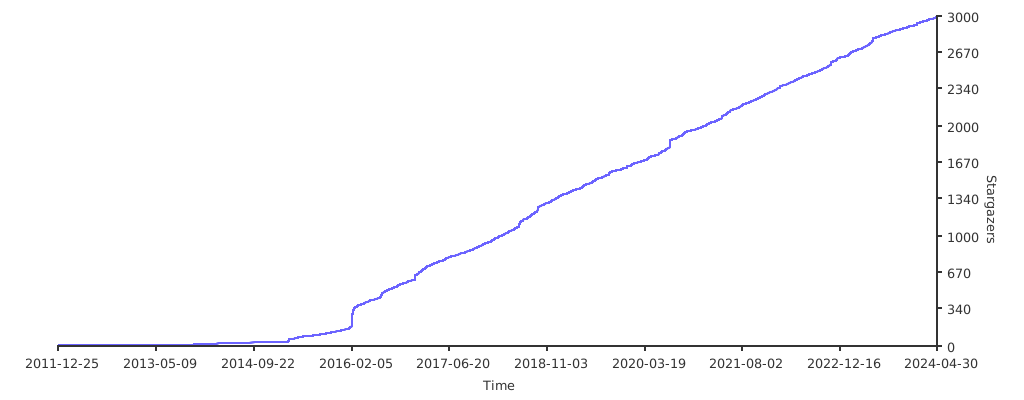
Stargazers over time
License
© 2009-2026 Manfred Touron - MIT License
Contributors
(top 30 of 42)


Similar repos


Languages
Go
97.4%
Makefile
1.2%
:computer: make your ssh client smarter
3,220
stars
850
commits
Go
primary language
Sep 8, 2026
updated
README
assh
Overview
A transparent wrapper that adds support for regex, aliases, gateways, dynamic hostnames, graphviz, json output, yaml configuration, and more to SSH.
lib-ssh wraps assh as a ProxyCommand; it means that it works seamlessly with:
- ssh
- scp
- rsync
- git
- Desktop applications depending on
lib-sshorssh(i.e., Tower, Atom.io, SSH Tunnel Manager)
For specific examples, see 3rd Party Integration
Features
Configuration features
- regex support
- aliases
gate->gate.domain.tld - gateways -> transparent ssh connection chaining
- includes: split configuration in multiple files, note that OpenSSH as of v7.3 has native support for this
- local command execution: finally the reverse of RemoteCommand
- templates: equivalent to host but you can't connect directly to a template, perfect for inheritance
- inheritance: make hosts inherits from host hosts or templates
- variable expansion: resolve variables from the environment
- smart proxycommand: RAW tcp connection when possible with
netcatandsocatas default fallbacks - rate limit: configure a per-host or global rate-limiting
- JSON output
- Graphviz: graphviz reprensentation of the hosts
Using Gateway from command line
assh can use the ProxyCommand with netcat feature of OpenSSH transparently and without the pain of using extended configuration.
Connect to hosta using hostb as a gateway.
flowchart
    direction TB

    y[you]
    a[hosta]
    b[hostb]
    fw((firewall))

    style fw fill:#f00,color:#fff

    y ==x fw
    fw .-> a

    y --> b
    b --> a
$ ssh hosta/hostb
user@hosta $
Equivalent to ssh -o ProxyCommand="ssh hostb nc %h %p" hosta
Connect to hosta using hostb as a gateway using hostc as a gateway.
flowchart
    direction TB

    y[you]
    a[hosta]
    b[hostb]
    c[hostc]
    fw((firewall))

    style fw fill:#f00,color:#fff

    y ==x fw
    fw ..-> a

    y --> c
    c --> b
    b --> a
$ ssh hosta/hostb/hostc
user@hosta $
Equivalent to ssh -o ProxyCommand="ssh -o ProxyCommand='ssh hostc nc %h %p' hostb nc %h %p" hosta
Using Gateways from configuration file
You can define an equivalent of the "ProxyCommand with netcat" feature of OpenSSH, with a simpler syntax, more advanced workflows, and a unique fallback feature.
Let's consider the following assh.yml file
hosts:
  hosta:
    Hostname: 1.2.3.4

  hostb:
    Hostname: 5.6.7.8
    Gateways: hosta

  hostc:
    Hostname: 9.10.11.12
    Gateways: hostb

  hostd:
    Hostname: 13.14.15.16
    GatewayConnectTimeout: 2
    Gateways:
    - direct
    - hosta
ssh hosta->ssh 1.2.3.4ssh hostb->ssh -o ProxyCommand="ssh hostb nc %h %p" hostassh hostc->ssh -o ProxyCommand="ssh -o ProxyCommand='ssh hostc nc %h %p' hostb nc %h %p" hostassh hostd->- assh will try to
ssh 13.14.15.16 - then, fallback on
ssh -o ProxyCommand="ssh hostd nc %h %p" hosta - this method allows you to have the best performances when it is possible, but ensure your commands will work if you are outside of your company for instance
- assh will try to
Under the hood features
- Automatically regenerates
~/.ssh/configfile when needed - Inspect parent process to determine log level (if you use
ssh -vv, assh will automatically run in debug mode) - Automatically creates
ControlPathdirectories so you can use slashes in yourControlPathoption, can be enabled with theControlMasterMkdir: trueconfiguration in host or globally.
Hooks
Events
BeforeConnect
BeforeConnect is called just before assh tries to connect to the remote SSH port.
Note: BeforeConnect will be called for each SSH connection; if you use multiple gateways, it will be called for each gateways until one succeed to connect.
Example of Golang template variables:
// Host: https://pkg.go.dev/moul.io/assh/v2/pkg/config#Host
{{.Host.Name}}                                  //  localhost
{{.Host.HostName}}                              //  127.0.0.1
{{.Host.Port}}                                  //  22
{{.Host.User}}                                  //  moul
{{.Host.Prototype}}                             //  moul@127.0.0.1:22
{{.Host}}                                       //  {"HostName":"localhost","Port":22","User":"moul","ControlPersist":"yes",...}
{{printf "%s:%s" .Host.HostName .Host.Port}}    //  localhost:22
OnConnect
OnConnect is called as soon as assh is connected to the remote SSH port.
Note: OnConnect is not aware of the authentication process and will always be raised.
Example of Golang template variables:
// Host: https://pkg.go.dev/moul.io/assh/v2/pkg/config#Host
{{.Host.Name}}                                  //  localhost
{{.Host.HostName}}                              //  127.0.0.1
{{.Host.Port}}                                  //  22
{{.Host.User}}                                  //  moul
{{.Host.Prototype}}                             //  moul@127.0.0.1:22
{{.Host}}                                       //  {"HostName":"localhost","Port":22","User":"moul","ControlPersist":"yes",...}
{{printf "%s:%s" .Host.HostName .Host.Port}}    //  localhost:22

// Stats: https://pkg.go.dev/moul.io/assh/v2/pkg/commands#ConnectionStats
{{.Stats.ConnectedAt}}                           //  2016-07-20 11:19:23.467900594 +0200 CEST
OnConnectError
OnConnectError is called when assh fails to open a new TCP connection.
Example of Golang template variables:
// Host: https://pkg.go.dev/moul.io/assh/v2/pkg/config#Host
{{.Host.Name}}                                  //  localhost
{{.Host.HostName}}                              //  127.0.0.1
{{.Host.Port}}                                  //  22
{{.Host.User}}                                  //  moul
{{.Host.Prototype}}                             //  moul@127.0.0.1:22
{{.Host}}                                       //  {"HostName":"localhost","Port":22","User":"moul","ControlPersist":"yes",...}
{{printf "%s:%s" .Host.HostName .Host.Port}}    //  localhost:22

// Error
{{.Error}}                                      //  dial tcp: lookup localhost: no such host
OnDisconnect
OnDisconnect is called as the assh socket is closed.
warning: if you don't see a notification when closing an SSH connection, then you probably have ControlMaster configured; OnDisconnect is not linked to the ssh program but to its socket which may stay alive even after exiting the ssh program.
Example of Golang template variables:
// Host: https://pkg.go.dev/moul.io/assh/v2/pkg/config#Host
{{.Host.Name}}                                  //  localhost
{{.Host.HostName}}                              //  127.0.0.1
{{.Host.Port}}                                  //  22
{{.Host.User}}                                  //  moul
{{.Host.Prototype}}                             //  moul@127.0.0.1:22
{{.Host}}                                       //  {"HostName":"localhost","Port":22","User":"moul","ControlPersist":"yes",...}
{{printf "%s:%s" .Host.HostName .Host.Port}}    //  localhost:22

// Stats: https://pkg.go.dev/moul.io/assh/v2/pkg/commands#ConnectionStats
{{.Stats.ConnectedAt}}                           //  2016-07-20 11:19:23.467900594 +0200 CEST
{{.Stats.WrittenBytes}}                          //  3613
{{.Stats.WrittenBytesHuman}}                     //  3.6kb
{{.Stats.DisconnectAt}}                          //  2016-07-20 11:19:29,520515792 +0200 CEST
{{.Stats.ConnectionDuration}}                    //  6.052615198s
{{.Stats.ConnectionDurationHuman}}               //  6s
{{.Stats.AverageSpeed}}                          //  596.933bps
{{.Stats.AverageSpeedHuman}}                     //  3.4kb/s
BeforeConfigWrite
BeforeConfigWrite is called just before assh rewrite the ~/.ssh/config file.
Example of Golang template variables:
{{.SSHConfigPath}} // ~/.ssh/config
Hooks drivers
Exec driver
Exec driver uses Golang's template system to execute a shell command
Usage: exec <binary> [args...]
defaults:
  Hooks:
    OnConnect: exec echo '{{.Host}}' | jq .
# executes: `echo '{"HostName":"localhost","Port":"22","User":"moul","ControlPersist":"yes",...}' | jq .
# which results in printing a pretty JSON of the host
# {
#   "HostName": "localhost",
#   "Port": "22",
#   "User": "moul",
#   "ControlPersist": "yes",
#   ...
# }
defaults:
  Hooks:
    OnConnect: exec echo 'New SSH connection to {{.Host.Prototype}}.' | mail -s "SSH connection journal" m+assh@42.am
# send an email with the connection prototype
defaults:
  Hooks:
    BeforeConfigWrite: exec cp {{.SSHConfigPath}} {{.SSHConfigPath}}.backup
# make a copy of ~/.ssh/config before being rewritten
defaults:
  Hooks:
    AfterConfigWrite: 'exec echo "# date: `date`" >> {{.SSHConfigPath}}'
# Append a comment with the compilation date to the generated ~/.ssh/config file
defaults:
  Hooks:
  AfterConfigWrite: 'exec cat /path/to/my/provider/generated/.ssh/config >> {{.SSHConfigPath}}'
# Append another .ssh/config file to the generated .ssh/config file
The exec commands are blocking, a new driver for background tasks is planned. For now, you can run a job in background like this:
defaults:
  Hooks:
    OnConnect:
    - exec sleep 60 &
# execute the `sleep 60` command in background (non-blocking)
# if you quit your ssh connection, the process will continue in background.
Write driver
Write driver uses Golang's template system to write out data to stdout
Usage: write <line:string...>
defaults:
  Hooks:
    OnConnect:
    - write New SSH connection to {{.Host.Prototype}}.
# writes: "New SSH connection to moul@127.0.0.1:22." on the terminal on connection
defaults:
  Hooks:
    OnDisconnect:
    - "write SSH connection to {{.Host.Name}} closed, {{ .Stats.WrittenBytes }} bytes written in {{ .Stats.ConnectionDuration }} ({{ .Stats.AverageSpeed }})"
# writes: SSH connection to localhost closed, 40 bytes written.
Notify driver
Notify driver uses Golang's template system to open Desktop notifications.
- Mac OS X: Built-in support
- Linux: Depends on gnotifier
- Windows: Not supported
- BSD: Not supported
Usage: notify <line:string...>
defaults:
  Hooks:
    OnConnect: notify New SSH connection to {{.Host.Prototype}}.
defaults:
  Hooks:
    OnDisconnect:
    - "notify SSH connection to {{.Host.Name}} closed, {{ .Stats.WrittenBytes }} bytes written in {{ .Stats.ConnectionDuration }} ({{ .Stats.AverageSpeed }})"
Configuration
assh now manages the ~/.ssh/config file, take care to keep a backup your ~/.ssh/config file.
~/.ssh/assh.yml is a YAML file containing:
- a
hostsdictionary containing multiple HOST definitions - a
defaultssection containing global flags - and an
includessection containing path to other configuration files
hosts:

  homer:
    # ssh homer ->  ssh 1.2.3.4 -p 2222 -u robert
    Hostname: 1.2.3.4
    User: robert
    Port: 2222

  bart:
    # ssh bart ->   ssh 5.6.7.8 -u bart           <- direct access
    #            or ssh 5.6.7.8/homer -u bart     <- using homer as a gateway
    Hostname: 5.6.7.8
    User: bart
    Gateways:
    - direct                   # tries a direct access first
    - homer                    # fallback on homer gateway

  maggie:
    # ssh maggie ->   ssh 5.6.7.8 -u maggie       <- direct access
    #              or ssh 5.6.7.8/homer -u maggie   <- using homer as a gateway
    User: maggie
    Inherits: bart             # inherits rules from "bart"

  bart-access:
    # ssh bart-access ->  ssh home.simpson.springfield.us -u bart
    Inherits:
    - bart-template
    - simpson-template

  lisa-access:
    # ssh lisa-access ->  ssh home.simpson.springfield.us -u lisa
    Inherits:
    - lisa-template
    - simpson-template

  marvin:
    # ssh marvin    -> ssh marvin    -p 23
    # ssh sad-robot -> ssh sad-robot -p 23
    # ssh bighead   -> ssh bighead   -p 23
    # aliases inherit everything from marvin, except hostname
    Port: 23
    Aliases:
    - sad-robot
    - bighead

  dolphin:
    # ssh dolphin   -> ssh dolphin -p 24
    # ssh ecco      -> ssh dolphin -p 24
    # same as above, but with fixed hostname
    Port: 24
    Hostname: dolphin
    Aliases: ecco
    RateLimit: 10M # 10Mbytes/second rate limiting

  schooltemplate:
    User: student
    IdentityFile: ~/.ssh/school-rsa
    ForwardX11: yes

  schoolgw:
    # ssh school ->   ssh gw.school.com -l student -o ForwardX11=no -i ~/.ssh/school-rsa
    Hostname: gw.school.com
    ForwardX11: no
    Inherits: schooltemplate

  "expanded-host[0-7]*":
    # ssh somehost2042 ->       ssh somehost2042.some.zone
    Hostname: "%h.some.zone"

  vm-*.school.com:
    # ssh vm-42.school.com ->   ssh vm-42.school.com/gw.school.com -l student -o ForwardX11=yes -i ~/.ssh/school-rsa
    Gateways: schoolgw
    Inherits: schooltemplate
    # do not automatically create `ControlPath` -> may result in error
    ControlMasterMkdir: true

  "*.shortcut1":
    ResolveCommand: /bin/sh -c "echo %h | sed s/.shortcut1/.my-long-domain-name.com/"

  "*.shortcut2":
    ResolveCommand: /bin/sh -c "echo $(echo %h | sed s/.shortcut2//).my-other-long-domain-name.com"

  "*.scw":
    # ssh toto.scw -> 1. dynamically resolves the IP address
    #                 2. ssh {resolved ip address} -u root -p 22 -o UserKnownHostsFile=null -o StrictHostKeyChecking=no
    # requires github.com/scaleway/scaleway-cli
    ResolveCommand: /bin/sh -c "scw inspect -f {{.PublicAddress.IP}} server:$(echo %h | sed s/.scw//)"
    User: root
    Port: 22
    UserKnownHostsFile: /dev/null
    StrictHostKeyChecking: no

  my-env-host:
    User: user-$USER
    Hostname: ${HOSTNAME}${HOSTNAME_SUFFIX}

templates:
  # Templates are similar to Hosts; you can inherit from them
  # but you cannot ssh to a template
  bart-template:
    User: bart
  lisa-template:
    User: lisa
  simpson-template:
    Host: home.simpson.springfield.us

defaults:
  # Defaults are applied to each hosts
  ControlMaster: auto
  ControlPath: ~/tmp/.ssh/cm/%h-%p-%r.sock
  ControlPersist: yes
  Port: 22
  User: bob
  Hooks:
    # Automatically backup ~/.ssh/config
    BeforeConfigWrite:
      - 'exec set -x; cp {{.SSHConfigPath}} {{.SSHConfigPath}}.bkp'

    AfterConfigWrite:
      # Concat another `ssh_config` file with the one just generated by `assh`
      - 'exec cat ~/.ssh/my-heroku-generated-config >> {{.SSHConfigPath}}'

      # Alert me with a Desktop notification
      - notify "{{.SSHConfigPath}} has been rewritten"

    OnConnect:
      # Log internal information to a file
      - exec printf '{{.}}' | jq . >> ~/.ssh/last_connected_host.txt

      # Alert me with a Desktop notification
      - notify New SSH connection to {{.Host.Prototype}} at {{.Stats.ConnectedAt}}

      # Write the host prototype to the terminal stderr
      - write New SSH connection to {{.Host.Prototype}}

    OnDisconnect:
      # write on terminal and in a Desktop notification some statistics about the finished connection
      - "write  SSH connection to {{.Host.HostName}} closed, {{.Stats.WrittenBytes }} bytes written in {{.Stats.ConnectionDuration}} ({{.Stats.AverageSpeed}}bps)"
      - "notify SSH connection to {{.Host.HostName}} closed, {{.Stats.WrittenBytes }} bytes written in {{.Stats.ConnectionDuration}} ({{.Stats.AverageSpeed}}bps)"

includes:
- ~/.ssh/assh.d/*.yml
- /etc/assh.yml
- $ENV_VAR/blah-blah-*/*.yml

ASSHBinaryPath: ~/bin/assh  # optionally set the path of assh
For further inspiration, these assh.yml files on public GitHub projects can educate you on how people are using assh
Usage
assh usage
NAME:
   assh - advanced ssh config

USAGE:
   assh [global options] command [command options] [arguments...]

VERSION:
2.8.0 (HEAD)

AUTHOR(S):
   Manfred Touron <https://github.com/moul/assh>

COMMANDS:
   ping          Send packets to the SSH server and display statistics
   info          Display system-wide information
   config        Manage ssh and assh configuration
   sockets       Manage control sockets
   help, h       Shows a list of commands or help for one command

GLOBAL OPTIONS:
  --config value, -c value       Location of config file (default: "~/.ssh/assh.yml") [$ASSH_CONFIG]
  --debug, -D                    Enable debug mode [$ASSH_DEBUG]
  --verbose, -V                  Enable verbose mode
  --help, -h                     show help
  --version, -v                  print the version
Usage examples
assh config build
Rewrites and replaces the existing ~/.ssh/config file.
This action is automatically done by assh when detecting configuration changes. Running this command is useful to set up assh or repair the configuration file.
$ assh config build > ~/.ssh/config
assh config list
List hosts and options.
$ assh config list
Listing entries

    *.scw -> root@[hostname_not_specified]:22
        StrictHostKeyChecking=no [custom options]
        UserKnownHostsFile=/dev/null [custom options]

    *.shortcut1 -> bob@[hostname_not_specified]:22

    *.shortcut2 -> bob@[hostname_not_specified]:22

    bart -> bart@5.6.7.8:22

    bart-access -> bob@[hostname_not_specified]:22

    dolphin -> bob@dolphin:24

    expanded-host[0-7]* -> bob@%h.some.zone:22

    homer -> robert@1.2.3.4:2222

    lisa-access -> bob@[hostname_not_specified]:22

    maggie -> maggie@[hostname_not_specified]:22

    marvin -> bob@[hostname_not_specified]:23

    my-env-host -> user-moul@[hostname_not_specified]:22

    schoolgw -> bob@gw.school.com:22
        ForwardX11=no [custom options]

    schooltemplate -> student@[hostname_not_specified]:22
        ForwardX11=yes [custom options]
        IdentityFile=~/.ssh/school-rsa [custom options]

    vm-*.school.com -> bob@[hostname_not_specified]:22

    (*) General options:
        ControlMaster: auto
        ControlPath: ~/tmp/.ssh/cm/%h-%p-%r.sock
        ControlPersist: yes
        Port: 22
        User: bob
assh config graphviz
Generate a graphviz graph of the hosts
$ assh config graphviz | dot -Tpng > assh-hosts.png
assh config search <keyword>
Search for <keyword> in hosts and host options.
$ assh config search bart
Listing results for bart:
    bart -> bart@5.6.7.8:22
    bart-access -> moul@[hostname_not_specified]:22
assh info
Display system-wide information.
$ assh info
Debug mode (client): false
CLI Path: /path/to/assh
Go version: go1.6.2
OS/Arch: darwin/amd64

RC files:
- ~/.ssh/assh.yml
- ~/.ssh/assh.d/hosts.yml
- ~/.ssh/assh.d/moul.yml
- ~/.ssh/assh.d/test.yml

Statistics:
- 299 hosts
- 2 templates
- 4 included files
assh sockets list
List active control sockets.
$ assh sockets list
4 active control sockets in "~/.ssh/cm/":

- bart/homer/lisa-22-root.sock (14 minutes)
- bart/homer-22-root.sock (14 minutes)
- bart-22-root.sock (14 minutes)
- marge-22-bart.sock (1 hour)
assh sockets flush
Close active control sockets.
$ assh sockets flush
Closed 4 control sockets.
assh sockets master
Create a master control sockets.
$ assh sockets master
assh ping
Send packets to the SSH server and display stats.
$ assh ping -c 4 localhost
PING localhost (127.0.0.1) PORT 22 (ssh) PROTO tcp
Connected to 127.0.0.1: seq=0 time=321µs protocol=tcp port=22
Connected to 127.0.0.1: seq=1 time=501µs protocol=tcp port=22
Connected to 127.0.0.1: seq=2 time=550µs protocol=tcp port=22
Connected to 127.0.0.1: seq=3 time=641µs protocol=tcp port=22

--- localhost assh ping statistics ---
4 packets transmitted, 4 packets received, 0.00% packet loss
round-trip min/avg/max = 321µs/503.25µs/641µs
Install
Get the latest version using GO (recommended way):
go install moul.io/assh/v2@latest
note: tested with Go1.7 or above
Get the latest released version using homebrew (Mac OS X):
brew install assh
Build the latest version
brew install assh --HEAD
Get a released version on: https://github.com/moul/assh/releases
Install with asdf-vm:
asdf plugin add assh
asdf install assh latest
asdf global assh latest
Register the wrapper (optional)
To improve experience when using advanced pattern matching, add the following at the end of your .bashrc / .zshrc / config.fish:
alias ssh="assh wrapper ssh --"
This step is not mandatory but highly recommended.
Note: ssh does not understand advanced patterns;
To bypass this limitation, assh maintains a list of known hosts and regenerate the ~/.ssh/config with all those expanded known hosts.
Without the wrapper, the ~/.ssh/config risks to be outdated when connecting to a new host for the first time and you will need to launch the command again.
With the wrapper, ssh will always be called with an updated ~/.ssh/config file.
Getting started
- Backup your old
~/.ssh/config:cp ~/.ssh/config ~/.ssh/config.backup - Create a new
~/.ssh/assh.ymlfile - Run
assh config build > ~/.ssh/configto validate the syntax of your~/.ssh/assh.ymlfile and automatically build your~/.ssh/configfile - You are ready!
Docker
Experimental: assh may run in Docker, however you will have limitations:
- The
asshcontainers does not have any binaries exceptassh, you can't useProxyCommand,ResolveCommand... - Docker may run on another host,
ssh localhostwill ssh to Docker host
docker run -it --rm -v ~/.ssh:/.ssh moul/assh --help
assh in Docker is slower and has more limitations, but it may be useful for testing or if you plan to use a Docker host as a remote Gateway
Alternative version
- v1 (2009-2015) - The original implementation. It worked quite well, but was a lot slower, less portable, harder to install for the user and harder to work on to develop new features and fix bugs
Troubleshooting
I can't use gateways
assh uses the built-in netcat mode of OpenSSH (shipped with OpenSSH 5.4) by default.
If your ssh client doesn't support this feature, you can configure a custom ProxyCommand configuration, i.e.,
hosts:
  myserver:
    host: 1.2.3.4
    gateways: mygateway
    # configure a custom proxycommand
    proxycommand: /bin/nc %h %p

  mygateway:
    host: 5.6.7.8
You can configure this rule globally:
defaults:
  proxycommand: nc %h %p
Also, be sure to have netcat installed on your system, or use an alternative proxy binary, i.e., socat.
How to Configure resolver to parse /etc/hosts and/or handle mDNS requests
assh resolves hostnames using the system built-in resolver, depending on the OS, you can enable new features and/or change modules order.
- Linux - nsswitch documentation
- Linux - mDNS support (nss-mdns)
- Mac OS X -
/etc/resolv.confdocumentation
unix_listener: "/Users/.../.ssh/cm/..." too long for Unix domain socket
Starting with OpenSSH v6.7 the socket name can be shortened by configuring %C for the name expansion.
defaults:
  ControlPath: ~/tmp/.ssh/cm/%C.sock
%C is a unique identifier based on a hash of the tuple of (local host, remote user, hostname, port).
How to disable the automatic configuration rewrite
Each time you call ssh, assh will check if the generated ~/.ssh/config file is outdated.
By default, it will transparently regenerate the configuration file if needed.
You can disable this behavior by generating the configuration file like this:
assh config build --no-automatic-rewrite
3rd Party Integration
Ansible
In your ansible.cfg under ssh_connection, make sure you have the following, changing the path to your assh:
[ssh_connection]
ansible_ssh_executable = '/usr/local/bin/assh wrapper ssh'
3rd Party Projects
- ansible-dotfiles-assh: Ansible - Configure SSH with ASSH
- appflow: Multitenant environment automation
Contributors
Code Contributors
This project exists thanks to all the people who contribute. [Contribute].
Financial Contributors
Become a financial contributor and help us sustain our community. [Contribute]
Individuals
Organizations
Support this project with your organization. Your logo will show up here with a link to your website. [Contribute]
Stargazers over time
License
© 2009-2026 Manfred Touron - MIT License
Similar repos
Contributors
(top 30 of 42)
Languages
Go
97.4%
Makefile
1.2%