




This repository contains the Proof of Concept (PoC) and technical breakdown for a 0-day pre-authentication Remote Code Execution (RCE) vulnerability affecting the XWorm RAT C2 Control Panel.
By abusing an unauthenticated path traversal vulnerability in the panel's file reception logic, an attacker acting as a fake client can overwrite internal panel dependencies (FastColoredTextBox.dll). Subsequently, issuing a protocol command triggers dynamic loading of the overwritten assembly, executing arbitrary code within the context of the running C2 panel (typically with administrative privileges).
| Parameter | Details |
|---|---|
| Target Application | XWorm Remote Access Trojan (RAT) Controller / Panel |
| Affected Versions | All versions up to and including XWorm v7.4 |
| Vulnerability Type | Path Traversal File Overwrite + DLL Hijacking / Dynamic Loading $\rightarrow$ RCE |
| CWE Classification | CWE-23: Relative Path Traversal CWE-427: Uncontrolled Search Path Element |
| Required Privileges | None (Pre-Authentication / Client Protocol Emulation) |
| Impact | Full Remote Code Execution (RCE) on the C2 Server Host |
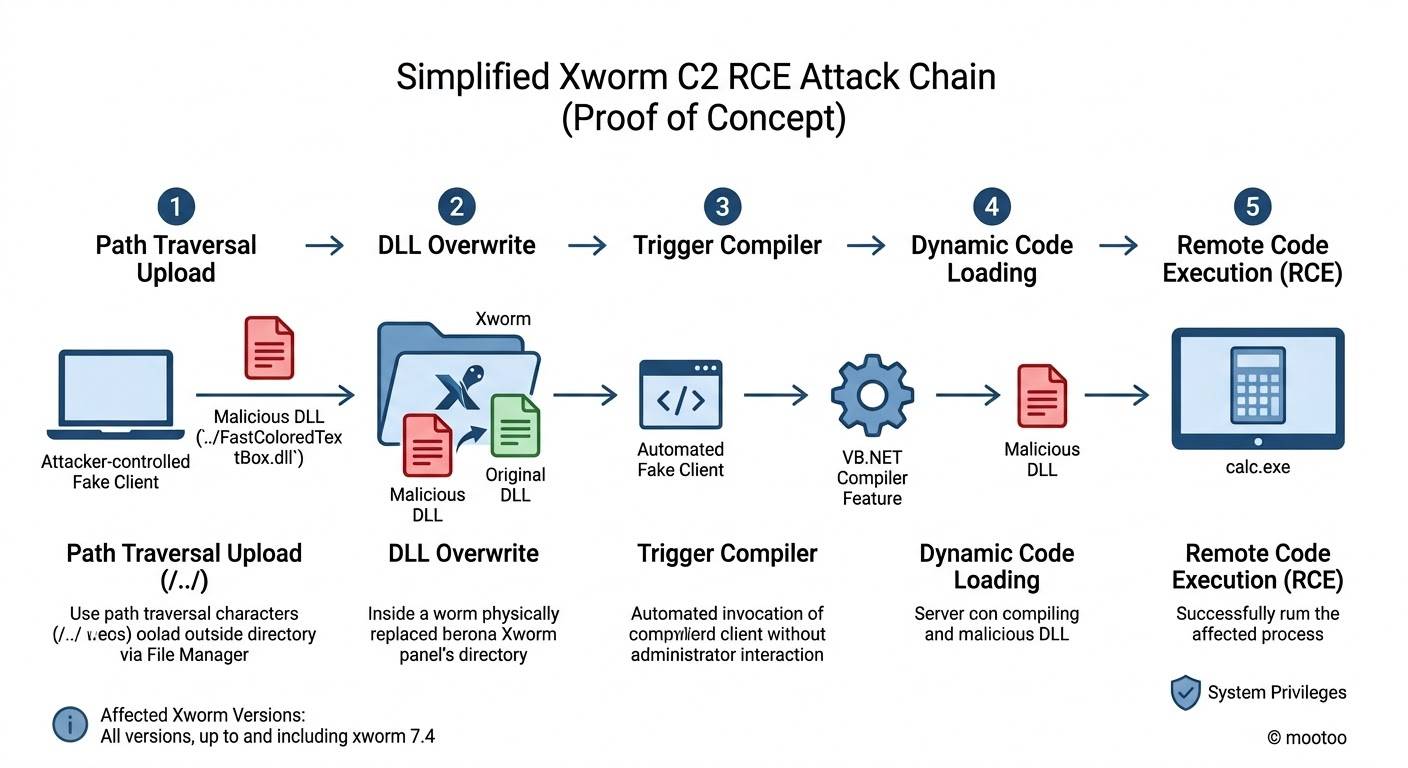
The attack chain consists of five automated stages:
[Fake Client]
      │
      ├─ 1. Path Traversal Upload (../FastColoredTextBox.dll)
      ▼
[XWorm Panel Directory]
      │
      ├─ 2. Overwrites FastColoredTextBox.dll
      ▼
[Trigger Protocol Command]
      │
      ├─ 3. Fake Client sends "Compiler" Command
      ▼
[Dynamic Code Loading]
      │
      ├─ 4. Panel opens VB.Net Compiler & loads FastColoredTextBox.dll
      ▼
[Remote Code Execution (RCE)]
      └─ 5. Arbitrary Code Executed (calc.exe / Shell / System Privileges)
Protocol Handshake & Fake Registration:
1723).INFO handshake containing crafted victim metadata.Path Traversal via File Manager:
FileM) specifying a directory traversal path (..).downloadedfile packet providing the target path .. and filename FastColoredTextBox.dll.Dependency Overwriting:
FastColoredTextBox.dll, a .NET syntax highlighting library commonly loaded on-demand by the XWorm GUI.Automated Triggering without User Interaction:
Compiler protocol command.Assembly Load & Code Execution (RCE):
FastColoredTextBox.dll.Administrator).├── exploit.py # Automated Python PoC exploit script
├── FastColoredTextBox.dll # Weaponized proof-of-concept DLL (executes calc.exe)
├── poc.jpg # High-resolution Attack Chain infographic
├── poc.mp4 # Full video demonstration of the exploit in action
├── requirements.txt # Python dependencies
├── LICENSE # MIT License
└── README.md # Technical documentation and analysis
pip install -r requirements.txt
python exploit.py -up FastColoredTextBox.dll -H <C2_HOST> -p <C2_PORT> -k "<ENCRYPTION_KEY>"
-up, --upload: Path to the DLL payload to upload (default: FastColoredTextBox.dll).-H, --host: IP or hostname of the XWorm panel (e.g. 127.0.0.1 or target lab server).-p, --port: Port of the XWorm panel (default: 1723).-k, --key: XWorm communication key (default: <V74PV74PV74PV74P>).-d, --dir: Directory traversal sequence (default: ..).-t, --trigger-name: Identifier for the compiler window trigger.A complete end-to-end video demonstration is included in this repository: poc.mp4.
For threat intelligence teams and defenders analyzing or neutralizing malicious XWorm infrastructures:
Path.GetFullPath() and strictly verified to stay within an isolated downloads directory. Disallow .., absolute paths, and UNC paths.This proof of concept is published strictly for educational, defensive, and authorized security research purposes. The author does not endorse or take responsibility for any unauthorized or illicit activities conducted with this code.
This repository contains the Proof of Concept (PoC) and technical breakdown for a 0-day pre-authentication Remote Code Execution (RCE) vulnerability affecting the XWorm RAT C2 Control Panel.
By abusing an unauthenticated path traversal vulnerability in the panel's file reception logic, an attacker acting as a fake client can overwrite internal panel dependencies (FastColoredTextBox.dll). Subsequently, issuing a protocol command triggers dynamic loading of the overwritten assembly, executing arbitrary code within the context of the running C2 panel (typically with administrative privileges).
| Parameter | Details |
|---|---|
| Target Application | XWorm Remote Access Trojan (RAT) Controller / Panel |
| Affected Versions | All versions up to and including XWorm v7.4 |
| Vulnerability Type | Path Traversal File Overwrite + DLL Hijacking / Dynamic Loading $\rightarrow$ RCE |
| CWE Classification | CWE-23: Relative Path Traversal CWE-427: Uncontrolled Search Path Element |
| Required Privileges | None (Pre-Authentication / Client Protocol Emulation) |
| Impact | Full Remote Code Execution (RCE) on the C2 Server Host |
The attack chain consists of five automated stages:
[Fake Client]
      │
      ├─ 1. Path Traversal Upload (../FastColoredTextBox.dll)
      ▼
[XWorm Panel Directory]
      │
      ├─ 2. Overwrites FastColoredTextBox.dll
      ▼
[Trigger Protocol Command]
      │
      ├─ 3. Fake Client sends "Compiler" Command
      ▼
[Dynamic Code Loading]
      │
      ├─ 4. Panel opens VB.Net Compiler & loads FastColoredTextBox.dll
      ▼
[Remote Code Execution (RCE)]
      └─ 5. Arbitrary Code Executed (calc.exe / Shell / System Privileges)
Protocol Handshake & Fake Registration:
1723).INFO handshake containing crafted victim metadata.Path Traversal via File Manager:
FileM) specifying a directory traversal path (..).downloadedfile packet providing the target path .. and filename FastColoredTextBox.dll.Dependency Overwriting:
FastColoredTextBox.dll, a .NET syntax highlighting library commonly loaded on-demand by the XWorm GUI.Automated Triggering without User Interaction:
Compiler protocol command.Assembly Load & Code Execution (RCE):
FastColoredTextBox.dll.Administrator).├── exploit.py # Automated Python PoC exploit script
├── FastColoredTextBox.dll # Weaponized proof-of-concept DLL (executes calc.exe)
├── poc.jpg # High-resolution Attack Chain infographic
├── poc.mp4 # Full video demonstration of the exploit in action
├── requirements.txt # Python dependencies
├── LICENSE # MIT License
└── README.md # Technical documentation and analysis
pip install -r requirements.txt
python exploit.py -up FastColoredTextBox.dll -H <C2_HOST> -p <C2_PORT> -k "<ENCRYPTION_KEY>"
-up, --upload: Path to the DLL payload to upload (default: FastColoredTextBox.dll).-H, --host: IP or hostname of the XWorm panel (e.g. 127.0.0.1 or target lab server).-p, --port: Port of the XWorm panel (default: 1723).-k, --key: XWorm communication key (default: <V74PV74PV74PV74P>).-d, --dir: Directory traversal sequence (default: ..).-t, --trigger-name: Identifier for the compiler window trigger.A complete end-to-end video demonstration is included in this repository: poc.mp4.
For threat intelligence teams and defenders analyzing or neutralizing malicious XWorm infrastructures:
Path.GetFullPath() and strictly verified to stay within an isolated downloads directory. Disallow .., absolute paths, and UNC paths.This proof of concept is published strictly for educational, defensive, and authorized security research purposes. The author does not endorse or take responsibility for any unauthorized or illicit activities conducted with this code.



