
README
wasmacs
wasmacs is a project for running GNU Emacs in the browser.
This is not a project to build an "Emacs-like editor." Its goal is to run the real Emacs on WebAssembly by keeping the GNU Emacs 30.2 C core and Elisp runtime at the center, while the browser side provides display, input, persistence, and portable filesystem images.
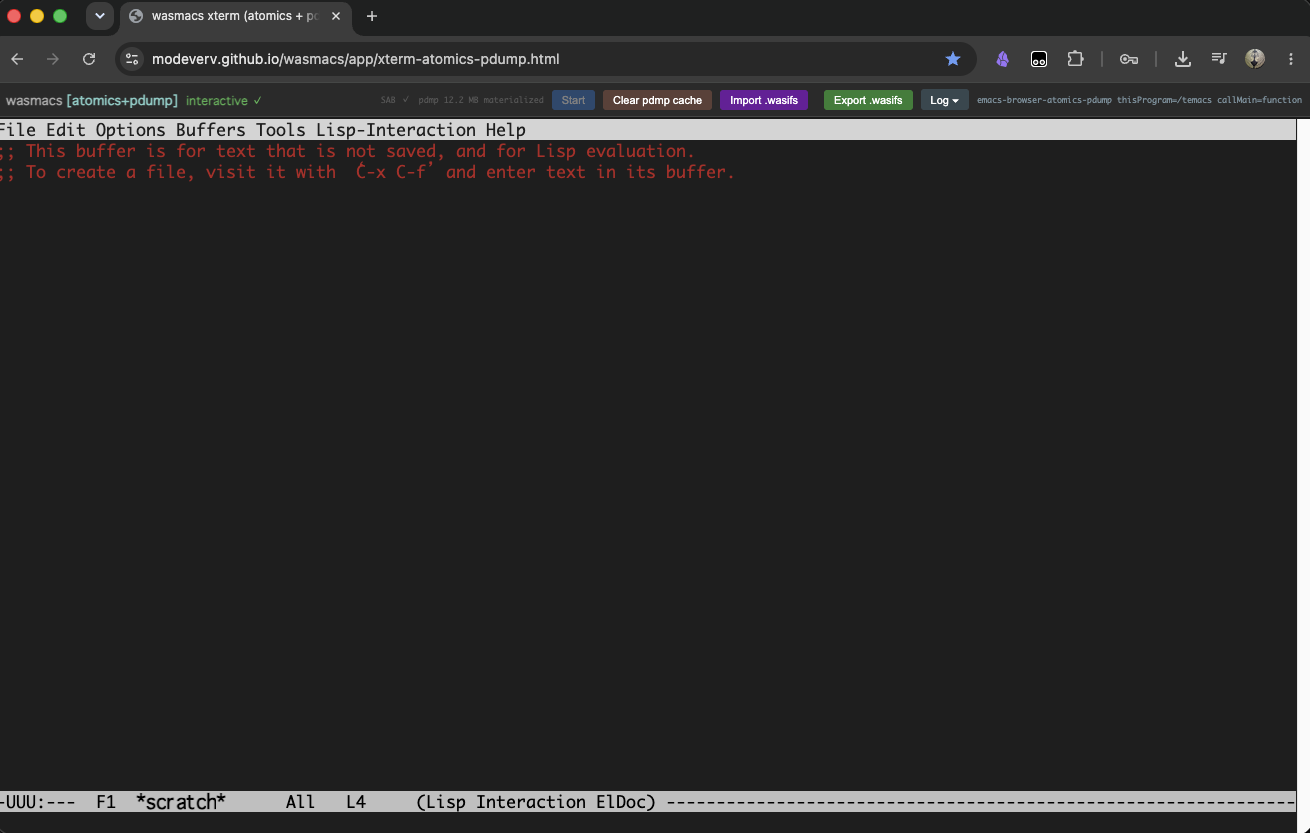
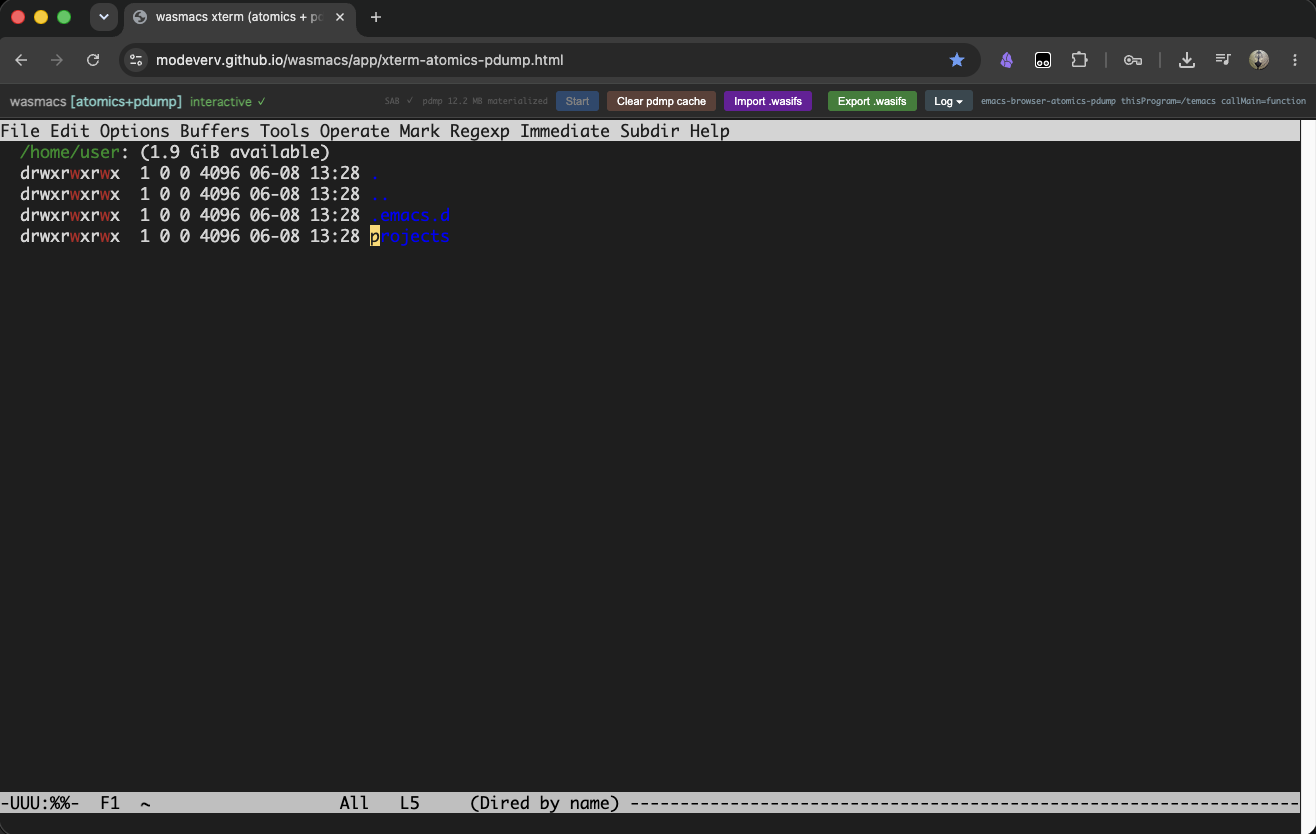
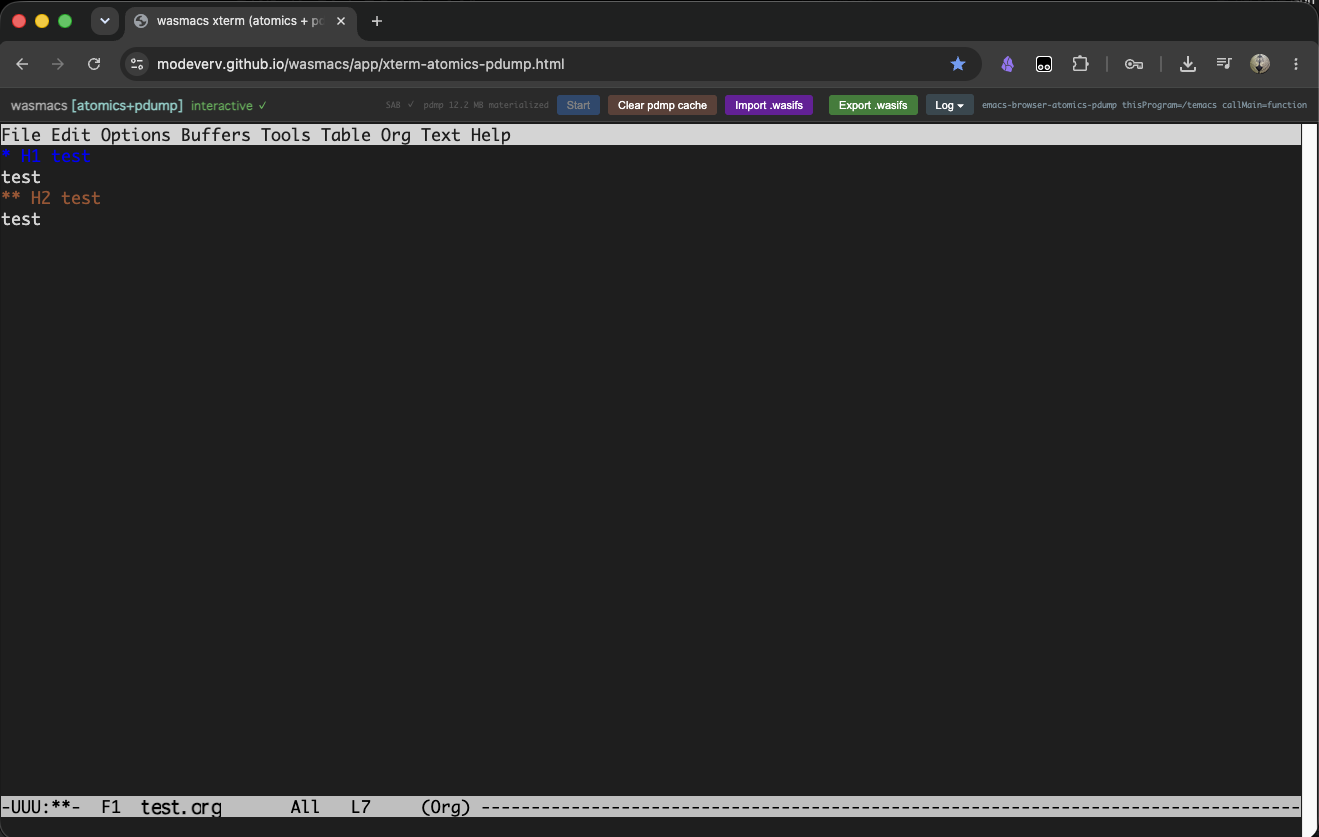
The current main route is the browser runtime built on SharedArrayBuffer, Atomics.wait, pdump, and xterm.js. It has reached *scratch*, Dired, Org mode, Elisp loading through load-file, and import/export of .wasifs images.
Current Capabilities
- Boot the GNU Emacs 30.2 C core in the browser
- Display Emacs
--nwthrough xterm.js - Handle truecolor, control keys, cursor movement, mouse input, bracketed paste, and resizing with
TERM=xterm-256color - Materialize the bundled
bootstrap-emacs.pdmpand reach the interactive waitpoint - Import/export
user-filesystem.wasifs - Load Elisp from the user-side
.wasifsimage withload-file - Boot from static hosting on GitHub Pages
- Route
url.el/package.elHTTP(S) requests throughhost.network.fetch - Use a user-operated self-hosted proxy for package archives that cannot be fetched directly because of CORS
- Copy yanked text to the browser clipboard
Current Limitations
- The Emacs core inside the browser does not have raw sockets or ordinary POSIX processes.
host.processis unavailable.- Emacs features that depend on external commands or subprocesses do not work as-is.
- Network features such as
package-refresh-contentsare constrained by browser fetch, CORS, and proxy configuration. - This is not a port of native GUI Emacs frames. The current route is terminal Emacs running on xterm.js.
- Pages artifacts under
docs/are split and constrained so they can be hosted by GitHub Pages. - A separate build route can generate the VS Code
.wasifsextension.
Repository Layout
src/wasm/   browser wasm app source
src/assets/ source assets copied into generated docs output
src/build/  docs and artifact generation scripts
src/c/      Emacs C-side patch layer
src/runtime/ host/runtime libraries used by tests and tools
tools/      build / validation / probe / prototype / inspection tools
tools/probs/ prototype and exploratory probe code
proxy/      self-hosted fetch proxy samples for package archives
vendor/     pinned upstream GNU Emacs source; read-only
build/      copied Emacs working tree, temporary state, and generated artifacts
build/artifacts/ generated wasm / pdmp / wasifs build products
build2/     VS Code-only copied Emacs workspace and runtime artifacts
doc/        architecture and planning notes
docs/       GitHub Pages output
vscode/     generated VS Code webview app bundle
logs/       ignored runtime logs; only .gitkeep is kept in Git
tests/      automated test code
archive/    old outputs and superseded files
vendor/emacs is the pinned upstream GNU Emacs source tree. Do not edit it directly. Experimental patches are applied to copied build trees.
Browser App
The main development route is available at the following URL after running npm run dev.
http://127.0.0.1:5173/app/xterm-atomics-pdump.html
make docs generates the GitHub Pages bundle. docs/index.html redirects / to the canonical app page, /app/xterm-atomics-pdump.html.
The Pages bundle follows these rules:
- Use the root
coi-serviceworker.jsto provide a COOP/COEP-like environment forSharedArrayBuffer. - Keep app and artifact URLs relative so project pages also work.
- Publish the Emscripten glue as
temacs.jsso static servers return a JavaScript MIME type. - Store the large Emscripten preload package as chunks under
docs/artifacts/temacs.data.parts/instead of a single oversizedtemacs.datafile.
Routine diagnostic logs are quiet by default. Append the following query parameter to enable verbose logs:
?debug-log=1
When inspecting the page with DevTools while resizing the viewport, this query parameter keeps the post-boot terminal size stable:
?no-live-resize=1
Screenshots
Startup
Dired
Org File
Requirements
- Node.js 24 or newer
- npm
- Emscripten toolchain
- GNU make
xterm.js is not vendored through node_modules. Browser pages load it from the jsDelivr CDN. The checked-in HTML directly references https://cdn.jsdelivr.net/npm/@xterm/xterm@5/....
After cloning, run:
npm ci
Common Commands
make prepare
make test
make build
make vscode-build
make docs
make dev
make prepare copies vendor/emacs to build/emacs-30.2-patched/src and applies src/c/patches/*.patch. Do not edit vendor/emacs directly.
make build regenerates the Emacs wasm / pdmp / wasifs artifacts under build/artifacts/, then refreshes the GitHub Pages bundle under docs/.
make dev starts the development server. The development server exposes runtime files at /artifacts/..., so workers and smoke URLs use the same URL contract as Pages.
make vscode-build generates the separate route for the VS Code .wasifs extension. VS Code-only artifacts are written under build2/artifacts/, and the webview app bundle is written under vscode/app/. This route does not consume or update docs/app or docs/artifacts.
Network Access
wasmacs treats network access as an explicit browser host capability.
The Emacs core does not receive raw sockets or host.process for package downloads. Instead, the checked-in wasmacs-url-fetch Lisp overlay routes url.el HTTP(S) requests through host.network.fetch. This lets package-refresh-contents, package-install, use-package :ensure, and similar features run as request/response services.
However, direct browser fetch is constrained by CORS. If the remote package archive does not allow the page origin, JavaScript cannot read the response body. Service Workers can help with app caching and COOP/COEP, but they cannot make an unreadable cross-origin response readable.
When an archive is blocked by CORS, users can configure a self-hosted fetch proxy under their own control. wasmacs does not provide a central proxy service.
Chrome companion extension
For Chrome-based local/dev use, wasmacs also includes an unpacked companion
extension in extension/. The extension provides the same explicit
host.network.fetch capability without disabling CORS globally:
wasmacs page
  -> content-script bridge
  -> extension service worker
  -> allowlisted fetch
  -> status / filtered headers / base64 body
Load it from chrome://extensions with Developer mode enabled, then choose
extension/ with Load unpacked. The default extension policy allows local
wasmacs pages at http://localhost/* and http://127.0.0.1/*, plus the
published Pages app at https://modeverv.github.io/wasmacs/*. It allows target
fetches for GNU ELPA, MELPA, raw GitHub files, and GitHub. It rejects
private-network targets and credentialed requests by default.
On the Atomics/pdump page, host.network.fetch detects the companion with
WASMACS_PROXY_PING. When the extension is available, package archive requests
use WASMACS_PROXY_REQUEST / WASMACS_PROXY_RESPONSE before falling back to
direct browser fetch or a configured self-hosted proxy. This path has been
manually verified with package-refresh-contents reaching the GNU ELPA package
menu from:
http://127.0.0.1:5173/app/xterm-atomics-pdump.html?autostart
An Emacs-side smoke expression:
(progn
  (require 'wasmacs-url-fetch)
  (setq wasmacs-url-fetch-proxy-url nil)
  (wasmacs-url-fetch-enable)

  (require 'package)
  (setq package-user-dir "/home/user/.emacs.d/elpa"
        package-check-signature nil
        package-archives '(("gnu" . "https://elpa.gnu.org/packages/")))
  (package-initialize)
  (unless package-archive-contents
    (package-refresh-contents))

  (require 'use-package)
  (setq use-package-always-ensure t)
  (use-package rainbow-mode
    :ensure t
    :demand t))
See extension/README.md for the ping test, safe GET test, options page, and
audit log notes.
Self-hosted proxy samples
The proxy/ directory includes sample implementations in Node, PHP, Rust, Perl, Ruby, Python, and PowerShell. Each sample accepts the same JSON request shape as the local development __wasmacs_network_fetch route and returns the response status, headers, and base64-encoded response bytes.
The proxy samples are allowlist-based by default. The Ruby sample is the exception: it defaults to * for localhost-only development.
Specify allowed archive origins as follows:
WASMACS_PROXY_ALLOWED_ORIGINS=https://elpa.gnu.org,https://melpa.org
When a local proxy is running, pass it to the browser runtime with network-proxy:
http://127.0.0.1:5173/app/xterm-atomics-pdump.html?network-proxy=http%3A%2F%2F127.0.0.1%3A8787%2F
The runtime first tries direct browser fetch. If CORS prevents reading the archive, it falls back to the configured proxy endpoint. On localhost development pages, it can also use the same-origin __wasmacs_network_fetch route provided by make dev. Static hosts such as GitHub Pages do not provide that route.
On the Atomics/pdump route, the worker relays host.network.fetch to the main page. The actual direct/proxy fetch runs on the main page thread, not as worker-local synchronous XHR, and the result is returned through a SharedArrayBuffer result slot.
When a public HTTPS page calls a localhost proxy, modern browsers may send a Private Network Access preflight. For that reason, the bundled proxy samples return Access-Control-Allow-Private-Network: true and echo the requesting Origin instead of using wildcard CORS.
A proxy can also be configured from Emacs Lisp for a specific user image or init flow:
(require 'wasmacs-url-fetch)
(setq wasmacs-url-fetch-proxy-url "http://127.0.0.1:8787/")
(wasmacs-url-fetch-enable)
The Emacs-side wasmacs-url-fetch-proxy-url value is sent with each url.el / package.el request and takes precedence over the page-level network-proxy default.
.wasifs Images
.wasifs files are portable filesystem images used by the browser runtime.
The current spike format is tar-compatible. A plain tar command can be used for low-level inspection:
tar tf user-filesystem.wasifs
For normal repository work, use the npm scripts:
npm run wasifs:list -- user-filesystem.wasifs
npm run wasifs:pack -- ./home-user user-filesystem.wasifs --root home/user
npm run wasifs:unpack -- user-filesystem.wasifs ./out
wasifs:pack packs a local directory under the requested image root.
- Use
--root home/userfor writable user images. - Use
--root systemfor read-only system image experiments.
wasifs:list and wasifs:unpack hide tar metadata noise such as PaxHeader, AppleDouble ._*, and .DS_Store, so the visible tree matches the portable filesystem contents.
Example: Importing Helm via a Packed Image
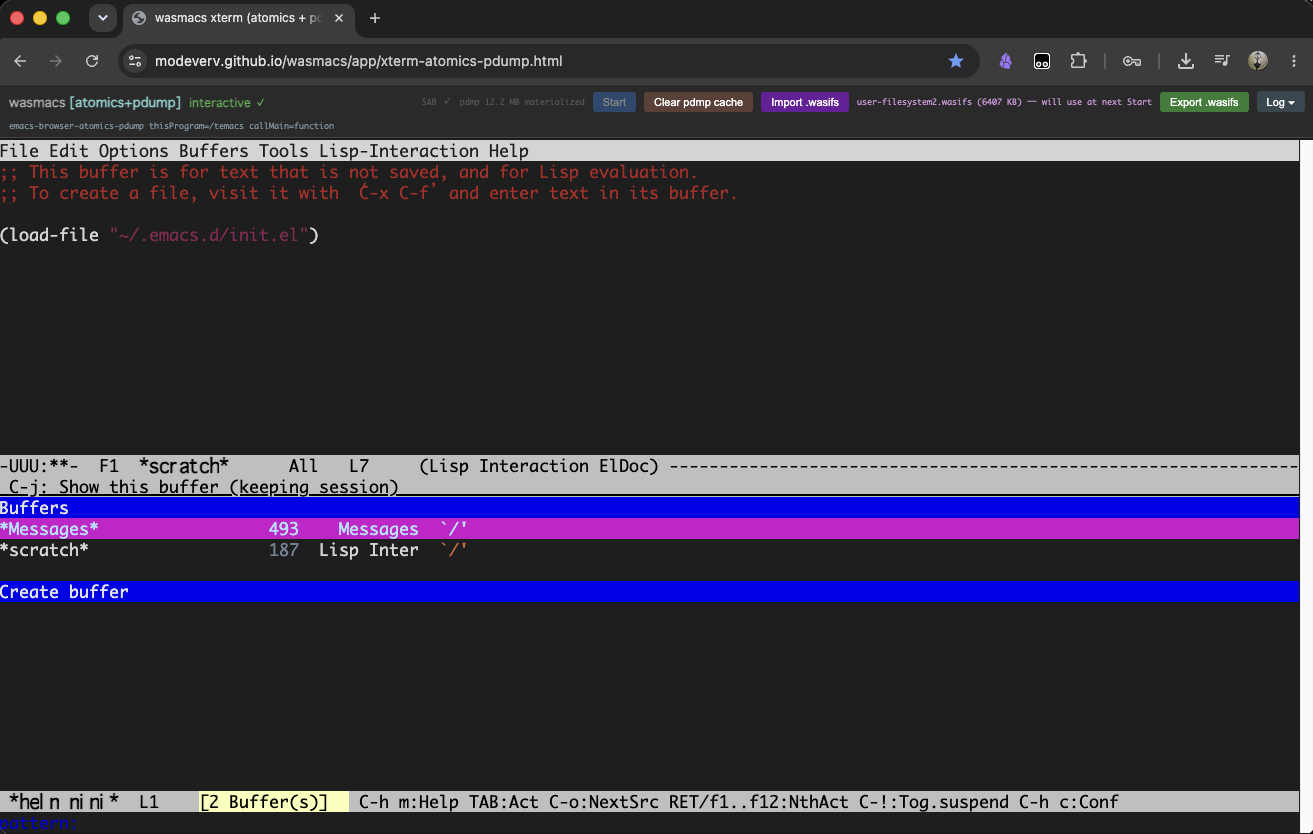
Artifact Policy
Build outputs are generated under build/artifacts/.
The publishable docs/ tree contains only the checked-in browser bundle and Pages-safe runtime artifacts. Files allowed under docs/artifacts/ are validated by tools/scripts/validate-git-artifact-policy.sh.
The old 512MB pdump restore failure is not the current browser status. The current Atomics/pdump xterm route has been verified to materialize the bundled pdmp and reach the interactive waitpoint from both the development server and the static Pages bundle.
make clean removes legacy dist/ if it exists and empties build/ and docs/. It intentionally leaves build2/ and vscode/ alone so the Pages route and VS Code route can be validated independently.
Runtime and validation logs are written under logs/, but log files are ignored by Git. Historical logs from before the reorganization baseline are kept under archive/old-logs/.
build/artifacts/host-abi.wit is generated by src/build/generate-host-abi-wit.mjs. It is a build artifact, not source under src/. It is validated by tools/scripts/validate-host-abi.sh.
dist/ is not part of the current layout.
Architecture
wasmacs is built around three core pieces:
emacs-core.wasm
system-lisp.wasifs
user-filesystem.wasifs
emacs-core.wasm contains the GNU Emacs C core, Elisp interpreter, bytecode runtime, and built-in primitives.
system-lisp.wasifs is a read-only image tied to a fixed Emacs release. It contains GNU Emacs lisp/, .el files, .elc files, autoload/loaddefs artifacts, and etc/ support files.
user-filesystem.wasifs is a writable portable image. It contains init.el, ELPA packages, site-lisp, working files, and journal/snapshot metadata.
The intended mount layout at startup is:
/system    read-only
/home/user writable
/tmp       volatile
load-path gives the user image priority over the system image:
/home/user/.emacs.d/lisp
/home/user/.emacs.d/elpa/*/
/system/lisp
This design separates the update cycles of the Emacs runtime, the standard Lisp distribution, and the user's workspace.
Before changing runtime ownership boundaries or C/wasm host surfaces, read:
ARCHITECTURE.md
PLAN.md
doc/small-os-for-emacs.md
Design Principles
- The Emacs core owns editor semantics.
- The browser UI is a display/input host; it must not fake undo, kill-ring, region, minibuffer, or file-visiting semantics.
.wasifsis the unit of portable workspaces.vendor/emacsis read-only.- Processes, ptys, and sockets are treated as explicit unavailable boundaries in the MVP.
- Product behavior and diagnostic behavior are kept separate.
- The low-level substrate is C/wasm-first. JavaScript remains the browser coordinator, host capability provider, and diagnostic harness.
In Development: VS Code .wasifs Extension
The VS Code .wasifs extension is a separate lane from the Pages bundle.
make vscode-build
This command generates VS Code-only runtime artifacts under build2/artifacts/ and the webview app bundle under vscode/app/. It does not update docs/app or docs/artifacts.
This keeps the GitHub Pages browser app and the VS Code webview extension experiment coexisting in the same repository while keeping artifact ownership separate.
Development Notes
This project is not only a browser port of Emacs. It is also an attempt to provide, inside the browser, the small compatibility OS that Emacs expects.
The important part is not to accumulate ad-hoc shims, but to organize the lifecycle, memory/root safety, control flow, blocking input, filesystem/persistence, preloaded state, host capabilities, and browser GUI boundary that Emacs requires.
When changing runtime ownership boundaries or C/wasm host surfaces, do not just add a patch that happens to work. Make clear which service and which invariant the change satisfies.
Contributors

100 commits
Similar repos


Languages
JavaScript
69.8%
Shell
20.9%
HTML
4.6%
README
wasmacs
wasmacs is a project for running GNU Emacs in the browser.
This is not a project to build an "Emacs-like editor." Its goal is to run the real Emacs on WebAssembly by keeping the GNU Emacs 30.2 C core and Elisp runtime at the center, while the browser side provides display, input, persistence, and portable filesystem images.
The current main route is the browser runtime built on SharedArrayBuffer, Atomics.wait, pdump, and xterm.js. It has reached *scratch*, Dired, Org mode, Elisp loading through load-file, and import/export of .wasifs images.
Current Capabilities
- Boot the GNU Emacs 30.2 C core in the browser
- Display Emacs
--nwthrough xterm.js - Handle truecolor, control keys, cursor movement, mouse input, bracketed paste, and resizing with
TERM=xterm-256color - Materialize the bundled
bootstrap-emacs.pdmpand reach the interactive waitpoint - Import/export
user-filesystem.wasifs - Load Elisp from the user-side
.wasifsimage withload-file - Boot from static hosting on GitHub Pages
- Route
url.el/package.elHTTP(S) requests throughhost.network.fetch - Use a user-operated self-hosted proxy for package archives that cannot be fetched directly because of CORS
- Copy yanked text to the browser clipboard
Current Limitations
- The Emacs core inside the browser does not have raw sockets or ordinary POSIX processes.
host.processis unavailable.- Emacs features that depend on external commands or subprocesses do not work as-is.
- Network features such as
package-refresh-contentsare constrained by browser fetch, CORS, and proxy configuration. - This is not a port of native GUI Emacs frames. The current route is terminal Emacs running on xterm.js.
- Pages artifacts under
docs/are split and constrained so they can be hosted by GitHub Pages. - A separate build route can generate the VS Code
.wasifsextension.
Repository Layout
src/wasm/   browser wasm app source
src/assets/ source assets copied into generated docs output
src/build/  docs and artifact generation scripts
src/c/      Emacs C-side patch layer
src/runtime/ host/runtime libraries used by tests and tools
tools/      build / validation / probe / prototype / inspection tools
tools/probs/ prototype and exploratory probe code
proxy/      self-hosted fetch proxy samples for package archives
vendor/     pinned upstream GNU Emacs source; read-only
build/      copied Emacs working tree, temporary state, and generated artifacts
build/artifacts/ generated wasm / pdmp / wasifs build products
build2/     VS Code-only copied Emacs workspace and runtime artifacts
doc/        architecture and planning notes
docs/       GitHub Pages output
vscode/     generated VS Code webview app bundle
logs/       ignored runtime logs; only .gitkeep is kept in Git
tests/      automated test code
archive/    old outputs and superseded files
vendor/emacs is the pinned upstream GNU Emacs source tree. Do not edit it directly. Experimental patches are applied to copied build trees.
Browser App
The main development route is available at the following URL after running npm run dev.
http://127.0.0.1:5173/app/xterm-atomics-pdump.html
make docs generates the GitHub Pages bundle. docs/index.html redirects / to the canonical app page, /app/xterm-atomics-pdump.html.
The Pages bundle follows these rules:
- Use the root
coi-serviceworker.jsto provide a COOP/COEP-like environment forSharedArrayBuffer. - Keep app and artifact URLs relative so project pages also work.
- Publish the Emscripten glue as
temacs.jsso static servers return a JavaScript MIME type. - Store the large Emscripten preload package as chunks under
docs/artifacts/temacs.data.parts/instead of a single oversizedtemacs.datafile.
Routine diagnostic logs are quiet by default. Append the following query parameter to enable verbose logs:
?debug-log=1
When inspecting the page with DevTools while resizing the viewport, this query parameter keeps the post-boot terminal size stable:
?no-live-resize=1
Screenshots
Startup
Dired
Org File
Requirements
- Node.js 24 or newer
- npm
- Emscripten toolchain
- GNU make
xterm.js is not vendored through node_modules. Browser pages load it from the jsDelivr CDN. The checked-in HTML directly references https://cdn.jsdelivr.net/npm/@xterm/xterm@5/....
After cloning, run:
npm ci
Common Commands
make prepare
make test
make build
make vscode-build
make docs
make dev
make prepare copies vendor/emacs to build/emacs-30.2-patched/src and applies src/c/patches/*.patch. Do not edit vendor/emacs directly.
make build regenerates the Emacs wasm / pdmp / wasifs artifacts under build/artifacts/, then refreshes the GitHub Pages bundle under docs/.
make dev starts the development server. The development server exposes runtime files at /artifacts/..., so workers and smoke URLs use the same URL contract as Pages.
make vscode-build generates the separate route for the VS Code .wasifs extension. VS Code-only artifacts are written under build2/artifacts/, and the webview app bundle is written under vscode/app/. This route does not consume or update docs/app or docs/artifacts.
Network Access
wasmacs treats network access as an explicit browser host capability.
The Emacs core does not receive raw sockets or host.process for package downloads. Instead, the checked-in wasmacs-url-fetch Lisp overlay routes url.el HTTP(S) requests through host.network.fetch. This lets package-refresh-contents, package-install, use-package :ensure, and similar features run as request/response services.
However, direct browser fetch is constrained by CORS. If the remote package archive does not allow the page origin, JavaScript cannot read the response body. Service Workers can help with app caching and COOP/COEP, but they cannot make an unreadable cross-origin response readable.
When an archive is blocked by CORS, users can configure a self-hosted fetch proxy under their own control. wasmacs does not provide a central proxy service.
Chrome companion extension
For Chrome-based local/dev use, wasmacs also includes an unpacked companion
extension in extension/. The extension provides the same explicit
host.network.fetch capability without disabling CORS globally:
wasmacs page
  -> content-script bridge
  -> extension service worker
  -> allowlisted fetch
  -> status / filtered headers / base64 body
Load it from chrome://extensions with Developer mode enabled, then choose
extension/ with Load unpacked. The default extension policy allows local
wasmacs pages at http://localhost/* and http://127.0.0.1/*, plus the
published Pages app at https://modeverv.github.io/wasmacs/*. It allows target
fetches for GNU ELPA, MELPA, raw GitHub files, and GitHub. It rejects
private-network targets and credentialed requests by default.
On the Atomics/pdump page, host.network.fetch detects the companion with
WASMACS_PROXY_PING. When the extension is available, package archive requests
use WASMACS_PROXY_REQUEST / WASMACS_PROXY_RESPONSE before falling back to
direct browser fetch or a configured self-hosted proxy. This path has been
manually verified with package-refresh-contents reaching the GNU ELPA package
menu from:
http://127.0.0.1:5173/app/xterm-atomics-pdump.html?autostart
An Emacs-side smoke expression:
(progn
  (require 'wasmacs-url-fetch)
  (setq wasmacs-url-fetch-proxy-url nil)
  (wasmacs-url-fetch-enable)

  (require 'package)
  (setq package-user-dir "/home/user/.emacs.d/elpa"
        package-check-signature nil
        package-archives '(("gnu" . "https://elpa.gnu.org/packages/")))
  (package-initialize)
  (unless package-archive-contents
    (package-refresh-contents))

  (require 'use-package)
  (setq use-package-always-ensure t)
  (use-package rainbow-mode
    :ensure t
    :demand t))
See extension/README.md for the ping test, safe GET test, options page, and
audit log notes.
Self-hosted proxy samples
The proxy/ directory includes sample implementations in Node, PHP, Rust, Perl, Ruby, Python, and PowerShell. Each sample accepts the same JSON request shape as the local development __wasmacs_network_fetch route and returns the response status, headers, and base64-encoded response bytes.
The proxy samples are allowlist-based by default. The Ruby sample is the exception: it defaults to * for localhost-only development.
Specify allowed archive origins as follows:
WASMACS_PROXY_ALLOWED_ORIGINS=https://elpa.gnu.org,https://melpa.org
When a local proxy is running, pass it to the browser runtime with network-proxy:
http://127.0.0.1:5173/app/xterm-atomics-pdump.html?network-proxy=http%3A%2F%2F127.0.0.1%3A8787%2F
The runtime first tries direct browser fetch. If CORS prevents reading the archive, it falls back to the configured proxy endpoint. On localhost development pages, it can also use the same-origin __wasmacs_network_fetch route provided by make dev. Static hosts such as GitHub Pages do not provide that route.
On the Atomics/pdump route, the worker relays host.network.fetch to the main page. The actual direct/proxy fetch runs on the main page thread, not as worker-local synchronous XHR, and the result is returned through a SharedArrayBuffer result slot.
When a public HTTPS page calls a localhost proxy, modern browsers may send a Private Network Access preflight. For that reason, the bundled proxy samples return Access-Control-Allow-Private-Network: true and echo the requesting Origin instead of using wildcard CORS.
A proxy can also be configured from Emacs Lisp for a specific user image or init flow:
(require 'wasmacs-url-fetch)
(setq wasmacs-url-fetch-proxy-url "http://127.0.0.1:8787/")
(wasmacs-url-fetch-enable)
The Emacs-side wasmacs-url-fetch-proxy-url value is sent with each url.el / package.el request and takes precedence over the page-level network-proxy default.
.wasifs Images
.wasifs files are portable filesystem images used by the browser runtime.
The current spike format is tar-compatible. A plain tar command can be used for low-level inspection:
tar tf user-filesystem.wasifs
For normal repository work, use the npm scripts:
npm run wasifs:list -- user-filesystem.wasifs
npm run wasifs:pack -- ./home-user user-filesystem.wasifs --root home/user
npm run wasifs:unpack -- user-filesystem.wasifs ./out
wasifs:pack packs a local directory under the requested image root.
- Use
--root home/userfor writable user images. - Use
--root systemfor read-only system image experiments.
wasifs:list and wasifs:unpack hide tar metadata noise such as PaxHeader, AppleDouble ._*, and .DS_Store, so the visible tree matches the portable filesystem contents.
Example: Importing Helm via a Packed Image
Artifact Policy
Build outputs are generated under build/artifacts/.
The publishable docs/ tree contains only the checked-in browser bundle and Pages-safe runtime artifacts. Files allowed under docs/artifacts/ are validated by tools/scripts/validate-git-artifact-policy.sh.
The old 512MB pdump restore failure is not the current browser status. The current Atomics/pdump xterm route has been verified to materialize the bundled pdmp and reach the interactive waitpoint from both the development server and the static Pages bundle.
make clean removes legacy dist/ if it exists and empties build/ and docs/. It intentionally leaves build2/ and vscode/ alone so the Pages route and VS Code route can be validated independently.
Runtime and validation logs are written under logs/, but log files are ignored by Git. Historical logs from before the reorganization baseline are kept under archive/old-logs/.
build/artifacts/host-abi.wit is generated by src/build/generate-host-abi-wit.mjs. It is a build artifact, not source under src/. It is validated by tools/scripts/validate-host-abi.sh.
dist/ is not part of the current layout.
Architecture
wasmacs is built around three core pieces:
emacs-core.wasm
system-lisp.wasifs
user-filesystem.wasifs
emacs-core.wasm contains the GNU Emacs C core, Elisp interpreter, bytecode runtime, and built-in primitives.
system-lisp.wasifs is a read-only image tied to a fixed Emacs release. It contains GNU Emacs lisp/, .el files, .elc files, autoload/loaddefs artifacts, and etc/ support files.
user-filesystem.wasifs is a writable portable image. It contains init.el, ELPA packages, site-lisp, working files, and journal/snapshot metadata.
The intended mount layout at startup is:
/system    read-only
/home/user writable
/tmp       volatile
load-path gives the user image priority over the system image:
/home/user/.emacs.d/lisp
/home/user/.emacs.d/elpa/*/
/system/lisp
This design separates the update cycles of the Emacs runtime, the standard Lisp distribution, and the user's workspace.
Before changing runtime ownership boundaries or C/wasm host surfaces, read:
ARCHITECTURE.md
PLAN.md
doc/small-os-for-emacs.md
Design Principles
- The Emacs core owns editor semantics.
- The browser UI is a display/input host; it must not fake undo, kill-ring, region, minibuffer, or file-visiting semantics.
.wasifsis the unit of portable workspaces.vendor/emacsis read-only.- Processes, ptys, and sockets are treated as explicit unavailable boundaries in the MVP.
- Product behavior and diagnostic behavior are kept separate.
- The low-level substrate is C/wasm-first. JavaScript remains the browser coordinator, host capability provider, and diagnostic harness.
In Development: VS Code .wasifs Extension
The VS Code .wasifs extension is a separate lane from the Pages bundle.
make vscode-build
This command generates VS Code-only runtime artifacts under build2/artifacts/ and the webview app bundle under vscode/app/. It does not update docs/app or docs/artifacts.
This keeps the GitHub Pages browser app and the VS Code webview extension experiment coexisting in the same repository while keeping artifact ownership separate.
Development Notes
This project is not only a browser port of Emacs. It is also an attempt to provide, inside the browser, the small compatibility OS that Emacs expects.
The important part is not to accumulate ad-hoc shims, but to organize the lifecycle, memory/root safety, control flow, blocking input, filesystem/persistence, preloaded state, host capabilities, and browser GUI boundary that Emacs requires.
When changing runtime ownership boundaries or C/wasm host surfaces, do not just add a patch that happens to work. Make clear which service and which invariant the change satisfies.
Similar repos
Contributors
100 commits
Languages
JavaScript
69.8%
Shell
20.9%
HTML
4.6%