
A collection of interactive kinetic art studies
See the codeSee what people are saying
README
Kinetic
Studies in motion. A collection of interactive kinetic art studies — pendulum waves, Möbius strips, rolling polyhedra, Chladni patterns — each driven by a handful of simple rules and rendered live in the browser.
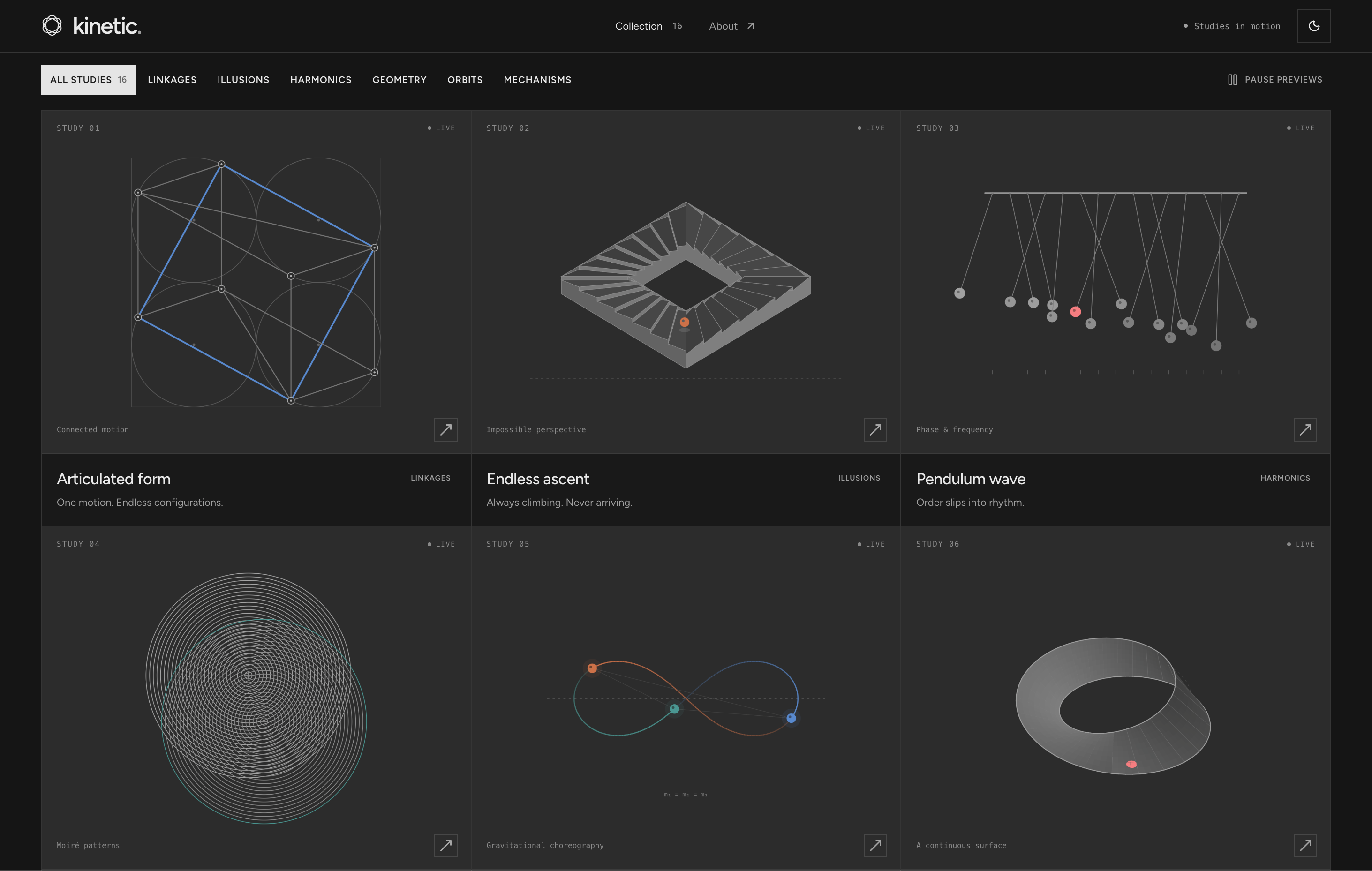
Every study animates continuously, exposes a parameter you can tune, and links to a detail page where you can pause, scrub the speed, and toggle construction guides.
Quick start
pnpm install
pnpm dev
The site runs at localhost:3000.
Scripts
| Command | What it does |
|---|---|
pnpm dev | Dev server on port 3000 |
pnpm build | Production build — prerenders every route to static HTML |
pnpm preview | Serve the build with Vite |
pnpm preview:workers | Serve the build with the real Cloudflare Workers runtime |
pnpm deploy:dry | Build and validate the deploy without publishing |
pnpm deploy | Build and deploy to Cloudflare Workers |
pnpm test | Run the Vitest suite |
pnpm typecheck | tsc --noEmit |
pnpm lint / pnpm format | ESLint / Prettier |
How it works
Two renderers, one component. Artwork picks between them per study:
- 2D canvas — the default. A
draw(ctx, study, time, parameter, guides)function dispatches onstudy.kindand paints each frame. - WebGL via
Artwork3D— opt-in with thespatialprop, used only on study detail pages. The eight kinds listed inscenes.tshave Three.js scenes, including the rigid-panel Miura fold and the gravity well.
WebGL is opt-in because each canvas holds its own GL context, and browsers evict the oldest once you exceed a low cap. The collection grid renders every card through the 2D path, so the collection of twenty-seven studies costs zero GL contexts. Detail pages mount exactly one.
Content is data. src/lib/studies.ts is a plain array — title, category, kind, parameter range, copy. Routing, the collection grid, the category filters, and the header count all derive from it.
The math is separate from the drawing. Geometry helpers live in src/lib/ (kinetic-math, rolling-cube, geometric-studies, …) and are unit-tested independently of any canvas, which is why the suite runs without a browser.
The newest studies explore a Geneva drive’s intermittent rotation, a Miura sheet’s coordinated folding, recursive branching, and collective motion. The flock uses a seeded, fixed-step simulation owned by each artwork; resetting or changing alignment restores the same starting arrangement. Construction guides reveal its local neighborhoods, while the other studies expose their geometric construction.
The gravity well is the exception to stepping state forward: orbits in a central potential repeat radially, so each body integrates one apoapsis-to-apoapsis period when the mass changes and every later moment is a lookup plus a known rotation. Scrubbing, resetting, and the 2D and WebGL views all agree on where each body is.
The prism traces rays exactly rather than drawing a picture of a spectrum: each wavelength gets its own refractive index from Cauchy's equation, bends by Snell's law at every face, and reflects when it meets a face beyond the critical angle.
The Peaucellier–Lipkin linkage never solves for its pen position numerically. Its bars force the crank end and the pen onto one ray from the fixed pivot, with the product of their distances fixed, so the pen is an inversion of the crank end in closed form. The trail is sampled from that formula, not stored, which is why moving the crank offset instantly redraws the whole path as a line or an arc.
Rendering and deployment
The build prerenders to static HTML — no server at runtime. crawlLinks starts at / and follows the collection grid's links, so every study page is emitted automatically and new studies need no build config.
Output lands in dist/client/ and deploys to Cloudflare Workers as static assets. wrangler.jsonc declares no main script, so no Worker code runs and static-asset requests are free and unlimited.
Stack
TanStack Start (router + SSR/prerender) · React 19 · TypeScript · Three.js · Tailwind CSS 4 · shadcn/ui · Vite · Vitest · Cloudflare Workers
Contributing
Kinetic is open source — the code lives at github.com/mnove/kinetic, created by mnove.
Adding a study, adjusting the math, or fixing a rendering bug — see CONTRIBUTING.md.
Similar repos





Languages
TypeScript
93.1%
CSS
6.7%
A collection of interactive kinetic art studies
See the codeSee what people are saying
README
Kinetic
Studies in motion. A collection of interactive kinetic art studies — pendulum waves, Möbius strips, rolling polyhedra, Chladni patterns — each driven by a handful of simple rules and rendered live in the browser.
Every study animates continuously, exposes a parameter you can tune, and links to a detail page where you can pause, scrub the speed, and toggle construction guides.
Quick start
pnpm install
pnpm dev
The site runs at localhost:3000.
Scripts
| Command | What it does |
|---|---|
pnpm dev | Dev server on port 3000 |
pnpm build | Production build — prerenders every route to static HTML |
pnpm preview | Serve the build with Vite |
pnpm preview:workers | Serve the build with the real Cloudflare Workers runtime |
pnpm deploy:dry | Build and validate the deploy without publishing |
pnpm deploy | Build and deploy to Cloudflare Workers |
pnpm test | Run the Vitest suite |
pnpm typecheck | tsc --noEmit |
pnpm lint / pnpm format | ESLint / Prettier |
How it works
Two renderers, one component. Artwork picks between them per study:
- 2D canvas — the default. A
draw(ctx, study, time, parameter, guides)function dispatches onstudy.kindand paints each frame. - WebGL via
Artwork3D— opt-in with thespatialprop, used only on study detail pages. The eight kinds listed inscenes.tshave Three.js scenes, including the rigid-panel Miura fold and the gravity well.
WebGL is opt-in because each canvas holds its own GL context, and browsers evict the oldest once you exceed a low cap. The collection grid renders every card through the 2D path, so the collection of twenty-seven studies costs zero GL contexts. Detail pages mount exactly one.
Content is data. src/lib/studies.ts is a plain array — title, category, kind, parameter range, copy. Routing, the collection grid, the category filters, and the header count all derive from it.
The math is separate from the drawing. Geometry helpers live in src/lib/ (kinetic-math, rolling-cube, geometric-studies, …) and are unit-tested independently of any canvas, which is why the suite runs without a browser.
The newest studies explore a Geneva drive’s intermittent rotation, a Miura sheet’s coordinated folding, recursive branching, and collective motion. The flock uses a seeded, fixed-step simulation owned by each artwork; resetting or changing alignment restores the same starting arrangement. Construction guides reveal its local neighborhoods, while the other studies expose their geometric construction.
The gravity well is the exception to stepping state forward: orbits in a central potential repeat radially, so each body integrates one apoapsis-to-apoapsis period when the mass changes and every later moment is a lookup plus a known rotation. Scrubbing, resetting, and the 2D and WebGL views all agree on where each body is.
The prism traces rays exactly rather than drawing a picture of a spectrum: each wavelength gets its own refractive index from Cauchy's equation, bends by Snell's law at every face, and reflects when it meets a face beyond the critical angle.
The Peaucellier–Lipkin linkage never solves for its pen position numerically. Its bars force the crank end and the pen onto one ray from the fixed pivot, with the product of their distances fixed, so the pen is an inversion of the crank end in closed form. The trail is sampled from that formula, not stored, which is why moving the crank offset instantly redraws the whole path as a line or an arc.
Rendering and deployment
The build prerenders to static HTML — no server at runtime. crawlLinks starts at / and follows the collection grid's links, so every study page is emitted automatically and new studies need no build config.
Output lands in dist/client/ and deploys to Cloudflare Workers as static assets. wrangler.jsonc declares no main script, so no Worker code runs and static-asset requests are free and unlimited.
Stack
TanStack Start (router + SSR/prerender) · React 19 · TypeScript · Three.js · Tailwind CSS 4 · shadcn/ui · Vite · Vitest · Cloudflare Workers
Contributing
Kinetic is open source — the code lives at github.com/mnove/kinetic, created by mnove.
Adding a study, adjusting the math, or fixing a rendering bug — see CONTRIBUTING.md.
Similar repos
Languages
TypeScript
93.1%
CSS
6.7%