Claude Code and Claude Desktop are good agent harnesses. This repo lets you drive their agent layer with a backend of your choice — an OpenAI key, an on-device model on your own GPU, or stock Anthropic — by translating between the Anthropic and OpenAI APIs locally. The chat window is always the real claude.ai web app; only the agent sub-layer (Claude Code) is repointed.
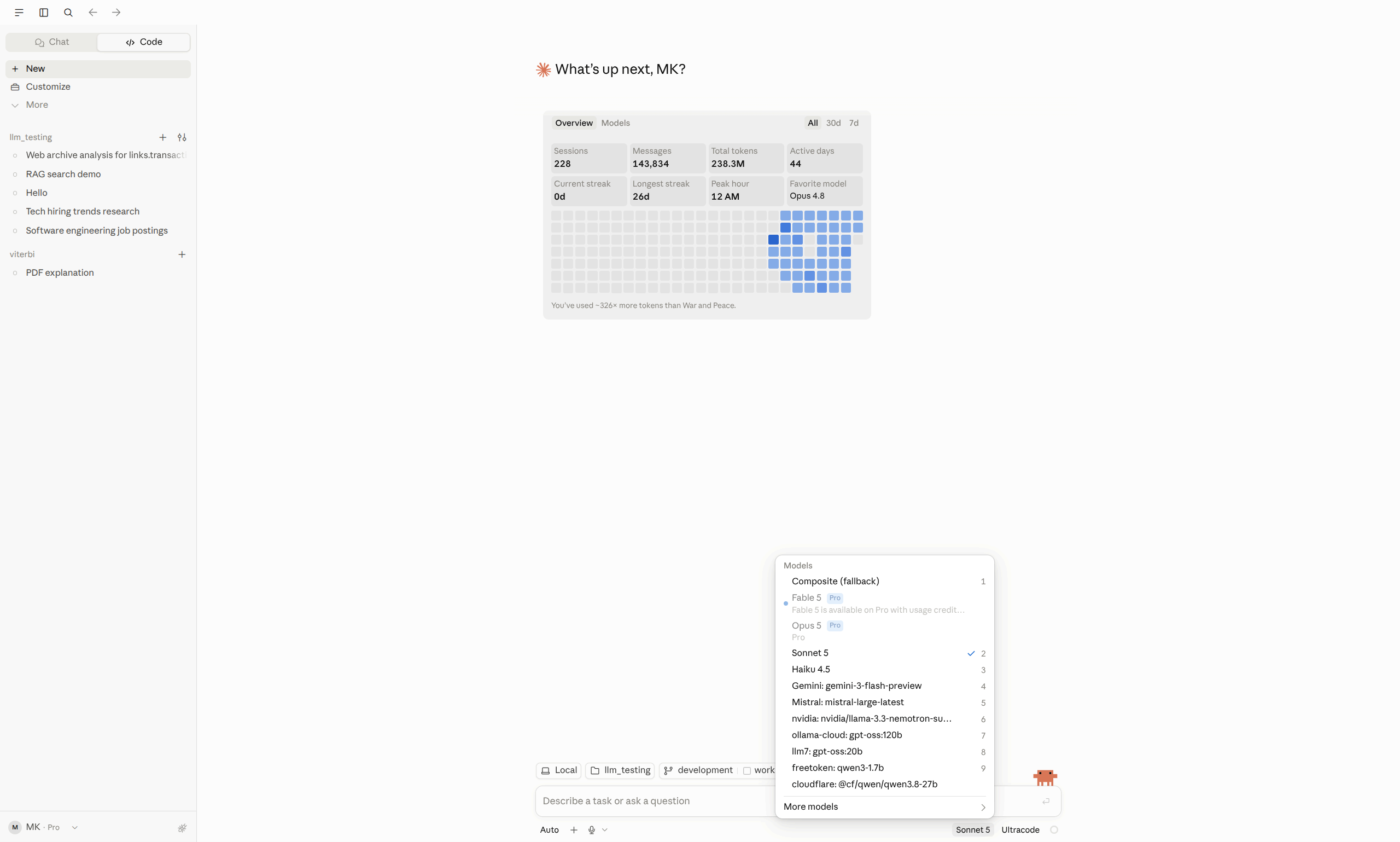
The desktop build's Code tab. The model picker lists Composite (the cross-provider fallback
chain) plus every keyed provider's models as provider:model — Gemini, Mistral, nvidia,
ollama-cloud, llm7, freetoken, cloudflare — each routing that turn to its own upstream through the
proxy; the local usage dashboard summarises agent activity.
Two independent things live here, and you may only want the first:
| What it is | What you need | |
|---|---|---|
1. The proxy — openai-proxy/ | A local server that speaks the Anthropic Messages API on the front and calls OpenAI (or any OpenAI-compatible server) on the back. Point any Anthropic-API client at it. | Node 22+ (native fetch), and an OpenAI key or a local server like Ollama |
| 2. The desktop build | Anthropic's Claude Desktop app, unpacked and run under a stock Electron runtime, with the proxy wired in, a provider switch, and a settings GUI | Linux or macOS, plus your own copy of Claude Desktop |
The proxy is the generally useful part: it works with the ordinary claude CLI on any machine,
and needs nothing from this repo's app/ directory. Everything below the
Desktop build heading is specific to running Anthropic's Electron app.
Licensing, read this first.
app/is Anthropic's unpacked proprietary bundle (~40 MB of their JavaScript, native binaries and resources). It is not redistributable, which is why this repository is private. For part 2 you must supply that directory from your own licensed Claude Desktop install — see Supplying the bundle. Nothing in part 1 touches it.
export OPENAI_API_KEY=sk-...              # or point at a local server; see below
cd openai-proxy && node supervise.mjs     # listens on 127.0.0.1:8123, restarts on crash
node proxy.mjs still works and is right for a one-off. Prefer the supervisor for anything you
leave running: the proxy has taken itself down on a dropped upstream socket with nothing
noticing for hours — the app, the launcher and every agent kept running against a closed port.
The supervisor restarts it, logs why, and gives up loudly rather than looping if it cannot start.
Point the stock Claude Code CLI at it:
ANTHROPIC_BASE_URL=http://127.0.0.1:8123 ANTHROPIC_API_KEY=unused claude -p "hello"
ANTHROPIC_API_KEY must be set to something because the CLI insists on it, but the proxy
ignores it and authenticates to OpenAI with OPENAI_API_KEY.
Verified end-to-end with the unmodified CLI: a full agent turn, 221 tools, tool calls executed
and results fed back, with the proxy log showing model=claude-opus-4-8->gpt-5.6-sol. The CLI
still says "Opus" because it hardcodes that in its own prompt; the proxy log and the
ANTHROPIC_BASE_URL in the process environment are the ground truth.
Set OPENAI_BASE_URL at any OpenAI-compatible server (Ollama,
llama.cpp, LM Studio, vLLM) and the proxy translates to it exactly as it does to OpenAI. A
loopback base URL is treated as keyless — no OPENAI_API_KEY needed (a placeholder
bearer is sent, which local servers ignore):
OPENAI_BASE_URL=http://127.0.0.1:11434/v1 OPENAI_MODEL=qwen2.5:7b-instruct OPENAI_API=chat \
  node openai-proxy/proxy.mjs
The desktop build wires this up as the local provider, which also
starts and tunes Ollama for you.
Everything has a default; set only what you want to change.
| Variable | Default | What it does |
|---|---|---|
OPENAI_API_KEY | — | Required for a remote endpoint; optional for a loopback one. Also read from .openai-key (see below). |
OPENAI_MODEL | gpt-5.6-sol | Any model id. Names containing codex route to Responses automatically; anything else lands on Chat Completions unless OPENAI_API=responses is set. |
OPENAI_BASE_URL | https://api.openai.com/v1 | Any OpenAI-compatible endpoint, including a local one. |
PORT | 8123 | |
OPENAI_API | responses | responses or chat, overriding the name heuristic. Required for a non-codex remote model: this app sends 200+ tools and Chat Completions caps at 128. |
OPENAI_REASONING_EFFORT | max | The proxy steps down to the highest value your model accepts. |
OPENAI_CLASSIFIER_SAFETY_MODEL | gpt-5.4-2026-03-05 | Model for Claude Code's auto-mode safety verdict. It has a 60-second deadline and denies the action when it expires, so this wants a fast model — see openai-proxy/README.md for the measurements. |
The full list — around thirty knobs, each documented with the bug that motivated it — is in openai-proxy/README.md.
Instead of environment variables, put KEY=VALUE lines in .openai-model at the repo root
(checked in, for non-secrets). The secret API key goes in its own gitignored file,
.openai-key (apiKey=…; copy .openai-key.example to start). Precedence is
env var → .openai-model → .openai-key → default.
That precedence lives in exactly one place, openai-proxy/config.mjs,
which also produces the config hash below. To see what a launch would actually use:
node openai-proxy/config.mjs # the effective config, with the source of each value
--hash prints just the config hash; --validate checks it and exits non-zero on an error. The
key never appears in any of them — only a sha256: fingerprint of it.
/health reports an identity, not just liveness:
{ "ok": true, "instance": "8f3c…", "pid": 82110, "configHash": "38d9c8b2…",
  "codeVersion": "a8e08f01…", "inflight": 0, "model": "gpt-5.6-sol", "…": "…" }
instance is a nonce generated at startup and also written to proxy-runtime.json. Only
the process that generated it can serve it, so matching both proves ownership — which is what
lets the launcher restart its proxy and refuse to touch anything else.configHash covers every behaviour-affecting setting plus a fingerprint of the key. The
launcher compares it and restarts a proxy serving stale settings, instead of the old behaviour
where any answer on /health counted as healthy and a changed model silently did not apply.codeVersion is a hash of the proxy sources, catching a process running older translation
logic with current settings.inflight is how many turns are being answered right now, so a restart can say what it
would interrupt.Supervisor behaviour is tuned by environment variable; the defaults are meant to be left alone.
PROXY_MAX_FAST_FAILURES (8) bounds immediate restart attempts, PROXY_RESTART_BASE_MS (500)
and PROXY_RESTART_MAX_MS (30000) set the backoff, and PROXY_HEALTH_EVERY_MS (15000) /
PROXY_HEALTH_TIMEOUT_MS (5000) / PROXY_HEALTH_MISSES (3) control the watchdog that replaces a
proxy holding the port without answering. An externally-killed proxy always restarts and never
counts toward the give-up bound.
| Chat Completions | Responses | |
|---|---|---|
| Tool limit | 128 (129 → HTTP 400) | none observed — probed to 512 |
| Reasoning controls | none | reasoning.effort, reasoning summaries |
| Local-server support | universal | recent Ollama; not all local servers |
Claude Code offers 27 tools; Claude Desktop offers over 200. On the chat surface the 128-tool cap is real, so the proxy keeps the essential tools (read/write/edit/run/search/plan/web, plus renderers) and fills the remainder in the agent's own order, logging what it dropped — a silently truncated tool list is indistinguishable from a model that just declined to use a tool.
Text and tool calls in both directions, streaming and non-streaming, plus fixes for behaviour differences between the two model families:
\(…\) / \[…\] for maths, which Claude's renderer shows
literally. Rewritten to $…$ / $$…$$, fence-aware so code samples stay verbatim.stop_sequences, which some models reject. The
proxy drops whichever parameter the API names and retries, so the next unsupported knob
self-heals too.Images work. Anthropic {type:"image", source:{…}} blocks — base64 or url — become
image_url on Chat Completions and input_image on Responses. If the model has no vision the
picture is dropped and the question kept, with an honest note in its place, rather than failing
the turn.
Known gaps: /v1/messages/count_tokens is estimated, and the cost figures the CLI prints are
computed from Anthropic's price list and are meaningless when proxied.
npm run eval           # run the corpus, diff against the frozen baseline
npm run eval:freeze    # overwrite the baseline with what the code does NOW
eval/ holds a synthetic, network-free corpus. Each case runs through the real proxy against
a fake upstream, and what gets recorded is the payload the proxy decided to send: resolved
model, tool count, whether a late tool survived, tool_choice, hint injection, reasoning,
verbosity, output cap, cache key, pricing tier. Every one of those decisions is settled before a
token is generated, which is what makes it a baseline rather than a sample. npm test checks the
frozen baseline on every run, so a behaviour change cannot arrive unnoticed inside an unrelated
commit. Alongside it are invariants the baseline is not allowed to encode away — a classifier
is never given tools, a safety verdict never resolves to the main model, an agent turn that
merely quotes the classifier contract keeps its full catalogue.
npm test # the whole suite: proxy + settings + launcher scripts + eval baseline
Most were written against a specific misbehaviour; the comments say which.
Runs Anthropic's Claude Desktop (@ant/desktop v1.24012.9, an Electron Forge + Vite build) from
its unpacked app.asar under a stock Electron runtime, with the proxy wired into the agent
layer, a provider switch, and a settings GUI over the launcher's config. Runs on Linux and
macOS.
app/ is committed in this repository — Anthropic's code — and that is exactly why it is
private and must not be published. node_modules/ and app/node_modules/ are not committed;
you populate them from your own licensed install.
To rebuild app/ from your own install:
app.asar in your Claude Desktop installation:
/usr/lib/claude-desktop/resources//Applications/Claude.app/Contents/Resources/npx @electron/asar extract app.asar app/app.asar.unpacked/node_modules/ back in over app/node_modules/ — the
native addons (@ant/claude-native, node-pty, and on macOS @ant/claude-swift) live there
as platform binaries and the app expects them beside their JS. On Linux, @ant/claude-swift
is absent by design and fails closed.The version here is @ant/desktop v1.24012.9; a different version will not necessarily match the
env-gated patches, which are keyed to strings in this build.
npm install        # stock Electron 42.9.2, once
./run.sh
Electron 42.9.2 is pinned to match the native modules harvested from a current Claude Desktop
install. A window opens on the claude.ai login screen; sign in as usual. run.sh re-creates the
resources/app.asar → app/ symlink and reinstalls the disclaimer helper on every launch, so
reinstalling node_modules costs nothing.
Linux note: npm install downloads the Electron binary from GitHub's release CDN. If that host
is blocked on your network, use a mirror:
ELECTRON_MIRROR=https://registry.npmmirror.com/-/binary/electron/ \
  ELECTRON_CUSTOM_DIR="v{{ version }}" node node_modules/electron/install.js
run.sh is cross-platform (uname -s): it resolves the Electron resources dir (dist/resources
on Linux, Electron.app/Contents/Resources on macOS), the Claude Desktop profile
(~/.config/Claude vs ~/Library/Application Support/Claude), and the disclaimer helper path
per platform. See LINUX.md for the port's design and the folded-conditional gotchas.
On modern Ubuntu (kernel.apparmor_restrict_unprivileged_userns=1) Electron's namespace sandbox is
blocked, so it needs a setuid-root chrome-sandbox — which the downloaded Electron isn't. run.sh
self-heals this by symlinking to the setuid-root chrome-sandbox the Claude Desktop .deb already
installed (same Electron build, byte-identical), keeping the renderer sandbox on with no sudo. If
no system copy matches, it prints the one-time sudo chown root:root … && sudo chmod 4755 … fix.
Stock Electron has no equivalent of Claude Desktop's TCC-attribution helper, and the app invokes
it as disclaimer <command> <args…> — which makes it the one supported boundary at which this
repo can choose the agent's internal model identity. The helper is repository-owned source
(scripts/claude-code-disclaimer.sh), installed as an absolute
symlink by scripts/install-disclaimer.mjs at the per-platform
Helpers/ path. In OpenAI/local mode it rewrites the bundled Claude Code executable to the
configured [1m] capability identity; in Anthropic mode it is an exact argv passthrough. It also
exports CLAUDE_CODE_SUBAGENT_MODEL so Task/Explore/teammate spawns — which run inside the
session process and have no argv to rewrite — get the right model. Nothing patches the Claude Code
binary or the app bundle.
Linux or macOS, and Node ≥ 22 (Electron 42 bundles its own Node for the app itself). The app refuses to start below Electron 34.
./settings.sh
Every parameter, grouped, each with the reasoning behind it, plus live status and Save &
restart. The status line separates configured from active: a proxy serving previous
settings is labelled STALE — restart to apply; a launch-time OPENAI_MODEL=x ./run.sh override
is shown as an override; and in Anthropic mode the OpenAI-only settings are dimmed as not in
effect. Save & restart stops the app (it holds an exclusive LevelDB lock on the session
store), waits for exit, stops the proxy only if it can prove the proxy is ours, relaunches, and
confirms the new proxy reports the expected config hash before reporting success. It is a local
127.0.0.1 page requiring a per-start token, because the API writes config and can restart the
app.
Two modes: anthropic (Claude, direct) or proxy (via the local translation proxy). In
proxy mode a single DEFAULT_PROVIDER (in .provider) picks the upstream that
backs the default turns, the background classifier and compaction — one of openai, local
(on-device Ollama), openrouter, cohere, gemini, mistral, groq, ollama (Ollama Cloud) — and any individual turn can run on a
different provider by picking a <provider>:<model> from the Code-tab model dropdown (the proxy
routes that turn to the named provider's key in .openai-key).
./run-proxy.sh        # via the local translation proxy — upstream = DEFAULT_PROVIDER in .provider
./run-anthropic.sh    # Claude, calling Anthropic directly (stock behaviour)
./run.sh              # whichever .provider says (default: proxy, upstream openai)
An old PROVIDER=openai|local|openrouter|cohere|gemini|mistral|groq|ollama (in .provider or on the command line)
still works — it selects proxy mode with that provider as the default upstream.
anthropic | proxy | |
|---|---|---|
agent's ANTHROPIC_BASE_URL | https://api.anthropic.com | http://127.0.0.1:8123 |
| translation proxy | not started | started, health-checked |
| backend the proxy calls | — | the DEFAULT_PROVIDER upstream (OpenAI / on-device Ollama / OpenRouter / Cohere / Gemini / Mistral / Groq / Ollama Cloud), plus any provider picked per-turn |
| API key | your Anthropic login | per upstream — .openai-key (remote) or none (loopback Ollama) |
| model | Claude, as shipped | the upstream's model, or a <provider>:<model> chosen in the dropdown |
Switching needs no un-patching: every edit to the bundle is env-gated
(PROXY_ANTHROPIC_BASE_URL || <original host>), so with the variable unset the app uses its own
Anthropic host. This affects only the agent — the chat window is the remote claude.ai web app
talking to Anthropic in every mode.
local)DEFAULT_PROVIDER=local points the proxy at a local OpenAI-compatible server instead of
api.openai.com, so the agent runs on this machine's GPU with no API key. It uses
Ollama, configured in .local-model. The Code-tab dropdown
also lists your installed Ollama thinking models as local:<model> (discovered at launch), so
you can run a single turn on-device from any mode.
It manages Ollama for you. The agent's prompt (system + up to 128 tools) is large, and a
system Ollama is usually pinned to a small context by its service unit — which would silently
truncate that prompt, and can't be rebound without root. So run.sh starts its own Ollama on
a side port (OLLAMA_MANAGED_PORT, default 11435) with a big context, sharing the models you
already pulled, and leaves the system Ollama untouched for its other clients. It reuses that
instance across launches and restarts it only when the context changes. The GPU tuning that makes
a big context fit a laptop card is applied automatically: q8_0 KV cache (≈half the VRAM of
f16), flash attention, and OLLAMA_NUM_PARALLEL=1 so the full context goes to the
single agent request instead of being split across slots. Set OLLAMA_AUTOSTART=0 to manage the
server yourself.
OLLAMA_CONTEXT_LENGTH is the default; CONTEXT_<model> overrides it
per model (a bigger native window can take more; a large model needs less to fit VRAM). The
compaction window follows automatically — run.sh derives CLAUDE_CODE_AUTO_COMPACT_WINDOW as
3/4 of the context in effect, so switching models keeps a sane window (override per model with
COMPACT_<model>, or globally with an explicit CLAUDE_CODE_AUTO_COMPACT_WINDOW).tool_calls, not dump them as text. qwen2.5:7b-instruct (32K), qwen3:8b (40K)
and granite4.1:8b (128K) do; qwen2.5-coder:7b does not. Pull it first (ollama pull <model>).local speaks Chat Completions by default (universal across local servers; its 128-tool cap also
helps a small model fit context). A 7-8B model on a laptop GPU is far less capable than the hosted
models — this is for privacy/offline use, not maximum quality.
Dot files at the repo root, all read by run.sh (or the proxy), each overridable by an env var of
the same name.
| File | Setting | Default | Effect |
|---|---|---|---|
.provider | PROVIDER | openai | openai = agent via the proxy to api.openai.com; local = proxy → on-device GPU model; anthropic = agent calls Anthropic directly |
.openai-model | OPENAI_MODEL and friends | gpt-5.6-sol | Everything in the proxy config table above, for openai mode |
.local-model | OPENAI_MODEL, context, Ollama tuning | Ollama qwen2.5:7b-instruct | The local server, model, per-model context and GPU tuning for local mode |
.openai-key (gitignored) | apiKey | — | The secret OpenAI key for openai mode. Not read in local/anthropic. Copy .openai-key.example to start |
.privacy | DISABLE_TELEMETRY | 1 | Turns off first-party telemetry and Sentry, and sinkholes the analytics hosts |
.sync | SYNC_CLAUDE_SESSIONS, SYNC_CLAUDE_GROUPING | 1 | Shares Claude Desktop's sessions and sidebar grouping with this build |
user-data/ is an isolated profile with one deliberate exception: claude-code-sessions is a
symlink to the real install's store, so sessions are genuinely shared and written in both
directions (issue #3). A session created or renamed in either app is immediately the other's —
and deleting one deletes it for both. Everything else in user-data/ (cookies, caches, Local
Storage) stays private to this build. Local Storage deliberately is not shared: LevelDB
permits one process at a time, so a shared directory would stop the second app from opening its
own UI state.
The app runs unpackaged (app.isPackaged === false).
Works: launches and stays up on Linux and macOS, renders the real Claude web UI, native addons
load, the desktop↔web IPC bridge is valid on the claude.ai origin, the agent runs through the
proxy on OpenAI or a local GPU model, telemetry is off (the isolated-segment beacon shows
ERR_BLOCKED_BY_CLIENT), and sessions sync with the real install.
Cannot work outside the signed bundle — auto-update, claude:// deep links, and anything
gated on macOS entitlements the stock Electron binary does not carry (the VM/"virtualization"
features, which the app reports as unavailable). On Linux the macOS-only pieces (global hotkeys,
memory-pressure telemetry from @ant/claude-swift, computer-use frame streaming) are absent by
design and fail closed; the launcher polyfills the few macOS-only Electron APIs the bundle calls
unconditionally at startup so it boots cleanly.
Alarming lines appear on every launch, including healthy ones — startup races, an
@ant/claude-swift/office365 ERR_MODULE_NOT_FOUND (macOS-only modules, fail closed), Wayland
binding warnings, and MISSING_TRANSLATION / "Cowork not supported" notices. To tell whether a
launch actually succeeded, grep for these:
grep -c "isLoggedOut: false" boot.log      # signed in
grep -c "loaded .* features" boot.log       # feature flags fetched
Delete user-data/.
| Document | What's in it |
|---|---|
| openai-proxy/README.md | The proxy in depth: every knob, every behaviour fix and the bug that motivated it, the classifier measurements, the compaction ladder |
| SESSIONS.md | How the desktop build relates to your real Claude install: shared memory, session sync, and why grouping behaves as it does |
| ARCHITECTURE.md | How the desktop app is built: which UI is local vs. remote, the IPC bridge the remote page uses, which layers can be modified |
| ANTHROPIC_ENDPOINTS.md | Every Anthropic endpoint the app calls, with payloads and what each is for |
| FINDINGS.md | Notable things in the bundle — permission modes, the extension registry, companion-hardware pairing, the auto-approved tool list |
| LINUX.md | The Linux port: native-module harvest, folded-conditional blockers, and what degrades off macOS |
| OPENROUTER.md | The OpenRouter provider: catalog analysis on a free-tier key, the 11-model free allowlist, quality/speed ordering, and how the allowlist gates the pickers and gateway discovery |
The proxy is self-contained (openai-proxy/, plus settings/ for the GUI) and carries no
Anthropic code, so it can be developed and shared independently of the bundle. If you extend it,
add a test naming the behaviour you fixed — that is the convention throughout, and it is what
caught several regressions in the fixes themselves.
Claude Code and Claude Desktop are good agent harnesses. This repo lets you drive their agent layer with a backend of your choice — an OpenAI key, an on-device model on your own GPU, or stock Anthropic — by translating between the Anthropic and OpenAI APIs locally. The chat window is always the real claude.ai web app; only the agent sub-layer (Claude Code) is repointed.
The desktop build's Code tab. The model picker lists Composite (the cross-provider fallback
chain) plus every keyed provider's models as provider:model — Gemini, Mistral, nvidia,
ollama-cloud, llm7, freetoken, cloudflare — each routing that turn to its own upstream through the
proxy; the local usage dashboard summarises agent activity.
Two independent things live here, and you may only want the first:
| What it is | What you need | |
|---|---|---|
1. The proxy — openai-proxy/ | A local server that speaks the Anthropic Messages API on the front and calls OpenAI (or any OpenAI-compatible server) on the back. Point any Anthropic-API client at it. | Node 22+ (native fetch), and an OpenAI key or a local server like Ollama |
| 2. The desktop build | Anthropic's Claude Desktop app, unpacked and run under a stock Electron runtime, with the proxy wired in, a provider switch, and a settings GUI | Linux or macOS, plus your own copy of Claude Desktop |
The proxy is the generally useful part: it works with the ordinary claude CLI on any machine,
and needs nothing from this repo's app/ directory. Everything below the
Desktop build heading is specific to running Anthropic's Electron app.
Licensing, read this first.
app/is Anthropic's unpacked proprietary bundle (~40 MB of their JavaScript, native binaries and resources). It is not redistributable, which is why this repository is private. For part 2 you must supply that directory from your own licensed Claude Desktop install — see Supplying the bundle. Nothing in part 1 touches it.
export OPENAI_API_KEY=sk-...              # or point at a local server; see below
cd openai-proxy && node supervise.mjs     # listens on 127.0.0.1:8123, restarts on crash
node proxy.mjs still works and is right for a one-off. Prefer the supervisor for anything you
leave running: the proxy has taken itself down on a dropped upstream socket with nothing
noticing for hours — the app, the launcher and every agent kept running against a closed port.
The supervisor restarts it, logs why, and gives up loudly rather than looping if it cannot start.
Point the stock Claude Code CLI at it:
ANTHROPIC_BASE_URL=http://127.0.0.1:8123 ANTHROPIC_API_KEY=unused claude -p "hello"
ANTHROPIC_API_KEY must be set to something because the CLI insists on it, but the proxy
ignores it and authenticates to OpenAI with OPENAI_API_KEY.
Verified end-to-end with the unmodified CLI: a full agent turn, 221 tools, tool calls executed
and results fed back, with the proxy log showing model=claude-opus-4-8->gpt-5.6-sol. The CLI
still says "Opus" because it hardcodes that in its own prompt; the proxy log and the
ANTHROPIC_BASE_URL in the process environment are the ground truth.
Set OPENAI_BASE_URL at any OpenAI-compatible server (Ollama,
llama.cpp, LM Studio, vLLM) and the proxy translates to it exactly as it does to OpenAI. A
loopback base URL is treated as keyless — no OPENAI_API_KEY needed (a placeholder
bearer is sent, which local servers ignore):
OPENAI_BASE_URL=http://127.0.0.1:11434/v1 OPENAI_MODEL=qwen2.5:7b-instruct OPENAI_API=chat \
  node openai-proxy/proxy.mjs
The desktop build wires this up as the local provider, which also
starts and tunes Ollama for you.
Everything has a default; set only what you want to change.
| Variable | Default | What it does |
|---|---|---|
OPENAI_API_KEY | — | Required for a remote endpoint; optional for a loopback one. Also read from .openai-key (see below). |
OPENAI_MODEL | gpt-5.6-sol | Any model id. Names containing codex route to Responses automatically; anything else lands on Chat Completions unless OPENAI_API=responses is set. |
OPENAI_BASE_URL | https://api.openai.com/v1 | Any OpenAI-compatible endpoint, including a local one. |
PORT | 8123 | |
OPENAI_API | responses | responses or chat, overriding the name heuristic. Required for a non-codex remote model: this app sends 200+ tools and Chat Completions caps at 128. |
OPENAI_REASONING_EFFORT | max | The proxy steps down to the highest value your model accepts. |
OPENAI_CLASSIFIER_SAFETY_MODEL | gpt-5.4-2026-03-05 | Model for Claude Code's auto-mode safety verdict. It has a 60-second deadline and denies the action when it expires, so this wants a fast model — see openai-proxy/README.md for the measurements. |
The full list — around thirty knobs, each documented with the bug that motivated it — is in openai-proxy/README.md.
Instead of environment variables, put KEY=VALUE lines in .openai-model at the repo root
(checked in, for non-secrets). The secret API key goes in its own gitignored file,
.openai-key (apiKey=…; copy .openai-key.example to start). Precedence is
env var → .openai-model → .openai-key → default.
That precedence lives in exactly one place, openai-proxy/config.mjs,
which also produces the config hash below. To see what a launch would actually use:
node openai-proxy/config.mjs # the effective config, with the source of each value
--hash prints just the config hash; --validate checks it and exits non-zero on an error. The
key never appears in any of them — only a sha256: fingerprint of it.
/health reports an identity, not just liveness:
{ "ok": true, "instance": "8f3c…", "pid": 82110, "configHash": "38d9c8b2…",
  "codeVersion": "a8e08f01…", "inflight": 0, "model": "gpt-5.6-sol", "…": "…" }
instance is a nonce generated at startup and also written to proxy-runtime.json. Only
the process that generated it can serve it, so matching both proves ownership — which is what
lets the launcher restart its proxy and refuse to touch anything else.configHash covers every behaviour-affecting setting plus a fingerprint of the key. The
launcher compares it and restarts a proxy serving stale settings, instead of the old behaviour
where any answer on /health counted as healthy and a changed model silently did not apply.codeVersion is a hash of the proxy sources, catching a process running older translation
logic with current settings.inflight is how many turns are being answered right now, so a restart can say what it
would interrupt.Supervisor behaviour is tuned by environment variable; the defaults are meant to be left alone.
PROXY_MAX_FAST_FAILURES (8) bounds immediate restart attempts, PROXY_RESTART_BASE_MS (500)
and PROXY_RESTART_MAX_MS (30000) set the backoff, and PROXY_HEALTH_EVERY_MS (15000) /
PROXY_HEALTH_TIMEOUT_MS (5000) / PROXY_HEALTH_MISSES (3) control the watchdog that replaces a
proxy holding the port without answering. An externally-killed proxy always restarts and never
counts toward the give-up bound.
| Chat Completions | Responses | |
|---|---|---|
| Tool limit | 128 (129 → HTTP 400) | none observed — probed to 512 |
| Reasoning controls | none | reasoning.effort, reasoning summaries |
| Local-server support | universal | recent Ollama; not all local servers |
Claude Code offers 27 tools; Claude Desktop offers over 200. On the chat surface the 128-tool cap is real, so the proxy keeps the essential tools (read/write/edit/run/search/plan/web, plus renderers) and fills the remainder in the agent's own order, logging what it dropped — a silently truncated tool list is indistinguishable from a model that just declined to use a tool.
Text and tool calls in both directions, streaming and non-streaming, plus fixes for behaviour differences between the two model families:
\(…\) / \[…\] for maths, which Claude's renderer shows
literally. Rewritten to $…$ / $$…$$, fence-aware so code samples stay verbatim.stop_sequences, which some models reject. The
proxy drops whichever parameter the API names and retries, so the next unsupported knob
self-heals too.Images work. Anthropic {type:"image", source:{…}} blocks — base64 or url — become
image_url on Chat Completions and input_image on Responses. If the model has no vision the
picture is dropped and the question kept, with an honest note in its place, rather than failing
the turn.
Known gaps: /v1/messages/count_tokens is estimated, and the cost figures the CLI prints are
computed from Anthropic's price list and are meaningless when proxied.
npm run eval           # run the corpus, diff against the frozen baseline
npm run eval:freeze    # overwrite the baseline with what the code does NOW
eval/ holds a synthetic, network-free corpus. Each case runs through the real proxy against
a fake upstream, and what gets recorded is the payload the proxy decided to send: resolved
model, tool count, whether a late tool survived, tool_choice, hint injection, reasoning,
verbosity, output cap, cache key, pricing tier. Every one of those decisions is settled before a
token is generated, which is what makes it a baseline rather than a sample. npm test checks the
frozen baseline on every run, so a behaviour change cannot arrive unnoticed inside an unrelated
commit. Alongside it are invariants the baseline is not allowed to encode away — a classifier
is never given tools, a safety verdict never resolves to the main model, an agent turn that
merely quotes the classifier contract keeps its full catalogue.
npm test # the whole suite: proxy + settings + launcher scripts + eval baseline
Most were written against a specific misbehaviour; the comments say which.
Runs Anthropic's Claude Desktop (@ant/desktop v1.24012.9, an Electron Forge + Vite build) from
its unpacked app.asar under a stock Electron runtime, with the proxy wired into the agent
layer, a provider switch, and a settings GUI over the launcher's config. Runs on Linux and
macOS.
app/ is committed in this repository — Anthropic's code — and that is exactly why it is
private and must not be published. node_modules/ and app/node_modules/ are not committed;
you populate them from your own licensed install.
To rebuild app/ from your own install:
app.asar in your Claude Desktop installation:
/usr/lib/claude-desktop/resources//Applications/Claude.app/Contents/Resources/npx @electron/asar extract app.asar app/app.asar.unpacked/node_modules/ back in over app/node_modules/ — the
native addons (@ant/claude-native, node-pty, and on macOS @ant/claude-swift) live there
as platform binaries and the app expects them beside their JS. On Linux, @ant/claude-swift
is absent by design and fails closed.The version here is @ant/desktop v1.24012.9; a different version will not necessarily match the
env-gated patches, which are keyed to strings in this build.
npm install        # stock Electron 42.9.2, once
./run.sh
Electron 42.9.2 is pinned to match the native modules harvested from a current Claude Desktop
install. A window opens on the claude.ai login screen; sign in as usual. run.sh re-creates the
resources/app.asar → app/ symlink and reinstalls the disclaimer helper on every launch, so
reinstalling node_modules costs nothing.
Linux note: npm install downloads the Electron binary from GitHub's release CDN. If that host
is blocked on your network, use a mirror:
ELECTRON_MIRROR=https://registry.npmmirror.com/-/binary/electron/ \
  ELECTRON_CUSTOM_DIR="v{{ version }}" node node_modules/electron/install.js
run.sh is cross-platform (uname -s): it resolves the Electron resources dir (dist/resources
on Linux, Electron.app/Contents/Resources on macOS), the Claude Desktop profile
(~/.config/Claude vs ~/Library/Application Support/Claude), and the disclaimer helper path
per platform. See LINUX.md for the port's design and the folded-conditional gotchas.
On modern Ubuntu (kernel.apparmor_restrict_unprivileged_userns=1) Electron's namespace sandbox is
blocked, so it needs a setuid-root chrome-sandbox — which the downloaded Electron isn't. run.sh
self-heals this by symlinking to the setuid-root chrome-sandbox the Claude Desktop .deb already
installed (same Electron build, byte-identical), keeping the renderer sandbox on with no sudo. If
no system copy matches, it prints the one-time sudo chown root:root … && sudo chmod 4755 … fix.
Stock Electron has no equivalent of Claude Desktop's TCC-attribution helper, and the app invokes
it as disclaimer <command> <args…> — which makes it the one supported boundary at which this
repo can choose the agent's internal model identity. The helper is repository-owned source
(scripts/claude-code-disclaimer.sh), installed as an absolute
symlink by scripts/install-disclaimer.mjs at the per-platform
Helpers/ path. In OpenAI/local mode it rewrites the bundled Claude Code executable to the
configured [1m] capability identity; in Anthropic mode it is an exact argv passthrough. It also
exports CLAUDE_CODE_SUBAGENT_MODEL so Task/Explore/teammate spawns — which run inside the
session process and have no argv to rewrite — get the right model. Nothing patches the Claude Code
binary or the app bundle.
Linux or macOS, and Node ≥ 22 (Electron 42 bundles its own Node for the app itself). The app refuses to start below Electron 34.
./settings.sh
Every parameter, grouped, each with the reasoning behind it, plus live status and Save &
restart. The status line separates configured from active: a proxy serving previous
settings is labelled STALE — restart to apply; a launch-time OPENAI_MODEL=x ./run.sh override
is shown as an override; and in Anthropic mode the OpenAI-only settings are dimmed as not in
effect. Save & restart stops the app (it holds an exclusive LevelDB lock on the session
store), waits for exit, stops the proxy only if it can prove the proxy is ours, relaunches, and
confirms the new proxy reports the expected config hash before reporting success. It is a local
127.0.0.1 page requiring a per-start token, because the API writes config and can restart the
app.
Two modes: anthropic (Claude, direct) or proxy (via the local translation proxy). In
proxy mode a single DEFAULT_PROVIDER (in .provider) picks the upstream that
backs the default turns, the background classifier and compaction — one of openai, local
(on-device Ollama), openrouter, cohere, gemini, mistral, groq, ollama (Ollama Cloud) — and any individual turn can run on a
different provider by picking a <provider>:<model> from the Code-tab model dropdown (the proxy
routes that turn to the named provider's key in .openai-key).
./run-proxy.sh        # via the local translation proxy — upstream = DEFAULT_PROVIDER in .provider
./run-anthropic.sh    # Claude, calling Anthropic directly (stock behaviour)
./run.sh              # whichever .provider says (default: proxy, upstream openai)
An old PROVIDER=openai|local|openrouter|cohere|gemini|mistral|groq|ollama (in .provider or on the command line)
still works — it selects proxy mode with that provider as the default upstream.
anthropic | proxy | |
|---|---|---|
agent's ANTHROPIC_BASE_URL | https://api.anthropic.com | http://127.0.0.1:8123 |
| translation proxy | not started | started, health-checked |
| backend the proxy calls | — | the DEFAULT_PROVIDER upstream (OpenAI / on-device Ollama / OpenRouter / Cohere / Gemini / Mistral / Groq / Ollama Cloud), plus any provider picked per-turn |
| API key | your Anthropic login | per upstream — .openai-key (remote) or none (loopback Ollama) |
| model | Claude, as shipped | the upstream's model, or a <provider>:<model> chosen in the dropdown |
Switching needs no un-patching: every edit to the bundle is env-gated
(PROXY_ANTHROPIC_BASE_URL || <original host>), so with the variable unset the app uses its own
Anthropic host. This affects only the agent — the chat window is the remote claude.ai web app
talking to Anthropic in every mode.
local)DEFAULT_PROVIDER=local points the proxy at a local OpenAI-compatible server instead of
api.openai.com, so the agent runs on this machine's GPU with no API key. It uses
Ollama, configured in .local-model. The Code-tab dropdown
also lists your installed Ollama thinking models as local:<model> (discovered at launch), so
you can run a single turn on-device from any mode.
It manages Ollama for you. The agent's prompt (system + up to 128 tools) is large, and a
system Ollama is usually pinned to a small context by its service unit — which would silently
truncate that prompt, and can't be rebound without root. So run.sh starts its own Ollama on
a side port (OLLAMA_MANAGED_PORT, default 11435) with a big context, sharing the models you
already pulled, and leaves the system Ollama untouched for its other clients. It reuses that
instance across launches and restarts it only when the context changes. The GPU tuning that makes
a big context fit a laptop card is applied automatically: q8_0 KV cache (≈half the VRAM of
f16), flash attention, and OLLAMA_NUM_PARALLEL=1 so the full context goes to the
single agent request instead of being split across slots. Set OLLAMA_AUTOSTART=0 to manage the
server yourself.
OLLAMA_CONTEXT_LENGTH is the default; CONTEXT_<model> overrides it
per model (a bigger native window can take more; a large model needs less to fit VRAM). The
compaction window follows automatically — run.sh derives CLAUDE_CODE_AUTO_COMPACT_WINDOW as
3/4 of the context in effect, so switching models keeps a sane window (override per model with
COMPACT_<model>, or globally with an explicit CLAUDE_CODE_AUTO_COMPACT_WINDOW).tool_calls, not dump them as text. qwen2.5:7b-instruct (32K), qwen3:8b (40K)
and granite4.1:8b (128K) do; qwen2.5-coder:7b does not. Pull it first (ollama pull <model>).local speaks Chat Completions by default (universal across local servers; its 128-tool cap also
helps a small model fit context). A 7-8B model on a laptop GPU is far less capable than the hosted
models — this is for privacy/offline use, not maximum quality.
Dot files at the repo root, all read by run.sh (or the proxy), each overridable by an env var of
the same name.
| File | Setting | Default | Effect |
|---|---|---|---|
.provider | PROVIDER | openai | openai = agent via the proxy to api.openai.com; local = proxy → on-device GPU model; anthropic = agent calls Anthropic directly |
.openai-model | OPENAI_MODEL and friends | gpt-5.6-sol | Everything in the proxy config table above, for openai mode |
.local-model | OPENAI_MODEL, context, Ollama tuning | Ollama qwen2.5:7b-instruct | The local server, model, per-model context and GPU tuning for local mode |
.openai-key (gitignored) | apiKey | — | The secret OpenAI key for openai mode. Not read in local/anthropic. Copy .openai-key.example to start |
.privacy | DISABLE_TELEMETRY | 1 | Turns off first-party telemetry and Sentry, and sinkholes the analytics hosts |
.sync | SYNC_CLAUDE_SESSIONS, SYNC_CLAUDE_GROUPING | 1 | Shares Claude Desktop's sessions and sidebar grouping with this build |
user-data/ is an isolated profile with one deliberate exception: claude-code-sessions is a
symlink to the real install's store, so sessions are genuinely shared and written in both
directions (issue #3). A session created or renamed in either app is immediately the other's —
and deleting one deletes it for both. Everything else in user-data/ (cookies, caches, Local
Storage) stays private to this build. Local Storage deliberately is not shared: LevelDB
permits one process at a time, so a shared directory would stop the second app from opening its
own UI state.
The app runs unpackaged (app.isPackaged === false).
Works: launches and stays up on Linux and macOS, renders the real Claude web UI, native addons
load, the desktop↔web IPC bridge is valid on the claude.ai origin, the agent runs through the
proxy on OpenAI or a local GPU model, telemetry is off (the isolated-segment beacon shows
ERR_BLOCKED_BY_CLIENT), and sessions sync with the real install.
Cannot work outside the signed bundle — auto-update, claude:// deep links, and anything
gated on macOS entitlements the stock Electron binary does not carry (the VM/"virtualization"
features, which the app reports as unavailable). On Linux the macOS-only pieces (global hotkeys,
memory-pressure telemetry from @ant/claude-swift, computer-use frame streaming) are absent by
design and fail closed; the launcher polyfills the few macOS-only Electron APIs the bundle calls
unconditionally at startup so it boots cleanly.
Alarming lines appear on every launch, including healthy ones — startup races, an
@ant/claude-swift/office365 ERR_MODULE_NOT_FOUND (macOS-only modules, fail closed), Wayland
binding warnings, and MISSING_TRANSLATION / "Cowork not supported" notices. To tell whether a
launch actually succeeded, grep for these:
grep -c "isLoggedOut: false" boot.log      # signed in
grep -c "loaded .* features" boot.log       # feature flags fetched
Delete user-data/.
| Document | What's in it |
|---|---|
| openai-proxy/README.md | The proxy in depth: every knob, every behaviour fix and the bug that motivated it, the classifier measurements, the compaction ladder |
| SESSIONS.md | How the desktop build relates to your real Claude install: shared memory, session sync, and why grouping behaves as it does |
| ARCHITECTURE.md | How the desktop app is built: which UI is local vs. remote, the IPC bridge the remote page uses, which layers can be modified |
| ANTHROPIC_ENDPOINTS.md | Every Anthropic endpoint the app calls, with payloads and what each is for |
| FINDINGS.md | Notable things in the bundle — permission modes, the extension registry, companion-hardware pairing, the auto-approved tool list |
| LINUX.md | The Linux port: native-module harvest, folded-conditional blockers, and what degrades off macOS |
| OPENROUTER.md | The OpenRouter provider: catalog analysis on a free-tier key, the 11-model free allowlist, quality/speed ordering, and how the allowlist gates the pickers and gateway discovery |
The proxy is self-contained (openai-proxy/, plus settings/ for the GUI) and carries no
Anthropic code, so it can be developed and shared independently of the bundle. If you extend it,
add a test naming the behaviour you fixed — that is the convention throughout, and it is what
caught several regressions in the fixes themselves.



