
blazing fast implicit surface evaluation
See the codeREADME
Fidget
Fidget is experimental infrastructure for complex closed-form implicit surfaces.
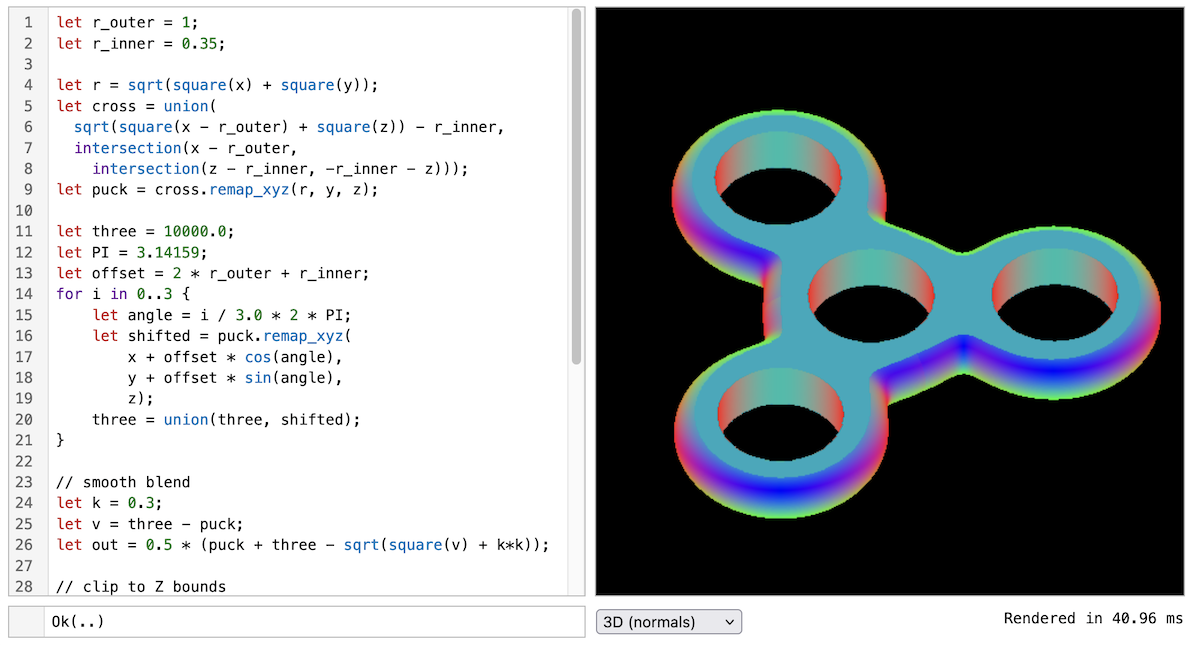
The library contains a variety of data structures and algorithms, e.g.
- Manipulation and deduplication of math expressions
- Conversion from graphs into straight-line code ("tapes") for evaluation
- Tape simplification, based on interval evaluation results
- A very fast JIT compiler, with hand-written
aarch64andx86_64routines for- Point-wise evaluation (
f32) - Interval evaluation (
[lower, upper]) - SIMD evaluation (
f32 x 4on ARM,f32 x 8on x86) - Gradient evaluation (partial derivatives with respect to x, y, and z)
- Point-wise evaluation (
- Bitmap rendering of implicit surfaces in 2D (with a variety of rendering modes) and 3D (producing heightmaps and normals)
- Meshing (using our own implementation of the Manifold Dual Contouring algorithm)
- A canonical bytecode format for tapes, for use in other interpreters
If this all sounds oddly familiar, it's because you've read Massively Parallel Rendering of Complex Closed-Form Implicit Surfaces. Fidget includes all of the building blocks from that paper, but with an emphasis on (native) evaluation on the CPU, rather than (interpreted) evaluation on the GPU.
The library has extensive documentation, including a high-level overview of the APIs in the crate-level docs; this is a great place to get started!
At the moment, it has strong Lego-kit-without-a-manual energy: there are lots of functions that are individually documented, but putting them together into something useful is left as an exercise to the reader. There may also be some missing pieces, and the API seams may not be in the right places; if you're doing serious work with the library, expect to fork it and make local modifications.
Issues and PRs are welcome, although I'm unlikely to merge anything which adds substantial maintenance burden. This is a personal-scale experimental project, so adjust your expectations accordingly.
Crate organization and versioning
The Fidget project is broken into separate crates for improved modularity and
compile times. Everything is re-exported by the fidget root crate, so you
shouldn't need to think about it. The version of the root crate is the maximum
version of any child crate; they're not necessarily bumped in lockstep, only
when things change.
Demos
The demos folder contains several demo tools and
applications built using the Fidget crate,
ranging from CLI to GUI to web app.
Projects using Fidget
- The Prospero Challenge was designed around Fidget's rendering implementation, then opened up to third-party submissions
rsaccon/fidget-koto: An adaptation of thefidget-viewerdemo using Koto for scripting (instead of Rhai)alexneufeld/fidgetpy: Python bindings and high-level API- Halfspace is an IDE for solid modeling using distance fields
- The Concavum Customizer is an interactive customizer for a parametric split keyboard
Support matrix
At the moment, Fidget supports a limited number of platforms:
| Platform | JIT support | CI | Support |
|---|---|---|---|
aarch64-apple-darwin | Yes | ✅ Tested | ⭐️ Tier 0 |
x86_64-unknown-linux-gnu | Yes | ✅ Tested | 🥇 Tier 1 |
x86_64-pc-windows-msvc | Yes | ✅ Tested | 🥈 Tier 2 |
aarch64-unknown-linux-gnu | Yes | ⚠️ Checked | 🥇 Tier 1 |
aarch64-pc-windows-msvc | Yes | ⚠️ Checked | 🥉 Tier 3 |
wasm32-unknown-unknown | No | ⚠️ Checked | 🥇 Tier 1 |
Explanation of keys
| CI | Description |
|---|---|
| ✅ Tested | cargo test is run for the given target |
| ⚠️ Checked | cargo check is run for the given target |
| Tier | Description |
|---|---|
| ⭐️ Tier 0 | A maintainer uses this platform as their daily driver |
| 🥇 Tier 1 | A maintainer has access to this platform |
| 🥈 Tier 2 | A maintainer does not have access to this platform, but it is tested in CI |
| 🥉 Tier 3 | A maintainer does not have access to this platform, and it is not tested in CI |
Support tiers represent whether maintainers will be able to help with
platform-specific bugs; for example, if you discover an
aarch64-pc-windows-msvc-specific issue, expect to do most of the heavy lifting
yourself.
CPU requirements
aarch64 platforms require NEON instructions and x86_64 platforms require
AVX2 and BMI2 support; all of these extensions are nearly a decade old and
should be widespread.
Disabling the jit feature allows for cross-platform rendering, using an
interpreter rather than JIT compilation. This is mandatory for the
wasm32-unknown-unknown target, which cannot generate "native" code.
Similar projects
Fidget overlaps with various projects in the implicit modeling space:
- kokopelli: script-based CAD/CAM in Python*
- Antimony: CAD from a parallel universe*
libfive: Infrastructure for solid modeling*- Massively Parallel Rendering of Complex Closed-Form Implicit Surfaces (MPR)*
- ImplicitCAD: Powerful, Open-Source, Programmatic CAD
- Ruckus: Procedural CAD For Weirdos
- Curv: a language for making art using mathematics
- sdf: Simple SDF mesh generation in Python
- Forged Thoughts: A Modeling & Rendering Language in Rust
- Raumkuenstler: Node-based modeling with an LLVM-powered JIT compiler
saft_sdf: Signed distance field function utilities and interpreter- Probably more; PRs welcome!
*written by the same author
(the MPR paper also cites many references to related academic work)
Compared to these projects, Fidget is unique in having a native JIT and using that JIT while performing tape simplification. Situating it among projects by the same author – which all use roughly the same rendering strategies – it looks something like this:
| CPU | GPU | |
|---|---|---|
| Interpreter | libfive, Fidget | MPR |
| JIT | Fidget | (please give me APIs to do this) |
Fidget's native JIT makes it blazing fast. For example, here are rough benchmarks rasterizing this model across three different implementations:
| Size | libfive | MPR | Fidget (VM) | Fidget (JIT) |
|---|---|---|---|---|
| 1024³ | 66.8 ms | 22.6 ms | 61.7 ms | 23.6 ms |
| 1536³ | 127 ms | 39.3 ms | 112 ms | 45.4 ms |
| 2048³ | 211 ms | 60.6 ms | 184 ms | 77.4 ms |
libfive and Fidget are running on an M1 Max CPU; MPR is running on a GTX 1080
Ti GPU. We see that Fidget's interpreter is slightly better than libfive, and
Fidget's JIT is nearly competitive with the GPU-based MPR.
Fidget is missing a bunch of features that are found in more mature projects.
For example, it only includes a debug GUI, and its meshing is much less
battle-tested than libfive.
LLM usage and contributions
I don't use LLMs to write non-trivial code (or documentation) in Fidget or Halfspace. In particular, I eschew agentic systems like Claude Code. One goal of these projects is to find the "right" APIs and software architecture for working with implicit surfaces, and I have to be using the APIs myself to discover rough edges and seams. Agentic loops are incredibly good at bandaging over paper cuts, which would defeat the purpose.
However, I do use LLMs for code review (typically using GitHub Copilot) and brainstorming (occasional chats with frontier models). Along with correct API design, an overarching goal of the project is to be as good as possible on various axes: correctness, performance, usability, documentation, etc. Since I'm the sole author, adding an additional layer of review helps me deliver better software.
User contributions are expected to abide by the same policy. Small contributions are typically welcome; if you are considering a large change, please open an issue or discussion first.
If you would like to avoid all possible LLM taint, I recommend pinning (or forking) Fidget 0.4.1.
License
© 2022-2026 Matthew Keeter
Released under the Mozilla Public License 2.0
Contributors


Similar repos


Languages
Rust
93.7%
WGSL
6.1%
blazing fast implicit surface evaluation
See the codeREADME
Fidget
Fidget is experimental infrastructure for complex closed-form implicit surfaces.
The library contains a variety of data structures and algorithms, e.g.
- Manipulation and deduplication of math expressions
- Conversion from graphs into straight-line code ("tapes") for evaluation
- Tape simplification, based on interval evaluation results
- A very fast JIT compiler, with hand-written
aarch64andx86_64routines for- Point-wise evaluation (
f32) - Interval evaluation (
[lower, upper]) - SIMD evaluation (
f32 x 4on ARM,f32 x 8on x86) - Gradient evaluation (partial derivatives with respect to x, y, and z)
- Point-wise evaluation (
- Bitmap rendering of implicit surfaces in 2D (with a variety of rendering modes) and 3D (producing heightmaps and normals)
- Meshing (using our own implementation of the Manifold Dual Contouring algorithm)
- A canonical bytecode format for tapes, for use in other interpreters
If this all sounds oddly familiar, it's because you've read Massively Parallel Rendering of Complex Closed-Form Implicit Surfaces. Fidget includes all of the building blocks from that paper, but with an emphasis on (native) evaluation on the CPU, rather than (interpreted) evaluation on the GPU.
The library has extensive documentation, including a high-level overview of the APIs in the crate-level docs; this is a great place to get started!
At the moment, it has strong Lego-kit-without-a-manual energy: there are lots of functions that are individually documented, but putting them together into something useful is left as an exercise to the reader. There may also be some missing pieces, and the API seams may not be in the right places; if you're doing serious work with the library, expect to fork it and make local modifications.
Issues and PRs are welcome, although I'm unlikely to merge anything which adds substantial maintenance burden. This is a personal-scale experimental project, so adjust your expectations accordingly.
Crate organization and versioning
The Fidget project is broken into separate crates for improved modularity and
compile times. Everything is re-exported by the fidget root crate, so you
shouldn't need to think about it. The version of the root crate is the maximum
version of any child crate; they're not necessarily bumped in lockstep, only
when things change.
Demos
The demos folder contains several demo tools and
applications built using the Fidget crate,
ranging from CLI to GUI to web app.
Projects using Fidget
- The Prospero Challenge was designed around Fidget's rendering implementation, then opened up to third-party submissions
rsaccon/fidget-koto: An adaptation of thefidget-viewerdemo using Koto for scripting (instead of Rhai)alexneufeld/fidgetpy: Python bindings and high-level API- Halfspace is an IDE for solid modeling using distance fields
- The Concavum Customizer is an interactive customizer for a parametric split keyboard
Support matrix
At the moment, Fidget supports a limited number of platforms:
| Platform | JIT support | CI | Support |
|---|---|---|---|
aarch64-apple-darwin | Yes | ✅ Tested | ⭐️ Tier 0 |
x86_64-unknown-linux-gnu | Yes | ✅ Tested | 🥇 Tier 1 |
x86_64-pc-windows-msvc | Yes | ✅ Tested | 🥈 Tier 2 |
aarch64-unknown-linux-gnu | Yes | ⚠️ Checked | 🥇 Tier 1 |
aarch64-pc-windows-msvc | Yes | ⚠️ Checked | 🥉 Tier 3 |
wasm32-unknown-unknown | No | ⚠️ Checked | 🥇 Tier 1 |
Explanation of keys
| CI | Description |
|---|---|
| ✅ Tested | cargo test is run for the given target |
| ⚠️ Checked | cargo check is run for the given target |
| Tier | Description |
|---|---|
| ⭐️ Tier 0 | A maintainer uses this platform as their daily driver |
| 🥇 Tier 1 | A maintainer has access to this platform |
| 🥈 Tier 2 | A maintainer does not have access to this platform, but it is tested in CI |
| 🥉 Tier 3 | A maintainer does not have access to this platform, and it is not tested in CI |
Support tiers represent whether maintainers will be able to help with
platform-specific bugs; for example, if you discover an
aarch64-pc-windows-msvc-specific issue, expect to do most of the heavy lifting
yourself.
CPU requirements
aarch64 platforms require NEON instructions and x86_64 platforms require
AVX2 and BMI2 support; all of these extensions are nearly a decade old and
should be widespread.
Disabling the jit feature allows for cross-platform rendering, using an
interpreter rather than JIT compilation. This is mandatory for the
wasm32-unknown-unknown target, which cannot generate "native" code.
Similar projects
Fidget overlaps with various projects in the implicit modeling space:
- kokopelli: script-based CAD/CAM in Python*
- Antimony: CAD from a parallel universe*
libfive: Infrastructure for solid modeling*- Massively Parallel Rendering of Complex Closed-Form Implicit Surfaces (MPR)*
- ImplicitCAD: Powerful, Open-Source, Programmatic CAD
- Ruckus: Procedural CAD For Weirdos
- Curv: a language for making art using mathematics
- sdf: Simple SDF mesh generation in Python
- Forged Thoughts: A Modeling & Rendering Language in Rust
- Raumkuenstler: Node-based modeling with an LLVM-powered JIT compiler
saft_sdf: Signed distance field function utilities and interpreter- Probably more; PRs welcome!
*written by the same author
(the MPR paper also cites many references to related academic work)
Compared to these projects, Fidget is unique in having a native JIT and using that JIT while performing tape simplification. Situating it among projects by the same author – which all use roughly the same rendering strategies – it looks something like this:
| CPU | GPU | |
|---|---|---|
| Interpreter | libfive, Fidget | MPR |
| JIT | Fidget | (please give me APIs to do this) |
Fidget's native JIT makes it blazing fast. For example, here are rough benchmarks rasterizing this model across three different implementations:
| Size | libfive | MPR | Fidget (VM) | Fidget (JIT) |
|---|---|---|---|---|
| 1024³ | 66.8 ms | 22.6 ms | 61.7 ms | 23.6 ms |
| 1536³ | 127 ms | 39.3 ms | 112 ms | 45.4 ms |
| 2048³ | 211 ms | 60.6 ms | 184 ms | 77.4 ms |
libfive and Fidget are running on an M1 Max CPU; MPR is running on a GTX 1080
Ti GPU. We see that Fidget's interpreter is slightly better than libfive, and
Fidget's JIT is nearly competitive with the GPU-based MPR.
Fidget is missing a bunch of features that are found in more mature projects.
For example, it only includes a debug GUI, and its meshing is much less
battle-tested than libfive.
LLM usage and contributions
I don't use LLMs to write non-trivial code (or documentation) in Fidget or Halfspace. In particular, I eschew agentic systems like Claude Code. One goal of these projects is to find the "right" APIs and software architecture for working with implicit surfaces, and I have to be using the APIs myself to discover rough edges and seams. Agentic loops are incredibly good at bandaging over paper cuts, which would defeat the purpose.
However, I do use LLMs for code review (typically using GitHub Copilot) and brainstorming (occasional chats with frontier models). Along with correct API design, an overarching goal of the project is to be as good as possible on various axes: correctness, performance, usability, documentation, etc. Since I'm the sole author, adding an additional layer of review helps me deliver better software.
User contributions are expected to abide by the same policy. Small contributions are typically welcome; if you are considering a large change, please open an issue or discussion first.
If you would like to avoid all possible LLM taint, I recommend pinning (or forking) Fidget 0.4.1.
License
© 2022-2026 Matthew Keeter
Released under the Mozilla Public License 2.0
Similar repos
Contributors
Languages
Rust
93.7%
WGSL
6.1%