
LLM inference in C/C++
See the codeREADME
llama.cpp — very large MoE models on a 64 GB Mac
A fork of llama.cpp for running MoE models far larger than available RAM by streaming their routed experts from SSD on demand, tuned specifically for Apple Silicon.
Testing hardware: M1 Max, 64 GB, ~400 GB/s. Everything except the routed experts stays resident; the experts live in a bounded cache filled by demand loads and a one-layer-ahead prefetcher. The usable checkpoint size is therefore set by disk throughput, not by RAM — a 284B model in 107 GiB runs on a machine with 64 GB, at a speed that is genuinely usable for agentic coding.
Decode at depth is dominated by the KV read, not by weight traffic, which is why streaming the experts costs so little once the context is deep. That is the entire premise of this approach, and most of the optimisation effort targets prefill and long context rather than short-prompt decode.
Support the Project
If this work is useful to you, a small donation is greatly appreciated and helps fund continued development.

Performance
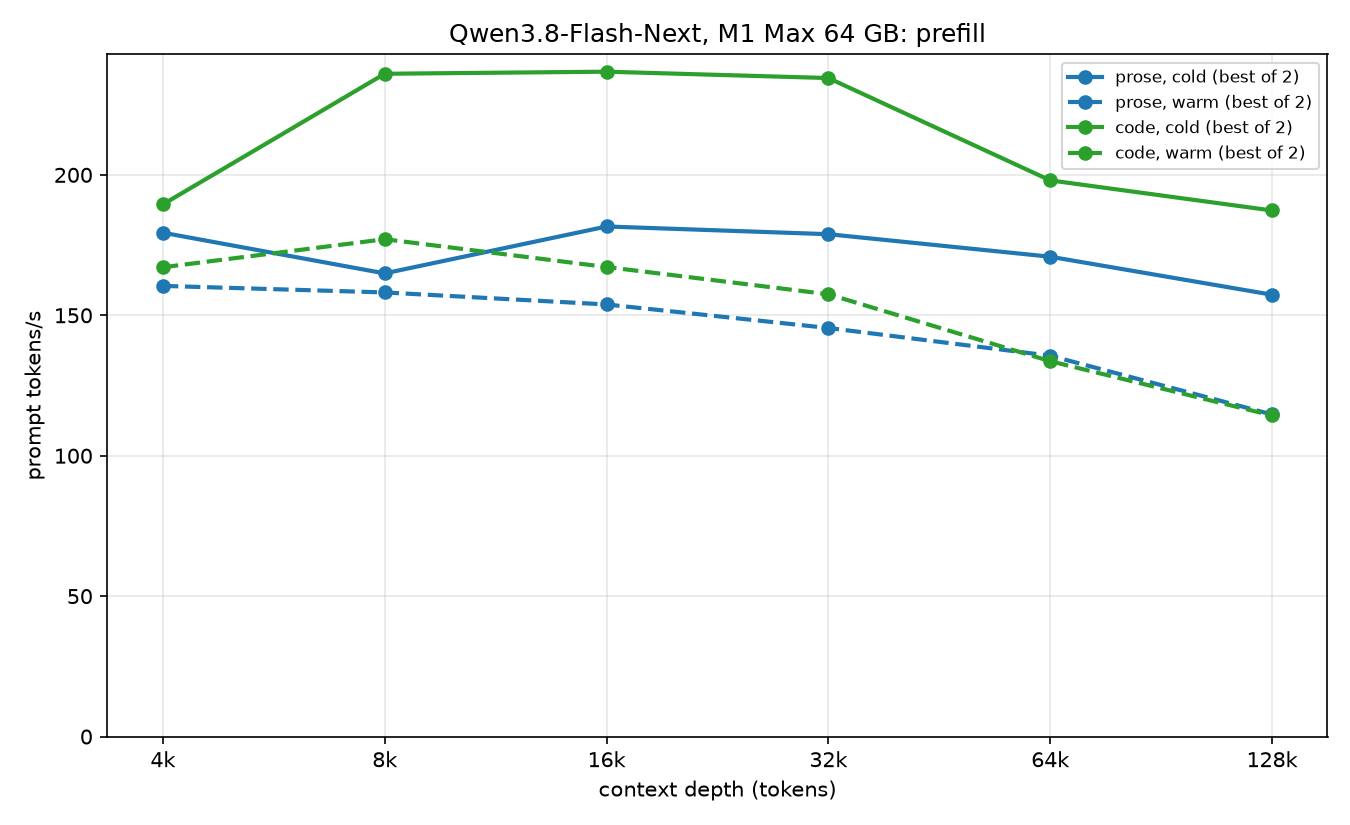
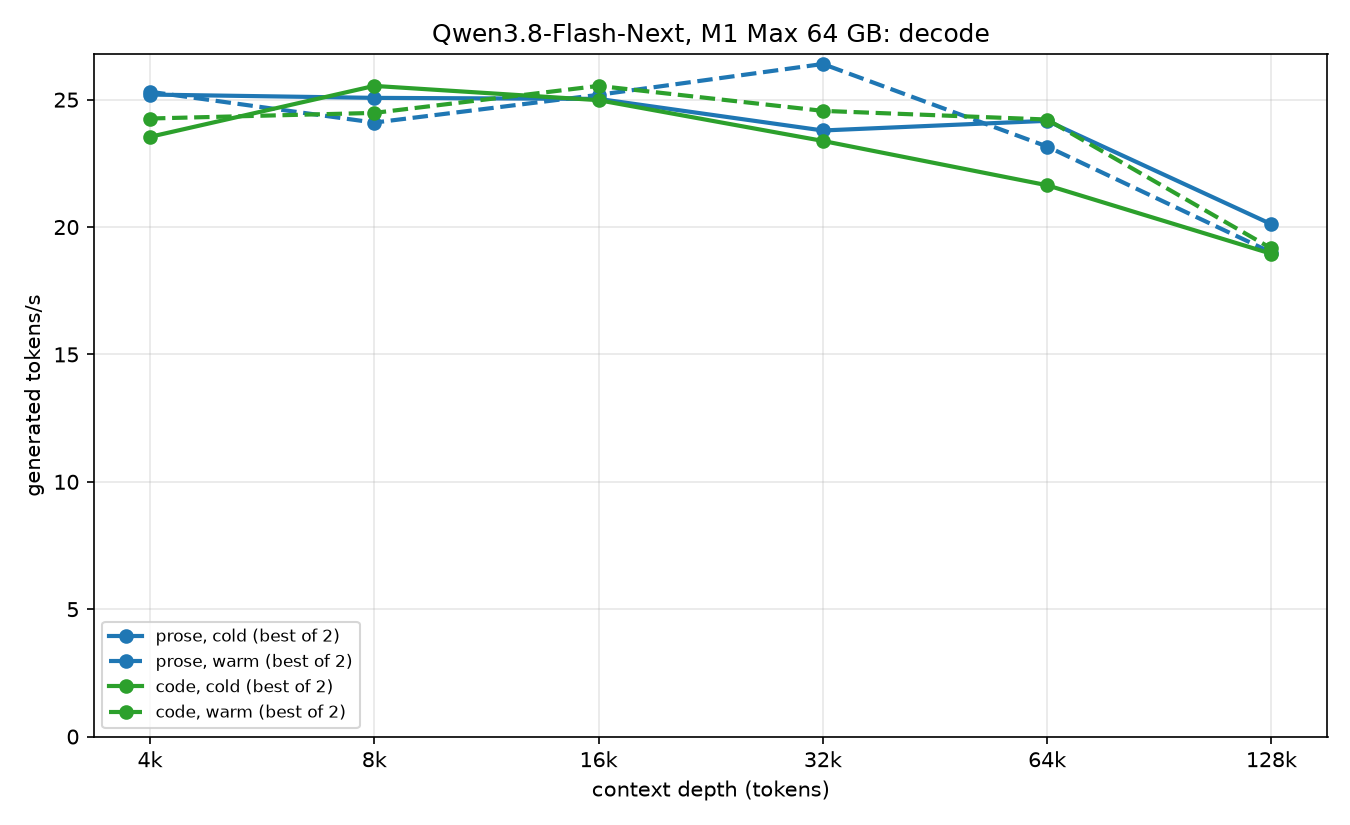
Qwen3.8-Flash-Next with its MTP head on the M1 Max 64 GB, measured with
llama-benchy against llama-server from 4k to 128k tokens of
context. Cold processes the whole context from scratch; warm sends a 2048-token prompt on top
of the already-cached context. Every request generates 256 tokens. Prose is War and Peace, code is
the llama.cpp sources; figures are the best of two runs, from the server's own timings. Both the
excerpts llama-benchy picks and the server's sampling use a fixed seed (1234), so runs repeat. Server
settings as in Running, with a 147456-token context, no mmproj and default flags.
Prefill (tokens/s)
| Depth | Prose cold | Prose warm | Code cold | Code warm |
|---|---|---|---|---|
| 4k | 179.4 | 160.5 | 189.5 | 167.1 |
| 8k | 164.9 | 158.1 | 236.0 | 177.1 |
| 16k | 181.6 | 153.9 | 236.7 | 167.2 |
| 32k | 178.9 | 145.5 | 234.5 | 157.5 |
| 64k | 170.9 | 135.6 | 198.0 | 133.7 |
| 128k | 157.3 | 114.7 | 187.3 | 114.3 |
Decode (tokens/s, MTP acceptance in brackets)
| Depth | Prose cold | Prose warm | Code cold | Code warm |
|---|---|---|---|---|
| 4k | 25.20 (0.53) | 25.31 (0.55) | 23.54 (0.55) | 24.26 (0.58) |
| 8k | 25.07 (0.57) | 24.10 (0.50) | 25.54 (0.64) | 24.48 (0.56) |
| 16k | 25.03 (0.55) | 25.19 (0.56) | 24.98 (0.58) | 25.54 (0.60) |
| 32k | 23.79 (0.55) | 26.40 (0.66) | 23.38 (0.56) | 24.56 (0.62) |
| 64k | 24.17 (0.66) | 23.16 (0.62) | 21.64 (0.57) | 24.22 (0.69) |
| 128k | 20.11 (0.62) | 19.00 (0.56) | 18.95 (0.57) | 19.16 (0.59) |
Against the previous table, decode is +10-16% at every depth: the expert remap now runs inside the command buffer instead of splitting the graph at every MoE layer, and the hyper-connection mixers have faster mat-vecs. Prefill is level; the cold figures read the experts from SSD and move by 5-15% between runs (a same-session A/B at 4k/8k put this build level with or ahead of the previous one).
Building
Standard llama.cpp build; Metal is the only backend this fork is tuned for.
cmake -B build -DGGML_METAL=ON
cmake --build build -j8 --config Release
Running
The configuration this fork is tuned on: Qwen3.8-Flash-Next with its MTP head and 128k context on an M1 Max 64 GB.
LLAMA_MOE_STREAM_LOOKAHEAD=16 LLAMA_SPEC_DRAFT_MOE_SLOTS=512 \
LLAMA_SPEC_REJECTION=1 LLAMA_SPEC_MTP_REJECTION=1 \
llama-server \
  --model model.gguf --mmproj mmproj.gguf \
  -ngl 99 -t 8 --flash-attn on \
  --moe-stream --moe-stream-cache 28 --moe-stream-io-threads 8 \
  -c 131072 -ctxcp 4 --load-mode dio -b 4096 -ub 4096 -cms 4096 -np 1 \
  [-ctk f16 -ctv f16] -cram 0 \
  -md mtp.gguf --spec-type draft-mtp [--spec-draft-n-max 3] \
  [--spec-draft-p-min 0] --spec-draft-ngl 99 \
  --spec-mtp-ngram-n-max 3 --spec-ngram-mod-n-match 8 \
  --ubatch-size-decode 32 [--moe-stream-cache-decode auto] [--prompt-decode-max 640] \
  --slot-save-path slots --slot-persist \
  --context-cache-path context-cache --context-cache-slots 3 \
  --temp 1.0 [--top-p 0.95] --min-p 0.01 \
  [--metrics] --host 0.0.0.0 [--port 8080]
What this fork adds on top of upstream
Kernel fixes carried ahead of upstream
- Flash-attention unroll cap at
DK = 512- upstream'sMIN(DK8/2, 4*NSG)guard folds to a 32x unroll that runs 3.97x slower on M1 Max; the cap keeps DeepSeek's 512-wide heads on the fast path. - Byte-indexed MXFP4 dequant - one half2 table lookup decodes both nibbles of a byte, halving the lookups in the MXFP4 mat-vec.
- Aligned q8_0 KV loads - naturally aligned halfword loads for q8_0 KV dequant on Metal.
MoE expert streaming
- Routed experts streamed from SSD (
--moe-stream,--moe-stream-cache,--moe-stream-io-threads,--moe-stream-direct) - llama.cpp can run MoE models larger than RAM: routed experts are read from the GGUF on demand into a bounded per-layer cache, with parallel slab reads, hotness-based eviction and zero-copy loads into the Metal shared buffer. This is what fits the 107 GiB DeepSeek V4 on a 64 GB Mac. - Pair-partitioned prefill waves (
LLAMA_MOE_STREAM_PARTITION, on) - when a ubatch touches more experts than the cache holds, each (token, expert) pair is computed once, in the wave that holds its expert, instead of every wave running over every pair. Prefill +37%. - Lookahead prefetch (
LLAMA_MOE_STREAM_LOOKAHEAD, default n_expert_used) - layer L+1's router predicts its experts from layer L's input, so their reads start a layer early. DeepSeek decode 6.0 -> 7.3 t/s; Qwen at width 16 -3.2% ms per step at 16k. - Hash-layer preload (
LLAMA_MOE_STREAM_NO_HASH_PREFETCHdisables) - DeepSeek's token-id-routed first layers start their reads before layer 0 instead of stalling on them; those 3 of 43 layers were 36% of the decode misses. - Phase-aware memory (
--ubatch-size-decode,--moe-stream-cache-decode,--prompt-decode-max) - after the prompt, the server drops to a small decode ubatch and gives the freed compute workspace to the expert cache, resized in place and refilled with the experts decode used last (LLAMA_MOE_STREAM_INPLACE,LLAMA_MOE_STREAM_WARM). Decode +10-12% on Qwen, +14% on DeepSeek; phase switches 2.9 -> 1.1 s.
Metal kernels
- Expert and small-batch mat-vecs - IQ3_XXS codebooks read by word, wider MXFP4 row tiles, more rows per simdgroup, and one token per threadgroup for the 2-8 token verify batches of speculative decoding; for Qwen's hyper-connection mixers, 8 rows per simdgroup on the short Q8_0 up-projection (K = 320: 81 -> 47 us at 4 tokens) and more loads in flight on the 4-row F32 inject (38 -> 23 us). Bit-identical, -7.3% ms per decode step, and the mixer kernels +3-5% Qwen decode on top.
MUL_MAT_IDover used tiles only - the expert GEMM runs only over the (expert, tile) pairs that hold tokens instead of launching threadgroups that find nothing. Prefill GPU time -7.0%.- Contiguous
CPYfast path - same-type contiguous copies move uint4s: the recurrent-state copies go 72.5 -> 10.7 us, -4.9% per decode step. - Heads-as-rows sparse flash attention (
GGML_METAL_FA_SPARSE_HR, on) - for GQA prefill with a sparse mask, one threadgroup per (token, KV head) makes the heads sharing the KV head the rows of a simdgroup-matrix tile, so each selected K/V row is loaded once per token; dense FA is kept while the KV range is under 3x the selection. 3.5-5x faster than the vec kernel; Qwen prefill +16-18% at 16-64k against the best previous path. Not bit-identical to the vec kernel. - Expert remap without graph splits (
GGML_METAL_HOST_OPS, on) - the expert-cache remap was a CPU op between two GPU splits at every MoE layer, so the GPU drained and waited ~0.5 ms for the host each time. It now runs on a host thread while the command buffer waits on an event. Byte-identical output; decode +9% on Qwen, +21% on DeepSeek V4. - Residency kept for the process lifetime (
GGML_METAL_RESIDENCY_KEEP_ALIVE_S) - upstream unwires the buffers 180 s after the last compute, after which a model that fills the machine is compressed or swapped and the next request stalls (~40 s measured). The fork keeps them wired while the process runs;N > 0restores a timeout.
DeepSeek
- Union-8 sparse attention (
LLAMA_DSV4_UNION, on;LLAMA_DSV4_UNION_MIN_NCSA, 4096) - blocks of eight prompt queries share one deduplicated top-k list, so prefill reads each selected row once per block instead of once per query, with each query's membership kept exact. Its chunked bitmap keeps the path engaged at long context instead of falling back to dense.
Qwen3.8-Flash-Next
- Block-level indexer selection - the QSA indexer selects whole blocks instead of materialising
an
[n_kv, n_tokens]cell table on every layer, cutting prefill's quadratic term. - PLE row prefetch (
LLAMA_PLE_PREFETCH, on) - every per-layer-embedding row a ubatch will gather from the 26.8 GiB table is advised to the kernel first. -4.8% ms per decode step, prompt -6.7%. - Gathered QSA prefill (
LLAMA_QSA_GATHER=1, opt-in;LLAMA_QSA_GATHER_MIN_KV, 8192) - flash attention reads only the selected cells, eight queries sharing their union. Cold prefill -7.4% at 50k tokens; not bit-identical. - Native MTP draft head - the model's own NextN block drafts for speculative decoding.
Speculative decoding
- Rejection sampling (
LLAMA_SPEC_REJECTION,LLAMA_SPEC_MTP_REJECTION, opt-in) - on sampled requests a draft token is accepted with probability min(1, p_target/q) rather than only on an exact match, so more drafts are kept for the same output distribution. MTP acceptance 0.537 -> 0.590, decode +6.5%. - N-gram suffix (
--spec-mtp-ngram-n-max N) - after a full MTP draft, up to N more tokens come from the verified history. Code edits +8.0% decode at N = 3; changes greedy text. - Bounded drafting (
--spec-max-prompt,LLAMA_SPEC_DRAFT_UBATCH,LLAMA_SPEC_DRAFT_MOE_SLOTS) skips the drafter's prefill on very long prompts and caps its ubatch and expert cache, so it never takes memory the target needs. The drafter's state also survives prompt-cache restores and checkpoint rollbacks, so it does not have to resynchronise.
SSD checkpoints and context cache
- Persistent slot (
--slot-persist) - the most recent conversation and its prompt checkpoints are saved on exit and restored on start: 5994 tokens back in 0.16 s instead of re-prefilled. - SSD context cache (
--context-cache-path,--context-cache-slots) - idle conversations spill to SSD instead of RAM and survive restarts; resuming one after a restart processed 258 tokens instead of re-prefilling 4724. Saved state is keyed by model, settings and graph switches, so a mismatch is refused rather than reused.
The two models, and why they are hard
They are hard in completely different ways, which is why each has its own log.
DeepSeek-V4-Flash-0731 — the I/O problem
284B, 256 experts per layer. The model is 107 GiB and the machine has 64 GB, so the experts must come off the disk while the GPU waits. Everything is about hiding that latency: prefetch far enough ahead, keep the right experts resident, and never let a demand read queue behind speculative work.
→ Research log — kernel survey, features, negative results.
Qwen3.8-Flash-Next — the graph-shape problem
Fast enough that the bottleneck left the disk entirely. What remained was GPU work the graph did not
need to do: a reshape that silently broke Metal's RMS_NORM→MUL fusion, copies that bought nothing,
a full sort of 512 expert scores to read the top 10, and an indexer materialising a table
proportional to context × chunk size on every layer. Plus three genuinely awkward architectural
features: four parallel residual streams, a 26.8 GiB PLE table that cannot be resident, and a native
MTP head whose hidden-state contract has three separate ways to fail silently.
→ Research log — kernel survey, features, negative results.
On the research logs
Both logs record negative results as first-class content, not as an appendix. Roughly half the entries are ideas that look obviously correct on paper and cost real GPU time to disprove.
That is deliberate. On hardware this constrained, knowing which plausible optimisation does not work — and why — has been worth more than the wins.
Each log also carries a kernel survey: every quant format the checkpoint could use, measured at that model's own expert-GEMM shape, ranked by time per effective bit-per-weight. The ranking does not match intuition — on this GPU the i-quant kernels are occupancy-bound and lose to simpler formats that read more bytes.
Upstream
This fork tracks ggml-org/llama.cpp. Upstream documentation applies for everything not listed above; see the upstream README for supported backends, model conversion and the general tool set.
Bugs found here that belong upstream are noted as such in the model logs.
Similar repos


Languages
C++
56.3%
C
15.9%
Python
7.2%
Cuda
5.3%
TypeScript
4.1%
Svelte
2.1%
HTML
2.0%
Metal
1.7%
Jinja
1.1%
LLM inference in C/C++
See the codeREADME
llama.cpp — very large MoE models on a 64 GB Mac
A fork of llama.cpp for running MoE models far larger than available RAM by streaming their routed experts from SSD on demand, tuned specifically for Apple Silicon.
Testing hardware: M1 Max, 64 GB, ~400 GB/s. Everything except the routed experts stays resident; the experts live in a bounded cache filled by demand loads and a one-layer-ahead prefetcher. The usable checkpoint size is therefore set by disk throughput, not by RAM — a 284B model in 107 GiB runs on a machine with 64 GB, at a speed that is genuinely usable for agentic coding.
Decode at depth is dominated by the KV read, not by weight traffic, which is why streaming the experts costs so little once the context is deep. That is the entire premise of this approach, and most of the optimisation effort targets prefill and long context rather than short-prompt decode.
Support the Project
If this work is useful to you, a small donation is greatly appreciated and helps fund continued development.
Performance
Qwen3.8-Flash-Next with its MTP head on the M1 Max 64 GB, measured with
llama-benchy against llama-server from 4k to 128k tokens of
context. Cold processes the whole context from scratch; warm sends a 2048-token prompt on top
of the already-cached context. Every request generates 256 tokens. Prose is War and Peace, code is
the llama.cpp sources; figures are the best of two runs, from the server's own timings. Both the
excerpts llama-benchy picks and the server's sampling use a fixed seed (1234), so runs repeat. Server
settings as in Running, with a 147456-token context, no mmproj and default flags.
Prefill (tokens/s)
| Depth | Prose cold | Prose warm | Code cold | Code warm |
|---|---|---|---|---|
| 4k | 179.4 | 160.5 | 189.5 | 167.1 |
| 8k | 164.9 | 158.1 | 236.0 | 177.1 |
| 16k | 181.6 | 153.9 | 236.7 | 167.2 |
| 32k | 178.9 | 145.5 | 234.5 | 157.5 |
| 64k | 170.9 | 135.6 | 198.0 | 133.7 |
| 128k | 157.3 | 114.7 | 187.3 | 114.3 |
Decode (tokens/s, MTP acceptance in brackets)
| Depth | Prose cold | Prose warm | Code cold | Code warm |
|---|---|---|---|---|
| 4k | 25.20 (0.53) | 25.31 (0.55) | 23.54 (0.55) | 24.26 (0.58) |
| 8k | 25.07 (0.57) | 24.10 (0.50) | 25.54 (0.64) | 24.48 (0.56) |
| 16k | 25.03 (0.55) | 25.19 (0.56) | 24.98 (0.58) | 25.54 (0.60) |
| 32k | 23.79 (0.55) | 26.40 (0.66) | 23.38 (0.56) | 24.56 (0.62) |
| 64k | 24.17 (0.66) | 23.16 (0.62) | 21.64 (0.57) | 24.22 (0.69) |
| 128k | 20.11 (0.62) | 19.00 (0.56) | 18.95 (0.57) | 19.16 (0.59) |
Against the previous table, decode is +10-16% at every depth: the expert remap now runs inside the command buffer instead of splitting the graph at every MoE layer, and the hyper-connection mixers have faster mat-vecs. Prefill is level; the cold figures read the experts from SSD and move by 5-15% between runs (a same-session A/B at 4k/8k put this build level with or ahead of the previous one).
Building
Standard llama.cpp build; Metal is the only backend this fork is tuned for.
cmake -B build -DGGML_METAL=ON
cmake --build build -j8 --config Release
Running
The configuration this fork is tuned on: Qwen3.8-Flash-Next with its MTP head and 128k context on an M1 Max 64 GB.
LLAMA_MOE_STREAM_LOOKAHEAD=16 LLAMA_SPEC_DRAFT_MOE_SLOTS=512 \
LLAMA_SPEC_REJECTION=1 LLAMA_SPEC_MTP_REJECTION=1 \
llama-server \
  --model model.gguf --mmproj mmproj.gguf \
  -ngl 99 -t 8 --flash-attn on \
  --moe-stream --moe-stream-cache 28 --moe-stream-io-threads 8 \
  -c 131072 -ctxcp 4 --load-mode dio -b 4096 -ub 4096 -cms 4096 -np 1 \
  [-ctk f16 -ctv f16] -cram 0 \
  -md mtp.gguf --spec-type draft-mtp [--spec-draft-n-max 3] \
  [--spec-draft-p-min 0] --spec-draft-ngl 99 \
  --spec-mtp-ngram-n-max 3 --spec-ngram-mod-n-match 8 \
  --ubatch-size-decode 32 [--moe-stream-cache-decode auto] [--prompt-decode-max 640] \
  --slot-save-path slots --slot-persist \
  --context-cache-path context-cache --context-cache-slots 3 \
  --temp 1.0 [--top-p 0.95] --min-p 0.01 \
  [--metrics] --host 0.0.0.0 [--port 8080]
What this fork adds on top of upstream
Kernel fixes carried ahead of upstream
- Flash-attention unroll cap at
DK = 512- upstream'sMIN(DK8/2, 4*NSG)guard folds to a 32x unroll that runs 3.97x slower on M1 Max; the cap keeps DeepSeek's 512-wide heads on the fast path. - Byte-indexed MXFP4 dequant - one half2 table lookup decodes both nibbles of a byte, halving the lookups in the MXFP4 mat-vec.
- Aligned q8_0 KV loads - naturally aligned halfword loads for q8_0 KV dequant on Metal.
MoE expert streaming
- Routed experts streamed from SSD (
--moe-stream,--moe-stream-cache,--moe-stream-io-threads,--moe-stream-direct) - llama.cpp can run MoE models larger than RAM: routed experts are read from the GGUF on demand into a bounded per-layer cache, with parallel slab reads, hotness-based eviction and zero-copy loads into the Metal shared buffer. This is what fits the 107 GiB DeepSeek V4 on a 64 GB Mac. - Pair-partitioned prefill waves (
LLAMA_MOE_STREAM_PARTITION, on) - when a ubatch touches more experts than the cache holds, each (token, expert) pair is computed once, in the wave that holds its expert, instead of every wave running over every pair. Prefill +37%. - Lookahead prefetch (
LLAMA_MOE_STREAM_LOOKAHEAD, default n_expert_used) - layer L+1's router predicts its experts from layer L's input, so their reads start a layer early. DeepSeek decode 6.0 -> 7.3 t/s; Qwen at width 16 -3.2% ms per step at 16k. - Hash-layer preload (
LLAMA_MOE_STREAM_NO_HASH_PREFETCHdisables) - DeepSeek's token-id-routed first layers start their reads before layer 0 instead of stalling on them; those 3 of 43 layers were 36% of the decode misses. - Phase-aware memory (
--ubatch-size-decode,--moe-stream-cache-decode,--prompt-decode-max) - after the prompt, the server drops to a small decode ubatch and gives the freed compute workspace to the expert cache, resized in place and refilled with the experts decode used last (LLAMA_MOE_STREAM_INPLACE,LLAMA_MOE_STREAM_WARM). Decode +10-12% on Qwen, +14% on DeepSeek; phase switches 2.9 -> 1.1 s.
Metal kernels
- Expert and small-batch mat-vecs - IQ3_XXS codebooks read by word, wider MXFP4 row tiles, more rows per simdgroup, and one token per threadgroup for the 2-8 token verify batches of speculative decoding; for Qwen's hyper-connection mixers, 8 rows per simdgroup on the short Q8_0 up-projection (K = 320: 81 -> 47 us at 4 tokens) and more loads in flight on the 4-row F32 inject (38 -> 23 us). Bit-identical, -7.3% ms per decode step, and the mixer kernels +3-5% Qwen decode on top.
MUL_MAT_IDover used tiles only - the expert GEMM runs only over the (expert, tile) pairs that hold tokens instead of launching threadgroups that find nothing. Prefill GPU time -7.0%.- Contiguous
CPYfast path - same-type contiguous copies move uint4s: the recurrent-state copies go 72.5 -> 10.7 us, -4.9% per decode step. - Heads-as-rows sparse flash attention (
GGML_METAL_FA_SPARSE_HR, on) - for GQA prefill with a sparse mask, one threadgroup per (token, KV head) makes the heads sharing the KV head the rows of a simdgroup-matrix tile, so each selected K/V row is loaded once per token; dense FA is kept while the KV range is under 3x the selection. 3.5-5x faster than the vec kernel; Qwen prefill +16-18% at 16-64k against the best previous path. Not bit-identical to the vec kernel. - Expert remap without graph splits (
GGML_METAL_HOST_OPS, on) - the expert-cache remap was a CPU op between two GPU splits at every MoE layer, so the GPU drained and waited ~0.5 ms for the host each time. It now runs on a host thread while the command buffer waits on an event. Byte-identical output; decode +9% on Qwen, +21% on DeepSeek V4. - Residency kept for the process lifetime (
GGML_METAL_RESIDENCY_KEEP_ALIVE_S) - upstream unwires the buffers 180 s after the last compute, after which a model that fills the machine is compressed or swapped and the next request stalls (~40 s measured). The fork keeps them wired while the process runs;N > 0restores a timeout.
DeepSeek
- Union-8 sparse attention (
LLAMA_DSV4_UNION, on;LLAMA_DSV4_UNION_MIN_NCSA, 4096) - blocks of eight prompt queries share one deduplicated top-k list, so prefill reads each selected row once per block instead of once per query, with each query's membership kept exact. Its chunked bitmap keeps the path engaged at long context instead of falling back to dense.
Qwen3.8-Flash-Next
- Block-level indexer selection - the QSA indexer selects whole blocks instead of materialising
an
[n_kv, n_tokens]cell table on every layer, cutting prefill's quadratic term. - PLE row prefetch (
LLAMA_PLE_PREFETCH, on) - every per-layer-embedding row a ubatch will gather from the 26.8 GiB table is advised to the kernel first. -4.8% ms per decode step, prompt -6.7%. - Gathered QSA prefill (
LLAMA_QSA_GATHER=1, opt-in;LLAMA_QSA_GATHER_MIN_KV, 8192) - flash attention reads only the selected cells, eight queries sharing their union. Cold prefill -7.4% at 50k tokens; not bit-identical. - Native MTP draft head - the model's own NextN block drafts for speculative decoding.
Speculative decoding
- Rejection sampling (
LLAMA_SPEC_REJECTION,LLAMA_SPEC_MTP_REJECTION, opt-in) - on sampled requests a draft token is accepted with probability min(1, p_target/q) rather than only on an exact match, so more drafts are kept for the same output distribution. MTP acceptance 0.537 -> 0.590, decode +6.5%. - N-gram suffix (
--spec-mtp-ngram-n-max N) - after a full MTP draft, up to N more tokens come from the verified history. Code edits +8.0% decode at N = 3; changes greedy text. - Bounded drafting (
--spec-max-prompt,LLAMA_SPEC_DRAFT_UBATCH,LLAMA_SPEC_DRAFT_MOE_SLOTS) skips the drafter's prefill on very long prompts and caps its ubatch and expert cache, so it never takes memory the target needs. The drafter's state also survives prompt-cache restores and checkpoint rollbacks, so it does not have to resynchronise.
SSD checkpoints and context cache
- Persistent slot (
--slot-persist) - the most recent conversation and its prompt checkpoints are saved on exit and restored on start: 5994 tokens back in 0.16 s instead of re-prefilled. - SSD context cache (
--context-cache-path,--context-cache-slots) - idle conversations spill to SSD instead of RAM and survive restarts; resuming one after a restart processed 258 tokens instead of re-prefilling 4724. Saved state is keyed by model, settings and graph switches, so a mismatch is refused rather than reused.
The two models, and why they are hard
They are hard in completely different ways, which is why each has its own log.
DeepSeek-V4-Flash-0731 — the I/O problem
284B, 256 experts per layer. The model is 107 GiB and the machine has 64 GB, so the experts must come off the disk while the GPU waits. Everything is about hiding that latency: prefetch far enough ahead, keep the right experts resident, and never let a demand read queue behind speculative work.
→ Research log — kernel survey, features, negative results.
Qwen3.8-Flash-Next — the graph-shape problem
Fast enough that the bottleneck left the disk entirely. What remained was GPU work the graph did not
need to do: a reshape that silently broke Metal's RMS_NORM→MUL fusion, copies that bought nothing,
a full sort of 512 expert scores to read the top 10, and an indexer materialising a table
proportional to context × chunk size on every layer. Plus three genuinely awkward architectural
features: four parallel residual streams, a 26.8 GiB PLE table that cannot be resident, and a native
MTP head whose hidden-state contract has three separate ways to fail silently.
→ Research log — kernel survey, features, negative results.
On the research logs
Both logs record negative results as first-class content, not as an appendix. Roughly half the entries are ideas that look obviously correct on paper and cost real GPU time to disprove.
That is deliberate. On hardware this constrained, knowing which plausible optimisation does not work — and why — has been worth more than the wins.
Each log also carries a kernel survey: every quant format the checkpoint could use, measured at that model's own expert-GEMM shape, ranked by time per effective bit-per-weight. The ranking does not match intuition — on this GPU the i-quant kernels are occupancy-bound and lose to simpler formats that read more bytes.
Upstream
This fork tracks ggml-org/llama.cpp. Upstream documentation applies for everything not listed above; see the upstream README for supported backends, model conversion and the general tool set.
Bugs found here that belong upstream are noted as such in the model logs.
Similar repos
Languages
C++
56.3%
C
15.9%
Python
7.2%
Cuda
5.3%
TypeScript
4.1%
Svelte
2.1%
HTML
2.0%
Metal
1.7%
Jinja
1.1%