
The official codebase for "Experiential Reinforcement Learning" - https://arxiv.org/pdf/2602.13949v1
Python
79
9 commits
updated Jul 2, 2026
README
Experiential Reinforcement Learning


This repository implements Experiential Reinforcement Learning (ERL), enabling post-training of language agents through an explicit experience–reflection–consolidation loop. Instead of relying solely on reward optimization, ERL enables agents to learn through structured reflection and refinement, turning environmental feedback into durable behavioral improvements. This repository provides the tools to build custom agents and environments, train them with ERL, and deploy adaptive agents capable of tackling complex, real-world tasks.
Algorithm Overview
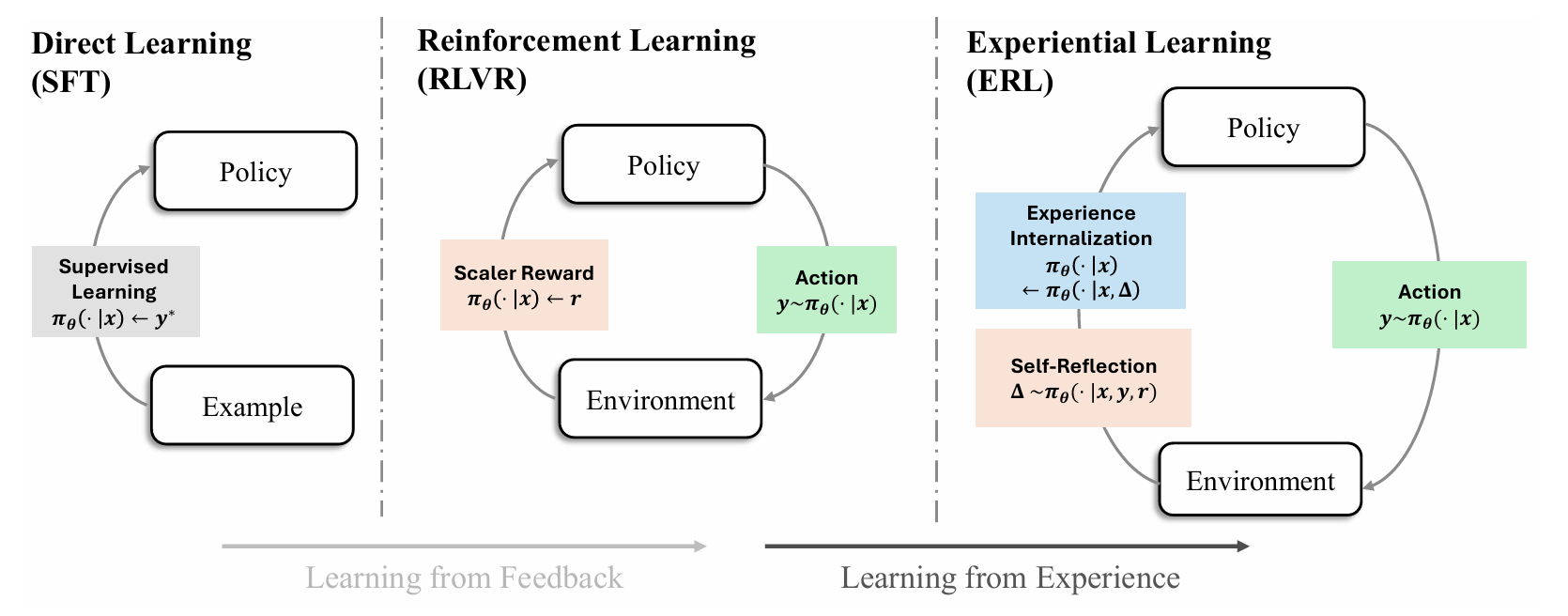
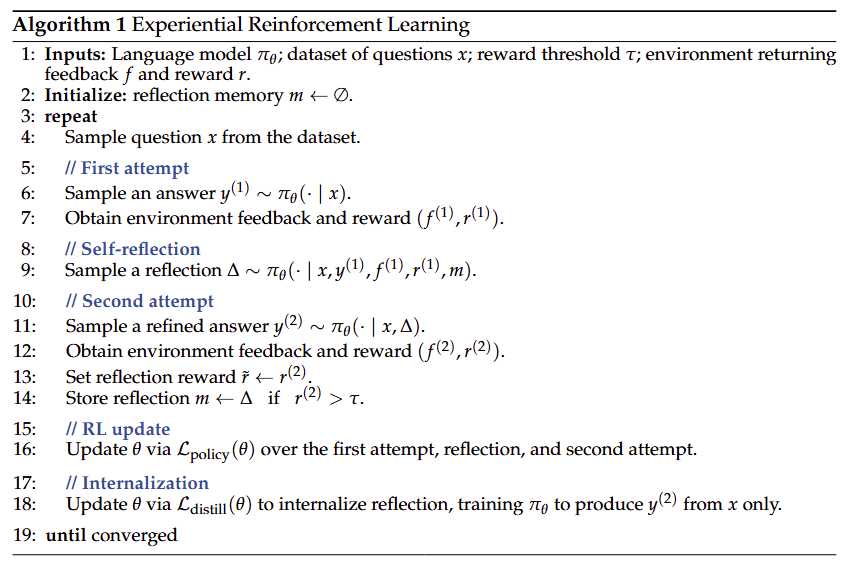
Experiential Reinforcement Learning (ERL) embeds an explicit experience–reflection–consolidation loop into reinforcement learning so that language agents can learn from interaction and internalize improvements. For each task, the agent produces an initial attempt, receives feedback, generates a reflection to diagnose failures, and produces a refined second attempt whose improvements are reinforced into the policy. We optimize the first attempt, reflection, and second attempt with a policy gradient objective (GRPO by default, with support for other methods). To internalize lessons from reflection and experience, we distill successful second attempts via supervised finetuning with context distillation, training the model to produce the improved response directly from the original prompt.
Getting Started 🎯
Our implementation of Experiential RL is based on rLLM v0.2.1 and verl v0.6.1. Please refer to their documentation for installation instructions.
Step 1: Building rLLM
rLLM requires Python >= 3.11. You can install it either directly via pip or build from source.
Option A: Direct Installation
uv pip install "git+https://github.com/rllm-org/rllm.git"
Option B: Building from Source
# Clone the repository
git clone https://github.com/rllm-org/rllm.git
cd rllm

# Create a conda environment
conda create -n rllm python=3.11 -y
conda activate rllm

# Build rLLM from source
uv pip install -e .
Step 2: Installing Training Backend
rLLM supports two training backends: verl and Tinker. ERL currently only supports verl as the training backend.
# Install verl
bash scripts/install_verl.sh
Installation with Docker 🐳
For a containerized setup, you can use Docker:
# Build the Docker image
docker build -t rllm .

# Create and start the container
docker create --runtime=nvidia --gpus all --net=host --shm-size="10g" --cap-add=SYS_ADMIN -v .:/workspace/rllm -v /tmp:/tmp --name rllm-container rllm sleep infinity
docker start rllm-container

# Enter the container
docker exec -it rllm-container bash
Examples
- ERL for Sokoban: grid-based planning workflow
- ERL for FrozenLake: navigation/control workflow
- ERL for HotpotQA: retrieval-augmented QA workflow
Adding New Tasks
You can extend ERL in two ways:
-
If you already have an agent built with an existing framework (for example LangGraph or AutoGen), use the rLLM SDK Engine.
- SDK docs: rLLM SDK Engine
- Reference example: ERL for HotpotQA
- In this example,
ErlHotpotSearchAgentdefines the LangGraph-based agent loop, andErlHotpotWorkflowin the same file wraps it into the ERL first-attempt -> reflection -> second-attempt training flow.
-
If you want a native rLLM workflow implementation, build your task with
AgentWorkflowEngine.- Workflow engine docs: rLLM AgentWorkflowEngine
- Reference example: ERL for FrozenLake
- In this case, replace
ErlFrozenLakeAgent,ErlFrozenLakeEnv, andErlFrozenLakeWorkflowwith your own task, then wire your classes intrain_erl_frozenlake_flow.py.
Acknowledgements
Our work is done as part of USC LIME Lab and Microsoft Office of Applied Research. We pay special thanks to Berkeley Sky Computing Lab and rLLM for their support. The implementation of Experiential RL is based on rLLM.
Citation
@misc{shi2026experientialreinforcementlearning,
      title={Experiential Reinforcement Learning},
      author={Taiwei Shi and Sihao Chen and Bowen Jiang and Linxin Song and Longqi Yang and Jieyu Zhao},
      year={2026},
      eprint={2602.13949},
      archivePrefix={arXiv},
      primaryClass={cs.LG},
      url={https://arxiv.org/abs/2602.13949},
}
Trademarks
This project may contain trademarks or logos for projects, products, or services. Authorized use of Microsoft trademarks or logos is subject to and must follow Microsoft’s Trademark & Brand Guidelines. Use of Microsoft trademarks or logos in modified versions of this project must not cause confusion or imply Microsoft sponsorship. Any use of third-party trademarks or logos are subject to those third-party’s policies.
Contributors

6 commits

1 commits

1 commits

1 commits
Similar repos



Languages
Python
74.5%
Jupyter Notebook
15.3%
Shell
10.1%
The official codebase for "Experiential Reinforcement Learning" - https://arxiv.org/pdf/2602.13949v1
Python
79
9 commits
updated Jul 2, 2026
README
Experiential Reinforcement Learning
This repository implements Experiential Reinforcement Learning (ERL), enabling post-training of language agents through an explicit experience–reflection–consolidation loop. Instead of relying solely on reward optimization, ERL enables agents to learn through structured reflection and refinement, turning environmental feedback into durable behavioral improvements. This repository provides the tools to build custom agents and environments, train them with ERL, and deploy adaptive agents capable of tackling complex, real-world tasks.
Algorithm Overview
Experiential Reinforcement Learning (ERL) embeds an explicit experience–reflection–consolidation loop into reinforcement learning so that language agents can learn from interaction and internalize improvements. For each task, the agent produces an initial attempt, receives feedback, generates a reflection to diagnose failures, and produces a refined second attempt whose improvements are reinforced into the policy. We optimize the first attempt, reflection, and second attempt with a policy gradient objective (GRPO by default, with support for other methods). To internalize lessons from reflection and experience, we distill successful second attempts via supervised finetuning with context distillation, training the model to produce the improved response directly from the original prompt.
Getting Started 🎯
Our implementation of Experiential RL is based on rLLM v0.2.1 and verl v0.6.1. Please refer to their documentation for installation instructions.
Step 1: Building rLLM
rLLM requires Python >= 3.11. You can install it either directly via pip or build from source.
Option A: Direct Installation
uv pip install "git+https://github.com/rllm-org/rllm.git"
Option B: Building from Source
# Clone the repository
git clone https://github.com/rllm-org/rllm.git
cd rllm

# Create a conda environment
conda create -n rllm python=3.11 -y
conda activate rllm

# Build rLLM from source
uv pip install -e .
Step 2: Installing Training Backend
rLLM supports two training backends: verl and Tinker. ERL currently only supports verl as the training backend.
# Install verl
bash scripts/install_verl.sh
Installation with Docker 🐳
For a containerized setup, you can use Docker:
# Build the Docker image
docker build -t rllm .

# Create and start the container
docker create --runtime=nvidia --gpus all --net=host --shm-size="10g" --cap-add=SYS_ADMIN -v .:/workspace/rllm -v /tmp:/tmp --name rllm-container rllm sleep infinity
docker start rllm-container

# Enter the container
docker exec -it rllm-container bash
Examples
- ERL for Sokoban: grid-based planning workflow
- ERL for FrozenLake: navigation/control workflow
- ERL for HotpotQA: retrieval-augmented QA workflow
Adding New Tasks
You can extend ERL in two ways:
-
If you already have an agent built with an existing framework (for example LangGraph or AutoGen), use the rLLM SDK Engine.
- SDK docs: rLLM SDK Engine
- Reference example: ERL for HotpotQA
- In this example,
ErlHotpotSearchAgentdefines the LangGraph-based agent loop, andErlHotpotWorkflowin the same file wraps it into the ERL first-attempt -> reflection -> second-attempt training flow.
-
If you want a native rLLM workflow implementation, build your task with
AgentWorkflowEngine.- Workflow engine docs: rLLM AgentWorkflowEngine
- Reference example: ERL for FrozenLake
- In this case, replace
ErlFrozenLakeAgent,ErlFrozenLakeEnv, andErlFrozenLakeWorkflowwith your own task, then wire your classes intrain_erl_frozenlake_flow.py.
Acknowledgements
Our work is done as part of USC LIME Lab and Microsoft Office of Applied Research. We pay special thanks to Berkeley Sky Computing Lab and rLLM for their support. The implementation of Experiential RL is based on rLLM.
Citation
@misc{shi2026experientialreinforcementlearning,
      title={Experiential Reinforcement Learning},
      author={Taiwei Shi and Sihao Chen and Bowen Jiang and Linxin Song and Longqi Yang and Jieyu Zhao},
      year={2026},
      eprint={2602.13949},
      archivePrefix={arXiv},
      primaryClass={cs.LG},
      url={https://arxiv.org/abs/2602.13949},
}
Trademarks
This project may contain trademarks or logos for projects, products, or services. Authorized use of Microsoft trademarks or logos is subject to and must follow Microsoft’s Trademark & Brand Guidelines. Use of Microsoft trademarks or logos in modified versions of this project must not cause confusion or imply Microsoft sponsorship. Any use of third-party trademarks or logos are subject to those third-party’s policies.
Similar repos
Contributors
6 commits
1 commits
1 commits
1 commits
Languages
Python
74.5%
Jupyter Notebook
15.3%
Shell
10.1%