
Code-as-CoT for Physically-Consistent Video Generation via an Agentic Dual-Engine System
Python
115
16 commits
updated Aug 6, 2026
README
🎬 VideoCoCo: Code as CoT for Physics-Faithful Video Generation
Official repository for VideoCoCo, a physics-faithful video generation pipeline that uses code as a chain-of-thought to draft physics before committing to pixels.
💥 News
- [2026.07.29] We release the Agent Skills, a toy dataset, and the inference code. Tuned weights are uploading to the 🤗 Hub.
🪄 Draft Before Generation
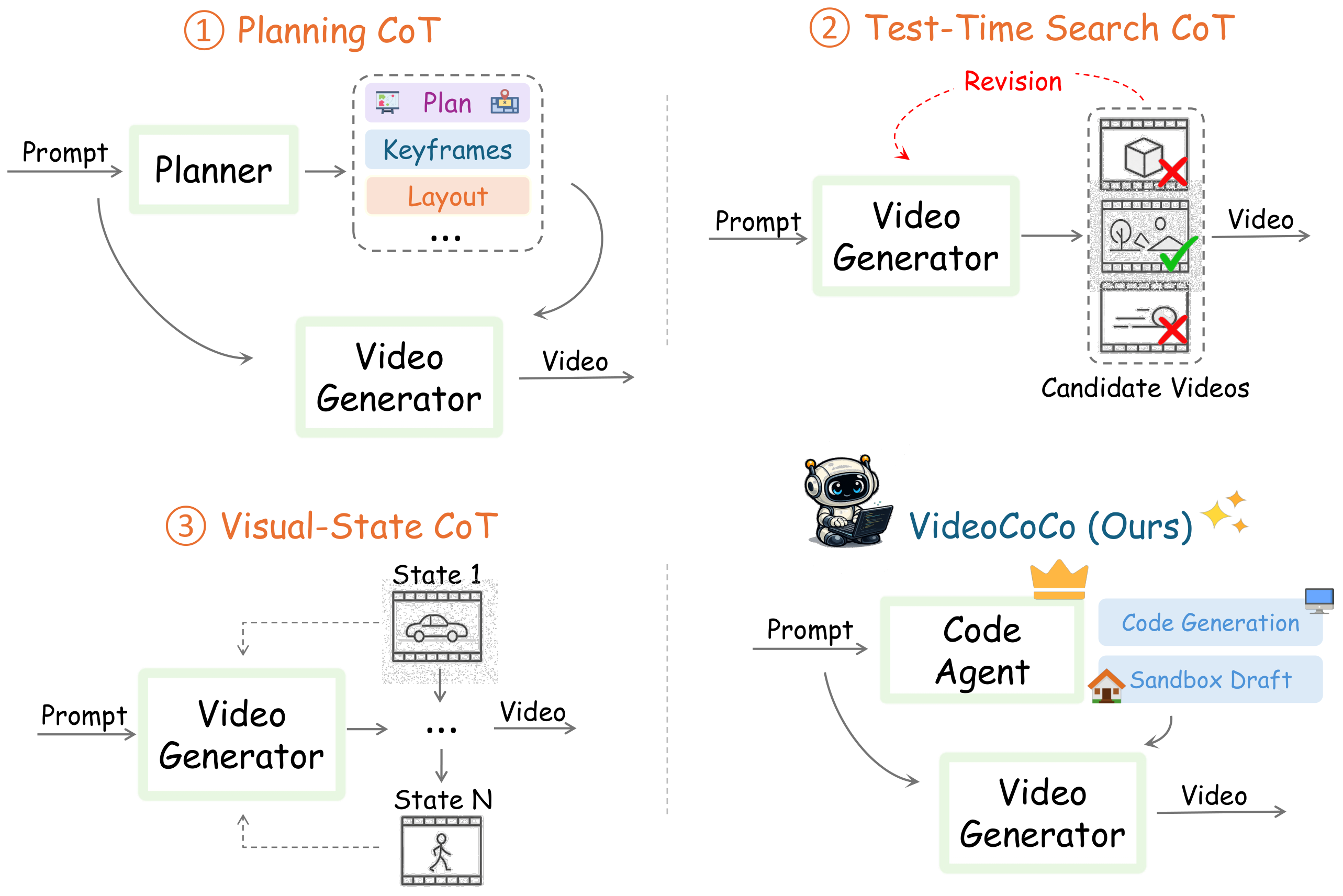
We propose VideoCoCo, an interleaved reasoning paradigm that carries a physical prior through an explicit visual draft before committing to pixels.
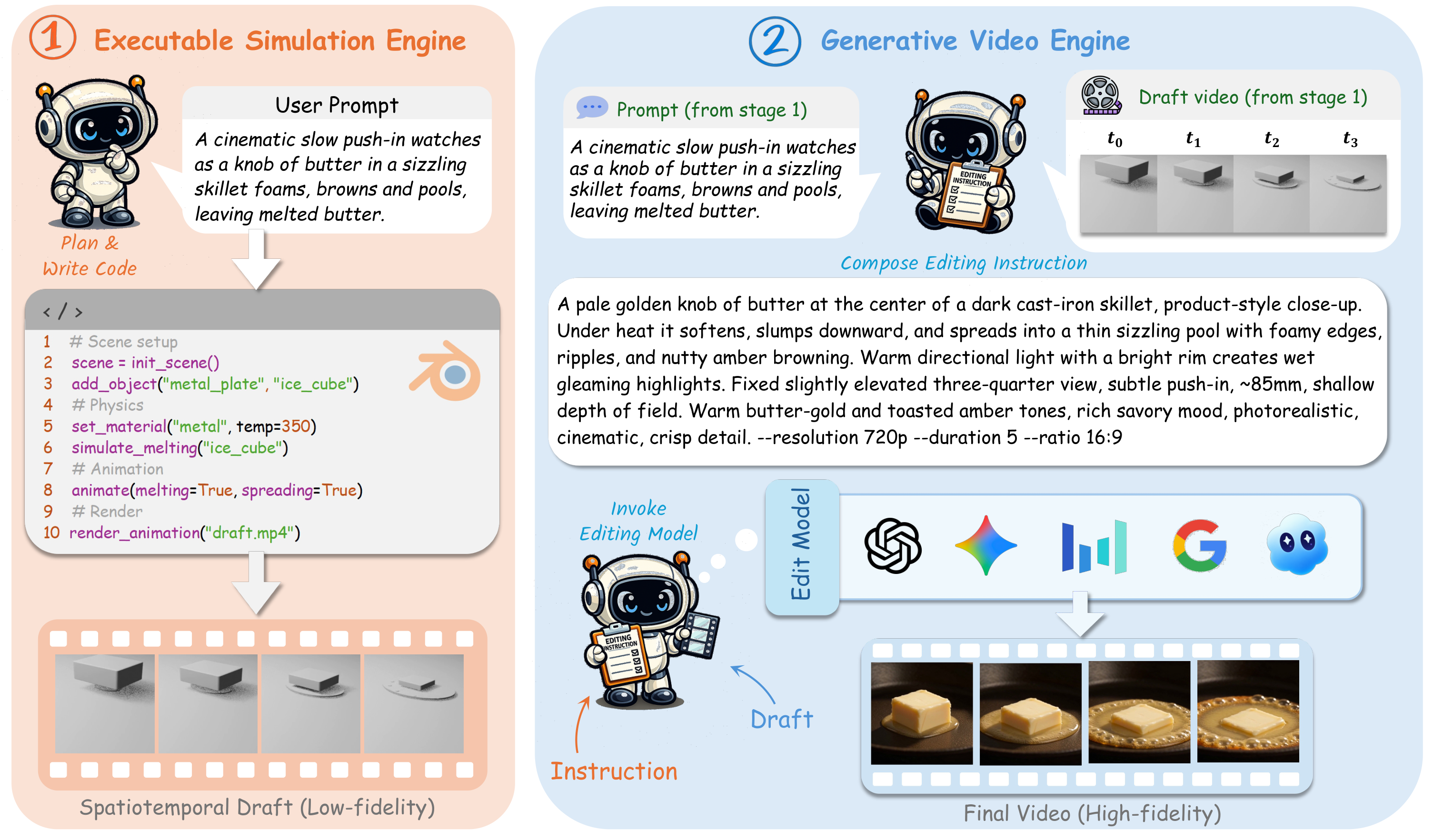
Our method 🎨 first has a code agent write simulation code and render it in a sandbox as a neutral white/clay proxy video that carries the correct motion, causality, and physics — meaning is expressed by shape, transparency, deformation, and coverage, never by color.
Then we 🔎 verify the proxy against the physical plan (a caused state must stay hidden until its causing transition), and 🖼️ restyle the proxy into a photorealistic video driven by a per-case edit instruction.
📦 What's in this repo
skill/— the five Agent Skills forming the pipeline:physical-state-planner→physical-video-blender-implementer→blender-mcp-video→seedance-edit-prompt→seedance-distill.data/toy_cases/— 8 hand-checked video-to-video (v2v) triplets.inference/— batch inference scripts + a patch against upstream OmniWeaving.- 🤗
mickyhimself/VideoCoCo— the tuned transformer.
🎬 Toy dataset
data/toy_cases/ — 8 v2v triplets, one directory per case:
data/toy_cases/
├── manifest.jsonl                 # one JSON line per case (index)
├── 0000_buoyancy/
│   ├── video.mp4                  # source: neutral white/clay physics proxy
│   ├── seedance.mp4               # target: photoreal restyle
│   └── edit_prompt.txt            # instruction used to restyle proxy -> photoreal
└── ...
Each manifest.jsonl line:
{"case_id": "0000_buoyancy", "source": "0000_buoyancy/video.mp4", "target": "0000_buoyancy/seedance.mp4", "instruction": "...", "category": "buoyancy"}
- source (
video.mp4) — a grayscale/white-material render. Physical meaning is carried by shape, motion, transparency, deformation, and coverage, not color. - target (
seedance.mp4) — the photorealistic result. - instruction (
edit_prompt.txt) — the English restyle prompt mapping source motion to the photoreal target.
The 8 cases cover buoyancy, stress/deformation, melting (×2), surface tension, sublimation, elasticity, and boiling — a toy sample for format inspection, not a training-scale corpus.
⚙️ Inference
See inference/README.md: clone the official
OmniWeaving, apply our patch,
pull the tuned weights from the 🤗 Hub, and run bench_infer/batch_infer_edit.py.
🗺️ Roadmap
- Agent Skills (
skill/— prompt → physical plan → Blender proxy → photoreal edit prompt) - Toy dataset (8 v2v triplets)
- Inference stack (
inference/— scripts + upstream patch) - Tuned weights (uploading to 🤗 Hugging Face Hub)
🧠 Our Related Work
Explore our additional research on Text-to-Image / Video Generation and CoT Reasoning:
- [CoCo] CoCo: Code as CoT for Text-to-Image Preview and Rare Concept Generation · model
- [DraCo] DraCo: Draft as CoT for Text-to-Image Preview and Rare Concept Generation · code
- [UniCorn] UniCorn: Towards Self-Improving Unified Multimodal Models through Self-Generated Supervision · code
- [SCOPE] SCOPE: Structured Decomposition and Conditional Skill Orchestration for Complex Image Generation · code
- [T2I-R1] T2I-R1: Reinforcing Image Generation with Collaborative Semantic-level and Token-level CoT · code
- [Image Generation CoT] Can We Generate Images with CoT? Let's Verify and Reinforce Image Generation Step by Step · code
- [NextStep-1] NextStep-1: Toward Autoregressive Image Generation with Continuous Tokens at Scale · code
- [LongCat-Next] LongCat-Next · model
📄 License
Dataset released for research use. The inference code and tuned weights build on Tencent HY-OmniWeaving and are governed by the Tencent HY Community License Agreement; those components ship with the corresponding license and attribution.


Code-as-CoT for Physically-Consistent Video Generation via an Agentic Dual-Engine System
Python
115
16 commits
updated Aug 6, 2026
README
🎬 VideoCoCo: Code as CoT for Physics-Faithful Video Generation
Official repository for VideoCoCo, a physics-faithful video generation pipeline that uses code as a chain-of-thought to draft physics before committing to pixels.
💥 News
- [2026.07.29] We release the Agent Skills, a toy dataset, and the inference code. Tuned weights are uploading to the 🤗 Hub.
🪄 Draft Before Generation
We propose VideoCoCo, an interleaved reasoning paradigm that carries a physical prior through an explicit visual draft before committing to pixels.
Our method 🎨 first has a code agent write simulation code and render it in a sandbox as a neutral white/clay proxy video that carries the correct motion, causality, and physics — meaning is expressed by shape, transparency, deformation, and coverage, never by color.
Then we 🔎 verify the proxy against the physical plan (a caused state must stay hidden until its causing transition), and 🖼️ restyle the proxy into a photorealistic video driven by a per-case edit instruction.
📦 What's in this repo
skill/— the five Agent Skills forming the pipeline:physical-state-planner→physical-video-blender-implementer→blender-mcp-video→seedance-edit-prompt→seedance-distill.data/toy_cases/— 8 hand-checked video-to-video (v2v) triplets.inference/— batch inference scripts + a patch against upstream OmniWeaving.- 🤗
mickyhimself/VideoCoCo— the tuned transformer.
🎬 Toy dataset
data/toy_cases/ — 8 v2v triplets, one directory per case:
data/toy_cases/
├── manifest.jsonl                 # one JSON line per case (index)
├── 0000_buoyancy/
│   ├── video.mp4                  # source: neutral white/clay physics proxy
│   ├── seedance.mp4               # target: photoreal restyle
│   └── edit_prompt.txt            # instruction used to restyle proxy -> photoreal
└── ...
Each manifest.jsonl line:
{"case_id": "0000_buoyancy", "source": "0000_buoyancy/video.mp4", "target": "0000_buoyancy/seedance.mp4", "instruction": "...", "category": "buoyancy"}
- source (
video.mp4) — a grayscale/white-material render. Physical meaning is carried by shape, motion, transparency, deformation, and coverage, not color. - target (
seedance.mp4) — the photorealistic result. - instruction (
edit_prompt.txt) — the English restyle prompt mapping source motion to the photoreal target.
The 8 cases cover buoyancy, stress/deformation, melting (×2), surface tension, sublimation, elasticity, and boiling — a toy sample for format inspection, not a training-scale corpus.
⚙️ Inference
See inference/README.md: clone the official
OmniWeaving, apply our patch,
pull the tuned weights from the 🤗 Hub, and run bench_infer/batch_infer_edit.py.
🗺️ Roadmap
- Agent Skills (
skill/— prompt → physical plan → Blender proxy → photoreal edit prompt) - Toy dataset (8 v2v triplets)
- Inference stack (
inference/— scripts + upstream patch) - Tuned weights (uploading to 🤗 Hugging Face Hub)
🧠 Our Related Work
Explore our additional research on Text-to-Image / Video Generation and CoT Reasoning:
- [CoCo] CoCo: Code as CoT for Text-to-Image Preview and Rare Concept Generation · model
- [DraCo] DraCo: Draft as CoT for Text-to-Image Preview and Rare Concept Generation · code
- [UniCorn] UniCorn: Towards Self-Improving Unified Multimodal Models through Self-Generated Supervision · code
- [SCOPE] SCOPE: Structured Decomposition and Conditional Skill Orchestration for Complex Image Generation · code
- [T2I-R1] T2I-R1: Reinforcing Image Generation with Collaborative Semantic-level and Token-level CoT · code
- [Image Generation CoT] Can We Generate Images with CoT? Let's Verify and Reinforce Image Generation Step by Step · code
- [NextStep-1] NextStep-1: Toward Autoregressive Image Generation with Continuous Tokens at Scale · code
- [LongCat-Next] LongCat-Next · model
📄 License
Dataset released for research use. The inference code and tuned weights build on Tencent HY-OmniWeaving and are governed by the Tencent HY Community License Agreement; those components ship with the corresponding license and attribution.