A practical microservices with the latest technologies and architectures like Vertical Slice Architecture, Event Sourcing, CQRS, DDD, gRpc, MongoDB, RabbitMq, Wolverine, and Aspire in .Net 10.
C#
1,407
1,058 commits
updated Oct 6, 2026



🚀 A practical microservices with the latest technologies and architectures like Vertical Slice Architecture, Event Sourcing, CQRS, DDD, gRpc, MongoDB, RabbitMq, Wolverine, and Aspire in .Net 10.

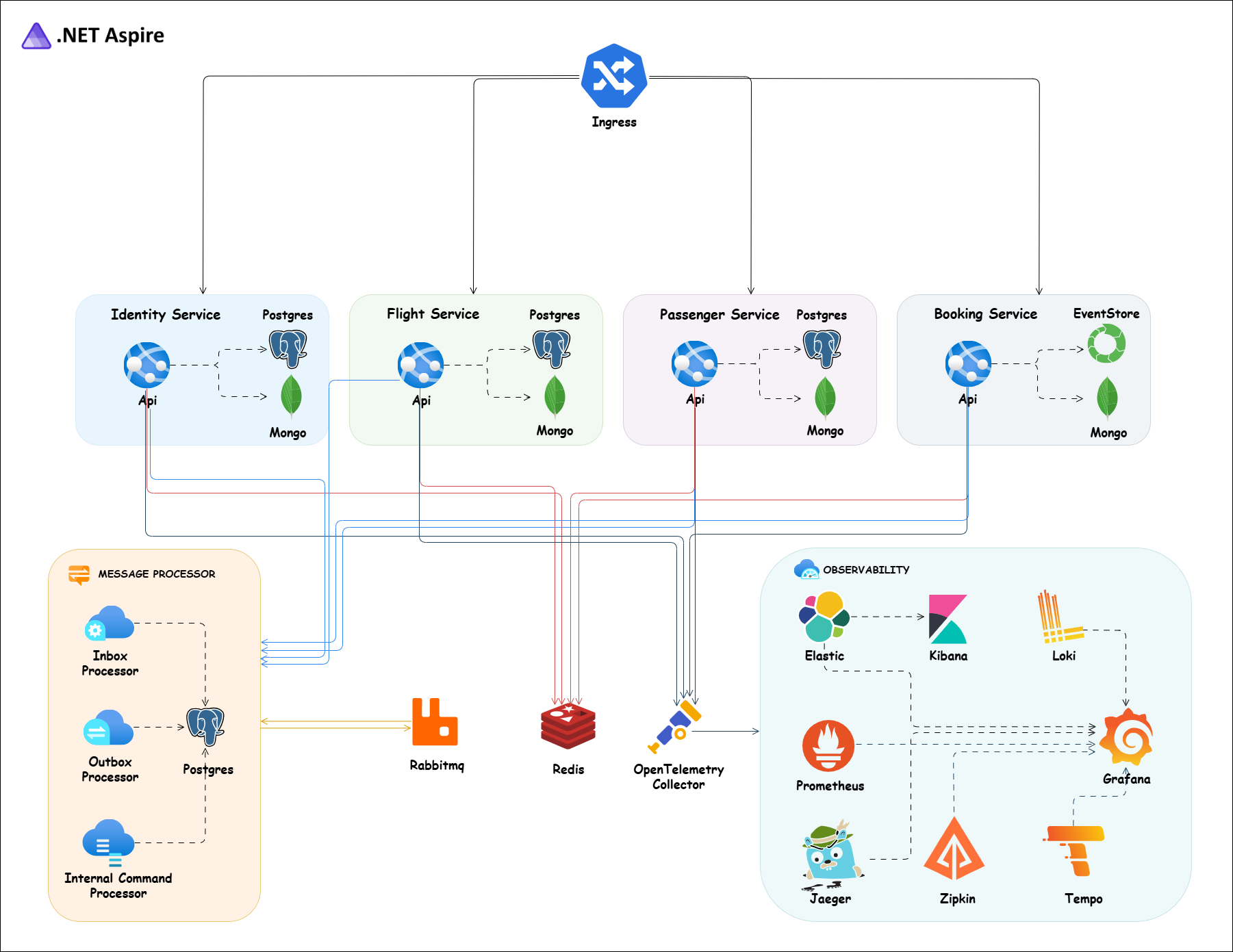
Vertical Slice Architecture for architecture level.Domain Driven Design (DDD) to implement all business logic.Rabbitmq on top of Wolverine for Event Driven Architecture.gRPC for internal communication.CQRS implementation with MediatR library.Postgres for write side database.MongoDB for read side database.Event Store for write side of Booking Microservice/Module to store all historical change of aggregate.Wolverine durable Inbox Pattern for ensuring message idempotency for receiver and Exactly once Delivery.Wolverine durable Outbox Pattern for ensuring no message is lost and there is at At Least One Delivery.Wolverine durable local queues for internal commands and asynchronous in-process workflows.Unit Testing for testing small units and mocking our dependencies with Nsubstitute.End-To-End Testing and Integration Testing for testing features with all dependencies using testcontainers.Contract Testing with PactNet for verifying producer and consumer compatibility.Fluent Validation and a Validation Pipeline Behaviour on top of MediatR.Minimal API for all endpoints.AspNetCore OpenApi for generating built-in support OpenAPI documentation in ASP.NET Core.Health Check for reporting the health of app infrastructure components.Docker-Compose and Kubernetes for our deployment mechanism.Kibana on top of Serilog for logging.OpenTelemetry for distributed tracing on top of Jaeger.OpenTelemetry for monitoring on top of Prometheus and Grafana.IdentityServer for authentication and authorization base on OpenID-Connect and OAuth2.Yarp as a microservices gateway.Kubernetes to achieve efficient scaling and ensure high availability for each of our microservices.Nginx Ingress Controller for load balancing between our microservices top of Kubernetes.cert-manager to Configure TLS in kubernetes cluster.Aspire for service discovery, observability, and local orchestration of microservices..NET 10 - .NET Framework and .NET Core, including ASP.NET and ASP.NET Core.MVC Versioning API - Set of libraries which add service API versioning to ASP.NET Web API, OData with ASP.NET Web API, and ASP.NET Core.EF Core - Modern object-database mapper for .NET. It supports LINQ queries, change tracking, updates, and schema migrations.AspNetCore OpenApi - Provides built-in support for OpenAPI document generation in ASP.NET Core.Wolverine - Durable messaging and local workflow library for .NET with RabbitMQ transport, inbox/outbox support, and local queues.MediatR - Simple, unambitious mediator implementation in .NET.FluentValidation - Popular .NET validation library for building strongly-typed validation rules.Scalar - Scalar provides an easy way to render beautiful API references based on OpenAPI/Swagger documents.Swagger UI - Swagger tools for documenting API's built on ASP.NET Core.Serilog - Simple .NET logging with fully-structured eventsPolly - Polly is a .NET resilience and transient-fault-handling library that allows developers to express policies such as Retry, Circuit Breaker, Timeout, Bulkhead Isolation, and Fallback in a fluent and thread-safe manner.Scrutor - Assembly scanning and decoration extensions for Microsoft.Extensions.DependencyInjectionOpentelemetry-dotnet - The OpenTelemetry .NET ClientDuendeSoftware IdentityServer - The most flexible and standards-compliant OpenID Connect and OAuth 2.x framework for ASP.NET Core.EasyCaching - Open source caching library that contains basic usages and some advanced usages of caching which can help us to handle caching more easier.Mapster - Convention-based object-object mapper in .NET.Hellang.Middleware.ProblemDetails - A middleware for handling exception in .Net Core.NewId - NewId can be used as an embedded unique ID generator that produces 128 bit (16 bytes) sequential IDs.Yarp - Reverse proxy toolkit for building fast proxy servers in .NET.Tye - Developer tool that makes developing, testing, and deploying microservices and distributed applications easier.gRPC-dotnet - gRPC functionality for .NET.EventStore - The open-source, functional database with Complex Event Processing.MongoDB.Driver - .NET Driver for MongoDB.xUnit.net - A free, open source, community-focused unit testing tool for the .NET Framework.Respawn - Respawn is a small utility to help in resetting test databases to a clean state.Testcontainers - Testcontainers for .NET is a library to support tests with throwaway instances of Docker containers.PactNet - Contract testing library for verifying consumer-provider compatibility in .NET services.K6 - Modern load testing for developers and testers in the DevOps era.Aspire - .NET stack for building and orchestrating observable, distributed cloud-native applications.Identity Service: The Identity Service is a bounded context for the authentication and authorization of users using Identity Server. This service is responsible for creating new users and their corresponding roles and permissions using .Net Core Identity and Jwt authentication and authorization.
Flight Service: The Flight Service is a bounded context CRUD service to handle flight related operations.
Passenger Service: The Passenger Service is a bounded context for managing passenger information, tracking activities and subscribing to get notification for out of stock products.
Booking Service: The Booking Service is a bounded context for managing all operation related to booking ticket.
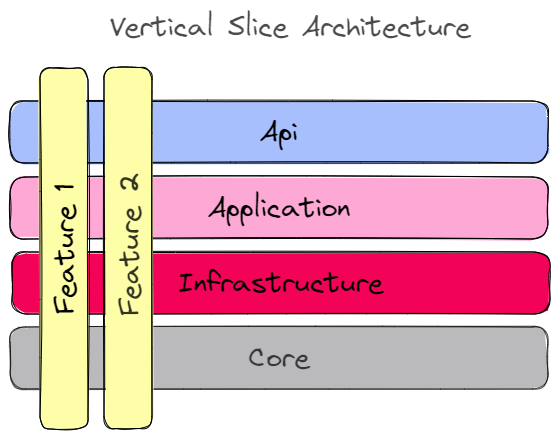
In this project, I used vertical slice architecture at the architectural level and feature folder structure to structure my files.
I treat each request as a distinct use case or slice, encapsulating and grouping all concerns from front-end to back.
When adding or changing a feature in an application in n-tire architecture, we are typically touching many "layers" in an application. We are changing the user interface, adding fields to models, modifying validation, and so on. Instead of coupling across a layer, we couple vertically along a slice. We minimize coupling between slices, and maximize coupling in a slice.
With this approach, each of our vertical slices can decide for itself how to best fulfill the request. New features only add code, we're not changing shared code and worrying about side effects.
Instead of grouping related action methods in one controller, as found in traditional ASP.net controllers, I used the REPR pattern. Each action gets its own small endpoint, consisting of a route, the action, and an IMediator instance (see MediatR). The request is passed to the IMediator instance, routed through a Mediatr pipeline where custom middleware can log, validate and intercept requests. The request is then handled by a request specific IRequestHandler which performs business logic before returning the result.
The use of the mediator pattern in my controllers creates clean and thin controllers. By separating action logic into individual handlers we support the Single Responsibility Principle and Don't Repeat Yourself principles, this is because traditional controllers tend to become bloated with large action methods and several injected Services only being used by a few methods.
I used CQRS to decompose my features into small parts that makes our application:
Using the CQRS pattern, we cut each business functionality into vertical slices, for each of these slices we group classes (see technical folders structure) specific to that feature together (command, handlers, infrastructure, repository, controllers, etc). In our CQRS pattern each command/query handler is a separate slice. This is where you can reduce coupling between layers. Each handler can be a separated code unit, even copy/pasted. Thanks to that, we can tune down the specific method to not follow general conventions (e.g. use custom SQL query or even different storage). In a traditional layered architecture, when we change the core generic mechanism in one layer, it can impact all methods.
For asynchronous messaging, this project uses Wolverine with RabbitMQ transport and PostgreSQL durability. Wolverine handles durable inbox/outbox delivery across services and also persists local internal commands through durable local queues, so integration events and in-process asynchronous workflows follow the same messaging model.
src/BuildingBlocks is a submodule from the Griffin repository and is already referenced by the services, so we only need to initialize it:
git submodule update --init src/BuildingBlocks
Note: A fresh clone can fetch the submodule in one step with
git clone --recurse-submodules.
For installing our requirement packages with .NET cli tools, we need to install dotnet tool manifest.
dotnet new tool-manifest
And after that we can restore our dotnet tools packages with .NET cli tools from .config folder and dotnet-tools.json file.
dotnet tool restore
Here we use husky to handel some pre commit rules and we used conventional commits rules and formatting as pre commit rules, here in package.json. of course, we can add more rules for pre commit in future. (find more about husky in the documentation)
We need to install husky package for manage pre commits hooks and also I add two packages @commitlint/cli and @commitlint/config-conventional for handling conventional commits rules in package.json.
Run the command bellow in the root of project to install all npm dependencies related to husky:
npm install
Note: In the root of project we have
.huskyfolder and it hascommit-msgfile for handling conventional commits rules with provide user friendly message andpre-commitfile that we can run ourscriptsas apre-commithooks. that here we callformatscript from package.json for formatting purpose.
For upgrading our nuget packages to last version, we use the great package dotnet-outdated. Run the command below in the root of project to upgrade all of packages to last version:
dotnet outdated -u
Config Certificate
Run the following commands to Config SSL in your system:
dotnet dev-certs https -ep %USERPROFILE%\.aspnet\https\aspnetapp.pfx -p password
dotnet dev-certs https --trust
Note: for running this command in
powershelluse$env:USERPROFILEinstead of%USERPROFILE%*
dotnet dev-certs https -ep ${HOME}/.aspnet/https/aspnetapp.pfx -p $CREDENTIAL_PLACEHOLDER$
dotnet dev-certs https --trust
To run the application using the Aspire App Host, execute the following command from the solution root:
aspire run
Note:The
Aspire dashboardwill be available athttp://localhost:18888
Docker Compose
To run this app in Docker, use the docker-compose.yaml and execute the below command at the root of the application:
docker-compose -f ./deployments/docker-compose/docker-compose.yaml up -d
Kubernetes
To configure TLS in the Kubernetes cluster, we need to install cert-manager based on the docs and run the following commands to apply TLS in our application. Here, we use Let's Encrypt to encrypt our certificate.
kubectl apply -f ./deployments/kubernetes/booking-cert-manager.yml
To apply all necessary deployments, pods, services, ingress, and config maps, please run the following command:
kubectl apply -f ./deployments/kubernetes/booking-microservices.yml
Build
To build all microservices, run this command in the root of the project:
dotnet build
Run
To run each microservice, run this command in the root of the Api folder of each microservice where the csproj file is located:
dotnet run
Test
To test all microservices, run this command in the root of the project:
dotnet test
Documentation Apis
Each microservice provides API documentation and navigate to /swagger for Swagger OpenAPI or /scalar/v1 for Scalar OpenAPI to visit list of endpoints.
As part of API testing, I created the booking.rest file which can be run with the REST Client VSCode plugin.
If you like my work, feel free to:
Thanks a bunch for supporting me!
Thanks to all contributors, you're awesome and this wouldn't be possible without you! The goal is to build a categorized, community-driven collection of very well-known resources.
Please follow this contribution guideline to submit a pull request or create the issue.
This project is made available under the MIT license. See LICENSE for details.
44 followers · starred May 2022
28 followers · starred Oct 2022
120 followers · starred Mar 2024
11 followers · starred Mar 2025
A practical microservices with the latest technologies and architectures like Vertical Slice Architecture, Event Sourcing, CQRS, DDD, gRpc, MongoDB, RabbitMq, Wolverine, and Aspire in .Net 10.
C#
1,407
1,058 commits
updated Oct 6, 2026
🚀 A practical microservices with the latest technologies and architectures like Vertical Slice Architecture, Event Sourcing, CQRS, DDD, gRpc, MongoDB, RabbitMq, Wolverine, and Aspire in .Net 10.
Vertical Slice Architecture for architecture level.Domain Driven Design (DDD) to implement all business logic.Rabbitmq on top of Wolverine for Event Driven Architecture.gRPC for internal communication.CQRS implementation with MediatR library.Postgres for write side database.MongoDB for read side database.Event Store for write side of Booking Microservice/Module to store all historical change of aggregate.Wolverine durable Inbox Pattern for ensuring message idempotency for receiver and Exactly once Delivery.Wolverine durable Outbox Pattern for ensuring no message is lost and there is at At Least One Delivery.Wolverine durable local queues for internal commands and asynchronous in-process workflows.Unit Testing for testing small units and mocking our dependencies with Nsubstitute.End-To-End Testing and Integration Testing for testing features with all dependencies using testcontainers.Contract Testing with PactNet for verifying producer and consumer compatibility.Fluent Validation and a Validation Pipeline Behaviour on top of MediatR.Minimal API for all endpoints.AspNetCore OpenApi for generating built-in support OpenAPI documentation in ASP.NET Core.Health Check for reporting the health of app infrastructure components.Docker-Compose and Kubernetes for our deployment mechanism.Kibana on top of Serilog for logging.OpenTelemetry for distributed tracing on top of Jaeger.OpenTelemetry for monitoring on top of Prometheus and Grafana.IdentityServer for authentication and authorization base on OpenID-Connect and OAuth2.Yarp as a microservices gateway.Kubernetes to achieve efficient scaling and ensure high availability for each of our microservices.Nginx Ingress Controller for load balancing between our microservices top of Kubernetes.cert-manager to Configure TLS in kubernetes cluster.Aspire for service discovery, observability, and local orchestration of microservices..NET 10 - .NET Framework and .NET Core, including ASP.NET and ASP.NET Core.MVC Versioning API - Set of libraries which add service API versioning to ASP.NET Web API, OData with ASP.NET Web API, and ASP.NET Core.EF Core - Modern object-database mapper for .NET. It supports LINQ queries, change tracking, updates, and schema migrations.AspNetCore OpenApi - Provides built-in support for OpenAPI document generation in ASP.NET Core.Wolverine - Durable messaging and local workflow library for .NET with RabbitMQ transport, inbox/outbox support, and local queues.MediatR - Simple, unambitious mediator implementation in .NET.FluentValidation - Popular .NET validation library for building strongly-typed validation rules.Scalar - Scalar provides an easy way to render beautiful API references based on OpenAPI/Swagger documents.Swagger UI - Swagger tools for documenting API's built on ASP.NET Core.Serilog - Simple .NET logging with fully-structured eventsPolly - Polly is a .NET resilience and transient-fault-handling library that allows developers to express policies such as Retry, Circuit Breaker, Timeout, Bulkhead Isolation, and Fallback in a fluent and thread-safe manner.Scrutor - Assembly scanning and decoration extensions for Microsoft.Extensions.DependencyInjectionOpentelemetry-dotnet - The OpenTelemetry .NET ClientDuendeSoftware IdentityServer - The most flexible and standards-compliant OpenID Connect and OAuth 2.x framework for ASP.NET Core.EasyCaching - Open source caching library that contains basic usages and some advanced usages of caching which can help us to handle caching more easier.Mapster - Convention-based object-object mapper in .NET.Hellang.Middleware.ProblemDetails - A middleware for handling exception in .Net Core.NewId - NewId can be used as an embedded unique ID generator that produces 128 bit (16 bytes) sequential IDs.Yarp - Reverse proxy toolkit for building fast proxy servers in .NET.Tye - Developer tool that makes developing, testing, and deploying microservices and distributed applications easier.gRPC-dotnet - gRPC functionality for .NET.EventStore - The open-source, functional database with Complex Event Processing.MongoDB.Driver - .NET Driver for MongoDB.xUnit.net - A free, open source, community-focused unit testing tool for the .NET Framework.Respawn - Respawn is a small utility to help in resetting test databases to a clean state.Testcontainers - Testcontainers for .NET is a library to support tests with throwaway instances of Docker containers.PactNet - Contract testing library for verifying consumer-provider compatibility in .NET services.K6 - Modern load testing for developers and testers in the DevOps era.Aspire - .NET stack for building and orchestrating observable, distributed cloud-native applications.Identity Service: The Identity Service is a bounded context for the authentication and authorization of users using Identity Server. This service is responsible for creating new users and their corresponding roles and permissions using .Net Core Identity and Jwt authentication and authorization.
Flight Service: The Flight Service is a bounded context CRUD service to handle flight related operations.
Passenger Service: The Passenger Service is a bounded context for managing passenger information, tracking activities and subscribing to get notification for out of stock products.
Booking Service: The Booking Service is a bounded context for managing all operation related to booking ticket.
In this project, I used vertical slice architecture at the architectural level and feature folder structure to structure my files.
I treat each request as a distinct use case or slice, encapsulating and grouping all concerns from front-end to back.
When adding or changing a feature in an application in n-tire architecture, we are typically touching many "layers" in an application. We are changing the user interface, adding fields to models, modifying validation, and so on. Instead of coupling across a layer, we couple vertically along a slice. We minimize coupling between slices, and maximize coupling in a slice.
With this approach, each of our vertical slices can decide for itself how to best fulfill the request. New features only add code, we're not changing shared code and worrying about side effects.
Instead of grouping related action methods in one controller, as found in traditional ASP.net controllers, I used the REPR pattern. Each action gets its own small endpoint, consisting of a route, the action, and an IMediator instance (see MediatR). The request is passed to the IMediator instance, routed through a Mediatr pipeline where custom middleware can log, validate and intercept requests. The request is then handled by a request specific IRequestHandler which performs business logic before returning the result.
The use of the mediator pattern in my controllers creates clean and thin controllers. By separating action logic into individual handlers we support the Single Responsibility Principle and Don't Repeat Yourself principles, this is because traditional controllers tend to become bloated with large action methods and several injected Services only being used by a few methods.
I used CQRS to decompose my features into small parts that makes our application:
Using the CQRS pattern, we cut each business functionality into vertical slices, for each of these slices we group classes (see technical folders structure) specific to that feature together (command, handlers, infrastructure, repository, controllers, etc). In our CQRS pattern each command/query handler is a separate slice. This is where you can reduce coupling between layers. Each handler can be a separated code unit, even copy/pasted. Thanks to that, we can tune down the specific method to not follow general conventions (e.g. use custom SQL query or even different storage). In a traditional layered architecture, when we change the core generic mechanism in one layer, it can impact all methods.
For asynchronous messaging, this project uses Wolverine with RabbitMQ transport and PostgreSQL durability. Wolverine handles durable inbox/outbox delivery across services and also persists local internal commands through durable local queues, so integration events and in-process asynchronous workflows follow the same messaging model.
src/BuildingBlocks is a submodule from the Griffin repository and is already referenced by the services, so we only need to initialize it:
git submodule update --init src/BuildingBlocks
Note: A fresh clone can fetch the submodule in one step with
git clone --recurse-submodules.
For installing our requirement packages with .NET cli tools, we need to install dotnet tool manifest.
dotnet new tool-manifest
And after that we can restore our dotnet tools packages with .NET cli tools from .config folder and dotnet-tools.json file.
dotnet tool restore
Here we use husky to handel some pre commit rules and we used conventional commits rules and formatting as pre commit rules, here in package.json. of course, we can add more rules for pre commit in future. (find more about husky in the documentation)
We need to install husky package for manage pre commits hooks and also I add two packages @commitlint/cli and @commitlint/config-conventional for handling conventional commits rules in package.json.
Run the command bellow in the root of project to install all npm dependencies related to husky:
npm install
Note: In the root of project we have
.huskyfolder and it hascommit-msgfile for handling conventional commits rules with provide user friendly message andpre-commitfile that we can run ourscriptsas apre-commithooks. that here we callformatscript from package.json for formatting purpose.
For upgrading our nuget packages to last version, we use the great package dotnet-outdated. Run the command below in the root of project to upgrade all of packages to last version:
dotnet outdated -u
Config Certificate
Run the following commands to Config SSL in your system:
dotnet dev-certs https -ep %USERPROFILE%\.aspnet\https\aspnetapp.pfx -p password
dotnet dev-certs https --trust
Note: for running this command in
powershelluse$env:USERPROFILEinstead of%USERPROFILE%*
dotnet dev-certs https -ep ${HOME}/.aspnet/https/aspnetapp.pfx -p $CREDENTIAL_PLACEHOLDER$
dotnet dev-certs https --trust
To run the application using the Aspire App Host, execute the following command from the solution root:
aspire run
Note:The
Aspire dashboardwill be available athttp://localhost:18888
Docker Compose
To run this app in Docker, use the docker-compose.yaml and execute the below command at the root of the application:
docker-compose -f ./deployments/docker-compose/docker-compose.yaml up -d
Kubernetes
To configure TLS in the Kubernetes cluster, we need to install cert-manager based on the docs and run the following commands to apply TLS in our application. Here, we use Let's Encrypt to encrypt our certificate.
kubectl apply -f ./deployments/kubernetes/booking-cert-manager.yml
To apply all necessary deployments, pods, services, ingress, and config maps, please run the following command:
kubectl apply -f ./deployments/kubernetes/booking-microservices.yml
Build
To build all microservices, run this command in the root of the project:
dotnet build
Run
To run each microservice, run this command in the root of the Api folder of each microservice where the csproj file is located:
dotnet run
Test
To test all microservices, run this command in the root of the project:
dotnet test
Documentation Apis
Each microservice provides API documentation and navigate to /swagger for Swagger OpenAPI or /scalar/v1 for Scalar OpenAPI to visit list of endpoints.
As part of API testing, I created the booking.rest file which can be run with the REST Client VSCode plugin.
If you like my work, feel free to:
Thanks a bunch for supporting me!
Thanks to all contributors, you're awesome and this wouldn't be possible without you! The goal is to build a categorized, community-driven collection of very well-known resources.
Please follow this contribution guideline to submit a pull request or create the issue.
This project is made available under the MIT license. See LICENSE for details.
44 followers · starred May 2022
28 followers · starred Oct 2022
120 followers · starred Mar 2024
11 followers · starred Mar 2025