Autonomous GPU Kernel Generation & Optimization via Deep Agents
Python
593
101 commits
updated Sep 8, 2026
KernelAgent turns PyTorch programs into verified Triton kernels and optimize its performance. It was designed around KernelBench workloads and combines:
GPU Kernel Synthesis Blog post: PyTorch KernelFalcon
GPU Kernel Optimization Blog post: PyTorch KernelAgent
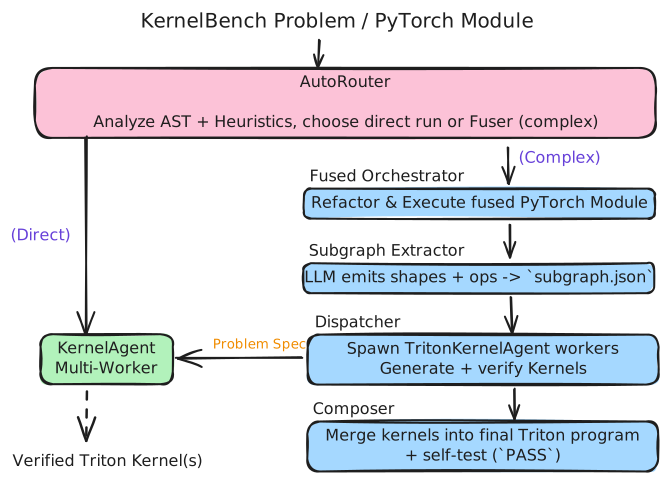
Every stage writes artifacts to a run directory under .fuse/<run_id>/, including the fused PyTorch code, subgraphs.json, individual KernelAgent sessions, and the final compose_out/composed_kernel.py.
 Every stage writes artifacts to a run directory under
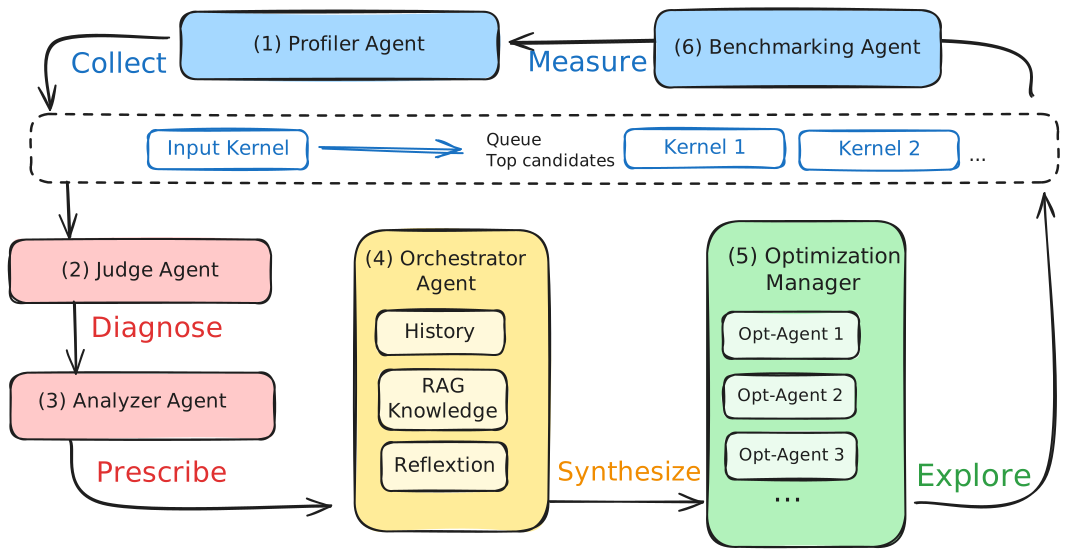
.optimize/<run_id>/, including the input Triton kernel, artifacts, individual optimization worker sessions, and the final output/best_kernel.py.
pip install triton or nightly from source)pip install -e .
pip install torch torchvision torchaudio --index-url https://download.pytorch.org/whl/xpu
Note: Intel XPU support requires:
Verify your XPU installation:
import torch
print(torch.xpu.is_available())  # Should print True
print(torch.xpu.device_count())  # Number of Intel GPUs
git clone https://github.com/ScalingIntelligence/KernelBench.git
Note: By default, KernelAgent UI searches for KernelBench at the same level as KernelAgent. (i.e. ../KernelBench)
You can export keys directly or use an .env file that the CLIs load automatically.
OPENAI_MODEL=gpt-5            # default model for extraction
NUM_KERNEL_SEEDS=4            # parallel workers per kernel
MAX_REFINEMENT_ROUNDS=10      # retry budget per worker
LOG_LEVEL=INFO                # logging level
KernelAgent currently supports OpenAI and Anthropic out-of-the-box. You can also use a custom OpenAI endpoint.
These can be configured in .env or via environment variables.
# OpenAI (models like `o4-mini`, `gpt-5`)
OPENAI_API_KEY=sk-...

# Anthropic (default; `claude-sonnet-4-20250514` is used when `OPENAI_MODEL` is unset)
ANTHROPIC_API_KEY=sk-ant-...

# Relay configuration for self-hosted gateways
LLM_RELAY_URL=http://127.0.0.1:11434
LLM_RELAY_TIMEOUT_S=120
More knobs live in triton_kernel_agent/agent.py and Fuser/config.py.
Auto-route a KernelBench problem — static analysis picks between the direct KernelAgent path and the full Fuser pipeline, with automatic fallback if the first attempt fails:
python -m Fuser.auto_agent \
  --problem /abs/path/to/KernelBench/level1/19_ReLU.py \
  --no-router-cache \     # avoid caching or using cached results
  --verify                # ensure final composition test runs
--no-router-cache can be enabled to avoid utilizing any cached router results and prevent writing to the cache.
Manually run the pipeline (extract → dispatch → compose) when you want explicit control over models or concurrency:
python -m Fuser.pipeline \
  --problem /abs/path/to/problem.py \
  --extract-model gpt-5 \
  --dispatch-model o4-mini \
  --dispatch-jobs auto \
  --compose-model o4-mini \
  --workers 4 \
  --max-iters 5 \
  --verify

# For Intel XPU
python -m Fuser.pipeline \
  --problem /abs/path/to/problem.py \
  --target-platform xpu \
  --extract-model gpt-5 \
  --dispatch-model o4-mini \
  --dispatch-jobs auto \
  --compose-model o4-mini \
  --workers 4 \
  --max-iters 5 \
  --verify
dispatch-jobs auto matches the number of discovered subgraphs; artifacts are placed under .fuse/<run_id>/.
Direct KernelAgent run — bypass Fuser and provide a plain language problem description or a KernelBench snippet:
from triton_kernel_agent import TritonKernelAgent

agent = TritonKernelAgent(num_workers=4, max_rounds=8, model_name="gpt-5")
result = agent.generate_kernel(
    problem_description="Implement ReLU over a contiguous 1D tensor of length 1024"
)

if result["success"]:
    print("Kernel path:", result["kernel_path"])
    print("Session directory:", result["session_dir"])
else:
    print("Failure:", result["message"])
UIs — interactive runs with Gradio frontends:
kernel-agent or python scripts/triton_ui.pyfuser-ui or python scripts/fuser_uipipeline-ui or python scripts/pipeline_uiAutoRouter (Fuser/auto_agent.py): parses the problem’s AST, looks for attention blocks, transposed convolutions, control flow, and long op chains. It caches decisions under .fuse/router_cache.json and can fall back to the other path if the first attempt fails. Use --no-router-cache to ignore the existing cache and caching new routes. Use --ignore-router-config to ignore router-provided tuning and rely on CLI args.
Fuser Orchestrator (Fuser/orchestrator.py): rewrites the PyTorch module into fusable modules, executes them for validation, and packages a tarball of the fused code. Run IDs and directories are managed via Fuser/paths.py.
Subgraph Extractor (Fuser/subgraph_extractor.py): prompts the LLM to emit a JSON array describing each unique subgraph, including ops, shapes, dtypes, and parameter tensors. Entries are deduplicated by shape signature so the dispatcher can reuse kernels.
Dispatcher (Fuser/dispatch_kernel_agent.py): converts each JSON item into a precise Triton generation spec, then spins up TritonKernelAgent processes in parallel. Each worker writes its own session directory with the candidate kernel, test harness, and verification logs.
TritonKernelAgent (triton_kernel_agent/): manages a pool of verification workers (worker.py, manager.py). Each worker iteratively asks an LLM for improvements, executes unit tests under sandboxed subprocesses (Fuser/runner.py), and enforces strict bans on PyTorch fallbacks. A run succeeds only when the test prints PASS (or the sentinel string) and exits with status 0.
Composer (Fuser/compose_end_to_end.py): stitches the verified kernels back into a single Triton program. The composed file contains one or more @triton.jit kernels plus a kernel_function(...) wrapper and a self-test that replays the original PyTorch problem. With --verify, the test is executed immediately and must succeed.
KernelAgent includes a hardware-guided optimization pipeline that iteratively improves a verified Triton kernel's performance using GPU profiling feedback.
The loop runs for up to N rounds, with early termination when the kernel reaches roofline (≥95% SOL) or when performance converges.
python scripts/optimization_ui.py --port 8085
Optimize a kernel using beam search — parallel exploration with top-N kernels and M bottleneck directions:
cd examples && python run_opt_manager.py \
  --kernel-dir optimize_01_matvec/ \
  --strategy beam_search \
  --max-rounds 5
| Component | Location | Role |
|---|---|---|
| OptimizationOrchestrator | triton_kernel_agent/opt_worker_component/orchestrator/ | Main optimization loop |
| KernelProfiler | triton_kernel_agent/opt_worker_component/profiling/ | NCU hardware profiling |
| BottleneckAnalyzer | triton_kernel_agent/opt_worker_component/prescribing/ | LLM-based bottleneck diagnosis |
| RooflineAnalyzer | kernel_perf_agent/kernel_opt/roofline/ | SOL classification and early stopping |
| Benchmark | triton_kernel_agent/opt_worker_component/benchmarking/ | CUDA event timing |
.optimize/workers/<worker_id>/<run_id>/artifacts
  kernel_round_0.py          # baseline kernel
  kernel_round_N.py          # kernel after round N
  round001_opt_prompt.txt    # optimization prompt sent to LLM
  round001_opt_reply.txt     # LLM response
  round001_strategy.json     # bottleneck analysis result
  ...
KernelAgent supports multiple GPU platforms for Triton kernel execution:
| Platform | Device String | Flag | Status |
|---|---|---|---|
| NVIDIA CUDA | cuda | --target-platform cuda (default) | Fully supported |
| Intel XPU | xpu | --target-platform xpu | Supported |
When targeting Intel XPU, KernelAgent automatically:
device='xpu' for all tensor allocations# Check CUDA availability
import torch
print("CUDA available:", torch.cuda.is_available())
# Check XPU availability
print("XPU available:", hasattr(torch, 'xpu') and torch.xpu.is_available())
A successful pipeline run yields a structure similar to:
.fuse/<run_id>/
  orchestrator/code.py.tgz         # fused PyTorch refactor
  subgraphs.json                   # shape-specialized subgraph descriptions
  kernels_out/
    <subgraph_id>/*                # per-subgraph KernelAgent sessions
    summary.json                   # success/failure per subgraph
  compose_out/
    composed_kernel.py             # final Triton program + self-test
    summary.json                   # composition metadata
These artifacts are designed for reproducibility: you can re-run a single kernel session, inspect prompts/responses, or feed composed_kernel.py directly into downstream tooling.
Looking for ready-to-browse kernel generation outputs? See the curated artifacts repo:
It includes selected L1/L2/L3 problems with:
subgraphs.json) and per‑subgraph Triton kernelsLooking for ready-to-browse kernel optimization outputs? See the curated artifacts repo:
It includes selected L1 problems with:
triton_kernel_agent/ — KernelAgent core (agent, worker manager, provider adapters, prompt templates)triton_kernel_agent/opt_worker_component/ — optimization pipeline (profiler, benchmarker, bottleneck analyzer, orchestrator)kernel_perf_agent/kernel_opt — roofline analysis, hardware specs, and benchmarking utilitiesFuser/ — auto-router, orchestration pipeline, CLIs, Gradio UIstriton_kernel_agent/templates/ — Jinja templates used when prompting TritonKernelAgentexamples/ — sample problems and prompt snippetstests/ — unit tests for agents and utilitiese2e_test.py — example end-to-end kernel generation harnessscripts/ — coverage/benchmark tooling, profiling helpers, CLI entry points (e.g., autoroute coverage runners, Triton UI)pip install -e .[dev]pytest -vCONTRIBUTING.mdKernelAgent is released under the Apache License 2.0; see LICENSE.
244 followers · starred Mar 2026
816 followers · starred Mar 2026
1,933 followers · starred Nov 2025
245 followers · starred Nov 2025
Autonomous GPU Kernel Generation & Optimization via Deep Agents
Python
593
101 commits
updated Sep 8, 2026
KernelAgent turns PyTorch programs into verified Triton kernels and optimize its performance. It was designed around KernelBench workloads and combines:
GPU Kernel Synthesis Blog post: PyTorch KernelFalcon
GPU Kernel Optimization Blog post: PyTorch KernelAgent
Every stage writes artifacts to a run directory under .fuse/<run_id>/, including the fused PyTorch code, subgraphs.json, individual KernelAgent sessions, and the final compose_out/composed_kernel.py.
Every stage writes artifacts to a run directory under .optimize/<run_id>/, including the input Triton kernel, artifacts, individual optimization worker sessions, and the final output/best_kernel.py.
pip install triton or nightly from source)pip install -e .
pip install torch torchvision torchaudio --index-url https://download.pytorch.org/whl/xpu
Note: Intel XPU support requires:
Verify your XPU installation:
import torch
print(torch.xpu.is_available())  # Should print True
print(torch.xpu.device_count())  # Number of Intel GPUs
git clone https://github.com/ScalingIntelligence/KernelBench.git
Note: By default, KernelAgent UI searches for KernelBench at the same level as KernelAgent. (i.e. ../KernelBench)
You can export keys directly or use an .env file that the CLIs load automatically.
OPENAI_MODEL=gpt-5            # default model for extraction
NUM_KERNEL_SEEDS=4            # parallel workers per kernel
MAX_REFINEMENT_ROUNDS=10      # retry budget per worker
LOG_LEVEL=INFO                # logging level
KernelAgent currently supports OpenAI and Anthropic out-of-the-box. You can also use a custom OpenAI endpoint.
These can be configured in .env or via environment variables.
# OpenAI (models like `o4-mini`, `gpt-5`)
OPENAI_API_KEY=sk-...

# Anthropic (default; `claude-sonnet-4-20250514` is used when `OPENAI_MODEL` is unset)
ANTHROPIC_API_KEY=sk-ant-...

# Relay configuration for self-hosted gateways
LLM_RELAY_URL=http://127.0.0.1:11434
LLM_RELAY_TIMEOUT_S=120
More knobs live in triton_kernel_agent/agent.py and Fuser/config.py.
Auto-route a KernelBench problem — static analysis picks between the direct KernelAgent path and the full Fuser pipeline, with automatic fallback if the first attempt fails:
python -m Fuser.auto_agent \
  --problem /abs/path/to/KernelBench/level1/19_ReLU.py \
  --no-router-cache \     # avoid caching or using cached results
  --verify                # ensure final composition test runs
--no-router-cache can be enabled to avoid utilizing any cached router results and prevent writing to the cache.
Manually run the pipeline (extract → dispatch → compose) when you want explicit control over models or concurrency:
python -m Fuser.pipeline \
  --problem /abs/path/to/problem.py \
  --extract-model gpt-5 \
  --dispatch-model o4-mini \
  --dispatch-jobs auto \
  --compose-model o4-mini \
  --workers 4 \
  --max-iters 5 \
  --verify

# For Intel XPU
python -m Fuser.pipeline \
  --problem /abs/path/to/problem.py \
  --target-platform xpu \
  --extract-model gpt-5 \
  --dispatch-model o4-mini \
  --dispatch-jobs auto \
  --compose-model o4-mini \
  --workers 4 \
  --max-iters 5 \
  --verify
dispatch-jobs auto matches the number of discovered subgraphs; artifacts are placed under .fuse/<run_id>/.
Direct KernelAgent run — bypass Fuser and provide a plain language problem description or a KernelBench snippet:
from triton_kernel_agent import TritonKernelAgent

agent = TritonKernelAgent(num_workers=4, max_rounds=8, model_name="gpt-5")
result = agent.generate_kernel(
    problem_description="Implement ReLU over a contiguous 1D tensor of length 1024"
)

if result["success"]:
    print("Kernel path:", result["kernel_path"])
    print("Session directory:", result["session_dir"])
else:
    print("Failure:", result["message"])
UIs — interactive runs with Gradio frontends:
kernel-agent or python scripts/triton_ui.pyfuser-ui or python scripts/fuser_uipipeline-ui or python scripts/pipeline_uiAutoRouter (Fuser/auto_agent.py): parses the problem’s AST, looks for attention blocks, transposed convolutions, control flow, and long op chains. It caches decisions under .fuse/router_cache.json and can fall back to the other path if the first attempt fails. Use --no-router-cache to ignore the existing cache and caching new routes. Use --ignore-router-config to ignore router-provided tuning and rely on CLI args.
Fuser Orchestrator (Fuser/orchestrator.py): rewrites the PyTorch module into fusable modules, executes them for validation, and packages a tarball of the fused code. Run IDs and directories are managed via Fuser/paths.py.
Subgraph Extractor (Fuser/subgraph_extractor.py): prompts the LLM to emit a JSON array describing each unique subgraph, including ops, shapes, dtypes, and parameter tensors. Entries are deduplicated by shape signature so the dispatcher can reuse kernels.
Dispatcher (Fuser/dispatch_kernel_agent.py): converts each JSON item into a precise Triton generation spec, then spins up TritonKernelAgent processes in parallel. Each worker writes its own session directory with the candidate kernel, test harness, and verification logs.
TritonKernelAgent (triton_kernel_agent/): manages a pool of verification workers (worker.py, manager.py). Each worker iteratively asks an LLM for improvements, executes unit tests under sandboxed subprocesses (Fuser/runner.py), and enforces strict bans on PyTorch fallbacks. A run succeeds only when the test prints PASS (or the sentinel string) and exits with status 0.
Composer (Fuser/compose_end_to_end.py): stitches the verified kernels back into a single Triton program. The composed file contains one or more @triton.jit kernels plus a kernel_function(...) wrapper and a self-test that replays the original PyTorch problem. With --verify, the test is executed immediately and must succeed.
KernelAgent includes a hardware-guided optimization pipeline that iteratively improves a verified Triton kernel's performance using GPU profiling feedback.
The loop runs for up to N rounds, with early termination when the kernel reaches roofline (≥95% SOL) or when performance converges.
python scripts/optimization_ui.py --port 8085
Optimize a kernel using beam search — parallel exploration with top-N kernels and M bottleneck directions:
cd examples && python run_opt_manager.py \
  --kernel-dir optimize_01_matvec/ \
  --strategy beam_search \
  --max-rounds 5
| Component | Location | Role |
|---|---|---|
| OptimizationOrchestrator | triton_kernel_agent/opt_worker_component/orchestrator/ | Main optimization loop |
| KernelProfiler | triton_kernel_agent/opt_worker_component/profiling/ | NCU hardware profiling |
| BottleneckAnalyzer | triton_kernel_agent/opt_worker_component/prescribing/ | LLM-based bottleneck diagnosis |
| RooflineAnalyzer | kernel_perf_agent/kernel_opt/roofline/ | SOL classification and early stopping |
| Benchmark | triton_kernel_agent/opt_worker_component/benchmarking/ | CUDA event timing |
.optimize/workers/<worker_id>/<run_id>/artifacts
  kernel_round_0.py          # baseline kernel
  kernel_round_N.py          # kernel after round N
  round001_opt_prompt.txt    # optimization prompt sent to LLM
  round001_opt_reply.txt     # LLM response
  round001_strategy.json     # bottleneck analysis result
  ...
KernelAgent supports multiple GPU platforms for Triton kernel execution:
| Platform | Device String | Flag | Status |
|---|---|---|---|
| NVIDIA CUDA | cuda | --target-platform cuda (default) | Fully supported |
| Intel XPU | xpu | --target-platform xpu | Supported |
When targeting Intel XPU, KernelAgent automatically:
device='xpu' for all tensor allocations# Check CUDA availability
import torch
print("CUDA available:", torch.cuda.is_available())
# Check XPU availability
print("XPU available:", hasattr(torch, 'xpu') and torch.xpu.is_available())
A successful pipeline run yields a structure similar to:
.fuse/<run_id>/
  orchestrator/code.py.tgz         # fused PyTorch refactor
  subgraphs.json                   # shape-specialized subgraph descriptions
  kernels_out/
    <subgraph_id>/*                # per-subgraph KernelAgent sessions
    summary.json                   # success/failure per subgraph
  compose_out/
    composed_kernel.py             # final Triton program + self-test
    summary.json                   # composition metadata
These artifacts are designed for reproducibility: you can re-run a single kernel session, inspect prompts/responses, or feed composed_kernel.py directly into downstream tooling.
Looking for ready-to-browse kernel generation outputs? See the curated artifacts repo:
It includes selected L1/L2/L3 problems with:
subgraphs.json) and per‑subgraph Triton kernelsLooking for ready-to-browse kernel optimization outputs? See the curated artifacts repo:
It includes selected L1 problems with:
triton_kernel_agent/ — KernelAgent core (agent, worker manager, provider adapters, prompt templates)triton_kernel_agent/opt_worker_component/ — optimization pipeline (profiler, benchmarker, bottleneck analyzer, orchestrator)kernel_perf_agent/kernel_opt — roofline analysis, hardware specs, and benchmarking utilitiesFuser/ — auto-router, orchestration pipeline, CLIs, Gradio UIstriton_kernel_agent/templates/ — Jinja templates used when prompting TritonKernelAgentexamples/ — sample problems and prompt snippetstests/ — unit tests for agents and utilitiese2e_test.py — example end-to-end kernel generation harnessscripts/ — coverage/benchmark tooling, profiling helpers, CLI entry points (e.g., autoroute coverage runners, Triton UI)pip install -e .[dev]pytest -vCONTRIBUTING.mdKernelAgent is released under the Apache License 2.0; see LICENSE.
244 followers · starred Mar 2026
816 followers · starred Mar 2026
1,933 followers · starred Nov 2025
245 followers · starred Nov 2025



